This sprightly romantic comedy kept me interested all the way through. Some may find the ending predictable, but right up until the last few minutes, I had the feeling it could go one of three ways: she winds up with a slightly toughed-up Schlump, she winds up with a slightly softened Red, or she leaves them both behind. I'm not that familiar with Gibson's work but she's very good in the Joan Blondell-type title role; Farrell's somewhat squeaky voice is put to good use, though I find his earlier look with glasses to be more attractive (pictured at left) than his macho makeover; Gargan (pictured above right with Gibson), a favorite character actor of mine, shines in the first fifteen minutes, though his character is more or less out of commission for the rest of the film. Zasu Pitts is fun as always. Other amusing lines: Gibson telling Farrell to change his vocabulary by using words "with hair on 'em"; when Gibson worries about how Farrell's fiancée would react if she went after him, Pitts says, "I'd say, Raspberries, Evangeline!" Very fun. [TCM]
Friday, August 29, 2014
AGGIE APPLEBY, MAKER OF MEN (1933)
This sprightly romantic comedy kept me interested all the way through. Some may find the ending predictable, but right up until the last few minutes, I had the feeling it could go one of three ways: she winds up with a slightly toughed-up Schlump, she winds up with a slightly softened Red, or she leaves them both behind. I'm not that familiar with Gibson's work but she's very good in the Joan Blondell-type title role; Farrell's somewhat squeaky voice is put to good use, though I find his earlier look with glasses to be more attractive (pictured at left) than his macho makeover; Gargan (pictured above right with Gibson), a favorite character actor of mine, shines in the first fifteen minutes, though his character is more or less out of commission for the rest of the film. Zasu Pitts is fun as always. Other amusing lines: Gibson telling Farrell to change his vocabulary by using words "with hair on 'em"; when Gibson worries about how Farrell's fiancée would react if she went after him, Pitts says, "I'd say, Raspberries, Evangeline!" Very fun. [TCM]
Wednesday, August 27, 2014
PRETTY MAIDS ALL IN A ROW (1971)
This is a crazy-ass movie that could only have been made in the crazy-ass 70s. The first half-hour centers on a teenage boy's erection (though we never see it, in or out of pants); every female student looks like a Playboy playmate; teachers have sex with students and there seem to be no problems with that, aside from the post-coital killings. It's not really a spoiler to note that Hudson is the killer, but his character has no consistent psychology—he is married with a young daughter and appears to love his wife, but still bangs schoolgirls a mile a minute. The killings seem to occur when the girls turn cold or want a commitment, but even that isn't clear or consistent. And in the somewhat surprising climax (which I won't spoil), it even appears as if his wife knows about his activities and is OK with them. Carson (pictured with Dickinson) is very cute and handles his unusual role well, and Dickinson is fine. Hudson seems a little at sea, like he couldn't quite commit to a murderous villain role. Also in the cast without much distinction are Telly Savalas as a detective (looking every inch like Kojak, the role he would become famous for a couple of years later), Roddy McDowell as the ineffectual principal, and Keenan Wynn as a police chief. I guess I'd have to say I enjoyed the movie, but I felt kinda gross afterward. [TCM]
Monday, August 25, 2014
THE GIRL IN BLACK STOCKINGS (1957)
This outdoorsy mystery has some promise, and a plot that for the most part is easy to follow, but the actors all seem to be sleepwalking through it, and it runs out of steam before the 60-minute mark, overstaying its welcome by a good 20 minutes. Barker (pictured with Randell) is OK, and I liked Dehner as the sheriff—he seems to be auditioning for a TV series about a laconic small-town cop. The two characters with the most potential, Bancroft and Windsor, aren't fleshed out enough to really be interesting, and Randell's character, who is supposed to be somewhat sympathetic, is very unpleasant, both as written and as acted. The death of one character near the end at a lumber mill is confusingly shot and, as far as I could tell, completely unmotivated. Fans of Van Doren will be disappointed since, despite her third billing, she only has one big scene. There are psychological threads galore, though most go nowhere: in addition to Randell's odd paralysis, there's Windsor's overdone attention to her brother and Bancroft's cold-fish ways with Barker despite her surface flirtatiousness. Not to mention that strange death at the lumber mill. The Utah setting is a plus. Overall, the movie is not hard to watch but it's hard to like. [TCM]
Thursday, August 21, 2014
SAMSON AND THE SEVEN MIRACLES OF THE WORLD (1961)
The hero of this sword-and sandal film set in China, in the original Italian version, is Maciste, though in the English dub, he's just a somewhat random muscleman (Gordon Scott) who has taken the legendary name Samson to strike fear into the hearts of villains. Here, he's battling a Mongol horde led by Garak, who has a Chinese princess under his thumb. Garak tries to get rid of her teenage brother by throwing him in a pit with a tiger, but Samson leaps in and successfully wrestles the tiger (alternately an old and tired live one and a bug-eyed stuffed one), saving the boy. Then he joins forces with some Chinese rebels to free the princess from a forced marriage to Garak. There's some folderol involving Chinese monks and seven miracles that are supposed to happen, the final one being that, when Garak's men entomb Samson in a tiny crawlspace underground, he finds the superhuman strength to break free and in doing so triggers an earthquake that spells an end to the Mongols. Because the muscled Scott played Tarzan in the 50s and because in this movie all he wears is a dangly red loincloth, this felt like a Tarzan-goes-to-China movie for me, which makes as much sense as a faux-Samson (or even an Italian Maciste) in China. The best scene is one in which he stops racing horses from executing a group of men buried up to their necks in the ground. Aside from the novelty of its setting and the presence of Scott, who is a notch above most peplum actors, this is nothing special. The print from Alpha Video is technically letterboxed, but because jarring pan-and-scan cuts remain, I suspect it is not presented at its true original aspect ratio. [DVD]
Wednesday, August 20, 2014
WHITE PONGO (1945)
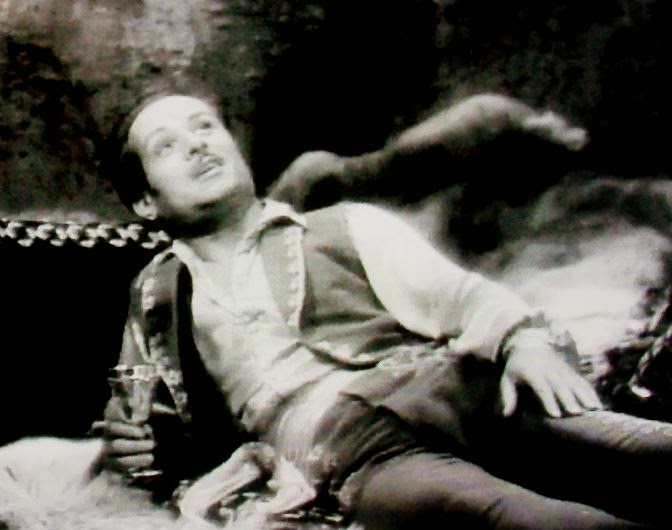
An explorer named Gunderson has been captured by an African tribe and is tied up as though for sacrifice, but an older man, Prof. Gerig, also being held by the tribe, comes to his rescue. He lets Gunderson go but asks him to take the journal of the late Dierdorf, whose expedition Gerig was on, back to civilization. A huge white ape—the White Pongo of the title—appears in the village and Gunderson gets away while it goes on a rampage. He makes his way to a European outpost and dies of a fever, but gets the journal delivered to a British anthropologist named Bragdon (Gordon Richards) who realizes that Dierdorf assumed the White Pongo was the missing link between ape and man. Bragdon takes an expedition out to capture the ape to take back to London. Of course, there are complications: Bragdon's daughter Pamela (Maris Wrixon) is along and Bragdon's secretary Carswell (Michael Dyne) has a thing for her. She has dallied with him in the past, but now she falls for Bishop (Richard Fraser), one of the hired riflemen; the fact that's he's rather stand-offish just inflames her interest. Along with the group is the German Kroegert who is secretly using the trip as a way to find a legendary gold mine that he can claim. And, of course, there's the menacing White Pongo, in addition to the run-of-the-mill menacing apes one finds in African jungles in the movies.This Poverty Row adventure really has little to recommend it—no name actors, long plodding sections of people canoeing down a river or walking through jungles, not much plot—but still I stayed with it to the end, and the end is the most interesting part because [SPOILER] unlike in the average Tarzan movie, in this one the trappers get the ape and take it to England. Of course, the trappers here are scientists rather than zookeepers or hunters, so we're supposed to be on their side. There are no hunky shirtless heroes here: Fraser, ostensibly the hero, is quite bland and passive even though he turns out to be a Rhodesian secret agent on the trail of Kroegert; he's supposed to be stoic but he comes off more as petulant and boring. As the femme interest, Wrixon (pictured with Fraser) is equally bland, and for most of the movie, fairly unlikable. There is dreadful comic relief in the person of George Lloyd as a Cockney-accented ass who I kept wishing would get torn limb from limb by the apes—though I did chuckle when he called the ape the "blinkin’ missing link." The best I can say about the actors is that Dyne is appropriately slimy as Carswell who winds up going over to Kroegert's side when Pamela throws him over. The ape outfits are actually not bad, though they’re largely wasted because, aside from the opening scene, the White Pongo never really bothers anyone until the climax. Only recommended for mild novelty. [YouTube]
Monday, August 18, 2014
THE STORY OF RUTH (1960)
Monday, August 11, 2014
SHERLOCK HOLMES’ FATAL HOUR (1931)
aka THE SLEEPING CARDINAL
Our story begins with two plot threads that will obviously come together: 1) Someone is breaking into London bank vaults, injuring or killing the night watchmen, but no money is ever missing, and Inspector Lestrade asks for Holmes' help; 2) Ronald Adair, a British diplomat, has been cheating at cards and winning big, trying to keep up appearances after his inheritance went bust. His concerned sister, afraid he'll get in trouble if he's exposed, goes to Dr. Watson to see if Holmes can help her. We eventually see the connection: Adair is taken to a room where he is blackmailed by an underworld figure who speaks from behind a painting called The Sleeping Cardinal. The bank break-ins have involved stealing money and replacing it with counterfeit bills, then taking the real money overseas where it won't be traced. Adair, traveling with a diplomatic passport, doesn't have his luggage searched so the Voice wants him to smuggle the money out; if he refuses, he is told that his cheating ways will be exposed and he will be ruined. As Holmes delves into these cases he beings to suspect that the culprit is his old nemesis Professor Moriarty.
Arthur Wontner played Holmes is a series of 30s British B-films (I reviewed a previous film here) and is considered by some to the best movie Holmes. Wontner is fine, probably playing the character more like Doyle wrote him than most, but I still like Basil Rathbone best. One problem is that Wontner is very low-key, as is Ian Fleming as Watson. This leaves Lastrade (Phillip Hewland) to provide much of the energy. Leslie Perrins as Adair is fine, but no one else leaves much of an impression. Based loosely on two Doyle stories, "The Empty House" and "The Final Problem," this is one of the most strongly plotted of any Holmes film, and the cinematography gives the movie some atmosphere; the opening scene of the bank robbery is shot in almost total darkness with just enough glossy white light that we're confused about what's happening. Similarly, the spooky scene with the Sleeping Cardinal painting seems to have come right out of a Saturday matinee serial. Because Wontner's films are mostly in the public domain, available prints are often in poor condition, but the one I saw on Hulu Plus was in good shape. [Hulu Plus streaming]
Our story begins with two plot threads that will obviously come together: 1) Someone is breaking into London bank vaults, injuring or killing the night watchmen, but no money is ever missing, and Inspector Lestrade asks for Holmes' help; 2) Ronald Adair, a British diplomat, has been cheating at cards and winning big, trying to keep up appearances after his inheritance went bust. His concerned sister, afraid he'll get in trouble if he's exposed, goes to Dr. Watson to see if Holmes can help her. We eventually see the connection: Adair is taken to a room where he is blackmailed by an underworld figure who speaks from behind a painting called The Sleeping Cardinal. The bank break-ins have involved stealing money and replacing it with counterfeit bills, then taking the real money overseas where it won't be traced. Adair, traveling with a diplomatic passport, doesn't have his luggage searched so the Voice wants him to smuggle the money out; if he refuses, he is told that his cheating ways will be exposed and he will be ruined. As Holmes delves into these cases he beings to suspect that the culprit is his old nemesis Professor Moriarty.Arthur Wontner played Holmes is a series of 30s British B-films (I reviewed a previous film here) and is considered by some to the best movie Holmes. Wontner is fine, probably playing the character more like Doyle wrote him than most, but I still like Basil Rathbone best. One problem is that Wontner is very low-key, as is Ian Fleming as Watson. This leaves Lastrade (Phillip Hewland) to provide much of the energy. Leslie Perrins as Adair is fine, but no one else leaves much of an impression. Based loosely on two Doyle stories, "The Empty House" and "The Final Problem," this is one of the most strongly plotted of any Holmes film, and the cinematography gives the movie some atmosphere; the opening scene of the bank robbery is shot in almost total darkness with just enough glossy white light that we're confused about what's happening. Similarly, the spooky scene with the Sleeping Cardinal painting seems to have come right out of a Saturday matinee serial. Because Wontner's films are mostly in the public domain, available prints are often in poor condition, but the one I saw on Hulu Plus was in good shape. [Hulu Plus streaming]
Friday, August 08, 2014
SIMBA (1955)
Thursday, August 07, 2014
CAPTAIN THUNDER (1930)
Most critical commentary on this movie focuses on the bad sound and the performance of Varconi, a Hungarian actor who played a wide range of exotic roles. The dialogue is indeed difficult to follow at times, between the dicey recording and the exaggerated accents of several of the actors. And Varconi is not the ideal hero: at almost 40, he's a smidge old for the adventurous lead, showing signs of going to seed, and at times he seems like he's playing a supporting role. But he's game and his light touch is just right for the tone of the film—which makes the climax all the more surprising. Wray, the year before KING KONG, doesn't really stand out, thought Judels is good as the buffoonish Ruiz. Don Alverado, as Juan, was kind of a B-movie Valentino, though he never got past supporting parts. [TCM]
Tuesday, August 05, 2014
IF IT’S TUESDAY, THIS MUST BE BELGIUM (1969)
A World-Wind Tour bus leaves London for a 2-week trip through Europe with a bunch of American tourists. Of course, most of them are comic variations on the "Ugly American" stereotypes: Murray Hamilton is a grouser who constantly complains that things aren't like they are back home; his teenage daughter (Hilary Thompson) is looking for a cute boy to spend time with; Norman Fell's wife (Reva Rose) accidentally winds up on a different tour and he spends all his time trying to contact her; Marty Ingels takes pictures of sexy native women, intending to tell his buddies back home that he slept with all of them; Michael Constantine is a war vet revisiting old sites; Sandy Baron is looking forward to visiting relatives in Italy, unaware that they're ready to marry him off to a cousin. The main plotline involves Suzanne Pleshette, a lovely young single woman who seems vaguely dissatisfied with her fiancé; the handsome English tour guide (Ian McShane) wants to add her to his long list of erotic conquests, but through a series of comic misadventures, she remains mostly aloof until they begin to develop real feelings for each other. Then who should show up but her well-meaning but whitebread fiancé. Having been released in 1969, this comedy is awkwardly situated between old and new; the stereotypes are obvious, much of the humor is dated, and few of the characters or situations are surprising, but with the swinging single tour guide, the movie tries to be hip, and the plotline involving the teenage daughter is totally 60s: she and the moderately cute political agitator she hooks up with (Luke Halpin, star of TV's Flipper) travel about and visit a youth hostel—in which 60s icon Donovan strums guitar and sings the gloomy, folky "Lord of the Reedy River." (He also wrote the cute title song but does not sing it.) Though the film was shot on location—Rome, Brussels, Amsterdam, Venice—it mostly has a drab TV-movie look. Some of the performances are pitched in a one-note TV way; particularly irritating are Fell, Constantine and Ingels. But the young McShane (pictured with Pleshette) is a nice surprise, and Pleshette and Baron are very good as well. Also with Peggy Cass and Mildred Natwick, both underused. Aubrey Morris, who I know as Alex's counselor in CLOCKWORK ORANGE, has a small, almost completely silent role as a man who brings an empty piece of luggage into which he puts stolen objects from each stop. Watch all the way to the credits for a final fun scene involving Morris. There are also very brief cameos from John Cassavettes, Robert Vaughan, Vittorio De Sica, and Virna Lisi, among others. Mild fun for fans of the era. [TCM]
Friday, August 01, 2014
SUMMER WITH MONIKA (1953)
Despite the "beach party" title and the brief nudity that made this a sensation in the early career of Ingmar Bergman, this is mostly a drab and downbeat study of love and lust among the young. 19-year-old Harry (Lars Ekborg) lives with his ailing father and has an unfulfilling job at a glassworks shop. At a café, he meets Monika (Harriet Andersson); they make a date to see a movie (called Song of Love) and later she announces that he may kiss her, even as she pauses to check herself out in her compact mirror. As they begin an affair, it's clear that what she knows of love she has learned from movies and songs. To escape their boring lives in Stockholm, they take Harry's father's small boat and head off to live on a lake for the summer. For a time, they live idyllically, but soon reality barges in: a jealous ex-boyfriend of Monika's shows up to make trouble, they run out of money and try to steal food, and eventually she discovers she's pregnant. In a reversal of the usual cultural narrative, it's Monika who rejects responsibility (and her relationship with Harry) and Harry who winds up taking the baby in. Considering this film's sexy reputation, this is in some ways an anti-erotic story. It manages to make romance—and sex—seem like a lot of work. Both lead actors are good—and Andersson in particular is quite attractive—and they carry the film through its ups and downs. There's about 10 seconds of female nudity, but generally an average television drama has more sexual content that this film has. Ultimately, this is a sad little movie that seems to say that we should hang onto the memories of our carefree summers while we can because they're ephemeral, and maybe bogus even while we're living them. [DVD]
Subscribe to:
Comments (Atom)