Tuesday, July 12, 2011

MOROCCO (1930)

Gary Cooper is a Foreign Legionnaire who is temporarily stationed in Morocco, where he gets the hots for Marlene Dietrich, a sultry singer and dancer in a small café. On her first night, she causes a sensation when she comes out in a tuxedo; the rowdy crowd makes fun of her, but they are silenced by Cooper, who wants to let her do her thing. Her thing consists of strolling through the crowd flirting with everyone (even giving a seductive kiss to a shocked young woman) and tossing Cooper a flower as she leaves the floor. However, the older and richer Adolphe Menjou is also obsessed with Dietrich, and he has the means to help her rise in society. While Cooper goes after Dietrich, he is not lacking for female companionship, and his affair with his boss's wife leads to trouble. Menjou gets the officer to tone down a threatened court-martial and instead Cooper is sent out to the desert to fight Arabs. He wants to quit the Legion and run off with Dietrich, but she's not sure she can give up the creature comforts that Menjou can give her. She moves in with the older man, but at their engagement party, Cooper's troop marches through the streets, on their way to another desert station. The next morning, Dietrich gives up everything to join the "rear guard" of the besotted women who follow the Legionnaires.

As with most of Marlene Dietrich's collaborations with director Josef von Sternberg, the plot is not the point, Dietrich is, aided by the lush visuals surrounding her. She (and Sternberg) don't disappoint here; Dietrich is exotically beautiful and sounds as sexy as she looks. Cooper, young, lanky and confident, is almost as sexy as she is. "Languid" is the word that kept coming to my mind, in a positive way, for Dietrich, Cooper, and the overall tone. One review I read of the movie noted how unusual it is to have a situation in which both the male and female protagonists are sexually experienced; they are both, in their way, "bad." Even better, neither one really has to reform by the end, though Dietrich has to sacrifice her secure way of life. It's beautifully photographed, and though clearly not shot in Africa, the sets and locations provide a plausible Moroccan fantasy, just as they do for CASABLANCA. As a bonus, Dietrich sings two songs in her inimitable style. [TCM]

Sunday, July 10, 2011

TARZAN’S DESERT MYSTERY (1943)

Two confessions: 1) as a lad on the edge of puberty, I was fascinated with Tarzan. I read Tarzan books and comic books, saw bits and pieces of the Tarzan movies on Sunday afternoons (I couldn’t always watch the whole thing because Dad got the TV on Sundays for football), and owned a book called Tarzan of the Movies, filled with pictures of hunky men wearing only loincloths. If it was a book that made me gay, this was it; 2) even though I was a big Tarzan fan, I can only recall seeing two of the Johnny Weissmuller films all the way through: Tarzan of the Apes (his first one) and Tarzan and His Mate (his second one). Of his twelve Tarzan movies, these two are considered the best. By the time Weissmuller made this one (his eighth), even though he wasn't 40 yet, he was going to seed: his face was a bit puffy, his stocky body was way past its prime, and his acting hadn’t improved. Even his famous yell sounds a bit puny here. Still, this movie has its moments and I wasn't sorry to have sat through it.

With World War II raging, Jane is in England working as a nurse; she sends Tarzan a message asking him to send her a rare fever cure found in a jungle past the Arabian town of Bir Herari. That town is run by a well-intentioned sheik with a handsome, Yale-educated son, Prince Salim. Unfortunately, the sheik has allowed a businessman named Hendricks to have too much influence; the working people like the sheik but despise the unfair, hard-driving Hendricks, whom we discover is actually named Heinrichs (and thus probably a Nazi). Meanwhile, Tarzan, Boy and Cheetah cross paths outside town with vaudeville entertainer Connie Bryce who has been sent on a mission to deliver a message to Salim from an old Yale buddy, exposing Hendricks. She goes about singing the Yale fight song ("Boo-la, boo-laaaa…") in order to find the prince but just after she gives him the message, Hendricks and his henchman kill Salim and pin the murder on Kelly, who is sentenced to death. With Tarzan in jail on a trumped-up charge of horse thievery, it's up to Boy and Cheetah to help him escape so they can all free Connie. Then, the real excitement starts as the good guys go racing through a desert sandstorm to reach the jungle to get the fever medicine before the bad guys catch up with them. Tarzan and his pals (and Hendricks) have to face giant prehistoric lizards, giant man-eating plants, and a giant spider before the medicine is found and the proper message delivered to the sheik.

The soon-to-be-bloated Weissmuller seems to just be going through the motions, but this is a fun flick thanks to the exotic setting, the supporting cast, and the youthful energy of Boy, played by 12-year-old Johnny Sheffield. Nancy Kelly does a good job with the underwritten role of Connie, Otto Kruger makes a good Germanic villain, Joe Sawyer is fine as his associate, and Robert Lowery (the first actor to play Batman, in a 1949 serial) is handsome indeed as Salim. In fact, at times this seems barely to be a Tarzan film; it plays better as a WWII B-spy thriller. The spider is laughably bad and most of the other effects are borrowed from other movies, but the last 20 minutes, beginning with the horse stampede that Tarzan uses to free Connie from the hangman's noose, move along nicely. My favorite line is from Kelly, when explaining to Salim about singing the Yale song: "I've had a very liberal education; I've been intercepting Yale passes for years." With Turner Classic running Tarzan films all summer, there will certainly be more Tarzan reviews on the way. [TCM]

Friday, July 08, 2011

10:30 P.M. SUMMER (1966)

A 60s alienation film, but strictly a second-rate copy of Antonioni by director Jules Dassin. The film opens with a handsome man (Julian Mateos) stalking through a rainstorm, arriving at a house where his wife has just had sex with another man. He shoots them both dead and goes on the run. Cut to four people who are taking a car trip through Spain: a middle-aged couple (Peter Finch and Melina Mercouri), their 7-year-old daughter, and a lovely young woman (Romy Schneider, pictured at right with Finch) whose exact relationship to the family is never clear; she's having an affair with Finch, she's friends with (and takes one mildly erotic shower with) Mercouri, and sometimes looks after the child. They happen to stop for the night in the village where the murder we saw has just occurred. The depressed, alcoholic and restless Mercouri hears about the whole affair and seems to feel some spiritual kinship with the outlaw. That night, after witnessing Finch and Schneider kissing passionately in the rain, Mercouri sees Mateos in hiding, on a rooftop rolled up in a tarp. She befriends him and helps him hide for the night in a field outside the village. Sadly, when she checks on him the next morning, he's dead. This is the catalyst for another restless day and night for Mercouri, leading to a frenzied flamenco dance scene followed by an ending, copied right out of Antonioni, which is ambiguous but the most satisfying part of the movie. The screenplay is by New Wave-ish writer Marguerite Duras, based on her own short story, and the characters just haven't been given enough roundness. We learn practically nothing about their past, and their actions in the present seem mostly unmotivated. Leaving Mercouri's relationship with the killer husband hazy is fine, but leaving her role in the potential ménage-a-trois unclear is sloppy--some critics say that she imagines some of the love scenes between Finch and Schneider, but I didn't pick up on that. Mercouri's performance is almost over-the-top in a harsh and ugly way. Finch and the sexy Schneider are good, but poor Mateos (above left) doesn't even get a single line of dialogue. The best thing about the film is the cinematography; the film always looks great, and as lovely as the landscape shots are, the night rain scenes are especially effective. [DVD]

Tuesday, July 05, 2011

THE LOCKED DOOR (1929)

Young innocent secretary Barbara Stanwyck goes to a bootleg drinking party on a yacht just outside the 7-mile limit with her boss's slimy son, Rod La Rocque. The yacht is raided just as La Rocque is forcing himself on Stanwyck; a photographer snaps a pic of the two, but La Rocque bribes him to get the photo. Eighteen months later, Stanwyck has married her new boss, William Boyd, and has a new upper-class life which is disturbed when she finds out that La Roque is back, and dating Boyd's beloved kid sister (Betty Bronson). When Stanwyck tells La Rocque to leave their family alone, he tells her he's planning on leaving for Hawaii with Bronson, and if anyone tries to squelch his plans, he'll show Boyd the incriminating photograph. Things come to a climax one night in La Rocque's fancy two-story hotel room to which all the principals arrive at one time or another; one person winds up dead, but two confess to the murder. The ending is satisfactory but relies on a ridiculous plot twist (the dead person is not quite dead yet) to wrap things up. The title seemingly refers to two different doors: the one that La Rocque locks on the yacht and the locked hotel room door that figures prominently in the ending. Based on a play, Stanwyck's first talking picture is stagy but does incorporate some interesting camera moves, especially the opening, a long tracking shot in which the camera moves along a bar on the yacht as hordes of obnoxious rich people shout orders at the bartenders. Boyd, not the same actor who went on to fame as Hopalong Cassidy, is the weak link here; Stanwyck is fine and though La Rocque overplays his dastardly role a bit, it fits the character. Zasu Pitts has a small comic relief part as a telephone operator at the hotel. [TCM]

Sunday, July 03, 2011

HEAVENS ABOVE! (1963)

The Reverend Smallwood (Peter Sellers) is a prison chaplain who is appointed head at the parish of a small English village. The appointment is an accident—he's the wrong Smallwood—but no one catches it at first. Smallwood is a genial type, but he's upset that the town seems too concerned with money and comfort and not enough with basic Christian values like love and charity. He hires a black garbageman (Brock Peters) as his assistant, lets a large and obnoxious homeless family live at the vicarage, and insults the rich Lady Despard, whose family owns a company that has made a fortune with a wonder pill called Tranquilax (it's a sedative, a stimulant, and a laxative). Surprisingly he gets Lady Despard on his side and she offers to give him all her farm’s excess food (and extra drug products from the company) to give away to the needy. Soon, however, all the town's residents are taking advantage of the offer, and with no one buying anything, the local economy goes belly up, as does the drug company when Smallwood starts disparaging Tranquilax from the pulpit. Eventually, the town turns against Smallwood; he is relieved of his duties and appointed to become the first vicar of outer space. Yes, outer space.

This seems for a while like it's going to go in a heartwarming Capra direction, but the satire, which is directed at virtually all the characters, even Smallwood, is too biting and cynical for that, and the narrative goes off in unexpected directions. The homeless family, which you assume will become pleasant and stand on its own two feet, remains lazy and unlikable; Lady Despard's conversion is surprisingly genuine, and the mild-mannered assistant doesn't have the fortitude to remain by Smallwood's side. Even Smallwood loses his heroic sheen and seems like a naïve boob by the end. Overlong and not for all tastes, but an interestingly bitter little comedy. [TCM]

Friday, July 01, 2011

MAJOR BARBARA (1941)

This is one of the strangest movies I've ever seen. I've always struggled a bit with the plays of George Bernard Shaw: his dialogue is witty and his characters are interesting, but the messages feel muddled to me, perhaps because I'm unfamiliar with the specific social contexts of the plays, most of which were written between 1890 and 1920. The major of the title is Barbara Underschaft (Wendy Hiller), daughter of a wealthy weapons manufacturer. She believes the family business is evil and she has renounced it (though she still lives her family and relies on their money personally) and works for the Salvation Army saving souls and feeding the poor. When Adolphus (Rex Harrison), a Greek scholar who gives streetcorner classes for workers, sees Barbara electrify a crowd with her sermon, he falls in love with her. He offers himself up to be saved, but is direct with Barbara about his feelings for her. Strange plotpoint #1: She basically says, OK, no problem, we're now a couple, and suddenly what one might expect would be the entire plot of a Hollywood romantic comedy is dispensed with in five minutes. Barbara takes Adolphus home to meet her family and it happens to be the night that Barbara's mother has invited her estranged husband (Robert Morley) for dinner for the first time since the children have grown up. Strange plotpoint #2: The family tradition for passing on the reins of the business is that they must go not to a biological child, but to an adopted child, and Underschaft feels the need to find an heir. Underschaft and Barbara spend much of the rest of the film sparring over their philosophies; he winds up donating a huge amount of money to the Salvation Army to keep it running, and when the Army accepts it, Barbara, feeling it's tainted money made by war and death, resigns. Eventually, Underschaft takes Barbara on a tour of one of his plants, which he runs like a working man's mini-utopia (strange plotpoint #3) and decides to adopt Adolphus (who is technically an orphan) to run the business. Barbara sees that capitalism is more beneficial than giving handouts to the poor, so she joins them.

And that's only about half of the plot of the film. There are other major story threads involving folks at the Salvation Army: Robert Newton plays a drunkard who is upset that his former girlfriend has been saved; he winds up smacking young Army worker Deborah Kerr across the face, and spends the rest of the movie torn between not caring and trying to make it up to her. Emlyn Williams is a poor but sly artist and Marie Ault is an old but sly woman; the two have a particularly good scene together. The movie works fairly well until the last third, but the whole weird "utopia" solution at the end feels like Shaw, who wrote the screenplay based on his own play, is trying to have his socialist cake and eat his capitalist cupcake, too. The fact that England was in the middle of war when the film was made may have had something to do with the contradictory presentation of Morley's weapons work. Harrison, though present for much of the film, isn't a very active presence, and acting-wise, Hiller (pictured above with Williams) carries the movie well, along with Morley and Williams. There are witty lines; my favorite, from Barbara's mother: "You go on as if religion were a pleasant subject." A very odd experience indeed. [TCM]

Tuesday, June 28, 2011

PANIC IN YEAR ZERO (1962)

Not long after Ray Milland and his family have left their suburban Los Angeles home for a fishing vacation at a cabin in the woods, the Commies drop bombs on L.A., New York, and other freedom-loving cities around the world. After deciding not to turn around and fight the traffic heading out of the city to check on Grandma, the family heads to the woods; along the way, they witness small incidents indicating the unraveling of civilized behavior (theft and thuggish mayhem). While trying to horde supplies, Milland himself winds up stealing from a hardware store, though he insists he’ll pay the owner back—good intentions make it OK? They get to the campground, tear down a bridge so others can’t follow, and set up house in a cave. Soon, the hardware store guy shows up, as do the thugs they saw on the road, who have more mayhem on their minds.

This Cold War-era sci-fi-ish thriller has potential, but its low budget gets in the way. There are practically no special effects, though the first shot of the sky brightening when the bomb drops is effective. A post-apocalypse vibe is clearly intended, but it all feels a bit like a Gilligan's Island kind of apocalypse, partly due to the presence of Frankie Avalon, just before he hit pay dirt with the American International "Beach" movies, as Milland’s son. Don’t get me wrong, Avalon is actually surprisingly good in the part, but along with mom Jean Hagan (who spent years playing the mom on Make Room for Daddy), the ho-hum black & white cinematography, and the suburban woods setting, it all feels very bland and made-for-TV. Most of the budget seems to have been spent on one trashed suburban street set used briefly late in the film. The teenage daughter, Mary Mitchel, is very wooden and didn’t have much of a career after the 60s. Even the actors playing the thugs don’t usually feel very threatening. The loud, jazzy score gives the drab proceedings a jumped-up feeling for a while, but the music gets wearisome. Love the title, though. Milland directed, with little distinction. Michael Bay should re-make this one with blood, sex, and CGI galore. [TCM]

Saturday, June 25, 2011

ARISE, MY LOVE (1940)

An early WWII propaganda film disguised as a romance, or maybe vice versa. Ray Milland, after fighting as a soldier of fortune for the losing side in the Spanish Civil War, is waiting to be executed when an American woman (Claudette Colbert) claiming to be his wife shows up to plead for his release. We know that Milland has never seen this woman before, but the prison warden (George Zucco) is taken in and agrees to let him go. Moments later, Zucco discovers the deception and sends out an alarm, but the two manage to escape, just barely, in a plane. It turns out she's a reporter trying to land a name-making scoop, which she does. Some ridiculously coy romantic escapades occur in Paris, then they fall in love on a train to Berlin where she has a job as a war correspondent. They spend a few nice days in the French countryside until Hitler invades Poland. When Americans are warned to leave Europe, they book passage on the S.S. Athenia and feel guilty about leaving until their ship is sunk by the Nazis (an actual historic incident), at which point they decide to stay and do what they can in Europe. After France falls and Milland is injured in air combat, they go to America to spread the word and fight the isolationists.

This was one of the earliest films to actively support intervention in the European war, a rather controversial point at the time--it was released in the fall of 1940, over a year before Pearl Harbor. The mix of political argument and romantic comedy is awkward (as with the later ONCE UPON A HONEYMOON) and I wish it had been weighted more one way or the other. Milland was as handsome and charming as he ever was and he works well with Colbert. Zucco is a delightful surprise in a mostly comic role, though he's only in the first 15 minutes of the film. The film lacks strong supporting characters; Dennis O'Keefe and Dick Purcell do what they can with the small roles of pilot buddies of Milland's who crop up a couple of times as voices of conscience, and Walter Abel is amusing as Colbert's often flustered boss, but no one aside from the leads has much screen time. The title comes from a line in the Song of Solomon which is quoted a couple of times. Co-scripted by Billy Wilder. [TCM]

Wednesday, June 22, 2011

ARCH OF TRIUMPH (1948)

A pale, overlong and overly complicated CASABLANCA retread. In 1938 Paris, just before the outbreak of World War II, a refugee doctor (Charles Boyer) prowls the streets trying to stay a step ahead of the authorities and at the same time, planning to get revenge against the Nazi officer (Charles Laughton) who tortured a girlfriend of his to death. One night, he sees a young woman (Ingrid Bergman) wandering the streets, on the verge of collapse after her lover dropped dead in her hotel room. He takes care of her and introduces her to his friend, a former Russian officer (Louis Calhern) now reduced to working as a doorman. Eventually Boyer is caught and deported, and Bergman is taken in by an old lover (Stephen Bekassy). Act II picks up several months later, in the summer of '39, when Boyer works his way back to Paris where Bergman insists she doesn't love her sugar daddy, though the bitter Boyer isn't sure he believes her—and Bekassy seems loath to let her go. Boyer also meets up with Laughton, who doesn’t recognize him, and the plotlines of Boyer's revenge and Bergman's predicament cross at the climax.

The film is based on a long novel by Erich Maria Remarque, and the original cut was apparently almost as long as GONE WITH THE WIND. The existing print is a little over two hours, which is both too short and too long: too long for the Boyer/Bergman affair, which has a leisurely pace that grows tedious, and too short to give an interesting supporting cast much to do. Laughton's part has been cut down so he has almost nothing to do until the last 15 minutes. Calhern's character is colorful and interesting, and I wish we had seen more of him. Also with Curt Bois, Ruth Warrick, and in a cameo, Michael Romanoff, a famous Hollywood restauranteur of the time. The DVD is murky, but that could be because of the shadowy noir-like look of the film. [DVD]

Monday, June 20, 2011

OUT OF THE FOG (1941)

I hesitate to be too enthusiastic about this film, for fear of overselling what is essentially a solidly made, minor-key melodrama, but for what was probably intended as a classy B-film to highlight a couple of up-and-coming stars, this is good stuff. One night on the docksides, John Garfield, a small-time racketeer, comes skulking out of the fog, having just set fire to a small fishing boat. His racket is "insurance," and the fire is intended as a warning for tailor Thomas Mitchell and cook John Qualen; Garfield is trying to force them into paying him a weekly sum not to torch their boat. Mitchell's daughter (Ida Lupino) is dating Eddie Albert, a sweet but unambitious guy, but when Garfield starts paying attention to her, her frustration with her boring dockside life bubbles over and she begins making plans to run off to Cuba with him (not realizing how he's treating her father). When Garfield finds out that Mitchell has saved up some money as a down payment on a new boat, he tries to get the money from him, but this time Mitchell and Qualen decide not to be pushed around.

There are lots of things I like about this movie. Though the sets are a bit stagy, they are effective and atmospheric. Oddly, the outdoor scenes, usually thick with fog, feel more claustrophobic than the indoor scenes; the two main interiors, the tailor shop and a restaurant called Caroline's Fish Grotto, are spacious, far more than real dockside storefronts would be. The acting is solid all around. Garfield is tops playing a real shit, but for a few minutes, when he’s talking to Lupino about Cuba and possibly getting married, you feel he might actually have a heart. Lupino seems a bit too wordly for her character and Albert’s character is the only one that feels cardboard (the only one who doesn’t seem to change). Mitchell and Qualen are strong, and there's good support from George Tobias as a fellow merchant, Aline MacMahon as Mitchell’s whiny, sickly wife, Leo Gorcey (of the Bowery Boys) as a bartender, and Jerome Cowan as a D.A.

Based on a play by Irwin Shaw, the movie winds up being a celebration of ordinary folks (the play was called "The Gentle People"). When Mitchell tries to warn Lupino about Garfield, she replies, with a wisdom beyond her years, "That’s the way the world’s made--the strong take from the weak," clearly understanding that people like her father are among the weak, but here the weak manage to come out on top, at least briefly. As one character says, the ordinary can still love each other "just like millionaires and poets." The film's ending (reminiscent of a central plot twist in Dreiser's "An American Tragedy") is different from the play's, due mostly to the Production Code, but I was still surprised at how much the film gets away with in terms of not punishing certain behavior that could be argued to be immoral; in the last scene, even the neighborhood cop has to look the other way. It would be nice if this little film made it onto DVD someday (maybe as part of a John Garfield boxed set), but until then, watch the TCM schedule for a rerun. [TCM]

Saturday, June 18, 2011

BEFORE MIDNIGHT (1933)

One stormy night, police inspector Ralph Bellamy is called to the mansion of millionaire William Jeffery. There is a family superstition that the appearance of a pool of blood on the fireplace hearth means the patriarch of the family will soon die, and this evening the blood has appeared. Just before midnight, lightning strikes, the lights go out, and the windows in the study fly open. Jeffrey indeed drops dead in a roomful of people, apparently of fright, but an autopsy shows that he was poisoned via hypodermic. The suspects include his faithful secretary (Claude Gillingwater), with whom Jeffrey had spent the past several years in China collecting curios, the secretary's somewhat mysterious-acting wife, and the lawyer who is caught breaking into Jeffrey's safe. Jeffrey had a young ward (June Collyer) whom he dearly loved but who was hoping to marry the family doctor, against Jeffrey's wishes. Eventually, another murder is committed and a couple of people are revealed to be not who they say they are before Bellamy and his sidekick (George Cooper) eventually solve the murder. This is a nicely atmospheric little thriller, not quite spooky enough to be considered an "old dark house" movie but still quite fun. Bellamy, before he found his niche as the dopey best friend in romantic comedies, is fine as the detective, and Cooper and Gillingwater are standouts in the supporting cast. [TCM]

Thursday, June 16, 2011

SLIGHTLY SCARLET (1956)

Sexy redhead Dorothy has just gotten out of jail after serving time for theft; she is released into the custody of her only slightly less attractive sister June, who works for Ralph Jensen, a lawyer running for mayor. He's trying to oust the current crooked crowd who run the city according to the orders they get from mob boss Solly Caspar, who is getting Ben, one of his slick henchmen, to dig up dirt on June to hurt her boss. Of course, that dirt involves Dorothy, who in addition to being a kleptomaniac is also a bit of a tramp. What follows includes Solly throwing someone out of a window, Dorothy throwing herself at Ben—and shooting a harpoon at him—and June trying to take a shoplifting rap for Dorothy and falling for Ben, who is also falling for June. Based on a James Cain novel, this has the trappings of film noir, although it's in glossy color. It takes a while for the plot to get into gear, but once it does, it moves along nicely. Arlene Dahl fares the best as the sexpot Dorothy; Rhonda Fleming is adequate in the relatively thankless role of the good sister; John Payne is lackluster as Ben, the bad guy turned hero. The well-shot blood-spattered climax is worth waiting for, though overall the movie feels a bit sluggish, and the DVD print from VCI is occasionally murky. [DVD]

Sunday, June 12, 2011

THE KREMLIN LETTER (1970)

This complex Cold War spy thriller begins with Navy officer Patrick O'Neal getting pulled from duty to "volunteer" to finish up an important spy mission in the Soviet Union which is on the verge of failure. He meets his handlers, the renowned Highwayman (Dean Jagger) and his associate (Richard Boone), at the funeral of his predecessor and is sent to gather up a team including a retired spy named The Whore, a gay spy (George Sanders) whom we first see in drag in a gay bar, and a female safecracker (Barbara Parkins). The mission: retrieve a letter stating that the Americans will help the Russians if they decide to go to war with China—the perfect Hitchcockian MacGuffin, as it’s important enough to drive the plot, but is almost completely beside the point. Once in the USSR, the Americans blackmail a Russian spy (by threatening his wife and daughter in the US) to get his apartment to use as a clearinghouse for the information they glean, all of which is collected by and filtered through O'Neal who reports to Boone. Up to about the halfway point, the plot was fairly easy to follow, but at some point, I lost the thread of the comings, goings, and dealings; still, the film remained compelling as characters die, secrets are revealed, and things build to a nice knife-twist of an ending.

This is worth watching if only to see a bunch of actors having fun in a movie that is not fun, that is in fact a dark and cynical take on the more popular James Bond spy story. O'Neal isn't bad but considering he is in most of the scenes, his lack of charisma leaves the film with a bit of hole in its center. Much more fun to watch is Richard Boone, best known for his TV work, especially as Paladin in Have Gun Will Travel, playing a good-guy spy you love to hate as an all-powerful, amoral good-old Texas boy. Part of the blackmail against the Russian spy involves Boone, in his thick drawl, saying that they will convert his daughter into "the most per-verted human being the human mind can imagine": i.e., a lesbian. Max von Sydow, Bibi Andersson and Orson Welles are fine as various Russian characters. Sanders does a decent job playing old and gay, though he seems visibly uncomfortable in his short drag scene (see picture above). This is out on a limited edition DVD, but Fox Movie Channel runs it sometimes, and it looks like it's scheduled for airing on TCM in August. [FMC]

Friday, June 10, 2011

EAST SIDE, WEST SIDE (1949)

We first meet well-heeled married couple James Mason and Barbara Stanwyck having dinner with Stanwyck's widowed mother, Gale Sondergaard, a retired actress. The two seem happy although past troubles are hinted at--Mason was a philanderer but has apparently reformed. Mason is called away for a business meeting, and afterward, he goes out to a nightclub where he dances with sexy Cyd Charisse before he runs into the incendiary Ava Gardner, an ex-mistress of his. She's back in town and available, and Mason is like a recovering alcoholic who has had a drink placed in his hand. Mason gets into an altercation with Gardner's date and, with tabloid photographers all around, gets punched out. Charisse takes him to her apartment to recover. The next morning, Stanwyck sees the headlines and seeks out Charisse, who explains what happened (leaving out any mention of Gardner). The two women become friendly, and run into each other again at a book party for former cop Van Heflin, who is an old flame of Charisse's. The set-up is now complete: Gardner tries to steal Mason away from Stanwyck, who finds herself attracted to Heflin, and he to her. Suddenly, Gardner is found dead in her apartment and, Stanwyck, who had argued with her that afternoon, is a potential suspect.

At heart, this is a romantic melodrama, and a fairly adult one for its era, with people acting in relatively realistic ways. The murder mystery aspect feels tacked on for a little extra sensationalism, which the movie doesn't really need, since Gardner (pictured above with Mason) gives the movie plenty of sensation. She's a knockout and she gives a very good performance as a wicked femme fatale. The acting is first-rate all around: Stanwyck holds her own against Gardner, and Mason and Heflin are fine. Sondergaard doesn't have much to do, but she’s crucial to the plot at the end and has a nice confrontation scene with Mason. The real surprise is how good Cyd Charisse is--I know she was a hell of a dancer, but I was never impressed with the little bits of acting she got to do in her MGM musicals. She pulls out a solid performance here, even though her character is not terribly important to the overall story. Nancy Davis (better known as First Lady Nancy Reagan) has a small role as Stanwyck's friend, and William Frawley appears as a bartender. Recommended for fans of glossy melodramas and Ava Gardner. [TCM]

Wednesday, June 08, 2011

THE RIVER (1929)

Charles Farrell, a strapping but innocent young man who has never known a woman in any way, shape, or form (even his mother died when he was a baby) builds himself a barge and goes sailing down the river to get a look at life. At a dam construction site, he puts in for the winter, just missing a big fuss in which the foreman (Alverdo Sabato) has been sent to jail for the murder of a man who was paying too much attention to Sabato's mistress (Mary Duncan). Left behind are Duncan, living alone with a pet crow which she takes care of but also sees as the eyes of Sabato still watching her, and big burly deaf-mute Ivan Linow, a buddy of the dead man who has vowed to get revenge. Farrell and Duncan meet cute-sexy while he's swimming naked in the river (and exposing, briefly, much more flesh than usual for the average male movie star) and take a liking to each other, engaging in some awkward but sensuous flirtation which causes him to miss his train to the big city. After a number of missed trains, he decides to stay for the winter and they set up housing together, but when he proposes marriage, she tosses him out in a snowstorm, telling him he's not man enough yet. He decides to show her by going on a tree-chopping marathon in the storm, but after the fourth tree, he collapses. Linow finds him unconscious and almost frozen to death, and he and Duncan try desperately to save his life (pictured below).

Added as an extra on the SEVENTH HEAVEN disc in the Frank Borzage boxed set from Fox, this silent film is a reconstruction of a 75 minute movie of which only about 45 minutes remains extant. Missing are the beginning (which sets up the backstory about Duncan, Sabato, and Linow), a couple of scenes in the middle, and the climax, in which Sabato escapes jail and comes to the river to kill Farrell. The disc includes on-screen text summarizing what's missing along with a handful of stills to illustrate the action. Still, what's left is remarkable, and really does tell a clear stand-alone narrative. The pre-Code story is very sexy, with an unusual focus on the hunky Farrell in what would typically be the role of the female: the virginal innocent (whose semi-clad body is often on display) being wooed by a more experienced lover. He's actually quite good at coming off as innocent but also sexy and confident, and Duncan is equally good at being a woman of the world without seeming trampy. The sets, of her cabin, the construction camp, and the ravine with the train track running over it are nicely detailed and almost expressionistic. One perfect scene summarizes the plot, the tensions, and the visual style: one night in her cabin, he sets a checkerboard up on the bed, ready for a good game; she clearly just wants to screw. She throws the board off the bed and lights a candle, but the light causes a huge shadow of the crow and its cage to be cast over the bed, stopping her in her tracks. It's a shame the entire film doesn't exist, but what's left is still quite wonderful. [DVD]

Friday, June 03, 2011

BRIGHAM YOUNG (1940)

In the 1840s, a band of Mormons who have slowly moved westward to escape persecution are now feeling the heat in Illinois. During a huge celebration, a vigilante mob attacks with torches and guns. They set the house on fire, whip a couple of older men to death, and even shoot one of the few non-Mormons present. When Mormon leader Joseph Smith (Vincent Price) suggests that the Mormons arm themselves for protection, he is arrested for treason, found guilty despite a heartfelt courtroom speech from Smith's friend Brigham Young (Dean Jagger), and killed by a mob. Soon the Mormons are split between staying to compromise with the town businessmen, a position advocated by Angus Duncan (Brian Donlevy), and following Brigham Young on an exodus to Mexico. They wind up leaving, crossing an iced-over river as a mob follows, burning all the Mormon homes. Even Duncan comes along, though tensions remain between the two men--it seems to come down to a question of who is getting the "real" messages from God. The strong implication here is that Young doesn't feel like God is speaking through him, but he has to say so to lead his people. The rest of the film follows their trek west; many of them, including Duncan, want to go on to California and the Gold Rush, but Young is determined to settle in valley they find near a salt lake. Most of the families stay and endure a very hard winter, only to face a horde of crickets who are about to destroy their crops. Just as Young is about to admit his failings, flocks of seagulls appear and eat the crickets. Next thing you know, Salt Lake City is a going concern.

Almost everything I know about Mormons comes from Angels in America or South Park--I had a Mormon friend in high school, but he blended right in with us Catholics and Protestants. I'm sure this film is just as fictionalized as any other slice of Hollywood history, but you can't prove it by me. The historical aspect is very interesting; Joseph Smith and Brigham Young both come across as utopian socialists, advocating living by the laws of nature, not buying or selling land, and working together for the common good so that no one accumulates too much money. Most of the actors are quite good, including Jagger, Mary Astor as Young's wife, Jane Darwell as a Mormon matriarch, and John Carradine as a cornrowed Mormon cowboy, but too much time is spent on a romance subplot between Jonathan Kent (Tyrone Power, pictured in the background, with Jagger) and the non-Mormon Zina (Linda Darnell), who, after her father is killed in the raid, joins up with the Mormons, though she never joins the faith, and spends the rest of the movie dating Kent. Power and Darnell are two lovely people, but they don't work up many sparks, and there's no compelling reason to root for them to marry. Actually, the whole polygamy issue is mostly skirted here--a joke is made early on about multiple wives, and Darnell's chief objection to marrying Power is that she's afraid of becoming just one of many objects of his affection. The movie was, for a time, retitled Brigham Young--Frontiersman in an attempt to bring in Western fans. [FCM]

Monday, May 30, 2011

NIGHT TRAIN TO PARIS (1964)

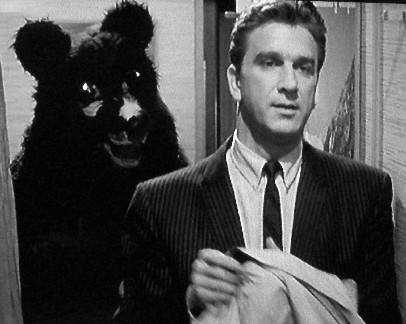
On a London street on New Year's Eve, an old man passes a computer tape filled with defense secrets to another man then tries to skulk away, but he's caught by a pudgy man in glasses (Eric Pohlmann) and quickly dispatched. The man with the tape (Hugh Latimer) and his lovely assistant (Aliza Gur) go to Leslie Nielsen, Latimer's old friend who now works as an airlines PR man, to get a flight to Paris to deliver the tape to the proper authorities. All flights are filled, but Nielsen gets them booked on a train chartered by a ski club, traveling with a fashion photographer as a cover. But the pudgy assassin kills Latimer and the photographer, leaving Nielsen traveling with Gur on the train which is ferried across the Channel--along with a bunch of drunken skiers and a man in a bear suit (pictured with Nielsen) who proves to be handy when Nielsen discovers that the assassin is on the train. There are other complications until the final tense chase at the French port of Dunkirk.

This hour-long black-and-white B-movie is a pleasant surprise. For a cheapie second feature, it's filmed in a remarkably stylish fashion, using the wide screen effectively, and has a very nice jazzy score that gives it a James Bond feel. Nielsen is no Bond, but makes an excellent hero, alternately befuddled and confident. Gur is a fine 60s fashion plate who may have a secret or two of her own. The train setting with the revelers and the bear reminds me of the climax of Trading Places. This movie has escaped critical attention (not listed in Halliwell or Maltin) but with its appearance on DVD, this might change. No buried gem, but with appropriate expectations, fun. [DVD]

Friday, May 27, 2011

THE GLEIWITZ CASE (1961)

Practically every review I've run across of this film says that it was ahead of its time, and it was. It's billed as a re-enactment of an historical event, but today a re-enactment tends to mean one of those rather awful documentary shows on the History Channel which have actors presenting the destruction of Pompeii or a Civil War battle, done with a low budget, bad script, and overbearing narration. This is artfully done; it does more than just follow the facts, but resists the temptation to make a melodrama with fully fleshed-out characters and big actor turns. The event is an attack on a German radio station in August of 1939, supposedly carried out by a Polish commando unit but actually staged by Nazis as an excuse to invade Poland--the action which started World War II. The main character is Nazi officer Alfred Naujocks (played by Hannjo Hasse) who masterminded the incident and who gave testimony about it after the war at Nuremberg. We watch as he collects six soldiers-in-training who have spent time in Poland and can speak the language, and prepares them for their mission. One of the men goes to the radio station, posing as an engineering troubleshooter, to scope out the place. A Polish prisoner (Hilmar Thate, pictured) is chosen to be a fall guy; complete with fake credentials, he will be left dead at the scene, supposedly one of the commandos killed by the SS when they respond to the attack.

There aren't any real surprises as everything goes pretty much as planned. We spend a lot of time with the prisoner (though I don't think he has any dialogue) especially in a long scene showing him being driven blindfolded to the radio station. There are no real character insights, though we do get a strange (and to my mind, misguided) flashback scene that seems to try to explain the character of Naujocks. The director, Gerhard Klein, has a keen visual sense, using lots of artfully composed close-ups and off-kilter shots, and though not a lot happens here in terms of narrative, the film is never boring (perhaps partly because it's very short, around 70 minutes). Very interesting and unusual. [DVD]

Tuesday, May 24, 2011

THE GOOD BAD GIRL (1931)

A tired old plot gets an uninspired turn around the block in this lifeless film. Mae Clarke is tired of being the kept woman of gangster Robert Ellis; she’s carrying on an affair with James Hall (at first, the two deliberately don’t exchange information about their lives, not even their names, à la Last Tango in Paris, but that interesting little kink is not explored). Ellis doesn’t want to lose her, especially when he kills a man and wants her to give him an alibi, but she refuses to and marries Hall. Ellis tries escaping to Philadelphia but is caught and goes to jail, but when headlines crop up connecting Clarke to Ellis, Hall, under pressure from his wealthy parents, leaves her. She has a baby which Hall's mother tries to take from her, then Ellis escapes from jail and vows revenge against Clarke. The climax which sorts things out is as predictable as everything else. Clarke is OK, but both of her men are drab, cardboard figures. The melodramatic story was done to death in the early 30s and is not presented in any interesting fashion here. The only fun in the film is the mild comic relief of Marie Prevost as Clarke's friend and Paul Porcasi as her gangster boyfriend. Prevost's best line, when asked if Ellis has gone to Philadelphia: "No one goes to Philadelphia unless they have to." [TCM]

Saturday, May 21, 2011

WESTERN PACIFIC AGENT (1950)

In a small California town, a thuggish hobo named Frank (known by reputation as the West Coast Kid) arrives and asks his father, kindly and respected storekeeper Joe, for another handout. Joe, fed up with his son's bad ways, refuses, so Frank splits and decides to get some cash another way: he murders Pops, a drawbridge operator, and Bill, a railroad paymaster, so he can get his hands on the payroll money. A railroad agent, Rod Kendall, comes to town to investigate. All he has to go on is a fingerprint and the knowledge that the killer has a nervous habit of chewing on toothpicks. Rod gets some help from town doofus Elmer, who can identify the killer, and from Bill's grieving sister Martha. Frank, in hiding in hobo camps and on railroad cars, finds out that because the serial numbers of the stolen bills have been released by the authorities, all that money is useless to him. It isn't long before Joe realizes that it's his son who is the main suspect, and soon everything is tidied up in a climax involving a shootout and a chase up the drawbridge.

This hour-long crime film sounds better in summary than it plays out. The plot is decent, the production values are mid-to-low B, and there is some clever dialogue here and there, but the acting is fairly weak, especially from the leads, Kent Taylor as Rod and Sheila Ryan as Martha (who, to be fair, is given almost nothing to do except marry Rod at the very end). The reason to watch is Mickey Knox (pictured) who gives a solid performance as the vicious, nervous Frank. Morris Carnovsky is good as the father, and Sid Melton is bearable as the sparingly-used comic relief character Elmer. This film actually has Knox say, "Come and get me, copper!" and "They'll never take me alive!" Best dialogue: when Elmer, collecting evidence in a notepad, asks a woman her name, she says, "None of your puny business!" As she walks away, he replies, "How do you spell puny?" That's as funny as it gets. [DVD]

Thursday, May 19, 2011

QUADRILLE (1938)

Carl, an American movie star (meant to be a Cary Grant/Errol Flynn type, I think) arrives for a quick press jaunt in Paris. He is met by Philippe, a newspaper editor, and Claudine, a writer for a New York paper and a good friend of Paulette, a famous actress with whom Philippe has been living for six years, and to whom he is on the verge of proposing marriage. The handsome Carl sweeps Paulette off her feet; they have a one-night stand after which he leaves, to return in two days. Philippe finds out and isn't quite sure what to think or do; Claudine makes a play for Carl herself; Philippe considers going ahead and marrying Paulette and making Claudine his mistress; Paulette makes a half-hearted stab at suicide, but, this being a romantic comedy, happy endings are in store for all, though not necessarily the ending an American audience will expect.

Sacha Guitry is a French actor, director and playwright, well known in his homeland, but not so known here, probably because he never came to Hollywood and didn't make any English language films. I was glad to finally have the chance to see a Guitry film now that Criterion has issued a 4-movie set. He wrote the film and plays Philippe, and, aside from seeming a bit too old for the part (he looks a good 10-15 years older than the other members of the "quadrille"), he does a fine job. But the real joy in watching this, in addition to witty dialogue and an occasional visual fillip, is in seeing how very differently things play out in this French film than they would have in a Hollywood film of the same era. No bones are made about the live-in relationship between Philippe and Paulette, and the fact that Carl sleeps with Paulette is equally crystal clear--he begins undressing her while she's on the phone with Philippe. The movie makes light of infidelity and suicide, and the ending, while not as unconventional as the other elements, probably would not have flown in America. The other actors, none of whom I'd heard of but all of whom are good, are Gaby Morlay as Paulette, Georges Grey as Carl, and Jacqueline Delubac as Claudine (pictured above with Guitry and Grey). I thought this was great fun, but most critics say this is the weakest film in the boxed set, so I’ll have to check the others out. [DVD]

Monday, May 16, 2011

DECISION BEFORE DAWN (1951)

A tense and complex wartime spy story, a bit different from the average spy film. In 1944, Richard Basehart, who was wounded in combat, has been assigned to an American intelligence unit headed by Gary Merrill. They're experimenting with a new strategy: recruiting German POWs to be parachuted back into Germany to bring back information. When some of the prisoners hold a kangaroo court and kill a German who had been making defeatist remarks (even though by this point, Germany was indeed clearly on the ropes), Oskar Werner, a friend of the dead man, volunteers for a mission, thinking that he can help his country by helping to end the war sooner and save lives. Another POW (Hans Christian Blech) also volunteers, for more mercenary reasons (money), and Basehart becomes the third man, the radio operator. Their mission is to get troop movement info that could help a German general who wants to surrender to the Allies. Once back in Germany, Werner uses an assumed identity to get access to an officer who knows the troop plans. He meets up with a sympathetic woman (Hildegarde Neff), but also soon realizes that an SS man is suspicious of him. After Werner is recognized by a family friend and finds out that his father is still alive, he has mixed feelings about his work. In the tense climax, all three men wind up on the run from the Gestapo.

Though Basehart is top-billed, this is Werner's show all the way and he carries it off very well, creating an interesting, three-dimensional character whom we care about but who is also ambiguous enough that we think he might conceivably betray his mission. It doesn't hurt that Werner (pictured above) is a handsome and charismatic actor. At times, the film reminded me of The Sound of Music: the Americans are stationed in a working French abbey complete with nuns all around, and near the climax, Werner and Basehart are discovered hiding in the shadows by a young boy who seems about to give them up to the Nazis. There is some inventive camerawork and excellent use of location shooting in bombed-out post-war Germany. This was nominated for the Best Picture award, but has been largely forgotten since, but it is worth searching out; it's on DVD as part of Fox's Heroes of War collection. [FMC]

Friday, May 13, 2011

GOODBYE GEMINI (1970)

Blonde twins Jacki and Julian (Judy Geeson and Martin Potter, pictured at right) arrive in London with their big teddy bear Agamemnon to stay at the house of an old family friend. When she’s not as accommodating as they’d like, Julian arranges for her to have a fatal accident on the stairs. With the house to themselves, they leap into the decadent lifestyle of swinging London, becoming part of a circle that includes a closeted gay politician (Michael Redgrave), a not-so-closeted gay art dealer (Freddie Jones), a young man of indeterminate sexuality named Clive (Alexis Kanner) and his supposed girlfriend Denise (Marion Diamond) who nevertheless starts flirting with Julian, who himself does some heavy-duty flirting with his own sister—if you find overtones of incest to be a “yuck factor,” this movie’s not for you. Julian is raped by two drag queens, and pictures are taken of the event. Clive tries to blackmail Julian with the pictures (he needs money to pay off a gambling debt), but Julian and Jacki kill him and separate to go on the run. Jacki, who thought they were just scaring Clive, is traumatized and wanders the streets where she is befriended by Redgrave who seems to genuinely care for her, but who also can’t afford to have his name attached publicly to a murder scandal. Meanwhile, where is Julian?

This is pretty much the definition of kinky, at least mainstream cinema kinky. In the beginning, it has some promise, feeling like a Shirley Jackson novel updated to the sexy, druggy 60s, but the narrative unravels quickly. The twins act like addled amoral children, talking frequently to the teddy bear and blithely unconcerned with the consequences of any of their actions. It’s not really worth doing psychological readings of the characters, though it does seem like Julian’s incestuous feelings are hiding his inner homosexuality. Sometimes the movie looks interesting (the 60s colors, some odd camera angles) and at least two of the supporting performances are worth seeing: Redgrave, who manages to give his character some shadings of depth, and Jones, who adds some much needed humor now and then. A stronger screenplay would have helped make this something more than just a period novelty. [DVD]

Monday, May 09, 2011

CHLOE (1934)

After fifteen years away, Mandy returns to the swamp near the Colonel's turpentine plantation seeking revenge for the lynching of her husband Sam (for which, as we find out, the Colonel wasn't actually responsible). Jim ferries Mandy and her mixed-race daughter Chloe down the river to Mandy's old shack which has been empty all this time--though Mandy, a voodoo practitioner who talks to animals, believes that a bat she finds in the shack is the soul of Sam. While Mandy plots her revenge, the mild-mannered mixed-race Jim falls in love with Chloe, but she falls in love with Wade, a white man who is works with the Colonel. (Wade meets her when he and Jim save her from an assault by a drunk who leers at her and says, "High yellow! That always was my meat!") The Colonel hears rumors of Mandy's plot but dismisses them, proclaiming that voodoo is just "a mixture of savagery, gin, mumbo-jumbo and drumbeats"--to which his niece replies, "Sounds like the menu at Sing-Sing!" Well, it turns out that Chloe is really the Colonel's daughter, originally named Betty Ann, whom he had assumed drowned in a tragic accident as a child--it was really Mandy's daughter who died, but Mandy took Betty Ann as her own and let others think it was Betty Ann who died). When all this is about to be revealed, Mandy kidnaps Chloe to use in a voodoo sacrifice. The presence in the woods of the drunken would-be rapist complicates matters; can Jim and/or Wade save our heroine?

That’s a lot of plot for a Poverty Row movie that doesn't even run an hour. Most of the film is rather laughable (even more laughable is that has a reputation as a horror movie simply because it involves voodoo), but the sexual and racial politics are interesting, to say the least. For starters, Chloe (pictured above) is played by a white actress, Olive Borden, which does make some sense given what we discover about her parentage. Jim is treated as a black man but looks as white as Wade (Reed Howes), his rival. In fact, the actor who plays Jim is the white Philip Ober (married at one time to Vivian Vance). That leaves Georgette Harvey, as Mandy, and Richard Huey, as the Colonel's servant, as the only black actors in major roles here. Jim's a nice, good-looking guy, and whenever he shows up, we hear the theme song, "Love is Calling You," leading us to believe that he and Chloe will wind up together, but of course when it comes out that she's white, we know that Wade will win Chloe's heart--by which time she's reverted to being called Betty Ann. The circumstances behind Sam's lynching remain unclear, I thought deliberately, but probably due to sloppy writing. As far as the acting, Ober does a nice job in an understated style. Harvey commands the camera, but overdoes the nutty revenge stuff a bit. There is almost constant background music, which grows irritating. Still, this is one of those loony bits of "underground" old Hollywood that needs to be seen to be believed. [DVD]

Saturday, May 07, 2011

MEN IN EXILE (1937)

An unofficial remake of the pre-Code melodrama SAFE IN HELL, this time with a male lead. Jimmy (Dick Purcell) is an ex-con taxi driver who gets shanghaied by some crooks into driving a getaway cab in a jewelry store robbery. After a clerk is killed, Jimmy knows the cops won't believe that he was forced into participating, so he escapes to a Caribbean island where he is beyond the laws of extradition. Smuggler Rocky Crane helps Jimmy get settled, but then wants Jimmy to help him run guns to the local revolutionary group and Jimmy refuses to join in. He gets a job at a hotel run by the crusty Mother Haines, and falls for her daughter Sally (June Travis), who is worried about Rocky's evil influences on her brother Danny (Alan Baxter). There's also Colonel Gomez, the ruler of the island, who thinks that Jimmy and/or Danny might know the names of the chief revolutionaries. Eventually, Rocky is busted on a gunrunning trip thanks to his wife Rita (Veda Ann Borg) who is sleeping with Danny on the sly. Rocky breaks out of jail and comes to kill Danny, but Danny kills Rocky instead. The political and the personal mix when Jimmy is arrested for Rocky's murder; Gomez doesn't seem to care all that much who gets executed for the murder, but he does still care about the shadowy rebels.

This is typical Warners B-movie fare for the time. The good news is that there is a fair amount of action and it's all over in just under an hour; the bad news is that the potentially interesting plot is rushed through. The interesting news (SPOILER!) is that the film ends with Jimmy able to stay on the island, not having to return to the States to make the case for his innocence, a far cry from the downbeat ending of the original, in which the main character was a prostitute charged with the death of a client. The unwholesome atmosphere of the original was one of its pluses; here, everything has been sanitized and questions of morality mostly simplified. The romantic leads are boring; Alan Baxter (pictured) shows some promise in his early scenes, but he isn't given much to do. Directed by John Farrow, Mia's father. Worth a look for B-movie fans. [TCM]

Wednesday, May 04, 2011

THE CAPTAIN HATES THE SEA (1934)

An odd little comedy-drama, a GRAND HOTEL-type story set on an ocean liner. The captain of the title (Walter Connolly) is actually a relatively minor character here; he does in fact hate his current job of running a cruise ship which always seems filled with pathetic souls trying to escape the bad circumstances or boredom of their own lives--except for the articulation of this pessimistic philosophy, Connolly is mostly comic relief. Among the passengers: John Gilbert, an alcoholic writer who has given up on Hollywood (think F. Scott Fitzgerald) and is trying to dry out and get a start on a novel; former cop Victor McLaglen who is after fellow passenger Fred Keating who is in possession of some stolen bonds; John Wray, a well-to-do man who is upset with the gossip about his wife (Wynne Gibson) who was formerly known for her loose morals; Akim Tamiroff, a South American revoluntionary; Helen Vinson, a librarian who flirts with both Gilbert and Keating, but who is ultimately revealed to be Keating's partner in crime (though she wants the bonds more than she wants Keating); and Alison Skipworth as a brassy old broad who also happens to be filthy rich. Everyone crosses paths with everyone else, including the comic relief crew members Leon Erroll as the steward who is always pissing off the captain, and Walter Catlett as the bartender, who eventually becomes chummy with Gilbert, who begins drinking again almost as soon as the ship leaves the dock.

Most of the storylines aren't terribly compelling, but the actors all give good performances. Vinson, Skipworth, and Catlett are always fun and don't disappoint here. I'd never heard of Keating before; this was his first film and he only made a handful more, mostly B-pictures. He's fairly handsome and does a nice job here. I've never been a huge McLaglen fan, though he's excellent in John Ford's THE INFORMER, and he's OK in what amounts to the second lead--though he's actually billed above Gilbert (both pictured above). Truly, the reason to watch this film is Gilbert, in what was his final film before succumbing to his real-life alcohol problems and dying of a heart attack only two years later at the age of 38. Gilbert is excellent, underplaying the kind of role that John Barrymore overplayed in GRAND HOTEL; the character knows he's more or less been licked by life, but he accepts his fate quietly and stoically and even with good humor. The only real surprise in terms of plot is the outcome of Tamiroff's story, and once that happens, the other stories take rather predictable turns. Still, this is a must-see for Gilbert fans. [TCM]

Tuesday, May 03, 2011

WHEN WERE YOU BORN (1938)

On a ship about to arrive in San Francisco, astrologer Anna May Wong does a quickie horoscope reading for passenger Lola Lane and predicts that she will have good luck; she promptly wins the shipboard lottery. The message isn't so good for James Stephenson: he only has 48 hours to live. Sure enough, a day later, Stephenson, a wealthy importer of exotic goods, is found dead in his apartment. It appears to be a suicide but the cops soon discover it was murder, and they ask Wong for help in the investigation. The suspects include his fiancée Margaret Lindsay (who is also an old college pal of Wong's), his butler, his business partner, and the man that Lindsay was actually in love with (Anthony Averill), all of whom were in the apartment at one time or another the night of the murder. Wong goes about asking everyone when they were born, and from that she is able to spin a remarkable amount of information. Drug smuggling and bad investments play parts in possible motive theories. Wong tells the cops that two more people will die before the killer is found, and that's what happens.

This is a fairly routine B-mystery, worth seeing for its two novelties: the astrology angle and the appearance of Anna May Wong, Asian-American actress of the 20s and 30s who has become something of a cult star. She has the lead role, though she unfairly gets only second billing to Lindsay. The film opens with a short lecture by occult philosopher Manley P. Hall about the astrological signs--I'm guessing that horoscopes weren't quite as solidly a part of pop culture then as they are now. The predictions Wong makes based on birthdays and birth hours are, of course, always right, but also always ridiculous; she's like Sherlock Holmes, except instead of noticing physical and psychological details, she notices what sign the moon was in when a suspect was born. Her consistent correct predictions get tiresome, and honestly, Wong gives a rather lifeless performance, but it's still interesting to see her in a leading role. Charles Wilson does a nice job as the inspector, who becomes a convert to Wong's ways a little too easily, Jeffrey Lynn plays a reporter, and John Ridgely, a personal favorite B-actor, has two lines as a cop who calls in a tip which ends up helping to break the case open. [TCM]

Sunday, May 01, 2011

SECRET CEREMONY (1968)

Mia Farrow is a waifish young girl whose mother has recently died, leaving her alone in a large house in London, theoretically in the care of two aunts whose idea of care is to visit her occasionally and steal knick-knacks. One day on the bus, Farrow sees Elizabeth Taylor, a lonely, high-class prostitute who bears a resemblance to Farrow's mother. Taylor has her own sorrow, having lost her daughter through an accidental drowning. Farrow follows Taylor around like a puppy, insisting that Taylor is her mother. When she sees how the girl lives, Taylor takes on the persona of the mother; at first, she seems inclined to behave like the aunts and steal some of Farrow's riches, but soon she begins to feel real compassion for her, as though they truly were mother and daughter. Soon, however, Farrow's possibly incestuous stepfather (Robert Mitchum) arrives, to seduce (or re-seduce) Farrow, and maybe Taylor while he's at it. Eventually, Farrow claims to be pregnant--with Mitchum the presumed father--but Taylor discovers that she has been stuffing a doll in her dress to look as though she was with child. What happens in the last 15 minutes results in two deaths and allows the murderous survivor to get away scot free.

This is a crazy movie, not quite camp, which might have worked better as a play. Farrow and Taylor are incredibly mannered in the first 20 minutes or so (much of which plays out with very little dialogue), the fault I assume of the director, Joseph Losey, who may have felt he was doing something avant-garde; if this was made today, it wouldn't be a star-driven film but a moody independent film (with a pre-jail Lindsay Lohan and a post-"Single Man" Julianne Moore, maybe). The movie looks great, with interesting use of color and good sets. Unfortunately, the bizarre acting and confused plotting work against this as effective entertainment. For 60s film buffs only. [TCM]