 I'm not quite sure what to make of this film, a satirical parable of pop culture and politics which has some good ideas but can't follow through on most of them. In the near future, pop singer Paul Jones is the new hot commodity. In his masochistic stage act, he is beaten and jailed, then freed but kept in handcuffs; he attacks his guards who then beat him up some more. All the while, he's singing and the teenage audience is yelling and cheering. We soon discover that Jones's act is actually subsidized by the ruling government in England, who see his show as catharsis for unmoored, violent youth who might otherwise be involved in protest or political agitation. Offstage, Jones is a passive cipher who always looks like he's on the verge of tears, his private life nonexistent, waiting for his handlers to guide his career to its next step. The only people who seem at all close to him are his bodyguard and a model (Jean Shrimpton) who is also his half-hearted girlfriend. When there's an apple glut, Jones does an ad to sell apples. More seriously, when the powers that be decide that the masses need to find God, Jones is set up as a pop messiah. The large open-air concert/crusade is the highlight of the movie, as Jones leads chants like, "We will conform," and does a rock version of the hymn "Jerusalem" while cripples are brought forward for healing. It's done like Leni Reifenstahl shooting a Billy Graham revival and the movie could have used more of this stylistic power throughout. The ending isn't quite as predictable as one might think—there is no explicit martyrdom, just a kind of slow fade as Jones finally rebels against his handlers—but the film really has nowhere to go after the big crusade scene. The ideas floating around about consumerism, pop culture, and politics are interesting, but the script could have used some tightening, and Jones (the original lead singer for Manfred Mann) doesn't make a very charismatic figure. [TCM]
Friday, July 19, 2013
PRIVILEGE (1967)
I'm not quite sure what to make of this film, a satirical parable of pop culture and politics which has some good ideas but can't follow through on most of them. In the near future, pop singer Paul Jones is the new hot commodity. In his masochistic stage act, he is beaten and jailed, then freed but kept in handcuffs; he attacks his guards who then beat him up some more. All the while, he's singing and the teenage audience is yelling and cheering. We soon discover that Jones's act is actually subsidized by the ruling government in England, who see his show as catharsis for unmoored, violent youth who might otherwise be involved in protest or political agitation. Offstage, Jones is a passive cipher who always looks like he's on the verge of tears, his private life nonexistent, waiting for his handlers to guide his career to its next step. The only people who seem at all close to him are his bodyguard and a model (Jean Shrimpton) who is also his half-hearted girlfriend. When there's an apple glut, Jones does an ad to sell apples. More seriously, when the powers that be decide that the masses need to find God, Jones is set up as a pop messiah. The large open-air concert/crusade is the highlight of the movie, as Jones leads chants like, "We will conform," and does a rock version of the hymn "Jerusalem" while cripples are brought forward for healing. It's done like Leni Reifenstahl shooting a Billy Graham revival and the movie could have used more of this stylistic power throughout. The ending isn't quite as predictable as one might think—there is no explicit martyrdom, just a kind of slow fade as Jones finally rebels against his handlers—but the film really has nowhere to go after the big crusade scene. The ideas floating around about consumerism, pop culture, and politics are interesting, but the script could have used some tightening, and Jones (the original lead singer for Manfred Mann) doesn't make a very charismatic figure. [TCM]
Wednesday, July 17, 2013
THE SHANGHAI GESTURE (1941)
 Shanghai is a bustling city of riches, vice, and decadence for those, we are told, "who wish to live between the lines of laws and customs." The heart of the city is Mother Gin Sling's casino, a magnificent pleasure palace in white, designed like Dante's circles of Hell, with a gaming table in a pit at the center where huge sums of money are won and lost every night. We first meet Dixie, a brassy blonde showgirl from Brooklyn stranded in the city. She is taken in by the dusky, passive Doctor Omar—he says he is a doctor of nothing, and others call him the poet laureate of Shanghai, though all the poetry he spouts is from Omar Khayyam—who gets her a job at the casino, though what exactly she does aside from wearing sexy dresses and making wisecracks is never made clear. Next we meet another newcomer to Shanghai, a dark exotic young woman who gives her name as Poppy Smith; she is more fragile than Dixie, but she's got money and a Russian man squiring her around town. She thinks the casino smells evil but it fascinated by it and by Omar. That night, Mother Gin Sling gets the bad news that she will have to shut down her establishment; it's part of a large lot of land bought by rich speculator Sir Guy Charteris. Realizing she cannot fight the deal, she instead tries digging up dirt on Charteris and discovers two interesting items: Poppy is his daughter (real name Victoria), and Charteris is actually a man named Dawson who was briefly married to Mother Gin Sling in her youth and who treated her badly. Mother plots to reduce Poppy to a shell of her former self by getting her hooked on drinking and gambling, and then on the casino's final night, the eve of Chinese New Year, she'll unveil the spectacle of Victoria's ruin to Charteris at a fancy dinner party. Things go as planned, but Charteris has a little secret of his own which casts everything in a different light for Mother.
Based on a notorious stage play, the Production Code people didn't want this movie made at all. In the play, the casino is a brothel, and the name of the main character is Mother Goddam. Lots of changes were made to get this material through the censors, but a strong atmosphere of decadence and corruption remains, and it doesn't take much reading between the lines to figure out what's what. Dixie (Phyllis Brooks) has clearly been hired as a prostitute; Omar (Victor Mature) is completely amoral and pretty much high all the time, on opium I assume; Poppy (Gene Tierney), after Omar is through with her, is certainly drug-addled as well. This film was the last hurrah of Josef von Sternberg, who would certainly have centered this film around Marlene Dietrich if he had made it a few years earlier. Though its stage origins remain obvious, the movie looks great. Long shots of the casino are stuffed with interesting detail—the main credits include an acknowledgement of the unsung extras, and indeed they are crucial in the building of atmosphere. The print I saw wasn't spectacular, but the rich blacks and overexposed whites come through well enough.
 This was an early lead role for Tierney, and while some critics complain that she overacts, I think she was wise to do so here, since her character is such a melodramatic soap-opera type. For the most part, Power barely registers since he has little to do besides look like he's in an opium haze all the time. The rest of the cast is fine, including Walter Huston as Charteris, Eric Blore as the bookkeeper who is on crutches the whole time (someone says to him, "Stop behaving like a disabled flamingo!"), Albert Basserman as a city official, and Mike Mazurki as a bare-chested sinister rickshaw driver. Best of all is Ona Munson, unrecognizable in Asian makeup as Mother Gin Sling (pictured). Her face is usually frozen in a sickly smile, but her voice (you can hear Belle Watling, her character in GONE WITH THE WIND, loud and clear) and mannerisms give full vent to her desires and frustrations. Things end well for no one (except maybe Omar who probably curls back up with his hookah), but the ending has just enough ambiguity to allow us to imagine that not all the guilty parties will pay for their crimes. Not a masterpiece, perhaps, but a must-see for classic-era fans. [TCM]
Monday, July 15, 2013
THE SIGN OF THE RAM (1948)
 Sherida has arrived in Cornwall to take a job as secretary for a writer, Leah, who produces gushy inspirational poetry under the pen name Faith Hope. Leah is confined to a wheelchair; years ago, she saved two of her stepchildren from drowning but her legs were crushed and she's been crippled ever since. Sherida finds the family quite friendly, especially Leah's gentle husband Mallory, but soon Leah begins to suspect that something is going on between Sherida and Mallory. It's not, but once Leah's jealous fuse has been lit, it can't be put out. As two of her stepchildren, Logan and Jane, make plans to marry their sweethearts and leave the house, Leah hatches her own plans to meddle in their affairs to keep them at home, or as one character says, keep her "band of slaves intact." Then she plants a seed in the mind of her youngest, Christine, about the dalliance she imagines between Mallory and Sherida, leading Christine to put an overdose of sleeping powder in Sherida's water. Slowly, Leah's plotting becomes evident to all, but they may not be able to undo all her damage.
 A gothic melodrama in the vein of DRAGONWYCK, GUEST IN THE HOUSE, and UNCLE SILAS, this plays out in a lower key than the above films but it still generates some thrills along the way. One big plus is the atmosphere; it's set in a big old mansion on a cliff with crashing waves below (think THE UNINVITED, also set in Cornwall) and the dramatic outdoor settings are used well. The film was crafted specifically for Susan Peters (above left) who plays Leah; she was a starlet whose career was taking off when she was paralyzed in a hunting accident in 1945. This film was to have been her comeback, and she's quite good in the role, underplaying both the character's inner sinister nature and her outer vulnerable appearance. Sadly, she made no other films and died four years later. The other actors are fine, especially Alexander Knox as the husband, the handsome Ross Ford as Logan, Diana Douglas as Catherine (a free-spirited artist and Logan's lover, pictured with Ford), and Ron Randall as Simon (the family doctor and the object of Jane's affections). Sherida (Phyllis Thaxter) and the two daughters don’t make as much of an impact, partly (for me) because they're not as well differentiated as the rest—the three young women look and act alike: dark hair, attractive, and vivacious (except when Leah has them under her thumb). The story takes a while to get going; there's a lot of exposition laid out in long dialogue scenes during the first half-hour before things really get going. But this movie definitely deserves to be better known than it is. [TCM]
Thursday, July 11, 2013
DARLING, HOW COULD YOU? (1951)
 In turn-of-the-century New York City, the Grey children (older teenager Amy and 10-year-old Cosmo who hates his name and wants to be called Charles) are dropped off at the wrong theater by their housekeeper Fanny and they see a melodrama about an adulterous wife who is shunned by society for her behavior. Amy is much taken with the play and feels that she now has some acquaintance with the "seamy side" of life. The next day, the children await the return of their parents who have been living and working in Panama for years; Amy and Cosmo barely remember them, and when Amy goes to meet their ship, she's on the lookout for an elderly couple, but in fact they are still young and vibrant people so Amy doesn't notice them. That's just the first of a series of misunderstandings between the kids and their parents (who have their own misconceptions about their children), the biggest of which involves Amy assuming that her mother is having a "seamy side" affair with a young doctor who is actually just a family friend. Afraid that her mom will be "hounded from society," she sets out to fix things, which of course only messes things up more. Since this is a comedy (based on a play by J.M. Barrie), everything works out in the end. This little trifle is mostly fun though it might be more interesting if played at a slightly faster pace, more like farce. Joan Fontaine and John Lund (pictured) are adequate as the parents; Mona Freeman as Amy and Peter Hansen as the family friend come off the best. There’s a nice Barrie reference when Amy, in discussing seeing the melodrama, says, "I wouldn’t have learned half as much from Peter Pan!" [Netflix streaming]
Tuesday, July 09, 2013
BOULDER DAM (1936)
 Ross Alexander and Lyle Talbot work as mechanics at a Detroit taxi company. Alexander is cocky and egotistical, though his boss (William Pawley) admits he's the best in the shop. One day when Alexander comes in late yet again, Pawley fires him. They get into a fistfight and Pawley hits his head on the stone floor and dies. Alexander, fearing arrest, hops on a train and heads out west, a hungry, jobless hobo. In the desert, he helps Patricia Ellis fix her broken-down car, and later runs into her again at a nightclub where she sings. Ellis somewhat unaccountably takes a liking to the grungy, unpleasant Alexander; she buys him a meal and takes him home to her family, who give him free room and board. Under Ellis' influence, Alexander begins to straighten up and soon gets a job working construction on Boulder Dam. When a driver loses control of a truck filled with dynamite, Alexander jumps on board and tosses the TNT into the river. For a while, he's a hero, and he even gets engaged to Ellis, but Talbot shows up to work on the dam, recognizes Alexander, and threatens to blackmail him.
Alexander (pictured with Ellis) was being groomed by Warners as a Dick Powell-like performer, but even at his peak, he didn't have the easy, bubbly persona needed to fit that bill. Here, for a while, he's fairly convincing as a kind of anti-hero—despite his overly mannered delivery of dialogue, he does work up some slimy charm—but as the plot developed, I never found him sympathetic or likeable. The main thing this B-movie has to offer is the unusual backdrop of Boulder Dam, now called Hoover Dam, which was built over a five-year period and was officially dedicated just months before this film was released. I doubt there was any location shooting aside from some background footage, but the runaway truck scene and the finale—involving two men left hanging over the dam when a cable snaps—are well done. Ellis is unmemorable and Talbot, as usual, isn't given enough to do. Eddie Acuff does nicely with a small comic relief role as a fellow worker called Alley Oop. [TCM]
Friday, July 05, 2013
THE VIKING (1931)
 In snowy, raw Newfoundland, where only the hearty survive, Luke, the new mailman, is overtaken by a snowstorm and found unconscious. Brawny, cocky Jed finds Luke and takes him to the village where Mary Joe nurses him back to health. Luke, because of his family's past, is considered a jinx (a "jinker") and has taken this lowly job to break the jinx but it didn't quite work. Over time, Mary Joe grows fond of Luke, even though the brutish Jed fancies himself to be her boyfriend. When the men of the village take their annual trek across the snowy wastes to Labrador to go seal hunting, Luke decides to join them. The ship captain discovers that Luke is a jinker and won't take him, but after Jed sees Mary Joe chatting up Luke, Jed gets Luke on board. On the ice, the ship eventually gets stuck in ice a few times and tension mounts between Jed and Luke (with Jed going so far as to take a shot at Luke) until, as the men drag the seals back to the ship, a storm rises which leaves Luke and Jed stranded on the ice. Can they work together to survive?
This film is basically just another version of the old romantic rivals story, in which a rough-and-tough older man and a younger, better-looking "wet behind the ears" guy fall for the same woman and wind up competing for her. What makes this different is the background; it was shot almost completely outdoors and on location in Newfoundland. The scenes on the ice are spectacular and, despite the creakiness of the narrative conventions, this film is worth seeing just for the setting. The acting is fine if not anything special: Charles Starrett (hunky hero of THE MASK OF FU MANCHU) is Luke, Arthur Vinson is Jed—and since the woman's role is not as important as the showboating men, Louise Huntington, as Mary Joe, doesn’t get to make much of an impression. Real-life ship captain Bob Bartlett, who sailed with Admiral Perry to the North Pole, plays the captain. The young director, Varick Frissel, died in a ship explosion when he went back to Newfoundland to get more location footage. [TCM]
Wednesday, July 03, 2013
ENTERTAINING MR. SLOANE (1970)
 Middle-aged Kath and her aged father (known as Dadda) live in a once-nice house on the edge of a graveyard, and Kath attends funerals as recreation. Kath's brother Ed (who lives elsewhere) is in business and does well enough that he owns a flashy pink Cadillac. For some reason, Dadda won't speak to Ed, and Ed doesn't come around very often. One day after a funeral, Kath sees a handsome, shirtless young man, Mr. Sloane, doing sit-ups on top of a grave. Apparently homeless and on the run from someone or something, he accepts an offer from the horny Kath to live with her, and soon they're going at it with some energy, though clearly she's enjoying herself more than he is. While Sloane is stretched out in bed resting, wearing just a very skimpy pair of briefs, Ed discovers him and practically begins salivating. What follows is a kind of game in which Kath and Ed compete for Sloane's affections, or at least for his body. Complicating matters is that Dadda believes that Sloane is the man who killed his boss, a porn purveyor, and threatens to turn him in to the police. Sloane thinks that he has the upper hand and can manipulate the whole family, but it may be that he's the one being manipulated.
This once-shocking black comedy, based on a play by Joe Orton, still has the power to unsettle. Partly because none of the characters are particularly sympathetic, the situation they're in never feels very real, and there is little import to anyone’s actions. Still, the film conjures up some queasiness here and there. The emphasis on the physical desirability of Sloane makes the film unusual for its time. Peter McEnery plays Sloane with a smile and a smirk which both get more desperate as he loses control of the game he's playing. As good as he is, it's the fearless performances of Beryl Reid (Kath) and Harry Andrews (Ed) that make this movie still watchable. Reid, who was 50 at the time, traipses about in sheer day-glo outfits with nothing underneath, with no idea how pathetic she seems to those around her. Andrews (pictured above with McEnery), a character actor who will look familiar to you even if you can't place him exactly (THEATER OF BLOOD, DEATH ON THE NILE, THE RULING CLASS), is uncomfortably good as the closeted respectable businessman who drives himself to distraction with his passion for Sloane. There aren't many out-loud laughs in the movie, and the ending which certainly shocked audiences of the 70s won't be shocking at all today—it might even seem a little quaint. Interesting viewing [Netflix streaming]
Tuesday, July 02, 2013
THE CASE OF THE STUTTERING BISHOP (1937)
 Perry Mason takes a case from an Australian bishop (yes, the stutterer of the title). It's complicated: years ago, Ida Gilbert, daughter-in-law of the millionaire Brownley, was found guilty of manslaughter in a car accident. She fled to Australia and gave up her daughter to the bishop who placed her in foster care back in America. Now a young woman named Janice has shown up claiming to be the long-missing heiress and Brownley has taken her in. The bishop wants Mason to help Ida and her friend Stella look for the real Janice and convince Brownley that the one living in his house is a fake. Then the bishop vanishes, and Brownley is found dead, shot in his car by a woman in a white raincoat. There's also something a little fishy about Ida's buddy Stella. Can Perry, aided by his secretary Della Street and his assistant Paul Drake, sort out all the loose ends, bring the killer to justice, figure out who the real heiress is, and find out what happened to the bishop?
Of course he can, he's Perry Mason! The Mason movies aren't as placid as the Raymond Burr TV episodes—they're really just another 30s detective B-movie series like Philo Vance or Charlie Chan, and as such, they're enjoyable. As in the show, the climax here occurs in a crowded courtroom with a nice twist exposed in a dramatic fashion. When Warren William played Perry Mason, he was light and charming; here, Donald Woods is fairly drab and stoic but not without some appeal. It has been said that Woods came closest to approximating the original Mason from Erle Stanley Gardner's books, but since I’ve never read one, I can't say. I liked Ann Dvorak as a sprightly Della, and I enjoyed seeing Craig Reynolds and Frank Faylan is small roles. The bishop's stuttering is simply a red herring. [TCM]
Thursday, June 27, 2013
ALI BABA AND THE FORTY THIEVES (1944)
 In Baghdad, Ali, the young son of the Caliph, and Amara, the young daughter of the Caliph's advisor Cassim, make a blood oath to solidify their pledge of love, but not long after, Cassim, working with the Mongols, betrays the Caliph who is killed. Ali escapes into the desert where he discovers the secret hiding place of a band of thieves, in a deep mountain cave which opens up only to the phrase, "Open, O sesame." The thieves adopt him, naming him Ali Baba, and soon they become a small resistance band against the Mongols. Years later, Amara is to be married to the pretender Caliph, Kahn. When Ali, the new leader of the thieves, recognizes Amara as his childhood sweetheart, he leads a raid to rescue Amara from marriage to the evil Kahn.
Like the earlier ARABIAN NIGHTS, this pairing of Jon Hall (Ali) and Maria Montez (Amara), both pictured at right, is a colorful and fun adventure film with good sets and costumes, an appropriate amount of comic relief, and lots of rousing action scenes. Hall is never quite up to the standards of a grade-A screen hero (like Tyrone Power or Errol Flynn) but he suffices. Montez pretty much gives one-note performances, but her exotic looks make up for her acting weaknesses. Andy Devine, as Abdullah, Ali's protector, is amusing but never obnoxiously so. Standouts in the supporting cast include Scotty Beckett as the young Ali, Turhan Bey as a slave to Amana who winds up helping the thieves, Frank Puglia as Cassim, and Fortunio Bononova as the head of the thieves. [DVD]
 In Baghdad, Ali, the young son of the Caliph, and Amara, the young daughter of the Caliph's advisor Cassim, make a blood oath to solidify their pledge of love, but not long after, Cassim, working with the Mongols, betrays the Caliph who is killed. Ali escapes into the desert where he discovers the secret hiding place of a band of thieves, in a deep mountain cave which opens up only to the phrase, "Open, O sesame." The thieves adopt him, naming him Ali Baba, and soon they become a small resistance band against the Mongols. Years later, Amara is to be married to the pretender Caliph, Kahn. When Ali, the new leader of the thieves, recognizes Amara as his childhood sweetheart, he leads a raid to rescue Amara from marriage to the evil Kahn.
 Like the earlier ARABIAN NIGHTS, this pairing of Jon Hall (Ali) and Maria Montez (Amara), both pictured at right, is a colorful and fun adventure film with good sets and costumes, an appropriate amount of comic relief, and lots of rousing action scenes. Hall is never quite up to the standards of a grade-A screen hero (like Tyrone Power or Errol Flynn) but he suffices. Montez pretty much gives one-note performances, but her exotic looks make up for her acting weaknesses. Andy Devine, as Abdullah, Ali's protector, is amusing but never obnoxiously so. Standouts in the supporting cast include Scotty Beckett as the young Ali, Turhan Bey as a slave to Amana who winds up helping the thieves, Frank Puglia as Cassim, and Fortunio Bononova as the head of the thieves. [DVD]
Tuesday, June 25, 2013
ARABIAN NIGHTS (1942)
 An old bearded man reads a story about half-brothers from the Arabian Nights to a gaggle of buxom harem girls. Haroun (Jon Hall) is the rightful Caliph of Baghdad, but his half-brother Kamar (Leif Erickson) has tried to overthrow him and failed, so now Kamar has been hanging by his arms for seven days in what is called the Slow Death. On the seventh night, with Kamar seemingly on the edge of death, his band of rebels attacks, freeing him. In fierce hand-to-hand fighting, Haroun receives a life-threatening wound and passes out. An impish circus acrobat named Ali (Sabu) sees the attack and rushes to Haroun's aid. Knowing the danger Haroun is in, Ali takes the Caliph's Ring off his hand and puts it on the dead body of a rebel whose face has been smashed by a rock beyond recognition, so Kamar will assume that Haroun is dead. Ali takes Haroun in, shaves his beard so he won't be recognized, and helps him recover with some assistance from renowned dancing girl Scheherazade (Maria Montez). But Scheherazade is being sought by Kamar—she promised to marry him if he ever gained the title of Caliph—so the circus winds up on the run, not just from Kamar's men but also from slave traders and from a rogue member of Kamar's group who would be happy to see both brothers dead.
This is the colorful adventure film which introduced the popular pairing of Hall and Montez, who went on to do five more films together. Made during the first year of WWII, there were wartime restrictions placed on film budgets, but the studio, Universal, the producer, Walter Wanger, and the director, John Rawlins, managed to create a movie that looked spectacular, not just with bright Technicolor hues but with effective sets and lovely backgrounds. The beefy Hall and exotic Montez are not the greatest actors, but there is some chemistry there, and the supporting cast is fun. Billy Gilbert does a variation on his usual sputtering doofus as the head of the circus—in action scenes when he belly-butts someone, a distinct "boinnng" is heard on the soundtrack; John Qualen and Shemp Howard have some fun playing older versions of Aladdin (still on the search for another magic lamp) and Sinbad (always trying to tell tales of his glory days). The chief pleasure I got out of this was the look of the movie: gorgeous colors, remarkable backdrops, and even some real sand dunes—shot on location in Utah, not Iraq. [DVD]
 An old bearded man reads a story about half-brothers from the Arabian Nights to a gaggle of buxom harem girls. Haroun (Jon Hall) is the rightful Caliph of Baghdad, but his half-brother Kamar (Leif Erickson) has tried to overthrow him and failed, so now Kamar has been hanging by his arms for seven days in what is called the Slow Death. On the seventh night, with Kamar seemingly on the edge of death, his band of rebels attacks, freeing him. In fierce hand-to-hand fighting, Haroun receives a life-threatening wound and passes out. An impish circus acrobat named Ali (Sabu) sees the attack and rushes to Haroun's aid. Knowing the danger Haroun is in, Ali takes the Caliph's Ring off his hand and puts it on the dead body of a rebel whose face has been smashed by a rock beyond recognition, so Kamar will assume that Haroun is dead. Ali takes Haroun in, shaves his beard so he won't be recognized, and helps him recover with some assistance from renowned dancing girl Scheherazade (Maria Montez). But Scheherazade is being sought by Kamar—she promised to marry him if he ever gained the title of Caliph—so the circus winds up on the run, not just from Kamar's men but also from slave traders and from a rogue member of Kamar's group who would be happy to see both brothers dead.
This is the colorful adventure film which introduced the popular pairing of Hall and Montez, who went on to do five more films together. Made during the first year of WWII, there were wartime restrictions placed on film budgets, but the studio, Universal, the producer, Walter Wanger, and the director, John Rawlins, managed to create a movie that looked spectacular, not just with bright Technicolor hues but with effective sets and lovely backgrounds. The beefy Hall and exotic Montez are not the greatest actors, but there is some chemistry there, and the supporting cast is fun. Billy Gilbert does a variation on his usual sputtering doofus as the head of the circus—in action scenes when he belly-butts someone, a distinct "boinnng" is heard on the soundtrack; John Qualen and Shemp Howard have some fun playing older versions of Aladdin (still on the search for another magic lamp) and Sinbad (always trying to tell tales of his glory days). The chief pleasure I got out of this was the look of the movie: gorgeous colors, remarkable backdrops, and even some real sand dunes—shot on location in Utah, not Iraq. [DVD]
Thursday, June 20, 2013
LAST HOLIDAY (1950)
 George Bird, a tractor salesman, learns he has Lampington’s disease; his doctor tells him he has only weeks to live. As he has no wife, children, family or close friends to commiserate with, he decides to withdraw his savings and take a last holiday at a posh resort hotel. While there, he tells no one about his fate, and the workers and guests, mostly of a class higher that Bird's, begin to think of him as a man of mystery. Not only does he make friends and get respect, he wins money while gambling and discovers the potential for romance with the housekeeper Mrs. Poole. He gets a job offer, gives money to the Rockinghams who are in dire financial straits, and when the hotel staff goes on a 24-hour "sympathetic" strike, he takes the lead and gets all the guests to pitch in and keep things running. Then Dr. Lampington himself shows up at the hotel and when he finds out Bird's secret, tells him he has no signs of the disease and must have been misdiagnosed. Is this the beginning of a new chapter in Bird's life?
This pleasant comedy is almost a little too placid; believe me, I don’t need car chases or destructive slapstick to enjoy comedies, but this one could use some jolts of energy now and then. Still, it's fun (with dark edges), well written by J.B. Priestly, and the cast is superb, beginning with Alec Guinness as Bird in a subtle performance that I can imagine being bettered only by Peter Sellers. Other standouts: Kay Walsh (pictured with Guinness) as Mrs. Poole who is just right in the role of the self-possessed woman who almost falls for the sympathetic mystery man; Beatrice Campbell as Mrs. Rockingham who teeters on the verge of romancing Bird; Grégoire Aslan as Gambini the hotel keeper; Brian Worth as Mr. Rockingham who, in a plotline that essentially goes nowhere, is involved in a currency smuggling scheme; Esma Cannon as Miss Fox, a shy downtrodden companion to a rich lady; and Ernest Thesiger as Lampington whose character has the potential to be quite eccentric (as most of Thesiger's roles are) but isn't fleshed out enough. Bernard Lee and Wilfrid Hyde-White also appear. It’s sweet and a little melancholy, and worth seeing. [DVD]
 George Bird, a tractor salesman, learns he has Lampington’s disease; his doctor tells him he has only weeks to live. As he has no wife, children, family or close friends to commiserate with, he decides to withdraw his savings and take a last holiday at a posh resort hotel. While there, he tells no one about his fate, and the workers and guests, mostly of a class higher that Bird's, begin to think of him as a man of mystery. Not only does he make friends and get respect, he wins money while gambling and discovers the potential for romance with the housekeeper Mrs. Poole. He gets a job offer, gives money to the Rockinghams who are in dire financial straits, and when the hotel staff goes on a 24-hour "sympathetic" strike, he takes the lead and gets all the guests to pitch in and keep things running. Then Dr. Lampington himself shows up at the hotel and when he finds out Bird's secret, tells him he has no signs of the disease and must have been misdiagnosed. Is this the beginning of a new chapter in Bird's life?
 This pleasant comedy is almost a little too placid; believe me, I don’t need car chases or destructive slapstick to enjoy comedies, but this one could use some jolts of energy now and then. Still, it's fun (with dark edges), well written by J.B. Priestly, and the cast is superb, beginning with Alec Guinness as Bird in a subtle performance that I can imagine being bettered only by Peter Sellers. Other standouts: Kay Walsh (pictured with Guinness) as Mrs. Poole who is just right in the role of the self-possessed woman who almost falls for the sympathetic mystery man; Beatrice Campbell as Mrs. Rockingham who teeters on the verge of romancing Bird; Grégoire Aslan as Gambini the hotel keeper; Brian Worth as Mr. Rockingham who, in a plotline that essentially goes nowhere, is involved in a currency smuggling scheme; Esma Cannon as Miss Fox, a shy downtrodden companion to a rich lady; and Ernest Thesiger as Lampington whose character has the potential to be quite eccentric (as most of Thesiger's roles are) but isn't fleshed out enough. Bernard Lee and Wilfrid Hyde-White also appear. It’s sweet and a little melancholy, and worth seeing. [DVD]
Tuesday, June 18, 2013
THE ANNIVERSARY (1968)
 Every year Mrs. Taggert insists that her three grown sons join her to celebrate her wedding anniversary to her late husband. And it seems that every year, she uses the event to reassert her dominance over her sons, insulting and humiliating them to keep them under her thumb—she owns the family construction business, and all three work for her, with varying degrees of competence. Henry, who is charge of the day-to-day business, is an unmarried milquetoast and transvestite who steals women's underwear from stores and clotheslines and seems happy with the status quo. The other two, however, have plans to escape: Terry, with a wife and kids, is planning to move to Canada; Tom, the youngest, has brought his pregnant fiancée to the celebration despite Mother's almost certain disapproval. And indeed, Mrs. Taggert spends the entire evening running everyone down, trying to get her way. Will this be the year when things backfire?
Bette Davis has a field day chewing the scenery as the horrid mother in this black comedy. She wears an eyepatch (due to a BB gun accident years ago, caused by one of her sons) and, though the film is set in England, Davis doesn't bother with an accent, and she doesn't need to—sounding like Bette Davis is scary enough. She cackles and spits out insults with relish. To Terry's wife, pregnant with her fourth child, she says, "Natural good manners told me when to put the plug in." Glaring at Tom's tarty girlfriend who plunked down next to her on the couch, she says, "Would you mind sitting somewhere else? Body odor offends me." Based on a play, most of the film takes place in Mom's house, though the camera set-ups are varied enough that it rarely feels stagy, and when it does venture out, to a dinner at a restaurant, it doesn't feel right. The rest of the cast is good, especially Jack Hedley as Terry, doing a nice job of not being as kowtowing as Henry (James Cossins) but not able to rebel as obviously as Tom (Christian Roberts), and Sheila Hancock as Terry's wife. Not all the plot twists work—a cruel prank that Mrs. Taggert plays on Terry's wife comes off as half-baked and childish—but this is a strong example of the strain of black comedy that blossomed in the 1960s. And this is a better movie overall than Davis' more famous campy dark comedy WHATEVER HAPPENED TO BABY JANE. [DVD]
 Every year Mrs. Taggert insists that her three grown sons join her to celebrate her wedding anniversary to her late husband. And it seems that every year, she uses the event to reassert her dominance over her sons, insulting and humiliating them to keep them under her thumb—she owns the family construction business, and all three work for her, with varying degrees of competence. Henry, who is charge of the day-to-day business, is an unmarried milquetoast and transvestite who steals women's underwear from stores and clotheslines and seems happy with the status quo. The other two, however, have plans to escape: Terry, with a wife and kids, is planning to move to Canada; Tom, the youngest, has brought his pregnant fiancée to the celebration despite Mother's almost certain disapproval. And indeed, Mrs. Taggert spends the entire evening running everyone down, trying to get her way. Will this be the year when things backfire?
Bette Davis has a field day chewing the scenery as the horrid mother in this black comedy. She wears an eyepatch (due to a BB gun accident years ago, caused by one of her sons) and, though the film is set in England, Davis doesn't bother with an accent, and she doesn't need to—sounding like Bette Davis is scary enough. She cackles and spits out insults with relish. To Terry's wife, pregnant with her fourth child, she says, "Natural good manners told me when to put the plug in." Glaring at Tom's tarty girlfriend who plunked down next to her on the couch, she says, "Would you mind sitting somewhere else? Body odor offends me." Based on a play, most of the film takes place in Mom's house, though the camera set-ups are varied enough that it rarely feels stagy, and when it does venture out, to a dinner at a restaurant, it doesn't feel right. The rest of the cast is good, especially Jack Hedley as Terry, doing a nice job of not being as kowtowing as Henry (James Cossins) but not able to rebel as obviously as Tom (Christian Roberts), and Sheila Hancock as Terry's wife. Not all the plot twists work—a cruel prank that Mrs. Taggert plays on Terry's wife comes off as half-baked and childish—but this is a strong example of the strain of black comedy that blossomed in the 1960s. And this is a better movie overall than Davis' more famous campy dark comedy WHATEVER HAPPENED TO BABY JANE. [DVD]
Friday, June 14, 2013
THE BELLE OF NEW YORK (1952)
 In Gay Nineties New York, Vera-Ellen works for the Daughters of Right (as in, the Salvation Army); she attracts lots of men with her looks but few of them are really looking for salvation (as with Jean Simmons in GUYS AND DOLLS). Meanwhile, playboy Fred Astaire, about to finally get married, holds a bachelor party with all of his ex-girlfriends. Afterwards, he realizes he doesn't really love his intended, and, out in the city for a carriage ride, he spots Vera singing with the Daughters and is immediately smitten. She brushes him aside, telling him that true love should leave you walking on air; right after she leaves, Fred does, in fact, dance on air, winding up on top of the Washington Square arch. He keeps after her, and she insists he must begin to work for a living. When he gets a job as a streetcar driver, they perform a dance to the cute song "Oops!" and Vera starts to levitate as well. Fred's rich aunt (Marjorie Main), who is also a patron for the Daughters of Right, is happy about their relationship and pays off Fred's former fiancée (for breach of promise) and also offers to pay for Fred and Vera's wedding, but the night before, Fred and his friends get plastered at a bachelor party and he misses the wedding. How will these kids ever get back together?
Though I love movie musicals, the late 40s/early 50s was not their prime era (the big exception being SINGIN’ IN THE RAIN). With the MGM musicals of that time—like this one—it often feels like they're trying too hard in some areas (overdone production design) and not hard enough in others (underbaked plotting). I always enjoy seeing Fred Astaire dance, and the plot device of dancing on air is fun, but the rest of this is a little flat. Astaire was in his 50s and beginning to look a little creepy/pervy paired up with younger women. The peak of that nonsense came a few years later in FUNNY FACE in which, at 58 but looking 65, he was paired up with Audrey Hepburn, not quite 30 but looking barely 21. There’s not much chemistry between Astaire and Vera-Ellen; she seems rather cold throughout, even when she's supposed to be thawing out. The dance numbers are generally fine, even if the songs themselves are not memorable. I always enjoy Marjorie Main’s presence, and the supporting cast includes Keenan Wynn, Clinton Sundberg, and Alice Pearce (the first Mrs. Kravitz on Bewitched). The last "dancing on air" number is a nice closer. [TCM]
 In Gay Nineties New York, Vera-Ellen works for the Daughters of Right (as in, the Salvation Army); she attracts lots of men with her looks but few of them are really looking for salvation (as with Jean Simmons in GUYS AND DOLLS). Meanwhile, playboy Fred Astaire, about to finally get married, holds a bachelor party with all of his ex-girlfriends. Afterwards, he realizes he doesn't really love his intended, and, out in the city for a carriage ride, he spots Vera singing with the Daughters and is immediately smitten. She brushes him aside, telling him that true love should leave you walking on air; right after she leaves, Fred does, in fact, dance on air, winding up on top of the Washington Square arch. He keeps after her, and she insists he must begin to work for a living. When he gets a job as a streetcar driver, they perform a dance to the cute song "Oops!" and Vera starts to levitate as well. Fred's rich aunt (Marjorie Main), who is also a patron for the Daughters of Right, is happy about their relationship and pays off Fred's former fiancée (for breach of promise) and also offers to pay for Fred and Vera's wedding, but the night before, Fred and his friends get plastered at a bachelor party and he misses the wedding. How will these kids ever get back together?
Though I love movie musicals, the late 40s/early 50s was not their prime era (the big exception being SINGIN’ IN THE RAIN). With the MGM musicals of that time—like this one—it often feels like they're trying too hard in some areas (overdone production design) and not hard enough in others (underbaked plotting). I always enjoy seeing Fred Astaire dance, and the plot device of dancing on air is fun, but the rest of this is a little flat. Astaire was in his 50s and beginning to look a little creepy/pervy paired up with younger women. The peak of that nonsense came a few years later in FUNNY FACE in which, at 58 but looking 65, he was paired up with Audrey Hepburn, not quite 30 but looking barely 21. There’s not much chemistry between Astaire and Vera-Ellen; she seems rather cold throughout, even when she's supposed to be thawing out. The dance numbers are generally fine, even if the songs themselves are not memorable. I always enjoy Marjorie Main’s presence, and the supporting cast includes Keenan Wynn, Clinton Sundberg, and Alice Pearce (the first Mrs. Kravitz on Bewitched). The last "dancing on air" number is a nice closer. [TCM]
Wednesday, June 12, 2013
TOMORROW IS ANOTHER DAY (1951)
 When he was 13, Steve Cochran shot and killed his drunken, abusive father; tried as an adult, he served 18 years in prison and is now being released with a chunk of money he earned through work, a cheap suit, and bus fare. He's hardened over the years, but he's not broken, and he sets out to start a new life. In a diner, Cochran is befriended by John Kellogg who helps him get a job as a welder, but Cochran soon discovers that Kellogg is a reporter who writes a sensationalistic front page story about him, so he leaves for New York City, hoping for anonymity in the big city. At a dime-a-dance joint, he meets up with tough blonde Ruth Roman; she shows him around town and he falls hard for her. It turns out she's being "kept" by a cop (Hugh Sanders), and when the three have words, the violent Sanders knocks out Cochran, then Roman (more or less accidentally) shoots Sanders. When Cochran comes to, Roman lets him think that he shot Sanders, and when they find out the cop has died, the two go on the run, winding up in a California farming camp where they get married, bond with another couple, and seem to be on the way to living a normal life. But soon Cochran is recognized when his picture is run in a true crime magazine—will they run again and stay and make a stand? And will Roman come clean with Cochran?
I am now an official Steve Cochran fan. With his dark, handsome, brooding look, he had a decent career in B-films, often noir or crime films, often as a conflicted hero (as here) or anti-hero (as in PRIVATE HELL 36). He may not have been an Oscar-caliber actor, but he brought a certain presence to his roles that generated the required heat or coolness as called for—he could come off as a dumb lug, a smart average guy, a slick seducer, or a naïve sucker. Here, he exhibits bits of all those personas: he's not dumb, exactly, but having grown up behind bars, he is unschooled socially, and part of the appeal of the first half of the movie is watching him negotiate his return to society. Roman is good as a tough gal who slowly softens up (and goes from brassy blonde to natural dark hair)—we keep hoping she doesn't quite have it in her to truly be a femme fatale. In the supporting cast, Lurene Tuttle stands out as a co-worker at the farm, and Lee Patrick (Effie in THE MALTESE FALCON) has a small but effective bit as Roman's sister. The latter half, set at the farm camp, feels at times like a serious version of IT HAPPENED ONE NIGHT. Despite an ending that is a little too sunny and ties up loose ends a little too neatly, this is a standout film noir. [TCM; also on DVD]
 When he was 13, Steve Cochran shot and killed his drunken, abusive father; tried as an adult, he served 18 years in prison and is now being released with a chunk of money he earned through work, a cheap suit, and bus fare. He's hardened over the years, but he's not broken, and he sets out to start a new life. In a diner, Cochran is befriended by John Kellogg who helps him get a job as a welder, but Cochran soon discovers that Kellogg is a reporter who writes a sensationalistic front page story about him, so he leaves for New York City, hoping for anonymity in the big city. At a dime-a-dance joint, he meets up with tough blonde Ruth Roman; she shows him around town and he falls hard for her. It turns out she's being "kept" by a cop (Hugh Sanders), and when the three have words, the violent Sanders knocks out Cochran, then Roman (more or less accidentally) shoots Sanders. When Cochran comes to, Roman lets him think that he shot Sanders, and when they find out the cop has died, the two go on the run, winding up in a California farming camp where they get married, bond with another couple, and seem to be on the way to living a normal life. But soon Cochran is recognized when his picture is run in a true crime magazine—will they run again and stay and make a stand? And will Roman come clean with Cochran?
I am now an official Steve Cochran fan. With his dark, handsome, brooding look, he had a decent career in B-films, often noir or crime films, often as a conflicted hero (as here) or anti-hero (as in PRIVATE HELL 36). He may not have been an Oscar-caliber actor, but he brought a certain presence to his roles that generated the required heat or coolness as called for—he could come off as a dumb lug, a smart average guy, a slick seducer, or a naïve sucker. Here, he exhibits bits of all those personas: he's not dumb, exactly, but having grown up behind bars, he is unschooled socially, and part of the appeal of the first half of the movie is watching him negotiate his return to society. Roman is good as a tough gal who slowly softens up (and goes from brassy blonde to natural dark hair)—we keep hoping she doesn't quite have it in her to truly be a femme fatale. In the supporting cast, Lurene Tuttle stands out as a co-worker at the farm, and Lee Patrick (Effie in THE MALTESE FALCON) has a small but effective bit as Roman's sister. The latter half, set at the farm camp, feels at times like a serious version of IT HAPPENED ONE NIGHT. Despite an ending that is a little too sunny and ties up loose ends a little too neatly, this is a standout film noir. [TCM; also on DVD]
Monday, June 10, 2013
THE RISING OF THE MOON (1957)
 An anthology movie with three stories of Irish life directed by John Ford as a kind of labor of love, on a fairly low budget with no star power except for the presence of Tyrone Power as a host. In "The Majesty of the Law," a policeman travels from city to country to serve an arrest warrant on his old friend Dan who kicked a neighbor's ass and won’t pay the fine. In "A Minute's Wait," a train pulls into a station and the porter announces, "One minute’s wait only!"; the passengers pour off the train and entertain themselves at the bar or amongst themselves. At the end of the minute, they get back on the train only to have a delay that results another one-minute wait… and another, and another. The last, "1921," based on a famous short play, is about an Irish political prisoner who is about to be executed by the British, and how with help from some unlikely folks, he escapes his fate.
Though the last story is somewhat more serious in tone than the rest, these are all basically comedies of character and circumstance. The first is akin to a shaggy-dog story as the policeman (Cyril Cusack) and his buddy Dan (Noel Purcell) do a long dance around each other, both knowing that the upshot will be that Dan will go to jail. Cusack doesn’t relish his job, and Purcell is too proud not to eventually face up to his just deserts—he even spurns an offer from the offended party to pay the fine himself so Purcell won't have to leave. Both actors are fine, especially Purcell. "A Minute's Wait" is the most fun as we are briefly immersed in the comic stories of a handful of characters including a man about to enter an arranged marriage, a woman with a niece of marriageable age, an engineer who tells a ghost story at the bar which keeps being interrupted by calls to get back on the train, a rather dour couple who cling to their first-class car, and a team of champion hurlers. There's even a goat who winds up riding first-class (pictured). The whole bit is predictable but quite fun. Best line: the porter proposing to the shopgirl by saying, "How’d you like to be buried with my people?" The last story has more dramatic heft but is still kept light and has a nice surprise ending. Among the standout performers in the latter two stories (many of them members of Dublin's Abbey Theatre) are Jimmy O'Dea as the porter, Paul Farrell as the engineer, and well-known stage actor Donal Donnelly as the prisoner. This is not typical John Ford fare, and the Irish accents are occasionally a bit thick, but as an anthology film, this is one of the better ones. [TCM]
 An anthology movie with three stories of Irish life directed by John Ford as a kind of labor of love, on a fairly low budget with no star power except for the presence of Tyrone Power as a host. In "The Majesty of the Law," a policeman travels from city to country to serve an arrest warrant on his old friend Dan who kicked a neighbor's ass and won’t pay the fine. In "A Minute's Wait," a train pulls into a station and the porter announces, "One minute’s wait only!"; the passengers pour off the train and entertain themselves at the bar or amongst themselves. At the end of the minute, they get back on the train only to have a delay that results another one-minute wait… and another, and another. The last, "1921," based on a famous short play, is about an Irish political prisoner who is about to be executed by the British, and how with help from some unlikely folks, he escapes his fate.
Though the last story is somewhat more serious in tone than the rest, these are all basically comedies of character and circumstance. The first is akin to a shaggy-dog story as the policeman (Cyril Cusack) and his buddy Dan (Noel Purcell) do a long dance around each other, both knowing that the upshot will be that Dan will go to jail. Cusack doesn’t relish his job, and Purcell is too proud not to eventually face up to his just deserts—he even spurns an offer from the offended party to pay the fine himself so Purcell won't have to leave. Both actors are fine, especially Purcell. "A Minute's Wait" is the most fun as we are briefly immersed in the comic stories of a handful of characters including a man about to enter an arranged marriage, a woman with a niece of marriageable age, an engineer who tells a ghost story at the bar which keeps being interrupted by calls to get back on the train, a rather dour couple who cling to their first-class car, and a team of champion hurlers. There's even a goat who winds up riding first-class (pictured). The whole bit is predictable but quite fun. Best line: the porter proposing to the shopgirl by saying, "How’d you like to be buried with my people?" The last story has more dramatic heft but is still kept light and has a nice surprise ending. Among the standout performers in the latter two stories (many of them members of Dublin's Abbey Theatre) are Jimmy O'Dea as the porter, Paul Farrell as the engineer, and well-known stage actor Donal Donnelly as the prisoner. This is not typical John Ford fare, and the Irish accents are occasionally a bit thick, but as an anthology film, this is one of the better ones. [TCM]
Friday, June 07, 2013
TRAPPED BY TELEVISION (1936)
 Nat Pendleton is a nice-guy bill collector and science buff; he's sent to collect money from independent inventor Lyle Talbot but winds up getting interested in Talbot's latest device: the "television machine," which can broadcast and receive television signals. Pendleton gets his boss to hire Talbot as a bill collector, but he's just as much of a nice guy as Pendleton, and doesn't do very well at his job. When he goes to collect from Mary Astor, she ends up agreeing to help him raise money for his invention. They try to make a presentation of their invention for Paragon Broadcasting Company, but bad guys Mark Lawrence and Robert Strange sabotage it. Can the nice guys (and girl) overcome? This B-movie is a little creaky, and anyone expecting a science-fiction thriller from the title will be disappointed, but it moves quickly. The first half feels a little like a Gold Diggers movie, except instead of trying to put on a show, our heroes are trying to transmit a television image. I always like Talbot, and Pendleton and Astor provide strong support. Keep your expectations low and you’ll have a nice time. [Netflix streaming]
 Nat Pendleton is a nice-guy bill collector and science buff; he's sent to collect money from independent inventor Lyle Talbot but winds up getting interested in Talbot's latest device: the "television machine," which can broadcast and receive television signals. Pendleton gets his boss to hire Talbot as a bill collector, but he's just as much of a nice guy as Pendleton, and doesn't do very well at his job. When he goes to collect from Mary Astor, she ends up agreeing to help him raise money for his invention. They try to make a presentation of their invention for Paragon Broadcasting Company, but bad guys Mark Lawrence and Robert Strange sabotage it. Can the nice guys (and girl) overcome? This B-movie is a little creaky, and anyone expecting a science-fiction thriller from the title will be disappointed, but it moves quickly. The first half feels a little like a Gold Diggers movie, except instead of trying to put on a show, our heroes are trying to transmit a television image. I always like Talbot, and Pendleton and Astor provide strong support. Keep your expectations low and you’ll have a nice time. [Netflix streaming]
Thursday, June 06, 2013
OVERLAND STAGE RAIDERS (1938)
 The El Dorado Mining Company has had gold shipments stolen off the Oro Grande bus line. Stony Brooke, Tucson Smith and Lullaby Joslin, buddies known as The Three Mesquiteers, talk the boss of the mine into using an airplane service to ship their gold. Stony approaches Ned Hoyt and his sister Beth, who run a small air service, about expanding, and talks the local cattlemen into selling their cattle and investing in the plane company. Ned has a mysterious past—we discover he served time for something, but got his pilot's license back—but he's a hard worker, and Stony is a little sweet on Beth, so when executives from the bus line plot to ruin the Hoyt's business, Stony and the Mesquiteers come to the rescue. This is an average B-western of the era which is of general interest for two reasons: 1) John Wayne is Stony, a role in played in a handful of Three Mesquiteers movies before the success of STAGECOACH sent his career upwards; 2) renowned silent film actress Louise Brooks (PANDORA’S BOX, pictured at right with Wayne) appears here as Beth, in her last screen credit. Fans of Brooks may feel like they need to see this, but she basically sleepwalks through the role with little energy and no enthusiasm, coming off as no better or worse than any nameless B-actress who might have played a similar role in any other B-western. Ray Corrigan (Tucson) and Max Terhune (Lullaby) are also fairly colorless, though Terhune has a couple of silly bits with a puppet named Elmer. Slightly better are Anthony Marsh as Ned and Gordon Hart as the evil bus company owner. An average B-western, though the DVD from Olive Films presents it in great shape, probably better than it looked on its initial release. I've previously reviewed a non-John Wayne Mesquiteers film, VALLEY OF HUNTED MEN. [DVD]
 The El Dorado Mining Company has had gold shipments stolen off the Oro Grande bus line. Stony Brooke, Tucson Smith and Lullaby Joslin, buddies known as The Three Mesquiteers, talk the boss of the mine into using an airplane service to ship their gold. Stony approaches Ned Hoyt and his sister Beth, who run a small air service, about expanding, and talks the local cattlemen into selling their cattle and investing in the plane company. Ned has a mysterious past—we discover he served time for something, but got his pilot's license back—but he's a hard worker, and Stony is a little sweet on Beth, so when executives from the bus line plot to ruin the Hoyt's business, Stony and the Mesquiteers come to the rescue. This is an average B-western of the era which is of general interest for two reasons: 1) John Wayne is Stony, a role in played in a handful of Three Mesquiteers movies before the success of STAGECOACH sent his career upwards; 2) renowned silent film actress Louise Brooks (PANDORA’S BOX, pictured at right with Wayne) appears here as Beth, in her last screen credit. Fans of Brooks may feel like they need to see this, but she basically sleepwalks through the role with little energy and no enthusiasm, coming off as no better or worse than any nameless B-actress who might have played a similar role in any other B-western. Ray Corrigan (Tucson) and Max Terhune (Lullaby) are also fairly colorless, though Terhune has a couple of silly bits with a puppet named Elmer. Slightly better are Anthony Marsh as Ned and Gordon Hart as the evil bus company owner. An average B-western, though the DVD from Olive Films presents it in great shape, probably better than it looked on its initial release. I've previously reviewed a non-John Wayne Mesquiteers film, VALLEY OF HUNTED MEN. [DVD]
Monday, June 03, 2013
PORTRAIT IN BLACK (1960)
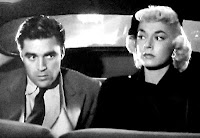
 Lloyd Nolan is an old, cranky bedridden shipping magnate; the considerably younger Lana Turner (pictured) is his second wife, Sandra Dee is his daughter, Anthony Quinn is his doctor and Richard Basehart is his assistant. Basehart believes that Turner and Quinn are lovers—and they are. When Turner expresses a desire to learn to drive even though she has a chauffeur (Ray Walston), Nolan becomes suspicious. Meanwhile, Dee is dating John Saxon, whose family's business was ruined because of Nolan. Quinn gets an offer for a job in Zurich and tells Turner that he's going to take it since Nolan remains an impediment to their happiness; Turner becomes upset and talks him into helping her kill Nolan by injecting an air bubble into his hypodermic needle. At first, they think they've gotten away with it, but soon Turner gets a letter saying, "Congratulations on your successful murder." Who knows what they’ve done? They assume it’s Basehart, but could it be Dee? Or even Walston? Or someone else? Unfortunately, when they kill off one of the suspects, another letter arrives. This glossy thriller is quite fun, caught somewhere between soap opera and film noir—though the fact that it was shot in widescreen and bright color works against the noir atmosphere. It's set in San Francisco, so occasionally a scene feels like it came out of Hitchcock's VERTIGO. All the actors are good; though I’m not a fan of Quinn's, he does a nice job here playing against type as a relatively quiet and passive man. Anna May Wong has a small role as a housekeeper. Yes, the overall tone is to-the-hilt melodrama (though it's not over-the-top enough to be campy), but that’s half the fun. The other half is figuring who’s doing what to whom; there aren’t many likable characters which is a bit of a weakness since we're not really invested in anyone being proved innocent, but still, this is 60s era fluff-thriller fun done by pros. [DVD]
 Lloyd Nolan is an old, cranky bedridden shipping magnate; the considerably younger Lana Turner (pictured) is his second wife, Sandra Dee is his daughter, Anthony Quinn is his doctor and Richard Basehart is his assistant. Basehart believes that Turner and Quinn are lovers—and they are. When Turner expresses a desire to learn to drive even though she has a chauffeur (Ray Walston), Nolan becomes suspicious. Meanwhile, Dee is dating John Saxon, whose family's business was ruined because of Nolan. Quinn gets an offer for a job in Zurich and tells Turner that he's going to take it since Nolan remains an impediment to their happiness; Turner becomes upset and talks him into helping her kill Nolan by injecting an air bubble into his hypodermic needle. At first, they think they've gotten away with it, but soon Turner gets a letter saying, "Congratulations on your successful murder." Who knows what they’ve done? They assume it’s Basehart, but could it be Dee? Or even Walston? Or someone else? Unfortunately, when they kill off one of the suspects, another letter arrives. This glossy thriller is quite fun, caught somewhere between soap opera and film noir—though the fact that it was shot in widescreen and bright color works against the noir atmosphere. It's set in San Francisco, so occasionally a scene feels like it came out of Hitchcock's VERTIGO. All the actors are good; though I’m not a fan of Quinn's, he does a nice job here playing against type as a relatively quiet and passive man. Anna May Wong has a small role as a housekeeper. Yes, the overall tone is to-the-hilt melodrama (though it's not over-the-top enough to be campy), but that’s half the fun. The other half is figuring who’s doing what to whom; there aren’t many likable characters which is a bit of a weakness since we're not really invested in anyone being proved innocent, but still, this is 60s era fluff-thriller fun done by pros. [DVD]
Saturday, June 01, 2013
MODEL SHOP (1969)
 Gary Lockwood is a mid-20s guy living near a beach in Los Angeles, a year out of grad school and looking for a job as an architect; not designing run-of-the-mill stuff like diners or grocery stores, mind you, but making something really cool like a new Eiffel Tower. He's spent the last year living off of his pretty blond girlfriend (Alexandra Hay), a model hoping for a shot as an actress, but she's getting tired of his layabout mooching. And as this is the late 60s, he also has the threat of the draft hanging over him since he no longer gets a college deferment. The film follows Lockwood through one 24-hour period, beginning as he wakes up to the sound of two guys at his front door ready to repossess his garish green MG unless he can come up with $100 in back payments. They agree to give him to the end of the business day to find the money. After Hay berates him (justifiably) for his general passivity and lack of commitment—to her or to a career—Lockwood visits some old college friends in order to borrow the hundred bucks. Along the way, he becomes obsessed with a beautiful French woman (Amouk Aimée) who is stranded in California after a messy divorce; she is working as a model in a sleazy studio where men can buy a model's time, not for sex but to take sexy photographs. After he finds out from his parents in San Francisco that he must report to the draft board on Monday morning, he goes home and gets high while looking at his pics of Aimée. When night falls, Lockwood goes to the studio and hooks up with her for a one-night stand. The next morning, he calls her only to find out from her roommate that she's gone, having gotten just enough money to go back to Paris. The film ends with Lockwood repeating the phrase, "Always try" into the phone.
 The description probably makes this sound like a late European New-Wave entry examining rootlessness and alienation; the director, Jacques Demy, is French, though known best for the lush romantic musical THE UMBRELLAS OF CHERBROUG, and certainly the film is not strong on narrative or acting (most of the cast except Lockwood and Aimée seem to be amateurs), but still it keeps you watching, and it's not alienation as much as middle-class apathy that seems to be the main theme. It helped, for me, that the camera is almost always focused on the handsome Lockwood, who, for good measure, wears a snug t-shirt and jeans throughout—except when he's shirtless in the first scene. His character is fleshed out a bit more than you might expect, though because he seems so aimless, it is difficult to feel much empathy for him. Aimée's character is rather far-fetched; it seems unlikely given her looks and manner that she'd have to humble herself in a skid-row skin parlor to make ends meet. The rock group Spirit appear as themselves, an up-and-coming band with a debut album just out, but as actors, they're terrible—even a line like "Hey, man, how ya doing?" sounds stiff. I suppose the "Always try" mantra at the end is supposed to be positive, but Lockwood doesn't sound like he believes it, and the last moments reek of sweaty desperation. An interesting movie. And again, Gary Lockwood in tight clothes. [DVD]
 Gary Lockwood is a mid-20s guy living near a beach in Los Angeles, a year out of grad school and looking for a job as an architect; not designing run-of-the-mill stuff like diners or grocery stores, mind you, but making something really cool like a new Eiffel Tower. He's spent the last year living off of his pretty blond girlfriend (Alexandra Hay), a model hoping for a shot as an actress, but she's getting tired of his layabout mooching. And as this is the late 60s, he also has the threat of the draft hanging over him since he no longer gets a college deferment. The film follows Lockwood through one 24-hour period, beginning as he wakes up to the sound of two guys at his front door ready to repossess his garish green MG unless he can come up with $100 in back payments. They agree to give him to the end of the business day to find the money. After Hay berates him (justifiably) for his general passivity and lack of commitment—to her or to a career—Lockwood visits some old college friends in order to borrow the hundred bucks. Along the way, he becomes obsessed with a beautiful French woman (Amouk Aimée) who is stranded in California after a messy divorce; she is working as a model in a sleazy studio where men can buy a model's time, not for sex but to take sexy photographs. After he finds out from his parents in San Francisco that he must report to the draft board on Monday morning, he goes home and gets high while looking at his pics of Aimée. When night falls, Lockwood goes to the studio and hooks up with her for a one-night stand. The next morning, he calls her only to find out from her roommate that she's gone, having gotten just enough money to go back to Paris. The film ends with Lockwood repeating the phrase, "Always try" into the phone.
 The description probably makes this sound like a late European New-Wave entry examining rootlessness and alienation; the director, Jacques Demy, is French, though known best for the lush romantic musical THE UMBRELLAS OF CHERBROUG, and certainly the film is not strong on narrative or acting (most of the cast except Lockwood and Aimée seem to be amateurs), but still it keeps you watching, and it's not alienation as much as middle-class apathy that seems to be the main theme. It helped, for me, that the camera is almost always focused on the handsome Lockwood, who, for good measure, wears a snug t-shirt and jeans throughout—except when he's shirtless in the first scene. His character is fleshed out a bit more than you might expect, though because he seems so aimless, it is difficult to feel much empathy for him. Aimée's character is rather far-fetched; it seems unlikely given her looks and manner that she'd have to humble herself in a skid-row skin parlor to make ends meet. The rock group Spirit appear as themselves, an up-and-coming band with a debut album just out, but as actors, they're terrible—even a line like "Hey, man, how ya doing?" sounds stiff. I suppose the "Always try" mantra at the end is supposed to be positive, but Lockwood doesn't sound like he believes it, and the last moments reek of sweaty desperation. An interesting movie. And again, Gary Lockwood in tight clothes. [DVD]
Thursday, May 30, 2013
AIR HAWKS (1935)
 Ralph Bellamy is the head of Independent Transcontinental Lines (ITL), a small and scrappy cargo and mail airlines. He's trying to get a lucrative government contract so he can get a bank loan to expand the company, but banker Wyrley Birch considers him a risk and wants him to sell out to the larger Continental Lines, something neither Bellamy nor his pilots want to do. But a group of men, including the head of Continental (Robert Middlemass), a casino owner (Douglas Dumbrille), and a mysterious "Chief," have hired a German scientist (Edward Van Sloan, pictured) to use his experimental laser-type ray to cause fires on ITL planes, making it look like the planes went down due to faulty equipment and care, which would pressure ITL to sell. A snoopy journalist (Victor Killian) gets on the case and discovers that Van Sloan is headquartered at an abandoned inn, but can he get this news out in time to save lives, and save ITL?
As with many B-films of the era, this is plot-heavy—the above doesn’t even touch on the romantic interest/femme fatale (Tala Birell) angle, or the sad story of the pilot who dies in one of the ray attacks and the wife and daughter he leaves behind. There's even a subplot involving real-life aviator Wiley Post who agrees to fly an ITL plane across the country to revive faith in the company. But considering the movie is under 70 minutes, the busy narrative keeps interest from flagging, and this winds up being a fun, fast-paced thriller. Bellamy is fine as the hero, Dumbrille good as the most visible villain, and Van Sloan (Van Helsing in the original DRACULA) makes a fine, almost archetypal mad doctor, though he doesn't get as much screen time as he deserves. The early scene in which Dumbrille and Middlemass meet the mad doctor at the inn is nicely creepy, right out of an "old dark house" movie, and the ending, with Bellamy attacking the death-ray machine, is exciting. The only thing that would really improve this movie is a better title, like DEATH-RAY IN THE SKY. [TCM]
 Ralph Bellamy is the head of Independent Transcontinental Lines (ITL), a small and scrappy cargo and mail airlines. He's trying to get a lucrative government contract so he can get a bank loan to expand the company, but banker Wyrley Birch considers him a risk and wants him to sell out to the larger Continental Lines, something neither Bellamy nor his pilots want to do. But a group of men, including the head of Continental (Robert Middlemass), a casino owner (Douglas Dumbrille), and a mysterious "Chief," have hired a German scientist (Edward Van Sloan, pictured) to use his experimental laser-type ray to cause fires on ITL planes, making it look like the planes went down due to faulty equipment and care, which would pressure ITL to sell. A snoopy journalist (Victor Killian) gets on the case and discovers that Van Sloan is headquartered at an abandoned inn, but can he get this news out in time to save lives, and save ITL?
As with many B-films of the era, this is plot-heavy—the above doesn’t even touch on the romantic interest/femme fatale (Tala Birell) angle, or the sad story of the pilot who dies in one of the ray attacks and the wife and daughter he leaves behind. There's even a subplot involving real-life aviator Wiley Post who agrees to fly an ITL plane across the country to revive faith in the company. But considering the movie is under 70 minutes, the busy narrative keeps interest from flagging, and this winds up being a fun, fast-paced thriller. Bellamy is fine as the hero, Dumbrille good as the most visible villain, and Van Sloan (Van Helsing in the original DRACULA) makes a fine, almost archetypal mad doctor, though he doesn't get as much screen time as he deserves. The early scene in which Dumbrille and Middlemass meet the mad doctor at the inn is nicely creepy, right out of an "old dark house" movie, and the ending, with Bellamy attacking the death-ray machine, is exciting. The only thing that would really improve this movie is a better title, like DEATH-RAY IN THE SKY. [TCM]
Monday, May 27, 2013
THE BATTLE OF THE BULGE (1965)
 War buffs find this movie problematic because of how fictionalized the account of the battle, a turning point in WWII, is. I won't quibble with that; their concerns are real, and given that the movie was made only 20 years after the war, it's odd that the filmmakers weren't more careful with easily-checked details. But as entertainment, this works better than other war epics of the era (THE LONGEST DAY, A BRIDGE TOO FAR)—there is more attention to character, the battlefield tactics are clear, and even though it's nearly three hours, it doesn't feel as bloated as the others, being well paced, dragging a bit only right after intermission. In December 1944, the Allies seem to have the Germans on the run and many American soldiers are lulled into thinking that the war is nearly over. But during a reconnaissance flight, Kiley (Henry Fonda), a former cop turned intelligence officer, snaps a picture of a highly esteemed German officer, Colonel Hessler (Robert Shaw, pictured at left); to Kiley, his presence means that the Germans are planning a major offensive in Belgium, but his superiors don’t believe him. In fact, Hessler is planning a major push near the Ardennes Forest. In the meantime, the Germans parachute a small troop of English-speaking soldiers, led by Schumacher (Ty Hardin) who spent time in Texas and knows enough American pop culture to pass, in order to disrupt communication; they switch road signs and pretend to be Allied soldiers about to explode the Ruhr bridge, delaying the real Allies from destroying it until the Germans can cross. Eventually, Kiley is proven correct and his bosses (represented by Robert Ryan and Dana Andrews) change their strategy and drive the Germans back.
 Though the facts are not always correct and clichés abound, one of the strong pluses of this film is character development. We get to know a handful of men who become our guides to the twists and turns in the narrative. Fonda is good as the man in whom his superiors can't quite put their faith, until it's almost too late. As those superiors, Ryan and Andrews aren't given much to do except to voice the official Army line. George Montgomery is an experienced sergeant who is the driver for a newbie lieutenant (James MacArthur); Montgomery resents the callow youth, but when the two are captured and witness the German slaughter of American prisoners as Malmedy, MacArthur has his own personal turning point and plays an important part in the climax, in which the Germans make a last stab at taking over an American oil depot to get desperately-needed fuel. Hardin (seen at right) is good, even a bit fun, as the fake Texan. Telly Savalas is mostly comic relief as a sergeant who runs a lucrative business in "merchandise" (mostly cigarettes and booze) with the help of a French girl who has fallen in love with him. But the best performance is by Robert Shaw who does a great job of bringing Hessler, the admittedly stereotyped ultra-Nazi, to life—we don't exactly get to know him, but we do find him the most compelling figure in the movie. Hans Christian Blech plays his assistant who eventually finds Hessler's fervor too much in the face of certain defeat. The battles play out well, and it is to the credit of director Ken Annakin that we are never confused about what is happening where—a problem I have with many of the later bloated war films. Some critics complain about obvious use of rear projection and miniatures, but I didn't really notice such problems. In my eyes, this is one of the better war films of the 60s. [TCM]
 War buffs find this movie problematic because of how fictionalized the account of the battle, a turning point in WWII, is. I won't quibble with that; their concerns are real, and given that the movie was made only 20 years after the war, it's odd that the filmmakers weren't more careful with easily-checked details. But as entertainment, this works better than other war epics of the era (THE LONGEST DAY, A BRIDGE TOO FAR)—there is more attention to character, the battlefield tactics are clear, and even though it's nearly three hours, it doesn't feel as bloated as the others, being well paced, dragging a bit only right after intermission. In December 1944, the Allies seem to have the Germans on the run and many American soldiers are lulled into thinking that the war is nearly over. But during a reconnaissance flight, Kiley (Henry Fonda), a former cop turned intelligence officer, snaps a picture of a highly esteemed German officer, Colonel Hessler (Robert Shaw, pictured at left); to Kiley, his presence means that the Germans are planning a major offensive in Belgium, but his superiors don’t believe him. In fact, Hessler is planning a major push near the Ardennes Forest. In the meantime, the Germans parachute a small troop of English-speaking soldiers, led by Schumacher (Ty Hardin) who spent time in Texas and knows enough American pop culture to pass, in order to disrupt communication; they switch road signs and pretend to be Allied soldiers about to explode the Ruhr bridge, delaying the real Allies from destroying it until the Germans can cross. Eventually, Kiley is proven correct and his bosses (represented by Robert Ryan and Dana Andrews) change their strategy and drive the Germans back.
 Though the facts are not always correct and clichés abound, one of the strong pluses of this film is character development. We get to know a handful of men who become our guides to the twists and turns in the narrative. Fonda is good as the man in whom his superiors can't quite put their faith, until it's almost too late. As those superiors, Ryan and Andrews aren't given much to do except to voice the official Army line. George Montgomery is an experienced sergeant who is the driver for a newbie lieutenant (James MacArthur); Montgomery resents the callow youth, but when the two are captured and witness the German slaughter of American prisoners as Malmedy, MacArthur has his own personal turning point and plays an important part in the climax, in which the Germans make a last stab at taking over an American oil depot to get desperately-needed fuel. Hardin (seen at right) is good, even a bit fun, as the fake Texan. Telly Savalas is mostly comic relief as a sergeant who runs a lucrative business in "merchandise" (mostly cigarettes and booze) with the help of a French girl who has fallen in love with him. But the best performance is by Robert Shaw who does a great job of bringing Hessler, the admittedly stereotyped ultra-Nazi, to life—we don't exactly get to know him, but we do find him the most compelling figure in the movie. Hans Christian Blech plays his assistant who eventually finds Hessler's fervor too much in the face of certain defeat. The battles play out well, and it is to the credit of director Ken Annakin that we are never confused about what is happening where—a problem I have with many of the later bloated war films. Some critics complain about obvious use of rear projection and miniatures, but I didn't really notice such problems. In my eyes, this is one of the better war films of the 60s. [TCM]
Saturday, May 25, 2013
SWEENEY TODD, THE DEMON BARBER OF FLEET STREET (1936)
 This is the first talkie version of the story of the killer barber, a
character first brought to life in a Victorian pulp novel called A
String of Pearls. Thanks to the Stephen Sondheim musical and the recent
Tim Burton film adaptation, his story is familiar, but this telling has a
few differing details. The narrative is set up as the intertwining of
three plotlines: 1) Sweeney Todd (Tod Slaughter) is a barber who
specializes in shaving sailors and murdering the ones who have money or
jewels on them. He puts them in a special barber chair, pulls a lever,
and they are dumped down into his basement; the fall generally kills
them, but if not, Todd goes downstairs with his razor and, in his words,
polishes them off. Mrs. Lovatt (Stella Rho, pictured at left with Slaughter), who owns a bakery next
door, chops the bodies up and makes meat pies of them, and also splits
the ill-gotten booty with Todd; 2) The handsome Mark (Bruce Seton, pictured below) is in
love with the lovely Joanna (Eve Lister), but her father, a shipowner,
doesn’t approve because Mark is just a poor sailor. Todd sets his
leering eyes for Joanna, and attempts to blackmail the father into
essentially selling Joanna to him; 3) Mark's comic relief sidekick
Stanley flirts with Joanna's sidekick Nan.
This is the first talkie version of the story of the killer barber, a
character first brought to life in a Victorian pulp novel called A
String of Pearls. Thanks to the Stephen Sondheim musical and the recent
Tim Burton film adaptation, his story is familiar, but this telling has a
few differing details. The narrative is set up as the intertwining of
three plotlines: 1) Sweeney Todd (Tod Slaughter) is a barber who
specializes in shaving sailors and murdering the ones who have money or
jewels on them. He puts them in a special barber chair, pulls a lever,
and they are dumped down into his basement; the fall generally kills
them, but if not, Todd goes downstairs with his razor and, in his words,
polishes them off. Mrs. Lovatt (Stella Rho, pictured at left with Slaughter), who owns a bakery next
door, chops the bodies up and makes meat pies of them, and also splits
the ill-gotten booty with Todd; 2) The handsome Mark (Bruce Seton, pictured below) is in
love with the lovely Joanna (Eve Lister), but her father, a shipowner,
doesn’t approve because Mark is just a poor sailor. Todd sets his
leering eyes for Joanna, and attempts to blackmail the father into
essentially selling Joanna to him; 3) Mark's comic relief sidekick
Stanley flirts with Joanna's sidekick Nan.
 It is made clear in the beginning, as the film cuts back and forth
between the three stories, that money is the root of all the problems
here. Mark doesn't have enough money to marry Joanna, Todd wants more
and more money, Joanna's father is about to go bankrupt, Mrs. Lovatt is
worried that Todd is holding out on her, and even Stanley complains that
Nan is asking for too much when she wants him to bring back a long list
of specialty items from his next trip abroad. Fans of the Sondheim work
will be surprised to find a subplot involving an African native
uprising, the upshot of which is that Mark soon returns to England with
plenty of money, only to wind up in Sweeney Todd's basement. Mrs. Lovatt,
both jealous of Todd's attentions to Joanna and upset that he might be
keeping some of the victim's valuables from her, helps Mark escape,
leading to a moderately thrilling climax with all the characters
gathered at the barber shop.
It is made clear in the beginning, as the film cuts back and forth
between the three stories, that money is the root of all the problems
here. Mark doesn't have enough money to marry Joanna, Todd wants more
and more money, Joanna's father is about to go bankrupt, Mrs. Lovatt is
worried that Todd is holding out on her, and even Stanley complains that
Nan is asking for too much when she wants him to bring back a long list
of specialty items from his next trip abroad. Fans of the Sondheim work
will be surprised to find a subplot involving an African native
uprising, the upshot of which is that Mark soon returns to England with
plenty of money, only to wind up in Sweeney Todd's basement. Mrs. Lovatt,
both jealous of Todd's attentions to Joanna and upset that he might be
keeping some of the victim's valuables from her, helps Mark escape,
leading to a moderately thrilling climax with all the characters
gathered at the barber shop.
This is a low-budget affair, but Tod Slaughter, famous British blood-and-thunder actor, does a nice job as Todd, putting some real relish into his "polish them off" threats, and the rest of the cast is solid, with Seton and Lister especially good. 13-year-old John Singer is fine as Tobias, the abused apprentice who plays an important role in the climax. The ending is more predictable and traditional than that of the musical, which has a more downbeat conclusion. The man-into-meat-pies plotline is never explicitly stated. Since the print on the Alpha DVD (which is in terrible shape) is roughly five minutes shorter than the length of record, and there is a rather jagged edit during a scene in which Lovatt is preparing to dispose of a body, I assume that such an explanatory scene has simply been cut out somewhere along the line, so you have to have knowledge of the play to get the black-humored scene near the end when a man is speculating about the disappearance of so many sailors from the neighborhood, while eating one of Mrs. Lovatt's pies. [DVD]
 This is the first talkie version of the story of the killer barber, a
character first brought to life in a Victorian pulp novel called A
String of Pearls. Thanks to the Stephen Sondheim musical and the recent
Tim Burton film adaptation, his story is familiar, but this telling has a
few differing details. The narrative is set up as the intertwining of
three plotlines: 1) Sweeney Todd (Tod Slaughter) is a barber who
specializes in shaving sailors and murdering the ones who have money or
jewels on them. He puts them in a special barber chair, pulls a lever,
and they are dumped down into his basement; the fall generally kills
them, but if not, Todd goes downstairs with his razor and, in his words,
polishes them off. Mrs. Lovatt (Stella Rho, pictured at left with Slaughter), who owns a bakery next
door, chops the bodies up and makes meat pies of them, and also splits
the ill-gotten booty with Todd; 2) The handsome Mark (Bruce Seton, pictured below) is in
love with the lovely Joanna (Eve Lister), but her father, a shipowner,
doesn’t approve because Mark is just a poor sailor. Todd sets his
leering eyes for Joanna, and attempts to blackmail the father into
essentially selling Joanna to him; 3) Mark's comic relief sidekick
Stanley flirts with Joanna's sidekick Nan.
This is the first talkie version of the story of the killer barber, a
character first brought to life in a Victorian pulp novel called A
String of Pearls. Thanks to the Stephen Sondheim musical and the recent
Tim Burton film adaptation, his story is familiar, but this telling has a
few differing details. The narrative is set up as the intertwining of
three plotlines: 1) Sweeney Todd (Tod Slaughter) is a barber who
specializes in shaving sailors and murdering the ones who have money or
jewels on them. He puts them in a special barber chair, pulls a lever,
and they are dumped down into his basement; the fall generally kills
them, but if not, Todd goes downstairs with his razor and, in his words,
polishes them off. Mrs. Lovatt (Stella Rho, pictured at left with Slaughter), who owns a bakery next
door, chops the bodies up and makes meat pies of them, and also splits
the ill-gotten booty with Todd; 2) The handsome Mark (Bruce Seton, pictured below) is in
love with the lovely Joanna (Eve Lister), but her father, a shipowner,
doesn’t approve because Mark is just a poor sailor. Todd sets his
leering eyes for Joanna, and attempts to blackmail the father into
essentially selling Joanna to him; 3) Mark's comic relief sidekick
Stanley flirts with Joanna's sidekick Nan.  It is made clear in the beginning, as the film cuts back and forth
between the three stories, that money is the root of all the problems
here. Mark doesn't have enough money to marry Joanna, Todd wants more
and more money, Joanna's father is about to go bankrupt, Mrs. Lovatt is
worried that Todd is holding out on her, and even Stanley complains that
Nan is asking for too much when she wants him to bring back a long list
of specialty items from his next trip abroad. Fans of the Sondheim work
will be surprised to find a subplot involving an African native
uprising, the upshot of which is that Mark soon returns to England with
plenty of money, only to wind up in Sweeney Todd's basement. Mrs. Lovatt,
both jealous of Todd's attentions to Joanna and upset that he might be
keeping some of the victim's valuables from her, helps Mark escape,
leading to a moderately thrilling climax with all the characters
gathered at the barber shop.
It is made clear in the beginning, as the film cuts back and forth
between the three stories, that money is the root of all the problems
here. Mark doesn't have enough money to marry Joanna, Todd wants more
and more money, Joanna's father is about to go bankrupt, Mrs. Lovatt is
worried that Todd is holding out on her, and even Stanley complains that
Nan is asking for too much when she wants him to bring back a long list
of specialty items from his next trip abroad. Fans of the Sondheim work
will be surprised to find a subplot involving an African native
uprising, the upshot of which is that Mark soon returns to England with
plenty of money, only to wind up in Sweeney Todd's basement. Mrs. Lovatt,
both jealous of Todd's attentions to Joanna and upset that he might be
keeping some of the victim's valuables from her, helps Mark escape,
leading to a moderately thrilling climax with all the characters
gathered at the barber shop. This is a low-budget affair, but Tod Slaughter, famous British blood-and-thunder actor, does a nice job as Todd, putting some real relish into his "polish them off" threats, and the rest of the cast is solid, with Seton and Lister especially good. 13-year-old John Singer is fine as Tobias, the abused apprentice who plays an important role in the climax. The ending is more predictable and traditional than that of the musical, which has a more downbeat conclusion. The man-into-meat-pies plotline is never explicitly stated. Since the print on the Alpha DVD (which is in terrible shape) is roughly five minutes shorter than the length of record, and there is a rather jagged edit during a scene in which Lovatt is preparing to dispose of a body, I assume that such an explanatory scene has simply been cut out somewhere along the line, so you have to have knowledge of the play to get the black-humored scene near the end when a man is speculating about the disappearance of so many sailors from the neighborhood, while eating one of Mrs. Lovatt's pies. [DVD]
Friday, May 24, 2013
R.P.M (1970)
 Two radical student groups occupy the administration building at a large university; Gary Lockwood is the socialist/student rights leader and Paul Winfield is the head of the black student group. They demand that the current president resign and be replaced by hip, much-published sociology professor Anthony Quinn, who is so very 60s with-it that he sleeps with his students (currently with sexy grad student Ann-Margret). The board of trustees asks Quinn to accept, and though he figures he'll get caught in the middle, he accepts. The radicals let him into the building and give him a list of twelve demands to take back to the board. After some negotiating, the board gives in to some of them (a black trustee, a review of college investments) but the final three, including having a student voice in hiring and firing, become sticking points. Quinn advises the students to compromise, having gotten most of what they wanted, but instead Lockwood and Winfield threaten to destroy the administration computers. Meanwhile, Ann-Margret attacks Quinn, saying he's never been in love and just sleeps with a string of groupies; the best line in the movie has Ann-Margret tell him that his sexual activity increases in proportion to the length of his bibliography. Eventually, Quinn calls in the cops who use tear gas to get rid of the students. Although the resolution is relatively peaceful, the student body turns against Quinn whom we assume in the last scene of the film, as he walks slowly through a crowd of hecklers, has become a broken man.
 This is one of the few Hollywood films of the era to attempt to deal seriously with the issue of campus unrest--the only other one that comes to mind is THE STRAWBERRY STATEMENT, which was released a couple of months earlier. Though this film is not nearly as bad its critical reputation would have it, there are a couple of big problems. First, it had the misfortune to be made before but released after the Kent State shootings, which would largely call a halt to major campus unrest. Here, the issue doesn't appear to be so much a concern with police violence but more with the campus bureaucracy. The other problem is that the students aren't given a consistent attitude or philosophy. Their demands aren't discussed at any length and they wind up mostly seeming just stubborn. The relationship between Quinn and Ann-Margret is interesting but not explored in much depth. Lockwood (pictured at right, and above with Winfield, looking scruffily cute but rather blank) and Winfield aren't rounded characters at all. Quinn is OK but seems a bit uncomfortable. Best viewed as a period piece. [TCM]
 Two radical student groups occupy the administration building at a large university; Gary Lockwood is the socialist/student rights leader and Paul Winfield is the head of the black student group. They demand that the current president resign and be replaced by hip, much-published sociology professor Anthony Quinn, who is so very 60s with-it that he sleeps with his students (currently with sexy grad student Ann-Margret). The board of trustees asks Quinn to accept, and though he figures he'll get caught in the middle, he accepts. The radicals let him into the building and give him a list of twelve demands to take back to the board. After some negotiating, the board gives in to some of them (a black trustee, a review of college investments) but the final three, including having a student voice in hiring and firing, become sticking points. Quinn advises the students to compromise, having gotten most of what they wanted, but instead Lockwood and Winfield threaten to destroy the administration computers. Meanwhile, Ann-Margret attacks Quinn, saying he's never been in love and just sleeps with a string of groupies; the best line in the movie has Ann-Margret tell him that his sexual activity increases in proportion to the length of his bibliography. Eventually, Quinn calls in the cops who use tear gas to get rid of the students. Although the resolution is relatively peaceful, the student body turns against Quinn whom we assume in the last scene of the film, as he walks slowly through a crowd of hecklers, has become a broken man.
 This is one of the few Hollywood films of the era to attempt to deal seriously with the issue of campus unrest--the only other one that comes to mind is THE STRAWBERRY STATEMENT, which was released a couple of months earlier. Though this film is not nearly as bad its critical reputation would have it, there are a couple of big problems. First, it had the misfortune to be made before but released after the Kent State shootings, which would largely call a halt to major campus unrest. Here, the issue doesn't appear to be so much a concern with police violence but more with the campus bureaucracy. The other problem is that the students aren't given a consistent attitude or philosophy. Their demands aren't discussed at any length and they wind up mostly seeming just stubborn. The relationship between Quinn and Ann-Margret is interesting but not explored in much depth. Lockwood (pictured at right, and above with Winfield, looking scruffily cute but rather blank) and Winfield aren't rounded characters at all. Quinn is OK but seems a bit uncomfortable. Best viewed as a period piece. [TCM]
Wednesday, May 22, 2013
HOMICIDE FOR THREE (1948)
 Navy officer Peter Duluth, on a 36-hour leave, meets his wife Iris in Los Angeles; they got married a year ago but there was no time for a honeymoon, so now on their first anniversary, they're looking for a hotel room where they can catch up on lost time, so to speak. All the hotels are booked solid, but a young woman named Miss Rose, who is leaving town to elope, takes pity on the couple and lets them use her room while she's gone. Unfortunately, a weekend of casual canoodling is not in the cards: first, people who see Iris keep thinking she looks like a puppeteer named Mona who, it turns out, is a cousin of Iris's; later, a drunk comes up to Iris and warns her that she's in danger because "the white rose and the red rose are out." Then when Peter goes to a steambath to ward off a cold, his uniform is stolen. He meets up with a detective named Hatch who agrees to help them figure out what's going on, but they soon discover that Mona is dead, and red and white roses are found in her apartment. By the time Peter and Iris get tangled up with a strange drunken man they nickname The Beard and two more women who seem targeted by the roses killer, they realize they're up to their necks in trouble.
This pleasant B-mystery is based on a novel by Patrick Quentin (a pen name for two writers, one of whom, Hugh Wheeler, went on to co-write the musical Sweeney Todd) who wrote a series of Peter Duluth books. (A later book was turned into a movie with Ginger Rogers called BLACK WIDOW but the characters' last names were changed to Denver.) I'm sorry there were no more in this series because for a low-budget film, this is fast-moving and fun, like an episode of Remington Steele. Warren Douglas and Audrey Long work together well as Peter and Iris, with Douglas in particular doing a nice job of looking like he just wants to get Long alone in a hotel room and screw—at heart this is a comedy of delayed sexual consummation, like MY FAVORITE WIFE. The colorful supporting cast includes Lloyd Corrigan as The Beard—who turns out to be a criminologist—and Grant Withers as Hatch. There's also a helpful cab driver who calls himself an "amateur psychoanalyzer." The identity of the killer was a total surprise to me. A short, sweet, light thriller. [Netflix streaming]
 Navy officer Peter Duluth, on a 36-hour leave, meets his wife Iris in Los Angeles; they got married a year ago but there was no time for a honeymoon, so now on their first anniversary, they're looking for a hotel room where they can catch up on lost time, so to speak. All the hotels are booked solid, but a young woman named Miss Rose, who is leaving town to elope, takes pity on the couple and lets them use her room while she's gone. Unfortunately, a weekend of casual canoodling is not in the cards: first, people who see Iris keep thinking she looks like a puppeteer named Mona who, it turns out, is a cousin of Iris's; later, a drunk comes up to Iris and warns her that she's in danger because "the white rose and the red rose are out." Then when Peter goes to a steambath to ward off a cold, his uniform is stolen. He meets up with a detective named Hatch who agrees to help them figure out what's going on, but they soon discover that Mona is dead, and red and white roses are found in her apartment. By the time Peter and Iris get tangled up with a strange drunken man they nickname The Beard and two more women who seem targeted by the roses killer, they realize they're up to their necks in trouble.
 This pleasant B-mystery is based on a novel by Patrick Quentin (a pen name for two writers, one of whom, Hugh Wheeler, went on to co-write the musical Sweeney Todd) who wrote a series of Peter Duluth books. (A later book was turned into a movie with Ginger Rogers called BLACK WIDOW but the characters' last names were changed to Denver.) I'm sorry there were no more in this series because for a low-budget film, this is fast-moving and fun, like an episode of Remington Steele. Warren Douglas and Audrey Long work together well as Peter and Iris, with Douglas in particular doing a nice job of looking like he just wants to get Long alone in a hotel room and screw—at heart this is a comedy of delayed sexual consummation, like MY FAVORITE WIFE. The colorful supporting cast includes Lloyd Corrigan as The Beard—who turns out to be a criminologist—and Grant Withers as Hatch. There's also a helpful cab driver who calls himself an "amateur psychoanalyzer." The identity of the killer was a total surprise to me. A short, sweet, light thriller. [Netflix streaming]
Monday, May 20, 2013
YOU WERE NEVER LOVELIER (1942)
 Back in 2004, I saw the first teaming of Fred Astaire and Rita Hayworth, YOU’LL NEVER BE RICH; I thought it had some wonderful dancing but otherwise found it wanting in comparison to the Astaire/Rogers musicals of the 30s. This one has dancing that is just as fabulous and a romantic comedy storyline that breaks no new ground, essentially rehashing the Astaire/Rogers mixed-up, on-again, off-again romances. Here, Astaire is a dancer stranded in Buenos Aires due to too much gambling. Bandleader Xavier Cugat (playing himself) agrees to help him get a job at a hotel run by the cantankerous Adolphe Menjou. Meanwhile, Menjou's two youngest daughters are pissed because, even though they have boyfriends ready and willing to marry them, family tradition holds that the older child must marry first, and that means some complicated plotting by everyone to get beautiful but cold-as-ice Rita Hayworth thawed out and married off to someone. Menjou starts sending orchids and writing anonymous "secret admirer" letters to Hayworth, hoping to loosen her up—yes, both a creepy and nonsensical plot device—and Hayworth mistakenly thinks that Astaire is the admirer. Menjou asks Astaire to play along in exchange for a dancing gig at the hotel, but to be obnoxious so that Hayworth will dismiss him but perhaps be in the mood to find romance with one of several handsome and eligible men who will be present at a big party at Menjou's. What could possibly go wrong?
Yeah, Daddy writing the notes is creepy—and gets creepier right up to the climax—and Hayworth plays the cold fish almost too well, so that she and Astaire don't really mesh as personalities, but they sure dance together well; I'd say she’s second only to Rogers as a romantic dance partner to Astaire (Cyd Charisse was sexy though not necessarily romantic). Their best number is their first one, the lushly romantic "I'm Old Fashioned." The other highlight is the jivey little jazz song, "The Shorty George." I miss the grand supporting casts of the 30s films; here, only Gus Schilling as a (possibly gay) nephew and employee of Menjou's provides any real sideline fun. Favorite line: when Fred first meets Rita and tries flirting, to no avail, he is reduced to cooing, "The air is nice…”; when she fails to respond, he says, with exaggerated exasperation, "…and there seems to be an abundance of it!" Not a great film, but it does make me sorry that these two didn't make a few more together. [TCM]
 Back in 2004, I saw the first teaming of Fred Astaire and Rita Hayworth, YOU’LL NEVER BE RICH; I thought it had some wonderful dancing but otherwise found it wanting in comparison to the Astaire/Rogers musicals of the 30s. This one has dancing that is just as fabulous and a romantic comedy storyline that breaks no new ground, essentially rehashing the Astaire/Rogers mixed-up, on-again, off-again romances. Here, Astaire is a dancer stranded in Buenos Aires due to too much gambling. Bandleader Xavier Cugat (playing himself) agrees to help him get a job at a hotel run by the cantankerous Adolphe Menjou. Meanwhile, Menjou's two youngest daughters are pissed because, even though they have boyfriends ready and willing to marry them, family tradition holds that the older child must marry first, and that means some complicated plotting by everyone to get beautiful but cold-as-ice Rita Hayworth thawed out and married off to someone. Menjou starts sending orchids and writing anonymous "secret admirer" letters to Hayworth, hoping to loosen her up—yes, both a creepy and nonsensical plot device—and Hayworth mistakenly thinks that Astaire is the admirer. Menjou asks Astaire to play along in exchange for a dancing gig at the hotel, but to be obnoxious so that Hayworth will dismiss him but perhaps be in the mood to find romance with one of several handsome and eligible men who will be present at a big party at Menjou's. What could possibly go wrong?
 Yeah, Daddy writing the notes is creepy—and gets creepier right up to the climax—and Hayworth plays the cold fish almost too well, so that she and Astaire don't really mesh as personalities, but they sure dance together well; I'd say she’s second only to Rogers as a romantic dance partner to Astaire (Cyd Charisse was sexy though not necessarily romantic). Their best number is their first one, the lushly romantic "I'm Old Fashioned." The other highlight is the jivey little jazz song, "The Shorty George." I miss the grand supporting casts of the 30s films; here, only Gus Schilling as a (possibly gay) nephew and employee of Menjou's provides any real sideline fun. Favorite line: when Fred first meets Rita and tries flirting, to no avail, he is reduced to cooing, "The air is nice…”; when she fails to respond, he says, with exaggerated exasperation, "…and there seems to be an abundance of it!" Not a great film, but it does make me sorry that these two didn't make a few more together. [TCM]
Saturday, May 18, 2013
THE CAMP ON BLOOD ISLAND (1958)
 During World War II, on an island off the coast of Malaysia, the Japanese have established two prison camps, one for men and one for women. Commander Yamamitsu and his assistant Sakamura run the men's camp in a brutal fashion, torturing and killing men for trying to escape, and taking hostages whom they threaten to kill when they want information. If the Japanese win the war, Yamamitsu says he will let the prisoners establish new lives in Japan, but if they lose, he will burn down both camps and slaughter all the inmates. As it happens, the Japanese have already surrendered, but because the camp radio is out of commission, Yamamitsu doesn’t know this yet. However, the prisoners, led by Col. Lambert, do know, thanks to a secret radio in possession of a Dutch prisoner (nicknamed, of course, "Dutch"). They're trying to keep the Japanese from finding out, hoping they'll get liberated by the Allies first, but eventually a diplomat named Beattie, who rarely agrees with Lambert's leadership, cracks and tries to spill the beans.
This film has a reputation for a couple of reasons. When it came out, it was seen as a much-needed antidote to the general whitewashing of the behavior of the Japanese army during the war. It opens with a claim that it's based on a true story, but even with all the powers of the Internet, I could not verify that—though a novelization of the movie became a bestseller. The other big selling point of the movie was its graphic depictions of gore and torture. In terms of explicitness, from today's vantage point, it would barely garner a PG rating, but at least two scenes are fairly brutal in tone: the opening in which Peters, a captured escapee, is forced to dig his own grave before he is shot and falls dead into it; and a later scene involving a beheading. An effective non-graphic scene has Sakamura answer the doctor's plea for fresh bandages by throwing the bloody bandages that had been wrapped around Peters' torso on the ground and saying, "He doesn’t need these anymore." Andre Morell is a little too low-key as Lambert; theoretically, there's a plot-point reason for this—he is keeping news of the surrender from the men—but the performance could have used a bit more fire. Hammer horror icon Barbara Shelley plays a female prisoner who makes a daring escape near the end with an American (Phil Brown) who arrives on the island. All of the three major Japanese roles are played by Anglo actors; the best is Marne Maitland as the martinet Sakamura, the villain you love to hate. [TCM]
 During World War II, on an island off the coast of Malaysia, the Japanese have established two prison camps, one for men and one for women. Commander Yamamitsu and his assistant Sakamura run the men's camp in a brutal fashion, torturing and killing men for trying to escape, and taking hostages whom they threaten to kill when they want information. If the Japanese win the war, Yamamitsu says he will let the prisoners establish new lives in Japan, but if they lose, he will burn down both camps and slaughter all the inmates. As it happens, the Japanese have already surrendered, but because the camp radio is out of commission, Yamamitsu doesn’t know this yet. However, the prisoners, led by Col. Lambert, do know, thanks to a secret radio in possession of a Dutch prisoner (nicknamed, of course, "Dutch"). They're trying to keep the Japanese from finding out, hoping they'll get liberated by the Allies first, but eventually a diplomat named Beattie, who rarely agrees with Lambert's leadership, cracks and tries to spill the beans.
This film has a reputation for a couple of reasons. When it came out, it was seen as a much-needed antidote to the general whitewashing of the behavior of the Japanese army during the war. It opens with a claim that it's based on a true story, but even with all the powers of the Internet, I could not verify that—though a novelization of the movie became a bestseller. The other big selling point of the movie was its graphic depictions of gore and torture. In terms of explicitness, from today's vantage point, it would barely garner a PG rating, but at least two scenes are fairly brutal in tone: the opening in which Peters, a captured escapee, is forced to dig his own grave before he is shot and falls dead into it; and a later scene involving a beheading. An effective non-graphic scene has Sakamura answer the doctor's plea for fresh bandages by throwing the bloody bandages that had been wrapped around Peters' torso on the ground and saying, "He doesn’t need these anymore." Andre Morell is a little too low-key as Lambert; theoretically, there's a plot-point reason for this—he is keeping news of the surrender from the men—but the performance could have used a bit more fire. Hammer horror icon Barbara Shelley plays a female prisoner who makes a daring escape near the end with an American (Phil Brown) who arrives on the island. All of the three major Japanese roles are played by Anglo actors; the best is Marne Maitland as the martinet Sakamura, the villain you love to hate. [TCM]
Wednesday, May 15, 2013
THE LOWER DEPTHS (1936)
 The Baron (Louis Jouvet) gets a dressing down from a government minister; he has borrowed some "secret funds" for gambling and has lost the money. Seeming unconcerned, he makes one more effort to win big, but loses. That night, a thief named Pépel (Jean Gabin) breaks into the Baron's house, but when the Baron tells him that everything of value has been repossessed, the two bond over their dire straits in life, and the Baron comes to stay at the squalid boarding house where Pépel stays. Pépel has his hands full staying out of the hands of the law and dallying with Vassilissa, the young wife of the elderly landlord Kostylev, and Natasha, Vassilissa's sister. Other characters we get to know include a down-on-his-luck actor (Robert Le Vigan) who keeps telling people that he is an "organism poisoned by alcohol," a young, whimsical and frequently drunken accordion player (Maurice Baquet), a cobbler and his dying wife, and a fat police inspector who has set his cap for Natasha. Pépel's love triangle takes center stage until the end when one character commits suicide and another is killed in a brawl—the police are told that it was his life in "the lower depths" that killed him.
Based on a Maxim Gorky play, Jean Renoir's film version retains most of the Russian names (and at least in the subtitles, the Russian currency of rubles) but is set in Paris. For a good chunk of its running time, this almost comes off as a French version of YOU CAN’T TAKE IT WITH YOU, though one in which Kostylev (the Lionel Barrymore equivalent) is a rotten bastard instead of a sweet fairy-godfather figure. The flophouse, through grungy, is large and open and filled with colorful people, and generally seems like a pleasant place to stay. Gabin and Jouvet (pictured above), who were two of France's most esteemed actors of the time, have a wonderful chemistry together—better than Gabin has with either of his lovers, though Suzy Prim as Vassilissa is fine as a woman you love to hate who is occasionally likeable. Renoir's style feels very modern, with a moving camera that occasionally passes behind objects which obscure the action briefly, as if we were spying unseen on the characters. Another dramatic piece this movie conjures up is Eugene O'Neill's The Iceman Cometh, in which the down-and-out denizens of a bar are stripped of their illusions by a truth-teller. Here, Gabin is a kind of truth-teller, but he allows most of them to keep their illusions, and even gets a relatively happy ending himself—a weak but not fatal plot point. Some may find the light tone of the movie to clash too much with the underlying narrative—and Akira Kurasawa's version of the same material, made in 1957, is apparently darker and more faithful to Gorky, though I have not seen it—but this is still worth seeing, for Renoir's style and the two lead actors. [DVD]
 The Baron (Louis Jouvet) gets a dressing down from a government minister; he has borrowed some "secret funds" for gambling and has lost the money. Seeming unconcerned, he makes one more effort to win big, but loses. That night, a thief named Pépel (Jean Gabin) breaks into the Baron's house, but when the Baron tells him that everything of value has been repossessed, the two bond over their dire straits in life, and the Baron comes to stay at the squalid boarding house where Pépel stays. Pépel has his hands full staying out of the hands of the law and dallying with Vassilissa, the young wife of the elderly landlord Kostylev, and Natasha, Vassilissa's sister. Other characters we get to know include a down-on-his-luck actor (Robert Le Vigan) who keeps telling people that he is an "organism poisoned by alcohol," a young, whimsical and frequently drunken accordion player (Maurice Baquet), a cobbler and his dying wife, and a fat police inspector who has set his cap for Natasha. Pépel's love triangle takes center stage until the end when one character commits suicide and another is killed in a brawl—the police are told that it was his life in "the lower depths" that killed him.
Based on a Maxim Gorky play, Jean Renoir's film version retains most of the Russian names (and at least in the subtitles, the Russian currency of rubles) but is set in Paris. For a good chunk of its running time, this almost comes off as a French version of YOU CAN’T TAKE IT WITH YOU, though one in which Kostylev (the Lionel Barrymore equivalent) is a rotten bastard instead of a sweet fairy-godfather figure. The flophouse, through grungy, is large and open and filled with colorful people, and generally seems like a pleasant place to stay. Gabin and Jouvet (pictured above), who were two of France's most esteemed actors of the time, have a wonderful chemistry together—better than Gabin has with either of his lovers, though Suzy Prim as Vassilissa is fine as a woman you love to hate who is occasionally likeable. Renoir's style feels very modern, with a moving camera that occasionally passes behind objects which obscure the action briefly, as if we were spying unseen on the characters. Another dramatic piece this movie conjures up is Eugene O'Neill's The Iceman Cometh, in which the down-and-out denizens of a bar are stripped of their illusions by a truth-teller. Here, Gabin is a kind of truth-teller, but he allows most of them to keep their illusions, and even gets a relatively happy ending himself—a weak but not fatal plot point. Some may find the light tone of the movie to clash too much with the underlying narrative—and Akira Kurasawa's version of the same material, made in 1957, is apparently darker and more faithful to Gorky, though I have not seen it—but this is still worth seeing, for Renoir's style and the two lead actors. [DVD]
Monday, May 13, 2013
THINGS HAPPEN AT NIGHT (1947)
 The Prescott family, despite still living in the ancestral mansion, has fallen on hard times and is hoping that daughter Joyce's marriage into the millionaire Ebury family will allow them to continue living in the manner to which they are accustomed. The only problem is that the Prescott house seems to be haunted. Unexplained events over the past few weeks include pieces of coal scattered about the drawing room floor, a hat ripped down the middle, pictures on the wall tuned upside down, attic lights going on and off at strange hours, and rugs and curtains catching fire (and see the levitating apples pictured at left). The cook is constantly threatening to leave, and now news about the supernatural shenanigans is spreading in the village, possibly putting Joyce's marriage in jeopardy. One day, three people descend upon the house: Harris, an insurance man looking into possible claims involving a burned rug; Spencer, an investigator from the Institute of Psychical Research; and Ebury, hoping to snuff out the outrageous rumors about a ghost. Spencer decides that a poltergeist is to blame, and that the mischievous spirit has possessed Audrey, the younger sister. Everyone agrees to stay in the house that night while Spencer attempts an exorcism, but soon even stranger things are happening.
I pieced the above summary together, hoping to make sense of what was a cut and disjointed print of the movie; IMDb gives the film's length as 79 minutes, but the print I saw was just under an hour, so clearly there is stuff missing—one obvious omission is a song, "First of Forever" which is listed in the opening credits but didn’t appear in the film I saw. In the first half, the movie reminded me of THE UNINVITED, a serious ghost story told in a light tone, but eventually this becomes more like a slapstick comedy, even though the poltergeist and the possession are presented as real. No explanation is given for who the naughty spirit is or why it has descended on the house, and Joyce, the bride-to-be, is barely in the movie. The last 20 minutes, in which the poltergeist causes much humorous havoc, are fun though things never really get scary. Gordon Harker, who plays Harris, was a famous B-actor in British films in the 30s and 40s. The only other actor to stand out is Joan Young, who does a nice job as the cook. [YouTube]
 The Prescott family, despite still living in the ancestral mansion, has fallen on hard times and is hoping that daughter Joyce's marriage into the millionaire Ebury family will allow them to continue living in the manner to which they are accustomed. The only problem is that the Prescott house seems to be haunted. Unexplained events over the past few weeks include pieces of coal scattered about the drawing room floor, a hat ripped down the middle, pictures on the wall tuned upside down, attic lights going on and off at strange hours, and rugs and curtains catching fire (and see the levitating apples pictured at left). The cook is constantly threatening to leave, and now news about the supernatural shenanigans is spreading in the village, possibly putting Joyce's marriage in jeopardy. One day, three people descend upon the house: Harris, an insurance man looking into possible claims involving a burned rug; Spencer, an investigator from the Institute of Psychical Research; and Ebury, hoping to snuff out the outrageous rumors about a ghost. Spencer decides that a poltergeist is to blame, and that the mischievous spirit has possessed Audrey, the younger sister. Everyone agrees to stay in the house that night while Spencer attempts an exorcism, but soon even stranger things are happening.
I pieced the above summary together, hoping to make sense of what was a cut and disjointed print of the movie; IMDb gives the film's length as 79 minutes, but the print I saw was just under an hour, so clearly there is stuff missing—one obvious omission is a song, "First of Forever" which is listed in the opening credits but didn’t appear in the film I saw. In the first half, the movie reminded me of THE UNINVITED, a serious ghost story told in a light tone, but eventually this becomes more like a slapstick comedy, even though the poltergeist and the possession are presented as real. No explanation is given for who the naughty spirit is or why it has descended on the house, and Joyce, the bride-to-be, is barely in the movie. The last 20 minutes, in which the poltergeist causes much humorous havoc, are fun though things never really get scary. Gordon Harker, who plays Harris, was a famous B-actor in British films in the 30s and 40s. The only other actor to stand out is Joan Young, who does a nice job as the cook. [YouTube]
Saturday, May 11, 2013
THE BEASTS OF MARSEILLES (1957)
aka SEVEN THUNDERS
 In 1943, Dave and Jim, two British POWs, have escaped and are hiding out in a rather unsavory quarter of Marseilles. While waiting to be smuggled out in a fishing boat, they are given a room in a shabby apartment building next to a whorehouse which is frequented by German officers. The handsome, dashing Dave (Stephen Boyd) flirts with a blonde beauty named Lise (Anna Gaylor); the slightly less handsome Jim (Tony Wright) forms a bond with an older British woman (Kathleen Harrison) who lets him share her bed and pose as her husband when the Nazis come parading through the building. In a separate plotline, the Germans are trying to find out why almost a hundred people have vanished without a trace. They suspect a serial killer and they're right; the kindly Dr. Martout (James Robertson Justice) has a nice evil business going. He gets a man named Blanchard to send him desperate refugees trying to escape; Martout promises to help them, gets them to bring all their cash or gold, gives them a glass of poisoned cognac, and kills them, throwing their bodies in a lime pit in his cellar. When the Germans decide to evacuate the neighborhood and blow it up to get rid of two problems (the refugees and the killer), Dave and Jim's paths cross with Martout's.
For a while, this is a different and intriguing take on the traditional WWII resistance movie—with a dash of ARSENIC AND OLD LACE. The narrative takes its time developing and we meet several interesting side characters: Blanchard (Eugene Deckers), the man who sends refugees to Martout, thinking he's being helpful, unaware of their fates; the colorful madam of the whorehouse (Katherine Kath) who has good survival instincts; Schlip (Martin Miller) and Bourdin (George Coulouris), two refugees who wind up drinking Martout's cognac; and a German soldier named Eric (James Kenney), a skittish 20-year-old virgin who is out of his comfort zone at the whorehouse and who later accidentally shoots and kills a child, an act which has more reverberations then you'd guess. All the actors do fine jobs. Boyd (pictured with Gaylor), though hunky, is a bit on the bland side, but Wright and Gaylor take up the slack nicely, and Harrison is fun as always. Justice is excellent as the seemingly civilized but cold-blooded doctor who tells Schlip that he's doing him a favor, poisoning him rather than sending him to Auschwitz. Kath stands out in her few scenes as the madam—most fun in a scene in which Harrison discovers that there's a secret passage between her spartan bedroom and Kath's ornately decorated bedroom next door. The movie feels a bit long getting to its climax, and the some of the destruction effects are lame—obvious rear projection or matting of exploding buildings. This doesn't crop up much, so it's worth catching it the next time it does. The best explanation I've seen for the original British title is that it might be a reference to a verse in the Book of Revelation about seven thunders being heard at the time of the apocalypse. [TCM]
aka SEVEN THUNDERS
 In 1943, Dave and Jim, two British POWs, have escaped and are hiding out in a rather unsavory quarter of Marseilles. While waiting to be smuggled out in a fishing boat, they are given a room in a shabby apartment building next to a whorehouse which is frequented by German officers. The handsome, dashing Dave (Stephen Boyd) flirts with a blonde beauty named Lise (Anna Gaylor); the slightly less handsome Jim (Tony Wright) forms a bond with an older British woman (Kathleen Harrison) who lets him share her bed and pose as her husband when the Nazis come parading through the building. In a separate plotline, the Germans are trying to find out why almost a hundred people have vanished without a trace. They suspect a serial killer and they're right; the kindly Dr. Martout (James Robertson Justice) has a nice evil business going. He gets a man named Blanchard to send him desperate refugees trying to escape; Martout promises to help them, gets them to bring all their cash or gold, gives them a glass of poisoned cognac, and kills them, throwing their bodies in a lime pit in his cellar. When the Germans decide to evacuate the neighborhood and blow it up to get rid of two problems (the refugees and the killer), Dave and Jim's paths cross with Martout's.
For a while, this is a different and intriguing take on the traditional WWII resistance movie—with a dash of ARSENIC AND OLD LACE. The narrative takes its time developing and we meet several interesting side characters: Blanchard (Eugene Deckers), the man who sends refugees to Martout, thinking he's being helpful, unaware of their fates; the colorful madam of the whorehouse (Katherine Kath) who has good survival instincts; Schlip (Martin Miller) and Bourdin (George Coulouris), two refugees who wind up drinking Martout's cognac; and a German soldier named Eric (James Kenney), a skittish 20-year-old virgin who is out of his comfort zone at the whorehouse and who later accidentally shoots and kills a child, an act which has more reverberations then you'd guess. All the actors do fine jobs. Boyd (pictured with Gaylor), though hunky, is a bit on the bland side, but Wright and Gaylor take up the slack nicely, and Harrison is fun as always. Justice is excellent as the seemingly civilized but cold-blooded doctor who tells Schlip that he's doing him a favor, poisoning him rather than sending him to Auschwitz. Kath stands out in her few scenes as the madam—most fun in a scene in which Harrison discovers that there's a secret passage between her spartan bedroom and Kath's ornately decorated bedroom next door. The movie feels a bit long getting to its climax, and the some of the destruction effects are lame—obvious rear projection or matting of exploding buildings. This doesn't crop up much, so it's worth catching it the next time it does. The best explanation I've seen for the original British title is that it might be a reference to a verse in the Book of Revelation about seven thunders being heard at the time of the apocalypse. [TCM]
Tuesday, May 07, 2013
THE GREAT MR. NOBODY (1941)
 "Dreamy" Smith is a young, sweet-natured guy who works in a newspaper's classified ad department; his buddy "Skipper" Martin is an older guy who works on a salvage barge. Together, they're ready to leave their jobs, buy a boat, and sail the world, leaving behind their city woes and troublesome women. The problems are: 1) every time Dreamy gets enough money put aside, he loses it somehow, usually by giving it away to someone in need; 2) Dreamy isn't as ready as Skipper is to leave women behind—in fact, he's got a girlfriend named Mary at the newspaper who doesn't want to see him go. When the paper gets a new publisher who gives cash bonus prizes for good ideas to boost circulation, Dreamy's boss, Mr. Wade, starts stealing Dreamy's ideas and passes them off as his own. Skipper and Mary want him to stand up for himself, but for different reasons: Skipper hoping he'll earn the prize money to buy the boat, and Mary hoping he'll earn enough money so they can get married. Or is there a third option?
This is a very cute little comedy that works mostly due to a plot that's a little out of the ordinary, though there is a Capraesque tone to the proceedings, albeit more comic and with less pomp and sentiment. I must admit that, though I liked the characters, I got a little tired of Dreamy's constant self-sacrificing, especially when his charitable acts wound up screwing over his buddy and girlfriend. Eddie Albert (pictured) is perfect as Dreamy, with a sweet and "dreamy" but not dumb persona; Alan Hale is just as good as Skipper (a character name that his son, Alan Hale Jr. would inherit on Gilligan's Island), and Joan Leslie is fine as Mary. The strong supporting cast includes John Litel as mean Mr. Wade, William Lundigan as the handsome new publisher who has his eye on Mary, Dickie Moore as Limpy, a crippled newsboy, and John Ridgeley as a reporter. [TCM]
 "Dreamy" Smith is a young, sweet-natured guy who works in a newspaper's classified ad department; his buddy "Skipper" Martin is an older guy who works on a salvage barge. Together, they're ready to leave their jobs, buy a boat, and sail the world, leaving behind their city woes and troublesome women. The problems are: 1) every time Dreamy gets enough money put aside, he loses it somehow, usually by giving it away to someone in need; 2) Dreamy isn't as ready as Skipper is to leave women behind—in fact, he's got a girlfriend named Mary at the newspaper who doesn't want to see him go. When the paper gets a new publisher who gives cash bonus prizes for good ideas to boost circulation, Dreamy's boss, Mr. Wade, starts stealing Dreamy's ideas and passes them off as his own. Skipper and Mary want him to stand up for himself, but for different reasons: Skipper hoping he'll earn the prize money to buy the boat, and Mary hoping he'll earn enough money so they can get married. Or is there a third option?
This is a very cute little comedy that works mostly due to a plot that's a little out of the ordinary, though there is a Capraesque tone to the proceedings, albeit more comic and with less pomp and sentiment. I must admit that, though I liked the characters, I got a little tired of Dreamy's constant self-sacrificing, especially when his charitable acts wound up screwing over his buddy and girlfriend. Eddie Albert (pictured) is perfect as Dreamy, with a sweet and "dreamy" but not dumb persona; Alan Hale is just as good as Skipper (a character name that his son, Alan Hale Jr. would inherit on Gilligan's Island), and Joan Leslie is fine as Mary. The strong supporting cast includes John Litel as mean Mr. Wade, William Lundigan as the handsome new publisher who has his eye on Mary, Dickie Moore as Limpy, a crippled newsboy, and John Ridgeley as a reporter. [TCM]
Monday, May 06, 2013
SPRING IS HERE (1930)
 This very cute romantic musical is set at the Braley estate on Long Island and begins on a fine June morning. On the patio, Mary Jane, the youngest Braley girl, is arguing with her on-and-off boyfriend Stacy; they sing "Spring Is Here," a "carpe diem" song in which he lets her know that, at 16 going on 17, she's in danger of getting "old and crusty." In the dining room, Betty gets yelled at by Mom and Dad about coming home too late ("Are you in training to be a night watchman?") They're anxious to marry her off to her long-time boyfriend Terry, but at the party last night, she got bored with him and went off for a moonlight drive with dashing Steve. Terry tries to get her back by singing her a love letter ("Sincerely Yours") and she sings back that she'll use the song the next time she sees Steve. Mary Jane suggests that Terry act "bad" to get Betty's attention, so at a party that night, he flirts outrageously with several women, including Betty's mom, but his behavior winds up sending Betty back into Steve's arms. However, Mr. Braley throws Terry out of the house, and that gets Betty's juices flowing, and when Steve arrives to elope, she winds up back with Terry.
 An early screen musical by Rodgers and Hart, this seems to be a little-seen rarity, and it's worth seeking out. As moviemaking, it's nothing special, with stagy, static camera takes, but there is some clever dialogue, the songs are appealing—"With a Song in My Heart" went on to become a standard—and the actors are all energetic and seem to be having fun, especially Frank Albertson as Stacy and Inez Courtney as Mary Jane (pictured above right). In most romance films, we know who's going to wind up with the girl, but here neither character seems coded as the obvious winner. Top billing goes to the handsome and hearty Lawrence Gray as Steve, which would normally make him the hero, but even though he doesn't really have any major flaws of character, he loses out in the end. Alexander Gray (no relation) is Terry and, as he's not as attractive or chipper as Steve and comes off as a bit stodgy, we would expect him to lose out, but he doesn't. Bernice Claire (pictured with Alexander Gray) is fine as Betty, and Louise Fazenda and Ford Sterling are excellent as the parents. Among the standout scenes: Mr. Braley dragging a marriage proposal for his daughter out of the oblivious Terry; the first song in which Stacy sings that "Spring is the time for love in Vitaphone plays"—a reference to the Vitaphone Company, the talkies division of Warner Bros. which made the movie; Terry kissing everyone at the party; and the next-to-last song, "What’s the Big Idea" in which Stacy expresses his randiness to Mary Jane, and she replies, "The way you use your hands/You're a traveling man." Overall, a delight for fans of early musicals. [TCM]
 This very cute romantic musical is set at the Braley estate on Long Island and begins on a fine June morning. On the patio, Mary Jane, the youngest Braley girl, is arguing with her on-and-off boyfriend Stacy; they sing "Spring Is Here," a "carpe diem" song in which he lets her know that, at 16 going on 17, she's in danger of getting "old and crusty." In the dining room, Betty gets yelled at by Mom and Dad about coming home too late ("Are you in training to be a night watchman?") They're anxious to marry her off to her long-time boyfriend Terry, but at the party last night, she got bored with him and went off for a moonlight drive with dashing Steve. Terry tries to get her back by singing her a love letter ("Sincerely Yours") and she sings back that she'll use the song the next time she sees Steve. Mary Jane suggests that Terry act "bad" to get Betty's attention, so at a party that night, he flirts outrageously with several women, including Betty's mom, but his behavior winds up sending Betty back into Steve's arms. However, Mr. Braley throws Terry out of the house, and that gets Betty's juices flowing, and when Steve arrives to elope, she winds up back with Terry.
 An early screen musical by Rodgers and Hart, this seems to be a little-seen rarity, and it's worth seeking out. As moviemaking, it's nothing special, with stagy, static camera takes, but there is some clever dialogue, the songs are appealing—"With a Song in My Heart" went on to become a standard—and the actors are all energetic and seem to be having fun, especially Frank Albertson as Stacy and Inez Courtney as Mary Jane (pictured above right). In most romance films, we know who's going to wind up with the girl, but here neither character seems coded as the obvious winner. Top billing goes to the handsome and hearty Lawrence Gray as Steve, which would normally make him the hero, but even though he doesn't really have any major flaws of character, he loses out in the end. Alexander Gray (no relation) is Terry and, as he's not as attractive or chipper as Steve and comes off as a bit stodgy, we would expect him to lose out, but he doesn't. Bernice Claire (pictured with Alexander Gray) is fine as Betty, and Louise Fazenda and Ford Sterling are excellent as the parents. Among the standout scenes: Mr. Braley dragging a marriage proposal for his daughter out of the oblivious Terry; the first song in which Stacy sings that "Spring is the time for love in Vitaphone plays"—a reference to the Vitaphone Company, the talkies division of Warner Bros. which made the movie; Terry kissing everyone at the party; and the next-to-last song, "What’s the Big Idea" in which Stacy expresses his randiness to Mary Jane, and she replies, "The way you use your hands/You're a traveling man." Overall, a delight for fans of early musicals. [TCM]
Thursday, May 02, 2013
MUSIC IS MAGIC (1935)
 Bebe Daniels is an aging movie star appearing in a new stage show. She's not a big draw anymore but seems completely oblivious to that fact—maybe because her young boyfriend (Thomas Beck) always sits in the front row and applauds wildly—and still makes big-star demands on everyone. Also in the show is a musical comedy trio (Alice Faye, Frank Mitchell, Joe Durant) looking to hit the big time. When the show's tour is canceled, the trio goes to Hollywood where Faye works at a laundry and the two guys work on a streetcar. Faye thinks their manager has arranged for an audition for her with a big producer, but he sneaks her into a Mexican restaurant to sing while the producer is eating dinner. Eventually, she gets a movie role—in a movie with Daniels, who has brought her kid sister to Hollywood. Daniels has big ideas for the movie; her vision for one production number calls for "Rabbits… symbolic… about 150." The sister gets the hots for Beck, Faye gets her big break, and Daniels is finally able to face up to reality, admits the girl she's passing off as her sister is really her daughter, and agrees to take a smaller role in the movie. This short musical isn't bad considering Alice Faye is the star—I've never really warmed up to Faye, and she's no better here, early in her career, than she was later, but there is the novelty that in this film she's done up as a dead ringer for Jean Harlow (as in the picture above). Mitchell and Durant, who were a real-life comedy team, do a lot of physical comedy; some of it works, some doesn't. Daniels is quite good as an egotistical movie star, playing mostly for good-natured laughs instead of mean jabs. The title song got stuck in my head for a few days, but now I can't recall it at all. It's fun that Thomas Beck's character’s name is Tony Bennett. [FMC]
 Bebe Daniels is an aging movie star appearing in a new stage show. She's not a big draw anymore but seems completely oblivious to that fact—maybe because her young boyfriend (Thomas Beck) always sits in the front row and applauds wildly—and still makes big-star demands on everyone. Also in the show is a musical comedy trio (Alice Faye, Frank Mitchell, Joe Durant) looking to hit the big time. When the show's tour is canceled, the trio goes to Hollywood where Faye works at a laundry and the two guys work on a streetcar. Faye thinks their manager has arranged for an audition for her with a big producer, but he sneaks her into a Mexican restaurant to sing while the producer is eating dinner. Eventually, she gets a movie role—in a movie with Daniels, who has brought her kid sister to Hollywood. Daniels has big ideas for the movie; her vision for one production number calls for "Rabbits… symbolic… about 150." The sister gets the hots for Beck, Faye gets her big break, and Daniels is finally able to face up to reality, admits the girl she's passing off as her sister is really her daughter, and agrees to take a smaller role in the movie. This short musical isn't bad considering Alice Faye is the star—I've never really warmed up to Faye, and she's no better here, early in her career, than she was later, but there is the novelty that in this film she's done up as a dead ringer for Jean Harlow (as in the picture above). Mitchell and Durant, who were a real-life comedy team, do a lot of physical comedy; some of it works, some doesn't. Daniels is quite good as an egotistical movie star, playing mostly for good-natured laughs instead of mean jabs. The title song got stuck in my head for a few days, but now I can't recall it at all. It's fun that Thomas Beck's character’s name is Tony Bennett. [FMC]
Subscribe to:
Posts (Atom)
