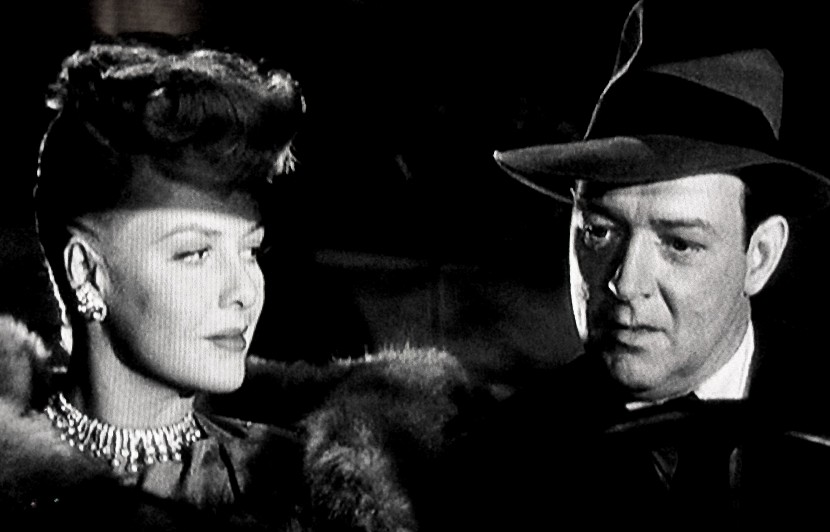
Wednesday, August 21, 2013

QUEEN OF THE AMAZONS (1947)

As you know if you read this blog regularly, I enjoy B-movies of the 30s and 40s. With their cheap sets, unexceptional acting, flimsy scripts, and short running times, they are an acquired taste; today's younger moviegoers, used to more professionalism in any given cable TV program than they'll find in some of these films, probably never watch them. But for me there is something pleasurable about their unpretentious tone, their largely unknown cast members, and sometimes a style so primitive that I think, "Hell, I could have made this in my backyard!" And, of course, there is the pleasure of picking the film apart for its illogic or its plot loopholes or its boring and/or batshit-crazy performances. This movie is really no better or worse than hundreds of other B-movie adventure films, but it deserves to be enshrined in the "so bad it’s almost good" category.

Jean Preston is in India hunting for her fiancĂ© Greg Jones; he was last seen on safari but has vanished.  She and Greg's father learn from two natives named Tondra and Moya that Greg had mysteriously gone off to Africa on a solo safari with Moya as his guide, but before they can tell more, Moya is shot and killed. Leaving the dead body in her hotel room, Jean and Mr. Jones head off to Africa and into the jungle with an entourage including a young—and possibly sinister—admirer named Wayne, a comic-relief cook named Gabby, a handful of natives, and a hunky guide named Gary. We find out, in part through awkward narration from Mr. Jones, that Greg was actually investigating an ivory smuggling gang so they worry that harm has come to him. Actually, he has fallen in love with Zita, the Queen of the title, one of a group of women who survived a shipwreck years ago and have set up their own little village in the wilderness. When our gang gets to Zita's place, they discover that someone with a tie to Zita may be behind the smuggling ring.

The one strong point here is the plot which is as compelling as any average jungle melodrama—imagine Gary as Tarzan and Jean as Jane—but most of it is laid out as exposition. What little action there is comes mostly at the end, in a nicely done battle sequence between the good guys and the bad guys. The rest of the film is made up of bland dialogue scenes interspersed with obvious stock footage of lions and tigers and natives—lots of stock footage. Scenes tend to either end abruptly or take too long to fade away. The acting is mostly dreadful, but of course that's part of the fun. Patricia Morison is a total zero as Jean, as is Keith Richards (not the Rolling Stone) as Wayne. John Miljan is boring as the elder Jones, and Amira Moustafa, in her one starring role, is both exotic and unexciting as Zita. B-movie stalwart Robert Lowery (pictured with Moustafa) is fine as Gary and old pro J. Edward Bromberg does what he can with the underwritten part of Gabby. The best line is Gary's: “Zita, my dear, you're quite a queen.” Certainly not everyone's cup of tea, but my bad movie self was happy. [DVD]

Monday, August 19, 2013

THE SEED OF MAN (1969)

A 50-year truce in a global war has been breached; war has continued and various illnesses are laying waste to the populace. A young couple (Marco Margine and Anne Wiazemsky, pictured) at the airport see TV screens playing footage of the war and head out to the countryside to escape. Along the way, after driving through a particularly long tunnel, they see a schoolbus stopped in the middle of the road with everyone on it dead of the plague. Soon they are stopped by a patrol, checked for signs of plague, and told to leave their car and head off on foot and find a new home. At the seashore, they find a beach house whose owner’s dead body is sprawled out in a chair on the front porch. They set up housekeeping there with Margine turning the house into a museum with, among other things, a typewriter and a huge wheel of cheese on a pedestal. Margine wants a child but Wiazemsky doesn’t want to bring a new life into the world. They encounter a black-shirted paramilitary group on horseback who tell them that procreation is their duty; later, another woman (Annie Giradot) comes by, flirts with Margine and eventually has sex with him, but the jealous Wiazemsky beats her to death, cuts off her leg, and serves it up for dinner that night.

You probably don’t need any more plot summary to decide if this Italian film is your cup of post-apocalyptic tea. The journey-to-the-sea trope reminds me of Cormac McCarthy's recent book The Road (I haven't seen the movie) and the last half of GLEN AND RANDA. Directed by Marco Ferreri and made on the cheap, the film has very few special effects—war footage is obviously black & white newsreel film from WWII—and very little gory make-up (except in two short scenes). There is a gigantic washed-up dead whale (yes, it's a Moby Dick symbol) and a nice moment when the couple see a blimp in the sky and assume it's help on the way but it's actually a Merry Christmas ad for Pepsi. The ending is frustrating on both a narrative and symbolic level. For fans of 60s and/or end-of-the-world films only. [DVD]

Saturday, August 17, 2013

GLEN AND RANDA (1971)

We first see Glen and Randa, two young people, frolicking naked near a stream and investigating a rusted car up in a tree—apparently the tree grew through the car. The world into which they were born is post-apocalyptic—apparently due to nuclear war—and the population of America seems to be broken up into small communal camps of people who can barely communicate with each other, let alone set up any kind of government. Glen and Randa have patched together bits of information gleaned from books, comic books, and magazines about the way the country used to be—when they see a horse, they think it’s either a dog or a camel—and Glen wants to find The City, which he thinks is called Metropolis. They meet up with a glad-handing fellow who calls himself the Magician, a self-styled clown/wise man figure who babbles constantly but makes little sense, and with a map he gives them, the two go on the road. They discover Randa is pregnant and eventually reach the West coast, which now is in Idaho, and are befriended by an old man named Sidney Miller living alone on a beach. He lets they stay in a dilapidated trailer (with the skeleton of its previous occupant still stretched out on a couch) and helps them enlarge their vocabulary by writing the names of household objects (like “stoev” and “teve”) on the objects. When Miller tells them that people used to sit and watch TV all night, they plunk themselves down in front of it, staring at the blank screen because they think they should. Glen is certain that if he could just get across the water, he'd find The City, though Sidney tells him that nothing's left past the water.  There’s a birth, a death, a fire, and an Adam & Eve (with a twist) ending.

I don’t review many movies of the 70s because the end of the Production Code and the beginning of the movie rating system really does mark a distinct break between the classic and modern movie eras. But this was one I've wanted to see since I was a teenager. It's a low-budget, scruffy independent film (called "underground" in its day) which was originally released with an X rating because of the male and female full-frontal nudity featured in the opening scene. However, despite one brief sex scene later in the film, this would not raise many eyebrows today—and has indeed been re-rated with an R. It's usually described as science-fiction because of its setting in a future world, but it has very few of the trappings of traditional SF, and is more akin to EASY RIDER in its look and feel. Steve Curry, from the original cast of Hair, does a nice job as the innocent stripling Glen. He's so good, it seems strange that his acting career went nowhere. He has to carry the picture partly because Randa, played by Shelly Plimpton, is barely a character; she has few lines and aside from being pregnant plays no important part in the action. The most shocking scene in the film involves Curry grabbing fish out of a stream and beating them to death on the rocks (not an ASPCA-approved moment). Garry Goodrow is incredibly tedious as the Magician, with most of his monologues seeming improvised. It took fortitude to stick with the movie past his section (roughly the first half-hour), but things did get better. Woodrow Chambliss is effective as the old man, the only character here to have a potentially interesting backstory, and his bonding with Glen and Randa is touching without being overly sentimental. Worth seeing; the satisfying ending makes up a bit for the rough first third. Pictured is Steve Curry. [DVD]

Thursday, August 15, 2013

MASK OF THE DRAGON (1951)

Daniel, an American soldier who is heading back home from Korea, agrees to take a valuable jade dragon statuette with him to deliver to a gift shop called the Jade Lotus. He assumes he’s doing a good deed for the Chinese storeowner, but he's unwittingly smuggling uranium into the States. When he arrives in Los Angeles, he is attacked and killed by two thugs but they don't get the dragon; he had mailed it to the wife of his good friend, private eye Phil Ramsey. The rest of the movie is a cat-and-mouse game involving Phil, his wife Ginny, the proprietor of the Jade Lotus, his henchmen, the cops, and a singing TV hostess named Terry. The print of this B-thriller on a Forgotten Noir set from VCI is beautiful; it's a shame that the movie is so bad. Richard Travis, who plays Phil, is a terrible actor, though to be fair, he's no worse than most of the rest of the cast. Sid Melton (familiar to me as Uncle Charley on TVs Make Room for Daddy, far right in the picture at left) is just dreadful as an offensive comic relief thug—a Caucasian making a series of bad jokes about Asian names, as in "Chiang Kai-shek and his cousin Cancelled Check." An actor credited as Mr. Moto (also the jokey name of his character, pictured putting the blindfolded Travis in an armhold) is the serious thug who knows some martial arts moves. The only actors in the movie worth watching are Sheila Ryan as Ginny and Lyle Talbot as a cop. The film, which didn't have much steam to start with, stops dead in its tracks for a country/western number by a TV band. The background score is played primarily on an organ, like in an old soap opera. In the final shot, Travis looks right at the camera and says, "Confucius say, when hero captures crook, time for picture to end." Finally: 1) this is NOT a noir; 2) there is no mask, of a dragon or otherwise. [DVD]

Tuesday, August 13, 2013

TARZAN’S REVENGE (1938)

Mr. and Mrs. Reed and their daughter Eleanor are on safari in Africa, hoping to take some live animals back to place in zoos, while Eleanor's fiancĂ© Nevin is killing crocodiles on the river. The wealthy Ben Alleu Bey comes on to Eleanor, though she thoroughly rebuffs him. When Eleanor falls and gets stuck in the riverbank mud, Nevin wrings his wussy hands while Tarzan comes swinging in to help her. Safari guide Olaf, a burly guy with a facial twitch, eggs the group on to find the rare white crocodile, leading them toward Bey's palace in the jungle. After some adventures with lions and chimps, Eleanor is snatched by Bey's men, Nevin proves again to be the non-heroic type, and Tarzan again comes to her rescue. This is an unofficial entry in the Tarzan series, made not by MGM but as an indie production by Sol Lesser, so instead of Johnny Weissmuller, Tarzan is played by Glenn Morris (pictured), an Olympic decathlon champ. Morris is a bit goofy looking and a little wooden but serviceable. Olympic swimming champ Eleanor Holm is his leading lady who decides to stay in the jungle with Tarzan at the end. Neither one ever starred in a movie again. There's a good supporting cast including George Barbier as Dad, Hedda Hopper as Mom, C. Henry Gordon as the slimy Bey, George Meeker as the wimpy—and eventually villainous—Nevin, and Joe Sawyer as Olaf. The budget for this was lower than for the MGM films, but the palace sequence is quite impressive, with elaborate sets and a dancing-girls number. This was the last non-franchise Tarzan movie for many years. The film was legal (Edgar Burroughs sold Sol Lesser the rights to one novel) but only MGM and RKO would make Tarzan films until the late 1950s. Quite watchable with adjusted expectations. [TCM]

Sunday, August 11, 2013

THE PERILS OF PAULINE (1933 serial)

This is not the legendary silent serial from 1914 which most famously featured its put-upon title heroine tied to railroad tracks; it's not even a remake (even though it has a speeding train behind its title card), it just uses the title of the original attached to a completely different character and plot. Still, this is a top-notch 12-chapter serial. Prof. Hargrave, his daughter Pauline, and his scaredy-cat secretary Dodge are in the Orient searching for the other half of a broken ceramic disc with contains the formula to a poison gas which has been responsible for the destruction of entire ancient civilizations. Hargrave wants to find it, test it to see if it works, and give the formula to the government for safe keeping, but the evil Dr. Bashan and his henchman Fang are hot on his trail, wanting the gas for their own nefarious purposes. Handsome American architect Robert Warde, out of a job because a local civil war, saves Pauline from being kidnapped and ends up tagging along on their quest. After finding the disc half in a Chinese temple, they discover that the disc only has instructions for finding the actual formula on another disc. Hargrave's group, always trailed by Bashan's, goes to Egypt, Singapore, and New York City in search of the disc. Each 20-minute chapter ends with a cliffhanger in which someone, usually Pauline, is in danger from Bashan and his men; the next chapter shows them getting saved, usually by Warde, and moving on to the next temple or jungle or museum where more trouble awaits.

Unlike many of the later serials, this was made by a big studio, Universal, and the first few chapters are much better made than the average B-studio serial. Well-integrated stock footage makes the tumult of the war-torn village effective, and the Tsai Tsin Temple scenes are exciting. From there, things slow down a bit as the formula kicks in: Hargrave's gang finds something; Bashan just misses getting it and plots to steal it from them later. There's a typhoon at sea, a rafting expedition down a jungle river with a dangerous leopard up in the trees, and marauding natives and animals, all run-of-the-mill scenarios for serials. In the last few chapters, a spooky museum and a raging fire in a Manhattan building allow the pace to pick up again, leading to a tidy ending, not just for Hargrave but for Pauline and Warde as well.

At the beginning, Pauline appears to be a girl who can take care of herself, shooting and killing at least one attacker, but eventually she mostly gets in trouble, screams really loud (almost as though she'd heard Pee-Wee Herman’s word of the day), and gets saved by Warde. Evalyn Knapp is adequate but no more as Pauline, though Craig Reynolds (acting under the name Robert Allen, pictured abpve left with Knapp) is fine as Warde. John Davidson, who spent much of the rest of his career as a serial villain, looks evil enough as Bashan (above right), but never gets the chance to bust loose with any over-the-top evil attitude. A British comic actor named Sonny Ray (at left) has the thankless role of Dodge, the cowardly comic relief. He's OK, just used too often—at least once a chapter, he has to shriek or flail or generally mince around with his ass stuck out. His best moment, in Chapter 9, is in the museum where he falls into a plaster trough and comes out looking (and walking) like a mummy. Hargrave (James Durkin) is occasionally referred to as Hargraves and even Hargreaves, sometimes within the same scene. Also with Pat O'Malley as a helpful pilot and Frank Lackteen as the scary-looking Fang. If you've never seen a serial, this might be a good one to start with.  [TCM]

Friday, August 09, 2013

FANTASTIC ARGOMAN (1967)

aka THE INCREDIBLE PARIS INCIDENT   

Here's something different: a movie that combines the superhero and secret agent genres. We first see Argoman, a slightly dumpy masked guy in yellow and black tights, on a mission for the Soviet Union. When he's attacked by two camps of villains, he uses his telepathic powers to get them to kill each other and he escapes, getting a snuff box used by Peter the Great as payment. In his alter-ego as playboy spy Sir Reginald Hoover, he is called upon by Scotland Yard to get back the royal Crown of St. Edward which has been stolen by someone who signs her notes "Jenabell, Queen of the World." It turns out that what she's really after is a gigantic one-of-a kind jewel which has immense powers of its own. What follows is a series of encounters between Argoman and the Queen of the World (and her henchmen). The DVD print is faded and splicy, and the moviemaking itself is lackluster. The problems begin with the tone: lazy camp with no real visual or narrative flair. Roger Browne, as Hoover/Argoman, is boring when out of costume, and a low-rent Adam West-as-Batman when in costume. His character has some promise—he stole the Mona Lisa, he loses his powers for six hours if he has sex—but is neither consistent nor consistently funny. Dominique Boschero is unmemorable as the Queen of the World, though I do like her green glittery outfit with a headdressy helmet. Eduardo Fajardo is OK as Chandra, Hoover's butler/sidekick (pictured with Browne). Whether the problem was a too-low budget or too-paltry imagination, this just doesn't work. Mystery Science Theater 3000 really should have gotten their hands on this one. [DVD]

Monday, August 05, 2013

HARPER (1966)

Detective Lew Harper (Paul Newman) is living in his small office because his wife (Janet Leigh) is divorcing him. He takes on a case for the rich invalid Mrs. Sampson (Lauren Bacall); her husband is missing and, though she doesn't necessarily want him back, she suspects he's shacked up with a woman and wants to who he's with. Either way, the family wants to avoid involving the police, but soon a ransom note arrives. This straightforward detective thriller (not really a film noir despite having a set-up like the film of THE BIG SLEEP—even featuring Bacall, that movie's star) moves through its predictable paces, and what makes it watchable are the interesting characters, mostly red herrings, and actors playing them: Shelley Winters as an alcoholic former movie star who was the latest in a string of Sampson's mistresses; Arthur Hill as the family lawyer and old buddy of Harper's, who may not be completely trustworthy; Pamela Tiffin as Bacall's sexy stepdaughter, Robert Wagner as the family driver and pilot who may be engaged in a dalliance with Tiffin, Julie Harris as a drug-addicted jazz singer and former mistress of Sampson's, and Stother Martin as a new age guru. Newman is fine as the laid-back gumshoe, kind of a very mellow but still manly Sam Spade (and sexy as hell even when he's supposed to be scuzzy and unclean first thing in the morning, as in the above picture), but both Bacall and Leigh are underused. The visual and narrative styles are rather flat, so at two hours, it wears out its welcome, but the last minute—a very 60s touch—is worth sticking around for. Based on a book by crime writer Ross Macdonald—in the book, the character is named Lew Archer. [TCM]

Friday, August 02, 2013

THE DIAMOND WIZARD (1954)

A million dollars is stolen from the U.S. Treasury and a Federal agent on the case in Minneapolis is killed by two British men who are trying to sell synthetic diamonds as real ones. Scotland Yard is worried that a glut of the diamonds, which test as real, could destroy the South African economy. American Dennis O'Keefe, a friend of the dead agent, is called in to work with Scotland Yard on the case. The only clue they have is that one of the killers has eyes of two different colors. By coincidence, O'Keefe meets up with Margaret Sheridan, who is looking for her missing father, a scientist who worked on the H-bomb. It turns out that her dad's latest hobby is working with diamonds. Sure enough, her father is being held captive by crooks who are forcing him to create these new diamonds. The first half of this B-thriller, made in England and directed by leading man O'Keefe, is slow going—too many scenes of people standing around in offices exchanging information. But things pick up nicely in the last 20 minutes after Sheridan is abducted by the bad guys, and during a chase sequence, there's a well-shot scene on an escalator (pictured). A little more of that visual style would have been welcome. O'Keefe is a fine hero; the rest of the cast is rather colorless except for a nice turn by Alan Wheatley as a diamond dealer. If you can get through the slow first half, it's decent viewing. [Netflix streaming]

Wednesday, July 31, 2013

NIGHT EDITOR (1946)

William Gargan is a world-weary cop with a sweet wife and cute son who is trying break off an affair with spoiled rich sexy blonde Janis Carter, who seems to like things a little rough. One night, while parked near a beach, he tries to tell her goodbye, but she gets into a tussle with him which ends in a torrid kiss. However, at the same time, they see a man beat a woman to death with a tire iron in another parked car. He pulls his gun to shoot at the escaping killer, but Carter warns him about the scandal that would erupt if he got involved. When the police investigate, they find Gargan's tire tracks in the sand. Before they can trace the tracks, the cops arrest a man for the murder. Gargan knows they don't have the right man, so he races against time to find the killer on his own. When it turns out that Carter not only knew the dead woman, but may be engaged in a dalliance with a suspect whose prints were found at the scene, things get even stickier for Gargan.

This unsung little B-film is a very nice example of film noir, complete with a flawed and conflicted hero (more like an anti-hero for most of the film), a sexy femme fatale, and passion and murder in the night. Gargan is fine as the appropriately hangdog lead; in his attempted breakup scene, he actually gets to say lines like, "This is the end of the line," "You’re just no good for me, baby," and "We both add up to zero." Carter (pictured with Gargan), however, burns up the screen, giving one of the best "bad girl" performances in all of noir. She (the character) is smoking hot and knows it, lording her power over poor Gargan for most of the running time. Only at the climax, which involves an icepick in someone's back, does she falter a bit, and I blame that on the writing. Jeff Donnell is colorless as Gargan's wife. The title comes from a radio show from which this was adapted; the main story is framed as a flashback told by the night editor (Charles D. Brown) of the New York Star to his staff, primarily intended as a cautionary tale aimed at a sweaty and despondent young reporter (Coulter Irwin, who definitely has the sweaty part down). A must-see for noir fans, available on the DVD set Bad Girls of Film Noir, Volume 2. [DVD]

Monday, July 29, 2013

WILDCAT BUS (1940)

This had a lot of potential to be interesting to me: a little-known B-movie which has generated very little comment, a lead actor I'd never heard of, and a left-field focus on the illegal "hired car" business. Things do start off well: it opens "cute" with young layabout playboy heir Charles Lang being kicked out of his penthouse apartment because he’s been judged incompetent. His chauffeur and faithful buddy Paul Guilfoyle goes out job-hunting with him. Cute scene #2: looking for a job at Federated Bus Line, Lang gives a boot in the ass to a mechanic working under a car who turns out to be Fay Wray, who is also the boss's daughter. Based on his experience, Guilfoyle gets a job as a bus driver but Lang is turned away. He winds up with a job as a wildcat driver, someone who charges passengers to ride in his car from one city to another, but who isn't officially licensed as a bus or cab driver. We soon discover that his boss, Don Costello, is using underhanded tricks, like tampering with the buses to cause accidents, to drive Federated out of business. It takes a while, but eventually Lang realizes what's going on, and after Guilfoyle is seriously injured in one of the arranged wrecks, Lang teams up with Wray to put the wildcatters out of business.

I wanted to like this, but after a promising 15 minutes, it peters out due to so-so performances and a disjointed narrative, like someone took every other page out of the script to shorten the running time. To its credit, it does move quickly and the last 10 minutes, involving a bit of vigilante justice, play out well. Lang (pictured at right) looks like a 40s Tab Hunter and does an OK job with his comic bits, but is not a heroic type. He has little chemistry with Wray who does the best she can with an inconsistent character—sometimes cold, sometimes sympathetic. Guilfoyle is fine, as is Leona Roberts as Ma Talbot, the kindly old washwoman who is actually the brains behind the wildcatters. Not a total waste of time, but not the quirky gem I was hoping for. [TCM]

Friday, July 26, 2013

THIS SIDE OF THE LAW (1950)

David Cummins is bedraggled, injured, and stuck at the bottom of an abandoned cistern on the Taylor estate, desperate to escape, and his story plays out in flashback. Just two weeks ago, he was a homeless man sentenced to 30 days in jail for vagrancy when out of the blue a lawyer named Cagle pays his fine and frees him, with one condition: Cagle thinks Cummins is a dead ringer for a rich man named Malcolm Taylor who has been missing for almost seven years, and he wants Cummins to impersonate him with his family. Malcolm is about to be declared dead, and Cagle thinks the wrong people will get the estate if that happens, so Cummins is to show up, claim he's Malcolm, and stick around long enough so Cagle can fix the estate inheritance. At Sans Souci, the Taylor mansion on a cliff, Cummins manages to fool the three relatives there: Malcom's weak-willed brother Calder, Calder’s sexy wife Nadine (with whom Malcolm has had an affair), and Malcolm's wife Evelyn, who seems to have been ignored by Malcolm. He gets a chilly reception as none of them are particularly happy to see him back, but soon Nadine realizes that David is missing a distinctive scar of Malcolm's and she threatens to expose him unless she can get in on the fix. When David tells Cagle, the lawyer arranges a meeting with Nadine and a series of machinations begin which wind up with Cummins in the cistern, one family member dead, and the others threatened by Cagle.

Despite a number of plot holes and a couple of bland performances, this is a good little B-gothic noir; it takes a little while to get going, but the last 20 minutes are fun. Kent Smith (as David/Malcolm) and Robert Douglas (as Cagle) are on the bland side—the part of the lawyer would have been perfect for someone like George Zucco to sink his teeth into. But Viveca Lindfors is fine as Evelyn, John Alvin is appropriately slimy as Calder, and best of all is Janis Paige who steals the movie as Nadine. One can argue about whether or not she fits the criteria for a noir femme fatale, but she is a strong presence and you wish to see more of her. Smith isn't bad, especially in the last half, but he doesn’t play a conflicted noir hero/anti-hero like John Garfield (FORCE OF EVIL) or even Tom Neal (DETOUR). The atmospheric camerawork helps, and the Warner Archive print is gorgeous. Pictured are Smith and Lindfors. [DVD]

Thursday, July 25, 2013

THE BRASHER DOUBLOON (1947)

As the hot Mojave summer winds blow, detective Philip Marlowe (George Montgomery) is called out to the mansion of rich widow Mrs. Murdock (Florence Bates) to investigate the disappearance of a rare coin, a Brasher doubloon—no need to know what that means, it's just a McGuffin. Marlowe winds up meeting an interesting group of people in the course of the case. Murdock's young secretary Merle Davis (Nancy Guild, pictured at right with Montgomery), wearing Night of Bliss perfume, is flirty with Marlowe, then tells him she has a phobia of being touched, partly due to the harassment that Mrs. Murdock's late husband subjected her to—Marlowe offers to help her with her problem and she seems agreeable. But soon he discovers she has a secret: she accidentally pushed Mr. Murdock to his death from a high window during the Rose Parade. There’s also Murdock's slick but slimy son Leslie (Conrad Janis); coin dealer Elisha Morningstar, whose call about the doubloon alerted Mrs. Murdock to her loss; scarred thug Eddie Prue who tries to ransack Marlowe's office; Prue's boss Vince Blair, a club owner; and the German newsreel photographer Vannier who has been making money on the side through blackmail.  People get beaten up and killed, a counterfeit copy of the coin turns up, and some of Vannier's newsreel footage winds up playing a part in the finale.

Based on a novel by Raymond Chandler, this is a veritable encyclopedia of film noir tricks and techniques. There's an unstable, possibly unreliable woman who tells lies when it suits her (like Mary Astor's character in MALTESE FALCON), a man who is invited into the gumshoe's office only to cause trouble (like Peter Lorre's character in FALCON), an attempted beating of the detective (like poor Alan Ladd went through in THE GLASS KEY), and a convoluted plot that may or may not make sense (as in THE BIG SLEEP, with Bogart as Marlowe). This is a B-production and it shows in the fast pace and short length (72 minutes), and in the casting of Montgomery as Marlowe. I like Montgomery but he's no Bogart—he makes a rather lightweight private dick, and there's very little sense of danger (to him or from him). Still, the movie works largely due to the supporting cast: Bates is always fun in the "dragon lady" role, and Janis makes the character of the son more interesting than he should be. Guild is unconvincing as the femme fatale/heroine—the studio wanted her to be another Lauren Bacall though she would seem better suited to light B-comedies. But overall this is worth seeing for fans of noir or detective movies of the era. [DVD]

Tuesday, July 23, 2013

PORTLAND EXPOSÉ (1957)

George Madison owns the Woodland Tavern on the outskirts of Portland, Oregon, a nice, friendly town that is in the process of being overrun by a crime syndicate. A couple of thugs named Joe and Larry visit Madison and want him to install their pinball and gambling machines. When he refuses, they send out some phony labor protesters to picket in front of his establishment. George holds out for a while until they threaten to throw acid in the face of his teenage daughter Ruth. He gives in and soon the Tavern is hopping, although it's been overrun by gamblers and loud jazz music. Ruth's boyfriend Benny assumes that, because of her father's business, she's a girl of loose morals and one night, he tries some hanky-panky with her in the woods. She sends him away but is then cornered by Joe, who has done time for fooling around with underage girls—"Hopheads aren’t nothin' compared to what ails him," another character says—and he assaults her, though George saves her before Joe can get very far. George sends his wife and kids away and gets in contact with some labor union leaders who are also fighting against the mob. He agrees to pretend to cozy up to the thugs while wearing a wire to get evidence against them but soon the thugs smell a rat, and when Ruth reconciles with Benny and returns to Portland to attend a dance with him, she winds up in the middle between her dad and the bad guys.

This B-crime thriller isn't really in any way, shape or form film noir, but that’s how it's being sold on DVD. Hard-core noir fans won’t find much here but as a down-and-dirty crime melodrama, it's quite watchable. The setting, in a city but in a rural wooded area, is interesting. Edward Binns, familiar from well over 100 TV supporting roles, is serviceable as the average-Joe hero. Virginia Gregg, another TV face, doesn’t have much to do as his wife; Carolyn Craig is OK as the daughter, and the actor playing Benny is better (but uncredited). It's the villains that make this worth watching: Larry Dobkin, as Larry, makes his character seem like a slow-witted goon but vicious and smarter than he looks, and Frank Gorshin (the original Riddler on TV's Batman, pictured above) is spectacularly slimy as the child-molesting Joe. Joe Flynn (the captain on McHale's Navy) has a bit part as a good guy. There's a fun scene in the last half involving a sweet old lady who is actually a madam arriving in Portland to start up a business; she wants only good girls, "no dipsos, no hopheads." [DVD]

Friday, July 19, 2013

PRIVILEGE (1967)

I'm not quite sure what to make of this film, a satirical parable of pop culture and politics which has some good ideas but can't follow through on most of them. In the near future, pop singer Paul Jones is the new hot commodity. In his masochistic stage act, he is beaten and jailed, then freed but kept in handcuffs; he attacks his guards who then beat him up some more. All the while, he's singing and the teenage audience is yelling and cheering. We soon discover that Jones's act is actually subsidized by the ruling government in England, who see his show as catharsis for unmoored, violent youth who might otherwise be involved in protest or political agitation. Offstage, Jones is a passive cipher who always looks like he's on the verge of tears, his private life nonexistent, waiting for his handlers to guide his career to its next step. The only people who seem at all close to him are his bodyguard and a model (Jean Shrimpton) who is also his half-hearted girlfriend. When there's an apple glut, Jones does an ad to sell apples. More seriously, when the powers that be decide that the masses need to find God, Jones is set up as a pop messiah. The large open-air concert/crusade is the highlight of the movie, as Jones leads chants like, "We will conform," and does a rock version of the hymn "Jerusalem" while cripples are brought forward for healing. It's done like Leni Reifenstahl shooting a Billy Graham revival and the movie could have used more of this stylistic power throughout. The ending isn't quite as predictable as one might think—there is no explicit martyrdom, just a kind of slow fade as Jones finally rebels against his handlers—but the film really has nowhere to go after the big crusade scene. The ideas floating around about consumerism, pop culture, and politics are interesting, but the script could have used some tightening, and Jones (the original lead singer for Manfred Mann) doesn't make a very charismatic figure. [TCM]

Wednesday, July 17, 2013

THE SHANGHAI GESTURE (1941)

Shanghai is a bustling city of riches, vice, and decadence for those, we are told, "who wish to live between the lines of laws and customs." The heart of the city is Mother Gin Sling's casino, a magnificent pleasure palace in white, designed like Dante's circles of Hell, with a gaming table in a pit at the center where huge sums of money are won and lost every night. We first meet Dixie, a brassy blonde showgirl from Brooklyn stranded in the city. She is taken in by the dusky, passive Doctor Omar—he says he is a doctor of nothing, and others call him the poet laureate of Shanghai, though all the poetry he spouts is from Omar Khayyam—who gets her a job at the casino, though what exactly she does aside from wearing sexy dresses and making wisecracks is never made clear. Next we meet another newcomer to Shanghai, a dark exotic young woman who gives her name as Poppy Smith; she is more fragile than Dixie, but she's got money and a Russian man squiring her around town. She thinks the casino smells evil but it fascinated by it and by Omar. That night, Mother Gin Sling gets the bad news that she will have to shut down her establishment; it's part of a large lot of land bought by rich speculator Sir Guy Charteris. Realizing she cannot fight the deal, she instead tries digging up dirt on Charteris and discovers two interesting items: Poppy is his daughter (real name Victoria), and Charteris is actually a man named Dawson who was briefly married to Mother Gin Sling in her youth and who treated her badly. Mother plots to reduce Poppy to a shell of her former self by getting her hooked on drinking and gambling, and then on the casino's final night, the eve of Chinese New Year, she'll unveil the spectacle of Victoria's ruin to Charteris at a fancy dinner party. Things go as planned, but Charteris has a little secret of his own which casts everything in a different light for Mother.

Based on a notorious stage play, the Production Code people didn't want this movie made at all. In the play, the casino is a brothel, and the name of the main character is Mother Goddam. Lots of changes were made to get this material through the censors, but a strong atmosphere of decadence and corruption remains, and it doesn't take much reading between the lines to figure out what's what. Dixie (Phyllis Brooks) has clearly been hired as a prostitute; Omar (Victor Mature) is completely amoral and pretty much high all the time, on opium I assume; Poppy (Gene Tierney), after Omar is through with her, is certainly drug-addled as well. This film was the last hurrah of Josef von Sternberg, who would certainly have centered this film around Marlene Dietrich if he had made it a few years earlier. Though its stage origins remain obvious, the movie looks great. Long shots of the casino are stuffed with interesting detail—the main credits include an acknowledgement of the unsung extras, and indeed they are crucial in the building of atmosphere. The print I saw wasn't spectacular, but the rich blacks and overexposed whites come through well enough. 

This was an early lead role for Tierney, and while some critics complain that she overacts, I think she was wise to do so here, since her character is such a melodramatic soap-opera type. For the most part, Power barely registers since he has little to do besides look like he's in an opium haze all the time. The rest of the cast is fine, including Walter Huston as Charteris, Eric Blore as the bookkeeper who is on crutches the whole time (someone says to him, "Stop behaving like a disabled flamingo!"), Albert Basserman as a city official, and Mike Mazurki as a bare-chested sinister rickshaw driver. Best of all is Ona Munson, unrecognizable in Asian makeup as Mother Gin Sling (pictured). Her face is usually frozen in a sickly smile, but her voice (you can hear Belle Watling, her character in GONE WITH THE WIND, loud and clear) and mannerisms give full vent to her desires and frustrations. Things end well for no one (except maybe Omar who probably curls back up with his hookah), but the ending has just enough ambiguity to allow us to imagine that not all the guilty parties will pay for their crimes. Not a masterpiece, perhaps, but a must-see for classic-era fans.  [TCM]

Monday, July 15, 2013

THE SIGN OF THE RAM (1948)

Sherida has arrived in Cornwall to take a job as secretary for a writer, Leah, who produces gushy inspirational poetry under the pen name Faith Hope. Leah is confined to a wheelchair; years ago, she saved two of her stepchildren from drowning but her legs were crushed and she's been crippled ever since. Sherida finds the family quite friendly, especially Leah's gentle husband Mallory, but soon Leah begins to suspect that something is going on between Sherida and Mallory. It's not, but once Leah's jealous fuse has been lit, it can't be put out. As two of her stepchildren, Logan and Jane, make plans to marry their sweethearts and leave the house, Leah hatches her own plans to meddle in their affairs to keep them at home, or as one character says, keep her "band of slaves intact." Then she plants a seed in the mind of her youngest, Christine, about the dalliance she imagines between Mallory and Sherida, leading Christine to put an overdose of sleeping powder in Sherida's water. Slowly, Leah's plotting becomes evident to all, but they may not be able to undo all her damage.

A gothic melodrama in the vein of DRAGONWYCK, GUEST IN THE HOUSE, and UNCLE SILAS, this plays out in a lower key than the above films but it still generates some thrills along the way. One big plus is the atmosphere; it's set in a big old mansion on a cliff with crashing waves below (think THE UNINVITED, also set in Cornwall) and the dramatic outdoor settings are used well. The film was crafted specifically for Susan Peters (above left) who plays Leah; she was a starlet whose career was taking off when she was paralyzed in a hunting accident in 1945. This film was to have been her comeback, and she's quite good in the role, underplaying both the character's inner sinister nature and her outer vulnerable appearance. Sadly, she made no other films and died four years later. The other actors are fine, especially Alexander Knox as the husband, the handsome Ross Ford as Logan, Diana Douglas as Catherine (a free-spirited artist and Logan's lover, pictured with Ford), and Ron Randall as Simon (the family doctor and the object of Jane's affections). Sherida (Phyllis Thaxter) and the two daughters don’t make as much of an impact, partly (for me) because they're not as well differentiated as the rest—the three young women look and act alike: dark hair, attractive, and vivacious (except when Leah has them under her thumb). The story takes a while to get going; there's a lot of exposition laid out in long dialogue scenes during the first half-hour before things really get going. But this movie definitely deserves to be better known than it is. [TCM]

Thursday, July 11, 2013

DARLING, HOW COULD YOU? (1951)

In turn-of-the-century New York City, the Grey children (older teenager Amy and 10-year-old Cosmo who hates his name and wants to be called Charles) are dropped off at the wrong theater by their housekeeper Fanny and they see a melodrama about an adulterous wife who is shunned by society for her behavior. Amy is much taken with the play and feels that she now has some acquaintance with the "seamy side" of life. The next day, the children await the return of their parents who have been living and working in Panama for years; Amy and Cosmo barely remember them, and when Amy goes to meet their ship, she's on the lookout for an elderly couple, but in fact they are still young and vibrant people so Amy doesn't notice them. That's just the first of a series of misunderstandings between the kids and their parents (who have their own misconceptions about their children), the biggest of which involves Amy assuming that her mother is having a "seamy side" affair with a young doctor who is actually just a family friend. Afraid that her mom will be "hounded from society," she sets out to fix things, which of course only messes things up more. Since this is a comedy (based on a play by J.M. Barrie), everything works out in the end. This little trifle is mostly fun though it might be more interesting if played at a slightly faster pace, more like farce. Joan Fontaine and John Lund (pictured) are adequate as the parents; Mona Freeman as Amy and Peter Hansen as the family friend come off the best. There’s a nice Barrie reference when Amy, in discussing seeing the melodrama, says, "I wouldn’t have learned half as much from Peter Pan!" [Netflix streaming]

Tuesday, July 09, 2013

BOULDER DAM (1936)

Ross Alexander and Lyle Talbot work as mechanics at a Detroit taxi company. Alexander is cocky and egotistical, though his boss (William Pawley) admits he's the best in the shop. One day when Alexander comes in late yet again, Pawley fires him. They get into a fistfight and Pawley hits his head on the stone floor and dies. Alexander, fearing arrest, hops on a train and heads out west, a hungry, jobless hobo. In the desert, he helps Patricia Ellis fix her broken-down car, and later runs into her again at a nightclub where she sings. Ellis somewhat unaccountably takes a liking to the grungy, unpleasant Alexander; she buys him a meal and takes him home to her family, who give him free room and board. Under Ellis' influence, Alexander begins to straighten up and soon gets a job working construction on Boulder Dam. When a driver loses control of a truck filled with dynamite, Alexander jumps on board and tosses the TNT into the river. For a while, he's a hero, and he even gets engaged to Ellis, but Talbot shows up to work on the dam, recognizes Alexander, and threatens to blackmail him.

Alexander (pictured with Ellis) was being groomed by Warners as a Dick Powell-like performer, but even at his peak, he didn't have the easy, bubbly persona needed to fit that bill. Here, for a while, he's fairly convincing as a kind of anti-hero—despite his overly mannered delivery of dialogue, he does work up some slimy charm—but as the plot developed, I never found him sympathetic or likeable. The main thing this B-movie has to offer is the unusual backdrop of Boulder Dam, now called Hoover Dam, which was built over a five-year period and was officially dedicated just months before this film was released. I doubt there was any location shooting aside from some background footage, but the runaway truck scene and the finale—involving two men left hanging over the dam when a cable snaps—are well done. Ellis is unmemorable and Talbot, as usual, isn't given enough to do. Eddie Acuff does nicely with a small comic relief role as a fellow worker called Alley Oop. [TCM]

Friday, July 05, 2013

THE VIKING (1931)

In snowy, raw Newfoundland, where only the hearty survive, Luke, the new mailman, is overtaken by a snowstorm and found unconscious. Brawny, cocky Jed finds Luke and takes him to the village where Mary Joe nurses him back to health.  Luke, because of his family's past, is considered a jinx (a "jinker") and has taken this lowly job to break the jinx but it didn't quite work. Over time, Mary Joe grows fond of Luke, even though the brutish Jed fancies himself to be her boyfriend. When the men of the village take their annual trek across the snowy wastes to Labrador to go seal hunting, Luke decides to join them. The ship captain discovers that Luke is a jinker and won't take him, but after Jed sees Mary Joe chatting up Luke, Jed gets Luke on board. On the ice, the ship eventually gets stuck in ice a few times and tension mounts between Jed and Luke (with Jed going so far as to take a shot at Luke) until, as the men drag the seals back to the ship, a storm rises which leaves Luke and Jed stranded on the ice.  Can they work together to survive?

This film is basically just another version of the old romantic rivals story, in which a rough-and-tough older man and a younger, better-looking "wet behind the ears" guy fall for the same woman and wind up competing for her. What makes this different is the background; it was shot almost completely outdoors and on location in Newfoundland. The scenes on the ice are spectacular and, despite the creakiness of the narrative conventions, this film is worth seeing just for the setting. The acting is fine if not anything special: Charles Starrett (hunky hero of THE MASK OF FU MANCHU) is Luke, Arthur Vinson is Jed—and since the woman's role is not as important as the showboating men, Louise Huntington, as Mary Joe, doesn’t get to make much of an impression. Real-life ship captain Bob Bartlett, who sailed with Admiral Perry to the North Pole, plays the captain. The young director, Varick Frissel, died in a ship explosion when he went back to Newfoundland to get more location footage. [TCM]

Wednesday, July 03, 2013

ENTERTAINING MR. SLOANE (1970)


Middle-aged Kath and her aged father (known as Dadda) live in a once-nice house on the edge of a graveyard, and Kath attends funerals as recreation. Kath's brother Ed (who lives elsewhere) is in business and does well enough that he owns a flashy pink Cadillac. For some reason, Dadda won't speak to Ed, and Ed doesn't come around very often. One day after a funeral, Kath sees a handsome, shirtless young man, Mr. Sloane, doing sit-ups on top of a grave. Apparently homeless and on the run from someone or something, he accepts an offer from the horny Kath to live with her, and soon they're going at it with some energy, though clearly she's enjoying herself more than he is. While Sloane is stretched out in bed resting, wearing just a very skimpy pair of briefs, Ed discovers him and practically begins salivating. What follows is a kind of game in which Kath and Ed compete for Sloane's affections, or at least for his body. Complicating matters is that Dadda believes that Sloane is the man who killed his boss, a porn purveyor, and threatens to turn him in to the police. Sloane thinks that he has the upper hand and can manipulate the whole family, but it may be that he's the one being manipulated.

This once-shocking black comedy, based on a play by Joe Orton, still has the power to unsettle. Partly because none of the characters are particularly sympathetic, the situation they're in never feels very real, and there is little import to anyone’s actions. Still, the film conjures up some queasiness here and there. The emphasis on the physical desirability of Sloane makes the film unusual for its time. Peter McEnery plays Sloane with a smile and a smirk which both get more desperate as he loses control of the game he's playing. As good as he is, it's the fearless performances of Beryl Reid (Kath) and Harry Andrews (Ed) that make this movie still watchable. Reid, who was 50 at the time, traipses about in sheer day-glo outfits with nothing underneath, with no idea how pathetic she seems to those around her. Andrews (pictured above with McEnery), a character actor who will look familiar to you even if you can't place him exactly (THEATER OF BLOOD, DEATH ON THE NILE, THE RULING CLASS), is uncomfortably good as the closeted respectable businessman who drives himself to distraction with his passion for Sloane. There aren't many out-loud laughs in the movie, and the ending which certainly shocked audiences of the 70s won't be shocking at all today—it might even seem a little quaint. Interesting viewing [Netflix streaming]

Tuesday, July 02, 2013

THE CASE OF THE STUTTERING BISHOP (1937)


Perry Mason takes a case from an Australian bishop (yes, the stutterer of the title). It's complicated: years ago, Ida Gilbert, daughter-in-law of the millionaire Brownley, was found guilty of manslaughter in a car accident. She fled to Australia and gave up her daughter to the bishop who placed her in foster care back in America. Now a young woman named Janice has shown up claiming to be the long-missing heiress and Brownley has taken her in. The bishop wants Mason to help Ida and her friend Stella look for the real Janice and convince Brownley that the one living in his house is a fake. Then the bishop vanishes, and Brownley is found dead, shot in his car by a woman in a white raincoat. There's also something a little fishy about Ida's buddy Stella. Can Perry, aided by his secretary Della Street and his assistant Paul Drake, sort out all the loose ends, bring the killer to justice, figure out who the real heiress is, and find out what happened to the bishop?

Of course he can, he's Perry Mason! The Mason movies aren't as placid as the Raymond Burr TV episodes—they're really just another 30s detective B-movie series like Philo Vance or Charlie Chan, and as such, they're enjoyable. As in the show, the climax here occurs in a crowded courtroom with a nice twist exposed in a dramatic fashion. When Warren William played Perry Mason, he was light and charming; here, Donald Woods is fairly drab and stoic but not without some appeal. It has been said that Woods came closest to approximating the original Mason from Erle Stanley Gardner's books, but since I’ve never read one, I can't say. I liked Ann Dvorak as a sprightly Della, and I enjoyed seeing Craig Reynolds and Frank Faylan is small roles. The bishop's stuttering is simply a red herring. [TCM]

Thursday, June 27, 2013

ALI BABA AND THE FORTY THIEVES (1944)

In Baghdad, Ali, the young son of the Caliph, and Amara, the young daughter of the Caliph's advisor Cassim, make a blood oath to solidify their pledge of love, but not long after, Cassim, working with the Mongols, betrays the Caliph who is killed. Ali escapes into the desert where he discovers the secret hiding place of a band of thieves, in a deep mountain cave which opens up only to the phrase, "Open, O sesame." The thieves adopt him, naming him Ali Baba, and soon they become a small resistance band against the Mongols. Years later, Amara is to be married to the pretender Caliph, Kahn. When Ali, the new leader of the thieves, recognizes Amara as his childhood sweetheart, he leads a raid to rescue Amara from marriage to the evil Kahn.

Like the earlier ARABIAN NIGHTS, this pairing of Jon Hall (Ali) and Maria Montez (Amara), both pictured at right, is a colorful and fun adventure film with good sets and costumes, an appropriate amount of comic relief, and lots of rousing action scenes. Hall is never quite up to the standards of a grade-A screen hero (like Tyrone Power or Errol Flynn) but he suffices. Montez pretty much gives one-note performances, but her exotic looks make up for her acting weaknesses. Andy Devine, as Abdullah, Ali's protector, is amusing but never obnoxiously so. Standouts in the supporting cast include Scotty Beckett as the young Ali, Turhan Bey as a slave to Amana who winds up helping the thieves, Frank Puglia as Cassim, and Fortunio Bononova as the head of the thieves. [DVD]

Tuesday, June 25, 2013

ARABIAN NIGHTS (1942)

An old bearded man reads a story about half-brothers from the Arabian Nights to a gaggle of buxom harem girls. Haroun (Jon Hall) is the rightful Caliph of Baghdad, but his half-brother Kamar (Leif Erickson) has tried to overthrow him and failed, so now Kamar has been hanging by his arms for seven days in what is called the Slow Death. On the seventh night, with Kamar seemingly on the edge of death, his band of rebels attacks, freeing him. In fierce hand-to-hand fighting, Haroun receives a life-threatening wound and passes out. An impish circus acrobat named Ali (Sabu) sees the attack and rushes to Haroun's aid. Knowing the danger Haroun is in, Ali takes the Caliph's Ring off his hand and puts it on the dead body of a rebel whose face has been smashed by a rock beyond recognition, so Kamar will assume that Haroun is dead. Ali takes Haroun in, shaves his beard so he won't be recognized, and helps him recover with some assistance from renowned dancing girl Scheherazade (Maria Montez). But Scheherazade is being sought by Kamar—she promised to marry him if he ever gained the title of Caliph—so the circus winds up on the run, not just from Kamar's men but also from slave traders and from a rogue member of Kamar's group who would be happy to see both brothers dead.

This is the colorful adventure film which introduced the popular pairing of Hall and Montez, who went on to do five more films together. Made during the first year of WWII, there were wartime restrictions placed on film budgets, but the studio, Universal, the producer, Walter Wanger, and the director, John Rawlins, managed to create a movie that looked spectacular, not just with bright Technicolor hues but with effective sets and lovely backgrounds. The beefy Hall and exotic Montez are not the greatest actors, but there is some chemistry there, and the supporting cast is fun. Billy Gilbert does a variation on his usual sputtering doofus as the head of the circus—in action scenes when he belly-butts someone, a distinct "boinnng" is heard on the soundtrack; John Qualen and Shemp Howard have some fun playing older versions of Aladdin (still on the search for another magic lamp) and Sinbad (always trying to tell tales of his glory days). The chief pleasure I got out of this was the look of the movie: gorgeous colors, remarkable backdrops, and even some real sand dunes—shot on location in Utah, not Iraq. [DVD]

Thursday, June 20, 2013

LAST HOLIDAY (1950)

George Bird, a tractor salesman, learns he has Lampington’s disease; his doctor tells him he has only weeks to live. As he has no wife, children, family or close friends to commiserate with, he decides to withdraw his savings and take a last holiday at a posh resort hotel. While there, he tells no one about his fate, and the workers and guests, mostly of a class higher that Bird's, begin to think of him as a man of mystery. Not only does he make friends and get respect, he wins money while gambling and discovers the potential for romance with the housekeeper Mrs. Poole. He gets a job offer, gives money to the Rockinghams who are in dire financial straits, and when the hotel staff goes on a 24-hour "sympathetic" strike, he takes the lead and gets all the guests to pitch in and keep things running. Then Dr. Lampington himself shows up at the hotel and when he finds out Bird's secret, tells him he has no signs of the disease and must have been misdiagnosed. Is this the beginning of a new chapter in Bird's life?

This pleasant comedy is almost a little too placid; believe me, I don’t need car chases or destructive slapstick to enjoy comedies, but this one could use some jolts of energy now and then. Still, it's fun (with dark edges), well written by J.B. Priestly, and the cast is superb, beginning with Alec Guinness as Bird in a subtle performance that I can imagine being bettered only by Peter Sellers. Other standouts: Kay Walsh (pictured with Guinness) as Mrs. Poole who is just right in the role of the self-possessed woman who almost falls for the sympathetic mystery man; Beatrice Campbell as Mrs. Rockingham who teeters on the verge of romancing Bird; GrĂ©goire Aslan as Gambini the hotel keeper; Brian Worth as Mr. Rockingham who, in a plotline that essentially goes nowhere, is involved in a currency smuggling scheme; Esma Cannon as Miss Fox, a shy downtrodden companion to a rich lady; and Ernest Thesiger as Lampington whose character has the potential to be quite eccentric (as most of Thesiger's roles are) but isn't fleshed out enough. Bernard Lee and Wilfrid Hyde-White also appear. It’s sweet and a little melancholy, and worth seeing. [DVD]

Tuesday, June 18, 2013

THE ANNIVERSARY (1968)

Every year Mrs. Taggert insists that her three grown sons join her to celebrate her wedding anniversary to her late husband. And it seems that every year, she uses the event to reassert her dominance over her sons, insulting and humiliating them to keep them under her thumb—she owns the family construction business, and all three work for her, with varying degrees of competence. Henry, who is charge of the day-to-day business, is an unmarried milquetoast and transvestite who steals women's underwear from stores and clotheslines and seems happy with the status quo. The other two, however, have plans to escape: Terry, with a wife and kids, is planning to move to Canada; Tom, the youngest, has brought his pregnant fiancĂ©e to the celebration despite Mother's almost certain disapproval. And indeed, Mrs. Taggert spends the entire evening running everyone down, trying to get her way. Will this be the year when things backfire?

Bette Davis has a field day chewing the scenery as the horrid mother in this black comedy. She wears an eyepatch (due to a BB gun accident years ago, caused by one of her sons) and, though the film is set in England, Davis doesn't bother with an accent, and she doesn't need to—sounding like Bette Davis is scary enough. She cackles and spits out insults with relish. To Terry's wife, pregnant with her fourth child, she says, "Natural good manners told me when to put the plug in." Glaring at Tom's tarty girlfriend who plunked down next to her on the couch, she says, "Would you mind sitting somewhere else? Body odor offends me." Based on a play, most of the film takes place in Mom's house, though the camera set-ups are varied enough that it rarely feels stagy, and when it does venture out, to a dinner at a restaurant, it doesn't feel right. The rest of the cast is good, especially Jack Hedley as Terry, doing a nice job of not being as kowtowing as Henry (James Cossins) but not able to rebel as obviously as Tom (Christian Roberts), and Sheila Hancock as Terry's wife. Not all the plot twists work—a cruel prank that Mrs. Taggert plays on Terry's wife comes off as half-baked and childish—but this is a strong example of the strain of black comedy that blossomed in the 1960s. And this is a better movie overall than Davis' more famous campy dark comedy WHATEVER HAPPENED TO BABY JANE. [DVD]

Friday, June 14, 2013

THE BELLE OF NEW YORK (1952)

In Gay Nineties New York, Vera-Ellen works for the Daughters of Right (as in, the Salvation Army); she attracts lots of men with her looks but few of them are really looking for salvation (as with Jean Simmons in GUYS AND DOLLS). Meanwhile, playboy Fred Astaire, about to finally get married, holds a bachelor party with all of his ex-girlfriends. Afterwards, he realizes he doesn't really love his intended, and, out in the city for a carriage ride, he spots Vera singing with the Daughters and is immediately smitten. She brushes him aside, telling him that true love should leave you walking on air; right after she leaves, Fred does, in fact, dance on air, winding up on top of the Washington Square arch. He keeps after her, and she insists he must begin to work for a living. When he gets a job as a streetcar driver, they perform a dance to the cute song "Oops!" and Vera starts to levitate as well. Fred's rich aunt (Marjorie Main), who is also a patron for the Daughters of Right, is happy about their relationship and pays off Fred's former fiancée (for breach of promise) and also offers to pay for Fred and Vera's wedding, but the night before, Fred and his friends get plastered at a bachelor party and he misses the wedding. How will these kids ever get back together?

Though I love movie musicals, the late 40s/early 50s was not their prime era (the big exception being SINGIN’ IN THE RAIN). With the MGM musicals of that time—like this one—it often feels like they're trying too hard in some areas (overdone production design) and not hard enough in others (underbaked plotting). I always enjoy seeing Fred Astaire dance, and the plot device of dancing on air is fun, but the rest of this is a little flat. Astaire was in his 50s and beginning to look a little creepy/pervy paired up with younger women. The peak of that nonsense came a few years later in FUNNY FACE in which, at 58 but looking 65, he was paired up with Audrey Hepburn, not quite 30 but looking barely 21. There’s not much chemistry between Astaire and Vera-Ellen; she seems rather cold throughout, even when she's supposed to be thawing out. The dance numbers are generally fine, even if the songs themselves are not memorable. I always enjoy Marjorie Main’s presence, and the supporting cast includes Keenan Wynn, Clinton Sundberg, and Alice Pearce (the first Mrs. Kravitz on Bewitched). The last "dancing on air" number is a nice closer. [TCM]

Wednesday, June 12, 2013

TOMORROW IS ANOTHER DAY (1951)

When he was 13, Steve Cochran shot and killed his drunken, abusive father; tried as an adult, he served 18 years in prison and is now being released with a chunk of money he earned through work, a cheap suit, and bus fare. He's hardened over the years, but he's not broken, and he sets out to start a new life. In a diner, Cochran is befriended by John Kellogg who helps him get a job as a welder, but Cochran soon discovers that Kellogg is a reporter who writes a sensationalistic front page story about him, so he leaves for New York City, hoping for anonymity in the big city. At a dime-a-dance joint, he meets up with tough blonde Ruth Roman; she shows him around town and he falls hard for her. It turns out she's being "kept" by a cop (Hugh Sanders), and when the three have words, the violent Sanders knocks out Cochran, then Roman (more or less accidentally) shoots Sanders. When Cochran comes to, Roman lets him think that he shot Sanders, and when they find out the cop has died, the two go on the run, winding up in a California farming camp where they get married, bond with another couple, and seem to be on the way to living a normal life. But soon Cochran is recognized when his picture is run in a true crime magazine—will they run again and stay and make a stand? And will Roman come clean with Cochran?

I am now an official Steve Cochran fan. With his dark, handsome, brooding look, he had a decent career in B-films, often noir or crime films, often as a conflicted hero (as here) or anti-hero (as in PRIVATE HELL 36). He may not have been an Oscar-caliber actor, but he brought a certain presence to his roles that generated the required heat or coolness as called for—he could come off as a dumb lug, a smart average guy, a slick seducer, or a naĂŻve sucker. Here, he exhibits bits of all those personas: he's not dumb, exactly, but having grown up behind bars, he is unschooled socially, and part of the appeal of the first half of the movie is watching him negotiate his return to society. Roman is good as a tough gal who slowly softens up (and goes from brassy blonde to natural dark hair)—we keep hoping she doesn't quite have it in her to truly be a femme fatale. In the supporting cast, Lurene Tuttle stands out as a co-worker at the farm, and Lee Patrick (Effie in THE MALTESE FALCON) has a small but effective bit as Roman's sister. The latter half, set at the farm camp, feels at times like a serious version of IT HAPPENED ONE NIGHT. Despite an ending that is a little too sunny and ties up loose ends a little too neatly, this is a standout film noir. [TCM; also on DVD]

Monday, June 10, 2013

THE RISING OF THE MOON (1957)

An anthology movie with three stories of Irish life directed by John Ford as a kind of labor of love, on a fairly low budget with no star power except for the presence of Tyrone Power as a host. In "The Majesty of the Law," a policeman travels from city to country to serve an arrest warrant on his old friend Dan who kicked a neighbor's ass and won’t pay the fine. In "A Minute's Wait," a train pulls into a station and the porter announces, "One minute’s wait only!"; the passengers pour off the train and entertain themselves at the bar or amongst themselves. At the end of the minute, they get back on the train only to have a delay that results another one-minute wait… and another, and another. The last, "1921," based on a famous short play, is about an Irish political prisoner who is about to be executed by the British, and how with help from some unlikely folks, he escapes his fate.

Though the last story is somewhat more serious in tone than the rest, these are all basically comedies of character and circumstance. The first is akin to a shaggy-dog story as the policeman (Cyril Cusack) and his buddy Dan (Noel Purcell) do a long dance around each other, both knowing that the upshot will be that Dan will go to jail. Cusack doesn’t relish his job, and Purcell is too proud not to eventually face up to his just deserts—he even spurns an offer from the offended party to pay the fine himself so Purcell won't have to leave. Both actors are fine, especially Purcell. "A Minute's Wait" is the most fun as we are briefly immersed in the comic stories of a handful of characters including a man about to enter an arranged marriage, a woman with a niece of marriageable age, an engineer who tells a ghost story at the bar which keeps being interrupted by calls to get back on the train, a rather dour couple who cling to their first-class car, and a team of champion hurlers. There's even a goat who winds up riding first-class (pictured). The whole bit is predictable but quite fun. Best line: the porter proposing to the shopgirl by saying, "How’d you like to be buried with my people?" The last story has more dramatic heft but is still kept light and has a nice surprise ending. Among the standout performers in the latter two stories (many of them members of Dublin's Abbey Theatre) are Jimmy O'Dea as the porter, Paul Farrell as the engineer, and well-known stage actor Donal Donnelly as the prisoner. This is not typical John Ford fare, and the Irish accents are occasionally a bit thick, but as an anthology film, this is one of the better ones. [TCM]

Friday, June 07, 2013

TRAPPED BY TELEVISION (1936)

Nat Pendleton is a nice-guy bill collector and science buff; he's sent to collect money from independent inventor Lyle Talbot but winds up getting interested in Talbot's latest device: the "television machine," which can broadcast and receive television signals. Pendleton gets his boss to hire Talbot as a bill collector, but he's just as much of a nice guy as Pendleton, and doesn't do very well at his job. When he goes to collect from Mary Astor, she ends up agreeing to help him raise money for his invention. They try to make a presentation of their invention for Paragon Broadcasting Company, but bad guys Mark Lawrence and Robert Strange sabotage it. Can the nice guys (and girl) overcome? This B-movie is a little creaky, and anyone expecting a science-fiction thriller from the title will be disappointed, but it moves quickly. The first half feels a little like a Gold Diggers movie, except instead of trying to put on a show, our heroes are trying to transmit a television image. I always like Talbot, and Pendleton and Astor provide strong support. Keep your expectations low and you’ll have a nice time. [Netflix streaming]

Thursday, June 06, 2013

OVERLAND STAGE RAIDERS (1938)

The El Dorado Mining Company has had gold shipments stolen off the Oro Grande bus line. Stony Brooke, Tucson Smith and Lullaby Joslin, buddies known as The Three Mesquiteers, talk the boss of the mine into using an airplane service to ship their gold. Stony approaches Ned Hoyt and his sister Beth, who run a small air service, about expanding, and talks the local cattlemen into selling their cattle and investing in the plane company. Ned has a mysterious past—we discover he served time for something, but got his pilot's license back—but he's a hard worker, and Stony is a little sweet on Beth, so when executives from the bus line plot to ruin the Hoyt's business, Stony and the Mesquiteers come to the rescue. This is an average B-western of the era which is of general interest for two reasons: 1) John Wayne is Stony, a role in played in a handful of Three Mesquiteers movies before the success of STAGECOACH sent his career upwards; 2) renowned silent film actress Louise Brooks (PANDORA’S BOX, pictured at right with Wayne) appears here as Beth, in her last screen credit. Fans of Brooks may feel like they need to see this, but she basically sleepwalks through the role with little energy and no enthusiasm, coming off as no better or worse than any nameless B-actress who might have played a similar role in any other B-western. Ray Corrigan (Tucson) and Max Terhune (Lullaby) are also fairly colorless, though Terhune has a couple of silly bits with a puppet named Elmer. Slightly better are Anthony Marsh as Ned and Gordon Hart as the evil bus company owner. An average B-western, though the DVD from Olive Films presents it in great shape, probably better than it looked on its initial release. I've previously reviewed a non-John Wayne Mesquiteers film, VALLEY OF HUNTED MEN. [DVD]

Monday, June 03, 2013

PORTRAIT IN BLACK (1960)

Lloyd Nolan is an old, cranky bedridden shipping magnate; the considerably younger Lana Turner (pictured) is his second wife, Sandra Dee is his daughter, Anthony Quinn is his doctor and Richard Basehart is his assistant. Basehart believes that Turner and Quinn are lovers—and they are. When Turner expresses a desire to learn to drive even though she has a chauffeur (Ray Walston), Nolan becomes suspicious. Meanwhile, Dee is dating John Saxon, whose family's business was ruined because of Nolan. Quinn gets an offer for a job in Zurich and tells Turner that he's going to take it since Nolan remains an impediment to their happiness; Turner becomes upset and talks him into helping her kill Nolan by injecting an air bubble into his hypodermic needle. At first, they think they've gotten away with it, but soon Turner gets a letter saying, "Congratulations on your successful murder." Who knows what they’ve done? They assume it’s Basehart, but could it be Dee? Or even Walston? Or someone else? Unfortunately, when they kill off one of the suspects, another letter arrives. This glossy thriller is quite fun, caught somewhere between soap opera and film noir—though the fact that it was shot in widescreen and bright color works against the noir atmosphere. It's set in San Francisco, so occasionally a scene feels like it came out of Hitchcock's VERTIGO. All the actors are good; though I’m not a fan of Quinn's, he does a nice job here playing against type as a relatively quiet and passive man. Anna May Wong has a small role as a housekeeper. Yes, the overall tone is to-the-hilt melodrama (though it's not over-the-top enough to be campy), but that’s half the fun. The other half is figuring who’s doing what to whom; there aren’t many likable characters which is a bit of a weakness since we're not really invested in anyone being proved innocent, but still, this is 60s era fluff-thriller fun done by pros. [DVD]

Saturday, June 01, 2013

MODEL SHOP (1969)

Gary Lockwood is a mid-20s guy living near a beach in Los Angeles, a year out of grad school and looking for a job as an architect; not designing run-of-the-mill stuff like diners or grocery stores, mind you, but making something really cool like a new Eiffel Tower. He's spent the last year living off of his pretty blond girlfriend (Alexandra Hay), a model hoping for a shot as an actress, but she's getting tired of his layabout mooching. And as this is the late 60s, he also has the threat of the draft hanging over him since he no longer gets a college deferment. The film follows Lockwood through one 24-hour period, beginning as he wakes up to the sound of two guys at his front door ready to repossess his garish green MG unless he can come up with $100 in back payments. They agree to give him to the end of the business day to find the money. After Hay berates him (justifiably) for his general passivity and lack of commitment—to her or to a career—Lockwood visits some old college friends in order to borrow the hundred bucks. Along the way, he becomes obsessed with a beautiful French woman (Amouk AimĂ©e) who is stranded in California after a messy divorce; she is working as a model in a sleazy studio where men can buy a model's time, not for sex but to take sexy photographs. After he finds out from his parents in San Francisco that he must report to the draft board on Monday morning, he goes home and gets high while looking at his pics of AimĂ©e. When night falls, Lockwood goes to the studio and hooks up with her for a one-night stand. The next morning, he calls her only to find out from her roommate that she's gone, having gotten just enough money to go back to Paris. The film ends with Lockwood repeating the phrase, "Always try" into the phone.

The description probably makes this sound like a late European New-Wave entry examining rootlessness and alienation; the director, Jacques Demy, is French, though known best for the lush romantic musical THE UMBRELLAS OF CHERBROUG, and certainly the film is not strong on narrative or acting (most of the cast except Lockwood and AimĂ©e seem to be amateurs), but still it keeps you watching, and it's not alienation as much as middle-class apathy that seems to be the main theme. It helped, for me, that the camera is almost always focused on the handsome Lockwood, who, for good measure, wears a snug t-shirt and jeans throughout—except when he's shirtless in the first scene. His character is fleshed out a bit more than you might expect, though because he seems so aimless, it is difficult to feel much empathy for him. AimĂ©e's character is rather far-fetched; it seems unlikely given her looks and manner that she'd have to humble herself in a skid-row skin parlor to make ends meet. The rock group Spirit appear as themselves, an up-and-coming band with a debut album just out, but as actors, they're terrible—even a line like "Hey, man, how ya doing?" sounds stiff. I suppose the "Always try" mantra at the end is supposed to be positive, but Lockwood doesn't sound like he believes it, and the last moments reek of sweaty desperation. An interesting movie. And again, Gary Lockwood in tight clothes. [DVD]