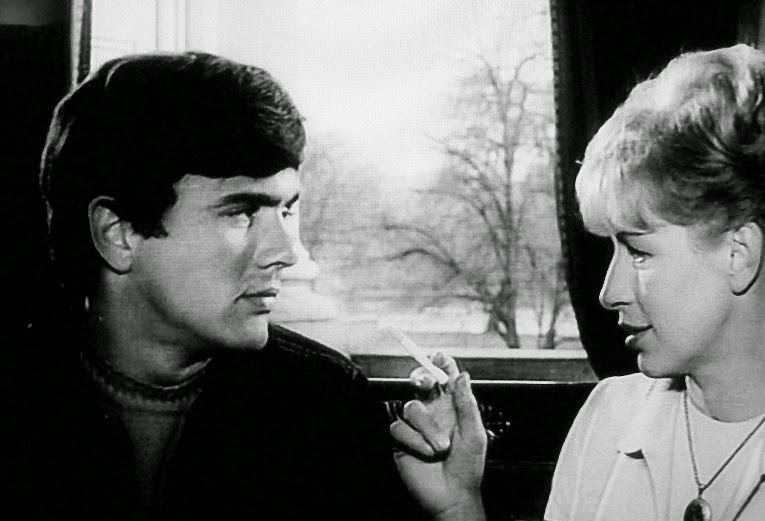
In the wake of the success of the Beatles' film A HARD DAY'S NIGHT, it's not surprising that other British Invasion bands got their own movies. This one, which features the Dave Clark Five, is a little different. The band, like the Beatles, came off as playful, stomping, fun-loving guys, but the movie they're in is anything but dumb fun. The Five play TV stunt men who have been hired to appear in an ad campaign for meat, in support of Dinah, the young and lovely model whose face has already appeared on a slew of billboards with slogans like "Meat for Go!" Dinah (Barbara Ferris) hits it off with Steve (Dave Clark), the most serious of the stuntmen and, feeling hemmed in by the demands of her bosses, she takes off in a car with Steve during an ad shoot; they plan to visit a nearby island, and on the way they wind up in a number of situations: publicly subverting the meat campaign, being asked for pot and heroin by some stoned homeless hippies, getting in the middle of military war games, and meeting a hip, middle-aged couple who collect pop culture ephemera. Meanwhile, the chief ad executive tells the press that Dinah has been kidnapped, so everyone (the ad men, the police, the rest of the stuntmen) goes looking for them. Monday, July 21, 2014
HAVING A WILD WEEKEND (1965)
aka CATCH US IF YOU CAN
In the wake of the success of the Beatles' film A HARD DAY'S NIGHT, it's not surprising that other British Invasion bands got their own movies. This one, which features the Dave Clark Five, is a little different. The band, like the Beatles, came off as playful, stomping, fun-loving guys, but the movie they're in is anything but dumb fun. The Five play TV stunt men who have been hired to appear in an ad campaign for meat, in support of Dinah, the young and lovely model whose face has already appeared on a slew of billboards with slogans like "Meat for Go!" Dinah (Barbara Ferris) hits it off with Steve (Dave Clark), the most serious of the stuntmen and, feeling hemmed in by the demands of her bosses, she takes off in a car with Steve during an ad shoot; they plan to visit a nearby island, and on the way they wind up in a number of situations: publicly subverting the meat campaign, being asked for pot and heroin by some stoned homeless hippies, getting in the middle of military war games, and meeting a hip, middle-aged couple who collect pop culture ephemera. Meanwhile, the chief ad executive tells the press that Dinah has been kidnapped, so everyone (the ad men, the police, the rest of the stuntmen) goes looking for them.
It feels a bit as if the screenwriter took the five-minute segment from HARD DAY'S NIGHT in which George Harrison winds up in an advertising executive's office mocking their latest teeny-bopper star and spun a whole movie out of it. There is a lot of comic potential here, but first-time director John Boorman (DELIVERANCE, EXCALIBUR) is in a serious, almost somber mood that winds up giving the whole enterprise a schizophrenic feel. It's in black and white and most of the scenes with Ferris and Clark, which make up more than half the film, are kin to the serious social issue British films of the era (ROOM AT THE TOP, BILLY LIAR) with little laugh-out-loud humor. But the film is punctuated with wacky setpieces mostly involving the rest of the Dave Clark Five, bouncing on trampolines and holding wild parties; the most successful sequence is a costume party which features people dressed up as pop icons (Harpo Marx, Jean Harlow, the Frankenstein monster). But the wacky scenes feel out of place here, partly because Ferris and Clark are very good in their roles, as are Robin Bailey and Yootha Joyce (pictured with Clark) as the couple they spend most of the movie with. Some nice tidbits: Joyce calls Clark "saturine and well-built"; Bailey remarks that "young people are callously hopeful"; one message of the movie is delivered by Ferris to Clark: "Why can't you enjoy the journey?" The ending is downbeat, though certainly not tragic, and it's no surprise that this didn't do well at the box office given the way it was promoted as a rollicking rock & roll comedy (there are Dave Clark Five songs used in the background, but the guys never play music onscreen). Boorman's use of arty cinematography feels much more self-conscious than Richard Lester's in the Beatles movies. Not recommended for a feel-good lark, but very interesting if approached as a fairly serious meditation on mass media. [Warner Archive streaming]
In the wake of the success of the Beatles' film A HARD DAY'S NIGHT, it's not surprising that other British Invasion bands got their own movies. This one, which features the Dave Clark Five, is a little different. The band, like the Beatles, came off as playful, stomping, fun-loving guys, but the movie they're in is anything but dumb fun. The Five play TV stunt men who have been hired to appear in an ad campaign for meat, in support of Dinah, the young and lovely model whose face has already appeared on a slew of billboards with slogans like "Meat for Go!" Dinah (Barbara Ferris) hits it off with Steve (Dave Clark), the most serious of the stuntmen and, feeling hemmed in by the demands of her bosses, she takes off in a car with Steve during an ad shoot; they plan to visit a nearby island, and on the way they wind up in a number of situations: publicly subverting the meat campaign, being asked for pot and heroin by some stoned homeless hippies, getting in the middle of military war games, and meeting a hip, middle-aged couple who collect pop culture ephemera. Meanwhile, the chief ad executive tells the press that Dinah has been kidnapped, so everyone (the ad men, the police, the rest of the stuntmen) goes looking for them. Friday, July 18, 2014
BILLY THE KID (1930)
I’m used to Hollywood versions of historical events being glamorized and falsified, but I admit I was taken aback by this ending, especially when most folks, if they know nothing else about Billy the Kid, know he was killed by Pat Garrett. As is usual with this story, Billy is played by someone too old (the Kid was 21 when he died and Brown, pictured, was 26 and looked more like 30), though Brown is fine in the role, and Beery is also good as Garrett, underplaying instead of engaging in his usual scene-stealing. Johnson is a blank as the Sweet Flower of Eastern Womanhood, though supporting players Roscoe Ates (as comic relief) and James Marcus (the bad guy Donovan) stand out. Compare this with the 1941 Robert Taylor version ; the later movie is better but this one is more than passable if taken as just a western tale. [TCM]
Wednesday, July 16, 2014
WATERFRONT (1939)
Monday, July 14, 2014
THE FLEET’S IN (1942)
This cute Paramount musical was filmed in late 1941 before Pearl Harbor, though it was released in early 1942, after the United States entered the war, so it occupies a strange narrative place. In the movie, there is no mention of war; in fact, Holden refers to having one last short stint in the Pacific before his Navy duties are over, something that probably would have rung false to moviegoers of 1942. The plot is a variation on the Astaire/Rogers movies in which a mismatched couple slowly fall in love. This doesn't have the wit or visual style of those films; it relies more on physical comedy, and your tolerance for the wacky stylings of Betty Hutton will determine how much of this you will sit through. I lasted til the end but just barely. The very young William Holden (pictured to the right of Bracken) is quite comely and creates an interesting character: he's not shy in the obvious comical way that most actors of the time would have been, but instead he seems more like a thoughtful, quiet young man still figuring out his place in the world. Lamour is brittle and fairly unappealing; I didn't know what Holden saw in her that made him continue with his mild pursuit. I'm not a fan of Hutton, and this movie didn't change my mind, but she does have one good number, "Arthur Murray Taught Me to Dance in a Hurry." I like Bracken and he's fine here, managing the tricky task of being the comic sidekick without going overboard and becoming irritating. Jimmy Dorsey and his band perform backup throughout and there are two standards in the soundtrack, "Tangerine" (which became a hit again in the disco era) and "I Remember You." Also with Gil Lamb, a tall Ray Bolger-type dancer, and Big Band performers Jimmy Dorsey, Helen O'Connell and Bob Eberly. Cute but not essential. [TCM]
Friday, July 11, 2014
DJANGO (1966)
"Spaghetti Western" is the term for an Western film shot in Italy, by Italian directors and with an Italian cast, though set in the American Old West and featuring an American or British star in the lead role. The plot typically involves a loner hero or anti-hero who arrives in a town and is caught between two battling factions. He usually kicks the bad guys' asses then leaves town. I have seen very few of these except for the archetypal one, THE GOOD THE BAD AND THE UGLY which was Clint Eastwood's breakout movie role, but I saw that years ago on a tiny tabletop TV, not letterboxed, so my memory of it is very dim. So I'm calling DJANGO my first spaghetti Western. Django (Franco Nero, pictured) comes into a very muddy town dragging a coffin behind him. The nearly-empty frontier town has been ruined by a war between a gang of Mexican bandits and a group of proto-Ku Klux Klan Southerners led by Major Jackson. Django sees a woman being whipped by some ugly men; she's Maria, a prostitute who has made the mistake of selling herself to both the Mexicans and the Confederates. The Mexicans who are whipping her are shot to death by a gang of Confederates, but when they decide to burn her at the stake, Django kills the Confederates and takes her back to the saloon/brothel which is about the only going concern left. Django is on neither side in the small war; out for revenge against Major Jackson, he seems to buddy up to the Mexicans, but later he steals a huge fortune in gold from the bandits. There are a couple of startling scenes of slaughter and a torture scene in which a monk has his ear cut off and is forced to eat it. Ultimately, Django is punished by having both his hands broken, and yet in the tense climax, he manages to come out on top anyway.
This is violent and nihilistic, and entertaining. The character of Django is the perfect anti-hero: we can't really condone much of what he does, but because everyone else around him is pretty much evil and he seems to be acting out of a need for personal vengeance, we're on his side most of the time. Nero is handsome and charismatic; even though he is caked in mud all through the movie, everyone else is even filthier. No one else comes close to being very likeable—Maria has been wronged, for sure, but we never get to know her very well; Nathaniel, the saloon owner and pimp, seems harmless; and everyone else is a bastard. Though there is lots of violence, it's not as gory as it would have been if made twenty years later; for example, the ear slicing scene is not nearly as graphic as Quentin Tarentino's similar moment in RESERVOIR DOGS. The presence of a machine gun seems anachronistic, but why bother about details? I don't think I’ll be going on a spaghetti Western jag anytime soon, but I did enjoy this. [DVD]Tuesday, July 08, 2014
HERCULES AND THE PRINCESS OF TROY (1965 TV-movie)
Monday, July 07, 2014
THE MAGIC CARPET (1951)
Thursday, July 03, 2014
RIDERS OF THE PURPLE SAGE (1941)
This is based on a novel by Zane Grey which is considered one of the most popular and influential western novels ever; it has been filmed at least five times, as far back as 1918 and as recently as 1996 (for TV). I know the title mostly because of its adoption by a Grateful Dead country-rock band, the New Riders of the Purple Sage. I was a little disappointed that the story was nothing special—perhaps an early version of the "loner on the range" plotline—but the movie itself is entertaining. I'm a big fan of George Montgomery's 40s movies; he's a solid B-movie substitute for Clark Gable or Tyrone Power, and he's very good here. Howard is mostly unmemorable and Gillette is handsome but bland, but other supporting actors are worth catching, including Barrat, Kane Richmond as the judge’s son (pictured to the right of Montgomery), and Richard Lane as a vigilante. Little Patsy Patterson does a nice job as Howard's daughter though she never appeared in another film, and Oscar O’Shea is decent comic relief as a loveable old coot. The last fifteen minutes, including Montgomery facing a whole gang of vigilantes as he tries to rescue the kidnapped Patterson, are exciting. [FMC]
Wednesday, July 02, 2014
SCREAMING EAGLES (1956)
Monday, June 30, 2014
BORN TO BE BAD (1950)
Though sometimes referred to as a film noir, this is really a romantic melodrama and a very enjoyable one. I'm not a big Fontaine fan; she's OK here, giving her phony simpering an edge, but I couldn't help imagine how much better someone like Lauren Bacall or Audrey Totter or Lana Turner would have been. But the supporting cast is a great one. Ryan, in potentially dangerous good guy/bad guy mode, is at his most appealing, not just physically but as a character. He seemed too smart to let himself be used by Fontaine the way he is, but he's also the heart of the movie. Even if you've not been a fan of Ryan's in the past, I think you'll like him here. Scott is almost as good as the nice-guy millionaire who can't quite figure out what’s going on. I also enjoyed Mel Ferrer as Gobby, a bohemian artist who is friends with everyone, who paints a portrait of Fontaine, and is also the only one who knows what's going on all the time. The character is coded (fairly openly) as gay, so he winds up as the passive observer who, in an amusing scene at the end, is the only one to get anything good out of his relationship with Fontaine. Virginia Farmer has a small but crucial role as Fontaine's Aunt Clara. Well acted, nicely shot, this feels like a low-rent ALL ABOUT EVE—not a slam, but actually a compliment. One last detail: it seems like there are more kiss-clinches in this movie than I can remember in any non-romance film I've ever seen; I hope Fontaine and her leading men had lots of breath mints handy. [TCM]
Friday, June 27, 2014
PERFECT UNDERSTANDING (1933)
This is one of several movies from the pre-Code days that took as a subject the search for a better kind of marriage, one that wouldn’t degrade either partner and would allow a certain amount of freedom in matters of work and play. Of course, the real subject is, a better kind of marriage is poppycock and traditional marriage still works best. The plot is predictable and the dialogue no better than it needs to be, but the movie is worth seeing for its two stars. Silent star Swanson (pictured with Olivier) only made a handful of talkies after this one, but she's fine here, as is Olivier who wasn't terribly self-important yet. He's quite handsome and a little bit scrawny as we see in the Cannes beach scenes. Halliday adopts a thick accent and it seems to hamper his acting a bit. Swanson's real-life husband Michael Farmer plays George, and despite the overwhelming critical consensus that he can't act, I thought he was OK. Nora Swinburne is Stephanie and Nigel Playfair has some fun as Lord Portleigh. The director, Cyril Gardner, gives the movie some nice stylistic touches—long tracking shots, montages, interesting shots—but the background music is almost never-ending and occasionally got on my nerves. Future director Michael Powell wrote the screenplay. [TCM]
Thursday, June 26, 2014
THE WITCH’S CURSE (1962)
aka MACISTE IN HELL
In 1550s Scotland, Martha Gunt is being burned as a witch; she goes to her death proclaiming that the presiding judge, Parrish, is getting revenge against her because she wouldn’t sleep with him and she as she dies, she curses the village, specifically the very ground she is burned on. One hundred years later, a gnarled tree has grown at the spot of her death; the curse causes girls from the town to hang themselves from the tree, which then blooms after their deaths. A descendent of the witch, also named Martha, has arrived in town to marry her boyfriend Charley and spend their honeymoon in the old Gunt castle, but when the villagers get wind of this, they grab their torches and head to the castle to kill Martha, hoping this will lift the curse.
Up to now, this has been a standard 60s horror film as ground out by Hammer Films or American International. But suddenly, who should show up in the middle of the night but Maciste, the Italian muscular, shirtless action hero, riding a horse and ready to kick some torch-wielding villager ass. He saves Martha and Charley from death, but cannot stop the officials from carting her off to jail, where she's to be burned as a witch the next day unless Maciste can break the curse. He heads off to the witch's tree, uproots it enough to go down into the ground beneath it, and enters Hell itself where he looks for the old witch Martha to try and convince her to call off the curse.
There is something almost charming about this odd sloppy hybrid. They don't even try to explain what the Hercules-era Maciste from Italy is doing in 17th century Scotland. The moment when the loinclothed hunk comes riding out of the night to save Martha is jolting in a fun way. The first shots of Hell, with dozens of underdressed people writhing in torture, are impressive, though as Maciste travels on, Hell feels rather sparsely populated. He runs across the old witch Martha who, in a nice touch, is hanging around with Judge Parrish, the man who put her to death. Among his hellish adventures: he meets Prometheus who has his intestines eternally pecked at by an eagle; gets his hands badly burned, then healed by a mysterious lovely lady; loses his memory then has it restored by looking into a magic pool to see his exploits of the past—by way of scenes from previous Maciste movies; and has to deal with an avalanche and some stampeding bulls. Kirk Morris—actually, an Italian actor named Adriano Bellini (pictured)—is likeable and boyishly cute in addition to being lithely hunky. And while I’m on the subject, Angelo Zanolli is quite handsome as Charley, who stands by his new bride even to the extent of climbing up to the stake with her as she's about to be burned. Something a little different for horror and/or peplum fans. [DVD]
Up to now, this has been a standard 60s horror film as ground out by Hammer Films or American International. But suddenly, who should show up in the middle of the night but Maciste, the Italian muscular, shirtless action hero, riding a horse and ready to kick some torch-wielding villager ass. He saves Martha and Charley from death, but cannot stop the officials from carting her off to jail, where she's to be burned as a witch the next day unless Maciste can break the curse. He heads off to the witch's tree, uproots it enough to go down into the ground beneath it, and enters Hell itself where he looks for the old witch Martha to try and convince her to call off the curse.
Wednesday, June 25, 2014
LA BATAILLE DU RAIL (1946)
aka THE BATTLE OF THE RAILS
This WWII fiction film about French railway workers who became part of the Resistance by sabotaging rail traffic in the occupied zone is unusual in a few ways. It's not a documentary, though it often feels like one—and it is rumored that some actual footage of sabotage missions made it into the final film. Many of the actors were non-professionals. Perhaps in the service of verisimilitude, none of the characters is developed, and only one, the chief guy in the office who is also directing the resistance efforts, is in enough scenes to become familiar to us. Instead of a narrative, the film is structured in chronological episodes just before, during and after D-Day, ending with the liberation of the town of St. Andre. In the beginning, we see small acts of smuggling—of packages and people—followed by the fairly subtle delaying of the arrival of trains packed with German soldiers. As the narrator tells us, the railmen's acts of sabotage were "grains of sand" to make grit in the Nazi war machine. The film does build to a climax of sorts when the railroad workers hear about the Allied landing; the last part of the movie follows the huge concerted effort to stop soldiers, tanks and weapons from reaching Normandy; the French get some help from an RAF air raid.
Even though we don't get to know any of the characters (who also remain mostly nameless), we do feel for them as individuals working against the evil of the Nazis. One remarkably well-done sequence occurs fairly early in the film; after some trains have been blown up, the Nazis, unable to pin down any saboteurs, take several workers hostage and eventually line them to be killed by a firing squad. The camera looks down the row of men facing a wall (pictured), as one by one they are picked off. Another notable scene near the end shows a train derailment that looks very real. This is an early work by director Rene Clement (FORBIDDEN GAMES, PURPLE NOON); his style is solid and assured, perhaps because he had shot a number of actual documentary films before this one. The print on the DVD from Facets is not in the best shape, and some of the subtitles are a little off when it comes to translating idioms; "Bon appĂ©tit" is shown as "Good appetite," and later odd phrases include "Ain't that a lark!" and "I like to realize…" But this is an oddity worth seeing. [DVD]
This WWII fiction film about French railway workers who became part of the Resistance by sabotaging rail traffic in the occupied zone is unusual in a few ways. It's not a documentary, though it often feels like one—and it is rumored that some actual footage of sabotage missions made it into the final film. Many of the actors were non-professionals. Perhaps in the service of verisimilitude, none of the characters is developed, and only one, the chief guy in the office who is also directing the resistance efforts, is in enough scenes to become familiar to us. Instead of a narrative, the film is structured in chronological episodes just before, during and after D-Day, ending with the liberation of the town of St. Andre. In the beginning, we see small acts of smuggling—of packages and people—followed by the fairly subtle delaying of the arrival of trains packed with German soldiers. As the narrator tells us, the railmen's acts of sabotage were "grains of sand" to make grit in the Nazi war machine. The film does build to a climax of sorts when the railroad workers hear about the Allied landing; the last part of the movie follows the huge concerted effort to stop soldiers, tanks and weapons from reaching Normandy; the French get some help from an RAF air raid. Even though we don't get to know any of the characters (who also remain mostly nameless), we do feel for them as individuals working against the evil of the Nazis. One remarkably well-done sequence occurs fairly early in the film; after some trains have been blown up, the Nazis, unable to pin down any saboteurs, take several workers hostage and eventually line them to be killed by a firing squad. The camera looks down the row of men facing a wall (pictured), as one by one they are picked off. Another notable scene near the end shows a train derailment that looks very real. This is an early work by director Rene Clement (FORBIDDEN GAMES, PURPLE NOON); his style is solid and assured, perhaps because he had shot a number of actual documentary films before this one. The print on the DVD from Facets is not in the best shape, and some of the subtitles are a little off when it comes to translating idioms; "Bon appĂ©tit" is shown as "Good appetite," and later odd phrases include "Ain't that a lark!" and "I like to realize…" But this is an oddity worth seeing. [DVD]
Monday, June 23, 2014
ENEMY AGENTS MEET ELLERY QUEEN (1942)
Police sergeant Velis (James Burke) boards a train to New York; he is escorting Reese, a suspect in the murder of Dutch jewel merchant Van Dorn and they're handcuffed together. Also on board are the very Germanic Heinrich (Sig Ruman) and his henchman who manage to knock Velis out and get Reese away from him, at which point they throw Reese off the train to his death. As it happens, Ellery Queen (William Gargan) and his secretary Nikki (Margaret Lindsay) are also on the train and when Velis is fired by the chief inspector (Charley Grapewin) who is also Queen's father, Queen agrees to help Velis get his job back by digging into the mystery. It winds up involving a mummy case imported from Cairo which has diamonds in it that are being smuggled away from the Nazis by Van Dorn's widow (Gale Sondergaard), and that's what Heinrich and his men are after. I like Gargan but there is so much going on and so many characters that he winds up fading into the background. Even the scene-stealing Sondergaard doesn't get much of a chance to shine. Familiar faces include Gilbert Roland as the mysterious Mr. Gillette, Minor Watson as Commodore Lang, an old friend of the Queens, and James Seay as a Marine who is handy with his fists and who helps Queen out in the fisticuffs-filled finale. This works better as a spy thriller (or a wartime propaganda piece) than as a detective series entry, as there is little to make this seem distinctively an Ellery Queen story. (YouTube)
Friday, June 20, 2014
CREATURE OF DESTRUCTION (1967)
Even by TV-movie standards, this is cheap and mostly lame. A quickie from American International which needed a few new films to flesh out its syndication package, it's a few steps above Ed Wood but don't expect much out of this. The saving grace is Les Tremayne who had a lengthy career in movies, radio and TV, working regularly up to 1990. Though he may be a bit embarrassed about the production around him, he gives a nicely understated performance, sinister but not histrionic. Kincaid (pictured) was pleasant enough as beach movie eye candy, but here he just seems wooden, and his character, who would seem to be the hero, mostly just observes and predicts bad things—and the fact that all his dialogue is post-dubbed doesn't help. The monster itself is a very bad knock-off of the Creature from the Black Lagoon with ping-pong balls for eyes. Most of the night scenes are clearly cloudy-afternoon scenes with no attempt made to darken them. For trash connoisseurs and fans of wooden hunks only. [DVD]
Thursday, June 19, 2014
SINFUL CARGO (1936)
aka YELLOW CARGO
Drug enforcement agent Conrad Nagel is re-assigned to Immigration and sent to Los Angeles to stop a ring of smugglers who are bringing in "Asiatics" illegally. The suspicion is that some bigwig Hollywood type might be behind it, and sure enough, Nagel immediately suspects the owners of Globe Productions, a new company whose big boss, a guy named Brace, is elusive, and whose only director (Jack La Rue) isn't doing much directing. To get an in, Nagel's cover story is that he's a Broadway actor looking for work so has a good reason to hang around Globe's offices. Also suspicious is reporter Eleanor Hunt who, along with her bumbling cameraman (Vince Barnett), haunts Globe's offices trying to get an interview with anyone—she reasons that studios always want publicity, and when one doesn't, it's as newsworthy as "man bites dog." It turns out that Globe is, in fact, a front for the smugglers: they take a small boatload of extras dressed in Chinese garb out to a nearby island to shoot a scene, send the extras back on a commercial boat, and bring the illegal immigrants back on their private boat, seeming to be the same extras that went over. Nagel disguises himself as an extra to investigate, the same day that Hunt and Barnett hide on the island to get pictures. What could go wrong?
This Poverty Row B-movie is a little better than average, partly due to the interesting storyline—though as usual with these cheapies, there are some plotholes here and there to ignore. Nagel, who had a long career as a supporting player and B-star, is fine—he played the same character, Alan O'Connor, in three other movies. La Rue and Barnett are familiar faces to the classic movie fan; La Rue (pictured above with the gun) was very busy, mostly as a villain, credited in more than 50 movies just between 1933 and 1940. I could have done with a little less comic relief from Barnett, and Hunt seems almost like an amateur, but overall this is a fun hour. One highlight is a little girl in the Globe waiting room who wants to know what Shirley Temple has that she doesn't. The movie's director, Crane Wilbur, plays Brace, the head of the ring. [DVD]
Drug enforcement agent Conrad Nagel is re-assigned to Immigration and sent to Los Angeles to stop a ring of smugglers who are bringing in "Asiatics" illegally. The suspicion is that some bigwig Hollywood type might be behind it, and sure enough, Nagel immediately suspects the owners of Globe Productions, a new company whose big boss, a guy named Brace, is elusive, and whose only director (Jack La Rue) isn't doing much directing. To get an in, Nagel's cover story is that he's a Broadway actor looking for work so has a good reason to hang around Globe's offices. Also suspicious is reporter Eleanor Hunt who, along with her bumbling cameraman (Vince Barnett), haunts Globe's offices trying to get an interview with anyone—she reasons that studios always want publicity, and when one doesn't, it's as newsworthy as "man bites dog." It turns out that Globe is, in fact, a front for the smugglers: they take a small boatload of extras dressed in Chinese garb out to a nearby island to shoot a scene, send the extras back on a commercial boat, and bring the illegal immigrants back on their private boat, seeming to be the same extras that went over. Nagel disguises himself as an extra to investigate, the same day that Hunt and Barnett hide on the island to get pictures. What could go wrong?This Poverty Row B-movie is a little better than average, partly due to the interesting storyline—though as usual with these cheapies, there are some plotholes here and there to ignore. Nagel, who had a long career as a supporting player and B-star, is fine—he played the same character, Alan O'Connor, in three other movies. La Rue and Barnett are familiar faces to the classic movie fan; La Rue (pictured above with the gun) was very busy, mostly as a villain, credited in more than 50 movies just between 1933 and 1940. I could have done with a little less comic relief from Barnett, and Hunt seems almost like an amateur, but overall this is a fun hour. One highlight is a little girl in the Globe waiting room who wants to know what Shirley Temple has that she doesn't. The movie's director, Crane Wilbur, plays Brace, the head of the ring. [DVD]
Monday, June 16, 2014
A COLD WIND IN AUGUST (1961)
To us today, this psychodrama is average soap opera material, but in its day, this was probably somewhat daring material. Iris has problems but because of the times, they are not explicitly explained—Juley seems to have been her lover at one time, but they are platonic friends now, even though that frustrates him. It’s not clear if she's what would have been called a "nymphomaniac," or if she has just been, shall we say, underserved by men in the past, and Vito serves her just fine. Of course, a happy ending is not in the cards here, but neither is a tragic ending. Marlowe was almost 30 when the movie was made, but he makes a fairly convincing teenager, all gangly twitchiness and puppy-dog attitude. I was thinking he would have made a good Tony in WEST SIDE STORY. Albright, best known as the sexy singer in the Peter Gunn TV series, takes her character seriously (even if she doesn't get much help from the screenplay) and creates someone likeable rather than evil or perverted—and of course, today, she'd just be considered a healthy "cougar." The low-budget black & white look of the film gives it a nicely gritty feel. [DVD]
Friday, June 13, 2014
THE BLACK TENT (1956)
Charles Holland's brother David (Anthony Steel) was reported dead in action in North Africa during the war; years later, a claim for native reparations with his name on it comes to the attention of Charles (Donald Sinden) who heads off to the desert to find the Bedouin tribe that presented the claim. In flashback, we get David's story: in 1942, badly wounded in a skirmish with the Germans, David made his way to a Bedouin camp and collapsed. The men of the group, tying to stay neutral, are a little nervous but young Mabrouka, daughter of Sheik Salem ben Yussff, tends to him and as he recovers, a romantic attraction develops about which the Sheik is not pleased as she is already promised to another Bedouin. When a German patrol arrives, Mabrouka hides David in some nearby ruins. The man to whom Mabrouka is engaged winds up betraying David, and the Sheik eventually sides with David to fight off a Nazi patrol. He gives his daughter to David in marriage and soon Mabrouka is pregnant, but when David finds out that British troops are near, he feels compelled to join them. On the way, he sacrifices himself to save the Sheik. Back in the present day, as Charles learns the truth, he tries to talk Mabrouka into letting him take their light-skinned child back to England to claim his inheritance.An odd little film; not a war movie as implied by the poster, but a romantic melodrama set against a war background, and an action movie fan would not find much excitement here. The whole idea of the Anglo falling for the Exotic Other and going native is hardly new—this was the basis of many romance films from Valentino's THE SHIEK onward—nevertheless, the plot is just different enough to hold interest. I've just recently discovered the minor pleasures of Anthony Steel as a B-movie leading man, and he is good in this, though Andre Morrell may be better as the Sheik who actually grows and changes during the film (as do both Holland brothers, leading to an ending which is predictable but satisfying). A young Donald Pleasance with a duskied-up face has a small role. Not bad for a second-feature melodrama. [Netflix streaming]
Wednesday, June 11, 2014
LOOSE ANKLES (1930)
This is a cute comedy, helped immensely by the attractive and likeable duo of Young and Fairbanks; she's sexy and fizzy, he's handsome and charming. The two largely vanish during the long speakeasy sequence at the end as the aunts and gigolos take over, to good comic effect. Fine support is given by Louise Fazenda (Aunt Sarah) who sounds like the Wicked Witch of the West when she shrieks at Young, "You purple woman! You lavender woman! ... You rainbow!!" I also liked cute Eddie Nugent as Andy, one of the gigolos, whom we first see lolling naked in the bathtub. Though this may not be top-drawer pre-Code material—the story is thin and predictable—it is a lot of fun. [TCM]
Sunday, June 08, 2014
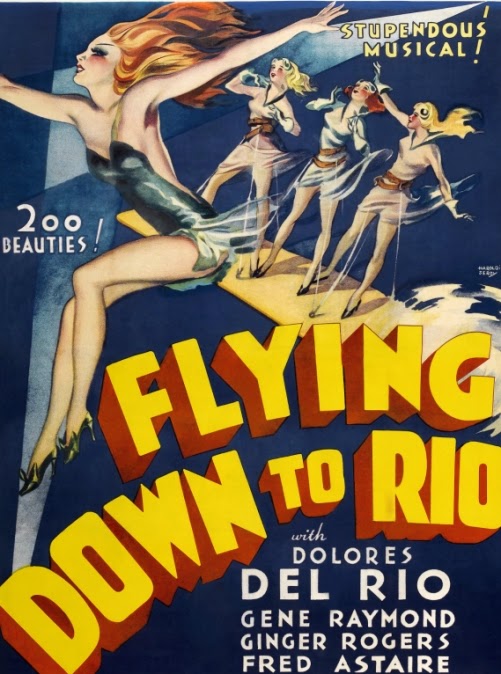
FLYING DOWN TO RIO (1933)
This musical concerning the romantic misadventures of a hotel bandleader is remembered today not for its stars, Gene Raymond and Delores del Rio, but for a pair of supporting players who soon would get top billing in their movies: Fred Astaire and Ginger Rogers. At a Miami hotel, Gene Raymond is the flirtatious bandleader (Astaire and Rogers are part of the band) whose shenanigans have gotten him in trouble before, and now he has been strictly warned not to fraternize with any guests. Unfortunately, Brazilian hottie Del Rio arrives and, even though she's engaged, she sets off sparks with Raymond and the band winds up unemployed—but not for long. They get a job at a hotel in Rio, but complications ensue: the hotel, the target of a hostile takeover, is owned by Del Rio's father, and her intended is an old friend of Raymond's. It’s nice to see Astaire and Rogers shine in their comic relief roles, and whenever there's music, Astaire can't resist the rhythm, like he was born to dance. Their production number together, "The Carioca," is fun, though the best sequence in the film, seemingly inspired by Busby Berkeley, is near the end when chorus girls perform strapped onto the wings of a biplane. Raymond is handsome and charming, though Del Rio is flat and listless. Great supporting players Eric Blore and Franklin Pangborn appear all too briefly in the Miami scenes. A pre-Code movie, there are some risquĂ© elements here and there: Rogers wears a very revealing dress in her first song, and the clothes of the girls on the plane blow off. Fun line, in reaction to Del Rio's sex appeal: "What have these South Americans got below the equator that we haven't?" A fun movie that sparkles even more whenever Astaire and Rogers are front and center. [DVD]
Thursday, June 05, 2014
THOR AND THE AMAZON WOMEN (1963)
Wednesday, June 04, 2014
HONOLULU (1939)
Though no timeless classic, this is a small-scale delight. Young does a very nice job in both roles (pictured above), even if the characters of Mason and Smith aren't really all that different. Powell is perfectly charming, as is Gracie Allen as her sidekick. Normally when Gracie was in a movie with her real-life husband George Burns, the two were paired in their patented "dumb bunny" comic routines, but here they don't meet until the end and their brief bit is not nearly as funny as Allen's earlier shtick—and Burns himself has little to do as the agent. Rita Johnson is amusing, especially since she sounds a bit like Madeline Kahn. Also with Eddie 'Rochester' Anderson as a butler and Ruth Hussey as an actress in Mason's latest movie (she’s in the first 2 minutes and then vanishes). There's a cute production number at a costume party where guests come as their favorite movie star—Gracie Allen appears as Mae West with Marx Brothers imitators, including two Grouchos. My favorite comedic moment comes from Rochester who tries to multiply 6 times 8; after some thought, he says drily, "Let’s call it 30." There’s a silly plotline involving Smith owing money to his fiancĂ©e's father (Clarence Kolb) but you can ignore that. The rest is fun. [Warner Archive streaming]
Monday, June 02, 2014
SANDS OF THE KALAHARI (1965)
Thursday, May 29, 2014
KIT CARSON (1940)
In the mid-1800s, the western United States was still largely unexplored, and trappers often served as guides for pioneers seeking a route to California. When we meet trapper Kit Carson (Jon Hall, pictured), he is on the road with his buddies Ape (Ward Bond) and Lopez (Harold Huber); they'd be happy to settle in one place for a while, but as Ape puts it, Carson has "horizon fever," always wanting to see what's on the other side of the hill. The three run into an ambush by Shoshone Indians with rifles—Carson suspects that someone has armed them and put them up to mischief—but they escape. When they arrive at Fort Bridger in Wyoming, the last outpost of civilization before the long trek to California, and just when it seems like Carson might agree to stay a spell, he gets talked into guiding a wagon train of settlers led by Paul Terry (Clayton Moore) to California. For a while, they're accompanied by a group of cavalry led by Captain Fremont (Dana Andrews). Both Carson and Fremont wind up smitten with young and lovely settler Dolores Murphy (Lynn Bari); she seems to favor Carson at first, but soon comes to find him a bit too "savage" for her taste, a judgment triggered primarily by the way he and his men torture a captured Indian to get information—though as it turns out, the Indian is actually a Mexican, and Carson realizes that the Mexican General Castro is the mastermind behind the attacking Shoshones, trying to scare away settlers. Fremont and his men take their leave of Carson and Terry's wagon train, but further attacks drive them back together, and soon Carson and Fremont have put aside their differences to plan their move against Castro.This indie western/adventure is quite fun, more compelling than many of the big studio westerns of the era. Part of it, somewhat surprisingly, is the solid acting. I don't typically associate Jon Hall, beefcakey star of mid-40s exotic adventure tales like ARABIAN NIGHTS, with good acting, but he makes a fine laid-back hero here, and Andrews is a good foil for him. Bari is just as good, and I like the fact that at the end, even though she settles for Andrews, she still seems torn between the two. Ward Bond makes a perfect sidekick to Hall, and distinctive-looking character actress Renie Riano does the same for Bari. Clayton Moore is surprisingly handsome as Terry—I'm more used to seeing Moore as the masked Lone Ranger—though he's not around very long. Good old C. Henry Gordon is quite villainous as Castro. The film also looks good—it helps that some of this was shot on locations in Utah and Arizona rather than just on Hollywood sets. I suspect that this strays pretty far from historical truth, but what 40s historical film doesn't? Good fun. [Netflix streaming]
Tuesday, May 27, 2014
NOCTURNE (1946)
But most everything else about this movie works well. The stylish cinematography is by Harry J. Wild, who did noirs, westerns, and even a couple of Tarzan movies. The director, Edwin L. Marin, though not especially distinguished, also had a wide range of genres under his belt. The best acting comes from Bari, a B-heroine stalwart (pictured above with Raft), and Pevney (pictured at right) who went on to be a very busy movie and TV director (best known for several episodes of the original Star Trek series). But even most of the supporting actors down to the smaller roles are good: Myrna Dell as the tarty Susan, Mabel Paige as Raft's mother, Bern Hoffman as the chunky Torp, John Banner as a gayish photographer. Even Edward Ashley as Vincent, whom we only see for two minutes, makes an impression. There’s a great windy night scene and a cute moment in which Raft visits Bari on the RKO lot and we see actual sets from SINBAD THE SAILOR. Despite the lackluster central performance, this is a solid noir that is worth seeing. [TCM]
Friday, May 23, 2014
THE SPY IN BLACK (1939)
This WWI spy thriller was released just months before WWII broke out, and indeed watching it now, it’s easy to see it as a WWII story as there seems to have been little effort at giving the sets and costumes a period look. It also plays out like the average WWII spy story, though the setting on an isolated island is unusual. The lead actors are all very good: Conrad Veidt, best known as CASABLANCA's Major Strasser, is Hardt, a humanized German whom we actually like, even if we don't want his mission to succeed; Valerie Hobson as Anne (or, technically the spy who takes Anne's place, pictured above with Veidt) and Sebastian Stan as Ashington are fine, as is Marius Goring as a German officer. Torin Thatcher, who I know as the villain in JACK THE GIANT KILLER, one of my favorite movies as a kid, plays a German soldier. The first half plays out at leisure, allowing character development; the last section becomes more suspenseful but also a bit cluttered in terms of plot points. The print I saw on TCM was murky and scratchy, and had a few dead audio spots. [TCM]
Thursday, May 22, 2014
DIARY OF A LOST GIRL (1929)
Thymian lives with her father above his drug store. On the day that she is being confirmed, the housekeeper is sacked for being pregnant and later kills herself, even as Dad hires a new one named Meta who quickly becomes his mistress. That night, Thymian is raped by her father's sales partner and becomes pregnant; her child is given away and she is sent to a home for wayward girls (when a few of those girls flirt with her) run by a sadistic lesbian disciplinarian. She escapes and meets up with the dissolute and penniless Count Osdorff who installs her in a brothel (as a dance instructor, in theory). Eventually, Osdorff marries Thymian, not out of love but convenience, and when her father dies, she gives her inheritance to Meta who, with her kids, has been left in bad straits. Osdorff, who was counting on that money, jumps out their window to his death. And et cetera until Thymian winds up more or less on an even keel thanks to the Count's uncle becoming her sugar daddy.This German silent movie crams in enough plot for an entire season of a nighttime soap opera, and not always very skillfully, but there are at least two reasons to see it: the stylish direction of G.W. Pabst (PANDORA'S BOX, THE WHITE HELL OF PITZ PALU) and the lead performance of Louise Brooks as Thymian. She is riveting, even if she doesn't quite get to shine as she did as Lulu in PANDORA'S BOX. Her character here, like Lulu, is knocked around by life but Thymian doesn't have the same tragic ending as Lulu; she may wind up unfulfilled and relatively unhappy but she's respectable. At one point, she is referred to as "lost, as we all are" and the last message of the film, delivered by the sugar daddy, is "With a little more love, no one on this earth would ever be lost." Maybe, but the moral hypocrisy of the middle class is seen as the primary source of the "lost girl's" misery. At any rate, this is enjoyable on three levels: as a sensationalistic tract, as a exercise in visual style, and for a rare chance to see Brooks before her too-short career ended. [DVD]
Monday, May 19, 2014
WAR GODS OF BABYLON (1962)
There aren't enough shirtless studs here for this to qualify as a muscleman movie (hell, there aren't any as far as I could see), but as a low-budget Italian action epic, it works well. The narrative is clear and has just enough intrigue to make it fun to follow. I have no idea if any of this is grounded in history; Nineveh and Babylon are both in the Bible, there was an Iranian priest named Zoroaster, and one secondary character is named Hammurabi which is the name of a Babylonian king—but does it really matter? American actor Howard Duff brings some understated gravitas to the role of Sardanapolos, and Luciano Marini (pictured) is a handsome-enough Samos. The battle scenes are so-so, but the climactic flood destruction is quite impressive, even though much of it was clearly done with miniatures. Interestingly, one major character gets killed off earlier than you would expect. Recommend for the 60s epic fan. [DVD]
Thursday, May 15, 2014
KNIVES OF THE AVENGER (1966)
On a beach, an old oracle named Jona tells Karin that her Viking husband Arald, missing at sea for years, will return soon, but she also tells Karin that she is in danger and should take her son Moki and leave. Slowly, the backstory is revealed: two Viking tribes, one ruled by Rurik and one by Arald's father, were enemies for some time, but they agreed to a peace pact. But on the wedding day of Arald and Karin, Hagen, a rough and brutish warrior who had been hired as a protector of Aarld's people, rides in with the heads of Rurik's wife and son, apparently not realizing that peace had been reached. Arald's father exiles Hagen, but later that day, Rurik and his men ride in, killing the king and razing their village. Rurik himself, his face hidden by a helmet, rapes Karin. Back to the present, where Karin and her son, suspicious of everyone, turn away a hungry blond begger; just as he leaves, a gang of Hagen's brutes attack Karin and the blond man comes back to kick ass, axing the lead attacker right in the chest. Karin gratefully takes him in, and we soon find out that the blond protector is Rurik, and, though he does not reveal his identity to Karin, he suspects that Karin's son is the fruit of his rape. Rurik has turned over a new leaf, but what will happen when: 1) Arald does in fact return, and 2) Hagen also returns with intent to kill Karin and Moki?This Italian action melodrama from Mario Bava, better known for his horror and fantasy films (BLACK SUNDAY, DANGER DIABOLIK) was a very pleasant discovery. Bava’s visual sense is always interesting—though you need to see it widescreen—and the plot and characters are fairly complex for the genre; it combines elements of the western SHANE and the epic tale The Odyssey. The American star who anchors the film is Cameron Mitchell (with his hair dyed radioactive yellow) and he's not bad, even though he doesn’t have the physique one might expect for this Viking hero. Better is Fausto Tozzi (Americanized as Frank Ross) as the vicious Hagen; I never exactly sympathized with him, but he does come off much more rounded than most such stock villains. Both Giacomo Rossi-Stuart (aka Jack Stuart, pictured to the left of Mitchell) as Arald and Elissa Pichelli as Karin are fine. There is a lot of violence but very little gore, and the long one-on-one knife fight between Rurik and Hagen conjures up memories of the big fight in THE QUIET MAN. The theme music is quite catchy. Overall, a little gem. [DVD]
Tuesday, May 13, 2014
Q PLANES (1939)
aka CLOUDS OVER EUROPE
Released just before the outbreak of World War II, this is a delightful little anomaly: a cross between spy thriller and screwball comedy. Ralph Richardson is a slightly eccentric Scotland Yard secret agent who is investigating the problem of why experimental test planes are taking off and disappearing, never to be found. Though his superiors aren't convinced that there's a problem, Richardson gets word that there may be a spy working at Barrett and Ward, the aviation company producing the planes. When a plane carrying something called a Supercharger takes off, we see what's behind the disappearances: men on board a salvage ship called the Viking use a secret new ray to disable the plane and cut off its communications; they pull the plane out of the water, put the pilots in the hold, and steal the apparatus. Except this time, Richardson had the Supercharger taken off at the last minute. Meanwhile, a hotshot pilot (Laurence Olivier) also suspects sabotage at the plant, and he's suspicious of Valerie Hobson, a young woman who works at the plant diner. But it turns out that Hobson is a reporter, and also Richardson's sister. Soon, the three of them are working together to catch the saboteurs.
"Delightful" is the perfect word for this. The breezy tone reminds me of the wonderful NIGHT TRAIN TO MUNICH; the characters are likeable, the actors seem to be having fun, and despite the dangers the characters face, we know they'll come out unscathed—which might not have been the case if the film had been made a couple of years later after the war had taken its toll on Europe. Richardson, who had a penchant for a wee bit of overacting later in his career, is absolutely right as the almost whimsical agent; Olivier (pictured behind Richardson), who also did his share of going over the top, seems to realize there's no competing with Richardson so he plays it fairly straight; Hobson keeps up with them both, doing a nice job with some rapid-fire dialogue. I don't want to push the "screwball" comparison too much, but if an American version had been made, William Powell and Myrna Loy would have been great in the Olivier and Hobson roles, though no one comes to mind to replace Richardson—maybe a young Edmund Gwenn? Very fun and highly recommended. [Criterion streaming]
Thursday, May 08, 2014
THE GRASS IS GREENER (1960)
Cary Grant is a British earl who has fallen on hard times; he and his wife (Deborah Kerr) have turned their mansion into a tourist attraction and have a butler just for show—the butler complains that he has nothing to do; he's trying to write a novel but doesn't have enough insecurity or despair to succeed. When a rich American oilman (Robert Mitchum) arrives, he begins a flirtation with Kerr that leads to a full-fledged affair when she trots off to London for a few days to be with him. Jean Simmons, the friend that Kerr is supposed to be staying with, goes to Grant with stories of Kerr's infidelity. At a house party weekend, Grant plans to get Kerr back, and sarcastic jabs turn into a duel between Grant and Mitchum. And since this is a comedy, things get righted in the end, and the butler winds up with some juicy plotlines for his novel. This was directed by Stanley Donen, and much as I love SINGIN' IN THE RAIN, I have not really liked any other Donen films; his non-Gene Kelly musicals aren't very fizzy and his comedies and caper films fall flat for me. This has potential in the farcical plot and the more than competent actors, but the farce flops and the actors feel at sea. Simmons in particular seems out of place, not so much her as her character who feels wedged in for plotpoint reasons only. There is a very amusing split-screen scene as Grant (with Simmons) talks to Mitchum (with Kerr) on the telephone. Moray Watson (pictured to the left of Mitchum and Grant) does well with the role of the butler. Not terrible but disappointing. [TCM]
Tuesday, May 06, 2014
HUNGRY HILL (1947)
Big multi-generational family saga of two feuding Irish families: the lower-class Donovans and the wealthy Brodricks. Copper John Brodrick starts up a copper mine on land once held by the Donovans, and old Morty Donovan curses them, saying the hill will destroy them. Copper John has four sons, and two of them, Henry and Greyhound John, vie for the affections of the saucy Miss Fanny. When a theft occurs at the mine, the Brodricks accuse the Donovans of being behind it. There follows death, fire and destruction (an especially well-shot scene) and Henry is killed in an explosion. John goes away to become a lawyer, eventually returns and weds Fanny; they raise the next generation of Brodricks (including Wild Johnnie who is, per his name, wild and ill-mannered) who will continue to clash with the Donovans, though Johnnie becomes smitten with a Donovan girl, young Kate. Copper John dies of typhoid, contracted through a Donovan, and Fanny winds up alone, gambling desperately in London, and winding up with the means to end the long feud. There are some nice setpieces, including the above-mentioned fire at the mine and a rare light-hearted moment involving a fiddle player at a fancy party who takes the guests from a slow stately dance to a wild jig. This is based on a novel by Daphne du Maurier; I have not read it, but I suspect that the movie has to drop a lot of plotlines and move quickly through others because of time constraints. What's left is engrossing enough with some decent acting all around: Cecil Parker as Copper John, Dennis Price as Greyhound John, Dermot Walsh as Wild Johnnie, Michael Denison as Henry, Margaret Lockwood as Fanny, and, in other roles, Jean Simmons, Eileen Herlie, and Siobhan McKenna. Pictured are Dennis Price and Margaret Lockwood. [TCM]
Friday, May 02, 2014
THE RELUCTANT SAINT (1962)
In Cupertino Italy in 1623, a young man named Joseph (Maximillian Schell) is growing up, well on the road to becoming the "village idiot"—at 20, he still attends school but the teachers finally tire of him and "graduate" him, leaving him at home with his industrious but impatient mother and his lazy drunken father. Mom convinces her brother, Father Giovanni, to take Joseph in at the local monastery, but he even has a rough time there—sent out on the streets to beg with other novices (to counteract "the poison of vanity"), he is set upon by rowdy youths who steal his robe. The monks make him a stable boy to keep him out of trouble but when a visiting bishop arrives, Joseph makes an impression by explaining the mystery of the Trinity better than a boringly serious monk does, so Father Raspi (Ricardo Montalban) is ordered to have Joseph study for the priesthood. You already know where this is going, don't you? Joseph is a "holy fool" figure, a bit like Saint Francis, and every time it seems like he's going to trip himself up, he is somehow saved; eventually, he does become a priest. But a supernatural aspect soon enters the picture: when Joseph accidently smashes a statue of the Virgin Mary, he takes the head of the statue and prays to it, and while he prays, he levitates. This isn't just in his head; he is seen by others who don't know what to make of it.
This is based on the legend of Joseph of Cupertino who is the patron saint of air travelers, pilots, and poor students, and in outline this is a gentle religious fantasy with the requisite amount of sweetness, humor, and moral lessons, but a mistake in casting makes this somewhat uncomfortable viewing: Maximillian Schell is far too intense (and, over 30 at the time, too mature) to play the holy fool. His brooding intensity doesn't strike the right note, and the intelligence behind Schell's eyes is too obvious for him to be effective even though he tries hard. The plot twists, especially those involved in his attaining of the priesthood, are fun, and Montalban (pictured at left, to the right of Schell) is very good as the skeptical priest who is torn between a genuine fondness for Joseph and worry that the boy's journey will scar him—and belittle the genuine students of the priesthood. The first episode of levitation is pulled off nicely, but by the end, one wishes they had spent some money on special effects or at least some more creative visual approaches. The last shot of Schell floating and Montalban grabbing his robe so he doesn’t take off like a Macy's Day balloon is cute but is badly staged. An odd little movie. [DVD]
Subscribe to:
Posts (Atom)