Wednesday, October 07, 2015

THE MYSTERY OF MR. WONG (1939)

We see a Chinese man on a boat throw a package overboard which is picked up by a man in a motorboat and passed along until it reaches its destination, the home of gem collector Brandon Edwards (Morgan Wallace).  It's a legendary jewel from China called the Eye of the Daughter of the Moon which was lost in the Japanese looting of Nanking and is now in Edwards' possession. But the day before, Edwards got a letter threatening death to the gem's owner so he calls in detective James Lee Wong to investigate. That night, at a party at Edwards' home, an elaborate game called Indications is played, with partygoers acting out charades in short skits. During the charade for a book called "Murder Comes at Midnight," the character Edwards is playing is shot by a gun filled with blanks, but after he falls to the ground, it's discovered that he's actually been shot dead, from a different gun, from a different direction. Among the suspects: Peter (Craig Reynolds), the lover of Edwards' wife Valerie, who has said that he'd kill Edwards if he ever mistreated his wife; Strogonoff, a Russian singer who has been "adopted" by the family and lives with them; a possibly suspicious maid and butler. Wong, his criminologist friend Janney, and police captain Street (Grant Withers) have their work cut out for them.

This is the second in the Mr. Wong series. Wong, usually played by Boris Karloff, is mild-mannered but obviously intelligent and a man of good taste. If it weren’t for the occasional Chinese robe and the atmosphere of Wong's home, Karloff's portrayal is subtle enough that you might not even notice the character's ethnicity. If only for the charades twist, this is the most memorable of the Mr. Wong movies; the Monogram low-budget problems are present in sets and scripting, but the acting is a notch above usual; in addition to the always reliable Karloff, Withers, Reynolds and Wallace are good. The set-up involving a deadly parlor game is pretty much the same that was used in the earlier MURDER AT MIDNIGHT; both were written by Scott Darling. In the above picture, Reynolds is seated at the desk, Karloff is behind him, and Withers is standing to the left. [DVD]

Monday, October 05, 2015

OBSESSION (1949)

aka THE HIDDEN ROOM   

We first see psychiatrist Clive Riordan (Robert Newton) in a low-key, distracted mood at his London men's club. When he returns home early, his wife Storm (Sally Grey) is gone, and when she returns, she's in the company of another man, the young American Bill Kronin (Phil Brown). They claim to have been at a concert, but Clive cleverly catches them in a lie, pulls a gun on Bill, and marches him out of the house. As far as Storm knows, that was the end of the story, but five days later, Bill is reported missing. Clive claims he doesn't know what happened, but we discover that Clive took Bill to an abandoned cellar near his office and chained him up so he has access to a cot and a bathroom but can't escape. Clive holds him for weeks; a bit of cat-and-mouse rapport develops, but Bill has no idea what Clive's plan is: each day, Clive brings in a small amount of acid and pours it in a tub—when the tub is full, he'll put Bill in it. Naturally, there are complications, the first being the Riordan's dog who follows Clive out to the hidden room one day, the second being a Scotland Yard inspector (Naunton Wayne) who starts snooping around.

Robert Newton (pictured) is the glue that holds this together and makes it worth watching. His character is given no background aside from the fact that he's a psychiatrist which in itself would have been interesting to delve into; his relationship with his wife is also not fleshed out. Grey is weak as the wife, perhaps because she is given little to work with—she seems singularly uninterested in Bill's whereabouts even though she was having an affair with him. Brown is better but his character is also flat. Newton, who was known to ham it up (see BLACKBEARD THE PIRATE), is quiet but tightly wound, and keeps the movie fairly tense. I like Naunton Wayne and he gives a nicely sly but understated performance as the cop. The dog and a cat both play important roles in the film's climax. [Criterion streaming]

Saturday, October 03, 2015

SECRET OF THE CHATEAU (1934)

The Duke de Mornay has died, apparently murdered by the notorious Prihec who kills in order to get his hands on rare books. Chief inspector Marotte shows up at the auction of the Duke's books—being run by M. Fos, a well known book dealer—hoping that the killer will also show up. Instead, Marotte runs into Julie Verlaine (Claire Dodd) as she's chatting with the Duke's nephew Paul (Clark Williams) who tells her he is trying to find a buyer for a Gutenberg Bible that belonged to his uncle. Julie is known as a thief who works with her live-in boyfriend Lucien (Jack La Rue); in fact, she has just been released from a short stint in jail, and Marotte lets her know that he's keeping an eye on her. Julie wants to leave behind her life of crime, even if that means leaving Lucien, though out of habit she steals a rare Moliere book at the auction. Paul, thinking Julie is a rare book expert, asks her to visit the chateau to verify the value of the Gutenberg, which is kept under lock and alarm along with a fake copy. At the chateau, there are troubled waters: Paul's aunt, Mme. Rombiere, argues that she owns half of the Bible and she wants a say in how it's disposed of; M. Bardou, the executor of the will, wants to donate it to a museum. Also at the chateau: Didi (Alice White), a frisky former lover of Paul's who wants some of the money he may come into; the butler Martin and his wife, the cook, both of whom have only been employed there for a few weeks; and Professor Racque, a book seller who claims to have been promised books from the Duke's collection. For various reasons, all stay the night in the chateau, and at midnight, the tower bell mysteriously rings out. Legend has it that whenever the bell rings, death will follow, and sure enough, later in the night, there's a scream, a gunshot, and the ringing of the bible's alarm bell, all simultaneously. The Bible is gone and Bardou is dead, though Marotte believes that the theft and the killing were done by two different people. How many more will die before Marotte gets to the bottom of the mystery?

Though originally sold to television in the 50s as part of Universal's famous Shock Theater package of horror films, this is not horror, nor does it really belong to the "old dark house" genre. It's just a traditional crime/mystery B-film, though an entertaining and well-paced one. The movie has a very light tone with a fair amount of comic relief which I thought worked well, though not all reviewers agree. George E. Stone does his usual comic sidekick role to good effect (in one scene, he tries to oil the hinges of a squeaking door with salad dressing), and Alice White brings a nice jolt of energy to the proceedings in all of her scenes. Dodd is fine; Williams may be a little low on passion as the romantic lead, but he's handsome and otherwise serviceable. Osgood Perkins, father of actor Anthony, is good as the suspicious butler, as is Ferdinand Gottschalk as the inspector. No earthshaker, and definitely not a pick for horror night, but a nice way for a fan of B-mysteries to pass an hour. Pictured above right are White and Stone; at left are Dodd and Williams. [YouTube]

Friday, October 02, 2015

MR. WONG, DETECTIVE (1938)

Businessman Simon Dayton feels threatened and has detective James Lee Wong brought in protect him. Dayton and his business partners Meisel and Wilk are shipping out a new chemical weapon and Dayton feels paranoid, mostly because inventor Carl Roemer claims that the men stole his formula and Dayton fears he may make trouble. Meisel and Wilk insist on having Dayton sign legal papers stating that if any one of them dies, the others will inherit the dead man's shares in the company. That very day, Roemer shows up brandishing a gun, demanding money. Roemer is subdued and led out of Dayton's office and the police are called. Moments later, Dayton is found dead in his office, killed by poison gas released from a small glass sphere. Wong has a glassblower reproduce the sphere and runs experiments on what might have caused the sphere to shatter, releasing the deadly gas. Roemer is held as a likely suspect, but when Wilk gets a threatening letter and is found dead from the same gas, Roemer seems to be in the clear and suspicion falls on Meisel. But what about the rather suspicious Russian baron and countess who enter the picture? And when Meisel dies a similar death, the police seem stumped. But Mr. Wong is not…

The two most famous Asian sleuths in Hollywood in the 1930s were Charlie Chan and Mr. Moto. B-studio Monogram introduced a third, Mr. Wong, based on a magazine fiction series by Hugh Wiley. As played by Boris Karloff, he is the least stereotyped of the bunch—he speaks in full English sentences, his make-up is fairly subtle and, though inclined to wear long Chinese robes while at home, there is otherwise little else to differentiate him from any movie detective of the era. This film, the first of six, is generally undistinguished in terms of acting, sets or style, though Karloff is fine—but he vanishes for long stretches of time so that the plot can get more convoluted than it needs to. To be fair, it's fairly easy to follow and I did enjoy the twists in both the identity of the killer and the method he uses to kill. Grant Withers is Sam Street, the cop who partners with Wong in all the films, and the worst I can say about him is that he's colorless. I've seen many of these in the past but have been revisiting the boxed set recently, so I'll review a few more soon. [DVD]

Thursday, October 01, 2015

BOSTON BLACKIE BOOKED ON SUSPICION (1945)

The Boston Blackie movies are light, unpretentious crime stories in which Chester Morris plays the title character, a reformed safecracker who now helps the cops out, usually because he falls under suspicion and has to clear himself. This entry is one of the best in the series. Blackie's rich buddy Arthur Manleder has just bought a rare and used bookstore and on the eve of an important auction, the book expert Kittridge takes ill and cannot be present. Blackie, knowing this could tarnish the store's reputation, disguises himself beneath white hair and a beard as Kittridge and conducts the auction himself. Unfortunately, a very rare signed edition of Dickens' "Pickwick Papers" turns out to be a forgery. The cops suspect Blackie, so he remains in disguise and, with help from his sidekick the Runt and from Kittridge's lovely assistant Gloria, tries to track down the real crook. He discovers that a man named Hadley is the forger, but Hadley is bumped off before Blackie can turn him in. Now Blackie, wanted for murder, doubles down to solve the case, not realizing that Gloria is actually in cahoots with the real crook, Jack Higgins. This hour-long thriller is light on its feet, contains many funny moments—mostly involving Morris, George E. Stone as the Runt, and Richard Lane as his nemesis, Inspector Farraday—and has a good cast. In addition to Morris and Stone, who always work well together, Lynn Merrick is very good as the two-faced gal pal, and it was nice to see one of my favorite B-movie leads, Steve Cochran, as the slimy but handsome bad guy. A nice treat for Boston Blackie fans. Pictured above are Stone, Morris and Cochran. [TCM]

Tuesday, September 29, 2015

LUXURY LINER (1933)

In the same way that GRAND HOTEL followed the intersecting storylines of a number of people staying in a Berlin hotel, this film follows the same formula with a number of people on a luxury liner sailing from Germany to New York City. In an opening vignette, we see the contrast between a young lad excited to get 20 marks for his voyage from his father, and a rich businessman casually tossing a 20 mark tip to a steward. This highlights one of the movie's thematic concerns, the class differences of the passengers, from lower class folks down in steerage to the wealthy up in first class. Among the characters we get to know: Zita Johann is a young nurse with a tragedy in her past that keeps her aloof and a bit mysterious; George Brent is a doctor who boards at the last minute in order to talk his estranged wife out of leaving him; Vivienne Osborne is Brent's wife who may be a bit tightly wound, and the man she's running off with is Frank Morgan, a wealthy shipping magnate; C. Aubrey Smith is a former clothing manufacturer who just got out of jail for embezzlement; Alice White is a flirty little gold-digger who wants to latch onto a man who can get her up to first class, though she’s not above a little flirtation with the cute elevator operator (Henry Wadsworth), both pictured at right.

As in GRAND HOTEL, the plots develop slowly as characters interact with each other. Brent, who arrives at the ship practically in hysterics wanting his wife back, talks the ship's doctor, an old friend of his, into letting let him take over for this trip. As Brent works with Johann and she sees his calm, inspiring bedside manner with a young mother and an elderly woman, she begins to thaw and romantic feelings spring up. Still, Brent confronts Osborne and she brandishes a gun to get him out of her cabin. Later, however, she finds out that her new lover is flirting with an opera singer and she pretty much snaps. Down in steerage, Smith becomes popular when he agrees to help the desperate lower-class travelers invest their money in stocks that White overheard Morgan talking up. By the end, there is a birth, a murder, a suicide, and some financial reversals. Some plotlines end predictably (Brent and Johann), some not (White and Smith). This was an enjoyable melodrama, though the tone remains relatively light throughout despite the murder and suicide. The acting is fine, with Johann, Osborne and White as standouts, and it’s fun to see C. Aubrey Smith out of his comfort zone—rich grandfathers—doing something a little different. This is the second time this summer I've seen Alice White and I think she's an underrated comic actress, with a little bit of a Harlow vibe, though sweeter and more pixieish. I ran across this rarity on YouTube and it's worth digging around to find. [YouTube]

Monday, September 28, 2015

INNER SANCTUM (1948)

An older gentleman (Fritz Leiber) is chatting with a young woman (Eve Miller) on a train, and she comes to believe he may have psychic powers. The rest of the movie is the story he tells her. A woman very much like her gets off a train to meet her lover (Charles Russell, pictured), but during an altercation he accidentally stabs her to death and, while dumping her wrapped-up body in a cargo car on the train, is glimpsed by a young boy (Dale Belding). Russell gets a ride with a friendly newspaper editor to a nearby small town where he finds lodging at a boarding house. The occupants include a harmless drunk, a flirtatious totsy (Mary Beth Hughes), a single mother (Lee Patrick), and, of course, the little boy who saw him at the train station. At first, the boy doesn't realize that Russell was involved in a murder, but soon news reaches the town about the corpse being discovered and Belding, who has to share his bedroom with Russell, starts getting suspicious. Can Russell escape town with Hughes before the boy becomes a threat? Or will the boy become his second victim?

The title, which has nothing to do with the plot, is from a series of mystery books and a radio show from the 40s. Universal produced a series of Inner Sanctum B-movies with Lon Chaney Jr. but this is not related to those, except that it's a mystery with overtones of film noir and the supernatural. As such, it's interesting though there is a tone problem with too much comic relief throughout. The editor and the drunk are both present mostly for comedy purposes, and even Lee Patrick gets her share of humorous lines. Charles Russell, however, is deadly serious and gives a good, tense performance, though at times it seems at odds with every other performance except that of the boy, who does a nice job being both scared and adventurous. If Russell's character was fleshed out more (as it is, we know virtually nothing about him), he'd be a solid noir lead. The supernatural element comes into play in the frame story with Leiber (the father of the fantasy author with the same name) and provides a nice sting at the end of the story. A memorably clichéd exchange: Hughes, to Russell, "You're even too bad for me"; Russell, in reply, "You're very pretty—when those lips aren't moving." [Streaming]

Wednesday, September 23, 2015

HOUSEWIFE (1934)

Bill (George Brent) was once a high school football hero, but now he's an office manager at an advertising firm. He wants to work on ad campaigns, but his boss belittles his every attempt to step outside the boundaries of his job. His wife Nan (Ann Dvorak) encourages him to stand up for himself, but things remain status quo until two things happen: his brother-in-law gets a better job, and his boss hires Pat (Bette Davis), an old school chum of Bill's, as an ad writer, and then humiliates Bill in front of Pat. Nan has saved a little money which she gives to Bill so he can quit and start his own ad agency. He struggles for a while but finally breaks into the big time when he snags Paul (John Halliday), a cosmetics magnate, as a client, even giving him advice about how to boost sales—by slapping a "double strength" label on his skin cream and doubling the price. Soon Bill has a very successful business, and has even hired Pat as a copy writer, which is, of course, the beginning of his downfall when he and Pat start an affair. To muddy the waters even more, Paul, sensing the situation, comes on to Nan. Soon, Bill and Nan head to divorce court until a near-tragedy in the family makes the two reconsider.

Technically, this movie was released a couple of months after the Production Code went into effect, but it gets away with presenting fairly explicitly an extramarital affair without really having to "punish" either of the participants. Davis was near a crossroads in her career—this was the first movie that came out after OF HUMAN BONDAGE made her a sensation—and though Ann Dvorak has the title role, and arguably the more important role, Davis is billed ahead of her and with good reason. Even at half-speed in a supporting part, Davis throws sparks and is the main reason to watch this, though Brent makes for a very appealing lead. Unfortunately, Dvorak comes off rather blandly, though our sympathy still remains with her character. Ruth Donnelly is fun as Dvorak's sister-in-law, and Hobart Cavanaugh and Robert Barrat are fine in supporting roles. This is mild, light-toned if not exactly comic, melodrama and is generally entertaining, but not a major Bette Davis film. Pictured are Davis and Brent. [DVD]

Monday, September 21, 2015

CANDLES AT NINE (1944)

Everard Hope is an cranky old man who lives in a large house in which the rule is, no electric lights after 9:00, only candles—we're never told why; there are references to the wartime blackouts, but this seems to be a family rule from way back. Even his pet parrot constantly squawks out, "Lights, you damned fool, lights!" Everard has collected his relatives in order to have a reading of his will, but the night before, he runs out of his bedroom yelling, "Fire!" and falls down the stairs to his death. It turns out that he's left his money to Dorothea, a chorus girl whom none of the other relatives know. The catch is that she must spend a month living in the house before she can claim the estate. Dorothea is advised by the rather sinister-looking housekeeper Julia that she might be in danger if she accepts the challenge—there is some mystery concerning the death of Everard's brother years ago in a fall from a window in the house, and Julia implies that she might not survive her tenancy. Nevertheless, Dorothea starts spending money she doesn't quite have yet, goes out for drinks with some flirtatious cousins, and moves in. William Gordon, a former detective, has his suspicions about some of the relatives and starts hanging around, trying to keep her safe.

This movie tries to span several genres: old dark house thriller, comedy, musical—we see Dorothea sing and dance at a club—and never really comes together. Horror movie fans in particular are likely to be disappointed at the lack of any real scares. Still, it's kind of fun, with good atmosphere and a scene-stealing performance from Beatrix Lehmann as the housekeeper (pictured), who functions as a kind of Mrs. Danvers character. She and Eliot Makeham (as the cranky old man) are the only ones who really take their roles seriously. The star of the film is Jessie Matthews, a stage and screen star in England, though this wound up being her last major movie before she had a second career on British television. One character says to her, "Gosh! You’re plucky!" but for me, she called to mind a low-energy Ann Miller. There’s also two comic relief brothers (Reginald Purdell and Hugh Dempster) who vie ineptly for Dorothea's hand. A few amusing lines crop up. When we see Dorothea do her act, she is accompanied on stage by Maurice, introduced by the MC as "not her husband and not likely to be." Later the brothers come to visit Dorothea and are told by Julia that she "is in but not at home," to which one of them replies, "Bit of a contortionist, what?" [YouTube]

Friday, September 18, 2015

THE IRON PETTICOAT (1957)

In this Cold War rehash of the Greta Garbo classic NINOTCHKA, Katharine Hepburn plays a Russian pilot who is forced out of the sky when she violates American air space in Germany. The Americans hope that she's a defector, but she claims she left Russia in a fit of pique because a man was promoted over her. She's not interested in being part of any anti-Communist propaganda (she despises the superficiality of American women who are only interested "only in nail polish and false bosoms"), but the Air Force would like to change her mind, so a major (Bob Hope) is put in charge of taking Hepburn to London and softening her up so she'll be a good little defector. Of course, as he tries to convert her, she tries to convert him to socialism, and slowly, despite the presence of Hope's fiancée, they start to fall in love.

Let me repeat that: Katherine Hepburn and Bob Hope fall in love. That is the main gimmick behind this movie, and it plays out as badly as you would expect. Though both actors are professionals and seem to be trying as hard as they can, they both seem very uncomfortable, with the picture above epitomizing their on-screen chemistry. Hepburn's accent is grating (and varies occasionally) and she looks dreadful; Hope mostly acts like he's in a Road movie with Bing Crosby—when someone insults him by calling him a "dog nose," Hope replies, "Oh, you got a little Crosby blood in ya!" Apparently, Hope brought in some of his own gag writers to "polish" the dialogue, and the screenwriter, the legendary Ben Hecht, had his name taken out of the official credits. Hepburn wasn't too happy, either, and the two had a frosty relationship. It's not quite a disaster; if nothing else, I like to tell friends that I've seen a romantic comedy with Hepburn and Hope, and watch their reactions. If you're expecting a Bob Hope comedy, you’ll probably like it, but if you want a Hepburn comedy like The Philadelphia Story or Bringing Up Baby, avoid it like the plague. [TCM]

Tuesday, September 15, 2015

TOO LATE BLUES (1961)

John Cassavetes' first movie for a big studio—and one of his last, as he eventually went on to forge a career as the godfather of American independent cinema—charts the rise and fall of a jazz musician (Bobby Darin) following the typical trajectory of such showbiz tales: hardscrabble beginnings, clashes with fellow musicians over his art, temptation to hit it big by selling out, leaving his buddies in the lurch because he has to follow his own muse, hitting bottom, seeing the error of his ways and maybe making a comeback in the end. Some of Cassavetes' later style is on display here, especially in the interesting camera moves and use of close-ups, but the narrative is slow-moving and several individual scenes go on too long, especially the odd poolroom fight scene between Darin's combo and a punk (Vince Edwards). Darin is good, if a bit of a cold fish, as the pianist torn between art and commercialism; Stella Stevens is very good as a somewhat neurotic (but in mostly a low-key fashion) young singer who Darin discovers and adds to his band; the actors playing the band members, including a young and surprisingly boyish Seymour Cassel, give naturalistic performances, though the music was actually played by pros including Benny Carter, Jimmy Rowles and Tommy Tedesco. The standout performance is given by Everett Chambers as Darin's agent who actually comes across as the most complex character—he cares about Darin, but he also cares about the band and making money, and he occasionally sleeps with Stevens. He acts sometimes in reprehensible ways but he's not a one-note villain. Chambers (pictured above with Darin behind him) left acting for a career in TV producing (including Peyton Place, Columbo, and Cassavetes' short-lived jazz/detective show Johnny Staccato). Marilyn Clark has a small role as a middle-aged woman who "keeps" Darin for a time. The score by David Raksin is fine, especially the fun opening number played by the band for a group of children. [TCM]

Friday, September 11, 2015

THE LOST VOLCANO (1950)

aka BOMBA AND THE LOST VOLCANO

Zoologist Paul Gordon (Donald Woods) is living with his wife Ruth and young son David in the middle of an African jungle, studying animals. David occasionally goes off to roam the wilds with his buddy Bomba the Jungle Boy, who has even provided him with a matching loincloth, but Paul and Ruth think Bomba is an imaginary friend. However, we have seen Bomba (Johnny Sheffield) secretly free some animals that Paul and his men captured one night. Meanwhile, Dr. Langley, an ethnologist from the Cairo Museum, shows up with his assistants Barton and Higgins, and wants to hire Paul to take them to find a dormant volcano which may point them toward a buried lost city. At first, Paul declines, saying he wants to take his family back to civilization, but soon, a jewel-studded knife that Bomba found near the volcano and gave to David as a gift ups the ante. Barton and Higgins volunteer to take David back to the city so Paul can lead their expedition, but actually the two kidnap David and try to force him to take them to the volcano so they can get their hands on whatever treasures there may be. Paul and Ruth and Langley go after the men. When Bomba gets in on the chase, there's all kinds of excitement: Barton shoots Bomba's vine in two, a python attacks Higgins, Bomba wrestles a crocodile, there’s more gunplay, and of course, guess which volcano suddenly picks this time to get active?

By now in the series, Bomba is a Jungle Teenager—Sheffield was 19—but he can still pull off some stand-offish charm, or charming stand-offishness, though it's clear Bomba would rather horse around with kids than start dating. This is the first Bomba movie that doesn't provide a young woman who falls for Bomba, and that's OK. One critic notes disparagingly that Sheffield has a wrestler's build rather than a swimmer's build like Johnny Weissmuller had as Tarzan—Weissmuller may have been, early in the Tarzan series, sleeker and more aesthetically pleasing, but Sheffield is just a different kind of beefcake. Young Tommy Ivo is fine as David, his character clearly intended to help skew the audience toward children. Woods and Marjorie Lord are adequate in the adult leads, and John Ridgely, on a downhill slide from his heyday as a supporting actor at Warner Brothers, is good as one of the bad guys. The action picks up nicely in the last 15 minutes as the volcano begins to boil. The "lost city" trope, common in Tarzan stories and other jungle adventures, will undoubtedly return in later series entries. [DVD]

Thursday, September 10, 2015

BEHIND GREEN LIGHTS (1946)

Sleazy reporter Walter Bard is visited by socialite Janet Bradley (Carole Landis), daughter of a mayoral candidate. He's holding incriminating papers and wants money for them, but Janet could only raise half the money, so after negotiations fail, she pulls out a gun, takes the papers by force, and leaves. Meanwhile, it's just another night at the nearby police station where new reporter Johnny Williams (Richard Crane) is being shown around the press room and Lt. Sam Carson (William Gargan) is warning some rowdy young people to stay home, listen to the radio and eat donuts rather than go carousing at "questionable joints." Suddenly, a car runs up over the curb in front of the station and a dead body falls out, that of Walter Bard, apparently killed by gunshot. Janet's name is found on Bard's calendar and she is called in for questioning. Carson gets a little sweet on her and tries hard to clear her name, though she admits to having had a gun. Meanwhile, newspaper publisher Max Calvert is told that a more detailed examination of the body discovered that Bard was actually killed by poison, not a gunshot wound, but as Janet's father is Calvert's chief rival for mayor, Calvert gets Yager, the coroner, to swap Bard's body for a John Doe body, hoping to strengthen the case against Janet which will hurt her father's chances on election day. In a comedy of errors, Bard's body winds up stashed away in the press room closet. And two more suspects enter the scene: Bard's estranged wife Nora (Mary Anderson) and her lawyer/boyfriend. Can Carson clear Janet's name before Calvert's paper smears her father's name?

This generally fun B-cop movie has a bit too much plot for its budget. The storylines and characters are interesting, but the execution leaves something to be desired. There is a fair amount of action, but leading man Gargan, whom I usually like, is pretty much confined to office scenes of expository dialogue, leaving the supporting cast to keep things moving. Richard Crane (pictured standing, with Gargan in the car), who I know as 50s TV sci-fi hero Rocky Jones, is especially fun as the reporter who finds the dead body, though after being set up in the beginning as an important character, he basically vanishes from the last half. Fred Sherman has a small but crucial role as a boxer who escapes police custody in order to get one last fight in. You actually hear the cliché line, "Get me rewrite, sweetheart" during a frantic press room scene. The print of this shown on the streaming channel Café Noir was not good, and quite chopped up in the beginning, and to make matters worse, the channel took this full screen film and blew it up to make it look widescreen, thereby frequently cutting off the tops of people's heads and making it impossible to read the opening text scrawl. Shame on you, Café Noir! [Streaming]

Tuesday, September 08, 2015

THE SHADOW (1933)

This film has nothing to do with the pulp fiction hero The Shadow, aka Lamont Cranston. Instead, it's an early sound "old dark house" B-mystery from England, and more enjoyable than the Lamont Cranston movies I've seen. A sinister figure known only as The Shadow has been blackmailing famous people, leading to a string of suicides of people (a movie star, a financier, a politician) who can't pay his price. Elliot, a Scotland Yard man, tries to con the Shadow by posing as someone who wants to sell him some incriminating letters, but their meeting ends with Elliot shot dead. Found in Elliot's hand is a small charm of a closed fist, the only physical clue the police have. That weekend, Sir Richard, the head of Scotland Yard, has a small house party, and Inspector Fleming, who worked on tracing the charm, thinks the Shadow might be drawn to Sir Richard's to get the charm back. Staying at the house that foggy Friday night: Sir Richard's flighty aunt, his lovely daughter Sonia, her sturdy fiancée Beverley, and an eccentric mystery novelist named Reggie who is the absolute stereotype of an upper-class British twit. Stopping by later is a stranded motorist named Jim and his sister Moya, who we know are not what they claim to be—Jim has some kind score from the past to settle with Sir Richard. There's also the butler who is spotted letting a suspicious figure in through a window. When Inspector Fleming is shot just as he's about to say who he thinks the Shadow is, Inspector Carr arrives with his men, having to deal with 1) Reggie trying to be helpful; 2) the aunt being nervous; 3) finding out that Sonia thinks the mysterious charm looks familiar, and 4) discovering that the key to the safe where the charm is being kept has gone missing.

Undoubtedly a "quota quicke," made to satisfy a law requiring that a certain percentage of movies shown in Great Britain be British productions, this low-budget mystery is great fun. It's paced well, with few slow sections, and the actors all acquit themselves nicely. The only actors in the cast that I'm familiar with are Elizabeth Allan as Sonia and Feliz Aylmer as Sir Richard. The standout is Henry Kendall (pictured at right with Allan) as the goofy Reggie, though as with much comic relief, some may get their fill of his twittering inanities earlier than others. He calls everyone "Old bean" or "Old thing," even when they ask him not to. There are some witty one-liners and though the film is rather stagy—the bulk of it happens on just a couple of sets—it generally doesn't feel static. There are a couple of plotholes, and given the identity of the Shadow, the film doesn't play fair in at least one scene, but all's well that ends well. Enjoyable. [YouTube]

Friday, September 04, 2015

VICE RAID (1960)

An off-screen narrator tells us that the Syndicate is like an octopus with its "dirty tentacles" in gambling, drugs and prostitution. We see cops Whitey (Richard Coogan) and Ben (Joseph Sullivan) stop small-time crook Muggsy for "transporting," i.e., bringing an unmarried female across state lines to work, one assumes, as a hooker. While Whitey is otherwise occupied, Ben tells Muggsy to beat it, then shoots him dead, letting us know that Ben is on the syndicate payroll and had to kill Muggsy to stop him from ratting on the big boys. Sure enough, big boss Vince (Brad Dexter), who runs several modeling agencies which are fronts for escort services, decides it's time to get Whitey out of his hair. He brings in buxom Carol Hudson (Mamie Van Doren) and lets Whitey snag her, then has her testify that Whitey entrapped her. Whitey gets booted off the force but talks his boss into giving him a chance to clear his name. He sets up a fake call-girl business and starts getting Vince's agencies closed down. Meanwhile Carol, who has been set up in a nice apartment as Vince's mistress, is shocked when her kid sister Louise shows up to visit her in the big city with hopes of becoming a model just like Carol. When Louise falls prey in a particularly awful way to the bad guys, Carol joins Whitey in his attempt to bring Vince to justice. This is a fairly well-paced B film, though Mamie Van Doren is pretty much the only reason to watch this to the end. The story is predictable, the lead actor (Coogan) is almost completely without charm, and the characters are one-dimensional. Brad Dexter brings some heat to his villain role, the stern narration lends the proceedings a pleasant campy aura, and the sexy sax music score is out of control. Favorite line: when Vince says to Carol, "You like money, don’t you?" she replies, "If I'd wanted glory, I'd have joined the WACS." Pictured above are Van Doren and Coogan. [Netflix streaming]

Thursday, September 03, 2015

RIO RITA (1942)

This is an odd duck of a film. It's based very loosely on a 1920s stage musical which was filmed at the dawn of the sound era as a vehicle for the comedians Wheeler and Woolsey who also starred in the Broadway production. Here, some of the songs have been retained, but the original plot involving a search by the Texas Rangers for a notorious Mexican bandit has been completely revamped for the slapsticky talents of Abbott and Costello, and for the wartime setting. Bud and Lou are stranded in Texas and hop into the trunk of a car with New York license plates, hoping to make it back to the Big Apple, but instead wind up at a hotel in a small Texas town near the Mexican border. It turns out they've hopped a ride with John Carroll, a singing star who is returning to his hometown for the first time in years and who starts up a flirtation with the lovely Kathryn Grayson, owner of the local hotel, who had a big crush on him in the past. However, Grayson may have cause to be jealous when Patricia Dane, who works for the hotel manager (Tom Conway), starts making a play for Carroll. Unbeknownst to our heroes, the hotel and the local radio station are nests of Nazi spies—led by Conway—who hope to get a coded message out in Carroll's big national broadcast. The best bits along the way to the predictable ending involve boxes of artificial apples that are actually miniature radios, a gigantic industrial washing machine in which Lou gets stuck, and the climactic arrival of singing Texas Rangers.

I loved Abbott and Costello when I was a kid; I have fond memories of seeing them on the local afternoon movie show and at school when they would sometimes show Friday afternoon movies. But they eventually lost their appeal to me, especially when I discovered the Marx Brothers, and I have rarely revisited their films in my adulthood. This was an early one that they did on loan to MGM from Universal, and it has more of the feel of a glossy MGM musical than it does a mid-budget Abbott & Costello romp. In fact, it feels like three different movies: an A&C comedy of bungling, an MGM musical, and a straight-up romance. The fit is a bit awkward at times, but frankly I found it rather fun to be bounced around between genres, especially when the likable John Carroll and the talented Kathryn Grayson (both pictured above) are providing the musical and romantic relief from the comedy. Barry Nelson has a small role as a government agent and Peter Whitney is effective as a Nazi thug. Overall, the few musical interludes are not memorable except for the Rangers song. A likable movie, if not one for the ages. [TCM]

Tuesday, September 01, 2015

THE ARNELO AFFAIR (1947)

Lawyer Ted Parkson (George Murphy) is a nice guy but has become obsessed with his work to the point where his wife Anne (Frances Gifford) feels neglected. One night, when the couple is supposed to go out on the town with their friend Vivian (Eve Arden), Ted begs off because he has brought home a new client, nightclub owner Tony Arnelo (John Hodiak). This is the last straw for Anne, especially when Tony begins a subtle flirtation with her; when Tony finds out that she has been dabbling in interior design, he asks her to head up a redesign of his club. She resists his increasing pressure to become his mistress, especially when she meets Claire Lorrison and discovers that she is also his lover. The next day, Claire is found dead and clues point to Anne as the killer.

As noirs go, this is fairly tepid. The one unusual aspect is that a woman is the noir hero—well-intended and sympathetic but caught in a problem partly of her own making. Gifford is good, indeed, the best actor in the cast. Hodiak is slick enough, but plays most of his scenes like a deer caught in headlights. Murphy is a zero—which, to be fair, his character is supposed to be, and Arden, as is often the case, shines in her few spotlight moments but doesn’t get much to do. 11-year-old Dean Stockwell plays the Parkson's son, and Dorothy Dandridge's mother Ruby has a very small role as their maid. Directed by cult radio figure Arch Oboler. [TCM]

Monday, August 31, 2015

TWO ON A GUILLOTINE (1965)

In the 1940s, magician Duke Duquesne has a successful act with his lovely wife Melinda, but when he introduces a new trick guillotine, it malfunctions during a test run and cuts off the head of a doll, which understandably upsets his wife. The next day, she has run off, never to be seen again, and Duke sends their daughter Cassie to live with relatives so he can remain on the road. Twenty years later, Duke dies, never having contacted Cassie, now a grown woman, and his death makes headlines because he has vowed to return from the dead. He has also left his mansion to Cassie with the stipulation that she must spend seven consecutive nights there before she comes into her inheritance. Handsome reporter Val Henderson befriends Cassie at the funeral and poses as a real estate agent in order to gain her trust and get the inside story on the house, and ideally, Duke's return. Cassie is stand-offish at first, but later is happy to have Val around as they find the house booby-trapped with spooky tricks, like a skeleton sliding through a room (on a wire) and moaning cries in the night (on tape). Also hanging around are Duke's assistant Dolly—who stands to gain if Cassie doesn't stay the seven nights—and Duke's agent Buzzy. Val doesn’t really think Cassie has anything to worry about—until Dolly reports seeing Duke's ghost. And what about that mysterious locked room? And that cute little bunny that shows up out of the blue? And, BTW, whatever happened to Melinda?

This is a run-of-the-mill haunted house flick crossed with a budding romance story between Cassie and Val. Despite the title and the ever-present threat/promise of someone getting beheaded, there is no gore and the tension goes rather slack at times. The pluses: the movie, in rich black & white, looks good and the mansion sets are quite atmospheric; Cesar Romero as Duke is very good, though he doesn't get much screen time; there's a quick, fun turn from Connie Gilchrist as a woman Cassie hires to be her cook. The minuses: Connie Stevens as Cassie (and in past scenes as Melinda) can never find the right register—she tends to be either over-the-top or bland; the plot is quite predictable and the film dawdles a bit getting to the climax. The middle ground: Dean Jones is interesting as Val—on the surface, he's the clean-cut boy next door, but occasionally he gets an unsettling look of intensity in his eyes that reminded me of Anthony Perkins. Unfortunately, nothing ever comes of that. In general, a middle-ground movie, the kind they don’t make anymore. Made today, this would be either a big-budget action film, an indie gorefest, or a Lifetime TV movie. Pictured are Jones and Stevens. [DVD]

Friday, August 28, 2015

NANCY GOES TO RIO (1950)

Famous actress Ann Sothern heads off to Rio on a vacation with her father (Louis Calhern) before she takes on her next musical. But the show's playwright is not happy that a 40-year-old woman will be playing his heroine, meant to be around 20. (It must be said that Sothern looks fabulous here, and could probably easily pass for 20 on stage.) After Sothern leaves, her teenage daughter (Jane Powell, the "Nancy" of the title), part of a summer stock acting troupe, comes to the attention of the playwright who [in Goofy Misunderstanding #1] offers her the part without telling her that Sothern thinks she has the part. So Powell heads down to Rio with a copy of the play, hoping to get her mom to help her prepare for her Broadway debut. On the ship, Powell has the (obnoxious) habit of reading her lines out loud in public, and when she delivers an overwrought monologue about having her child even though her husband has deserted her, well-meaning businessman Barry Sullivan [in Goofy Misunderstanding #2] assumes she's pregnant and alone, and he and many other passengers take her under their wings. When Sullivan expresses his concern and offers of help, she [in Goofy Misunderstanding #3] assumes he's proposing marriage. In Rio, Sothern and Calhern get in on the mix-up and add to it when Sullivan starts flirting with Sothern, and suddenly everyone assumes that [in Goofy Misunderstanding #4] mother and daughter are competing for the same man.

Sometimes my friends chide me for being too serious about my movie watching. "Don't you ever just switch off your brain and enjoy a movie without overthinking it?" they ask. "Not very often," I reply. I would argue that I think differently about different kinds of movies, so I don't approach, say, CITIZEN KANE and DARBY O’GILL AND THE LITTLE PEOPLE with the same expectations. But usually, no matter how popcorny the movie, I'm thinking critically about my experience of watching it. However, this fluffy musical battered my brain senseless with its bright colors, high energy, pretty faces, and the musical genre's great secret weapon, Carmen Miranda (at left). As usual, Miranda's role is totally expendable—I couldn't tell you a thing about her character except she works in an office—but every time she's on screen, she adds an energizing jolt of life to the proceedings, which often threaten to go stale. She gets to perform two songs in her patented "tutti-frutti" style and they are the musical standouts in a very forgettable batch of songs. The only other interesting musical moment is when Sothern, Powell and Calhern do a cute version of "Shine On, Harvest Moon," which only highlights how bland the original tunes are.

In addition to Hurricane Carmen, the movie's other pluses include the sparkling lead actresses, Sothern and Powell, who look gorgeous, act well, and have good mother-daughter chemistry. Powell in particular wears you down pleasantly with her spunky performance. Calhern is fun as a retired actor who can't quit acting, Scotty Beckett (above with Powell) is fine as Sothern's sweet, gawky boyfriend back home, Hans Conreid has a nice couple of moments as Sothern's butler in Rio, and Glenn Anders fleshes out a fairly small role as Sothern's gayish manager. Only Sullivan serves as bit of a buzzkill, never quite letting go enough to fit in with the general antic mood. No attempt is made at making it seem like Rio (maybe 30 seconds of location footage is included), but it was the colorful sets and costumes that really sent me into a fog of non-critical thinking. Make no mistake: this is not a classic like MEET ME IN ST. LOUIS or SINGIN' IN THE RAIN, but I would gladly succumb to its mild charms again sometime. [TCM]

Thursday, August 27, 2015

BOMBA ON PANTHER ISLAND (1949)

Rob Maitland (Harry Lewis) is in the jungles of Africa with his daughter Judy, on, what we are told, amounts to an island, hoping to build a plantation from scratch. However, he is having trouble keeping native workers employed to clear the land—they are superstitious and fear that cutting down the trees will rouse evil spirits. They also tell Eli, Rob's native assistant, that they think Rob's native housekeeper Losana is inhabited by the spirit of a panther, and indeed a panther has been prowling around and attacking the workmen. Rob and Judy are living with Mr. Barnes, colonial overseer, who tries to steer Rob on a middle path between native superstition and Western expansionism.

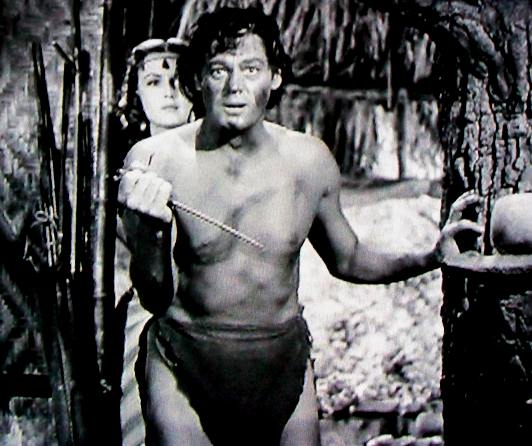
Enter Bomba, the Jungle Boy (Johnny Sheffield), who is, as Barnes tells Rob, "one of those jungle legends," an American boy left orphaned in the jungle at the age of 7, and now ten years later a strapping, self-sufficient teenager who wears a loincloth and speaks in broken English. We have earlier seen Bomba stalking a panther that killed his chimpanzee buddy, and now, when he helps a worker wounded by the panther get back to Barnes' house, Bomba gets entangled in the affairs of Rob and company. Rob is happy that Bomba might kill the dreaded panther, but the natives are unhappy because they call the panther—who might be Losana—taboo and think killing it will jinx them. Judy, who is tired of the jungle and wants to go back "where life means more than heat and insects and superstition and certain failure," is eventually charmed by Bomba, and he by her. When Losana gets a little flirty with Bomba, a mild triangle threatens to develop (though it never amounts to much dramatically). As far as what does develop dramatically, take note of two casually-dropped references early in the film: 1) Rob is thinking of clearing the trees by setting a fire; 2) Barnes' house is reinforced because occasionally, a "stiff wind from the veldt" blows up.

As I’d noted in an earlier review, I avoided Bomba movies for most of my life, but I'm enjoying discovering them now. Once you accept the limitations of the studio (Monogram, king of Poverty Row), the budgets (low but not bottom of the barrel), and the actors (mid-range but sincere), they are good Saturday-matinee fun. Like the first film, this one does a decent job of integrating stock footage—of monkeys in trees, of crocodiles, of panthers—with studio sets. Whenever the action starts to slow down, they cut to stock footage. Sheffield is growing on me; in the first film, I found him rather monotone and morose, but now I believe that his performance is crafted that way. He smiles more this time around—maybe because he's got two lovely ladies paying attention to him. He’s also hunky, in a stocky college wrestler kind of way, and more so than Weissmuller's Tarzan (for whom Sheffield played "Boy" for a while), his innocence and naivety seem genuine. Harry Lewis is fine as the antagonist, who for a change is not portrayed as broadly evil, just misguided. Irish actor Charles Irwin is OK as Barnes, and Allene Roberts is good as Judy. Lita Baron gets the thankless role of the mostly silent Losana, whose possible supernatural essence is teasingly suggested though nothing really comes of it. I've heard the series declines over the next few years, but until they do, I'll keep watching them—on Saturday afternoons with a big tub of popcorn in my lap. (Pictured are Sheffield, Roberts, and Woods.) [DVD]

Wednesday, August 26, 2015

THE DRUMS OF JEOPARDY (1931)

In pre-Revolution Russia, Dr. Boris Karlov (yes, that's the character’s name, played by Warner Oland) discovers his daughter, Anya, in bed, in agony and drenched in sweat. She's single and pregnant, and has tried to kill herself. When the Petroff necklace falls from her hand in her delirium, Karlov determines that one of the Petroff boys is responsible for her fate and vows to get revenge against the family. The necklace, made up of small jewels that look like drummers, has a legend attached: if one of the drummers is detached and sent to someone, that person will die within 24 hours. Anya goes rushing to the Petroffs and with her dying breath warns Gregor, her former lover, about her father's threat. Karlov follows waving a gun and says he'll detach the drummers and send them one by one to all the Petroff men. Years later, after the revolution when Karlov has become an influential Bolshevik, the Petroff patriarch receives a drummer and dies in his sleep that night. The Petroff brothers decide to leave for America, theoretically for political asylum, but on the ship, Ivan gets a drummer and is thrown overboard in the night. And then there were two…

Diplomat Martin Kent arranges to help the remaining brothers, Gregor and Nicholas, but upon their arrival in the United States, assassins give chase and wound Nicholas, so the two wind up taking refuge in the apartment of the lovely Kitty Conover and her cranky aunt Abbie. When they all endure a close call at the hands of Karlov's men, Kitty offers her family's country mansion as a safe house for the Petroff brothers—she has responded positively to some flirting from Nicholas—but even there, the men aren't truly safe and a wild ride is had by all before justice is done (by which I mean, SPOILER, Karlov kills Gregor, but is himself killed before he can get Nicholas, leaving the last Petroff free for Kitty, who seems spunky enough to avoid poor Anya's fate).

The filmmaking is a bit creaky here and there, but for a fairly early B-talkie, this moves well and is still enjoyable to watch. At 75 minutes, there is a lot of plot crammed in here, some bits more plausible than others, but the pace never slows down and the last half becomes sort of an old-dark-house thriller which also involves a room filled with poison gas and another room filling with rushing water. Oland is excellent as the man who, in the opening scene, looks like a mad doctor (see picture above), but is actually a caring father who goes a little crazy with revenge. Most of the other actors are not particular standouts, but Clara Blandick (Aunt Em in THE WIZARD OF OZ) has fun in the comic relief role of the aunt, and in fact, she plays a crucial role at the climax. Mischa Auer has a small role as one of Karlov's henchmen. (As for "Boris Karlov," that was apparently the name of the character in the original story, and this film was made just before Boris Karloff shot to fame in FRANKENSTEIN). [YouTube]

Monday, August 24, 2015

UPTIGHT (1968)

In Cleveland, days after the assassination of Martin Luther King Jr., a group of black activists sets out to steal a large shipment of guns and ammo. Johnny (Max Julien) comes to get the help of his friend Tank (Julian Mayfield), but Tank begs off, claiming to be too drunk to help—though clearly he's also depressed, due not just to the assassination, but also lack of money and the sad state of his personal life, which involves a former girlfriend who is raising a child alone. During the robbery, Johnny shoots a guard who later dies, and the cops are after him in force. Tank winds up getting much of the blame for the fiasco, and his former friends and associates turn their backs on him. In desperate need of cash, Tank informs on Johnny for a reward. Johnny is killed by the cops, and when Tank goes on a spending spree at a local bar, the activists realize what he's done, sealing his fate.

This is based on the 1935 John Ford film THE INFORMER, set during the period of the Troubles in Ireland, and it follows the trajectory of that film closely. The Informer was shot on a low budget, with director John Ford using shadows and fog to hide the shoddy sets, and making a minor masterpiece of atmosphere. Here, nighttime location shooting on the streets of Cleveland gives the movie a similarly effective look. Most reviews compare Uptight unfavorably to The Informer, but I found this to be a compelling and well-acted update of, though certainly not a replacement for, the Ford film. Mayfield (pictured), like Victor McLaglen in the 1935 film, comes off as both sympathetic and pathetic, and delivers an strong anchoring performance—all the more remarkable for the fact that this was his only major film role; he was primarily a writer and a civil rights activist. Good performances are also given by Ruby Dee as Tank's ex, Raymond St. Jacques as the militant leader, and Roscoe Lee Browne as a gay police informer who Tank blames for his own actions. The street scene in which the cops come looking for Johnny is exceptionally well done. Some critics note that the focus on racial politics takes away from a focus on character, but I thought the film had a good balance of the two. This doesn't crop up often but is available on DVD from Olive Films. [DVD]

Friday, August 21, 2015

MR. ARKADIN (1955)

aka CONFIDENTIAL REPORT

Guy Van Stratten (Robert Arden) is a petty crook who is smuggling cigarettes in Milan. We first see him and his girlfriend Mily at night on the docks, on the run from cops, when they almost literally stumble across a dying man named Bracco, who was stabbed by a one-legged man. Bracco whispers the name "Sophie" and implies that if they can get to rich industrialist Gregory Arkadin and mention that name along with Bracco's name, they might make some money from Arkadin—we assume by blackmail. But when Van Stratten finally gets to Arkadin (Orson Welles, at right), by cozying up to his pampered daughter Raina, things take a different turn: Arkadin tells Van Stratten that his earliest memory is of standing on a street corner in Zurich in the winter of 1927 with 200,000 Swiss francs and no memory of his life before. So Arakdin hires Van Stratten to dig up whatever he can about his life before 1927. Traipsing across Europe, Van Stratten runs into a number of interesting characters who knew Arkadin and remember that he made his money running a white slavery ring, but soon most of these folks wind up dead and Van Stratten realizes that he might be next.

This infamous Orson Welles film has been released in a variety of cuts over the years, and because Welles had no hand in the final cut of any version, none of the films has been accepted as standard. The recent Criterion set has three versions of the film; the one I'm reviewing was released by Warner Bros. as CONFIDENTIAL REPORT. It is the most maligned of the three, largely because it simplifies the arcane narrative structure a bit, but having also watched the "Comprehensive" version put together by Welles scholars based on his notes, I think the Warners cut is actually better. No matter how many ways one puts the various pieces and parts together, the story is the same and there are some ambiguities present, and in my summary, I smoothed over some jagged edges. But despite reports that the movie is a mess, it's actually fairly easy to follow. What's not easy is understanding character motivations; everyone remains something of a cipher—Arkadin of course, but no character is really fleshed out, and Van Stratten remains about as cloaked in mystery as Arkadin, to the point where I think a movie about him might be almost as interesting as one about Arkadin.

Welles, spinning another CITIZEN KANE-type biopic about a mysterious but larger-than-life figure, has a good time hamming it up as Arkadin, wearing an eccentric beard and an obviously theatrical wig. The person with the most screen time is Robert Arden as Van Stratten. Critics tend to find his performance lacking, but I liked him a lot. Arden makes the character a little bit likable and a little bit despicable, and no smarter or dumber than he needs to be. Given that the screenplay gives him little help, he works wonders with his face and his often strained tone of voice. (Speaking of voice, the fact that probably 75% of the dialogue is post-dubbed—even though most of the actors are English speakers—is a burden to the viewer, especially since sometimes the dubbing is worse than that found in Japanese monster movies. I think it's worth trying to get past that distraction.) Patricia Medina as Mily and Paola Mori as Raina are both fairly weak as the potential femmes fatales—and Medina's post-dubbing is particularly poor. A handful of character actors deliver strong support, including Akim Tamiroff, Peter van Eyck, Suzanne Flon (in a small role as a baroness, though she should have played Mily) and Katina Paxinou as the mysterious Sophie. Best of all is Michael Redgrave as a junk dealer (pictured at left, to the right of Robert Arden); he's about as close as the movie comes to any comic relief and though his character is not important, he's slyly riveting in his few minutes on screen. As in any Welles movie, it’s worth seeing for its visual style alone. Cockeyed camera angles and close-ups abound, along with a strong film-noir use of light and shadow in many scenes. There are several bravura sequences beginning, well, at the beginning with the dock scene, followed by a grand and expensive-looking masked ball, and an almost nausea-inducing scene between Arkadin and Mily on his boat. Both versions of the film that I watched feel unfinished and a little raw in spots, but I think it's well worth making time to see a version of this. [DVD]

Wednesday, August 19, 2015

BOMBA, THE JUNGLE BOY (1949)

George Harland is a world-class photographer; along with his teenage daughter Patricia, also a published photographer, he is in Africa on a photographic safari with his old friend Andy as guide and protector. But George is a stubborn, impatient, imperious fool who insists on taking unnecessary risks that rile up Andy, and Pat seems to be following in her father's footsteps. When George insists on going beyond the Big Rift, a dangerous area when no white man has ever been, Andy balks but ultimately agrees to take them. Pat goes off on her own, winding up lost, and just as a leopard attacks, she is saved by a teenage boy in a loincloth who calls himself Bomba. She feels threatened by him at first, but soon a bond forms between them and, when she wants to go find her father, Bomba reluctantly helps her. Along the way, she learns that Bomba was brought to the jungle years ago by a scientist who was searching for a place for himself outside of civilization. The man is now dead and Pat wants Bomba to return to the outside world with them. But soon, thanks to George's foolhardiness, they're all in trouble when they are caught witnessing a native tribe's lion hunt, a taboo event for outsiders.

Bomba movies ran frequently on TV back in the 60s but I had never seen one until now. To be honest, I've avoided them because of pictures I'd seen of Johnny Sheffield, who as a child actor played Boy to Johnny Weissmuller's Tarzan throughout the 40s, looking rather bloated and unenthusiastic in the title role. But in this first Bomba outing, Sheffield, at 18, is actually not bad, and the movie itself, despite being made at low-budget Monogram Studios, does a nice job of incorporating stock footage of Africa into the studio sets. Especially effective are repeated shots of flocking birds and leaping monkeys, and there are even a couple of brief scenes of animals killing each other. Sheffield's voice is surprisingly deep—I thought at first that he had been dubbed—and his acting is adequate. The character is not as charming as Tarzan, being a bit more stand-offish, but I liked the scene of his first contact with Pat (Peggy Ann Garner, very good in the role); after he saves her from a panther attack, she pulls a gun on him and he understandably finds it difficult to warm up to her. She keeps begging him to help her and he keeps saying "You tried to hurt me." Onslow Stevens plays Harland as an unrepentant but bland jackass; much better is Charles Irwin as the Scottish Andy. A pleasant diversion; perhaps I'll take the plunge and watch a few more of these in the future. [Warner Archive Instant]

Monday, August 17, 2015

SECRET ENEMIES (1942)

This is one of those fun Warner Bros. B-movies that is well-produced, fast-moving, acted just well enough, and goes by in a flash. Storyline #1: On the day after the Japanese attack on Pearl Harbor, German-American hotel owner Frank Reicher goes to his lawyer and friend (Craig Stevens) to see if he can help get his ailing wife out of Germany before war is declared. Stevens tries but is unsuccessful; however, Reicher's chauffeur puts him in touch with a doctor (Robert Warwick) who turns out to be a Nazi spy and who offers help if Reicher will let Warwick and his spies operate out of his hotel. Reluctantly, Reicher agrees. Storyline #2: Two FBI agents, John Ridgely and Charles Lang, are chasing a German spy and, at the recommendation of Stevens, who knows Lang, they stay at Reicher's hotel. Lang's room turns out to be a trap; a bellboy brings Lang a radio, and when he turns it on, a poison gas is pumped out which kills Lang. Because the hotel was suggested by Stevens, Ridgely suspects him of the murder, but when Stevens applies to be become an agent to avenge Lang's death, Ridgely becomes his teacher and mentor. Soon the plotlines converge and Stevens and Ridgely are hot on the trail of Warwick and his thugs.

With a running time of 57 minutes, there is not an ounce of fat on this speedy little spy thriller. There is a lot of plot—I've left out an entire thread about Stevens' girlfriend (Faye Emerson), a chanteuse in the hotel club, who may or may not be helping the Nazis—and a lot of action, with at least three separate well-staged slam-bang scenes of fistfights and gunplay. The poison gas scenes—there are two—are nicely played. Ridgely, who is one of my favorite B-actors of the 40s, and Stevens (both pictured above) are fine, though Warwick's performance as the head Nazi is a little underdone. Emerson's character seems like an afterthought to get some femme appeal in. But I'm not going to quibble—this is a solid B-film that I would watch again. [TCM]

Thursday, August 13, 2015

TARZAN TRIUMPHS (1943)

Tarzan's son Boy gets in trouble while climbing down a cliff to catch a glimpse of the hidden city of Pallandria. Zandra, a princess of the lost city, helps Tarzan save him. Tarzan's mate Jane is off in England tending to a sick relative, but she sends back word about the war with the Nazis, which has not yet affected Tarzan's homeland. But soon the Nazis begin circling the jungle looking for oil and other natural resources to use. An injured German paratrooper is saved and taken in by Tarzan and Boy. Schmidt, the Nazi, pretends to be British and is nursed back to health while secretly repairing his radio equipment so he can send for reinforcements. Meanwhile, the other Nazis have held a bloodless coup in Pallandria, forcing Zandra's tribe to work as slave labor in getting precious elements to use in the war effort. When a Nazi colonel tries to rape Zandra, her hunky brother Achmet steps in but is killed for his efforts. Back at Tarzan's place, Schmidt tries to kill Cheetah the chimp when he interrupts a radio transmission, but an elephant comes to the rescue, tossing the Nazi off a cliff. Zandra makes her way to Tarzan's place and asks for his help, but he remains a staunch isolationist, even after Boy teaches Zandra to flirt with Tarzan to get her way. However, when the Nazis come looking for Schmidt's radio and wind up kidnapping Boy, Tarzan finally gets pissed and joins Zandra in kicking some Nazi ass.

The war gave a new context to action movies and thrillers in general, especially B-genre movies, and the Tarzan series, downgraded from glossy MGM to lesser studio RKO, needed something new to stay interesting. At almost 40, Johnny Weismuller was looking a little too chunky to be comfortable swinging through the trees in a loincloth, and the actress who played Jane, Maureen O'Sullivan, had left. So Nazis were just the right ingredient to spice up the franchise. (The next film in the series, TARZAN’S DESERT MYSTERY makes the Nazis a fairly minor element while throwing in some more fantastic elements like a giant spider.) Frances Gifford is OK as Zandra, Johnny Sheffield is very good as Boy, Stanley Ridges is the Nazi colonel, and Stanley Brown is the ill-fated Achemt. A nice pick-me-up for a series starting to go stale. (Check out that fabulous treehouse compound of Tarzan's pictured at left--click on it for a bigger version.) [TCM]

Wednesday, August 12, 2015

DANCE HALL (1941)

This film opens as though it's going to be a peppy, carefree B-musical, but if you are a credit watcher, you'll see that it's based on a novel by W.R. Burnett, whose other novels and stories were adapted as noir-type crime movies, including SCARFACE, THE BEAST OF THE CITY and HIGH SIERRA, so be warned. The setting is the dance hall at Paradise Park, called Danceland; Cesar Romero is the charming but arrogant owner; William Henry is the young piano player who longs to write a symphony; Carole Landis is the new singer for the band. The night before she starts, Landis meets cute with Romero when she complains about the noisy late-night crap game Romero is involved in next door to her hotel room—she winds up joining the game and winning all the money. Soon, however, there are misunderstandings and entanglements: Landis is romanced by bland but nice guy J. Edward Bromberg; Romero tries to make her jealous by paying attention to June Storey, a gold-digging waitress; Henry is sweet on Storey, but we see she'll kiss anyone, and soon even her mild-mannered boss (Charles Halton) is hitting on her. Storey is inclined to hang out with the piano player when she finds out he has a little money saved up—to go to New York to try and sell his symphony—but after he gives it to Romero to help him out of a tight spot with some gamblers, she loses interest. In the end, Romero comes up with a scheme involving a dance contest with a big cash prize that he hopes will set everything right with everyone.

I assume based on Burnett's reputation that the original novel, titled The Giant Swing, was a bit more hard-boiled than this film turned out. As it is, the movie's tone is awkwardly situated between romantic comedy and gambling melodrama—but it's never very funny or very dramatic. The romance between Romero and Landis is played ambiguously, to the point where I was a little surprised that they walked into the sunset together at the end. The threats against Romero (pictured above, standing over Henry) aren't terribly threatening and, partly due to Henry's bland performance, the piano player’s storyline is absolutely forgettable. Romero and Landis are fine, though without much chemistry, and it was nice to see Bromberg playing something besides an ethnic type. Landis sings a couple of so-so songs, one with the unusual title, "There’s a Lull in My Life." [YouTube]

Monday, August 10, 2015

FLESH AND FANTASY (1943)

This anthology movie of three stories of the fantastic is framed by Robert Benchley as a man who is upset over a fortune teller's predictions and some disturbing dreams. He chats with a friend about fate and the friend tells three stories on the subject. In the first tale, set in New Orleans during Mardi Gras, unloved and homely Betty Field (pictured) is in love from afar with handsome young Robert Cummings. When the body of a suicide victim is pulled out of the river, Field is envious but before she can act on her impulse, an old man takes her to a mask shop and tells her to put on a mask and be beautiful until midnight. She and Cummings bond, and she talks him through a rough patch in his life. At midnight, she takes off the mask and her face is beautiful, made that way because she has given up bitterness and given selflessly to another. Next is an adaptation of an Oscar Wilde story in which Edward G. Robinson is told by a palm reader (Thomas Mitchell) that he is going to commit murder. Though he's not a believer in the supernatural, Robinson decides to get it over with and kill someone. He soon finds it's not quite that easy to mess with destiny. The final tale features Charles Boyer as an acrobat billed as the Drunken Gentleman whose act is to walk on the high wire while acting drunk. One night, he has a dream that he falls from the wire and sees a woman in the audience screaming; later, he meets the woman (Barbara Stanwyck) in real life. I think anthology TV shows like Twilight Zone have made movies like this feel obsolete, but in 1943 this was probably seen as unusual. While there are some arresting images in the film, only the first tale is memorable, mostly because of the magical midnight atmosphere. Acting is fine as is the cinematography. This might make good Halloween viewing, maybe as part of a double feature with the British DEAD OF NIGHT. [DVD]

Friday, August 07, 2015

THE FIGHTING PRINCE OF DONEGAL (1966)

In 1587, Prince Hugh of Donegal dies, leaving his son Hugh heir to his title. Since legend has it that "when Hugh succeeds Hugh, Ireland will be free," many clansmen think that young Hugh, also known as Red Hugh for the color of his hair, will be the one to lead an army against the English oppressors. But Hugh thinks their better chance is to get the varied Irish tribes together and go off to England to negotiate, trading their willingness to help the fight Spain for autonomy. However, because he's seen as a subversive threat to the crown, Hugh is captured by the Viceroy's men and held in Dublin Castle. Clan leaders MacSweeney and O'Neill take a treaty to the Viceroy in hopes of freeing Hugh, but the slimy British Captain Leeds, who by now has taken a strong personal disliking to Hugh who humiliated him in a fight in front of his soldiers, refuses to pass the treaty on to the Viceroy and takes O'Neill prisoner as well. While MacSweeney begins to rally his people, Hugh and O'Neill, with help from the Irish prison servant O'Toole, plot an escape, and when Captain Leeds decides to try to take Donegal Castle, a major confrontation is in the making.

I was 10 when this film came out, and though I didn't see it, I did own a comic book of it and it must have made an impression on me, because, though I'd completely forgotten about the movie's existence, when I saw it on the Turner Classic schedule, the cover of the comic book (pictured at right) suddenly appeared in my mind and I was determined to finally see this movie. Yes, it's a 60s Disney live-action picture, the idea of which usually puts me off, but for the most part, this is good swashbuckling fun. Don’t expect a gritty Braveheart-type movie here—it's family friendly (albeit with a few mostly bloodless sword-inflicted deaths) and the sets are colorful and clean. It's closer in tone to the Errol Flynn ROBIN HOOD of the 30s though obviously not in that film's league. The performances are a notch above the usual for Disney. Peter McEnery, whose biggest claim to fame is playing opposite Hayley Mills in Disney’s earlier THE MOON-SPINNERS, is the title character and though he can't come near to filling Errol Flynn's boots, he makes a handsome and charming hero. Susan Hampshire is Kathleen, the requisite leading lady, though she barely makes a mark as intrigue and swordplay rather than romance carry the day here. Tom Adams, who looks like a more handsome Basil Rathbone (pictured to the right of McEnery), plays O'Neill, who begins as a rival of Hugh's for Kathleen's attentions but becomes a loyal right-hand buddy to Hugh. Adams almost always has a slightly snarky, ironic look in his eyes—for a while, I wasn't sure if he was going to be a good guy or a bad guy, and that gave his character an interesting shading. Perhaps best of all is Gordon Jackson, well remembered as the butler Hudson in the original Upstairs, Downstairs series, giving a full-blooded turn as the wicked Captain Leeds. Andrew Kier as MacSweeney is fine, and Maurice Roeves and Donal McCann make the most of their small roles helping Hugh in his escape. The movie is not exactly action-filled, but the final siege of the castle is quite exciting. This really should be on DVD. [TCM]

Wednesday, August 05, 2015

HIGHWAY 301 (1950)

This crime film begins with the sitting governors of three states giving brief introductions about the actual case the movie is based on, all drily expounding on the message that crime never pays. Luckily, the movie that follows is far less pedantic than the governors, as we follow the exploits of five guys (and a couple of molls) known as the Tri-State Gang, bank robbers who are not above killing innocent bystanders if need be. The leader of the gang, Steve Cochran, seems like a smooth charmer who might have a sensitive side, but he's really a dead-eyed brute. The other gang members (including Richard Egan and Robert Webber who both went on to long character-actor careers) will follow Cochran anywere, but after an apparenly successful bank job, a witness sees them change cars and the cops finally have a concrete clue with a license plate number. Cochran's gal (Aline Towne) gets tired of running, so in a particularly graphic scene, he guns her down on the stairs of an apartment building. The gang slowly splinters from here on out; their next robbery, of 2 million dollars from an armored car, goes south when, after killing one of the guards, Cochran finds out that the money is "cut cash," worthless bills which have been cut up and are headed for destruction. Eventually Webber's Canadian girlfriend (Gaby Andrè) becomes a liability and, in a tense scene, Cochran hunts her down on the streets and shoots her. However, she survives, though in a coma, and Cochran, now basically solo, goes after her one more time.

After that dry opening, the rest of the film has a bit of a split personality problem. Some scenes are done in a straightforward, narrated police procedural mode, and these scenes slow the movie down. Luckily, most of this is a noir melodrama with dark city streets, bursts of violence, and a gritty feel. Cochran (pictured above) is the main reason to watch; he gives a solid, controlled performance as a sociopathic crook, slightly less unhinged that WHITE HEAT's Cody Jarrett (James Cagney) but heading in that direction—Cochran played a gang member in that movie, and the final moments of this film are reminiscent of WHITE HEAT's finale. Webber and Egan are good, Towne and Andrè are fine as the molls, though the good guys, including Edmon Ryan as a cop and Virginia Grey as a reporter, don't get many chances to shine. The first bank robbery is shot effectively from above, and all the scenes of violence are tense and brutal. The typical conflicted noir hero is absent—Cochran never gives a second thought to his violent ways—though some of the gang members have second thoughts. Highly recommended. (In the picture at left, Cochran is to the left in the front seat, and Egan is behind him.) [TCM and DVD]

Tuesday, August 04, 2015

THE LAND UNKNOWN (1957)

800 Navy men and one woman, a reporter, head off to Antarctica to work on mapping the uncharted polar region. Commander Jock Mahoney is interested in a 1947 report from one of Admiral Byrd's men that a warm-water oasis was spotted in the middle of the ice mass. Mahoney, the reporter (Shawn Smith), and two other men (pilot William Reynolds and mechanic Phil Harvey) get in a helicopter and attempt a quick reconnaissance flight to find the oasis, but a storm springs up, followed by a giant flying pterodactyl which knocks them down into a lush, warm canyon. The radio is out, they need more tools to fix the helicopter, and they have thirty days until the rest of the expedition leaves them behind. Soon, they discover giant dinosaurs, a huge man-eating plant, and another human being (Henry Brandon), the sole survivor from a previous lost expedition. Brandon has gone a little nuts and offers to tell them where they can find his crash site to get tools in exchange for them leaving Smith behind with him. Of course, they don't agree and they spend the rest of the month searching for the tools. On the thirtieth day, Brandon finally relents and reveals the location of the crash, but a huge swimming beast threatens to scuttle their escape plan.

This interesting but not terribly compelling adventure fantasy is slightly above a B-movie, but not quite in A-territory. In widescreen black & white, the movie generally looks good, with nice "fantasyland" sets and backgrounds, but the dinosaurs are a mixed bag. The worst is a huge Tyrannosaurus Rex which is clearly some poor guy in a Godzilla-like plastic suit, though the lake-dwelling elasmosaurus is fairly effective. Mahoney, who went on to play Tarzan a couple of years later, is a totally average lead; Smith is a notch better; the handsome Reynolds is best, and really should have been the lead; Brandon is fine as the slightly crazy "caveman." The men get sweaty and their t-shirts get wet a couple times (see picture above, with Reynolds, Mahoney and Smith), so the beefcake quotient was in an acceptable range for me. In general, one of those that's promising and makes you wish it was a little bit better than it is. [DVD]