Friday, March 31, 2017

THE DEATH KISS (1932)

A well-dressed woman strolls up to a duded-up stranger on the street, kisses him on the mouth and walks away, saying she just couldn't resist. But it turns out that the kiss was a signal to a thug in a car who shoots the man dead. Then the camera pulls back and we see that we've been watching a movie scene being shot. But when they go to restage it for another take, the corpse doesn't get up. In fact, the actor, Myles Brent, has actually been shot dead. All the guns on the set are examined and contain blanks, so it appears he was shot by someone in hiding. The cops are called but studio writer Franklyn Drew (David Manners), who really wants to write detective novels, shows up and decides to compete with the police, with some sidekick help from Gully, the security guard. Among the suspects: the actress Marcia Lane—the one who bestowed the 'death kiss' on Brent, who was Brent's ex-wife and who might be in line for a big insurance payoff; studio manager Steiner (Bela Lugosi) who, with his thick European accent and slicked-back hair just seems a little sinister in general; Grossmith, the head of the studio; the director (Edward Van Sloan); and Chalmers, a former gaffer who was fired for showing up to work drunk but who was given a job on set out of pity by Lane. Soon another studio worker is found dead at his home after drinking poison; the cops assume it's suicide (since there is a suicide note) but Drew and Gully notice clues that indicate it's murder. Will the killer strike again?

This pre-Code B-mystery was marketed as a horror film to take advantage of Bela Lugosi's presence, but he actually has a fairly small role—though it’s fun to see him in a straight role for a change. It's also fun to see Lugosi reunited with his DRACULA co-stars Manners and Van Sloan (both of whom are pictured at right). I'm a fan of Manners so I enjoyed seeing him get a lead role for a change—though he is technically the leading man in movies like DRACULA, THE MUMMY and THE BLACK CAT, he is overshadowed in those by the villains and/or, as in DRACULA, by the leading lady. He gives his character enough personality that I'm sorry there weren't more Franklyn Drew mysteries. Ames is a bit of a sleepwalker here, and Van Sloan, like Lugosi, vanishes for long stretches, but there a number of good supporting performances from Alexander Carr (Grossmith), Harold Minjir (his flamingly gay assistant), Vince Barnett (Gully) and Al Hill (an assistant director). I'm not sure why this was put on Blu-Ray; the audio commentary by Richard Harland Smith is very good but the film itself hasn't been given much of a restoration. It does, however, have a handful of scenes featuring hand-tinting, including a startling moment when a film being projected catches fire and a burst of yellow-orange suddenly appears. Flashlights and guns also glow yellow in a couple of scenes. [Blu-Ray]

Thursday, March 30, 2017

CYCLOTRODE X (1966/1946)

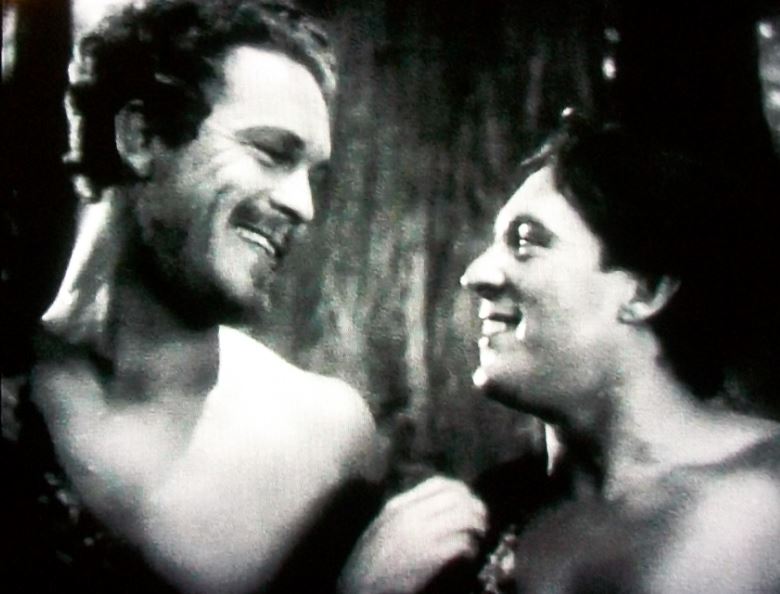
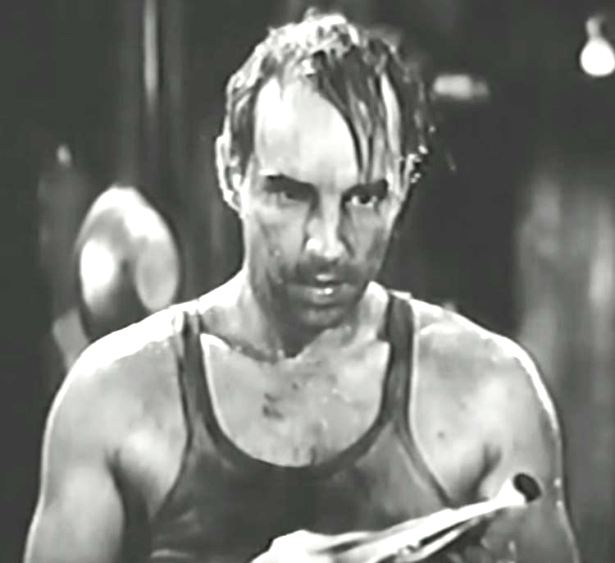
Professor Chambers has invented the Cyclotrode, a rather ill-defined McGuffin device that can wreck havoc with electrical power. Though he's developed it at his university for use by the government, a criminal mastermind known as the Crimson Ghost (who dresses in a huge grinning skull mask and—one can only assume since the film is in black & white—red robes) is after it for his own nefarious uses. When the machine and its inventor are taken, our hero Duncan Richards goes after them, knowing only that the Ghost is one of Chambers' university colleagues. This is a 100-minute condensed version of a 167-minute serial from 1946 called THE CRIMSON GHOST; it was released in the mid-60s during a period when old movie serials were considered campy fun, and it's a slam-bang affair, with all the fat trimmed. There isn't much more to the narrative than I've summarized above, but the movie is filled with incident, with cliffhangers arriving every ten minutes or so. At some point, a death ray is introduced, and at the climax, out of the blue, Duncan (Charles Quigley) and his chief assistant Diana (Linda Stirling) bring along a Doberman to help out. The skull face of the Crimson Ghost is indeed creepy, though the fact that we see him constantly, and that he basically just stalks about in his hideout and sends others to do his dirty deeds, makes him much less scary by the halfway point. Clayton Moore, later TV's Lone Ranger, is Ashe, the Ghost's main henchman, and he's actually more charismatic (and better looking) than the hero (he's on the left in the picture above, with Kenne Duncan as Chambers in the middle and the Crimson Ghost at right). The identity of the Ghost doesn't really matter since the characters of the suspects are all basically interchangeable. The best gimmick in the film is a necklace that the Ghost puts on those he has forced into doing his bidding; if anyone tries to remove it, he or she is instantly killed. As crowded as this film is with action, I doubt I'm missing much by not viewing the original serial—unlike the case of the more drastically edited SHADOW OF CHINATOWN. [Paramount Vault streaming]

Wednesday, March 29, 2017

SHOW GIRL IN HOLLYWOOD (1930)

Composer Jimmy Doyle (Jack Mulhall) is sweet on fledgling song-and-dance girl Dixie Dugan (Alice White); he wanted her for the lead in his new show Rainbow Girl, but his producers said no. Now, the show has closed and Frank, a Hollywood director (John Miljan), hears Dixie sing at a club and decides to use her in his next picture. She goes to Hollywood and becomes friends with Donny (Blanche Sweet), an actress from the silent days who is forgotten at 32, and former wife to Frank, though Dixie is unaware of that. Dixie is also unaware that Frank is the next thing to washed up, and sure enough, he's soon fired from the film. The producers decide to hang on to Dixie, they turn her film into an adaptation of Rainbow Girl, and Jimmy is brought out to the studio to work on the script. But soon Dixie, egged on by Frank who wants revenge against the studio, becomes a demanding diva and it seems like the picture might wind up getting shut down for good. Can Jimmy and Donny get Dixie away from the villainous Frank and salvage her movie career?

This early sound musical is almost done in by the weak lead performance from Alice White (pictured) who is way too cutesy early on, and later is too artificial to be effective as a bitch. But there are a few pleasures to be had. The best performance is by Blanche Sweet, who was in fact, like her character, a silent movie star whose career was about over—though in real life, she was 34. She sings a sad song about her chosen career: "There’s a tear for every smile in Hollywood/Every mile's a weary mile in Hollywood." Miljan is appropriately repugnant as the bad guy and Ford Sterling is fine as the movie producer. There's an interesting scene showing how a big production number is filmed, and a handful of stars (Al Jolson, Ruby Keeler, a very young Walter Pidgeon) appear briefly as themselves. The last song, "Hang on to a Rainbow" was originally shown in color, though the current print has it in black & white. [TCM]

Monday, March 27, 2017

DICK BARTON, SPECIAL AGENT (1948)

Dick Barton, a kind of scruffy, rougher-edged Bulldog Drummond-type adventurer, was the lead character in a popular British radio show of the post-war years. Along with his sidekicks Jock and Snowy, Barton ran down crooks and spies in serial adventures for seven years. This is the first of three Barton films that Hammer would make with the character. Barton, with Jock and Snowy (and a bagpipe) in tow, heads to Echo Bay for a vacation at Rosemary Cottage with his girlfriend Jean and fluttering housekeeper Betsy sent ahead to tidy up. But really, Barton is on a mission to find some smugglers, and on the road, he is shot at by a nasty thug named Roscoe who keeps insisting he never misses. But he misses Barton, who nevertheless plays dead long enough for Roscoe to assume he finished his job. Roscoe and his buddy Regan run a fresh fish shop, but their leader in illegal activities is Dr. Casper, a German disguised as a Swedish biologist. When the folks at Rosemary Cottage have local fish for breakfast, they discover stolen property (gems, jewels, silk stockings) inside the fish, and Barton knows they have their men. But when Schuller, a Nazi war criminal, shows up, we know something more sinister is going on: the smuggling is mostly a front for a plan to poison England's entire water supply. Caught up more or less unwittingly in all this is young Adele, working as Casper's secretary, assuming he really is just a biologist, and her boyfriend Tony, an innocent lad with a secret in his past who is being blackmailed into helping out.

Though obviously a low-budget affair seemingly aimed at the young teen matinee crowd, this does have its charms. At 70 minutes, it's chock full of cliffhanger incidents making it feel like a longer serial that has been trimmed way down for easier consumption. Unfortunately, short as it is, some of the non-action scenes feel like padding, and the comic relief, which is plentiful, only works on occasion. In particular, the duo of Jock and Snowy get very old very quickly. The nervous Betsy (Beatrice Kane), always threatening to faint, is actually quite funny, and the young lad Snub (Ivor Danvers), who idolizes Barton via his magazine exploits, is a welcome presence; when asked, as he is frequently, what he's doing mixed up in these dangerous activities, he replies smartly, "I'm a Barton Boy!" The acting is nothing special, though I did enjoy Don Stannard (pictured with Danvers) as Barton—he's energetic, handsome, and throws himself into the character with abandon.  My favorite scenes: when Barton is captured and bound up in a knight's outfit, and when a warehouse full of bad guys pile on top of Barton to beat the hell out of him, only to wind up beating each other up when he wiggles out. I'm on the fence about whether I want to see more of these films, but this one was fun. [YouTube]

Friday, March 24, 2017

OPERATION CROSSBOW (1965)

In 1942, British Intelligence gets reports that Germany is working on long-range rocket bombs (what became the V-1 and V-2) which could be devastating to England, and, if rumors are true, even to the United States. Though some are skeptical, Richard Johnson is assigned to head up an investigation of intelligence material, and soon photographic evidence is found of rocket launching sites behind enemy lines. Unfortunately, even though the Allies can bomb them, they can be rebuilt quickly, so a small squad of three agents are parachuted in to pose as engineers from occupied countries—as they are crucial to the German effort—and help sabotage the rocket project. The men (George Peppard, Tom Courtenay and Jeremy Kemp) infiltrate the factory using IDs of dead engineers, but face constant danger of being unmasked, especially when the wife of the man Peppard is impersonating (Sophia Loren) shows up at his boarding house. This is an underrated spy thriller with a nice balance of talk and action, and even a little bit of historical accuracy; the Richard Johnson character, Duncan Sandys was real, as was Hannah Reitsch (Barbara Reuting), the German pilot who helped test the rockets, and of course, the rockets were real, and did real damage. Churchill is a character, and though the actual operation seems to be fictional, it is true that some of the rocket factories were destroyed by Allied bombers, as happens in the climax to the film. There's not exactly an all-star cast—Sophia Loren, the biggest name, has an important but small role—but Peppard (pictured) provides a handsome face and solid leading-man heroics. There is strong support from Johnson, Courtenay and Kemp, and from John Mills, Trevor Howard, Lilli Palmer, Paul Henried and Helmut Dantine. The action and suspense sequences are handled well by director Michael Anderson. Recommended. [TCM]

Wednesday, March 22, 2017

DELUGE (1933)

Scientists Samuel S. Hinds and Edward Van Sloan are mystified by the strange weather being experienced all over the globe—strong storms, an unexpected eclipse, rapidly dropping barometers, earthquakes. Ships and planes are grounded, and people are warned to take shelter. The end of the world is predicted; soon, the entire west coast of the USA collapses, as does Louisiana, and the Arctic Ocean floods into the Great Lakes. Even New York City isn't spared; between quakes and floods, Manhattan is basically washed away. We focus on one family:  lawyer Sidney Blackmer, his wife (Lois Wilson), and their two young children, who live outside of New York. As the winds and quakes hit his neighborhood, Blackmer takes his family to the relative safety of a nearby stone quarry, but he is washed away from them and wakes up the next morning in a post-apocalyptic landscape and assumes they are dead. Meanwhile, champion swimmer Peggy Shannon washes up unconscious and nearly naked and is found by two ruffians who are just barely surviving in a shack. Both men (Fred Kohler and Ralfe Harolde) seem to have lust on their minds, but they take her unmolested to their shack where she recovers. Eventually, Harolde attempts to rape Shannon and Kohler attacks and kills him, not out of any noble instinct, but because he wants Shannon for himself. She escapes, collapses, is found by Blackmer who takes her in, and they slowly fall in love and consider themselves "married."

Not far from Blackmer's retreat, two groups of people are struggling to survive. Kohler falls in with a ragged group of thugs who use physical force to get what they want, but a more civilized community is trying to rebuild, and we discover that Wilson and her two children are recovering here. Matt Moore, who has been Wilson's caretaker, tells her that in these new conditions she must marry someone when she gets healthy (I assume to build up the population and discourage unbridled male lust) and of course he hopes it will be him. But she holds out hope that Blackmer is still alive. Moore's men are after Kohler's gang, and soon Kohler manages to kidnap Shannon. A three-way confrontation is in store between Kohler's men, Moore’s men and Blackmer, leading to the destruction of the thugs and the assimilation of Blackmer and Shannon in Moore's group. But when Blackmer and Shannon find each other alive, more tension brews.

This film, long considered lost, is one of the first big-scale disaster/apocalypse films, though today's viewers may not consider its scale to be very sizeable. These films tend to be judged on their effects; Richard Harland Smith, who does a fine audio commentary on the Blu-Ray, complains about people who call the effects here "primitive," but they are primitive, and it does the movie no favors to ignore that. They will seem especially unconvincing to a modern audience, but to classic movie fans, the effects (mostly model work, mattework and stock footage) are effective enough. (RKO sold some of the effects footage to Republic for use in its adventure serials.) What unbalances the movie is that all the disaster is presented at a speedy pace in the first 15 minutes. Once Blackmer wakes up to a flat and watery world (pictured at right), the film slows down and becomes a typical survival melodrama. In a modern disaster film, there would be some prelude and backstory early on, and the disaster spectacle would play out closer to the halfway point. The acting ranges from bland (Blackmer is not very charismatic) to very good (the little-known Peggy Shannon as the swimmer). Given the remark about Wilson having to marry, it would have been interesting to go into the philosophy behind the survivors' new way of life. As it is, no attempt is made here at discussions of religion or division of labor, just as no explanation is given for the apocalyptic deluge itself—though there is an odd opening statement which refers to God's promise to Noah not to flood the world again, explaining that this film is just playing with this idea. The tantalizing idea of a three-way relationship between the leads is brought up in the novel this film was based on, but even though this was a pre-Code film, that concept isn't even touched here. The print, the only known English language one in existence, has not been cleaned up very well, but it's watchable. An interesting find. [Blu-Ray]

Monday, March 20, 2017

DEVIL’S CARGO (1948)

Earlier in the 1940s, the Falcon series featured George Sanders as a playboy detective named Gay Lawrence; soon, the role was taken over by Sanders' real-life brother Tom Conway, playing Tom Lawrence, Gay's brother. But by 1948, the character known as the Falcon seemed to have no relation at all to the original. Here, his name is Michael Watling and he's apparently an amateur magician—no doubt because the actor playing him, John Calvert (at left), was a professional magician. This film begins with the murder of Lucky Conroy, followed by a visit from Delgado, Conroy's apparent killer, to Watling (lounging in his bathtub). Delgado confesses to the murder, saying Conroy was having an affair with his wife, and gives Watling a key for safekeeping. A lawyer named Mallon is keen to take Delgado's case, even after we discover that Delgado's wife Margo was the beneficiary of Conroy's life insurance. Soon, Delgado, while in jail, is found dead—poisoned—and a couple of people show an interest in Conroy's key. Watling lets a thug named Naga steal the key and follows him to a bowling alley where Naga opens a locker and is killed by an explosion. As is often the case in Poverty Row mysteries, the plot becomes a bit too convoluted to follow clearly, so I was left to contemplate Calvert's occasional (and rather pedestrian) magic tricks and the antics of his dog Brain Trust. Actually, this isn't a bad way to spend an hour, but it's not in the same league as the earlier Falcon movies. Calvert gives a very low-key performance which is occasionally effective, but he's no replacement for George Sanders, or even for Tom Conway. The supporting cast includes Lyle Talbot, Roscoe Karns and Rochelle Hudson. Low-key is indeed the key to the proceedings. Perhaps the most interesting thing stylistically here is that there is no dialogue for the first five minutes. [Streaming]

Thursday, March 16, 2017

TWELVE O’CLOCK HIGH (1949)

In England in 1949, American Harvey Stowell (Dean Jagger) sees an antique mug in a shop window and buys it, as it reminds him of his days in England as a major in the Air Force during World War II. He then visits an empty, muddy patch of land which used to be an Air Force base, and we flashback to 1942 when he was part of the 918th Bombardment Group, the only group conducting daylight bombing raids, and consequently suffering heavy casualties. After a particularly grueling mission, General Savage (Gregory Peck) orders another mission which the group's leader, Col. Davenport, thinks is suicidal. Savage asks to have Davenport replaced because he identifies too strongly with his men, and General Pritchard agrees, installing Savage in Davenport's place. He's a hard-ass and it takes a while for him to mold the recalcitrant men—one navigator kills himself as Davenport predicted might happen. Several men ask for transfers, and Savage has Stowell delay the requests for a few days so he can work on the men, toughening them up and gaining respect. Slowly, most of the group comes around, especially when Savage begins flying some of the missions with his men. (The antique mug from the beginning of the movie crops up as a signal that a man has been assigned to a new mission.) But, also slowly, Savage begins reacting like Davenport did, over-identifying with his men, and when a couple of deaths hit him hard, he shows signs of a nervous breakdown.

This well-respected war film is not a traditional war film—though there are a couple of battle scenes, the focus is on the relationships of the men with each other and with their commanding officers, and on the qualities that make (or might un-make) a good leader. The movie's strengths are in its relatively low-key approach to the psychological plot points, and the superb non-grandstanding performances, beginning with Peck and Jagger (pictured above; both nominated for Oscars with Jagger winning for supporting actor) and including Gary Merrill as Davenport, Hugh Marlowe (who may well do the best acting of his career here as an injured flier), Millard Mitchell, Paul Stewart and Bob Patten. This is one of the few war movies with no major female character, and no romantic complications. The tone is serious but not glum in this film which was one of the first to consider the psychological costs of war. Highly recommended. [DVD]

Tuesday, March 14, 2017

SWEET ADELINE (1934)

One night in Hoboken at Schmidt's Beer Garden, Schmidt announces he has re-named his chili "liberty beans" because of the Spanish-American War (90 years before Freedom Fries!). He also fires Sid (Donald Woods), the young composer who plays piano at his establishment because Sid has defied him in continuing to date his daughter Adeline (Irene Dunne). She wants to sing and act professionally, and when Sid gets backers to stage the operetta he's writing, he tries to get his producers to replace Elysia (Wini Shaw), the star they already have, with Adeline. But complications ensue: Major Day (Louis Calhern), the main backer, starts flirting with Adeline and eventually asks her to be his mistress, leading to a fight between Day and Sid; another producer comes to suspect that Elysia is a spy; at last, during the opening performance, someone sabotages the huge swing that Adeline uses in the play, causing an onstage injury. I generally like Dunne and Woods, but they both seem to be operating at low power here. Supporting performances by Calhern, Hugh Herbert and Ned Sparks give the movie some life, as do the production numbers, particularly "When We Were Young," which was inspired by Busby Berkekely’s wild Gold Diggers numbers. A minor musical to pass the time. Pictured from left: Woods, Dunne, Calhern. [TCM]

Friday, March 10, 2017

BATTLE OF THE WORLDS (1961)

Eve heads out to the beach with good news for her swim trunks-clad scientist boyfriend Fred: they're being transferred from the barren island observatory where they work now to a better assignment someplace else. She's also happy that they will no longer be working for the cranky old man who heads the observatory, Professor Benson (Claude Rains). They celebrate this news by deciding to get married. Meanwhile, two astronomers think they have discovered signs of a strange object heading for Earth. When Fred visits the eccentric Benson in his elaborate greenhouse, Benson is already aware of the planet-sized object which he has dubbed "the Outsider." Once the public is aware, experts predict that the Outsider will collide with Earth, but Benson claims it will not. He turns out to be correct, but what it does instead is quite strange: it goes into orbit around Earth and begins shooting out flying discs aimed at our planet. We soon discover that the saucers are unmanned, and that the Outsider seems to be, rather than a planet, a vehicle for a race of aliens. The military wants to destroy it, but Benson wants to learn what it is and accompanies a small group of scientists, including Fred and Eve, to land on the Outsider. They have a short amount of time to explore before the planet will be destroyed, and of course the recalcitrant Benson puts himself in harm's way by breaking off from the others. When told he is putting himself in danger, he says, "What importance does life have if to live means not to know?"

This Italian sci-fi film has big ambitions but is hobbled by a low budget, a flawed script, and poor English language dubbing. The idea of a spaceship that looks like a planet is good and would be used in later science-fiction movies. But much of the plotting feels half-hearted or perhaps unfinished. The relationship between Eve (Maya Brent) and Fred (Umberto Orsini, in yellow at left) is given a big build-up in the first 20 minutes, but it soon sputters out to the point where they actually break up (I have no idea why—perhaps I missed a plotpoint). A sequence set on a Mars base seems designed mainly to take up time in the middle of the movie. The special effects are colorful but cheap and will certainly be disappointing to current day viewers. As the narrative approaches the climax, it gets interesting but is not really allowed to develop beyond getting to the end of the movie. What's good about it? Well, a nice eerie atmosphere is sustained throughout due to cinematography, sets and the musical score. There is quite a bit of debate about the late-career performance of Claude Rains—many critics find him hammy and unbearable, but I join those who believe that he is the movie's main saving grace. In the first part of the film, when his character holds forth in his greenhouse, he seems to be sleepwalking through the role, but by the last half-hour, he is giving a full blooded performance, even if we can tell that he thinks the proceedings are generally beneath him. This is only the second film for director Antonio Margheriti (aka Anthony Dawson) who would go on to helm many low-budget films—sci-fi, horror, exploitation—and would reach his peak with a series of cheap but colorful films in the mid-60s, the best of which is WILD, WILD PLANET. This is a public domain movie so there seems to be no official video release; most of the DVDs out there are poor in quality, but the print I saw on a YouTube channel was at least presented in widescreen, even if it was a bit blurry at times. [YouTube]

Wednesday, March 08, 2017

THE RAKE’S PROGRESS (1945)

aka THE NOTORIOUS GENTLEMAN

In WWII, a British tank faces a bridge that might be mined. Despite being warned, the commander insists on heading over. Next we see a headline that officer Vivian Kenway (Rex Harrison) has been reported missing. We then flashback to see highlights in the life of Kenway. During the Armistice parades of 1918, young Kenway sneaks out of bed to join the celebrations and is given a shiny pin and told not to forget the "common man" soldiers. [Spoiler: he keeps the pin but rather forgets about the common man.] At Oxford in 1931, Kenway is a bit of a cut-up, putting a chamber pot on a beloved statue, and a bit of a cad, going on a date with Jill knowing that she's seeing his best friend Sandy (Griffith Jones). Sandy warns him to change his ways, but sure enough, Kenway is expelled. His family insists he make something of himself and is sent off to a South American coffee plantation, but that doesn't last long, and Kenway is able to return home and eke out a playboy existence on family money for a while. He meets up with his college buddy Sandy, who is now married to Jill, and he beings an affair with her which goes nowhere, except to a fistfight with Sandy (pictured). When his share of the family money dries up, he takes up race car driving but gets stranded in Vienna where Rikki (Lilli Palmer), a rich Jewish heiress running from the Nazis, helps him out; he also helps her out by marrying her and getting her out of Austria. But back in London, he has an affair and she tries to kill herself. Kenway continues his downward slide, becoming a door-to-door salesman and then a dancing companion (when he's criticized for his lack of ability, he says, "What do they expect for a bob—Fred Astaire?"). Finally, he aims for redemption by joining the Army in WWII and he works his way up to tank commander—and we're back to the beginning of the film. This life story of a useless fellow was loosely inspired by the famous series of paintings by Hogarth. Despite the melodramatic plot twists, the film retains a fairly light tone and Harrison does a nice job of keeping the unlikable title character charming enough that we care what happens to him. Palmer, Harrison’s real-life wife at the time, is very good as is the always appealing Griffin Jones. The rest of the actors don't really stand out, mostly because of their limited screen time, except for Godfrey Tearle as the father. [TCM]

Monday, March 06, 2017

THE SAINT MEETS THE TIGER (1943)

The Saint is Simon Templar, a Robin Hood-like criminal who now mostly works for the side of the law. In the run of Saint movies in the 30s and 40s, George Sanders played him most often, though Louis Hayward originated the role, and in the last two films—of which this is the final one—the part went to British B-movie actor Hugh Sinclair. Though he has none of Sanders' flair or snarky charm, Sinclair is likable enough in a laid-back way. The film begins with Templar getting a phone call from someone offering him a million pounds. But when the fellow shows up at Templar's door, he's been stabbed in the back; his dying words are "Tiger" and "Baycombe." Inspector Teal identifies the man as Joe Gallo, a bookie who was suspected of being part of a gang that pulled off the recent robbery of a million pounds in gold. Soon arriving in the quaint seaside village of Baycombe are Templar and his trusty butler Horace, where they meet some locals, including a nosy reporter named Tidemarsh; Pat Holm, a wealthy young woman, and her Aunt Agatha; banker and leading town citizen Lionel Bentley and his associate Bittle; and a visiting geologist named Karn who turns out to be Inspector Teal in disguise. Despite still having a healthy suspicion of Templar, Teal works with him to figure out who's who and what's what. The plot involves the gang attempting to smuggle the stolen gold out to a busted gold mine in South Africa owned by Pat, and though we learn fairly quickly that Bentley is one of the crooks, the rest of the trickery is best left unspoiled. Even though, as noted above, Sinclair is no Sanders, he goes through the paces in a pleasing fashion, making the character his own. Wylie Watson is no Eric Blore (one of the best screen butlers ever though he did not appear in any Saint movies) but he makes a fine sidekick, with a more pronounced sense of adventure than many a detective's butler. Gordon McLeod is fine as the inspector. Clifford Evans is Tidemarsh, who may be more than he appears, Jean Gillie (pictured with Sinclair) is so-so as Pat, and Louise Hampton is fine as Aunt Agatha, who may have a secret or two of her own. There is a nice double-cross twist near the end and the final conflict is exciting. Worth catching. [TCM]

Thursday, March 02, 2017

24 HOURS (1931)

It's 11 p.m. on a snowy night in New York—each time the narrative moves forward, we get a shot of a skyscraper clock—when we see a delivery of bootleg brandy arriving at a party at which the atmosphere feels a bit tense. Clive Brook is getting drunk and his wife Kay Francis is disgruntled; Brook leaves early, walks off in the snow, and stops for a nightcap at a late-night diner (where there is blood in the snow outside because someone was gunned down on the street and dragged into the back room). Later, he heads to a nightclub and leaves with his mistress, club singer Miriam Hopkins—who says about herself, "I'm good leather, but I just ain't polished." They go to her place and he promptly passes out, and when her estranged husband (Regis Toomey), who has a reputation as a "hophead," arrives in the middle of the night to beg forgiveness, Hopkins throws him out. Meanwhile, Francis leaves the party with her lover (Minor Watson) but she cuts things off with him and goes home alone.  The next morning, Hopkins is dead and Brook is arrested as the most likely suspect.

This bleak pre-Code movie is more interesting than compelling, partly because despite the emphasis on "immoral" behavior, the plots follow predictable paths to redemption—for most of the characters at least. The frame of a 24-hour period and the wintry backdrop both make the film a little different, and some of the performances, especially from Hopkins and Toomey, are quite good. The director, Marion Gehring, gives the film a nice visual style, anticipating film noir a bit, but the gloomy tone and slow pace end up working against it. Still, a must for fans of pre-Code cinema and/or Kay Francis. Pictured are Hopkins and Brook. [YouTube]

Wednesday, March 01, 2017

THE LAST COMMAND (1928)

Lev Andreyev (William Powell) is an expatriate Russian film director who, while flipping through a book of photos of extras, comes across a familiar face: Sergius Alexander (Emil Jannings, pictured at left) whom he recognizes as a former Czarist general. Andreyev, whom we discover was a revolutionary back in Russia, hires Alexander as an extra to play, what else, a Czarist general. But Alexander seems to be a damaged man; he's a recluse and has a head-nodding tic, and is reluctant to take the role, but he does. As Alexander applies his make-up, he flashes back to 1917 when, as a high-living officer, he confronts Andreyev and his fellow spy Natascha (Evelyn Brent); he whips Andreyev across the face and arrests him as a spy, but takes Natashca as a mistress. She is assigned to murder the general, but when she witnesses him calling off a staged battle for a royal visit, saying he won’t "sacrifice men for the entertainment of the Czar," she softens toward him. Later, however, during an armed rebellion at a train station, Alexander is attacked and forced to shovel coal, a degrading experience which, along with Natashca's seeming indifference, breaks him, bringing on his head tic. In the present, getting back into uniform may be the thing that will break him for good.

German actor Emil Jannings is best known for playing the pathetic college professor in thrall to Marlene Dietrich in THE BLUE ANGEL, but during his brief time in Hollywood in the late 20s, he won an Oscar for best actor for two 1928 movies, this and THE WAY OF ALL FLESH. Jannings is very good here, which makes it especially sad that FLESH is a lost film. He is absolutely convincing as both an arrogant upper-class general and as a doddering and broken old man, and he alone is a good enough reason to see this silent movie. Powell is also very good in a role quite different from the sly charmers he played in the 30s. Josef Von Sternberg directed and his movies are almost always worth seeing for their visual style. [TCM]

Monday, February 27, 2017

MISSION MARS (1968)

A team of astronauts (Darren McGavin, Nick Adams and George DeVries) are sent off on an 18 month-long mission to Mars. There is some chat about a 3-man Russian Mars mission that has been shrouded in secrecy. Once they get settled, they break out the pre-fab instant meals, but Adams gets a big laugh when he chows into a pastrami sandwich he snuck aboard. We then get a montage of everyday activities aboard the ship—exercise, relaxing under a sun lamp, playing chess, getting a haircut—and things go well until they see the frozen bodies of two cosmonauts floating in space (where's the third?, they wonder). They fly through a meteor storm unscathed and land on Mars where, during an exploration trip, they run across the third Russian, frozen, and take him back to the ship. Then contact with another life form occurs when a huge glowing orb materializes in front of their ship and small mechanical looking things that the crew calls Polarites appear and shoot deadly rays. NASA wants them to take off, but the aliens use an electromagnetic field to jam both their communications and their engines, so the three are stuck there. DeVries approaches the orb but is blinded, burned up, and taken into the orb. The cosmonaut thaws out, the orb starts speaking, repeating words that the astronauts speak, and Adams sacrifices himself so that McGavin and the Russian can escape. In the last scene, as the two are heading home, McGavin is given the news that his wife is going to a have a child.

This low-budget affair seems to have drawn some inspiration from 2001, even though it was released only three months after that film. The chess game and the sun lamp bathing are right from the earlier movie, and the soundtrack after they land on Mars reminds me of the avant-garde music heard in the latter scenes in 2001. But any resemblance ends there. Though the storyline has promise, the filmmakers don’t have enough money or imagination to make this anything more than of mild interest to fans of SF schlock. The three leads are fine, but everyone else comes off as amateurs. The film was shot in Miami, and it's been reported that most of the cast were locals. None stand out except a big bearded bear named Michael DeBeausset who plays the chief NASA liaison. The spacesuits the men wear are skintight and white and do not flatter them; the crotches look like those in long underwear. The helmets the men wear are just transparent shields that don't connect to the suits. The music bounces wildly around; under the credits is a pop song called "No More Tears" that has no relation to the movie; the rest of the score is loud, jazzy pop until the strange electronic stuff comes in on Mars. The Martian landscape is stagy but effective. McGavin and Adams both seem a little embarrassed and restrained; the quiet, stolid DeVries occasionally resembles Martin Landau. The director, Nicholas Webster, did a lot of TV but is mostly known for Santa Claus Conquers the Martians. The first half of this film is only marginally better than that one, but the last half does get better. Pictured from left to right are DeVries, Adams and McGavin. [YouTube]

Thursday, February 23, 2017

THE GIRL FROM 10TH AVENUE (1935)

At a high society wedding in New York City, Valentine is marrying John as Geoff (Ian Hunter), the man she broke up with, watches drunkenly from the sidewalk in front of the church. He creates a small scene and just as the police are called, working girl Miriam (Bette Davis) recognizes him and spirits him away to a café. His buddies Hugh and Tony find him and offer Miriam $100 to keep an eye on him for a while. Even though she’s about to be laid off at her sewing job, she is offended by the cash offer, but she does agree to watch over him. The next morning, he wakes up in her apartment to discover that the two of them, both drunk, got married at 3 a.m. the night before. She's willing to give him his freedom but he decides to stay with her and lay low until he gets back on his feet, socially speaking. Of course, soon Miriam truly falls in love with him, but when Valentine's marriage to John heads south in a hurry, she comes running back to Geoff, and the despondent John begins hanging out with Miriam. Complications ensue on the way to a happy ending. This is a cute romantic comedy very much in line with other mismatched-couple comedies of the era, but Davis is wasted in a fairly wishy-washy role—this is another movie like HOUSEWIFE and THE GOLDEN ARROW made before Davis won her first Oscar and Warners was putting her in anything. I very much liked British actor Ian Hunter, who isn't really cut from leading man cloth but who turns in a fine performance here, though the chemistry between the leads is only so-so. Colin Clive and Katherine Alexander are adequate as the other couple; more fun are Phillip Reed and John Eldredge as Geoff's friends, and Alison Skipworth as Miriam's landlady. A generally frothy comedy, undercut a bit by a rushed ending. Davis and Hunter are pictured above. [DVD]

Tuesday, February 21, 2017

THE SEVEN YEAR ITCH (1955)

Tom Ewell is a Manhattan publishing executive, getting close to middle age, and looking forward to a ritual that, according to this movie, seems to have been mandatory among businessmen of a certain age back in the 50s: sending his wife and child away to a resort (in this case in Maine) for the summer. Theoretically it's to get them out of the heat and sweat of the big city, but it's also a vacation for all these businessmen, many of whom plan to have a wild time while the family's away.  His wife makes him promise to stop smoking and drinking while she's gone, and he gives it the old college try, but he also winds up bored silly in his apartment, talking to himself constantly while trying to resist the lure of cigarettes and alcohol. The book he's currently editing is by a psychologist who posits the theory of the "seven year itch," a yen to stray that men get seven years into their marriage. He realizes he's been married for seven years and we see fantasy sequences in which he is set upon by the many horny women still left in the city, but when one such woman suddenly pops up in real life, a new neighbor living right above him, his resistance drops to near zero. He meets the neighbor (Marilyn Monroe) when she accidentally drops a potted plant off her balcony onto his. Angry at first, he looks up and sees not only a lovely, young, buxom blonde, but also a lovely blonde who is next to naked—her undies are in the refrigerator to stay cool because her apartment is so hot. He invites her down for a drink, imagining a spectacular seduction scene, and she certainly seems willing to play around, but despite many chances, he gets no further than a kiss. The next night, however, she asks if she can sleep over at his air-conditioned place. He worries about what the other neighbors and visitors will think, but she discovers that a door in her floor connecting her apartment with his which can be opened and invites herself in. Will he give in to the itch?

This film is famous for its iconic image of Monroe standing over a sidewalk grate, the breeze blowing her skirt practically up to her head—but the funny thing is, that ubiquitous full-length image of her doesn't actually appear in the movie. All we see is the skirt billowing from the waist down, a cut to her face, then a cut down to the skirt again. The full image was saved for publicity uses only, apparently. Overall, this sex farce has dated just as much as any sex farce, which means, quite a bit. I've read that in the play, the husband actually does sleep with the girl (who is never named, and only referred to in the cast list as The Girl), but of course under the Production Code, an unambiguous reference to adultery would not have been tolerated, so here their relationship is more chaste. However, though Ewell does a nice job in a role which requires him to be onscreen every moment of the film, his sexual charge is underplayed—he's got kind of a goofy, boyish appeal, like Robert Morse in the 60s, but had the role been portrayed by an actor with more physicality (Jack Lemmon, perhaps, who was boyish and sexy), the sparks might have been more interesting. I'm not a Monroe fan, but she does a nice job here keeping Ewell and the audience off-guard about how far she's willing to go with her flirtation. Because there are so many fantasy sequences interspersed throughout, it's tempting to read everything that happens with the Monroe character as fantasy, but I'm not sure that reading can be sustained. Evelyn Keyes is the wife and Sonny Tufts is the beefcake guy that she winds up spending time with in Maine, which makes Ewell jealous even as he plans to be unfaithful. Carolyn Jones appears is a small role as one of Ewell's fantasy conquests. Amusing, but if your tolerance for Ewell is low, you probably won’t make it all the way through the film. [DVD]

Friday, February 17, 2017

BROADWAY MUSKETEERS (1938)

A B-budget remake of the pre-Code classic THREE ON A MATCH. Margaret Lindsay is a rich, bored housewife and mother; Ann Sheridan is a low-rent singer/dancer; Marie Wilson is a secretary. The three were all friends growing up in an orphanage and they meet up again when Sheridan is thrown in jail for starting a strip tease and the other two pay her bail. They renew their friendship and get tangled up in each other's lives. Lindsay is having an affair with a gangster (Richard Bond); at first, Sheridan helps her hide the affair, but after Lindsay leaves for her new beau, Sheridan falls for her husband (John Litel) and they marry. Soon, Bond has put Lindsay's young daughter (Janet Chapman) in danger over some gambling debts, and Lindsay risks her own life to save her daughter. Litel and Chapman made an underwhelming father-daughter duo in LITTLE MISS THOROUGHBRED but they are slightly better here. Lindsay is bland as the tragic figure in the trio, nowhere near as good as Anne Dvorak was in the original (Bond is also no threat the original bad guy, Lyle Talbot) though Sheridan and Wilson are fine. Instead of the "three on a match" ritual in the first movie, here the women meet for lunch and throw their glasses into a fireplace. A comic highlight in the retelling of Snow White in gangster lingo by Dewey Robinson, a goon with a soft spot for kids, to Chapman. Also with Dick Purcell as the chief thug. Overall, does nothing to improve on the original except for the women's toast: "May we never have shiny noses." [TCM]

Tuesday, February 14, 2017

THE SAVAGE GIRL (1932)

After a lecture he's given about his African jungle adventures, Jim Franklin, procurer of wild animals, is approached by the drunken millionaire Amos Stitch. Stitch wants to finance a trip to Africa and have Franklin bag a few animals for his own private zoo, and of course Stitch wants to go along. Franklin somewhat reluctantly agrees, and Stitch insists they leave the next morning. They board the ship with Stitch, still—and always—inebriated, paying, on a whim, to have a taxi driver and cab brought along for the ride. In Africa, they hire the brutish German guide Vernuth to lead them into the jungle. They also hear stories, which they dismiss as folktales, about a white jungle goddess living with a tribe of natives, but of course, the stories prove to be true: there is a Savage Girl (never named) who doesn't speak English but can commune with jaguars and chimps. When the men trap a lion, the Girl steals into their camp that night and frees it, but she herself falls into another trap and is caught. (Considering her supposed savageness, it's odd that her only weapon—and talent—seems to be an ear-piercing shriek.) When Vernuth tries to have his way with her, Franklin steps in, kicks Vernuth out, and cozies up less violently to the Girl. The rest of the tale is of Vernuth's attempted revenge; he gets some natives to kidnap Franklin to use him as a sacrifice. Can the drunken millionaire and the not-so-adventurous taxi driver save the day?

This low-budget indie was, I imagine, rushed into production to benefit from the success earlier in the year of MGM's TARZAN THE APE MAN. Like most B (or below) adventure films, a lot of stock footage of jungle animals is used to make us think we're somewhere besides a studio in Hollywood—and as in most cases, it doesn't really work. But the bigger problem here is the Savage Girl herself—both as a character (she's mostly passive and uninteresting despite apparently being a "goddess") and as an actress (in later films like ISLAND OF DOOMED MEN, Rochelle Hudson is fine but here her acting consists of empty looks and screaming). Her leading man, Walter Byron as Franklin, isn't terribly inspiring, and Harry Myers as Stitch is a one-note drunk. The best performance is given by Adolph Milar as the German villain. Strangely, the movie opens with a crawl advising us to just relax and have a good time—did they really think anyone above the age of 7 would mistake this for a documentary, or a complex analysis of social issues? Not a total waste of time, but not really worth searching out. Pictured on the poster above, from left, are Milar, Byron and Hudson. [YouTube]

Thursday, February 09, 2017

THE STEEL LADY (1953)

The Trans-Africa Oil Company has sent four men out from Casablanca in a scouting plane looking for possible oil field sites in the Sahara Desert. The pilot (Rod Cameron) is a tough, no-nonsense type; the mechanic (Richard Erdman) is level-headed and friendly and missing his buxom blond girlfriend; the surveyor (John Dehner) drinks too much; which leaves the radio operator (Tab Hunter) as the young wet-behind-the-ears kid. As tensions begin to show, they hit a nasty sandstorm which grounds the plane and damages the radio—they can receive but not transmit. Knowing a rescue plane will be coming, they take turns keeping watch, but Hunter, who stayed awake too long working on the radio, falls asleep at his post and they miss the plane. However, they find a German WWII tank buried in the sand, get it started, and, with barely enough water for drinking and for the tank, decide to use it to get to a nearby Foreign Legion outpost. The increasingly drunken and sullen Dehner finds some gems hidden in the tank and doesn't tell the others. When they reach an oasis at which a Bedouin tribe is camped, they are given a friendly welcome and even an offer to buy the tank—it likely contains the Treasure of Calipha, stolen by the Germans during the war. Dehner realizes that the gems he found must be the Treasure so he sneaks into the tank and takes them, but he drops one; later, when the Bedouins search the tank, they see that lone gem and think the men are trying to steal their property. After a fistfight and shootout, the men escape—though Hunter is seriously wounded—and when Cameron finds out that Dehner actually did take the gems, he gets pissed. Soon, they find themselves surrounded by tribes with guns, but Hunter has also managed to get the transmitter working briefly—will help come in time?

This is a nifty little desert adventure B-movie that benefits from solid performances and the "Nazi stolen treasure" vibe of the McGuffin. The characters are developed just enough for us to care a little bit about their interactions, and the heat and grime and sweat and thirst all feel real enough. Only 22 at the time, Hunter feels a little less assured than the others, but it's not a bad performance. Cameron was mostly a star of Westerns on the big screen and played cops on TV; I only remember him as a minor player in NO HANDS ON THE CLOCK. Dehner, who I mostly know from 70s TV, makes a nicely slimy villain. The "Steel Lady" of the title is the tank. Overall, a good popcorn movie worth searching out. (Pictured left to right are Hunter, Erdman, Dehner and Cameron) [TCM]

Monday, February 06, 2017

THE VOICE OF MERRILL (1952)

A twisty, intriguing mystery with film noir touches (thematically if not visually) that could benefit from stronger acting and one more pass at the screenplay. The core characters are Hugh Allen (Edward Underdown), a writer nearing middle age who, despite having two published novels, is still toiling in obscurity; Ronald Parker, his publisher who seems a bit of a cold fish; Jonathan Roche (James Robertson Justice), a famous author with a weak heart who insists on ignoring his doctor's warnings that without lifestyle changes, he only has a few months to live; Alycia Roche (Valerie Hobson), Jonathan's wife, who fell out of love with him long ago. There is a fifth person tying the above four together: Jean Bridges, secretary to Parker and potential love interest for Allen. On the night that Hugh is to meet Jean for dinner, she is late and he ends up sitting with Ronald and Alycia. Sparks fly between Hugh and Alycia, but news soon arrives that Jean has been murdered in her bedroom (the event which opens the movie). As the police investigate, our foursome play out their little games. To help her new lover's career, Alycia talks her husband into letting Hugh be the public voice of Merrill, a pseudonym Jonathan is using for some lesser stories he's having read on the radio. It turns out that Jean had been blackmailing Ronald and drained his finances, so Ronald had gone to Jonathan asking for money, though Jonathan turned him down. When Jonathan has a life-threatening heart incident, Alycia considers withholding his medicine from him (shades of THE LITTLE FOXES), then later thinks about taking a more active role in getting rid of him. Meanwhile, the public thinks Hugh has written the popular Merrill stories which rankles Jonathan for a while until he goes to Ronald and finally agrees to give him money in exchange for him pulling a nasty trick on Jonathan and Alycia. All these plot threads come together in a climax right out of film noir, even taking place on a nighttime city street.

This little-known British film, known in the States as MURDER WILL OUT, is worth watching for, though as I noted in the beginning, the acting is generally on the second-string level; Justice is a standout, but Underdown (pictured), theoretically the protagonist, is left in the dust, and Hobson isn't that much better—she sometimes seems to be pulling faces instead of acting. B-director John Gillings pulls off some nice visuals, especially in the opening scene of the murder. The occasionally convoluted plot is kept fairly clear, though lack of background on some of the characters, particularly the murder victim, keep some plot points murky. [Amazon Streaming]

Thursday, February 02, 2017

NOAH’S ARK (1928)

This silent film (with some sound sequences) sets up two stories, a modern one set during WWI and a Biblical one about Noah and the ark, which are supposed to mirror and comment on each other. We start with Noah's ark after the flood, pictured with the rainbow God sent to assure Noah that he would never drown the world again. Then a pictorial comparison is drawn between man's hubris in the past (building the Tower of Babel, worshipping the Golden Calf) and the present (riches being won and lost in the stock market, gambling, suicide). We are introduced to our main characters in 1914, at the onset of war, as passengers on the Orient Express: Travis and Al (young American playboy buddies doing Europe for a lark); Mary (a lovely German girl, part of a traveling acting troupe) who flirts a bit with Travis; Nickeloff, a Russian from the War department (who looks like Rod Steiger in DR. ZHIVAGO), and an itinerant Holy Man. After some philosophical squabbling, during which Nickeloff declares that the only gods are money, science and war, the train derails and our band of travelers winds up at a lodge. Nickeloff enters Mary's room with nefarious intentions but is tossed out by Travis and Al—who frankly seem a lot more interested in each other than in any girls. When war is declared, however, the three stay in Paris—as a subtitle says, "Travis stayed because of Mary and Al stayed because of Travis." Years later, when America enters the war, Al patriotically enlists leaving Travis behind, but eventually Travis does as well, leading to a very lovey-dovey reunion between the two, but during battle, Al winds up dying in Travis' arms. Nickeloff, getting his revenge against Mary, claims she's a spy and puts her in front of a firing squad, but Travis, one of the shooters, recognizes her. Just as he tries to stop the execution, a bomb falls and they all wind up trapped in a cellar with the Holy Man from the train (pictured above).

At this point, a subtitle reads, "As the Ark prevailed upon the flood, so let Thy righteousness prevail in this Deluge of Blood." We now shift to the story of Noah's ark featuring the same actors from the WWI story—Noah is the Holy Man, building his ark at the command of God, and two of his sons are Travis and Al, still looking longingly at each other (pictured at right). The King of Ur (Nickeloff) abducts Noah's family's handmaid Miriam (Mary) as a virgin sacrifice, and Japeth (Travis), in love with her, goes to her rescue but is blinded and put to work in the stone mills. Just as Miriam is about to meet her fate, the Lord brings the flood, and we all know what happens next.

This film is notorious for the fact (which I've never seen seriously disputed) that three extras were killed during the flood sequence. It is indeed an impressive scene, but knowing about those deaths can't help but color your experience of it. Going beyond that, both sections of the film work fairly well, the first as romantic war melodrama, the second as biblical epic, but the meshing of the two is unwieldy and ultimately unsatisfying. The finale equates God's rainbow in the Bible story with the WWI armistice, implying that there will be no more war, and we all know how that turned out. The acting in the WWI section is good, with George O'Brien as Travis, Delores Costello as Mary, and Noah Berry as Nickeloff;  Guinn Williams, who was a sidekick stalwart in the 30s and a B-western player through the 50s, makes the most of a rare leading role here as Al, though he fades into the background in the Noah story. Myrna Loy has a small but noticeable role in both stories as well. Paul McAllister as Noah and the WWI Holy Man has little to do but look insufferably pious. When God speaks to Noah, it's as a burning bush and with huge stone tablets conveying his message, so I'm guessing that DeMille cribbed from this for his similar scene with Moses in THE TEN COMMANDMENTS. The two or three sound sections don't really add anything to the film; they're just there as a gimmick so the movie could be advertised as "talking." Worth seeing for fans of silent film. [TCM]

Monday, January 30, 2017

MIDNIGHT PHANTOM (1935)

I generally love B-movies and Poverty Row films of the 30s and 40s, but even my patience was tested by this one. I did get to the ending, so for the record, here's a summary. Cop Dan Burke tells police chief Sullivan that he intends to marry Sullivan’s daughter, Diana, though the chief wishes she would marry noted criminologist David Graham. Later, Dan's half-brother is killed during a bank robbery attempt and Sullivan decides that it would not be proper for Diana to marry Dan; his specific words to Dan are, "You'll never marry her as long as I’m alive!" That night, at midnight, Graham conducts a "line-up show" for the cops in which he shows how he can tell the specific criminal pasts of convicts just by looking at them. After the event, Sullivan is assumed to have fallen asleep, but he's actually dead, killed by a poison dart. There are several suspects, as Sullivan had alienated his officers with his recent attempts at cleaning up the department, but Dan is the most obvious suspect. Can Graham crack the case and clear his romantic rival—or does he really want to?

This is only 63 minutes, but it's one of the longest hours I've spent watching a movie. The plot is OK, and there is a nicely tricky ending, but the acting is blah and the dialogue is silly; when Dan is understandably upset over the death of his brother, Diana says woodenly, "Shake off the blues!" I expected her to go into a clunky rendition of Irving Berlin’s "Shakin' the Blues Away" but sadly it never happened. Most of the cast members are relative unknowns (Lloyd Hughes as Dan [pictured], Claudia Dell as Diana, Jim Farley as Sullivan) and I can tell from this movie why. But the usually reliable Reginald Denny doesn't fare much better as Graham, so maybe the poor acting is the fault of the director, Bernard B. Ray, who is also unknown to me—and is likely to stay that way. Things do pick up in the last ten minutes, but not enough for me to recommend this to anyone. [YouTube]

Wednesday, January 25, 2017

BLOOD AND BLACK LACE (1964)

This early giallo film (an Italian genre which typically mixes elements from mysteries and crime thrillers with sex, gore and an elaborate visual style) is also considered the starting point for what became the slasher movie. Technically, it's an old-fashioned mystery or police drama at heart. A masked killer is stalking a fashion house, killing attractive female models. The police are called in and it's discovered that the first woman killed, Isabella, was keeping a diary filled with salacious secrets about the fashion house, but the diary is now missing. The owners of the house (Cameron Mitchell and Eva Bartok) seem a little lackadaisical about the other models' concerns for their wellbeing and the murders continue, with the killer apparently searching for the diary. The chief inspector (Thomas Reiner) puts all the men in and around the house, including Mitchell, in jail overnight but a murder occurs anyway. How many more will die before justice is served?

Well, if you paid attention to the Italian title (which is usually translated as "Six Women for the Murderer") you'll know. You'll also probably figure out at least part of the solution. But the entertainment value here isn't in the mystery, but in the creepy but gorgeous stalking and murder setpieces. Director Mario Bava indulges his talent for use of color both visually and symbolically. Whatever you may think of the portrayal of the murders (unsettling but not as graphic as would become common after 1978's HALLOWEEN), the film is, between use of color and use of the camera, stunning looking. I find most giallo movies to be claustrophobic—I'm not sure if it's camera angles or airless plotting or the artificial dubbing—and this one is as well, perhaps mostly because it all takes place in the fashion house or in the models' homes. Despite the large size of the rooms and the widescreen format of the film, the atmosphere still feels stifling, and that may well add to the overall tone of unease. Mitchell, Bartok and Reiner are fine, and not much in the way of emoting is asked of anyone else. You could probably turn the sound down on this and still enjoy it as visual art: the red mannequins with jet black hair, the deep shadows, the rich reds and purples, the use of mirrors and curtains. This is a cult classic that deserves to be given credit for launching a genre of horror film that lives on. [TCM]

Monday, January 23, 2017

DEVIL MAY CARE (1929)

To avoid further war, Napoleon renounces the throne and goes into exile at Elba; his men, led by Ramon Novarro, send him off with a rousing song, but a group of Royalists, led by John Miljan, arrest Novarro and his men. Novarro is put in front of a firing squad but, in a clever, almost slapstick scene, confounds the soldiers and escapes. He tries hiding in the bedroom of a young woman (Dorothy Jordan) with whom he flirts, but when she finds out he is a follower of Napoloen, she gives him up to a soldier. But the resourceful Novarro thrashes the man, dresses in his uniform, and makes good another escape—this time to a chateau in southern France where his cousin, a countess (Marion Harris), lets him stay disguised as a footman. But guess who shows up? Jordan, a cousin of the countess, whom we discover holds a grudge against all thing Napoleonic because of relatives killed by Napoleon's men. Navarro falls in love with her and the overwhelming question becomes, can Novarro break down her prejudices and warm her up to his charms before he is called off to help Napoleon return from exile?

I know very little about Napoleon—pretty much just what Woody Allen says about him in LOVE AND DEATH—but the history and politics aren't important here. This is an early sound musical based on an 1851 French play, and taking that into account, it's mostly fun going until the last half-hour or so when Novarro's drawn-out romantic agonies get a little hard to sit through. However, Novarro is one of my favorite 30's actors and he mostly acquits himself nicely with his pleasant singing voice and his easy-on-the-eyes looks. Jordan and Harris are acceptable if not much more, and the same goes for the villainous Miljan. The song "How Can You Be So Charming" is cute the first time, tiresome by the fourth time. As a novelty, there is a brief scene of dancers at a festival shot in color—though now it's faded to mostly orange. Even if I got a little antsy near the end, it's still generally a pleasant diversion. [TCM]

Thursday, January 19, 2017

BELOW THE SEA (1933)

In 1917, a German submarine carrying gold bullion is sunk. Captain Von Boulting (Fredrick Vogeding) and a lieutenant make it to a small island and the captain draws a map showing where the sub is. As soon as they see a rescue ship, Von Boulting pushes his officer over a cliff so he won't have to share the booty if and when he ever manages to come back and get it. Twelve years later, the captain has been declared dead but has actually reinvented himself as a sailor named Schlemmer. In San Francisco, he has talked Lily, a brothel owner (Esther Howard) into backing his trip to get the gold by promising her half; he hires a deep-sea diver named Steve (Ralph Bellamy) to go along, but when Steve figures out what their goal is, he demands a third of the gold. Watching his share get smaller, Schlemmer leaves Lily behind and heads out with Steve and a small crew, but a huge storm winds up scotching their plans. In a lifeboat, Steve tears the treasure map in half so Schlemmer can't take another trip out without him. Three more years pass and this time, the two men are on an expedition sponsored by the wealthy Diana Templeton (Fay Wray), who proves to be a bit of a complication when she starts to fall for the gruff, perpetually smirking Steve; his demeanor slowly softens and the two seem on the verge of becoming an item. Another complication: Lily, who has stowed away, wanting her fair share of the gold. Soon, there is yet a third problem: a giant octopus!

This early action talkie will not be to all tastes, but given the time in which it was produced, it manages to be a fairly exciting film. It's odd to see Bellamy playing an unsavory character, but it's almost odder to have him reform his ways so relatively quickly. Aside from that, the rest of the story plays out well, with the two females, Wray and Howard, getting the acting honors. There's a cute scene in which Wray asks if she can get into Bellamy's diving suit—she wants to have her picture taken in it, not do any canoodling. The storm scenes are effective and even the octopus attack manages to work well. [TCM]

Monday, January 16, 2017

THE MAN WHO WOULDN'T TALK (1940)

When a Chilean mine company is taken over by American industrialist Frederick Keller, the workers are concerned about their future, and one American worker in particular (Lloyd Nolan) seems agitated when he recognizes Keller from his picture. In New York, Keller is preparing for a trip to Africa when he is found dead by gunshot in his bedroom. His disgraced former accountant is arrested for the crime, but in the middle of the trial, Nolan walks into the courtroom, gives the fake name of Joe Monday, and confesses to the murder, and even his court-appointed lawyer can't get him to give up his real name. Monday won't even try to put up a defense. In the meantime, Alice Stetson (Jean Rogers) reads about the case in the papers and has reason to believe that Monday is actually her brother Frank, reported as missing in action in WWI. She arranges a meeting with him, but he insists he isn't Frank, though he admits that Frank was in his company in the war, as was Keller, the murder victim. The key to all this might lie with the only other surviving member of the company, if he can be found in time. This melodrama is more interesting than compelling. It's very low-key and a little slow going in the middle, but Nolan gives a good performance against type, tamping down his usual high energy to play a stone-faced man of mystery, albeit a rather bland man. The end result is predictable even if not all of the narrative details are. No one else in the cast stands out, though you'll recognize Eric Blore and Onslow Stevens. Nowadays this would be an episode of TV crime show. Primarily recommended for fans of B-movies and/or of Nolan, who is pictured at left. [TCM]

Friday, January 13, 2017

THE SEA GULL (1968)

This seemingly faithful adaptation of an Anton Chekhov play is set at a country house by a lake, where the famous actress Arkadina (Simone Signoret) has gathered family and friends for a visit. Her son Konstantin (David Warner, at right) is trying his hand at writing plays but his work is ignored by his mother and by her lover, the successful but midbrow writer Trigorin (James Mason). When Konstantin stages a scene from the play, a monologue performed by aspiring actress Nina (Vanessa Redgrave), his mother is clearly bored by it and he throws a fit. Konstantin is in love with Nina but she gravitates toward Trigorin. There are other entanglements as well: a schoolteacher is in love with Masha, the daughter of the estate bailiff, but she (Kathleen Widdoes) holds an unrequited torch for Konstantin. Arkadina's brother (Harry Andrews) is retired but chronically ill and feels that he has never really lived. The bailiff's wife is also frustrated with her lot in life and holds a torch for Dorn, the local doctor (Denholm Elliott), who actually seems to the most well-adjusted person in attendance. A few days later, Konstantin kills a seagull and thrusts the bloody bird at Nina, surely intending some symbolic commentary on life, art, love and death.

Two years later, the same people meet at the house again. Konstantin is now a successful writer, though his mother admits to not having read any of his stories. Nina had a fling with Trigorin which produced a child that didn't live long. She's eking out a living as an actress and, though not a part of the group, is in a nearby town with an acting troupe, and has been fitfully corresponding with Konstantin, signing her notes "The Seagull." Masha is unhappily married to the teacher but still pines for Konstantin. The gathering of everyone is placid enough on the surface but when Nina sneaks onto the property, a tragic ending is in store for at least one character.

Full disclosure: despite my academic background and personal interest in drama, I've never read a Chekhov play. I've also never seen one performed, though I have seen two different TV productions of The Cherry Orchard. But having seen Woody Allen's wonderful parody of Russian literature, LOVE AND DEATH, this work feels quite familiar to me. This film looks beautiful, with the first half shot almost entirely outdoors, lakeside (in Sweden) with greens and yellows predominating, and the second half taking place inside a lovely wood-paneled home, all browns and golds. The acting is mostly first-rate; Redgrave and Warner take center stage in the showiest roles, but most everyone else is fine, with Elliott and Widdoes shining in relatively small parts. Some critics don't care for Signoret, mostly because of her accent—with most of the Russians played by British actors, why carp over a French accent—but I thought she was very good. For me, James Mason is the one weak link; I have no clue from his low-energy performance why the role of Trigorin is considered to be such a plum for an actor. He's not bad but he's bland, though he doesn't ruin the strength of the ensemble. It's slow moving at times, but the acting is always interesting and gets you over the rough spots. Pictured at left are Signoret, Mason, Redgrave and Warner [TCM]

Wednesday, January 11, 2017

MEN CALL IT LOVE (1931)

Callie and her husband hold a fancy party to announce their divorce—apparently they're going to continue to live in the same house but will be free to follow their own yearnings. Helen would like to be so bold—married to the drab Joe (who seems to be something of a hypochondriac), she's been having an affair with playboy Tony, but that has gone a bit cold as Tony pursues Connie, wife of Jack. Connie remains faithful to her husband, but she hasn't yet heard the rumors that Jack has been having a fling with a chorus girl. And so the stage is set for further affairs, threats of affairs, and (being a Hollywood film) reconciliations. This kind of comedy of romantic misadventure was common in the pre-Code era, and this one is about par for the course. None of the characters is particularly likeable, though as actors, I liked Norman Foster as Jack and Leila Hyams as Connie, the central couple (pictured). I'm not always a fan of Menjou, but as the playboy Tony, he's not bad here—though in a way, he's the villain of the piece, he's nicely ambiguous in his intentions. Mary Duncan, who retired from the screen two years later, is Helen, and Hedda Hopper has a small role as Callie, who could be seen as the catalyst for all the disgruntlement among the couples. The moral messages here are mixed: ultimately, marriage wins out, but the concept of quiet adultery on the side is given a relatively fair hearing. I enjoyed a moment when Foster hums "Singin’ in the Rain." I also enjoyed an upset Connie telling Tony to drive faster as they head to a rendezvous: "I crave speed! You don't know how I crave speed!" [TCM]

Monday, January 09, 2017

THE WHITE COCKATOO (1935)

Jim (Ricardo Cortez, pictured) arrives at the Hotel Navarre on a windswept coast in France. The Lovscheims, the hotelkeepers, seem like they're trying to talk him out of staying as they warn him about the wind, the chilly weather, and a pet white cockatoo that keeps flying about, but he's expecting to meet a friend there in a few days so he stays. Another guest is Sue Talley (Jean Muir), also waiting for someone: her brother, whom she has not seen since childhood, so she can prove her claim to part of the family fortune by presenting her half of a bible page that was split between the children years ago. Also arriving at the hotel: the stand-offish Dr. Roberts and a lawyer named Lorn who represents Sue's brother. On Jim's first night there, Sue is menaced by a mysterious Russian who is found dead, apparently killed with a small dagger from Jim's room. Jim is detained by the police but released when it is found the dead man was actually killed by poison. The next victim is Marcel, the bellboy, who is killed just as he is about to reveal the name of the person he suspects of murder. Then Sue's brother Frank (John Eldredge) shows up, things get pilfered from rooms, a mysterious figure is seen through a window in a room that has been unoccupied for years, and the police won't let anyone leave the hotel. Soon it's clear than almost no one is quite what they seem, except maybe Jim who tries to help Sue (if she really is Sue) claim her inheritance and find the killer.

This really is a little gem of a mystery. It's a B-movie from Warner Brothers (which means it's two or three notches above other B-films) and the acting is all over the map, but it's worth watching for the tricky plot and the wonderful feel of the settings. The hotel lobby and rooms are nicely atmospheric, and the constant blowing of the winds gives a nice added touch of unease. Cortez, one of my favorite 30s actors, is very good, though few others here match him. Muir in particular is a bland heroine and I didn't really care about her predicament. Minna Gommbel as Mrs. Lovscheim and Ruth Donnelly as another American guest are both fine. The fairly light tone throughout is similar to that of an old-dark-house film, though this hotel is rarely dark. Fun and thrilling in the classic era style. [TCM]

Friday, January 06, 2017

THE CYCLOPS (1957)

Susan (Gloria Talbott) defies local officials and hires a small group of men to fly out over a Mexican desert to look for Bruce, her missing fiancé. With her are Marty (Lon Chaney Jr.), a prospector who is sure there's uranium to be had in the mountains; Bruce’s buddy Russ (James Craig); and Lee (Tom Drake), a broken-down alcoholic pilot. As they near the site where Bruce was last known to have been, they run into dangerous downdrafts, and fisticuffs break out among the men. After they land, Marty discovers uranium and wants to fly back right away to make a claim, so the rest of the group worry that he may try to take the plane himself. Soon they come upon freakish giant animals including lizards, a spider, a rat, and a bird. Russ discovers that radioactivity has caused the mutations. Later, Susan becomes hysterical when she and Russ are trapped in a cave by a 30-foot tall man with a horribly disfigured face—and, as the title hints, only one eye. Yes, it's Bruce, also mutated due to radioactivity.

I think this must have made quite an impact on me when I first saw it at the tender age of 10, as the awful Cyclops face is burned into my consciousness. Or maybe it's because the cyclops face was featured on the cover of an issue of Famous Monsters of Filmland, just about my favorite magazine of all time. At any rate, my recent second viewing was not nearly so traumatic, though for a low-budget monster movie from Burt I. Gordon, this is fairly effective. As a kid, Lon Chaney Jr. would have been the only actor in the film I was familiar with. Now, it's an added bonus to see James Craig (the 40s B-equivalent of Clark Gable) and an older Tom Drake (the "Boy Next Door" from MEET ME IN ST. LOUIS) in the cast. Apparently, famous voice-over actor Paul Frees did uncredited work as the snarling grunts of the monster. There is a surprisingly graphic (for the time) shot near the end of the beast getting a huge stick of wood plunged in his eye. This is not a great film, but it's difficult to be entirely objective about a movie that has stayed with me for almost fifty years. [TCM]

Monday, January 02, 2017

OF HUMAN BONDAGE (1934)

Philip (Leslie Howard) is a young Englishman—sensitive, passive, afflicted with a club foot—living in Paris and studying to be a painter, but his mentor tells him he's wasting his time, saying his work doesn't show talent, "just industry and intelligence." He goes back to London for medical school where he is treated like a freak, with teachers making him show his foot to the other students. He makes some friends, including good-natured Harry (Reginald Denny), and most of them assume that Philip is quite sophisticated because he painted nudes in Paris. But he's actually rather shy, so it's a surprise when he takes out Mildred (Bette Davis), a snippy Cockney barmaid. When he's upset that she doesn't seem excited about the prospect of a second date, she snaps back, "If you don’t take me out, someone else will!" He becomes masochistically obsessed with her even though she treats him like dirt, and when he proposes to her, she informs him she's going to be marrying his friend Emil. Eventually Philip starts dating Norah, a romance writer who is good to him, but when Mildred shows up on his doorstep one night, pregnant and unmarried, he leaves Norah to devote himself to Mildred. Well, guess what? Mildred starts seeing his friend Harry, and when that goes south, she tries to get back in Philip's good graces again until she explodes in fury one night ("It made me sick when I had to let you kiss me! And after you kissed me, I always wiped my mouth!!") and burns up the bonds that Philip was relying on for school tuition. Finally, Philip has his fill of her, and she leaves, becoming a street tramp with a sick baby. You can foresee her sad ending from a mile away. But can Philip ever shake his obsession and find happiness with someone else?

This is the movie that made Bette Davis a name to contend with, and also the movie that was probably responsible for her first Oscar, won a year later for DANGEROUS, largely seen as a consolation prize for not even being nominated for BONDAGE. She gives a fierce performance, coming off as one of the harshest harridans in Hollywood history. Her role is important but rather surprisingly she doesn't get a lot of screen time. Still, it's her you'll remember about this film, otherwise an average pre-Code melodrama, based on a Somerset Maugham novel. Howard is fine in another somewhat mealy-mouthed role like Ashley Wilkes from Gone with the Wind, but he practically vanishes when Davis shares the screen with him. There is solid support from Reginald Denny, Reginald Owen, and Alan Hale; unfortunately, Frances Dee and Kay Johnson, as Philip's other romantic interests, don’t fare well against Davis. In the last half-hour or so, it's difficult to tell how much time is passing, and too much plot is crammed into too little time. The movie is in the public domain so it's easy to find, but most of the prints are in poor shape, so stick with TCM showings for this one. [TCM]