Tuesday, May 24, 2022

RETURN TO PEYTON PLACE (1961)

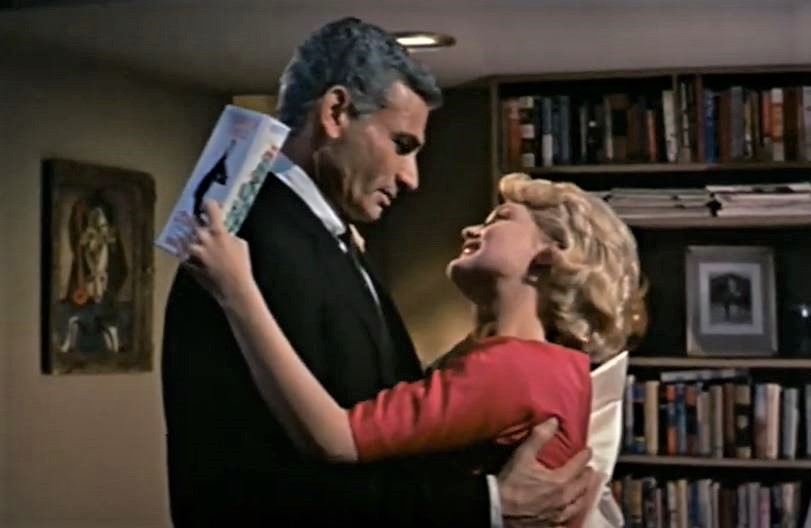
The first Peyton Place movie, based on a racy bestseller, is about the scandals and hypocrisies of a small New England town. If you haven't seen it, the only thing you really need to know to follow the events of this sequel, set several years later, is that Selena Cross (played here by Tuesday Weld) was raped by her stepfather whom she later killed in self-defense. This film begins as Alison McKenzie (Carol Lynley) learns that a novel she has written based on life in Peyton Place, and in particular on what happened to Selena and how badly the townspeople treated her, has been accepted for publication by publisher Lewis Jackman (Jeff Chandler), who asks her to come to New York City so he can help her get the book into shape. She does, falling in love with Jackman, a married man. Alison's mother Constance (Eleanor Parker) worries that she will wind up pregnant, as she herself did with Alison's father, though by now, Constance is quite respectable, married to Mike Rossi, the high school principal. Alison and Lewis work together many long nights; it's unclear how much more they get into, though we do see them kiss romantically at least once (pictured at right). When it's published, the book is a hit, even in Peyton Place where, though most people don't like it, everyone reads it. When mean rich lady Roberta Carter (Mary Astor) takes exception to it, she uses her power as a school board member to get the book pulled from the shelves of the high school library. Principal Rossi reinstates it, gets fired, and goes to the town council to get his job back, leading to a climactic town hall meeting pitting Mrs. Carter against Mike and Alison.

This sequel didn't do anywhere near the business that the original did (either book or film), perhaps because the secrets here are not as scandalous as those in the original. Surely the ambiguity that clouds the Alison/Lewis relationship didn't help. Also, the first movie edged near camp whereas this one is played a bit straighter. In addition to the main plot outlined above, this has a secondary story involving Mrs. Carter and her son Ted (Brett Halsey, at left), the character who actually "returns" to set up a law practice. He brings home his new pregnant Italian wife Raffaella (Luciana Paluzzi, who was married to Halsey in real life), and his mother tries her damndest to split them up. At one point, Raffaella basically accuses Mrs. Carter of having an unnatural love for her son, and later she deliberately skis down a dangerous ski slope in an attempt to cause a miscarriage—unless I missed something, we never know the outcome of the attempt. Selena gets her own somewhat pointless plotline where she falls for a Swedish ski instructor (Gunnar Hellstrom, who is moderately attractive but no big blond fantasy Swede) but that goes nowhere. 

Actingwise, the movie belongs to Mary Astor who does a good job slightly underplaying the big bad mother. Frankly, I could have used a bit more "jungle red" melodrama in her performance, but she's still very good. Halsey (he of the puppydog eyes) and Paluzzi are fine, and though I'm not a Jeff Chandler fan, he's good here as the publisher whose intentions vis a vis his author are never quite clear. Lynley, who wasn't 20 yet, doesn't have a strong presence—she sometimes seems just whiny as opposed to seriously conflicted. Tuesday Weld and Eleanor Parker aren't around long enough to register much but they're fine, as is Robert Sterling as Rossi. The uncredited guy who plays the friendly heckler at the town meeting (Tim Durant, maybe?) is good as is Jennifer Howard as Jackman's wife—both have short scenes but they stand out. Generally enjoyable 60s soap opera fluff. [DVD]

Thursday, May 19, 2022

AND SOON THE DARKNESS (1970)

Jane and Cathy are two young British women on a vacation, bicycling through the picturesque French countryside. At a sidewalk café, they notice a scruffily handsome man who is noticing them. When they leave, he follows them on his motor scooter. In a small village, they notice him again and seem caught between interest and fear. After a rest stop in some woods, a drowsy Cathy wants to stay and nap in the sun, while the more practical Jane wants to get going. In a bit of a huff, Jane bikes on to another small village where a local tells her that the road has a dangerous reputation as a girl had been raped and killed there some time ago. When Cathy doesn't show up, Jane rides back and finds only her camera in the clearing. The mysterious scooter rider, Paul, also shows up and offers to help look for Cathy, but Jane isn't sure she should trust him, even after he claims to be a detective who had, in fact, worked on the past murder along the road. Various villagers are introduced (a restaurant owner, a cop and his deaf father, a British teacher), all seeming a little off-kilter. Just because Paul seems the most suspicious, it seems like he can't be a rapist and killer—or can he?

Advertised as a horror movie, this is more a slow burn thriller though it partakes of the "big city vs. rural village" genre of films like The Texas Chainsaw Massacre. But there is very little here to draw horror fans. Even though it's only 100 minutes, it feels too long, as once it's established that Cathy is gone, the action, such as it is, is repetitious and mostly involves building up red herring situations. The ending is satisfying but it should have arrived in under 90 minutes. Michele Dotrice, sister of Karen who played Jane Banks in MARY POPPINS, is fine as the somewhat sensuous Cathy—there is in her character at least a smidge of the old stereotype of the sexy girl who is asking for trouble. Pamela Franklin (LEGEND OF HELL HOUSE) is very good as Jane. Sandor Elès (COUNTESS DRACULA) as Paul, pictured, is good at maintaining ambiguity about his character and his motivations right to the end. The bright sunlit locations make an interesting background to the tense proceedings. Certainly watchable if not especially memorable. [Streaming]

Monday, May 16, 2022

MADELEINE (1950)

In 1850s Glasgow, the Smith family is about to buy a home in the city, and the older daughter Madeleine (Ann Todd) is particularly taken with a basement bedroom which has a barred window looking out onto the sidewalk and the feet of passersby. When they're moved in, she shares the room (which looks like it was intended to be servants' quarters) with her younger sister, and we soon see what appealed to her about the room: her illicit lover Emile (Ivan Desny) walks past, tapping his walking cane against the bars and dropping love notes into the window. Her autocratic father (Leslie Banks) is insisting that she marry the respectable William Minnoch, but has allowed her not to set an engagement date yet, so she continues seeing Emile who is more handsome and exciting, but also struggling to get by. Soon, Madeleine presses Emile to elope with her, but he needs her money and so insists that they get married properly. She finally agrees to marry William, but Emile threatens to use her love letters to blackmail her. Eventually, Emile is found dead of arsenic poisoning in what is assumed to be a suicide, but a friend of Emil's takes Madeleine's letters to her father, and evidence comes out that Madeleine had set up a secret meeting with Emile the night before he died. When it is discovered that she had a bottle of arsenic in her possession, she is put on trial for murder.

[Spoilers follow] This David Lean film is based on a real case that ended in a "not proven" verdict, which is somewhere between guilty and not guilty. This ambiguous ending is actually fairly satisfying, with the last shot lingering on Madeleine's face as she leaves the courtroom, a tiny smile just about to break out. But what I found not satisfying is the portrayal of the fateful night before Emile's death. We are given brief glimpses of Emile heading for the basement window during a storm, and of Madeleine waiting for him, but we never actually see if they meet or not. Her story is that he never showed up. More confusion occurs involving what seems to have been an earlier poisoning attempt by Madeleine, but again, what we see is inconclusive. In prose, this kind of ambiguity would go down better, but in visuals, it's frustrating. Performances are fine. Todd was married to David Lean and he did the movie for her, as she had played the role on stage, but he considers this to be his worst movie. Todd is good, however, as is Desny as her lover. Leslie Banks as the father isn't given enough screen time or enough scenery to chew. Norman Wooland does what he can with the underwritten role of Minnoch; he manages to make him fairly sympathetic, as though he knows he is caught between the father and the daughter in a game that no one can win. The movie has the look of a film noir, and there is some fun to be had with the camera's focus on a phallic cane that Emile carries and twirls and thrusts, and at least once has yanked out of his hands by Madeleine. Despite the unsatisfying last third, it's worth seeing. Pictured are Desny and Todd. [TCM]

Friday, May 13, 2022

Z (1969)

This film set in an unnamed country begins with a message that any resemblance to real people and events is intentional—though based on a novel, the plot closely follows events that unfolded in Greece in 1963, and though most of the characters are based on specific people, no names are used in the film. We first see a lecture on getting rid of mildew in vineyards, and the general in charge of the security police (Pierre Dux) uses this as a political metaphor for getting rid of the "ideological malady" of various "-isms" in society. More specifically, he is hoping for "healthy antibodies" to show up to demonstrate against an upcoming anti-government conference of pacifists, led by a doctor (Yves Montand). After various venue changes forced by the government, the rally is held in a small union hall with large groups of demonstrators from both sides outside, with chants of "Disarmament!" met by chants of "Long live the bomb!" Montand is hit on the head by a hooligan but is able to go on with his speech. Afterwards, as he leaves the building, a man driving a small three-wheel delivery vehicle clubs him on the head. Montand collapses and dies a couple of days later. His death is blamed on a drunk driver, but a crusading journalist (Jacques Perrin) who is adept at snapping candid photos digs into the case and begins to uncover the truth, and helps a government appointed magistrate (Jean-Louis Trintignant, pictured) untangle the devious webs of the guilty parties. 

This is the movie that put Greek director Costa-Gravas in the international spotlight. It was the first film nominated for both Best Film and Best Foreign Film at the Oscars (it won the latter award). Though it is heavily political, it is easy to understand the clashing ideologies, and the tone of the film is much closer to a police procedural thriller than to a didactic story of politics. The acting is solid all around, from the lead roles to the smaller supporting parts, though second-billed Irene Papas, playing Montand's wife, has little screen time and almost no dialogue. Stylewise, the film alternates between fairly static dialogue-heavy scenes and action sequences with loud background music and off-kilter angles. This is surely an inappropriate response, but the constant repetition of bad guys coshing good guys over the head became almost comic. The title is a reference, not explained until the end, of Greek graffiti featuring the letter 'Z', the first letter of the Greek phrase meaning "He lives," used when the real-life doctor, Grigoris Lambrakis, was murdered. Very popular in its day, the movie's reputation seems to have gone into eclipse a bit, and though it's a little slow in places, it's well worth watching. [TCM]

Wednesday, May 11, 2022

THE TURNING POINT (1952)

A Midwestern city that has become infested with crime assigns academic John Conroy (Edmond O'Brien) as a special prosecutor with the specific chore of bringing down the sprawling crime syndicate of Neil Eichelberger (Ed Begley) who is, to the public, the respectable head of a trucking company. John has brought with him Amanda Waycross (Alexis Smith) whom he describes as his "Girl Friday and spiritual advisor." John's old friend Jerry McKibbon (William Holden), now a reporter, stops by John's office and questions him about his motives for taking on this job, worrying that he has misplaced political ambitions, (which John insists he does not have) and worries that John will wind up being a fall guy for the powers that be. Jerry also is clearly smitten with Amanda, and eventually she with him. When John asks his father Matt (Tom Tully), a cop, to be a lead investigator, Matt tries to turn him down, much to everyone's surprise. Jerry gets suspicious, especially since John has made it clear that he wants to get rid of bad cops just as much as gangsters, and soon discovers that Matt is indeed on Eichelberger's payroll, for having borrowed money from him years ago. Eichelberger assigns Matt to get hold of an old incriminating police file; Matt gets it but photocopies it so it will stay in the files. When Eichelberger discovers the double cross, Matt's days are numbered, and John and Jerry will face danger as well.

There is much more to the plot but I won't spoil the pleasures of seeing how it all plays out. This is an overlooked gem of noir/crime films that Eddie Muller of TCM has brought attention to, and it's well worth seeing—it doesn’t appear to be on a region 1 DVD but it's available for rental on Amazon Prime. I'm not sure it really deserves the noir label, as none of the three major characters (John, Jerry and Amanda) are exactly morally conflicted, though there is a strong urban feel to several scenes; at heart, it's a crime crusade movie, but noir fans should enjoy it. Holden, O'Brien and Smith are all great, though I wish Smith had a little more to do. Begley is nicely slimy as the bad guy, especially in his courtroom scene. The revelation here is Tom Tully, a familiar character actor. The scene in which he explains his moral dilemma to Holden is a standout and should have gotten him an Oscar nomination, as it is every bit as strong as the short scene that got Beatrice Straight a nod in NETWORK. (Tully did get a nomination for THE CAINE MUTINY a couple years later). Holden's first attempt at flirtation with Smith, whom he considers mostly a mindless socialite, consists of him saying, "Will you please sit down so I can throw myself at your feet?" Recommended. Pictured are Holden and Smith. [TCM]

Wednesday, May 04, 2022

BLAST OF SILENCE (1961)

Frankie Bono is a mid-level hitman from Cleveland who has gone to New York City during Christmas week to arrange a hit on a mobster named Troiano. He is warned to stay out of sight and get the job done by New Year's Eve. In a bar, he meets Pete, an old friend, and his sister Laurie who was Frankie's girlfriend in the past. Frankie thinks he maybe has a second chance with Laurie, but when he makes his move, which turns into a near-assault, she stops him. A fat slob of a guy named Ralph, who keeps rats as pets, is supposed to supply Frankie with a gun with a silencer, but Ralph stalls, asking for more money. Tracking Troiano, Frankie follows him to a beatnik club where the married gangster spends time with his mistress. Then things start to fall apart: Ralph finds out who Frankie's target is and threatens Frankie with blackmail; Frankie goes to Laurie's apartment hoping to restart their relationship but discovers she has a live-in boyfriend; when Frankie tries to get out of finishing the job, his employers threaten him: "A killer who doesn't kill gets killed." What’s a confused, depressed hitman to do?

This B-noir starts off rather fatalistically with narration about the birth of Frankie as the camera slowly moves through a tunnel in an expressionistic approximation of childbirth, and comes bursting out onto a train track into New York City, as though Frankie was predetermined to meet his fate there. The narration, in the second person by Lionel Stander, continues and adds to the existential noir feeling of the movie. Though cheap looking, the movie has urban atmosphere to burn, having been shot on New York streets. Its Christmas setting adds another element to the film's tone—noir expert Eddie Muller claims this is one of his favorite Christmas movies which he might have meant somewhat in jest. The scene of Frankie walking robotically past the decked-out Rockefeller Center is memorable. Allen Baron, who plays Frankie (and occasionally looks like a B-movie George C. Scott), went on to a long career as a television director, but never acted again. I wouldn't make grandiose claims for his acting talents, but he's fine here with a nice haunted, hunted look throughout. Larry Tucker as Ralph is memorable in a disgusting way, and Molly McCarthy as Laurie is very good as the passive but not weak woman who is confused by Frankie's actions. Not a polished classic (though it has gotten a Criterion Collection release) but a nice, tough example of late-period film noir. [TCM]

Monday, May 02, 2022

THE SUSPECT (1944)

In 1902 London, Philip (Charles Laughton), worker in a tobacco shop, is stuck in an unhappy marriage to his unstable wife Cora (Rosaline Ivan) who, in a fit of rage, has just torn up pages and pages of their son John's work. John moves out and Philip moves into his room. At work, he strikes up a friendly relationship with an unemployed secretary named Mary (Ella Raines) who is looking for a job. There's no opening at Philip's place, but quite taken with the woman, Philip helps her find another job and begins going out with her (and, we assume, having an affair with her). A parallel plotline develops as Philip becomes aware of the troubled marriage of his neighbor Gilbert (Henry Daniell), an alcoholic who beats his wife. Cora learns of Philip's affair but refuses to give him a divorce, and threatens to have Mary fired from her job. On Christmas day, Philip kills her by throwing her down the stairs and claiming she fell. Inspector Huxley (Stanley Ridges) suspects Philip and indeed lays out an elaborate description of how Philip might have done it, though he can't prove it. Philip marries Mary and seems to be in the clear until Gilbert acts on his suspicions and tries to blackmail Philip. Then things quickly fall to pieces. Charles Laughton is good at playing weak men caught up in bad circumstances. Sometimes he buckles (PAYMENT DEFERRED) and sometimes he finds strength to do the right thing (THIS LAND IS MINE). Here, he manages to do both. He gives in to his violent impulses by killing his wife, but in the end, he redeems himself, to some degree, by acting out of sympathy for an innocent person who is in peril because of him. The scene where the inspector lays out for Philip how he thinks the murder of Cora could have happened is nicely tense, as is a later scene between Philip and Gilbert (no spoiler here). The whole cast is solid and the dark look of the movie adds to the tension. Pictured are Laughton and Dean Harens as his son. [TCM]

Thursday, April 28, 2022

FIGHTING DEVIL DOGS (1938 serial)

This adventure serial tries to pass itself off as full of military action—in addition to the title, it's dedicated to the United States Marines, "vigilant guardians of our flag"—but though the two heroes are Marines, they might as well be private eyes or soldiers of fortune for all it matters to the plot. In China, Lt. Corby (Herman Brix) and Lt. Grayson (Lee Powell, both pictured at right) are sent to save some Americans stuck in Lingchuria during an attack by the Japanese. On the way, in the serial's most effective scene, they come across a fort filled with dead bodies (think the opening of Beau Geste or the 1994 miniseries of The Stand). Even the flies are dead. It would appear that everyone died of electrocution, but how? Soon they find out: massive fireballs come out of the sky, hitting the building and killing the Marines still inside. Back in the States, Grayson winds up charged with negligence in their deaths, but a similar attack occurs in San Diego at the laboratory of Dr. Warfield. Warfield escapes but Grayson's father is killed. Now the search for the villain who is using these electrified torpedoes known as Thunderbolts is personal… This 12-chapter serial is slightly better than average, mostly due to an interesting story and the changes of locale, from China to San Diego to Gehorda Island, out past Hawaii. The costumed villain, the Lightning (pictured below) is nothing special, but it has often been speculated that his costume may have inspired George Lucas in the creation of Darth Vader. There are way too many lurking background characters who might be the Lightning, and they're all too obviously red herrings, but when he is unmasked in the last chapter, it's a good reveal. 

It takes eleven chapters for someone to finally state the obvious: that with all the leaks of information, someone in the inner circle of good guys must be a bad guy. There's a variety of cliffhangers: a car chase on a cliff, a flaming torpedo headed for a dirigible, a building on fire, a shark in the ocean, and a locked room filling up with carbon monoxide. A few too many scenes consist obviously of stock footage or scenes from other Republic serials, including the flying Wing plane which is right out of a Dick Tracy serial. Two of the twelve chapters are mostly recaps, equivalent to TV series clip shows. Serials are no better than their heroes and these two are pretty good. Lee Powell and Herman Brix, later known as Bruce Bennett, are handsome and energetic, with Powell—who died in the war—more the focus than Brix. You may notice I haven’t mentioned a femme interest yet. That’s because Eleanor Stewart is terrible as Warfield's daughter; thankfully, she hasn't much to do, never becoming integral to the plot, and never striking sparks with either hero. Of the large supporting cast, only Perry Ivins stands out as a scientist named Crenshaw—he is so very creepy and suspicious, you know he can't possibly be a bad guy. He also, in a very deus ex machina move, comes up with a weapon in Chapter 11 to stop the Thunderbolts. A little shaggy around the edges but mostly good fun (and good fisticuffs). [DVD]

Tuesday, April 26, 2022

DRAGSTRIP GIRL (1957)

Hot-rodding buddies Jim (Steve Terrell) and Fred (John Ashley) are riding together down the city streets when they encounter hot-rodding Louise (Fay Spain). The boys race the girl for a while and Fred even jumps out of his car to stand up, straddling between the two cars. A motorcycle cop gives chase but they all manage to escape to a secret garage that the local kids maintain. Later, at Mama's Pizzeria, a friendly cop reminds the kids to race only on the dragstrip the city has provided and not on the streets. Louise, who is new to town, takes Jim and Fred to meet her parents. Jim, from a working-class background, impresses her dad with his car tinkering abilities, but Fred, a handsome rich kid, impresses mom because, well, he's handsome and rich. Louise winds up trading off between the two, pitting the buddies against each other as she tries to satisfy her need for speed. When Jim almost hits a woman with a baby carriage on a suburban street, he's shaken up, so Louise sidles up to Fred who is more willing to be reckless. Taunts and dares go back and forth between the boys until the big local race day where the winner will win a scholarship. The night before, Fred and his friend Rick steal Jim's car to see just how powerful it is, and while speeding, they hit and kill a pedestrian. Fred tries to arrange things so that blame will fall on Jim, but on the day of the race, Louise discovers what's going on. Will she be able to prove Jim's innocence, and will she want to?

This early hit for American International is enjoyable. This was certainly one of the movies that set the template for late 50s teen melodramas. It’s got it all: the teenage gang, the nice kid, the bad kid, the sexy gal, the hangout (at Mama’s Pizzeria, Mama and her husband provide some rather strained comic relief), and the general atmosphere of teenage angst. What's interesting here is that, though Fred is clearly a bad apple, juvenile delinquency and the generation gap are not issues: the kids are generally clean-cut and fun-loving and they get along well with cops and parents. Maybe too well: when Louise's dad sees her all dolled up for date night, he comments proudly, "That gal of mine knows how to bait a man trap!" Later when the kids have a petting party in the dark at Louise's house, her dad sneaks downstairs to turn all the lights back on, but the kids just turn them off again. 

The script and direction are par for the course, but the acting is a notch better than average. This was John Ashley's first movie; he went on to a busy career in teen flicks, playing bad guys and nice guys equally well. Later he was instrumental (both as actor and producer) in establishing the subgenre of cheap horror movies shot in the Philippines. Steve Terrell did a lot of TV through the mid-60s then gave it all up to become a Christian educator. Ashley is fairly aggressive with a cocky stance and in-your-face delivery; Terrell is generally passive—he has a tendency to walk hunched in like he's trying not to attract attention. But they have a palpable friendship chemistry here until the femme fatale ruins it. Fay Spain is fine as Louise, and remains mostly sympathetic despite her machinations. In addition to the comic relief of the pizzeria owners and the parents, there's Frank Gorshin as a goofy hot rodder (pictured above right between Ashley and Terrell). I loved Gorshin as TV's Riddler, but a little of him goes a long way and he wears out his welcome, though he does get one of the highlight scenes, dressed in funky drag and singing "Dragstrip Baby" in the pizzeria with Ashley in Elvis mode on guitar. It's fun to see a movie that was made before all the teen movies clichés were set in stone. [Amazon Prime]

Thursday, April 21, 2022

SYLVIE ET LE FANTÔME (aka SYLVIA AND THE PHANTOM) (1946)

Sixteen-year-old Sylvie lives with her family in an old castle, and she is fascinated by the family legend of Alain, her grandmother's lover who died many years ago in a duel, but whose portrait dominates a room in the castle and whose ghost is said to haunt the place. When her father, the Baron, decides to sell the painting to a local art dealer for some much needed cash, he knows Sylvie will be distraught so he decides to hire an actor to play the ghost of Alain at a ball being held for Sylvie's birthday. Immediately, complications ensue. First, Sylvie discovers a secret passage in the wall where the painting was, and in exploring it, runs into Ramure, who was attempting to burgle the place and darts away through the passage. Sylvie, not knowing his intentions, finds him handsome and mysterious. Then the art dealer's son, Frederick, meets her briefly and becomes infatuated with her, returning to the house to try and arrange a meeting. When the art dealer's assistant nails the painting into a wooden box, he hears a tapping response from inside, and we see the ghost of Alain rise out of the box, along with the ghost of his beloved dog (who wasted away and died on Alain's grave). On the night of the party, Ramure and Frederick are both caught in the house and both claim to be actors hired to play the ghost, and when the real actor, an older fellow, shows up, the Baron is happy to have all three don ghost costumes. Finally, the real ghost shows up, slips on a sheet, and all hell breaks loose.

This is a charming supernatural romance with distinct tones of melancholy which do not take away from the generally comic air of the film. First things first, however: Odette Joyeux, who plays Sylvie, was over 30 when she made this, and though she is lovely and charming and doesn't quite look 30, she surely does not look 16, so in my mind, Sylvie was turning 21. The most famous member of the cast is Jacques Tati (the ghost) who would go on to become something of a French Charlie Chaplin, directing and acting in several comic masterpieces in the 1950s. Here, however, he speaks no dialogue and has little to do besides glide about transparently and walk through doors and walls. Acting-wise, for me, the movie belongs to the two competing suitors, Francois Périer as Ramure and Jean Desailly as Frederick. Both are quite appealing and I was genuinely uncertain which man, if either, Sylvie would wind up with. (Frankly, I think she makes the wrong decision.) The transparent effect of the ghost was done on set, with two identical sets built at right angles to each other, with glass in between which reflects Tati on the second set against the main set. It's quite effective, though occasionally you can see light bouncing off the glass. As directed by Claude Autant-Lara (who went on to become a controversial French politician in the 1980s), the whole thing has a lovely light fantasy element which would make this a nice pairing with something like The Ghost and Mrs. Muir or A Matter of Life and Death. Pictured are the suitors, Périer and Desailly. [DVD]

Monday, April 18, 2022

THE CARIBBEAN MYSTERY (1945)

Two oil company geologists working on a Caribbean island are looking for a secret island in the middle of a swamp area that was rumored to have been used as a hiding place for pirate treasures. When they come across it, they're surprised to find it inhabited. The island's leader, Van den Berk (Roy Roberts), offers them rest, but instead has his associate Hartshorn take them off and shoot them. They become the latest in a string of men who have gone missing on the island over the past six months. The oil company calls in Smith (James Dunn), a private detective from Brooklyn (he calls himself a "flatfoot from Flatbush") who has a rather fast and loose way of operating that irritates the local police. In due time, he meets McCracken, the island’s governor; Gerald, McCracken’s son; Linda, the police commissioner's daughter, who is dating Gerald; Mrs. Gilbert, the manager of the hotel where Smith and his associate Gates are staying; and Marcel, the local doctor. It’s not long before people start getting menaced and/or killed, and eventually the action moves to the swamp where, in addition to the threat of Van den Berk, who has indeed found the pirate gold, there are alligators, snakes, and quicksand pits to contend with. 

This B-thriller is serviceable until the end when it actually gets fairly involving and exciting. I'm not a fan of James Dunn (though he did deserve his supporting actor Oscar for A Tree Grows in Brooklyn) and he's a bit lackluster here—and the more he tries to enliven his character, the more artificial he seems—but I eventually got used to him. It's a B-film but it was made by Fox so it's generally a notch above the norm. The cast seems second-string; Sheila Ryan, a very busy B-actress in the 40s, is second-billed as Mrs. Gilbert, but she only has one short scene. Of some note are Reed Hadley (as Marcel), Edward Ryan (no relation to Sheila, as Gerald), and Daral Hudson (the rather handsome bad guy Hartshorn). Production values are good and the identity of the chief bad guy (Van den Berk is doing someone else's bidding) was a bit surprising, revealed during an old-fashioned suspect gathering scene at the end. The story is based on a novel which also was the basis for Mr. Moto on Danger Island. Recommended. Pictured are Ryan and Dunn. [YouTube]

Wednesday, April 13, 2022

THE MOON AND SIXPENCE (1959)

Films made for TV aren't usually fodder for this blog (except for some from the Golden Age of the 1970s), but this one has strong interest for classic film fans and has just been released on DVD so is readily available for viewing. It was not presented live as many plays on TV were, but was shot on tape with individual sequences obviously recorded 'live' with no retakes, and so is an interesting look at what early TV drama was like. Based on a novel by W. Somerset Maugham which had previously been made as a theatrical film in 1942, this is a thinly veiled version of the life of artist Paul Gaugin. Here, he is named Charles Strickland (Laurence Olivier), and the play presents him as an average, everyday stockbroker, seemingly happy in his life and with his wife Amy (Geraldine Fitzgerald) until suddenly he isn't. After Amy has defended him as a good husband, he drops the bombshell that he wants to leave her and go to Paris by himself. She is convinced he is having an affair, but when she follows him, she finds out that, at the age of 40, he wants to start a new life as a painter. In Paris, he is befriended by fellow artist Dirk (Hume Cronyn) and his wife Blanche (Jessica Tandy). When Strickland falls on hard times and is sick and starving, Dirk has him move in, a kindness which Strickland pays back by taking Blanche from him—though the incident is portrayed more as Blanche becoming obsessed with Strickland and him just allowing the betrayal to happen. Things end badly between the two, and with Strickland hating his "human desires" and claiming that love is a disease, he goes off to the South Seas to paint and do nothing else. His story ends in Tahiti where he paints to his heart's content, has a satisfactory relationship with a local woman, and eventually contracts leprosy and dies, having left instructions to have all his work burned.

The big draw at the time for this production was the presence of Olivier, generally considered then the greatest living actor. He won an Emmy for it, as did Robert Mulligan for directing. While Olivier is very good, I found the supporting cast more interesting. Tandy's portrayal of a woman who seems completely unmoored by her attraction to Strickland is understated and exceptionally good. In addition to those mentioned above, the cast includes Judith Anderson and Jean Marsh as two island women and Denholm Elliott as an author, the usual Maugham stand-in, who tells the story even though he's not present for most of it. Olivier has a couple of line flubs which are left in. The leprosy makeup by Dick Smith is excellent. It was shot and transmitted in color, even being used in a magazine advertising campaign by RCA for its color televisions. The print on this DVD came from a kinescope, having been filmed directly from a television set, and the color comes and goes, and the picture gets murky from time to time, but none of those things make it unwatchable. (However, the DVD company, Redemption Hill, does manage to get four typos on the cover, including 'Jessice' for Jessica and 'Cronin' for Cronyn). Interesting viewing for its acting and its relative novelty as an acclaimed television production from the past. Pictured are Cronyn and Olivier. [DVD]

Monday, April 11, 2022

THE HUCKSTERS (1947)

Returning war veteran Vic Norman (Clark Gable) is trying to get a job in advertising, like he held before the war. Though down to his last fifty bucks, he knows he can't come off as desperate in interviews, but during an interview with Kimberly, the head of his own agency, Vic impulsively agrees to help out with a problem client, Evans (Sydney Greenstreet), who is trying to secure rich Manhattan socialites for an advertising campaign for his company's beauty soap. He gets Kay Dorrence (Deborah Kerr), a war widow, to participate, but at the photo shoot, she balks at appearing in a sexy negligee, so against Evans' wishes, Vic lets her wear an evening gown. At a meeting, Evans explains his philosophy that good ads should be irritatingly repetitive or shocking, but Vic wins him over by saying an ad for soap should stress cleanliness, not sexiness. Though Vic takes an immediate dislike to Evans, Vic takes a job with Kimberly, with Evans as his special client. Vic and Kay get close, though a misstep occurs when Vic invites Kay to spend a weekend with him at the Blue Penguin Inn. The inn used to be a nice resort but now it's a little sleazy, so Kay gets the wrong message about Vic's intentions and stands him up. But Vic has another woman who's interested in him, Jean (Ava Gardner), a lounge singer and old friend. Evans' next assignment for Vic is to go to California and get B-talent comic Buddy Hare (Keenan Wynn) to host a radio show. Vic finds Hare and his agent (Edward Arnold) obnoxious, and uses blackmail to get the agent to lowball Hare's salary. In the end, Vic doesn't like what he sees himself becoming and provides a memorable climax to the story in Evans' boardroom.

This movie doesn't seem to know what it wants to be. It's based on what is apparently a sharply satirical novel, but was toned down in the process of production and becomes a character study of Vic Norman with some lightly satirical jabs at advertising—think Mad Men without the 60s cultural enlightenment. But between the writing and Gable's lackluster performance, Vic just isn't that interesting. Gable and Kerr (pictured) work up some chemistry in their improbable class-conflicting romance, but as with Gable, her character is only sketchily drawn. With Ava Gardner sadly underused and Keenan Wynn a bit of an acquired taste, it's left to Sydney Greenstreet to give the movie a needed jolt every time he's on screen. His first scene is rightly notorious: to make his point about the impact of shock, Evans hawks out a huge gob of spit on the boardroom table in front of Vic and all of Evans' yes-men. Greenstreet makes Evans slimy and awful and quite memorable. Adolphe Menjou has a couple of nice scenes as an ad exec with a shameful secret. He also gets a good line, telling Gardner, "You shouldn’t get married; all that oomph ought to stay in circulation." It's filmed in that bland late-40s way that so many melodramas were, with Jack Conway displaying little directorial style. Certainly watchable, but not the classic satire it had the potential to be. [TCM]

Friday, April 08, 2022

ARABIAN NIGHTS (1974)

Following THE DECAMERON and THE CANTERBURY TALES in his Trilogy of Life, Pier Paolo Pasolini jettisons the original overarching narrative of the storyteller Scheherazade and simply dramatizes a handful of the tales with a different framing story. At a slave market, a woman named Zummurrud (aka the Lady of the Moons) is being sold with the unusual caveat that she can choose her buyer. A blue-eyed ruffian named Barsum bids on her, but when she sees the handsome young Nur Ed Din, she gives him the money to buy her. After making love, she makes a small cloth tapestry and gives it to Nur Ed Din to sell, warning him not to sell it to a blue-eyed man. Of course, he sells it to Barsum who kidnaps Zummurrud, setting in motion Nur Ed Din's search for her. Disguised as a man, she winds up at a city in the desert where the king has just died, and their ritual is to crown the next man who arrives at their gate. She is made king, and at the end of the movie, Nur Ed Din is led by a magical lion to the city where Zummurrud recognizes him, has him brought to her and when she commands him to have sex with her, she reveals her identity. Happy ending for both.

But the bulk of the film is taken up with the telling of a number of tales and tales within tales all involving love or lust. None of the more familiar Thousand and One Nights stories (Sindbad, Aladdin, Ali Baba) are told—though forty thieves are mentioned in passing as gang rapists. One story involves a prince in disguise who discovers a woman being held underground by a demon who comes and goes as he pleases. After sex, the prince leaves but forgets his shoes. The demon arrives, searches for and finds the prince, and takes him back to the girl. When the prince refuses the demon's demand that he kill the girl, the demon chops her up in pieces and turns the prince into a monkey. (This segment features one of the few special effects in the movie, the demon and the prince flying through the air.) In another, a character named Aziz leaves his intended for a woman, Budur, he has only glanced at through a window. Eventually, they have sex (including with a phallus-shaped arrow) and he later winds up castrated. 

Most of these stories have sad or tragic endings. Whether that's a judgment on sex or love or infidelity or power, I don't know. One tale near the end, about Nur Ed Din coming upon three naked women in a pool and trying to guess what they call their vaginas, is basically an extended bawdy joke. There is much graphic nudity and simulated sex, and many of the performers are non-professionals, though with the exception of Nur Ed DIn (Franco Merli), Zummurrud (Ines Pelligrini), and the demon (Franco Citti), there's not much need for acting skill in the service in characterizations. I've read that because many of the Middle East locals wouldn't do nude scenes, most of the major roles were filled by Italian actors, and the film frames are filled with handsome and beautiful faces. The lovely exteriors were shot in Iran, Africa and Nepal, and there is generally a very realistic feeling of sand and heat and sweat throughout. Still interesting to watch. Pictured is Francesco Paolo Governale who plays a character named Prince Tagi. [Criterion]

Tuesday, April 05, 2022

THE CANTERBURY TALES (1972)

The second of Pier Paolo Pasolini's Trilogy of Life films is based on Chaucer's classic collection of stories told by a group of pilgrims heading from London to Canterbury Cathedral. Though one might assume them to be religious stories, they aren't, though they deal in issues of morality. Pasolini was probably attracted to them for their cruder, sexier elements as in the other trilogy films. The director himself plays the poet Chaucer who arrives among the pilgrims, singing and wrestling in muck, with one selling indulgences "piping hot from Rome," as they set out for Canterbury. It is suggested everyone take turns along the way at telling comic stories to pass the time (someone observes that "between and jest and a joke, many a truth can be told") and we see Chaucer dutifully writing the tales down, but unlike in Chaucer's work, we don't see or know who is telling the tales. The first has the elderly Sir January deciding to marry a young woman; he sees May's bare ass in the marketplace and picks her. He proclaims loudly that he's worried that the force of his lovemaking will injure her (while one of his servants rolls his eyes), but as soon as she's married, she starts flirting with Damian, a young man who spreads his legs apart for her gazing delight and later masturbates to thoughts of her. January is struck blind, leaving May free to hook up with Damian, except that her husband insists she hold his hand everywhere they go. Out for a walk in the garden, Damian is hidden in a tree and May, under the pretense of picking berries, climbs up on January's back to enjoy some canoodling with her young man. A playful god watching the scene gives the old man back his sight, but a playful goddess gives May the words to explain away what he's seen. The next story has a summoner catch two men engaged in sex with young male prostitutes; one man pays the summoner a large sum to be freed but the other cannot and so is burned to death in the churchyard. The Devil, who is selling food to the onlooking crowd, follows the summoner as he tries to extort tax money out of a poor old woman, but with the Devil's help, the woman gets the best of the summoner, who winds up in Hell.

The rest of the tales mostly involve sex or toilet humor or both. In one story, a man attracted to someone else's wife holds onto his obvious erection as he prays to "soften all this is rigid." In another, the wife of Bath, whose husband is dying, is attracted to a young student, gives him a casual handjob, then immediately after the husband's funeral trots to another part of the church to marry the student. The famous Pardoner’s Tale, which may have inspired the moral lesson of The Treasure of the Sierra Madre, features bandits who plot against each other leading to no good end for any of them. Two stories involve farting as a major plot point, and the grotesque finale, inspired visually by Bosch, shows the devil shitting dead corrupt holy men out of his ass. None of the trilogy films rely on nuanced acting, with non-pro actors filling many roles, but Hugh Griffith (familiar from Ben-Hur, Tom Jones and Oliver!) is fine as Sir January. Prolific Italian actress Laura Betti is the Wife of Bath, and Pasolini regulars Ninetto Davoli and Franco Citti are also present. Davoli, who was Pasolini's companion for a time, is at the center of one of the best tales, the misadventures of a happy Chaplinesque doofus who leads a couple of policemen into a Keystone Kop situation (complete with some sped-up action). The photography and set design are splendid, with many shots having a gorgeous painterly look (see photo above) The raunchiest but also maybe the most accessible of the trilogy films. [Criterion Channel]

Friday, April 01, 2022

THE DECAMERON (1971)

Gay Catholic Marxist filmmaker Pier Paolo Pasolini made three films he called the Trilogy of Life, all based on famous collections of earthy morality tales from the past, the other two being THE CANTERBURY TALES and ARABIAN NIGHTS. In all three, the frame stories are more or less ignored (less so in CANTERBURY). In Boccaccio's original Decameron, ten people who have decamped from Florence to the countryside to escape the Black Death tell each other stories, some lewd, some allegorical. Here, several of the stories are told with no single frame or link. Instead, we are plunged into the world of (what I assume to be) 14th century Italy as we see a young man, Ciappelletto, murder someone and hide the body. Though we will come back to him later, the focus shifts to Andreuccio, a curly haired guy in tight pants who is visiting Naples. A beautiful woman sees him and tells him that she is his half-sister. She offers to put him up for the night, but when he has to use the bathroom, he is directed to a doorway which leads to a huge pit of excrement. The woman steals his money and he runs off into the night in his soiled nightclothes, and winds up involved with two thieves trying to steal jewels from the tomb of a recently deceased archbishop. Andreuccio climbs in the large stone tomb and tosses jewels out to the men but keeps a particularly valuable ring for himself. Suspecting what he's done, the two men close him up in the tomb and leave. How he gets out provides the climax of the story.

There are many more stories (mostly bawdy) told with more or less random links between them. Ciappelletto pops up later—on his deathbed, he scams a priest into declaring him a holy man despite being a thief, a rapist, and a homosexual. Pasolini himself shows up halfway through as an artist hired to paint a fresco in a church, and returns at the end having only done two of the three wall panels, declaring, "Why complete a work when it’s better just to dream it?" Which might be a good reason for adapting only about ten of the original 100 stories of the Decameron. The tale which is the most fun involves a young man who hears of a job opening as a gardener at a convent. He pretends to be a deaf-mute so his handsomeness won't put off the Mother Superior. He is hired, but he proves to be a source of temptation to the nuns (we see him up on a ladder with two nuns ogling his crotch) and soon the nuns are lining up waiting for his stud services. The upshot is too good to spoil here. There is also an interesting twist on a Romeo & Juliet story—a young maiden is in love, or at least lust, with a handsome man whom she thinks her parents won’t approve of. One warm summer night, she decides to sleep on an outdoor terrace to cool off, but it's actually so her young man can visit and spend the night. The next morning, the two are caught naked (she is holding his genitals, leading the father to say that she has caught a nightingale in her hand) but the outcome is happy rather than sad. A more tragic tale involves a woman whose brothers decapitate her lover; she then buries his head in a basil plant pot. 

There is nudity and simulated sex galore, including one shot of a tumescent penis, and the settings look appropriately grungy and muddy. The stories are a mixed bag, and things rather arbitrarily just grind to a halt, perhaps reflecting Pasolini's belief about unfinished art. The actors are used more for their faces and bodies than talent, but some of the more attractive cast members are Giuseppe Arrigio as Lorenzo (pictured above left, who winds up under the basil plant), Vincenzo Amato as the gardener, Ninetto Davoli as the thief caught in the tomb, and Francesco Gavazzi (at right) and Elisabetta Genovese as the terrace lovers. Franco Citti, who had a long career in Italian films and had a small role in two of the Godfather movies, plays Ciappelletto. Some viewers of the Trilogy of Life claim that the movies celebrate earthy humanity, which it does, but there is plenty of undeserved death and suffering too. I’ll review the others in the next few days; in general, I'd recommend these films more as interesting curiosities than must-see movies. This in a second-shot review; I reviewed it first in March 2007. [Criterion Channel]

Wednesday, March 30, 2022

HIT AND RUN (1957)

Gus (Hugo Haas) is a slovenly middle-aged man who owns a service station and junkyard, and by the standards of his small town, is fairly well off. His chief mechanic, the young and handsome Frank (Vince Edwards) lives above the garage and occasionally serves as a kind of bodyguard, keeping unwanted attention at bay. One night, the lonely Gus spies Julie (Cleo Moore), an attractive chorus girl sitting at a bar and being depressed about her situation. Gus comes on to her, promising to give her an overhauled jalopy if she'll visit him. Frank is not happy about her presence; he partly sees her as a golddigger, and he partly has the hots for her himself. Much to Frank's consternation, Julie marries Gus and moves in, causing Frank to say that he's quitting as soon as Gus can find a replacement. But soon, Frank is flirting with Julie who responds listlessly, finding Frank attractive but not as attractive as Gus' money. Unknown to them, an ex-con buddy of Gus's who has just gotten out of San Quentin, is coming for a visit. One night, Frank takes Julie for a ride in a rehabbed junker, and when he sees Gus strolling down the road, perhaps drunkenly, Frank hits and kills him, leaving the body as a hit and run victim. Julie's not happy with this turn of events, and she's even less happy when, at Gus's funeral, she sees someone who looks like Gus watching from afar. It turns out that the visiting ex-con is Gus' twin brother Dave who hangs around and catches on quickly that Julie and Frank are lovers. But Julie freaks herself out by thinking that perhaps Frank killed the wrong man, and that the guy calling himself Dave is actually Gus.

A nicely grungy B-movie revamp of THE POSTMAN ALWAYS RINGS TWICE, though here, Julie is a much more passive figure than Cora (Lana Turner). Haas (who also wrote and directed the movie) made several B-noirs with Cleo Moore, this being the last before she retired from movies at the age of 33. Moore isn't A-level talent, but she anchors her B-films well (see ONE GIRLS’ CONFESSION) and I'm sorry she never matured into more interesting roles. Haas is adequate as the small-town big-shot sad sack and as the less sad-sacky brother. As long as Vince Edwards has his eyes set to "smolder," he can do no wrong in my book, and he's the best thing in the movie. It takes a while for the somewhat choppy plot to take hold but eventually it’s solid B-noir entertainment. A song by Ella Mae Morse, "What Good Will It Do Me," is reminiscent of “In the Mood” which I found myself humming all day long. Pictured are Edwards, Moore and Haas. [YouTube]

Monday, March 28, 2022

SUBMARINE SEAHAWK (1958)

In the Pacific during World War II, the submarine Seahawk comes upon a Japanese warship; their first two torpedoes go astray but the third strikes the target. They are then ordered back to Pearl Harbor to get a new assignment and a new skipper as Stoker, the current commander, is kicked upstairs to an office job. Stoker turns in a negative report on Lt. Turner (he's a cold fish, too academic, and not especially well liked by the crew) and he recommends the friendlier Hallohan, but Capt. Boardman decides to put Turner in charge anyway, partly because their new mission involves intelligence gathered by Turner. It seems that some thirty Japanese warships have just disappeared from action and the Navy believes they're in hiding near the Mariana Islands for some nefarious plan. Boardman wants the Seahawk to go out on a reconnaissance mission to find the ships so the Navy can attack. Among the sailors under the taciturn Turner: Bellis, a naïve farm boy; Flowers, who's making it his mission to get the lad interested in girls; a radio operator; a "bearded sonar man" (which is how he listed in the credits); a new man named Shore who is on his first assignment and a little fragile; and Hallohan who, despite being overlooked for command, puts on a brave face and does his duty. The crew doesn't know that Turner was ordered not to risk engaging the enemy, so when the ship comes near a Japanese ship, the men resent Turner's order not to fire. Eventually, as the sub navigates mined waters in pursuit of a ship, Shore, the new guy, has a breakdown, threatening the men and their mission.

Until they found their niche with movies aimed at the teen market, American International dabbled in war films, distinctly B-movie affairs as all their films were. The director, Spencer Gordon Bennet, was at the end of a long career doing B-westerns and serials, and this film starts out badly, with awkward group scenes and stagy dialogue delivery. Submarine movies need to make us feel a bit claustrophobic, and this one is a little less effective at that than others. But things pick up a bit when the ship goes back out on its main mission and the actors, most of whom I was unfamiliar with, are all adequate and in some cases a bit more. John Bentley (CALLING PAUL TURNER) is a solid lead as Turner, the unemotional leader whom we can sense has some anxiety beneath his quiet surface. Paul Maxwell is even better as the reliable Hallohan. Wayne Heffley (Stoker) and Frank Gerstle (Boardman) are fine in scenes showing them keeping track of things back at HQ. Predictable comic relief comes from Henry McCann as the farm boy and Steve Mitchell as his friendly tormentor. Brett Halsey gives a one-note performance as the neurotic Shore, but to be fair, the role is pretty much one-note. The most exciting moments in the movie are made effective with footage from other bigger-budgeted movie—I recognized some scenes from the 1943 Cary Grant film Destination Tokyo. A worthy choice for a B-movie Saturday afternoon. Pictured are Maxwell and Halsey. [Streaming]

Friday, March 25, 2022

THE YIDDISH KING LEAR (1935)

A recent Blu-ray set from Kino Lorber, The Jewish Soul, features a number of Yiddish films made before World War II (including THE DYBBUK), most of which have had little exposure since their initial release. This one is considered by most critics to be the worst of the bunch, and while in terms of technical movie-making, that's true, it's still interesting viewing, especially if you approach it as a filmed stage production, which it is. Successful businessman David, his wife Hannah, and their three daughters (two with husbands) have gathered for Purim. During the meal, David announces that he intends to leave Vilna to go to the Holy Land to pray and study and do holy work. He divides his estate among his daughters (Etele, Gitele and Taybele), leaving control of his business to Etele's husband Avrum. Etele and Gitele express their thanks ostentatiously but Taybele, the youngest, who is not orthodox and not yet married, is uncomfortable with the situation, as she just wants to be free to go off to St. Petersburg with Joffe, her mentor (and, it seems, boyfriend-to-be) and study to be a doctor. David disowns her and Joffe points out that he is acting just like Shakespeare's King Lear and is bound to be sorry for his actions. David softens enough to instruct Avrum to give Taybele some money, but in David's absence, Avrum keeps the money, and also takes over David's properties. David does indeed live long enough to regret his actions (he goes blind and becomes a beggar), but the ending here is one of redemption: Taybele becomes a doctor, Avrum gets his just desserts, a "small" operation will restore David's sight, and there is reconciliation at the wedding of Taybele and Joffe.

The Lear parallels will be clear to anyone who knows the original play. In addition to Lear and his daughters, and Lear's reduced state and period of wandering, there is a Fool-type truth teller character who sticks with David. As noted above, this is largely a filmed stage production without an audience. Quite often, there are strange shaky cutaways to people's faces, not always congruent with what's happening in the scene. The acting is a little stagy and melodramatic (Maurice Krohner as David/Lear, for example), with the standouts being the lower-key performances of Miriam Grossman and Jacob Bergreen as Taybele and Joffe (all three pictured above). This won't be to everyone's taste, but given its limitations, I was engrossed enough to stick with it. In Yiddish (obviously) with English subtitles. [Blu-ray]

Tuesday, March 22, 2022

ALICE'S RESTAURANT (1969)

Arlo Guthrie, son of famous folk singer Woody Guthrie, came to fame in 1967 with "Alice's Restaurant Massacree," a 20 minute shaggy-dog story-song which occupied an entire side of the album Alice's Restaurant. The song, even when edited down to 5 minutes, never made the top 40 but it became an underground sensation, getting lots of airplay on album rock stations, and the album went gold. In 1969, Arthur Penn made a full-length movie based on the song with Guthrie playing himself and performing chunks of the original song as narration. The film retains the main narrative of the song at its center (a Thanksgiving celebration which ends with Arlo getting thrown in jail for littering—actually, dumping quite a bit of trash on public land), but builds a somewhat autobiographical plot around that. Arlo, trying to jumpstart a folk music career, becomes eligible for the draft. He starts college (mostly in order to get an exemption), gets in an altercation with hippie baiters, quits school, plays gigs in small clubs, and winds up spending some time with his old friends Alice (Patricia Quinn) and Ray (James Broderick) in a small town in Massachusetts. Alice, who runs a restaurant, has bought, with Ray, a deconsecrated church where they live with a rotating group of hippie youngsters. After a big Thanksgiving celebration, Arlo and a friend cart all the leftovers and trash to the city dump, only to find it closed for the holiday. They find a small cliff over which others have dumped some trash so they follow suit, but the local cop, Officer Obie, arrests them for littering, cuffing them and throwing them in jail until Alice pays their bail. After they're found not guilty, Arlo is called up by the military only to find that his arrest record makes him ineligible for the draft.

This comic story has been drawn out to feature film length and made more serious by fleshing out the characters. We see Arlo visit his dying father in the hospital and fending off the advances of an underage groupie (Shelley Plimpton, original cast member of Hair and mother of Martha Plimpton). Tensions between Alice and Ray, mom and dad figures to the hippie kids, grow when Ray starts spending too much time hanging out with a young man named Shelly (Michael McClanathan) who has just come out of heroin rehab, as if Ray is trying to escape "adulting" (as we might say today). There's also the intimation that Alice and Arlo are attracted to each other, though they don't seem to become intimate. The song's happy ending is undercut by the tragic death of Shelly and, despite the hippie wedding of Alice and Ray, the famous ambiguous ending shot of Alice, standing outside the church looking utterly lost as the kids leave and Ray seems to retreat into himself. (In real life, the two had divorced before the movie was made.)

This is sometimes considered one of those movies that was heralding the end of the peace & love generation, but it seems as if every movie that was ever made about the 60s was doing that—is there a mainstream movie that actually celebrated the hippie generation? Though it might not bother all viewers, this film has a tone problem: the events of the song, which take up less than half the running time, are presented mostly in an antic mood, and the rest in a downbeat, elegiac mood, and the two halves, while occasionally effective, generally work against each other. Guthrie is no actor, so Quinn and Broderick (Matthew Broderick's dad), both very good, win acting honors. McClanathan, a young man from Ohio, is quite good as Shelly, but after only a couple more roles, he left movie acting behind. William Obanhein, the real Officer Obie, plays himself, somewhat uncomfortably. M. Emmet Walsh has a wonderful double-talk moment at the Army induction office. Pete Seeger has a short scene as himself in Woody Guthrie's hospital room. Not a bad movie, exactly, but one that can only be viewed as a period novelty. Pictured at top right are Seeger and Guthrie; at left is Michael McClanathan). [DVD]
Friday, March 18, 2022

CALLING PAUL TEMPLE (1948)

A woman in a train compartment is found dead with the word "Rex" written on the window blind. This is the third Rex murder and Scotland Yard official Sir Graham Forbes calls on former detective and current mystery novelist Paul Temple for help. While Temple and Forbes are chatting in a nightclub, Norma, the featured singer, sends them a note that she has some knowledge about the Rex killer, but we see a woman in gray sneak into Norma's dressing room, and later Norma collapses and dies in the middle of a song. Paul's wife Steve discovers an Egyptian lipstick container in the dressing room and soon the two are playing detective. Among the suspects: an Egyptologist named Kohima, his secretary Mrs. Trevellyan (who sometimes dresses in gray), a teapot salesman named Davies (who was present on the train when the third victim was discovered), and Edward Lathom who may have the key to the crimes—he claims he's being blackmailed by Rex. Things come to a climax in an old monastery in Canterbury where our heroes are stuck in a room that is quickly filling with water. 

I'd never even heard of Paul Temple before watching this movie; I came to it after seeing the lead actor, John Bentley, in another movie. Temple was a character created for a BBC radio serial who went on to appear in movies, novels, and a daily comic strip. The B-mystery has a bit of a 'Nick and Nora' vibe going on between Paul and Steve, and the chemistry between Bentley and Dinah Sheridan (Steve) is solid. The plot is not as convoluted as some of the Charlie Chan movies got, and though things slow down a bit in the middle, the Canterbury setting in the last part of the film is interesting. The scene of the singer dropping dead in the middle of a song is startling, and her earlier song "Lady on the Loose" is fun, with the line, "All I want is a honey who'll be true to the end / Till the end of tonight." There is a surprising death of a likable character. None of the actors were familiar to me, though Margaretta Scott, who plays Trevellyan, went on to a continuing role in the original All Creatures Great and Small series. Nothing much out of the ordinary, but I may seek out other Paul Temple movies. Pictured are Sheridan and Bentley. [Streaming]

Tuesday, March 15, 2022

WHERE THE SPIES ARE (1966)

A British spy named Rosser vanishes in Beirut and MI6 needs to send someone to find him. MacGillivray, the big boss, learns of a medical conference being held there and tries to recruit a real doctor who would not seem suspicious. He approaches Jason Love (David Niven), who had done some intelligence gathering in the past. Love is reluctant, but when MacGillivray offers him an expensive, antique LeBaron car, he agrees. He is given a handful of spy gadgets which don't seem particularly useful to Love, and in fact he is told that they are more for psychological comfort than practical use. At a Paris stopover to switch planes, he fumbles his initial attempt at using a password to contact an agent, but finally meets up with Vikki (Françoise Dorleac), a lovely fashion model. As they seem to strike a spark, he dawdles at her apartment and misses his plane which promptly blows up in the air at takeoff. Vikki stays in Paris while Love makes it to Beirut where he proves himself a decent hand-to-hand fighter with an intruder in his hotel room who turns out to be Parkington (Nigel Davenport), another British agent. They discover that Rosser is dead (which we've known from the beginning) and that he knew details about a Russian assassination plot against an Arabian ruler. Suddenly instead of just being a contact, Love is in the dangerous thick of things. When Vikki shows up in Beirut, we wonder exactly whose side she's on. We find out.

Most review sources call this a spy spoof or a comedy-adventure. Though there is overall a light tone to the proceedings, I wouldn't quite call it a spoof or a comedy. It's more like the early James Bond movies, played mostly straight with a jokey reference here and there. This is no brooding Le Carre story but it's not a Dean Martin 'Matt Helm' movie either. The fact that Niven's character is an amateur is the occasion for some humor but it's fairly restrained. Niven, in his mid-50s at the time, is fine but maybe a bit too old for Dorleac, his leading lady, who was half his age (both pictured at left). At least it's not as creepy as Fred Astaire and Audrey Hepburn in Funny Face. Doreleac is good, as is Davenport (though he drops out halfway through). Cyril Cusack has what amounts to a cameo in the beginning as Rosser, and John Le Mesurier is fine as MacGillivray. There's a nifty helicopter rescue scene, and at 110 minutes, it does start to wear out its welcome by the climax. [TCM]

Thursday, March 10, 2022

CHAFED ELBOWS (1966)

Walter Dinsmore lives in Manhattan with his mother, whom he also sleeps with—she later says to the camera, "I know it's robbing the cradle but at least it's my own." His voiceover narration tells us that he's in the middle of his November breakdown. Told he's pregnant, a doctor performs a cesarean through his hip and delivers 189 ten-dollar bills, probably because he swallowed a nickel when he was a kid. On the street, a man walks up to him and spray paints his initials on Walter's overcoat, then tells him that he is now a living artwork ("You'll be sold right away because you're very pretentious"). In the middle of Walter's January breakdown, a director named Neo Realism casts him in an underground movie because he "radiates emptiness, despair, futility." He visits his cousin Levitica Zoho who is such a committed vegetarian, she won't even eat animal crackers. When she says she's pregnant, he throws her out her window. He faces murder charges, and is himself murdered, but Heaven (with a neophiliac God who hates dwarves) tosses him back to earth as the Virgin Mary says, "You tell Charlton Heston I'm waitin’ for him!" Walter records a pop song which rhymes "Hey, hey, hey!" with "Black leather negligee," and finally batters his mom to death with a root beer bottle, but she comes back to life, saying, "You can't kill real love," and they get married.

I was tempted to just post that summary with no critical remarks, because really, this is pretty much critic-proof. Written and directed by Robert Downey Sr., this film is one of the earliest to break out of the "underground" niche, or more precisely, to make the underground movies commercial successes. It became a midnight movie staple, and enjoyed runs in legitimate theaters. Nowadays its appeal is primarily historical as an example of a dead genre. It's not so much non-narrative as anti-narrative; you can follow the plot, as it were, but don't expect it to make sense. The most interesting part is its style: a mix of still images and live action sequences. But what makes it still somewhat watchable are the outrageous jokes, some verbal ("It's a universal feeling—or is it Warner Brothers?"), some visual (Walter's mother turns toward the camera to show a huge snaggle-toothed smile, which put me in mind of Edith Massey, the egg lady of John Waters' Pink Flamingos), some situational (a man tries to sell Walter a photo of Margaret Rutherford's ass). Downey is trying to offend people and he succeeds; Walter's brother wants to open an amusement park for white people that will feature Black people being oppressed (to put it delicately), and though you get the satirical intent (the workers will have job security), it's still a little shocking to hear even today. The quality of acting isn't really an issue, any more than in early John Waters movies, but for the record, George Morgan (pictured) makes for a generally appealing lead character, and Downey's wife Elsie good-naturedly plays all the female roles. As an example of 60s underground movies, this can't be beat. [TCM]

Monday, March 07, 2022

THE DOLL (1919)

The Baron von Chauterelle, eager to marry off his nephew Lancelot so he will be assured of an heir, invites all the village maidens to the town square for Lancelot to pick a suitable bride, who will then get a generous dowry from the Baron. But Lancelot bursts into tears when told this, and winds up running from the women right into a monastery. The monks, who eat well but plead scarcity to Lancelot ("We like to share, but not too much"), convince him to go to the famous dollmaker Hilarius who has advertised female automatons ("for bachelors, widowers and misogynists"). Their plan is for Lancelot to marry a life-sized doll and give the dowry money to the monks. As it happens, the doll that Hilarius has made, of his daughter Ossi, is accidentally broken by the dollmaker's apprentice. The real Ossi agrees to take the doll's place until the apprentice can fix the doll, but then Lancelot shows up, takes the doll, and marries her. Ossi is now stuck pretending to be artificial while at the same time, getting the upper hand on him and any other misogynistic men who cross paths with her. 

This German silent movie is a consistently funny satire with enough commentary on gender roles to feel fresh today—though it never conks you over the head with its lessons. In addition to the situations, there are other pleasures here. The lead performances are across-the-board excellent. Ossi Oswalda does a great job trying to move like a doll for the other cast members even as she lets us know what she’s doing and thinking. Hermann Thimig walks a nice tightrope as Lancelot; we never quite know what he has against women, and he often comes right to the edge of effeminacy without quite crossing over. Indeed, he comes off more as a just a man who can't quite accept adult emotional intimacy rather than being gay or a genuine misogynist. Perhaps best of all is 15-year-old Gerhard Ritterband as the apprentice. After he breaks the doll, he has a series of scenes in which he contemplates suicide–trust me, he's funny. He also gets to break the fourth wall once by talking directly to the audience. The sets are resolutely artificial, looking like a sunny, happy precursor to the expressionism of The Cabinet of Dr. Caligari (released the next year)—there are paper cut-outs and two pantomime horses, among other delights. Director Ernst Lubitsch keeps things fluffy throughout, even opening the film with a scene of him building a small-scale version of the setting. Quite fun. Pictured are Oswalda and Thimig. [TCM]

Wednesday, March 02, 2022

DENVER AND RIO GRANDE (1952)

This "based on a true story" film begins in the 1870s as a team of railroad workers, led by General Palmer (Dean Jagger) and his chief engineer Jim Vesser (Edmond O'Brien), is surveying a route for the Denver & Rio Grande railroad to lay a track through the Royal Gorge in Colorado. Vesser discovers that a rival team led by the unscrupulous McCabe (Sterling Hayden), working for the Canon City Railroad, is butting in on their territory. (At various points in the story, one or the other has official status to build, and the legalities of this situation were never clear to me.) Fisticuffs between Vesser and McCabe lead to the death of McCabe's associate Nelson, who was also an old friend of Vesser's. It's McCabe who accidentally shoots Nelson, but he puts the blame on Vesser. Vesser is cleared legally of charges, but Nelson's sister Linda (Laura Elliott) is bent on revenge. She also happens to be General Palmer's secretary, and she unwittingly plays into the hands of McCabe and his men by feeding them information about the whereabouts and plans of the Denver & Rio Grande men. Clashes between the teams continue, and Linda finds herself slowly warming toward Vesser even as she still holds him responsible for Nelson's death. But eventually, she will have to choose a side when the conflict becomes potentially deadly as McCabe goes all out to stop Vesser.

In most ways, this is an absolutely average Western, maybe even a little below average. It’s indifferently acted, lazily scripted (see my note about the legalities), predictable, has fairly bland physical settings, and is directed with no stylistic flair. On the other hand, it's watchable and generally avoids too much narrative dead time. There are two main reasons to see this. One is to see Sterling Hayden, pictured, in his youth—he was a very comely man who resembles a current-day ginger bear (a much-admired type in the gay world), and his performance is the best in the film, along with that of the always reliable Dean Jagger. The other reason is to see the spectacular train collision at the climax of the movie. No CGI or other visual effects are used—the filmmakers actually sent two trains crashing into each other on railroad tracks, and the outcome is something to see, though younger viewers who grew up on computer effects may be less impressed. Also with J. Carroll Naish, and some mild and inoffensive comic relief from Zasu Pitts and Paul Fix. [Criterion Channel]