Monday, July 18, 2022

PÉPÉ LE MOKO (1937) / ALGIERS (1938)

The Casbah section of Algiers is a rough district of criminals and prostitutes, and it's where where Pépé (Jean Gabin, at left) is more or less trapped. He's a successful criminal and one whom the French police would love to nab, but the labyrinthine layout of the Casbah makes a raid unlikely, and the denizens of the Casbah like Pépé and hide him from the police. There is a local cop, Slimane, who is friendly with Pépé and mostly leaves him to his own devices (their chemistry is a bit like that of Rick and Renault in CASABLANCA), but even he realizes that getting Pépé out of the Casbah where an arrest would be easy to pull off would be a feather in his cap. Pépé's life is not bad: he is liked by his fellow Casbah citizens, he has a small gang and a casual mistress (though it is said that when he dies, "there’ll be 3000 widows at his funeral") and serves as something of a mentor/big brother figure to young Pierrot. But he yearns to leave the Casbah, and in particular, would love to go back to Paris someday. Enter the glamorous tourist Gaby (Mireille Balin), kept woman to an older businessman. She hears about Pépé and finagles a meeting, and the two fall for each other. Actually, her appeal to Pépé is more about how she conjures up Paris for him in their conversation, but still his mistress Ines gets jealous and winds up becoming an important tool for Slimane in his newly-hatched plan to get Pépé out in the open.

Like CASABLANCA (in addition to the resemblance I noted above), I think the feel of this movie is enhanced greatly by the sets. There is no one place like Rick's that stands out, but the entire district with its narrow streets and atmospheric interiors feels exotic. This isn't film noir, but I feel like Pépé is an early antihero, technically a bad guy who we root for, even as we'e pretty sure he will meet a bad end—though much of the film is light in tone, there is not a happy ending in store. It helps that Gabin is like a less intense Bogart, lighter on his feet and with a smaller chip on his shoulder. The large supporting cast is good, especially Lucas Gridoux as Slimane and Gilbert Gil as Pierrot. Mireille Balin is no Ingrid Bergman—she looks attractive and sophisticated but otherwise I didn't find her particularly appealing, partly perhaps because her character is rather flat. Nice line, from the unlikable Regis (Fernand Charpin): "I'm an informer, not a hypocrite!" The last few shots of Gabin are astonishingly good.

This French film, directed by Julien Duvivier, wasn't released in the United States until 1941, partly because Hollywood made what is virtually a shot-by-shot remake in 1938. ALGIERS features Charles Boyer as Pépé and Hedy Lamarr as Gaby, and includes some footage from the French film in the opening scenes which set up the location. The film was popular and may be familiar to some baby-boomers as the inspiration for the Looney Tunes character Pepe Le Pew, who also popularized the phrase (spoken in a thick French accent) "Come with me to the Casbah"—though that phrase is not actually in the movie. The copyright on the film was allowed to lapse so it's in the public domain and there are plenty of DVDs with dicey, murky prints; as far as I know, it has never been restored which is a shame because the cinematography by James Wong Howe is lovely. The earlier film has the edge over this version, but just barely. Boyer is a slicker version of Gabin, and Lamarr is far better than Balin as Gaby—though here, thanks to the Production Code, Gaby is not a kept woman but a fiancée. (The Code also mandated a different, less effective ending.) The supporting cast is filled with familiar faces who are every bit as good, if not better, than the French cast. Joseph Calleia is adequate as Slimane (though I give Gridoux the edge), and others including Alan Hale, Johnny Downs (Pierrot, pictured at right with Boyer), Leonid Kinskey and Robert Greig are fine, and Gene Lockhart as the informer Regis, who comes to a bad end, was nominated for an Oscar as supporting actor. This version has a comic bit I don't remember from the French version: one of Pépé's thuggish associates (Stanley Fields) argues with him about every little command but always acquiesces with a meek "OK." A good line: Alan Hale, playing Grandpere, one of Pépé's protectors, gets his door smashed in by the cops as they look for Pépé and says with exasperation, almost directly to the camera, "Every few weeks I have to get new doors!" I recommend both films. [The French film is on Criterion Channel; the Hollywood film is on DVD]

Friday, July 15, 2022

CLEOPATRA JONES (1973)

Cleopatra Jones (Tamara Dobson) is a federal drug agent currently stationed in Turkey; when we first see her, she is overseeing the destruction by flame of a $30 million poppy field. Back in the States, the owner of that poppy field, Mommy (Shelly Winters), a bewigged cartoonish lesbian crime boss, vows revenge and starts by getting a contact in the Los Angeles police force to stage a raid on a halfway house for addicts started by Cleo and run by Reuben, who seems to be Cleo's occasional lover. This is calculated to bring Cleo back to the U.S. and trouble starts as soon as she gets off the plane with a shoot-out at the airport that leads to one dead hitman slumped on the baggage carousel. Mommy has competent henchmen, but she's running into trouble with Doodlebug (Antonio Fargas), one of her more powerful pushers who is beginning to chafe under Mommy's control. Cleo has the police force behind her, but she knows there is at least one corrupt cop on Mommy's payroll, and she goes to kindly Mrs. Johnson (Esther Rolle), a diner owner, and enlists the help of two sons, martial arts experts Matthew and Melvin, to ferret out the bad apple and bring about Mommy's downfall.

This came out during the first wave of blaxploitation flicks, gritty movies with Black heroes or anti-heroes (like Shaft and Superfly) battling "the Man" on big city streets. But this has more in common with secret agent films. Jones, six feet tall, dresses in fabulous colorful outfits, seemingly a different one for each scene, and has an attitude that puts her above the street hassles that the Black genre films of the 70s often dealt with. As great as Tamara Dobson looks, her performance is a bit hollow—her background was in fashion modeling and she still has a bit of the emotionless mannequin feel about her here. But she sure looks the part, and her supporting cast carries the rest of the film. Winters has a blast chewing the scenery and grabbing the ass of every young woman in sight. Fargas also has fun with the showy role of Doodlebug; at one point, sick of his sideman responding to everything by saying "That’s right," he complains that he's gonna "die of that's-right-icide!" Rolle (best known from TV as Florida on Maude and Good Times) is a welcome sight though she only has one short scene. But the handsome guys who play her karate-chopping sons (Albert Popwell and Caro Kenyatta) are highlights of the cast. Also with Dan Frazer as a good cop, Stafford Morgan has his right-hand man, and Bill McKinney as a total sleazeball. There is a great car chase (Cleo drives a slick blue Corvette) filmed at the same site as the drag car race in Grease, and the finale in a car junkyard is memorable. There's a sequel I plan to track down soon. Recommended. [Criterion Channel]

Tuesday, July 12, 2022

THE FLYING SAUCER (1950)

At the beginning of the Cold War, with reports of flying saucer sightings making headlines, the Air Force focuses on reliable sightings in Alaska near the Taku glacier, worried not that the saucers are extraterrestrial but that they are man-made vehicles which could be used for the secretive delivery of an atomic bomb. When they discover that Russian agents are in Alaska looking for the saucer, American intelligence sends playboy Mike Trent (Mikel Conrad) to investigate. The cover story is that he's had a nervous breakdown and is heading up there with a nurse in tow to recover. The nurse is Vee Langley (Pat Garrison), another agent. It takes a while for anything to happen: we see lots of pretty Alaskan landscapes and Mike and Vee wandering around in the woods and eventually smoochin’ on each other a bit. However, their caretaker Hans is pretty suspicious, and, as it turns out, up to no good. He is in cahoots with the Russians, and at one point attempts to shoot Vee though a bear scares him out of it. Meanwhile, Mike goes to Juneau to do more digging, gets a little drunk and a little beaten up, and soon finds out that the saucer is the invention of a Dr. Lawton. Turner (Denver Pyle), Lawton's assistant, is trying to get his boss to sell the saucer to the Russians, and when Mike discovers where it's hidden (in an isolated valley beyond the glacier), fisticuffs, explosions and an avalanche are in store.

This was the first movie to capitalize on the flying saucer sighting phenomenon of the late 40s and early 50s. Through the years, many more movies would come, but this stands out not just because it's the first but also because it's not really science-fiction, as the possibility that the saucer is of alien origin is never seriously entertained by any of the major characters. The film winds up being a fairly run-of-the-mill B-spy thriller. The star, Mikel Conrad, also directed and produced and co-wrote the screenplay, and perhaps wore one hat too many. His acting is acceptable, though he is rather unappealing and charmless (the actor and the character). His leading lady, Pat Garrison, is fairly bland and has no more major film credits, and there is no chemistry between the two leads. The narrative runs in fits and starts; once the action moves to Alaska (with actual location filming), things slow down as we get big chunks of what amounts to travelogue footage. Some of it, as in a scene where Mike flies over the glacier, is impressive but still goes on a bit too long, as though Conrad the producer didn't want to waste anything that Conrad the director had filmed. Conrad the director also has an inflated idea of how good Conrad the actor is, and lets him do some unwarranted showboating. There are some reliable character actors here, such as Russell Hicks and Frank Darien; the biggest name in the cast is probably Denver Pyle with over 150 TV credits including Uncle Jesse on The Dukes of Hazzard. Somewhat surprisingly, the saucer effect, both in the distance and up close, is very good. This is fun to watch as a historical novelty, as long as you don’t expect much more. [YouTube]

Monday, July 11, 2022

ELIZABETH THE QUEEN (1968 TV movie)

Maxwell Anderson's blank verse play about the love affair between the 60-something Elizabeth I and the 30-something Earl of Essex was adapted for the screen in 1939 as The Private Lives of Elizabeth and Essex with Bette Davis and Errol Flynn. This version, taped for television for Hallmark Hall of Fame—back when that name actually meant drama of quality—is drastically cut to fit within a 75 minute time frame, and it shows. Many scenes of exposition or transition are awkwardly chopped down to just two or three lines, and most of the background characters are not well differentiated. But the performances of Judith Anderson as Elizabeth and Charlton Heston as Essex are quite good. The plot is a highly fanciful and fictionalized version of history. In the play, it is implied that Elizabeth and Essex are lovers, despite their thirty-year age difference, though most historians don't believe their relationship was ever physical. At any rate, Essex is a much favored member of Elizabeth's court, and others, including Sir Walter Raleigh, are jealous of the attention he gets. And there is some question, even in Elizabeth's mind, about Essex's ambitions, not just on the battlefield but within the court; is he a possible usurper of the crown? Raleigh and Sir Robert Cecil plot to send the reluctant Essex to Ireland, hoping he'll get bogged down in fighting a revolution there. He does, and he defies his queen's orders by taking his troops into the interior rather than staying on the coast. Cecil intercepts messages sent between Elizabeth and Essex, making sure they're not received, leading to a major misunderstanding between the two. When Essex returns to London with his troops, it is assumed that he is back to take the throne by force; though he insists to the Queen that that's not his intention, his followers shouting their support for him in the streets send a different message.

Like the Davis-Flynn version, this is basically a melodrama of romance and power. In real life, Essex was forgiven his Ireland shenanigans (he apparently forged a truce which was not approved of by Elizabeth) but later did engage in a plan to capture the Queen and install James VI in her place. Elizabeth would seem rightfully to have sent Essex to his death. In Anderson's play, Essex's betrayal is played out more ambiguously. Though the streets are filled with his followers, he claims not to be plotting to dethrone her—what he really wants is to share her throne. Elizabeth cannot bring herself to contemplate that, assuming she would essentially become his prisoner. The two reach an impasse that can only be broken by Elizabeth sending Essex to the executioner; though she will suffer mightily for it, it is the price of holding on to power. Anderson is quite good; Heston is not an obvious choice, and the New York Times critic who reviewed this program back in 1968 criticized his "immobility of expression" and lack of passion, but I thought he was fine as a conflicted lover, even if he doesn’t quite capture the necessary pathos for the final scene. Adequate support is given by Michael Allinson as Raleigh, Harry Townes as Cecil, and Alan Webb as Sir Francis Bacon, a supporter of Essex. Staging and shooting are average for the era of taped performance. [DVD]

Thursday, July 07, 2022

THE GIRL CAN'T HELP IT (1957)

Fats (Edmond O'Brien) is a mobster who wants to marry his kept mistress Jerri (Jayne Mansfield, pictured) but he wants her to have a talent he can be proud of (besides being so sexy that men's glasses shatter and milk bottles spurt open when she walks past), so he hires agent Tom Miller (Tom Ewell) to make her a singing star. Tom starts by taking her out on the town to get some free publicity, but soon he has to face an unpleasant fact: she's an awful singer. Jerri admits to Tom that she doesn't want the high life, she just wants to be a housewife. But Fats insists on getting bandleader Ray Anthony to record a song he wrote, "Rock Around the Rockpile" (perhaps, with its prison life theme, this is a forerunner to Elvis's "Jailhouse Rock"?) and Jerri, rather than singing, provides a high-pitched siren screech at the climax of the song. Surprise, it's a hit! But soon, in scenes that parody 1930s gangster liquor war scenes, a jukebox war breaks out between Fats and his rival Wheeler, now a talent agent, and when Wheeler starts losing, he decides to take down his rival with a gun. But more surprises are in store here for all, including the fact that Tom and Jerri fall in love, and that Fats might be a promising entertainer in his own right.

This colorful celebration and parody of 1950s pop culture is cute and watchable, but I'm not sure how it wound up as part of the Criterion Collection, a brand which typically includes art films and, in their words, "important films." Though this is a narrative romantic comedy with an emphasis on satire, it's more known today for two other reasons: the climax of Jayne Mansfield's career as a Hollywood sex goddess, and the performances, sprinkled throughout the film, of a dozen or so 1950s rock and pop artists including Little Richard, Eddie Cochran, Fats Domino, and the Platters, along with lesser-known but still interesting acts such as Abbey Lincoln, The Treniers, and Johnny Olenn. The plot is a Born Yesterday rehash but with a sort of second-string cast. Ewell, who managed in the space of two years to get cast opposite both Mansfield and Marilyn Monroe (in THE SEVEN YEAR ITCH), is hangdog and drab—the boyish appeal he had with Monroe the year before is mostly gone here—and sort of sleepwalks his way through this film, though his double-take when he first meets Mansfield is classic. O'Brien is fine in the beginning but his hoarse growling gets monotonous. Mansfield is actually quite good, and gets better throughout as her character develops. The tit jokes (the eyeglasses, the milk bottles) are inevitable but caused my inner 13-year-old boy to laugh. The music is fun, and Henry Jones (a very familiar TV face and the handyman in THE BAD SEED) is a bright spot playing playing O'Brien’s assistant. But my absolute favorite part of the film is the presence of singer Julie London, playing herself as a former client of Ewell's that he had a crush on. As Ewell reminisces sadly, we see ghostly images of London in a variety of glamorous get-ups, lounging around Ewell's apartment as she sings her big hit "Cry Me a River." It's quite creative and funny. The rest of the movie is amusing and cartoonish, but could have used a little more wit and invention. [DVD]

Tuesday, July 05, 2022

THE BALCONY (1963)

Madame Irma (Shelley Winters) runs a brothel in what looks like an abandoned warehouse in an unnamed country where violent revolution is occurring in the streets, led by a legendary figure known as Roger (Leonard Nimoy) who may in fact actually be dead. The fantasies that her girls enact for their customers are elaborate. We see three such scenarios play out: one man dresses as a soldier and rides one of the women like a horse; another pretends to be a judge as a woman sits in a mock-up of an electric chair; and a third dresses as a bishop and listens to an erotic confession. Winters and her assistant, a former prostitute (Lee Grant), watch the proceedings on a closed-circuit TV. The chief of police (Peter Falk), trying to hold the government together, comes to Winters, who has been his lover, and asks her to provide people to play dignitaries (all killed in the revolt) in public to keep up the illusion of the government's power and stability. The three johns agree to play general, judge, and archbishop and ride around town in an open car, with Irma eventually decked out as a queen, and begin to act as though they actually hold power. Then a very-much-alive Roger shows up at the brothel and wants to playact as the police chief. 

Jean Genet's play was well received off-Broadway in 1960, and this movie looks and feels very much like a filmed stage play. The scenes that are set outside of the brothel consist mostly of stock footage of riots and ruins, which was a problem for me because when the three men are paraded through town, the scene looks so artificial, I first thought it was taking place in the brothel. This could have been deliberate, as much of the film's philosophical content involves the contrasting states of reality and illusion. Frankly, this can only be fruitfully discussed as a filmed play, and as such, it's compelling enough, though the situations and characters always feel theatrical and symbolic, with no real flesh and blood consequences. Matching this, the actors, for the most part, play their roles theatrically. They are all fine, especially Falk, who threatens to go over the top on occasion. Kent Smith (from the original CAT PEOPLE) is the soldier, and Ruby Dee has a small role as the bishop's penitent. A scene near the end of Falk and Nimoy, both having been stripped naked, is about as amusing as the movie ever gets. For fans of Genet or filmed theater. Pictured are Falk and Winters. [Criterion Channel]

Friday, July 01, 2022

BRIDAL SUITE (1939)

Neil is a dissolute playboy who wakes up with a hangover on the morning of his wedding to Abbie, but when he rushes to the church, he finds out he's actually an entire day late. Abbie's fed up and Neil's wealthy father is ready to disown him, but his mother is convinced that she can get the famous psychiatrist Dr. Grauer to give him a diagnosis of temporary amnesia which will get him a second chance with both dad and fiancée. So mom and son toddle off to a hotel in the mountains of Switzerland where Grauer is vacationing. Neil immediately starts flirting with Luise, the hotel manager, who responds just enough to make Neil think he has a chance. But Grauer, who seems to be either an official or unofficial guardian to Luise, analyzes Neil as being lazy and unable to shoulder responsibilities and therefore unable to truly love someone. When Luise discovers that Neil has a fiancée, she starts giving him the cold shoulder, but when Grauer and Luise don't return from a mountain hike, Neil joins the search party. When he finds them stranded on a peak, he is able to hash things out with both of them. Just when their romance seems about to spark again, who should show up but Abbie, ready to marry Neil on the ship back to the States. Will Neil go back to a life of irresponsibility or will he buckle down and change for Luise? The best thing about this B-level romantic comedy is its physical look; because it's an MGM B-film, elaborate sets and costumes make it look like an A-picture. I especially like the mountain rescue scene—it's artificial looking but effective. The writing is adequate—there are some plotholes but it moves at a good pace. The supporting cast is great, with A-level support from Gene Lockhart (the father), Billie Burke (the mother), Reginald Owen (Abbie's father), Walter Connolly (Dr. Grauer), and in smaller roles Arthur Treacher and Felix Bressart. Annabella, a French actress who never quite made it out of the novelty niche in the States, is fine as Luise. The weak link is Robert Young as Neil. Until the mountain rescue scene at the end, he was bland and rather unappealing, and I couldn't really make myself care if he reformed and got the girl or not. Still, it's generally harmless, and that supporting cast is worth watching. Pictured are Annabella, Connolly and Young. [TCM]

Wednesday, June 29, 2022

WHAT’S UP, DOC? (1972) / AT LONG LAST LOVE (1975)

I'd seen both these Peter Bogdanovich movies many years ago and saw them again recently after he passed on. Both are similar in terms of genre (in the neighborhood of screwball comedy), and both have plots that more or less resist summary—in fact, the plots almost feel beside the point—so I'm combining my comments here. DOC is an uncredited remake of 1938's BRINGING UP BABY, the archetypal screwball comedy. Barbra Streisand takes the Katherine Hepburn role of the insistent free-spirited young woman who takes an unprovoked shine to a buttoned-down, glasses-wearing scientist (here, Ryan O'Neal; in 1938, Cary Grant) and wears him down enough so that he leaves his uptight fiancée and takes a chance on future happiness with her. The 'screwball' label fits both the heroine, who is about as whacky as you can stand, but also the fast pace of the movie, with jokes and slapstick shots arriving like clockwork every few minutes. I'm not a fan of BABY but I find Streisand and O'Neal just charming enough that I wasn't climbing the wall at their incessant antics—though, to be honest, this is not a movie I could re-visit very often. The supporting cast is led by the delightful Madeline Kahn in her first movie (Blazing Saddles and Young Frankenstein would soon follow) and also features Austin Pendleton, Liam Dunn (stealing his scenes as a judge), Mabel Albertson, Michael Murphy, Sorrell Booke, and M. Emmet Walsh. I admit to being totally smitten with the nerdish cuteness of O'Neal here (pictured at left), and I find Streisand uses an admirably light touch, something she doesn't wield too often, to make her potentially unlikable character almost likable.

Three years later, Bogdanovich's career went into a nosedive with AT LONG LAST LOVE, in which tribute is paid to both the screwball comedy and 1930s musical romances. What may have tripped Bogdanovich up is the fact that the Fred Astaire and Ginger Rogers movies, the golden standard of 30s musical romances, were not screwball comedies; they were romantic comedies and had some eccentric characters and situations, but they were not paced at a breakneck speed, and the focus was always on the musical numbers. Oh, and, yes, the Astaire/Rogers movies had actors who could sing and dance, and the critical consensus at the time was that this movie was a bomb because most of the actors could do neither terribly well. It's difficult to get around that criticism. What I will say is that most of the singing isn't exactly awful, just amateurish. The main actors in this foursome roundelay are Burt Reynolds, Cybill Shepherd, Duilio Del Prete, and Madeline Kahn. The plot (as in WHAT'S UP, DOC?) is more or less immaterial to the movie; suffice to say that four upper-crust folks (or upper-crust wannabes) fall in love, provoke jealousies, and generally behave in wacky ways as they constantly sing and dance to the songs of Cole Porter. Shepherd is a good singer but has a hard time pulling off the casual, improvised-feeling tone of the conversation scenes. Reynolds gets by on his easy charm, but indeed cannot sing very well. Del Prete is kind of a washout; he's not a great singer and has a rather flat personality. Kahn sings fine but feels weighed down by the shortcomings of the others—all the characters act like they are half-drunk on champagne all the time, but the actors are working too hard to achieve that feeling effectively. Honestly, the actors who come out of this the best are John Hillerman and Eileen Brennan as a valet and a maid who slowly fall in love. Neither is known as a singer but they come across well, and Hillerman in particular is great fun as he enacts and enlarges on the uptight Eric Blore persona from the Astaire movies. 

Now let me get to the biggest problems with this movie. The iffy singing and the stiff acting are magnified by Bogdanovich's mannered style. He deliberately shot in very long single takes, eschewing close-ups or 2-shots (2 faces sharing the frame). It's fun for a while but it clearly takes its toll on the actors who have to deliver lots of fast-paced dialogue, and begins to feel repetitive and artificial. Bogdanovich's biggest mistake, however, was having the cast sing live. Adding live singing to long takes really does the movie in. With actors known for singing, this might have worked, but it does these folks no favors, though Shepherd and Hillerman handle the singing best. The look of the movie—it's in color but it's all blacks, whites, grays and silvers—is great and Cole Porter's songs are fun, though there are too many of them; it feels like there are more sung lyrics than spoken dialogue. This was probably intentional on Bogdanovich's part but it works against any real character depth, to the point where we just don't care about the outcome of any of the pairings. I hadn't seen this movie since the early 80s when it was on cable, and the only print I had access to now was a bootleg on YouTube which is a faulty transfer and is missing the last 10 minutes or so. I'd be happy to watch it "officially" again if I ever get the chance. Pictured are Shepherd, Reynolds and Kahn.

Monday, June 27, 2022

DESERT FURY (1947)

Eddie Bendix (John Hodiak) is a shady small-time gambler. His constant companion is Johnny (Wendell Corey) who acts as a valet, a cook, a protector, and maybe more. The two have returned to the small Nevada town of Chuckwalla after a few years away; Eddie left under a cloud when his wife died in a suspicious car accident, but now he seems to be in trouble with some big-shots in Las Vegas. Arriving in town at the same time is young Paula Haller (Lizabeth Scott, pictured with Hodiak) who is coming to stay with her mother Fritzi (Mary Astor) after bailing on yet another college. Mom is a big name in Chuckawalla as the owner of the town casino, but she wants Paula to do better for herself. Tom (Burt Lancaster), a handsome guy who used to be a rodeo rider until he hurt himself and is now the town cop, has a bit of a past with Paula, and Eddie has his own past with Fritzi. Now Eddie starts seeing Paula, who thinks he can be her ticket to a more exciting life. This makes Tom a little jealous, Johnny a lot jealous, and Fritzi steaming mad. She tries to bribe Tom into marrying Paula by offering to buy him his own ranch, but instead he tells Paula about the plan which sets her against her mother. When it looks like Paula is getting serious about Eddie, Tom warns her that she looks a lot like Eddie's first wife, whom locals think he murdered. All these seething passions start fires that will inevitably lead to tragedy for someone.

Film noir historian Eddie Muller calls this the most homoerotic film noir of all time, and he's probably right. Eddie, dark and handsome but a little slimy, is clearly in thrall to the mousy, mostly passive Johnny (mostly passive until he threatens to shoot Paula where she stands if she ever comes back to their place). The two met years ago at an automat in New York City at 2 in the morning and have been together ever since. At one point, Paula says to Eddie, "If you love me, get rid of Eddie!" He doesn’t—near the end when he tries to, Johnny sneers, "I'm Eddie Bendix!" Even ignoring the gay subtext, the film is a great noir view. Scott is dead sexy and Lancaster is almost as pretty. The dynamic between Astor and Scott is reminiscent of the dysfunctional mother-daughter relationship in The Little Foxes. Astor gives the best performance, but really all the actors are fine. I'm not a big fan of Hodiak or Corey, but they work well together here. The supporting cast is only so-so, but with five good leading actors, it doesn't matter. The color cinematography (especially the shots of the lovely Arizona locations) is dazzling, at times reminding me of the heightened colors (and heightened emotions) of a 1950 Douglas Sirk melodrama. This is definitely one to catch. [DVD]

Thursday, June 23, 2022

BEYOND ATLANTIS (1973)

Manuel, a Filipino fisherman, visits an island every couple of months where the beautiful but mysterious Syrene (Leigh Christian) trades pearls for supplies. When he takes one of the pearls to local pimp East Eddie (Sid Haig), Eddie recognizes it as a very rare and precious Tuscarawa pearl and he arranges a trip to the island with his sleazy buddy Logan (John Ashley) whose primary income seems to come from betting on cockfights. In turn, Logan gets clean-cut fisherman Mathias (Patrick Wayne) to pilot the expedition, saying they will split their haul three ways. Overhearing their conversation in a bar, Katherine (Lenore Stevens), a local anthropologist, wants to come along to test her theory about a lost tribe. Despite tensions between all four, they take off for the isolated island. They are cautiously welcomed by the islanders, goggle-eyed mutants who can stay underwater indefinitely, which is also where they prefer to have sex in the form of mini-water ballets. But Syrene and her father Nereus (George Nader), the ruler of the island, are not mutants, and we discover that Syrene is being pressured to mate with one of the guests in order to perpetuate their race. People dive and pearls are found and tensions keep growing. Eventually the handsome Mathias is more or less forced into an underwater mating with Syrene, but, as in the Treasure of the Sierra Madre, greed rears its ugly head and threatens to tear our group apart and even destroy the islanders.

Most of the notorious 1970s B-movies shot in the Philippines mix elements of horror and exploitation, but this has a different mix. It's not horror as much as fantasy adventure, and the sex is toned down quite a bit; when Ashley, who produced the film, and director Eddie Romero hired Wayne (son of legend John Wayne), Wayne insisted on a PG-rated movie so there is no nudity or sex, except for the little water ballets and the mating with Syrene during which Mathias' diving suit stays on. The fantasy element comes from the islanders whom Katherine theorizes are descendants of a tribe of natives from the legendary sunken island Atlantis who eventually migrated to the area. She thinks the eyes may have been due to inbreeding ("Incest?!" says a shocked Mathias). The script is not strong. The film opens with a brief scene of the islanders putting to death a man who accidently came upon the island, but if they needed a non-mutant for Syrene, why not keep him alive and use him? Or maybe even the sailor Manuel? Granted neither one was as good-looking as Patrick Wayne, but still, any port in a storm would seem to apply here. Very little happens to our little group after, in an early scene, Eddie falls into a pit filled with attacking crabs, which are more a nuisance than a threat. It's never explained why the sexy blond Syrene and her Caucasian father, in a toga and with a beard that looks like the kind you see on Ancient Greek statues, escaped the goggle eyes, though it is established that Syrene can spend a long time underwater. I do like the satisfying ending which is somewhat like the ending of Sierra Madre except it's played more or less for laughs.

Sid Haig probably gives the best and most consistent performance as a rather likable bad guy. Ashley, with bad hair and scuzzy sideburns, is losing his looks—appropriate for the role, I suppose—and his villainy is a bit on the whiny side. Wayne is OK as the hero, though he never finds a suitable groove for the character; sometimes he's strong and confident, sometimes surprisingly passive. Leigh Christian is sexy and solid as Syrene, and Lenore Stevens is believable as a beautiful scientist. George Nader, in his last movie role before becoming a novelist, has little to do. Vic Diaz, a regular in Eddie Romero's films, is effective as Manuel, who plays an important role in the finale. The middle of the movie is mostly padding as pearls are gathered and relationships mostly remain static. The natives eye makeup is usually derided by critics, but I thought it worked OK, partly because we never see them in close-up—in one dialogue scene, we only see the speaking native from the back. Not a great movie, but I'm not sorry I watched it; if nothing else, it’s another John Ashley flick under my belt. Pictured at top right are Wayne and Ashley; at left are Stevens and Wayne. [YouTube]

Tuesday, June 21, 2022

VALLEY OF THE DOLLS (1967)

Anne Welles (Barbara Parkins) leaves her small New England town of Lawrenceville for New York City, signs up with a temp agency and gets a job as an assistant to a theatrical lawyer. Her first assignment is to get temperamental Broadway star Helen Lawson (Susan Hayward) to sign some contracts. While at the theater, she meets a number of people who will be important to her over the next few years: Neely O'Hara (Patty Duke, at right), an up-and-coming musical star whom Lawson has dismissed from the show because she feels threatened by her; Jennifer North (Sharon Tate), a chorus girl who cozies up to a string of sugar daddies; Mel (Martin Milner), a PR man who's sweet on Neely; Lyon (Paul Burke), another entertainment lawyer. Over time, their paths cross frequently. Anne and Lyon begin an on-and-off personal relationship as Lyon and Neely begin a professional one—he gets her a spot on a national telethon which leads to records (she wins a special Grammy), Broadway and movies, but also to an addiction to "dolls," the uppers and downers she pops to keep up her arduous schedule. Jennifer marries lounge singer Tony Polar whose sister (Lee Grant) has an unusual hold on him. Neely marries the sweet-natured Mel, then has an affair with fashion designer Ted Casablanca. He is widely assumed by Hollywood to be gay, but Neely knows better: "Ted Casablanca is not a fag, and I'm the dame who can prove it!" She divorces Mel and marries Ted, has a breakdown, and goes through rehab. Lyon tries to get her career back on the rails with a role in a Broadway play (and she begins sleeping with Lyon as well), and soon Neely is turning into Helen Lawson, getting a younger star fired from the show. Happy endings are not in store for most of these folks.

Based on the wildly successful 60s novel by Jacqueline Susann (who has a cameo as a reporter), this is considered a great trash classic with lots of lines of dialogue that have entered the camp canon: "Sparkle, Neely, sparkle!"; "Boobies, boobies, boobies, nothin' but boobies!"; "Broadway doesn't go for booze and dope!"; "You know how bitchy fags can be"; and the Ted Casablanca quote above. Then there's the infamous women's room scene in which Neely tears off Helen's wig and throws it in the toilet. I'd seen the movie a couple of times in the past and was taken with it as camp or straight melodrama, but on this viewing, I rather enjoyed myself, taking a kind of middle ground. Overall, the movie is not quite as over-the-top as its reputation would have it. It's mostly Susan Hayward and Patty Duke who, overdoing the meanness and suffering, bear the brunt of the camp label. Despite that, I found Duke's performance often quite good, especially early on before the dolls kick in. Parkins underdoes her acting, tending to get overpowered by everyone else, but she's basically OK. This time through, I found Paul Burke and Lee Grant to be surprisingly good, both getting away without having to exaggerate their emotions. Tony Scotti (Tony Polar) went on to found the Scotti Brothers record label; I remember some of their 45s from my youth (Leif Garrett and Weird Al). Sharon Tate comes off the weakest, though she gets a good line in, referring to the French sex movies she's approached to do: "Subtitles over a bare bottom doesn't necessarily make it art." I make no claims for this as great art, but if you've dismissed it as trash, a second look might be edifying. [TCM]

Friday, June 17, 2022

MOTORCYCLE GANG (1957)

Randy (Steve Terrell) is out racing his motorcycle with friends when they engage two young women in a friendly chase in the outskirts of town. A cop comes after them and they manage to elude him, but Terry (Anne Neyland), one of the girls, hits a rock and falls. Randy helps her and the two hit it off. A bit of a rebellious rich girl, she's spending the summer with her elderly uncle while her parents visit Europe. Randy and Speed take Terry to the Blue Moon diner where their motorcycle club meets. They're a fairly clean-cut group of kids, and the club is run under strict rules enforced by a friendly cop who, aware of the earlier off-limits racing, lays down the law. Nick (John Ashley), a former friend of Randy's, returns from a year in jail, holding a grudge against Randy for it (a pedestrian death in which they were both involved). He also holds his old buddies in contempt for accepting the stodgy rules of the cops. He's a jerk, but he's slick and handsome, and Terry starts to date both him and Randy. Frustrated because he's tired of being just "average," Randy responds to taunts from Terry when she wants him to man up against Nick. The day before a sanctioned race (from which Nick is barred), Terry goads Randy into racing Nick across a railroad bridge. Realizing he's leaking oil, Nick doesn't fix it, hoping that Randy will slip on his oil track. Randy does, and falls off the bridge. He gets only minor injuries but is allowed to race the next day. When a drunken Nick and his buddies terrorize the Blue Moon, Randy gives up his first-place position in the race to go help the cops subdue the bad guys.

After DRAGSTRIP GIRL was a hit for American International, they shot this quickie with the same writer, director, and male stars, and it was released just six months later. If not exactly a remake, it was certainly inspired by the earlier film, featuring teenagers, vehicles, club hangouts, and a love triangle with an undecided woman in the middle. Also fisticuffs, comic relief (chiefly in the person of Carl Switzer, Alfalfa in the Our Gang movies who keeps using goofy slang, like calling a hot girl a "miger" for "mad tiger") and climactic road races. Terrell and Ashley play versions of their characters from Dragstrip Girl, not quite as convincingly as before but adequately. Russ Bender also repeats his role as the cop. Anne Neyland is fine as the gal in the middle. There's a cute scene with the Chinese owner of the Blue Moon playing Chinese guitar in a duet with Terry's uncle playing fiddle. Fine for fans of the genre. Pictured are Ashley and Terrell. [YouTube]

Wednesday, June 15, 2022

A WALK IN THE SUN (1945)

The plot of this World War II film can be summarized in just a few sentences: In 1943, a platoon of American soldiers makes a beach landing at Salerno, Italy, their mission to trudge five miles inland, occupy a farmhouse, and blow up a bridge. Over the course of one morning, from sunrise to noon, they carry out their task. Some men are killed in skirmishes, some are wounded and left behind for reinforcements to care for, and the leader, Sgt. Porter, who had to take command when their previous leader was mortally injured during the landing, has a meltdown and is left behind, crying and helpless. But much more happens here, even if little of it is exciting or consequential. Based on a novella, this is much more a character study of the soldiers, and a look at the reality of what everyday life was like for fighting men in WWII—lots of complaining, walking, digging, and bonding with men who might save your life eventually.

Lewis Milestone, director of the WWI classic All Quiet on the Western Front, made this movie on a relatively low budget, leading to only one full-scale battle scene at the film's climax and lots of intimate dialogue scenes consisting of 2 or 3 men in medium close-up. But for the most part, Milestone made his liabilities into assets; this is one of the more memorable and best-acted war movies of the 1940s. Dana Andrews takes center stage in a low-key way as the sergeant who has to step in and take control when Porter cracks up. Herbert Rudley is good as Porter who slowly and realistically comes apart over time. My favorites are Richard Conte (Rivera) and George Tyne (Friedman) as two buddies who chat, boast, insult each other and occasionally get philosophical. They have a scene, a minor marvel shot in one take, where they eat beans out of a can and keep talking the whole time. Sterling Holloway (later the voice of the Disney Pooh) is cast against his country bumpkin type as the medic, Norman Lloyd is a bellyacher whose refrain to the comments of others is "You kill me," and who is certain that by 1956, he'll be fighting the Battle of Tibet. John Ireland has the toughest role as a dreamer who is constantly, in his mind and occasionally out loud, writing letters home to his sister—he's good but the character never feels real. Lloyd Bridges, Huntz Hall and James Cardwell are standouts among the large supporting cast.

Though there is not a lot of action, the scenes of conflict (the climactic taking of the farmhouse and an earlier shorter scene of the ambush of a German armored car) are pulled off well. It feels like the Italian countryside even though it was shot on the Fox backlot in California—no beach, hence the beach landing at the beginning is not seen, only the men on the landing boat. The medium shots of men talking are interspersed with occasional horizontal panning shots of movement or action, which effectively varies the look of the film enough that things don't get too repetitious. "Nobody dies" is a refrain taken up by some of the men; though people do die here, we don't see dead bodies, just occasional hands thrusting up into the scene from below. We also never see a German face up close, though there is a short scene where the men meet two Italian soldiers (the Italian army has officially turned against the Germans at this point) who want to travel with the platoon. I’ve been running across a lot more poorly done audio commentaries—including editions of Evil Under the Sun, Death on the Nile, Murder in the Blue Room, Return to Peyton Place, Drifting—but the commentary here in this 2022 DVD, done by Alan K. Rode, is quite good. The only strong negative I have about the film is the distracting use of a couple of war ballads sung off-camera; luckily it's not done too much. It can raise expectations unrealistically to highly praise a low-key film like this, but I do heartily recommend it for viewers looking for something a little different in a war movie. Pictured are Tyne and Conte. [DVD]

Monday, June 13, 2022

OVER-EXPOSED (1956)

We meet Lila Krenshka (Cleo Moore) as she's being arrested with a bunch of other women employed by a bar to get men drunk and roll them for their money (or, let's be honest, being a hooker). She insists she's new in town and didn't know what she was getting into, haughtily dressing down one of the cops by saying, "I don't like being hustled by the fat hands of the law!" She's ordered to leave town on the next bus, and she begs photographer Max West not to publish her picture. He agrees, and finding out that she has an interest in photography, he hires her to pose for swimsuit pictures. Turns out Max is a good guy, and he is soon teaching her the basics of commercial photography. Eventually, he sends her off to New York City, renaming her Lila Crane, and gives her some equipment so she can start a career. In the city, she tries to get a job at the Allied News Service and fails, but also meets reporter Russ Bassett (Richard Crenna) who takes a liking to her, though she is rather prickly to him. While trying to get newsworthy shots at a huge building fire, Russ saves her when a wall almost falls on her, but she remains stand-offish. Lila gets a steady job as a "flash girl" at the Club Bamba, snapping pictures of guests having fun to sell to them. She moves up in the world to the Club Coco where she becomes friendly with society matron Mrs. Grange (Isobel Elsom) who used to pose for Max West. When Max, down on his luck, comes to visit, Lila hires him as an assistant. Russ proposes to Lila and asks her to become his photographer as he takes a new job covering Europe, but she wants to remain independent. But soon, Lila gets in over her head when she accidentally snaps an incriminating photo of a crime boss wanted for murder and winds up involved in blackmail and another murder.

Despite this movie being part of a Bad Girls of Film Noir DVD package, it's really just an urban crime melodrama, but noir fans will probably like it. Cleo Moore had a reputation as a sexpot lead in B-crime and noir films of the 1950s. She made one more movie and retired, and that was probably not a great loss to film history—she seemed capable but not much more, kind of a slightly older version of Mamie Van Doren—but she carries the film nicely. More interesting is the young Richard Crenna in his first leading role after coming to fame in the TV show (and movie) Our Miss Brooks. As Russ, he's good at balancing youthful enthusiasm, romantic yearning (which takes a long time for Lila to return), and clear-eyed practicality. He was 30 years old at the time, but the close-ups that reveal a mildly pock-marked face make him look even younger. Isobel Elsom, a frequent portrayer of society ladies, is good as Mrs. Grange. The nighttime urban setting does give this a film noir look, but thematically it's not a good noir fit, essentially being a damsel in distress (albeit a strong and independent damsel) crime movie. Despite some feminist feel concerning the importance of a career for Lila, the "happy" ending [Spoiler!] involves her giving it all up for Russ. I do love the fact that Lila's name is the same as the Vera Miles' character in Psycho. Pictured are Moore and Crenna. [TCM]

Wednesday, June 08, 2022

LUMIERE D'ÉTÉ (1943)

In a mountain village in France near an active construction site where a dam is being built, Cri-Cri, a former ballerina, runs an isolated but gorgeous hotel called the Guardian Angel. Her lover Patrice, an aristocrat living in a mansion nearby, is getting tired of her clinginess but perks up when the young and lovely Michele arrives. She is meeting her lover Roland, an artist, who shows up a couple days later, melodramatically devastated by the failure of a show in Paris that he had designed. It's frustrating to see Michele passively acquiesce to Roland and his moody self-pitying fits, but we're not sure the attentions of Patrice are a good alternative for her. Then Julien, a young and handsome construction worker, shows up to complicate matters, sparking with Michele. Patrice offers Roland, who can't pay his hotel bill, a job and rooms at his mansion, obviously to keep Michele near him. The jealous Cri-Cri pushes Julien to "rescue" Michele from her two unsuitable suitors at the mansion. As Roland starts drinking and becomes more unbalanced, we discover that Patrice has killed someone in the past (accidentally, he claims but Cri-Cri knows better). Things build to a climax as all the characters gather when Patrice throws a huge masked ball at his mansion.  

Made by Jean Grémillon during the German occupation of France, this was widely interpreted as an attack on both the Nazis and the decadent French upper class and was quickly pulled from circulation. Separated from its original context, it holds up very well as both compelling melodrama—albeit with an admirably light touch—and social satire. The acting is fine all around: Madeleine Renaud is nicely but not overly world-weary as Cri-Cri, Paul Bernard is a perfect decadent ass as Patrice, Madeleine Robinson plays Michele as sometimes innocent and sometimes experienced, and Georges Marchal (pictured with Robinson) is charming and attractive as Julien. Pierre Brasseur (Roland) suffers the most by seeming like a symbol rather than a fleshed-out character—his defining line, delivered to Michele, is "Of course I love you, but I prefer myself"—but the other members of the romantic quadrangle feel real. The three main settings (the hotel, the mansion and the dam site) are grand. Some reviews refer to the Guardian Angel as a shimmering glass hotel, but that's not quite right. It’s a traditional building but with a long glass-enclosed eating area which is indeed shimmering and provides a lovely background for most of the hotel scenes. Despite all the romantic drama, the film has a generally light feel, due in part to some comic relief side characters. Recommended. Aka SUMMER LIGHT. [DVD]

Monday, June 06, 2022

CATALINA CAPER (1967)

Larry, a guy in a hat and large 'nerd' glasses, sneaks into a surprisingly ugly and unsecured museum and steals an ancient scroll worth millions. He takes it to his boss, Arthur Duval, who is spending the summer on a yacht near Catalina Island with his wife and teenage son. Duval is supposed to acquire the scroll for a dealer named Lakopolous, but his plan is to make a duplicate of the scroll and pawn that off, then return the original. But Lakopolous is suspicious, in addition to being as duplicitous as Duval, and steals the scroll only to have it wind up at the bottom of the bay. Then he hires two divers to find it. But this is only one plot thread. The other involves college students Don and Charlie; Don, from Arizona, has never seen the sea (Charlie calls him a "desert rat") and rich Charlie invites him to spend the summer with him at Catalina so they can do some diving, some dancing and some girl-watching. While blond studly Charlie has girls literally hanging on him 24/7, Don pines away for Katrina, a Swedish girl whose boyfriend is one of the divers working for Lakopolous. And so the two plotlines collide, leading to some very mild action and very tedious comedy.

Despite having a poster that proclaims "Wild adventure—International intrigue!," this is just a low-budget beach movie, a couple of notches below the level of the Frankie & Annette movies of the mid-60s from American International Pictures (AIP). Don is played by Tommy Kirk, a former Disney kid star who was let go for being gay and who was trying a forge a career in that awkward stage between teen and adult. He made a couple of beach movies for AIP, but in this one, for Crown International, he was pretty close to the bottom of the barrel. At 26, he could still pass for a student, but one verging on dissipation. His buddy Charlie (Brian Cutler) is not unattractive, but he has zero personality and it's a mystery why every single beach babe is hot for him. Robert Donner provides perhaps the worst comic relief in any professional movie as Fingers O'Toole, a slapsticky maladroit ass whose schtick consists entirely of falling (on sidewalks, on floors, into water). The one genuine chuckle I got: when two of the beach dudes realize their dates have run off to hang with Charlie, they start dancing with each other. Maybe the real problem here is the director, Lee Sholem, because most of the actors (including Kirk) seem like they are giving a first line reading in every scene. Lyle Waggoner (the handsome fellow on the Carol Burnett Show) has a small role as one of Duval's divers. The only other actor of note is Michael Blodgett (the stud in Beyond the Valley of the Dolls) as a harbor security guy—he manages to give a professional performance, and he's credited as choreographer (though what we see of the dancing is mostly close-ups of boys' and girls' asses wiggling). The one high point: Little Richard performs a song called "Scuba Party" on the ferry boat over to the island. That happens fairly early on; you can safely grab a nap anytime after that. Pictured are Cutler and Kirk.[YouTube]

Thursday, June 02, 2022

WOLF CALL (1939)

Playboy Mike Vance (John Carroll) is on a drunken scavenger hunt with his girlfriend. One of the items on the list is a police dog, so Vance throws a brick through a pet shop window and takes a German shepherd that comes bounding out, tossing back enough cash to cover the dog and the damages. The next day, his father, upset with his ways, sends Mike on a mission to the Yukon to one of his properties, a radium mine named Radium City. Huge amounts of ore have to be shipped back to the States in order to produce just a small amount of radium, and Vance wants Mike to decide whether he should shut down the mine and sell the property or keep it going. Accompanied by the dog, which he has named Smokey, Mike arrives to discover a potential bad guy, Carson, the mine manger, whom we discover is working with Vinton, one of Vance's associates, to cheat him out of the property—they know that a scientist named McTavish has invented a formula that would allow them to process the ore cheaply right there in Canada, and they're working on a deal to acquire the mine for a corporate trust. Mike also meets a couple of good guys: McTavish, who is unaware of Carson's plans, and Father Devlin (Peter George Lynn), the area priest who senses that something bad is brewing. Mike meets and falls for Towana (Movita), the half-Indian daughter of MacTavish, at the same time that Smokey scouts out some territory for himself and strikes up a relationship with a wild dog while keeping clear of local wolf packs. Soon, back in the States, Vinton has convinced Vance that his son wants to keep the mine open just to hang with his local girl, so Vance is ready to sell. Can Mike get word to his father in time to stop the crooked deal?

This is supposedly based on a Jack London story, but no internet source out there has been able to track down which one. At any rate, the wolf and dog connection is a tenuous one, applied just to make this adventure melodrama stand out from the pack. This is a fairly enjoyable B-movie, largely due to John Carroll. He's known as the B-movie Clark Gable and that’s how he comes off here: handsome, masculine, in control, but less stoic than Gable. He even sings a little, including a kind of Nelson Eddy & Jeanette McDonald operetta bit with his leading lady Movita (who was married briefly to Marlon Brando in the 1960s). She's adequate in the role, but the romance plays out rather tepidly. More interesting is Lynn as the priest, though ultimately his role is underwritten. The rest of the cast is colorless. Loretta Young's sister Polly Ann Young plays the big city girlfriend who has little to do except realize at the end that Mike will be better off with Towana. Grey Shadow is the dog who plays Smokey and he's fine. There’s a very nice fisticuffs scene near the end as the bad guys attack Mike that is reminiscent of a cliffhanger in a serial chapter. Despite the misleading title (we only see wolves briefly), this is fun for B-movie fans. [YouTube]

Thursday, May 26, 2022

SATAN'S TRIANGLE (1975)

There is an area of the Caribbean popularly known as the Bermuda Triangle, where over the years, hundreds of people have mysteriously vanished while at sea. One day, Coast Guard rescue pilots Doug McClure and Michael Conrad fly a helicopter out to answer a Mayday call. The two are buddies but a little antagonistic—Conrad is conservative and religious and McClure is young and hedonistic. McClure even has Conrad lower the copter so he can ogle a topless sunbather on a boat. When they get to the schooner in distress, the first thing they see is a dead body hanging from the mast. McClure is dropped onto the boat and finds two more dead bodies, one looking like it's hanging suspended in the air. The only survivor is Kim Novak who seems rather fragile (but also, occasionally, rather flirtatious). With bad weather threatening and his fuel running low, Conrad heads back to base and says he'll return with more back-up the next morning. Novak then settles in with McClure and tells the story of her ill-fated fishing trip. An already tense situation existed as Jim Davis, recklessly trying to outdo his brother by catching a big fish, clashed with the crew and captain (Ed Lauter) who were trying to keep everyone safe. They rescue a priest (Alejandro Rey) found floating on some wreckage and the local sailors desert the ship, saying that with a priest on board in the Triangle, they will be tested by the devil. As soon as they leave, weird weather kicks up, people start dying (it's the priest who is hanging from the mast, having gone up to set off a signal flare), and Novak is now certain that she and McClure are similarly doomed by evil forces. McClure manages to come up with rational explanations for all the deaths, even the levitating body. Novak and McClure (pictured at left) have sex that night. The next morning, Conrad returns with a rescue team and both are taken up in a helicopter. Everything’s fine? Well, not exactly…

This TV-movie is no gem, but by the standards of 1970s TV-movies, it works, with the last ten minutes being particularly effective (no spoilers here). Novak's character seems a little vague and off-kilter, but that’s more or less explained by the ending. Novak, the star of A-movies, works well with McClure, a B-adventure movie guy, and they both get to do some scenery chewing at the end—both get to exhibit very creepy smiles. Some viewers on IMDb find the ending silly but I like it. Rey does a nice job as the somewhat mysterious priest, and Conrad (best known as the desk sergeant on Hill Street Blues) is fine in a relatively small role. The storm scene, shot in daylight in blurred focus, is a letdown. If you're not already a fan of 70s TV-movies, you may not find this your cup of tea, but those of us who were teenagers back then should enjoy it. Pictured are Novak and McClure. [YouTube]

Tuesday, May 24, 2022

RETURN TO PEYTON PLACE (1961)

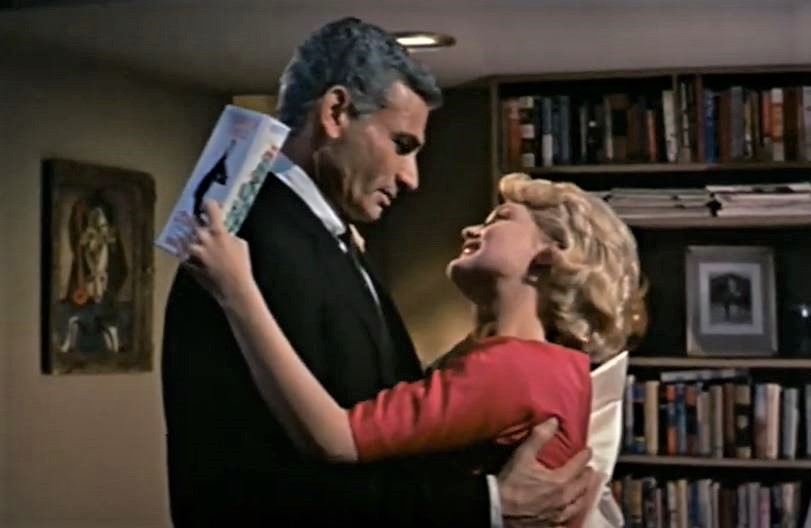
The first Peyton Place movie, based on a racy bestseller, is about the scandals and hypocrisies of a small New England town. If you haven't seen it, the only thing you really need to know to follow the events of this sequel, set several years later, is that Selena Cross (played here by Tuesday Weld) was raped by her stepfather whom she later killed in self-defense. This film begins as Alison McKenzie (Carol Lynley) learns that a novel she has written based on life in Peyton Place, and in particular on what happened to Selena and how badly the townspeople treated her, has been accepted for publication by publisher Lewis Jackman (Jeff Chandler), who asks her to come to New York City so he can help her get the book into shape. She does, falling in love with Jackman, a married man. Alison's mother Constance (Eleanor Parker) worries that she will wind up pregnant, as she herself did with Alison's father, though by now, Constance is quite respectable, married to Mike Rossi, the high school principal. Alison and Lewis work together many long nights; it's unclear how much more they get into, though we do see them kiss romantically at least once (pictured at right). When it's published, the book is a hit, even in Peyton Place where, though most people don't like it, everyone reads it. When mean rich lady Roberta Carter (Mary Astor) takes exception to it, she uses her power as a school board member to get the book pulled from the shelves of the high school library. Principal Rossi reinstates it, gets fired, and goes to the town council to get his job back, leading to a climactic town hall meeting pitting Mrs. Carter against Mike and Alison.

This sequel didn't do anywhere near the business that the original did (either book or film), perhaps because the secrets here are not as scandalous as those in the original. Surely the ambiguity that clouds the Alison/Lewis relationship didn't help. Also, the first movie edged near camp whereas this one is played a bit straighter. In addition to the main plot outlined above, this has a secondary story involving Mrs. Carter and her son Ted (Brett Halsey, at left), the character who actually "returns" to set up a law practice. He brings home his new pregnant Italian wife Raffaella (Luciana Paluzzi, who was married to Halsey in real life), and his mother tries her damndest to split them up. At one point, Raffaella basically accuses Mrs. Carter of having an unnatural love for her son, and later she deliberately skis down a dangerous ski slope in an attempt to cause a miscarriage—unless I missed something, we never know the outcome of the attempt. Selena gets her own somewhat pointless plotline where she falls for a Swedish ski instructor (Gunnar Hellstrom, who is moderately attractive but no big blond fantasy Swede) but that goes nowhere. 

Actingwise, the movie belongs to Mary Astor who does a good job slightly underplaying the big bad mother. Frankly, I could have used a bit more "jungle red" melodrama in her performance, but she's still very good. Halsey (he of the puppydog eyes) and Paluzzi are fine, and though I'm not a Jeff Chandler fan, he's good here as the publisher whose intentions vis a vis his author are never quite clear. Lynley, who wasn't 20 yet, doesn't have a strong presence—she sometimes seems just whiny as opposed to seriously conflicted. Tuesday Weld and Eleanor Parker aren't around long enough to register much but they're fine, as is Robert Sterling as Rossi. The uncredited guy who plays the friendly heckler at the town meeting (Tim Durant, maybe?) is good as is Jennifer Howard as Jackman's wife—both have short scenes but they stand out. Generally enjoyable 60s soap opera fluff. [DVD]

Thursday, May 19, 2022

AND SOON THE DARKNESS (1970)

Jane and Cathy are two young British women on a vacation, bicycling through the picturesque French countryside. At a sidewalk café, they notice a scruffily handsome man who is noticing them. When they leave, he follows them on his motor scooter. In a small village, they notice him again and seem caught between interest and fear. After a rest stop in some woods, a drowsy Cathy wants to stay and nap in the sun, while the more practical Jane wants to get going. In a bit of a huff, Jane bikes on to another small village where a local tells her that the road has a dangerous reputation as a girl had been raped and killed there some time ago. When Cathy doesn't show up, Jane rides back and finds only her camera in the clearing. The mysterious scooter rider, Paul, also shows up and offers to help look for Cathy, but Jane isn't sure she should trust him, even after he claims to be a detective who had, in fact, worked on the past murder along the road. Various villagers are introduced (a restaurant owner, a cop and his deaf father, a British teacher), all seeming a little off-kilter. Just because Paul seems the most suspicious, it seems like he can't be a rapist and killer—or can he?

Advertised as a horror movie, this is more a slow burn thriller though it partakes of the "big city vs. rural village" genre of films like The Texas Chainsaw Massacre. But there is very little here to draw horror fans. Even though it's only 100 minutes, it feels too long, as once it's established that Cathy is gone, the action, such as it is, is repetitious and mostly involves building up red herring situations. The ending is satisfying but it should have arrived in under 90 minutes. Michele Dotrice, sister of Karen who played Jane Banks in MARY POPPINS, is fine as the somewhat sensuous Cathy—there is in her character at least a smidge of the old stereotype of the sexy girl who is asking for trouble. Pamela Franklin (LEGEND OF HELL HOUSE) is very good as Jane. Sandor Elès (COUNTESS DRACULA) as Paul, pictured, is good at maintaining ambiguity about his character and his motivations right to the end. The bright sunlit locations make an interesting background to the tense proceedings. Certainly watchable if not especially memorable. [Streaming]

Monday, May 16, 2022

MADELEINE (1950)

In 1850s Glasgow, the Smith family is about to buy a home in the city, and the older daughter Madeleine (Ann Todd) is particularly taken with a basement bedroom which has a barred window looking out onto the sidewalk and the feet of passersby. When they're moved in, she shares the room (which looks like it was intended to be servants' quarters) with her younger sister, and we soon see what appealed to her about the room: her illicit lover Emile (Ivan Desny) walks past, tapping his walking cane against the bars and dropping love notes into the window. Her autocratic father (Leslie Banks) is insisting that she marry the respectable William Minnoch, but has allowed her not to set an engagement date yet, so she continues seeing Emile who is more handsome and exciting, but also struggling to get by. Soon, Madeleine presses Emile to elope with her, but he needs her money and so insists that they get married properly. She finally agrees to marry William, but Emile threatens to use her love letters to blackmail her. Eventually, Emile is found dead of arsenic poisoning in what is assumed to be a suicide, but a friend of Emil's takes Madeleine's letters to her father, and evidence comes out that Madeleine had set up a secret meeting with Emile the night before he died. When it is discovered that she had a bottle of arsenic in her possession, she is put on trial for murder.

[Spoilers follow] This David Lean film is based on a real case that ended in a "not proven" verdict, which is somewhere between guilty and not guilty. This ambiguous ending is actually fairly satisfying, with the last shot lingering on Madeleine's face as she leaves the courtroom, a tiny smile just about to break out. But what I found not satisfying is the portrayal of the fateful night before Emile's death. We are given brief glimpses of Emile heading for the basement window during a storm, and of Madeleine waiting for him, but we never actually see if they meet or not. Her story is that he never showed up. More confusion occurs involving what seems to have been an earlier poisoning attempt by Madeleine, but again, what we see is inconclusive. In prose, this kind of ambiguity would go down better, but in visuals, it's frustrating. Performances are fine. Todd was married to David Lean and he did the movie for her, as she had played the role on stage, but he considers this to be his worst movie. Todd is good, however, as is Desny as her lover. Leslie Banks as the father isn't given enough screen time or enough scenery to chew. Norman Wooland does what he can with the underwritten role of Minnoch; he manages to make him fairly sympathetic, as though he knows he is caught between the father and the daughter in a game that no one can win. The movie has the look of a film noir, and there is some fun to be had with the camera's focus on a phallic cane that Emile carries and twirls and thrusts, and at least once has yanked out of his hands by Madeleine. Despite the unsatisfying last third, it's worth seeing. Pictured are Desny and Todd. [TCM]

Friday, May 13, 2022

Z (1969)

This film set in an unnamed country begins with a message that any resemblance to real people and events is intentional—though based on a novel, the plot closely follows events that unfolded in Greece in 1963, and though most of the characters are based on specific people, no names are used in the film. We first see a lecture on getting rid of mildew in vineyards, and the general in charge of the security police (Pierre Dux) uses this as a political metaphor for getting rid of the "ideological malady" of various "-isms" in society. More specifically, he is hoping for "healthy antibodies" to show up to demonstrate against an upcoming anti-government conference of pacifists, led by a doctor (Yves Montand). After various venue changes forced by the government, the rally is held in a small union hall with large groups of demonstrators from both sides outside, with chants of "Disarmament!" met by chants of "Long live the bomb!" Montand is hit on the head by a hooligan but is able to go on with his speech. Afterwards, as he leaves the building, a man driving a small three-wheel delivery vehicle clubs him on the head. Montand collapses and dies a couple of days later. His death is blamed on a drunk driver, but a crusading journalist (Jacques Perrin) who is adept at snapping candid photos digs into the case and begins to uncover the truth, and helps a government appointed magistrate (Jean-Louis Trintignant, pictured) untangle the devious webs of the guilty parties. 

This is the movie that put Greek director Costa-Gravas in the international spotlight. It was the first film nominated for both Best Film and Best Foreign Film at the Oscars (it won the latter award). Though it is heavily political, it is easy to understand the clashing ideologies, and the tone of the film is much closer to a police procedural thriller than to a didactic story of politics. The acting is solid all around, from the lead roles to the smaller supporting parts, though second-billed Irene Papas, playing Montand's wife, has little screen time and almost no dialogue. Stylewise, the film alternates between fairly static dialogue-heavy scenes and action sequences with loud background music and off-kilter angles. This is surely an inappropriate response, but the constant repetition of bad guys coshing good guys over the head became almost comic. The title is a reference, not explained until the end, of Greek graffiti featuring the letter 'Z', the first letter of the Greek phrase meaning "He lives," used when the real-life doctor, Grigoris Lambrakis, was murdered. Very popular in its day, the movie's reputation seems to have gone into eclipse a bit, and though it's a little slow in places, it's well worth watching. [TCM]

Wednesday, May 11, 2022

THE TURNING POINT (1952)

A Midwestern city that has become infested with crime assigns academic John Conroy (Edmond O'Brien) as a special prosecutor with the specific chore of bringing down the sprawling crime syndicate of Neil Eichelberger (Ed Begley) who is, to the public, the respectable head of a trucking company. John has brought with him Amanda Waycross (Alexis Smith) whom he describes as his "Girl Friday and spiritual advisor." John's old friend Jerry McKibbon (William Holden), now a reporter, stops by John's office and questions him about his motives for taking on this job, worrying that he has misplaced political ambitions, (which John insists he does not have) and worries that John will wind up being a fall guy for the powers that be. Jerry also is clearly smitten with Amanda, and eventually she with him. When John asks his father Matt (Tom Tully), a cop, to be a lead investigator, Matt tries to turn him down, much to everyone's surprise. Jerry gets suspicious, especially since John has made it clear that he wants to get rid of bad cops just as much as gangsters, and soon discovers that Matt is indeed on Eichelberger's payroll, for having borrowed money from him years ago. Eichelberger assigns Matt to get hold of an old incriminating police file; Matt gets it but photocopies it so it will stay in the files. When Eichelberger discovers the double cross, Matt's days are numbered, and John and Jerry will face danger as well.

There is much more to the plot but I won't spoil the pleasures of seeing how it all plays out. This is an overlooked gem of noir/crime films that Eddie Muller of TCM has brought attention to, and it's well worth seeing—it doesn’t appear to be on a region 1 DVD but it's available for rental on Amazon Prime. I'm not sure it really deserves the noir label, as none of the three major characters (John, Jerry and Amanda) are exactly morally conflicted, though there is a strong urban feel to several scenes; at heart, it's a crime crusade movie, but noir fans should enjoy it. Holden, O'Brien and Smith are all great, though I wish Smith had a little more to do. Begley is nicely slimy as the bad guy, especially in his courtroom scene. The revelation here is Tom Tully, a familiar character actor. The scene in which he explains his moral dilemma to Holden is a standout and should have gotten him an Oscar nomination, as it is every bit as strong as the short scene that got Beatrice Straight a nod in NETWORK. (Tully did get a nomination for THE CAINE MUTINY a couple years later). Holden's first attempt at flirtation with Smith, whom he considers mostly a mindless socialite, consists of him saying, "Will you please sit down so I can throw myself at your feet?" Recommended. Pictured are Holden and Smith. [TCM]

Wednesday, May 04, 2022

BLAST OF SILENCE (1961)

Frankie Bono is a mid-level hitman from Cleveland who has gone to New York City during Christmas week to arrange a hit on a mobster named Troiano. He is warned to stay out of sight and get the job done by New Year's Eve. In a bar, he meets Pete, an old friend, and his sister Laurie who was Frankie's girlfriend in the past. Frankie thinks he maybe has a second chance with Laurie, but when he makes his move, which turns into a near-assault, she stops him. A fat slob of a guy named Ralph, who keeps rats as pets, is supposed to supply Frankie with a gun with a silencer, but Ralph stalls, asking for more money. Tracking Troiano, Frankie follows him to a beatnik club where the married gangster spends time with his mistress. Then things start to fall apart: Ralph finds out who Frankie's target is and threatens Frankie with blackmail; Frankie goes to Laurie's apartment hoping to restart their relationship but discovers she has a live-in boyfriend; when Frankie tries to get out of finishing the job, his employers threaten him: "A killer who doesn't kill gets killed." What’s a confused, depressed hitman to do?

This B-noir starts off rather fatalistically with narration about the birth of Frankie as the camera slowly moves through a tunnel in an expressionistic approximation of childbirth, and comes bursting out onto a train track into New York City, as though Frankie was predetermined to meet his fate there. The narration, in the second person by Lionel Stander, continues and adds to the existential noir feeling of the movie. Though cheap looking, the movie has urban atmosphere to burn, having been shot on New York streets. Its Christmas setting adds another element to the film's tone—noir expert Eddie Muller claims this is one of his favorite Christmas movies which he might have meant somewhat in jest. The scene of Frankie walking robotically past the decked-out Rockefeller Center is memorable. Allen Baron, who plays Frankie (and occasionally looks like a B-movie George C. Scott), went on to a long career as a television director, but never acted again. I wouldn't make grandiose claims for his acting talents, but he's fine here with a nice haunted, hunted look throughout. Larry Tucker as Ralph is memorable in a disgusting way, and Molly McCarthy as Laurie is very good as the passive but not weak woman who is confused by Frankie's actions. Not a polished classic (though it has gotten a Criterion Collection release) but a nice, tough example of late-period film noir. [TCM]

Monday, May 02, 2022

THE SUSPECT (1944)

In 1902 London, Philip (Charles Laughton), worker in a tobacco shop, is stuck in an unhappy marriage to his unstable wife Cora (Rosaline Ivan) who, in a fit of rage, has just torn up pages and pages of their son John's work. John moves out and Philip moves into his room. At work, he strikes up a friendly relationship with an unemployed secretary named Mary (Ella Raines) who is looking for a job. There's no opening at Philip's place, but quite taken with the woman, Philip helps her find another job and begins going out with her (and, we assume, having an affair with her). A parallel plotline develops as Philip becomes aware of the troubled marriage of his neighbor Gilbert (Henry Daniell), an alcoholic who beats his wife. Cora learns of Philip's affair but refuses to give him a divorce, and threatens to have Mary fired from her job. On Christmas day, Philip kills her by throwing her down the stairs and claiming she fell. Inspector Huxley (Stanley Ridges) suspects Philip and indeed lays out an elaborate description of how Philip might have done it, though he can't prove it. Philip marries Mary and seems to be in the clear until Gilbert acts on his suspicions and tries to blackmail Philip. Then things quickly fall to pieces. Charles Laughton is good at playing weak men caught up in bad circumstances. Sometimes he buckles (PAYMENT DEFERRED) and sometimes he finds strength to do the right thing (THIS LAND IS MINE). Here, he manages to do both. He gives in to his violent impulses by killing his wife, but in the end, he redeems himself, to some degree, by acting out of sympathy for an innocent person who is in peril because of him. The scene where the inspector lays out for Philip how he thinks the murder of Cora could have happened is nicely tense, as is a later scene between Philip and Gilbert (no spoiler here). The whole cast is solid and the dark look of the movie adds to the tension. Pictured are Laughton and Dean Harens as his son. [TCM]