 Have I mentioned my problem with old-fashioned movie serials? I like the idea of them, but I have a hard time getting through them. I've tried the original way of watching one chapter a week, I've tried watching a bunch at a time, and I even tried watching one all the way through, but I just can't get into the swing of them (though I did finish DRUMS OF FU MANCHU and one of the Superman serials). This movie is made up of the last eight episodes of the serial THE RETURN OF CHANDU, which I tried watching but couldn't get very far in. This feature-length distillation of a serial, which gets rid of the repetition and cuts right to the chase, is the way to go. Bela Lugosi is Chandu the Magician, a student of the mystical way of the Yogi, who is protecting the Princess Nadji (Maria Alba) from the cat worshipping Cult of Ubasti who is out to kidnap her, believing that she can be sacrificed to resurrect their dead priestess. Despite Chandu's best efforts, she is snatched away off of a ship and transported via a Magic Flaming Circle to the island of Lemuria, home of the Ubasti people. Chandu loses his magic powers but, with his young sidekicks Bob (Dean Benton) and Betty (Phyllis Ludwig) and some help from a Master of White Magic and a disembodied Yogi mentor, Chandu manages to save her at the last minute. The cliffhangers work even better here than in the serial since we don't have to sit through minutes of repeated and padded footage. Among the scraps from which our heroes escape are a shipwreck, a pit with a hungry tiger, a "pit and pendulum" device, and a huge stone meant to slowly crush the victim. Though this is clearly a B-level production, the sets (including one that looks a lot like KING KONG's Skull Island gate) and costumes are properly atmospheric. I especially like the huge, fierce statue of Ubasti the Cat God. It's a little disorienting to see Lugosi, who played the villain in the first Chandu movie, playing a good guy, but he's fine when you get used to him. He certainly out-acts anyone else here, with Alba being a particularly wooden damsel in distress. The mild-mannered Benton displays a nice physique in his brief shirtless scene. There is a strange drum sound which can be heard whenever the bad guys are around, a device used in the later Fu Manchu serial. The disc from Alpha Video is missing the crucial moment when Chandu is saved from the giant stone but is otherwise in OK shape. [DVD]
Monday, November 30, 2009
CHANDU ON THE MAGIC ISLAND (1934)
 Have I mentioned my problem with old-fashioned movie serials? I like the idea of them, but I have a hard time getting through them. I've tried the original way of watching one chapter a week, I've tried watching a bunch at a time, and I even tried watching one all the way through, but I just can't get into the swing of them (though I did finish DRUMS OF FU MANCHU and one of the Superman serials). This movie is made up of the last eight episodes of the serial THE RETURN OF CHANDU, which I tried watching but couldn't get very far in. This feature-length distillation of a serial, which gets rid of the repetition and cuts right to the chase, is the way to go. Bela Lugosi is Chandu the Magician, a student of the mystical way of the Yogi, who is protecting the Princess Nadji (Maria Alba) from the cat worshipping Cult of Ubasti who is out to kidnap her, believing that she can be sacrificed to resurrect their dead priestess. Despite Chandu's best efforts, she is snatched away off of a ship and transported via a Magic Flaming Circle to the island of Lemuria, home of the Ubasti people. Chandu loses his magic powers but, with his young sidekicks Bob (Dean Benton) and Betty (Phyllis Ludwig) and some help from a Master of White Magic and a disembodied Yogi mentor, Chandu manages to save her at the last minute. The cliffhangers work even better here than in the serial since we don't have to sit through minutes of repeated and padded footage. Among the scraps from which our heroes escape are a shipwreck, a pit with a hungry tiger, a "pit and pendulum" device, and a huge stone meant to slowly crush the victim. Though this is clearly a B-level production, the sets (including one that looks a lot like KING KONG's Skull Island gate) and costumes are properly atmospheric. I especially like the huge, fierce statue of Ubasti the Cat God. It's a little disorienting to see Lugosi, who played the villain in the first Chandu movie, playing a good guy, but he's fine when you get used to him. He certainly out-acts anyone else here, with Alba being a particularly wooden damsel in distress. The mild-mannered Benton displays a nice physique in his brief shirtless scene. There is a strange drum sound which can be heard whenever the bad guys are around, a device used in the later Fu Manchu serial. The disc from Alpha Video is missing the crucial moment when Chandu is saved from the giant stone but is otherwise in OK shape. [DVD]
Have I mentioned my problem with old-fashioned movie serials? I like the idea of them, but I have a hard time getting through them. I've tried the original way of watching one chapter a week, I've tried watching a bunch at a time, and I even tried watching one all the way through, but I just can't get into the swing of them (though I did finish DRUMS OF FU MANCHU and one of the Superman serials). This movie is made up of the last eight episodes of the serial THE RETURN OF CHANDU, which I tried watching but couldn't get very far in. This feature-length distillation of a serial, which gets rid of the repetition and cuts right to the chase, is the way to go. Bela Lugosi is Chandu the Magician, a student of the mystical way of the Yogi, who is protecting the Princess Nadji (Maria Alba) from the cat worshipping Cult of Ubasti who is out to kidnap her, believing that she can be sacrificed to resurrect their dead priestess. Despite Chandu's best efforts, she is snatched away off of a ship and transported via a Magic Flaming Circle to the island of Lemuria, home of the Ubasti people. Chandu loses his magic powers but, with his young sidekicks Bob (Dean Benton) and Betty (Phyllis Ludwig) and some help from a Master of White Magic and a disembodied Yogi mentor, Chandu manages to save her at the last minute. The cliffhangers work even better here than in the serial since we don't have to sit through minutes of repeated and padded footage. Among the scraps from which our heroes escape are a shipwreck, a pit with a hungry tiger, a "pit and pendulum" device, and a huge stone meant to slowly crush the victim. Though this is clearly a B-level production, the sets (including one that looks a lot like KING KONG's Skull Island gate) and costumes are properly atmospheric. I especially like the huge, fierce statue of Ubasti the Cat God. It's a little disorienting to see Lugosi, who played the villain in the first Chandu movie, playing a good guy, but he's fine when you get used to him. He certainly out-acts anyone else here, with Alba being a particularly wooden damsel in distress. The mild-mannered Benton displays a nice physique in his brief shirtless scene. There is a strange drum sound which can be heard whenever the bad guys are around, a device used in the later Fu Manchu serial. The disc from Alpha Video is missing the crucial moment when Chandu is saved from the giant stone but is otherwise in OK shape. [DVD]

Saturday, November 28, 2009
THE DAY THE EARTH CAUGHT FIRE (1961)
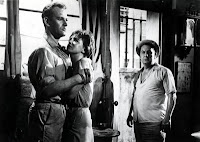 As the film opens, we are in London, albeit a dangerously hot and dry London (the black & white film is tinted orange for this scene to add to the heat effect), and sweaty reporter Edward Judd is waiting to find out if the "corrective bombs" have worked. We then flashback a few weeks as Judd’s newspaper reports on the strange weather occurrences around the globe: sunspot problems, record high temperatures, floods, and a mysterious fog sweeping through London (though in Hollywood movies, a mysterious fog in London is par for the course). Janet Munro, a worker at the weather service, leaks information to Judd (with whom she begins an affair) that leads the newspaper to theorize that, because the Americans and the Russians set off atomic test blasts simultaneously, the earth has been knocked off its axis and is speeding toward the sun. The news breaks, panics ensue, and the weather gets weirder with droughts, cyclones, and fires galore. Yes, the earth is in fact rushing toward the sun, and the international powers-that-be decide that setting off another big blast in Siberia (the corrective bombs mentioned in the first scene) may set things to right.
For a relatively low-budget sci-fi disaster film, this is well worth seeing. Shot in widescreen black & white, the movie always looks good, with the shots well framed. The use of special effects is fairly limited, with some stock footage, some theatrical effects, and just plain good acting and make-up (the sweaty people in the opening and closing, for example). Judd (who looks like a cross between Richard Burton and Gene Hackman) makes a nicely low-key hero, and both he and Munro have well-rounded characters to work with. The two have an interesting, almost risqué scene involving near-nudity and the fingering of underthings. The wonderful Leo McKern (the first Number Two in the original Prisoner series, and pictured above with Judd and Munro) does a nice job as Judd's editor. I enjoyed the fact that there is a separate credit for "beatnik music" (written by Monty Norman, the composer of the original James Bond theme) though I don't actually remember hearing any. [DVD]
 As the film opens, we are in London, albeit a dangerously hot and dry London (the black & white film is tinted orange for this scene to add to the heat effect), and sweaty reporter Edward Judd is waiting to find out if the "corrective bombs" have worked. We then flashback a few weeks as Judd’s newspaper reports on the strange weather occurrences around the globe: sunspot problems, record high temperatures, floods, and a mysterious fog sweeping through London (though in Hollywood movies, a mysterious fog in London is par for the course). Janet Munro, a worker at the weather service, leaks information to Judd (with whom she begins an affair) that leads the newspaper to theorize that, because the Americans and the Russians set off atomic test blasts simultaneously, the earth has been knocked off its axis and is speeding toward the sun. The news breaks, panics ensue, and the weather gets weirder with droughts, cyclones, and fires galore. Yes, the earth is in fact rushing toward the sun, and the international powers-that-be decide that setting off another big blast in Siberia (the corrective bombs mentioned in the first scene) may set things to right.
For a relatively low-budget sci-fi disaster film, this is well worth seeing. Shot in widescreen black & white, the movie always looks good, with the shots well framed. The use of special effects is fairly limited, with some stock footage, some theatrical effects, and just plain good acting and make-up (the sweaty people in the opening and closing, for example). Judd (who looks like a cross between Richard Burton and Gene Hackman) makes a nicely low-key hero, and both he and Munro have well-rounded characters to work with. The two have an interesting, almost risqué scene involving near-nudity and the fingering of underthings. The wonderful Leo McKern (the first Number Two in the original Prisoner series, and pictured above with Judd and Munro) does a nice job as Judd's editor. I enjoyed the fact that there is a separate credit for "beatnik music" (written by Monty Norman, the composer of the original James Bond theme) though I don't actually remember hearing any. [DVD]
Thursday, November 26, 2009
ROBINSON CRUSOE ON MARS (1964)
 When Astronauts Adam West and Paul Mantee have to pull some fancy maneuvering to escape collision with an asteroid, they wind up stuck in orbit around Mars. They eject in separate capsules and land on the planet; West is killed but Mantee and a monkey named Mona survive. Mantee has limited food and oxygen, but soon discovers a yellow coal-like rock that, when burned, gives off enough oxygen for him to use to get around. The monkey discovers a grotto with water and some edible vegetation and they live comfortably for a while. Soon, Mantee finds a skeleton in a marked grave and when he begins hallucinating (seeing the dead, zombie-like West walking around the cave), he fears for his sanity, but suddenly a "Man Friday" shows up. It turns out that an alien humanoid race is strip mining the planet and one of the slaves (Victor Lundin) escapes and stumbles into Mantee's cave. The two learn to communicate and must eventually go on the run from aliens searching for Lundin. They wind up at the polar ice cap hoping against hope for an escape ship from Earth.
When I was a teenager, I'd read good things about this movie in the monster mags, but when it showed up on network TV, it was, of course, panned and scanned, and my family hadn't moved up to a color set yet. I got bored with it long before the halfway mark and gave up. Now it's on a Criterion DVD, letterboxed and in beautiful color. I still got bored, but not until much later. In its day, the movie was marketed as scientifically accurate, and indeed, the landscape does look quite a bit like the photos from the Mars Rover--it was filmed in Death Valley, with the blue sky replaced by an eerie orange glow. The rest of the science (the lack of weightlessness, the oxygen from the stones) I'm not so sure about. Mantee does a good job in the middle third of the film, with no one but the monkey to play off of, but after Lundin shows up, things bog down a bit. Mantee looks hot in his snug black t-shirt, and we even get a quick nude shot of him jumping into a pond. For me, the movie is more interesting than compelling, more a novelty than a film I'd watch more than once. [DVD]

When I was a teenager, I'd read good things about this movie in the monster mags, but when it showed up on network TV, it was, of course, panned and scanned, and my family hadn't moved up to a color set yet. I got bored with it long before the halfway mark and gave up. Now it's on a Criterion DVD, letterboxed and in beautiful color. I still got bored, but not until much later. In its day, the movie was marketed as scientifically accurate, and indeed, the landscape does look quite a bit like the photos from the Mars Rover--it was filmed in Death Valley, with the blue sky replaced by an eerie orange glow. The rest of the science (the lack of weightlessness, the oxygen from the stones) I'm not so sure about. Mantee does a good job in the middle third of the film, with no one but the monkey to play off of, but after Lundin shows up, things bog down a bit. Mantee looks hot in his snug black t-shirt, and we even get a quick nude shot of him jumping into a pond. For me, the movie is more interesting than compelling, more a novelty than a film I'd watch more than once. [DVD]
Tuesday, November 24, 2009
THE H-MAN (1957)
 On a rainy night in Tokyo, a drug dealer is trying to stash his haul in the trunk of a getaway car, but when he suddenly looks down at the ground, screams, and falls, the driver guns it. Another car hits the man, but when onlookers gather, all that's left are his clothes and shoes. The police think he's alive and stake out the nightclub where his girlfriend Chikako sings. Masada, a biochemist, also comes to call at the club; he has a theory that radioactive rain from nuclear testing is causing some people to dissolve and he wants to know why. When a fisherman reports seeing someone on a ship dissolve after a luminous blob crawled up his leg, the police start taking Masada seriously. Sure enough, this glowing aquamarine slime (a good effect, by the way) starts showing up all over the place. Everyone persists in shooting at it, even though the bullets never have an effect. The climax, set in the sewers of Tokyo and involving flamethrowers (and reminiscent of THEM!), works well.
What with its thugs, molls, and dark rainy streets, much of this has the feel of a noirish gangster movie rather than a horror/SF flick. The two strands don’t fit together as snugly as one might hope, but aside from a long, slow car chase near the end involving one of the drug dealers whom the cops mistakenly think was a victim of the slime, it's generally fun. The effects are good and the segment set at sea is truly creepy (though the very first shot of the movie, with a nuclear fog enveloping what are clearly little toy boats, gave me a chuckle). I enjoyed the crazy song, "So Deep Is My Love" that Chikako sings, in English: “Like the stars above/Countless is my love [sic]/…Here in the bomb center/Heaven of you/I rest forevermore.” And that's not the English dubbed version, that's as sung in English in the original Japanese film (though both versions are on the disc, available, as is MOTHRA, as part of the Icons of Sc-Fi: Toho Collection). [DVD]
 On a rainy night in Tokyo, a drug dealer is trying to stash his haul in the trunk of a getaway car, but when he suddenly looks down at the ground, screams, and falls, the driver guns it. Another car hits the man, but when onlookers gather, all that's left are his clothes and shoes. The police think he's alive and stake out the nightclub where his girlfriend Chikako sings. Masada, a biochemist, also comes to call at the club; he has a theory that radioactive rain from nuclear testing is causing some people to dissolve and he wants to know why. When a fisherman reports seeing someone on a ship dissolve after a luminous blob crawled up his leg, the police start taking Masada seriously. Sure enough, this glowing aquamarine slime (a good effect, by the way) starts showing up all over the place. Everyone persists in shooting at it, even though the bullets never have an effect. The climax, set in the sewers of Tokyo and involving flamethrowers (and reminiscent of THEM!), works well.
What with its thugs, molls, and dark rainy streets, much of this has the feel of a noirish gangster movie rather than a horror/SF flick. The two strands don’t fit together as snugly as one might hope, but aside from a long, slow car chase near the end involving one of the drug dealers whom the cops mistakenly think was a victim of the slime, it's generally fun. The effects are good and the segment set at sea is truly creepy (though the very first shot of the movie, with a nuclear fog enveloping what are clearly little toy boats, gave me a chuckle). I enjoyed the crazy song, "So Deep Is My Love" that Chikako sings, in English: “Like the stars above/Countless is my love [sic]/…Here in the bomb center/Heaven of you/I rest forevermore.” And that's not the English dubbed version, that's as sung in English in the original Japanese film (though both versions are on the disc, available, as is MOTHRA, as part of the Icons of Sc-Fi: Toho Collection). [DVD]
Sunday, November 22, 2009
MOTHRA (1961)
 During a typhoon, a ship runs aground on Infant Island, a supposedly uninhabited place on which there is a high level of radioactivity. When the survivors are tested, they are free of radiation, due apparently to some red juice that island natives gave them. When an expedition sets out to investigate the island, an unscrupulous artifacts dealer (Jerry Ito) kidnaps two tiny female natives, not quite a foot high, variously referred to as "fairies" or "tiny beauties," and tours the country with them as performers. Unknown to Ito, the two women frequently sing a song to Mothra, a giant egg back on Infant Island. The egg hears the song and cracks open, and a giant caterpillar emerges; it swims across the ocean (and in the process, causes great damage to ships) and lays waste to Tokyo where it builds a giant cocoon and soon emerges as a giant (wait for it…) moth with glittery eyes and wings that knock down tall buildings. Mothra follows Ito to New Kirk City in the country of Rolisica, intent on rescuing the tiny beauties.
This is the probably the most whimsical and undoubtedly the gayest of the classic Japanese monster movies; it’s also the only one I actually saw in a theater, and even though I was only 8, I wasn't scared by it. Though there are effective scenes of destruction, the whole thing does feel a bit fey. It's a very colorful movie, with lots of pastels, Mothra's discoball eyes, and froofy production numbers with the fairies. I wish I could work up an actual gay reading of the film, but I can't. The country of Rolisica is clearly intended to be America, so there's probably a political reading to be done, but I think the movie is best appreciated on the fantasy level. Overall, it seems much more aimed at children than its predecessors (like GODZILLA),what with a tubby kid in a red cap and a comic relief Lou Costello-type who calls himself Snapping Turtle, though it’s not quite as much of a kiddie movie as the later GAMERA. I'll be watching some more fantasy and sci-fi films this week since I associate the Thanksgiving holiday with those kinds of movies, which I remember watching as a kid while out of school. [DVD]

 During a typhoon, a ship runs aground on Infant Island, a supposedly uninhabited place on which there is a high level of radioactivity. When the survivors are tested, they are free of radiation, due apparently to some red juice that island natives gave them. When an expedition sets out to investigate the island, an unscrupulous artifacts dealer (Jerry Ito) kidnaps two tiny female natives, not quite a foot high, variously referred to as "fairies" or "tiny beauties," and tours the country with them as performers. Unknown to Ito, the two women frequently sing a song to Mothra, a giant egg back on Infant Island. The egg hears the song and cracks open, and a giant caterpillar emerges; it swims across the ocean (and in the process, causes great damage to ships) and lays waste to Tokyo where it builds a giant cocoon and soon emerges as a giant (wait for it…) moth with glittery eyes and wings that knock down tall buildings. Mothra follows Ito to New Kirk City in the country of Rolisica, intent on rescuing the tiny beauties.
This is the probably the most whimsical and undoubtedly the gayest of the classic Japanese monster movies; it’s also the only one I actually saw in a theater, and even though I was only 8, I wasn't scared by it. Though there are effective scenes of destruction, the whole thing does feel a bit fey. It's a very colorful movie, with lots of pastels, Mothra's discoball eyes, and froofy production numbers with the fairies. I wish I could work up an actual gay reading of the film, but I can't. The country of Rolisica is clearly intended to be America, so there's probably a political reading to be done, but I think the movie is best appreciated on the fantasy level. Overall, it seems much more aimed at children than its predecessors (like GODZILLA),what with a tubby kid in a red cap and a comic relief Lou Costello-type who calls himself Snapping Turtle, though it’s not quite as much of a kiddie movie as the later GAMERA. I'll be watching some more fantasy and sci-fi films this week since I associate the Thanksgiving holiday with those kinds of movies, which I remember watching as a kid while out of school. [DVD]

Wednesday, November 18, 2009
SUNDOWN (1941)
 I don’t remember why I put this film on my Netflix queue; probably because of keywords like "exotic," "desert," "Nazis," "spies," and "Gene Tierney." As a Nazis-in-the-desert melodrama, it will hold your attention but it's an odd duck, situated uncomfortably between A- and B-movie territories; the production is more than competent but the energy flags a bit more often than one would like. In Kenya, district commissioner Bruce Cabot is not happy that Major George Sanders is sent in to take charge, until he discovers that Sanders is there to nip in the bud a German plan to sell guns to restless native tribes in the area. Gene Tierney, an exotic half-Arab, half-French woman who runs a large trading network, agrees to help the Brits find out how guns are getting smuggled in. Other characters who hang out at the commissioner’s house include Joseph Calleia as an Italian POW who has supposedly “defected” to the Allies side and cooks gourmet meals for Cabot, Reginald Gardiner as a stiff-upper-lip Brit, Carl Esmond as a Dutch scientist, and Harry Carey as a hunter. At least one of these men is not what he seems to be. At a dinner attended by most of the supporting characters, Tierney gets word through the native drummers, who get the word through “Habari,” a kind of native ESP communication, that one of the white men will die, and sure enough, after 45 talky minutes of exposition, Hammud (Marc Lawrence), the suspected gun runner, attacks and one of the men does indeed bite the dust. Tierney figures out who the Nazi spy among them is, but the Nazi also figures out that Tierney knows, and games of cat and mouse take up the last half of the movie. It turns out that Tierney isn’t actually Arab at all, just raised by Arabs, so by the rules of the Production Code, it’s safe for her and Cabot to pair off at the end. The finale also features an odd detour into religious territory as one of the characters, with his dying breath, delivers an out-of-the-blue propaganda speech about good churchgoing people, which is then echoed by a closing speech given in a bombed-out cathedral in London by Bishop Cedric Hardwicke (which perhaps influenced the ending of MRS. MINIVER in 1942). All the actors are fine, although Tierney, who gets star billing, doesn’t get much screen time until the last half-hour, when the pace picks up considerably. There are some nice sets, especially Cabot's circular house and a two-level prison cave in which Cabot and Tierney spend some time. Look for small bits by black actors Woody Strode and Dorothy Dandridge early in their careers. The whole thing might have played better as a down-and-dirty B-flick. [DVD]
 I don’t remember why I put this film on my Netflix queue; probably because of keywords like "exotic," "desert," "Nazis," "spies," and "Gene Tierney." As a Nazis-in-the-desert melodrama, it will hold your attention but it's an odd duck, situated uncomfortably between A- and B-movie territories; the production is more than competent but the energy flags a bit more often than one would like. In Kenya, district commissioner Bruce Cabot is not happy that Major George Sanders is sent in to take charge, until he discovers that Sanders is there to nip in the bud a German plan to sell guns to restless native tribes in the area. Gene Tierney, an exotic half-Arab, half-French woman who runs a large trading network, agrees to help the Brits find out how guns are getting smuggled in. Other characters who hang out at the commissioner’s house include Joseph Calleia as an Italian POW who has supposedly “defected” to the Allies side and cooks gourmet meals for Cabot, Reginald Gardiner as a stiff-upper-lip Brit, Carl Esmond as a Dutch scientist, and Harry Carey as a hunter. At least one of these men is not what he seems to be. At a dinner attended by most of the supporting characters, Tierney gets word through the native drummers, who get the word through “Habari,” a kind of native ESP communication, that one of the white men will die, and sure enough, after 45 talky minutes of exposition, Hammud (Marc Lawrence), the suspected gun runner, attacks and one of the men does indeed bite the dust. Tierney figures out who the Nazi spy among them is, but the Nazi also figures out that Tierney knows, and games of cat and mouse take up the last half of the movie. It turns out that Tierney isn’t actually Arab at all, just raised by Arabs, so by the rules of the Production Code, it’s safe for her and Cabot to pair off at the end. The finale also features an odd detour into religious territory as one of the characters, with his dying breath, delivers an out-of-the-blue propaganda speech about good churchgoing people, which is then echoed by a closing speech given in a bombed-out cathedral in London by Bishop Cedric Hardwicke (which perhaps influenced the ending of MRS. MINIVER in 1942). All the actors are fine, although Tierney, who gets star billing, doesn’t get much screen time until the last half-hour, when the pace picks up considerably. There are some nice sets, especially Cabot's circular house and a two-level prison cave in which Cabot and Tierney spend some time. Look for small bits by black actors Woody Strode and Dorothy Dandridge early in their careers. The whole thing might have played better as a down-and-dirty B-flick. [DVD]
Saturday, November 14, 2009
THE GREAT WALTZ (1938)
This biopic about Johann Strauss, the Waltz King, is notorious among classic movie buffs for a sequence which shows Strauss riding through the woods in a carriage, being inspired by the rhythm of the horse clopping along, the chirping of birds, and the piping of nearby shepherds to hum the melody that would become "Tales of the Vienna Woods." This scene does indeed look mighty silly when it's excerpted in That’s Entertainment II, but in the context of the film, it's actually a charming little bit. The story begins in Vienna in 1844 where, as we're told, life was boring, people were conformists, and new ideas were not accepted. That all changes the next year when bank clerk Strauss (Fernand Gravet), fired for composing music on the job, starts an orchestra made up of unemployed musicians. In a very effective scene, the group's first gig takes place in a huge cafe which remains mostly empty until an opera star strolls in and requests a song. Passersby on the street hear the lovely music and soon are flocking in. The rest of the film covers the rise in Strauss's fortunes and his two romances, one with his longtime love and wife (Luise Rainer) and the other with the opera singer who walked into the cafe (Miliza Korjus, who looks like Bette Midler and sounds like Madeline Kahn in BLAZING SADDLES). Rainer gets a good scene in which she goes a little mad with jealousy and takes a gun to the opera house, intending to shoot Korjus, but is so moved by the way the singer has inspired her husband that she decides to let him go off with her. (Of course, this being a Hollywood biography, the mistress turns all noble at the last minute and sends Strauss back to his wife--these relationships appear to bear little connection to Strauss's actual love life). While the narrative bogs down on occasion, the musical sequences always bring the film back to life, and the Blue Danube montage is good kitschy fun. Several of Strauss's melodies are featured with lyrics by Oscar Hammerstein. Also with Lionel Atwill and Hugh Herbert. Directed by Julien Duvivier. [TCM]
This biopic about Johann Strauss, the Waltz King, is notorious among classic movie buffs for a sequence which shows Strauss riding through the woods in a carriage, being inspired by the rhythm of the horse clopping along, the chirping of birds, and the piping of nearby shepherds to hum the melody that would become "Tales of the Vienna Woods." This scene does indeed look mighty silly when it's excerpted in That’s Entertainment II, but in the context of the film, it's actually a charming little bit. The story begins in Vienna in 1844 where, as we're told, life was boring, people were conformists, and new ideas were not accepted. That all changes the next year when bank clerk Strauss (Fernand Gravet), fired for composing music on the job, starts an orchestra made up of unemployed musicians. In a very effective scene, the group's first gig takes place in a huge cafe which remains mostly empty until an opera star strolls in and requests a song. Passersby on the street hear the lovely music and soon are flocking in. The rest of the film covers the rise in Strauss's fortunes and his two romances, one with his longtime love and wife (Luise Rainer) and the other with the opera singer who walked into the cafe (Miliza Korjus, who looks like Bette Midler and sounds like Madeline Kahn in BLAZING SADDLES). Rainer gets a good scene in which she goes a little mad with jealousy and takes a gun to the opera house, intending to shoot Korjus, but is so moved by the way the singer has inspired her husband that she decides to let him go off with her. (Of course, this being a Hollywood biography, the mistress turns all noble at the last minute and sends Strauss back to his wife--these relationships appear to bear little connection to Strauss's actual love life). While the narrative bogs down on occasion, the musical sequences always bring the film back to life, and the Blue Danube montage is good kitschy fun. Several of Strauss's melodies are featured with lyrics by Oscar Hammerstein. Also with Lionel Atwill and Hugh Herbert. Directed by Julien Duvivier. [TCM]
Wednesday, November 11, 2009
THE KILLERS (1964)
 Well-dressed tough guys Lee Marvin and Clu Gulager come to a school of the blind, knock some blind people around, and carry out the contract killing of teacher John Cassavetes. The older, philosophical Marvin wonders why Cassavetes didn’t even try to escape and accepted his death so passively; the younger, more casually brutal Gulager agrees to pal around with Marvin as he interviews people who knew Cassavetes, a former race car driver, and puts together his story. (Marvin has another motive: he knows that Cassavetes was involved in a million dollar heist in which the money went missing, and hopes to get his hands on some of the booty.) They discover that Cassavetes had been set to marry looker Angie Dickinson; when an accident causes irreparable damage to his eyesight, he leaves his career and her; some time later, the two renew their relationship, even though she's hooked up with gangster Ronald Reagan. Cassavetes joins up with Dickinson, Reagan, and his men for a mail truck heist. Double-crosses occur, leading to Cassavetes's fate, with Marvin and Gulager getting revenge for Cassavetes, though paying a high price for evening the score.
This is the second film inspired by Ernest Hemingway’s short story, and you may notice that I was able to use a few sentences from my summary of that movie in this summary, just changing the names. The first was an influential film noir; this one, in color and originally intended as the first made-for-TV movie but found too violent for broadcast, is closer in feel to the starker, more brutal crime films of the late 60's and early 70's. The beginning still comes from Hemingway, though not as recognizably as in the earlier film, and the narrative structure is similar, but this is not so much a remake as a re-working of the basics of the original. In the previous film, the two killers who don't know why their victim has been singled out for death are very minor characters; here, they drive the action, taking the place of the insurance investigator (Edmond O’Brien). Marvin, relatively soft-spoken, and Gulager, a hothead (and both fairly dapper and often wearing sunglasses), feel like characters who might have inspired Quentin Tarentino, and Marvin in particular gives a strong performance. Cassavetes and Dickinson are less mysterious than Lancaster and Gardner were, but both are fine. This was Reagan's last movie role and his first bad guy role—he's OK, though much of his performance feels phoned in. The movie is very violent, with poor Dickinson getting slapped around quite a bit; one scene in which Gulager punches her in the face is still startling after all these years. A rougher-edged movie that the 1946 version, and far away from the visual style of film noir, but a solid thriller that stands up well on its own. [DVD]
 Well-dressed tough guys Lee Marvin and Clu Gulager come to a school of the blind, knock some blind people around, and carry out the contract killing of teacher John Cassavetes. The older, philosophical Marvin wonders why Cassavetes didn’t even try to escape and accepted his death so passively; the younger, more casually brutal Gulager agrees to pal around with Marvin as he interviews people who knew Cassavetes, a former race car driver, and puts together his story. (Marvin has another motive: he knows that Cassavetes was involved in a million dollar heist in which the money went missing, and hopes to get his hands on some of the booty.) They discover that Cassavetes had been set to marry looker Angie Dickinson; when an accident causes irreparable damage to his eyesight, he leaves his career and her; some time later, the two renew their relationship, even though she's hooked up with gangster Ronald Reagan. Cassavetes joins up with Dickinson, Reagan, and his men for a mail truck heist. Double-crosses occur, leading to Cassavetes's fate, with Marvin and Gulager getting revenge for Cassavetes, though paying a high price for evening the score.
This is the second film inspired by Ernest Hemingway’s short story, and you may notice that I was able to use a few sentences from my summary of that movie in this summary, just changing the names. The first was an influential film noir; this one, in color and originally intended as the first made-for-TV movie but found too violent for broadcast, is closer in feel to the starker, more brutal crime films of the late 60's and early 70's. The beginning still comes from Hemingway, though not as recognizably as in the earlier film, and the narrative structure is similar, but this is not so much a remake as a re-working of the basics of the original. In the previous film, the two killers who don't know why their victim has been singled out for death are very minor characters; here, they drive the action, taking the place of the insurance investigator (Edmond O’Brien). Marvin, relatively soft-spoken, and Gulager, a hothead (and both fairly dapper and often wearing sunglasses), feel like characters who might have inspired Quentin Tarentino, and Marvin in particular gives a strong performance. Cassavetes and Dickinson are less mysterious than Lancaster and Gardner were, but both are fine. This was Reagan's last movie role and his first bad guy role—he's OK, though much of his performance feels phoned in. The movie is very violent, with poor Dickinson getting slapped around quite a bit; one scene in which Gulager punches her in the face is still startling after all these years. A rougher-edged movie that the 1946 version, and far away from the visual style of film noir, but a solid thriller that stands up well on its own. [DVD]
Sunday, November 08, 2009
THE KILLERS (1946)
 This is the movie that some critics point to as the archetypal film noir: a dark, shadowy look to match a dark, fatalistic tone; a flawed anti-hero; a sexy femme fatale; city streets; and, of course, murder. It also has a complex narrative structure with overlapping flashbacks. The first 10 minutes of the movie are drawn directly from the very short story of the same title by Ernest Hemingway: two tough guys come to a small town diner to carry out the contract killing of a fellow known as the Swede (Burt Lancaster). When a friend goes to Lancaster’s apartment to warn him, Lancaster refuses to budge, as if there is no escape, his only explanation being, “I did something wrong once.” Sure enough, the killers barge in and shoot him dead. And that’s all Hemingway wrote; this adaptation continues as an insurance investigator (Edmond O’Brien) starts interviewing people who knew Lancaster, a former small-time boxer who was forced to give up the game due to a hand injury and made some money in the numbers racket. His “good” gal (Virginia Christine) loses him to a “bad” gal (Ava Gardner at her sexiest). Lancaster takes a shoplifting rap for her and goes to jail; when he comes out, she’s hooked up with gangster Albert Dekker, and Lancaster winds up joining up with Gardner, Dekker and his men for a hat factory heist. Double-crosses occur, leading to Lancaster’s fate.
Though this movie is not quite CITIZEN KANE, it seems to have used KANE as its storytelling model: one man delves into the background of a dead man, looking for some meaning to his life and death. O’Brien is far more active here than the reporter in KANE, and though Lancaster steals the show with his smoldering performance, O’Brien is in some ways the main character, not just putting the pieces of Lancaster’s puzzle together, but actually finding the bad guys and getting some form of justice. He’s very good, as is Sam Levene as a cop and former friend of Lancaster’s, but the movie belongs to Lancaster and Gardner, who are impossibly sexy, work together well, and strike me as the 40’s equivalent of a modern silver screen pair like George Clooney and Catherine Zeta-Jones. The inky blackness of the cinematography and the glossy close-ups of the stars make this a treat for the eye. Following the flashbacks (occasionally out of order) as O’Brien collects testimony is not difficult, but for the most part, the secondary characters are not as compelling as those in KANE, and the middle of the movie, building to the heist, drags a bit. Still, as exemplary a piece of film noir as you’re likely to see. Available as part of a wonderful 2-disc set from Criterion, along with the 1964 version which I'll review soon. [DVD]
 This is the movie that some critics point to as the archetypal film noir: a dark, shadowy look to match a dark, fatalistic tone; a flawed anti-hero; a sexy femme fatale; city streets; and, of course, murder. It also has a complex narrative structure with overlapping flashbacks. The first 10 minutes of the movie are drawn directly from the very short story of the same title by Ernest Hemingway: two tough guys come to a small town diner to carry out the contract killing of a fellow known as the Swede (Burt Lancaster). When a friend goes to Lancaster’s apartment to warn him, Lancaster refuses to budge, as if there is no escape, his only explanation being, “I did something wrong once.” Sure enough, the killers barge in and shoot him dead. And that’s all Hemingway wrote; this adaptation continues as an insurance investigator (Edmond O’Brien) starts interviewing people who knew Lancaster, a former small-time boxer who was forced to give up the game due to a hand injury and made some money in the numbers racket. His “good” gal (Virginia Christine) loses him to a “bad” gal (Ava Gardner at her sexiest). Lancaster takes a shoplifting rap for her and goes to jail; when he comes out, she’s hooked up with gangster Albert Dekker, and Lancaster winds up joining up with Gardner, Dekker and his men for a hat factory heist. Double-crosses occur, leading to Lancaster’s fate.
Though this movie is not quite CITIZEN KANE, it seems to have used KANE as its storytelling model: one man delves into the background of a dead man, looking for some meaning to his life and death. O’Brien is far more active here than the reporter in KANE, and though Lancaster steals the show with his smoldering performance, O’Brien is in some ways the main character, not just putting the pieces of Lancaster’s puzzle together, but actually finding the bad guys and getting some form of justice. He’s very good, as is Sam Levene as a cop and former friend of Lancaster’s, but the movie belongs to Lancaster and Gardner, who are impossibly sexy, work together well, and strike me as the 40’s equivalent of a modern silver screen pair like George Clooney and Catherine Zeta-Jones. The inky blackness of the cinematography and the glossy close-ups of the stars make this a treat for the eye. Following the flashbacks (occasionally out of order) as O’Brien collects testimony is not difficult, but for the most part, the secondary characters are not as compelling as those in KANE, and the middle of the movie, building to the heist, drags a bit. Still, as exemplary a piece of film noir as you’re likely to see. Available as part of a wonderful 2-disc set from Criterion, along with the 1964 version which I'll review soon. [DVD]
Thursday, November 05, 2009
FOLLOW ME QUIETLY (1949)
 This short but effective noir police thriller was directed by Richard Fleischer (who later did 20,000 LEAGUES UNDER THE SEA and FANTASTIC VOYAGE) and was based on a story by noir and Western director Anthony Mann. There's a killer on the loose who calls himself The Judge; thinking he has somehow been "ordained" to judge others, he warns his victims that they deserve to die, then he kills them, usually strangling them from behind, and leaves a note for the police who are stumped and who are facing a public outcry for their failure to stop this guy. Cop William Lundigan and his sidekick Jeff Corey are obsessed with tracking him down. Lundigan develops an antagonistic relationship with Dorothy Patrick, a tabloid reporter who wants to help crack the case. When she boldly sneaks into his apartment one night to get information, he casually changes into his pajamas, pulls down his Murphy bed, and climbs in, leaving her at a loss for words. Eventually, he agrees to feed her info and let her write a story under his name. Lundigan, using what few witness descriptions he has, builds a faceless dummy figure of the Judge, hoping it may help in identifying some suspects. Just as the cop and the reporter seem to be getting along, she pisses him off by running an incomplete story that leads directly to another "Judge" death. Eventually, the dummy pays off when a waitress recognizes the figure, and the climactic chase takes place a la WHITE HEAT up and down the ladders of a large oil refinery.
What's memorable about this film is the gimmick of the faceless dummy; logically, I'm not sure why Lundigan decided to make such a thing since there is really nothing physical about the Judge that stands out from the ordinary, but it does make for a creepy prop. The best scene in the movie involves Lundigan and the dummy alone in a room on a rainy afternoon (see picture above). I like Lundigan and he's fine here as the stolid lead, though Patrick is bland and their romantic subplot is uninteresting after the amusing apartment scene. The film never quite lives up to its opening, a violent scene in which a newspaper editor is attacked by the Judge. This is a fairly straightforward police procedural which would have benefited from at least an attempt at some psychological delving into the Judge character. Worth seeing. [TCM]
 This short but effective noir police thriller was directed by Richard Fleischer (who later did 20,000 LEAGUES UNDER THE SEA and FANTASTIC VOYAGE) and was based on a story by noir and Western director Anthony Mann. There's a killer on the loose who calls himself The Judge; thinking he has somehow been "ordained" to judge others, he warns his victims that they deserve to die, then he kills them, usually strangling them from behind, and leaves a note for the police who are stumped and who are facing a public outcry for their failure to stop this guy. Cop William Lundigan and his sidekick Jeff Corey are obsessed with tracking him down. Lundigan develops an antagonistic relationship with Dorothy Patrick, a tabloid reporter who wants to help crack the case. When she boldly sneaks into his apartment one night to get information, he casually changes into his pajamas, pulls down his Murphy bed, and climbs in, leaving her at a loss for words. Eventually, he agrees to feed her info and let her write a story under his name. Lundigan, using what few witness descriptions he has, builds a faceless dummy figure of the Judge, hoping it may help in identifying some suspects. Just as the cop and the reporter seem to be getting along, she pisses him off by running an incomplete story that leads directly to another "Judge" death. Eventually, the dummy pays off when a waitress recognizes the figure, and the climactic chase takes place a la WHITE HEAT up and down the ladders of a large oil refinery.
What's memorable about this film is the gimmick of the faceless dummy; logically, I'm not sure why Lundigan decided to make such a thing since there is really nothing physical about the Judge that stands out from the ordinary, but it does make for a creepy prop. The best scene in the movie involves Lundigan and the dummy alone in a room on a rainy afternoon (see picture above). I like Lundigan and he's fine here as the stolid lead, though Patrick is bland and their romantic subplot is uninteresting after the amusing apartment scene. The film never quite lives up to its opening, a violent scene in which a newspaper editor is attacked by the Judge. This is a fairly straightforward police procedural which would have benefited from at least an attempt at some psychological delving into the Judge character. Worth seeing. [TCM]
Tuesday, November 03, 2009
DANGEROUS BLONDES (1943)
Bland B-comedy-thriller patterned, like many of the era, after the Thin Man series but with little of the charm or wit of those films. Allyn Joslyn, cast in the male lead as a writer of crime fiction who does some real-life detective work now and then, is the main problem here; though perfectly acceptable as comic support in movies like BEDTIME STORY, he is just not leading man material. We first see Joslyn on a radio quiz show competing directly with chief inspector Frank Craven on crime trivia. While Joslyn's wife (Evelyn Keyes) is listening to the show, a friend (Anita Louise) who works at an ad agency bursts in certain that a murder is going to take place that evening during a photo shoot. The principals in the case include the owner of the agency (Edmund Lowe) who is on the verge of bankruptcy, his wife (Ann Savage, the icy blonde in the noir classic DETOUR) who may be involved in an affair, her rich aunt who has agreed to appear in an ad and who may be Lowe's last chance at staving off his business problems, another model who causes a problem when it is discovered that she was once married to the aunt's husband, and a couple of assistants (John Hubbard and Michael Duane), one of whom wears his sunglasses at night, therefore becoming the most suspicious one in the bunch. The plot begins simply and builds nicely with extramarital flings (or at least desires) on the part of seemingly everyone, followed by the deaths of most of the folks who seemed like good suspects, but eventually the complications become, well, a bit too complicated, and the solution felt to me like a last-minute, out-of-the-blue job. Keyes and Louise give the movie its energy; Joslyn isn’t terrible, but he doesn't command the screen like the character should. Mary Forbes, William Demerest and John Abbott also appear. It feels like the studio, Columbia, thought this had potential to be a series, but there was never a follow-up. Diverting, but not a must-see. [TCM]
Bland B-comedy-thriller patterned, like many of the era, after the Thin Man series but with little of the charm or wit of those films. Allyn Joslyn, cast in the male lead as a writer of crime fiction who does some real-life detective work now and then, is the main problem here; though perfectly acceptable as comic support in movies like BEDTIME STORY, he is just not leading man material. We first see Joslyn on a radio quiz show competing directly with chief inspector Frank Craven on crime trivia. While Joslyn's wife (Evelyn Keyes) is listening to the show, a friend (Anita Louise) who works at an ad agency bursts in certain that a murder is going to take place that evening during a photo shoot. The principals in the case include the owner of the agency (Edmund Lowe) who is on the verge of bankruptcy, his wife (Ann Savage, the icy blonde in the noir classic DETOUR) who may be involved in an affair, her rich aunt who has agreed to appear in an ad and who may be Lowe's last chance at staving off his business problems, another model who causes a problem when it is discovered that she was once married to the aunt's husband, and a couple of assistants (John Hubbard and Michael Duane), one of whom wears his sunglasses at night, therefore becoming the most suspicious one in the bunch. The plot begins simply and builds nicely with extramarital flings (or at least desires) on the part of seemingly everyone, followed by the deaths of most of the folks who seemed like good suspects, but eventually the complications become, well, a bit too complicated, and the solution felt to me like a last-minute, out-of-the-blue job. Keyes and Louise give the movie its energy; Joslyn isn’t terrible, but he doesn't command the screen like the character should. Mary Forbes, William Demerest and John Abbott also appear. It feels like the studio, Columbia, thought this had potential to be a series, but there was never a follow-up. Diverting, but not a must-see. [TCM]
Saturday, October 31, 2009
COUNTESS DRACULA (1971)
 Despite the title, this is not a vampire film, but instead a re-telling of the legend of the Hungarian Countess Elizabeth Bathory, who tortured and killed dozens (some say hundreds) of young women, supposedly because she could bathe in the blood of virgins and stay unnaturally young. Here, Ingrid Pitt is an aging countess who has just been left a widow. The Count's will has left the estate to Pitt and their daughter (Lesley Anne Down), left the horses and stables to a hunky lieutenant (Sandor Eles, pictured), the library and its contents to a historian (Maurice Denham), and some old army uniforms to the castle steward (Nigel Green), who also happens to be Pitt's lover. No one is terribly happy with these arrangements, but an interesting melodrama about class and gender conflict is short-circuited when Pitt discovers, totally by accident, that the blood of virgins makes her look 30 years younger. She has Down kidnapped, poses as her own daughter, and strikes up an affair with Eles, which pisses off Green, even though he agrees to help her procure virgin sacrifices. The problem is that the effect wears off suddenly, with no warning, and her old self looks more and more ravaged each time. Denham gets suspicious, Green gets jealous, and Down eventually gets out of her captivity just as Eles is about to marry Pitt, leading to an ending which is a little too abrupt, but satisfying in a gothic fairy tale way. Pitt is good, and I found her old-age makeup to be quite convincing (though not all critics see it that way). The acting all around is a notch above par for a Hammer B-film, though the lovely Down doesn't get to do much except struggle with her captors, escape, and get caught so she can go through it all over again. The blood and gore is minimal, and the most shocking scene is early one, when Pitt's carriage runs over and kills a peasant begging for work. [DVD]
 Despite the title, this is not a vampire film, but instead a re-telling of the legend of the Hungarian Countess Elizabeth Bathory, who tortured and killed dozens (some say hundreds) of young women, supposedly because she could bathe in the blood of virgins and stay unnaturally young. Here, Ingrid Pitt is an aging countess who has just been left a widow. The Count's will has left the estate to Pitt and their daughter (Lesley Anne Down), left the horses and stables to a hunky lieutenant (Sandor Eles, pictured), the library and its contents to a historian (Maurice Denham), and some old army uniforms to the castle steward (Nigel Green), who also happens to be Pitt's lover. No one is terribly happy with these arrangements, but an interesting melodrama about class and gender conflict is short-circuited when Pitt discovers, totally by accident, that the blood of virgins makes her look 30 years younger. She has Down kidnapped, poses as her own daughter, and strikes up an affair with Eles, which pisses off Green, even though he agrees to help her procure virgin sacrifices. The problem is that the effect wears off suddenly, with no warning, and her old self looks more and more ravaged each time. Denham gets suspicious, Green gets jealous, and Down eventually gets out of her captivity just as Eles is about to marry Pitt, leading to an ending which is a little too abrupt, but satisfying in a gothic fairy tale way. Pitt is good, and I found her old-age makeup to be quite convincing (though not all critics see it that way). The acting all around is a notch above par for a Hammer B-film, though the lovely Down doesn't get to do much except struggle with her captors, escape, and get caught so she can go through it all over again. The blood and gore is minimal, and the most shocking scene is early one, when Pitt's carriage runs over and kills a peasant begging for work. [DVD]
Friday, October 30, 2009
THE CURSE OF THE MUMMY’S TOMB (1964)
 Undistinguished Hammer Studios potboiler which does incorporate one interesting variation on the traditional Mummy story. In 1900 Egypt, a British expedition, led by Sir Giles and including his daughter Annette and her boyfriend John, finds the tomb of Egyptian prince Ra; rather than give the treasures to a museum, the group's backer, an obnoxious American named King, decides to take it all, including the mummy's sarcophagus, on the road to make money. Of course, there’s a curse on the defilers of the tomb and sure enough, bad things start happening, beginning with a shipboard robbery of important papers and an attack on John. When sturdy Adam Beauchamp comes to their rescue, Annette falls for his charms. Soon, the mummy is missing, off on a killling spree starting with King. We get the backstory of Ra, who had his hand chopped off and was killed by his brother Be, and it turns out that brother Be is still alive, and wants the mummy for his own purposes. This element of the story is the one original thing in the movie, and I won’t spoil it with further discussion (though one look at the cast list at IMDb will do that for you).
There are all kinds of problems here: the acting is weak, the mummy is rather portly, and Annette speaks in a strange dubbed-in German accent. Fred Clark, as King, chews the scenery but winds up being the most colorful character in the movie, and despite his overbearing personality, you're sorry to see him go so early. Terence Howard as Beauchamp is also acceptable in his role as a somewhat mysterious stranger whom we're never quite sure if we should like or dislike. Though the mummy is a disappointment, there are two startling scenes of violence: one, in the very beginning, shows the chopping-off of a hand and is remarkably graphic for its day (I admit I gasped out loud); the other, late in the film, involves the mummy crushing someone's head with his foot, and while not graphic at all, it is still an effective shock. The other point of interest is that the stereotypically sinister Egyptian character of Hashmi Bey (George Pastell) winds up being not sinister at all. Not as bad as some critics claim (with a few calling this the worst Hammer film ever), but not one to go our of your way to see--although the Hammer Icons of Horror DVD set is a good one. [DVD]
 Undistinguished Hammer Studios potboiler which does incorporate one interesting variation on the traditional Mummy story. In 1900 Egypt, a British expedition, led by Sir Giles and including his daughter Annette and her boyfriend John, finds the tomb of Egyptian prince Ra; rather than give the treasures to a museum, the group's backer, an obnoxious American named King, decides to take it all, including the mummy's sarcophagus, on the road to make money. Of course, there’s a curse on the defilers of the tomb and sure enough, bad things start happening, beginning with a shipboard robbery of important papers and an attack on John. When sturdy Adam Beauchamp comes to their rescue, Annette falls for his charms. Soon, the mummy is missing, off on a killling spree starting with King. We get the backstory of Ra, who had his hand chopped off and was killed by his brother Be, and it turns out that brother Be is still alive, and wants the mummy for his own purposes. This element of the story is the one original thing in the movie, and I won’t spoil it with further discussion (though one look at the cast list at IMDb will do that for you).
There are all kinds of problems here: the acting is weak, the mummy is rather portly, and Annette speaks in a strange dubbed-in German accent. Fred Clark, as King, chews the scenery but winds up being the most colorful character in the movie, and despite his overbearing personality, you're sorry to see him go so early. Terence Howard as Beauchamp is also acceptable in his role as a somewhat mysterious stranger whom we're never quite sure if we should like or dislike. Though the mummy is a disappointment, there are two startling scenes of violence: one, in the very beginning, shows the chopping-off of a hand and is remarkably graphic for its day (I admit I gasped out loud); the other, late in the film, involves the mummy crushing someone's head with his foot, and while not graphic at all, it is still an effective shock. The other point of interest is that the stereotypically sinister Egyptian character of Hashmi Bey (George Pastell) winds up being not sinister at all. Not as bad as some critics claim (with a few calling this the worst Hammer film ever), but not one to go our of your way to see--although the Hammer Icons of Horror DVD set is a good one. [DVD]
Thursday, October 29, 2009
UNCLE SILAS (1947)
 This is not exactly a masterpiece, but it is perhaps the best Gothic melodrama I’ve seen to date. 17-year-old Caroline’s father is sick and adds a codicil to his will stating that, in the event of his death, she will be taken care of by her Uncle Silas (Derrick De Marney). Dad thinks Silas is a fine man who has been misunderstood because of a shadowy murder accusation in his past. Sure enough, Dad dies and Caroline (Jean Simmons) goes to Silas’s large, dark, and dilapidated mansion. At first, her uncle seems pleasant and just a little nutty, but we soon find out that, with debtors threatening to take his property, he’s plotting to get his hands on his late brother’s fortune, and with only Caroline in his way, that means she’ll have to die. Based on a book by Sheridan Le Fanu, this is an archetypal full-blooded Victorian-era Gothic tale, complete with an old dark house, a villainous governess, a rogue of a son, a handsome stranger, a locked-up wing in the house, stormy nights, and a scary face at the window. Hitchcock’s REBECCA may be a richer movie, but this one is more fun, partly due to the detailed sets, the shadowy cinematography, the well-worn story, and good performances, primarily from De Marney and Katina Paxinou as the crazy, wicked governess. This film, also known as The Inheritance, is hard to come across, but it deserves to be better known, and though it’s not a horror movie, would be perfect atmospheric viewing for late October. [TCM]
 This is not exactly a masterpiece, but it is perhaps the best Gothic melodrama I’ve seen to date. 17-year-old Caroline’s father is sick and adds a codicil to his will stating that, in the event of his death, she will be taken care of by her Uncle Silas (Derrick De Marney). Dad thinks Silas is a fine man who has been misunderstood because of a shadowy murder accusation in his past. Sure enough, Dad dies and Caroline (Jean Simmons) goes to Silas’s large, dark, and dilapidated mansion. At first, her uncle seems pleasant and just a little nutty, but we soon find out that, with debtors threatening to take his property, he’s plotting to get his hands on his late brother’s fortune, and with only Caroline in his way, that means she’ll have to die. Based on a book by Sheridan Le Fanu, this is an archetypal full-blooded Victorian-era Gothic tale, complete with an old dark house, a villainous governess, a rogue of a son, a handsome stranger, a locked-up wing in the house, stormy nights, and a scary face at the window. Hitchcock’s REBECCA may be a richer movie, but this one is more fun, partly due to the detailed sets, the shadowy cinematography, the well-worn story, and good performances, primarily from De Marney and Katina Paxinou as the crazy, wicked governess. This film, also known as The Inheritance, is hard to come across, but it deserves to be better known, and though it’s not a horror movie, would be perfect atmospheric viewing for late October. [TCM]
Wednesday, October 28, 2009
BLACK MOON (1934)
 This was once considered a lost film, and therefore some hoped that it might be a horror classic. It’s been found, and while it’s not quite a “classic,” it’s a solidly made thriller (with mild horror elements) in the genre of what I call the exotic jungle melodrama. Dorothy Burgess (at left) is a young wife and mother who was born and raised on the Caribbean island of San Christopher where, thanks to her black nurse Ruva, she was immersed in the voodoo culture of the island. Now, away from home for many years, she indulges in some unusual behavior, primarily sitting and pounding a drum on the floor with her 6-year-old daughter. Her husband (Jack Holt), in consultation with a doctor, agrees to send her off on a trip back home to see if it will help her. Holt’s secretary (Fay Wray), who secretly harbors a crush on her boss, goes along with Burgess and the daughter as a companion. A family employee from the island tries to stop the trip but winds up dead, killed by a black man skulking about in the shadows. Burgess arrives on the island and is welcomed by the wildly excited islanders; we soon realize that they see her as something of a long-lost voodoo priestess. When Burgess decides to extend her stay long enough to participate in a voodoo moon ceremony (at which there just might be a blood sacrifice), Wray wires the mainland to get help from Holt. The wireless operator is found hanged, but Holt makes it to the island in time for a grand old blood-and-thunder finale which involves most of the white people holed up in a tower while Burgess is about to sacrifice her own daughter.
There is some argument among film buffs as to whether or not this is a real horror film; as far as I’m concerned, if Val Lewton’s well-made but rather mild voodoo film I WALKED WITH A ZOMBIE has horror movie status, this one should as well. Granted, the first third of the movie is standard B-movie melodrama stuff, but the shadowy cinematography in the last part of the film adds atmosphere which is missing from the first half, the voodoo sacrifice scenes work up some horrific tension, and there’s a fairly high body count for a movie with a small cast. Fay Wray, the biggest name here, doesn’t have much to do aside from look worried. Holt, whom I’ve found to be somewhat wooden in the past, is quite good here, and Burgess, though third-billed, is the real star, doing a fine job in a tricky part that requires her to change moods and motivations. Clarence Muse is fine in a supporting role as the “good” native; Madame Sul-Te-Wan is wasted as Ruva. This one doesn’t show up a lot, but the print that TCM shows is surprisingly crisp and clean for a movie once thought lost. [TCM]
 This was once considered a lost film, and therefore some hoped that it might be a horror classic. It’s been found, and while it’s not quite a “classic,” it’s a solidly made thriller (with mild horror elements) in the genre of what I call the exotic jungle melodrama. Dorothy Burgess (at left) is a young wife and mother who was born and raised on the Caribbean island of San Christopher where, thanks to her black nurse Ruva, she was immersed in the voodoo culture of the island. Now, away from home for many years, she indulges in some unusual behavior, primarily sitting and pounding a drum on the floor with her 6-year-old daughter. Her husband (Jack Holt), in consultation with a doctor, agrees to send her off on a trip back home to see if it will help her. Holt’s secretary (Fay Wray), who secretly harbors a crush on her boss, goes along with Burgess and the daughter as a companion. A family employee from the island tries to stop the trip but winds up dead, killed by a black man skulking about in the shadows. Burgess arrives on the island and is welcomed by the wildly excited islanders; we soon realize that they see her as something of a long-lost voodoo priestess. When Burgess decides to extend her stay long enough to participate in a voodoo moon ceremony (at which there just might be a blood sacrifice), Wray wires the mainland to get help from Holt. The wireless operator is found hanged, but Holt makes it to the island in time for a grand old blood-and-thunder finale which involves most of the white people holed up in a tower while Burgess is about to sacrifice her own daughter.
There is some argument among film buffs as to whether or not this is a real horror film; as far as I’m concerned, if Val Lewton’s well-made but rather mild voodoo film I WALKED WITH A ZOMBIE has horror movie status, this one should as well. Granted, the first third of the movie is standard B-movie melodrama stuff, but the shadowy cinematography in the last part of the film adds atmosphere which is missing from the first half, the voodoo sacrifice scenes work up some horrific tension, and there’s a fairly high body count for a movie with a small cast. Fay Wray, the biggest name here, doesn’t have much to do aside from look worried. Holt, whom I’ve found to be somewhat wooden in the past, is quite good here, and Burgess, though third-billed, is the real star, doing a fine job in a tricky part that requires her to change moods and motivations. Clarence Muse is fine in a supporting role as the “good” native; Madame Sul-Te-Wan is wasted as Ruva. This one doesn’t show up a lot, but the print that TCM shows is surprisingly crisp and clean for a movie once thought lost. [TCM]
Tuesday, October 27, 2009
2 October short takes:
CASTLE OF THE LIVING DEAD (1964)
Lawlessness is rampant in Europe after the Napoleonic Wars--don't know why that’s important, but that’s what we're told. A traveling theatrical troupe is warned about their iffy future, in rhyme, by an old hag (Donald Sutherland in drag, who also has a role as one of the actors). They are invited to stay at the castle of Count Drago (Christopher Lee) who has a room full of stuffed animals—he’s an amateur taxidermist. One by one, members of the troupe are killed off and it looks like the Count will soon have a room of stuffed humans to call his own. This has potential, but once you know where it's going, it takes a long time getting there; despite some atmospheric shots in the castle and a handful of startling deaths (one with an arrow through an eye), my partner remarked halfway through the movie, "My, but life was tedious in the 19th century." Michael Reeves (THE CONQUERER WORM) is credited as a co-writer. [TCM]
 THE HORROR OF IT ALL (1963)
This movie plays out like THE OLD DARK HOUSE if the Munsters had been in the lead roles. American Jack Robinson (Pat Boone, believe it or not!) arrives at his girlfriend's family's mansion in England to ask for her hand in marriage. The family, in mourning for cousin Creighton, is an odd lot: Cornwallis is a ham actor, Natalia is a vampiric-looking lady, Muldoon is a crazy brute who has to be kept locked up, Percival is a delusional old man who keeps inventing things that have already been invented, and Grandpa is stuck in bed, reading Playboy. Soon, they start getting bumped off one by one and Jack's sure that someone is after the family's money and estate. This is a loony movie that is fun to watch once, but I can't imagine sitting through it again. One critic compared it to ARSENIC AND OLD LACE, and I think that's the kind of mood the director was going for, but Terence Fisher, despite being an old hand at Hammer horror films, is no Frank Capra, and Boone is definitely no Cary Grant, though he's OK, and he even gets a musical number midway through the movie. [TCM]
CASTLE OF THE LIVING DEAD (1964)
Lawlessness is rampant in Europe after the Napoleonic Wars--don't know why that’s important, but that’s what we're told. A traveling theatrical troupe is warned about their iffy future, in rhyme, by an old hag (Donald Sutherland in drag, who also has a role as one of the actors). They are invited to stay at the castle of Count Drago (Christopher Lee) who has a room full of stuffed animals—he’s an amateur taxidermist. One by one, members of the troupe are killed off and it looks like the Count will soon have a room of stuffed humans to call his own. This has potential, but once you know where it's going, it takes a long time getting there; despite some atmospheric shots in the castle and a handful of startling deaths (one with an arrow through an eye), my partner remarked halfway through the movie, "My, but life was tedious in the 19th century." Michael Reeves (THE CONQUERER WORM) is credited as a co-writer. [TCM]
 THE HORROR OF IT ALL (1963)
This movie plays out like THE OLD DARK HOUSE if the Munsters had been in the lead roles. American Jack Robinson (Pat Boone, believe it or not!) arrives at his girlfriend's family's mansion in England to ask for her hand in marriage. The family, in mourning for cousin Creighton, is an odd lot: Cornwallis is a ham actor, Natalia is a vampiric-looking lady, Muldoon is a crazy brute who has to be kept locked up, Percival is a delusional old man who keeps inventing things that have already been invented, and Grandpa is stuck in bed, reading Playboy. Soon, they start getting bumped off one by one and Jack's sure that someone is after the family's money and estate. This is a loony movie that is fun to watch once, but I can't imagine sitting through it again. One critic compared it to ARSENIC AND OLD LACE, and I think that's the kind of mood the director was going for, but Terence Fisher, despite being an old hand at Hammer horror films, is no Frank Capra, and Boone is definitely no Cary Grant, though he's OK, and he even gets a musical number midway through the movie. [TCM]
Monday, October 26, 2009
DAY THE WORLD ENDED (1955)
 This comes off as a remake of Arch Oboler's FIVE with less interesting dialogue and more action and cliches. However, it's one of the first "monster movies" I remember seeing in my youth, so I still have a soft spot for it. Opening much like FIVE, just after a nuclear apocalypse (with the words "The End" emblazoned across the screen), a radioactive fog is sweeping the world and retired military man Paul Birch and his daughter (Lori Nelson) have stocked up provisions in their house in an isolated California valley (into which the fog doesn't descend). They have enough for three to live comfortably--Lori's fiancé was expected but doesn't show up--but they take in a larger group of stragglers who were caught near the valley at the time of the blasts. They include slick thug Mike Connors, his stripper girlfriend (Adele Jergens), a grizzled old prospector and his burro, a man who seems to be on the verge of death from radiation poisoning, and a hunky geologist (Richard Denning). Trapped in the house together for weeks, tensions soon develop, mostly between Connors and Denning who both fall for Nelson, though of course she only has eyes for Denning. The dying man doesn't die but instead begins mutating into a creature with scaly amour, fit for surviving in the contaminated environment. It turns out that there is at least one other fully mutated monster hanging around outside the house who is almost as much a threat to our group as the violent and unpleasant Connors.
This Roger Corman film has an ultra-cheap look; the house is ugly, the huge sliding glass door drapes are always shut (probably due to a limited budget, though it does add to the claustrophobic feel), and the monster makeup, quite effective at first glance, is not so effective when given too much exposure. There is a nice plot twist involving the inevitable rain which Birch is sure it will be poisonous, and the identity of the roaming mutant is fairly subtly revealed (I certainly didn't catch it when I was 10 years old). Blond bombshell Jergens gives the best performance here, partly because her character is a little more nuanced than the rest. Denning gives good chest, but is otherwise unremarkable. Connors, better looking than Denning (but not as blond), went on to fame and fortune as Mannix on TV in the 60's. This is available in a decent widescreen DVD, paired with the junky treat THE SHE-CREATURE. [DVD]
 This comes off as a remake of Arch Oboler's FIVE with less interesting dialogue and more action and cliches. However, it's one of the first "monster movies" I remember seeing in my youth, so I still have a soft spot for it. Opening much like FIVE, just after a nuclear apocalypse (with the words "The End" emblazoned across the screen), a radioactive fog is sweeping the world and retired military man Paul Birch and his daughter (Lori Nelson) have stocked up provisions in their house in an isolated California valley (into which the fog doesn't descend). They have enough for three to live comfortably--Lori's fiancé was expected but doesn't show up--but they take in a larger group of stragglers who were caught near the valley at the time of the blasts. They include slick thug Mike Connors, his stripper girlfriend (Adele Jergens), a grizzled old prospector and his burro, a man who seems to be on the verge of death from radiation poisoning, and a hunky geologist (Richard Denning). Trapped in the house together for weeks, tensions soon develop, mostly between Connors and Denning who both fall for Nelson, though of course she only has eyes for Denning. The dying man doesn't die but instead begins mutating into a creature with scaly amour, fit for surviving in the contaminated environment. It turns out that there is at least one other fully mutated monster hanging around outside the house who is almost as much a threat to our group as the violent and unpleasant Connors.
This Roger Corman film has an ultra-cheap look; the house is ugly, the huge sliding glass door drapes are always shut (probably due to a limited budget, though it does add to the claustrophobic feel), and the monster makeup, quite effective at first glance, is not so effective when given too much exposure. There is a nice plot twist involving the inevitable rain which Birch is sure it will be poisonous, and the identity of the roaming mutant is fairly subtly revealed (I certainly didn't catch it when I was 10 years old). Blond bombshell Jergens gives the best performance here, partly because her character is a little more nuanced than the rest. Denning gives good chest, but is otherwise unremarkable. Connors, better looking than Denning (but not as blond), went on to fame and fortune as Mannix on TV in the 60's. This is available in a decent widescreen DVD, paired with the junky treat THE SHE-CREATURE. [DVD]
Saturday, October 24, 2009
MADHOUSE (1974)
This Vincent Price vehicle is closely modeled after his popular THEATER OF BLOOD from a year earlier, with a dash of flavoring from his Dr. Phibes movies tossed in. Price plays a horror movie actor who announces, at a party honoring his latest movie featuring his popular character Dr. Death, that he's engaged to marry a busty young blonde. Porn producer Robert Quarry tells Price that the woman used to be a porn star. In a fit of anger, Price goes looking for her and finds her decapitated. He's cleared of guilt in her murder, but goes into seclusion for years until screenwriter Peter Cushing talks him into reprising his Dr. Death role for a TV series. Things get complicated when 1) it turns out that Quarry, gone legit, is producing the series, and 2) someone starts killing young actresses on the set in ways that duplicate killings from the Dr. Death films. It's pretty obvious that Price is not the killer, but who is? Cushing? Quarry? A loony disfigured actress (Adrienne Corri) from Price's past who is now married to Cushing? A young network flack (Natasha Pyne) who's always buzzing around? This was the last movie Price made with American International, and it provides a nice send-off, being played rather tongue-in-cheek, though not as campily as the Phibes movies, and it includes clips from several of his AIP Poe films. Cushing is wasted, but Quarry and Corri are fine. Some plot points are rather loosely handled, but there are some nice visual touches, and, though most critics don't care for this movie, I found it almost as fun as PHIBES and BLOOD. [DVD]
This Vincent Price vehicle is closely modeled after his popular THEATER OF BLOOD from a year earlier, with a dash of flavoring from his Dr. Phibes movies tossed in. Price plays a horror movie actor who announces, at a party honoring his latest movie featuring his popular character Dr. Death, that he's engaged to marry a busty young blonde. Porn producer Robert Quarry tells Price that the woman used to be a porn star. In a fit of anger, Price goes looking for her and finds her decapitated. He's cleared of guilt in her murder, but goes into seclusion for years until screenwriter Peter Cushing talks him into reprising his Dr. Death role for a TV series. Things get complicated when 1) it turns out that Quarry, gone legit, is producing the series, and 2) someone starts killing young actresses on the set in ways that duplicate killings from the Dr. Death films. It's pretty obvious that Price is not the killer, but who is? Cushing? Quarry? A loony disfigured actress (Adrienne Corri) from Price's past who is now married to Cushing? A young network flack (Natasha Pyne) who's always buzzing around? This was the last movie Price made with American International, and it provides a nice send-off, being played rather tongue-in-cheek, though not as campily as the Phibes movies, and it includes clips from several of his AIP Poe films. Cushing is wasted, but Quarry and Corri are fine. Some plot points are rather loosely handled, but there are some nice visual touches, and, though most critics don't care for this movie, I found it almost as fun as PHIBES and BLOOD. [DVD]
Thursday, October 22, 2009
THE IRON ROSE (1973)
 A gloomy Gothic-toned tale of love, sex, and death. It's inspired by a poem by Tristan Corbiere, and some critics note that this movie is best approached as a visual poem; certainly like many poems, short stories, or TV series episodes, it's all about atmosphere over narrative, and it is effective here and there, but at feature-film length, it feels quite padded out. At a wedding party, a guest in black (Hugues Quester, acting here under the name Pierre Dupont) recites a short poem (by Corbiere) about death and flirts with a girl in red (Francoise Pascal) who may be a bit death-obsessed. They spend the next day together romping through a 70's Clairol commercial (except with fog and gloom instead of sunshine and tall grass) and take a picnic into a fenced-in graveyard. Down in a crypt, they get naked and do the deed while weird figures, like a clown, are traipsing about between the graves. After night falls, they try to find their way out but when they discover they are locked in, they get a little hysterical and start bickering. She lies down on a grave, acting like she's communing with the dead, and the pair wind up in a old burial pit, making out against a pile of bones. It's all downhill from here for the pair and for the audience. I do appreciate the attempt at producing a single concentrated effect, as Poe believed should be the goal of the short story, but the length here is a problem. Neither lead is particularly effective and the lack of background music hurts. There is a causal reference to it being November 1st, so maybe this is a Halloween/All Soul's Day story. Directed by French cult filmmaker Jean Rollin who is known for both horror and porn; this film has one completely gratuitous nude scene late in the proceedings, but frankly it's too little, too late. Aka LA ROSE DE FER and THE CRYSTAL ROSE. [DVD]
 A gloomy Gothic-toned tale of love, sex, and death. It's inspired by a poem by Tristan Corbiere, and some critics note that this movie is best approached as a visual poem; certainly like many poems, short stories, or TV series episodes, it's all about atmosphere over narrative, and it is effective here and there, but at feature-film length, it feels quite padded out. At a wedding party, a guest in black (Hugues Quester, acting here under the name Pierre Dupont) recites a short poem (by Corbiere) about death and flirts with a girl in red (Francoise Pascal) who may be a bit death-obsessed. They spend the next day together romping through a 70's Clairol commercial (except with fog and gloom instead of sunshine and tall grass) and take a picnic into a fenced-in graveyard. Down in a crypt, they get naked and do the deed while weird figures, like a clown, are traipsing about between the graves. After night falls, they try to find their way out but when they discover they are locked in, they get a little hysterical and start bickering. She lies down on a grave, acting like she's communing with the dead, and the pair wind up in a old burial pit, making out against a pile of bones. It's all downhill from here for the pair and for the audience. I do appreciate the attempt at producing a single concentrated effect, as Poe believed should be the goal of the short story, but the length here is a problem. Neither lead is particularly effective and the lack of background music hurts. There is a causal reference to it being November 1st, so maybe this is a Halloween/All Soul's Day story. Directed by French cult filmmaker Jean Rollin who is known for both horror and porn; this film has one completely gratuitous nude scene late in the proceedings, but frankly it's too little, too late. Aka LA ROSE DE FER and THE CRYSTAL ROSE. [DVD]
Wednesday, October 21, 2009
THE LEGEND OF THE 7 GOLDEN VAMPIRES (1974)
 Kai (Shen Chan), human caretaker for the legendary seven golden vampires of China, arrives in Transylvania to enlist Dracula’s help as one of the seven is dead or sick or something and needs to be mystically revived. Dracula takes Kai’s human form and heads off to the Chinese village where the vampires (who wear large golden bat medallions which apparently give them their power) capture buxom wenches and tie them to a large star-shaped torture device where they lie there bare-breasted, wriggling about to beat the band until the inevitable blood-letting when their blood drains down into a bubbling cauldron. But Dracula’s old nemesis Van Helsing (Peter Cushing) is hot on his trail, and he's partnered up with his son (Robin Stewart), a rich young countess (Julie Ege), and members of the Hsi clan, who have fought the vampires for years.
There was potential in this plotline, but the film ends up feeling like a Hammer movie unit was stuck in Hong Kong (where this was filmed) and decided to make a movie to pass the time until the next boat home. There is some lackluster kung-fu fighting, some terribly phony rubber bats, and, as mentioned above, some jiggling bosoms. The Chinese vampires react to icons of Buddah as Western vampires do to the cross. Van Helsing’s son, who has the looks of a second-rate romantic lead, is almost completely ineffectual, as an actor and a character. In a nice multicultural twist, his love interest is not the European Ege but a Hsi sister, and Ege has the hots for the leader of the Hsi clan. There is a fair amount of blood, though the most atmospheric scenes are of hordes of corpses rising from their graves to help the vampires. The best moment is when one man has to kill his beloved because she has been become a vampire, then has to spear himself because she bit him. Worth seeing as a novelty. [DVD]
 Kai (Shen Chan), human caretaker for the legendary seven golden vampires of China, arrives in Transylvania to enlist Dracula’s help as one of the seven is dead or sick or something and needs to be mystically revived. Dracula takes Kai’s human form and heads off to the Chinese village where the vampires (who wear large golden bat medallions which apparently give them their power) capture buxom wenches and tie them to a large star-shaped torture device where they lie there bare-breasted, wriggling about to beat the band until the inevitable blood-letting when their blood drains down into a bubbling cauldron. But Dracula’s old nemesis Van Helsing (Peter Cushing) is hot on his trail, and he's partnered up with his son (Robin Stewart), a rich young countess (Julie Ege), and members of the Hsi clan, who have fought the vampires for years.
There was potential in this plotline, but the film ends up feeling like a Hammer movie unit was stuck in Hong Kong (where this was filmed) and decided to make a movie to pass the time until the next boat home. There is some lackluster kung-fu fighting, some terribly phony rubber bats, and, as mentioned above, some jiggling bosoms. The Chinese vampires react to icons of Buddah as Western vampires do to the cross. Van Helsing’s son, who has the looks of a second-rate romantic lead, is almost completely ineffectual, as an actor and a character. In a nice multicultural twist, his love interest is not the European Ege but a Hsi sister, and Ege has the hots for the leader of the Hsi clan. There is a fair amount of blood, though the most atmospheric scenes are of hordes of corpses rising from their graves to help the vampires. The best moment is when one man has to kill his beloved because she has been become a vampire, then has to spear himself because she bit him. Worth seeing as a novelty. [DVD]
Subscribe to:
Posts (Atom)
