 A fisherman is yanked out of his canoe and into the deeps by a rather silly looking creature, a cross between the Creature from the Black Lagoon and the Cowardly Lion. When the body is found on the beach, it's covered with radiation burns. This is just the latest in a series of mysterious deaths in the area that folks are blaming on a phantom. Bill Grant is a G-Man sent to investigate; he runs into a suit-and-tie wearing beachcomber who says his name is Ted Baxter (yes, the unintentional laugh is the highlight of the movie) but really he's oceanographer Ted Stevens, working undercover for the government. (This strange bit of identity folderol seems put in just to use up a few minutes of screen time.) Both men want to talk to Professor King, an oceanographer at a local university who is up to something no good, coming home late at night, soaking wet, and hiding things from his nosy secretary, who finds them anyway. Also hanging around are King's promising student George (who skulks around in the dark with a spear gun), Commie spymaster Wanda (for whom George is working), and King's daughter Lois (who has little to do except be worried about her dad and get involved in a deadly dull semi-romance with Stevens). Overall, this has little to recommend it except to the die-hard B-movie sci-fi fan. The monster, seen in the first moments of the film, is ridiculous, and most scenes are made up dumb dialogue lamely delivered by people who seem like they'd rather be anywhere except in front of a camera. The exceptions are Phillip Pine, who isn't half-bad as the student George, the would-be Russian spy, and Vivi Janiss as the secretary; she seems like a community-theater actress, but she at least puts some energy into her role. This was one of the first movies from the company that became American International, home to Roger Corman for many years. [TCM]
Wednesday, July 15, 2015
THE PHANTOM FROM 10,000 LEAGUES (1956)
A fisherman is yanked out of his canoe and into the deeps by a rather silly looking creature, a cross between the Creature from the Black Lagoon and the Cowardly Lion. When the body is found on the beach, it's covered with radiation burns. This is just the latest in a series of mysterious deaths in the area that folks are blaming on a phantom. Bill Grant is a G-Man sent to investigate; he runs into a suit-and-tie wearing beachcomber who says his name is Ted Baxter (yes, the unintentional laugh is the highlight of the movie) but really he's oceanographer Ted Stevens, working undercover for the government. (This strange bit of identity folderol seems put in just to use up a few minutes of screen time.) Both men want to talk to Professor King, an oceanographer at a local university who is up to something no good, coming home late at night, soaking wet, and hiding things from his nosy secretary, who finds them anyway. Also hanging around are King's promising student George (who skulks around in the dark with a spear gun), Commie spymaster Wanda (for whom George is working), and King's daughter Lois (who has little to do except be worried about her dad and get involved in a deadly dull semi-romance with Stevens). Overall, this has little to recommend it except to the die-hard B-movie sci-fi fan. The monster, seen in the first moments of the film, is ridiculous, and most scenes are made up dumb dialogue lamely delivered by people who seem like they'd rather be anywhere except in front of a camera. The exceptions are Phillip Pine, who isn't half-bad as the student George, the would-be Russian spy, and Vivi Janiss as the secretary; she seems like a community-theater actress, but she at least puts some energy into her role. This was one of the first movies from the company that became American International, home to Roger Corman for many years. [TCM]

Monday, July 13, 2015
END OF THE ROAD (1970)
 At his graduate school graduation, Jacob Horner (Stacy Keach) gets his degree, then walks like a zombie through the celebrating throngs, goes to a train station, and stands on the platform in a catatonic state as train after train goes by. A big burly psychiatrist (James Earl Jones) who goes by the name Doctor D notices him and takes him to an asylum for some shock treatment, not with electricity but with startling multi-media (lights, film clips, sounds) one-on-one therapy. Soon he releases Horner who gets a job teaching grammar at a local university. He still goes catatonic at times—at one point, not even able to finish a casual phone conversation—but he slowly begins to fit in by "acting" the role of a "normal" college professor. One faculty couple, Joe and Rennie (Harris Yulin and Dorothy Tristan) takes him under their wing, but Joe turns out to be almost as damaged as Jacob, mistreating his wife and strutting around when he thinks he's alone playing with guns and acting like Hitler. Soon Jacob and Rennie are having an affair, Joe finds out, and when she becomes pregnant, only two options present themselves: Rennie's suicide or an abortion.
 This film, based on a John Barth novel, is very much a piece of its time. The story it tells is (mostly) a recognizably human tale but it's told in an artificial, surreal way which keeps our emotional response a bit distant, and which ultimately makes it difficult to sympathize with anyone. Stacy Keach gives a very good performance, doing the best he can with a character we never really get to know—because he's really more a stand-in for the Alienated American of the 1960s. The frequent newsreel-footage sequences which interrupt the film, and which also appear during the Doctor's therapy sessions, make it clear that one of the movie’s theses is that insanity is a proper response to the times (see also KING OF HEARTS, ZABRISKIE POINT, M*A*S*H). But even though Keach is often in an affectless state, he has enough energy and charisma to keep us interested in his character's fate—which is left most unsatisfactorily up in the air at the end. Yulin is good as an unlikable character, and Tristan gives the most emotionally rounded, realistic performance in the movie. Jones (pictured with Keach at right) is problematic; he bravely goes balls-out as the doctor who may be crazier than his patients, but he suffers from Symbolism Syndrome worse than even Keach. Grayson Hall has a one-scene role as a teacher who briefly becomes Keach's lover, and M. Emmett Walsh and James Coco are visible as asylum patients. An interesting movie, worth seeing for Keach and Tristan. [DVD]
Friday, July 10, 2015
STREET GIRL (1929)
 What this early sound musical lacks in technique and originality it makes up for in energy and acting. Mike Fall, Happy Winter, Joe Spring and Pete Summer make up a tight little jazz combo called the Four Seasons (get it?) and they're the big draw at a little café called the Beef & Beans. One night as they return to the large one-room apartment they share, Mike stops to help a young lady in distress. Fredericka Joyzelle, known as Freddie, an immigrant from the small European country Aregon, is fighting off an unwanted suitor and pangs of hunger when Mike finds her on the stoop to their building. He takes her upstairs and when the group finds out she plays the violin, they warm to her at once (even, eventually, the eternally scowling Happy), offering to let her stay with them. She becomes their manager and gets them a much better gig at the Little Aregon, and soon she and Mike are dating. But when Prince Nicholaus from Aregon visits New York and bestows a friendly kiss on Freddie in public, Mike becomes jealous. Soon, however, the two have smoothed things over, the band is the toast of the town, and the owner of the Little Aregon redoes his café into a fancy night spot and calls it Club Joyzelle in honor of Freddie. But the prince's plan to attend the grand opening makes Mike jealous all over again and he quits the band.
The predictable plot is about the only real negative here, and the fact that the stretching-out of the narrative makes the movie last about 15 minutes longer than it should have. Otherwise, this is pretty fun. The four actors playing the band—John Herron as Mike, Ned Sparks as Happy, Jack Oakie as Joe, and Guy Buccola as Pete—have a very believable rapport, and look like they're genuinely having fun playing music. I would have sworn that they were all playing their own instruments, but apparently the songs (written by Oscar Levant and Frank Loesser) are actually performed by Gus Arnheim and His Coconut Grove Ambassadors. Herron falters as the romantic male lead, which is partly the fault of the script which makes him a whiny little bitch, but the other lead, Betty Compson, is only fair, so we can concentrate on the solid performances of the supporting players. Oakie and Sparks are reliable pros, but Buccola, in a relatively small role, is fine—it's a shame he never made another movie. In addition to the band, there is also good work from Joseph Cawthorn as the café owner. There is interesting use of overlapping dialogue, which may have been a directorial choice, or may have been accidental as this was an early sound film, and the first one made by RKO. A little too long but fun. Pictured from left are Herron, Compson, Buccola, Oakie and Sparks. [TCM]
Wednesday, July 08, 2015
POSTAL INSPECTOR (1936)
 The title of this B-movie does not lie: it's all about the exciting life of a postal inspector (Ricardo Cortez). And I'm only being mildly facetious—his line of work is made to look like it's just a little less thrilling than that of a detective or a spy. The opening of the film shows he's also a good citizen: on a small passenger plane trying to land in the fog, Cortez enlists the aid of a young boy with a harmonica and a famous singer (Patricia Ellis) to calm a crying child who is making everyone else nervous. At the airport, Cortez meets his kid brother (Michael Loring) who happens to be an old childhood friend of Ellis. Slowly, a mild romance begins between Loring and Ellis, though Cortez is sorry to hear that Ellis is singing at a local club run whose owner (Bela Lugosi) Cortez knows to be a slimy character. Loring, who works for the Federal Reserve Bank, lets it slip in conversation that he is overseeing the transfer of 3 million dollars in worn-out bills to be taken out of circulation, and Ellis innocently mentions that fact in front of Lugosi who then plots to steal the money from the mail trucks. The robbery is successful—with two postal workers killed in the hold-up—and the rise of ferocious flood waters helps to distract the law. Cortez suspects that Ellis had something to do with the crime, but he's busy trying to keep the mail going during the flood. To clear her name, Ellis and Loring try and crack the case, but Lugosi gets the best of them, and it's up to Cortez to save them even as he continues to battle the flood.
And that's not all Cortez does. Several times during the film, we see him dealing with disgruntled people who have been hoodwinked by unscrupulous companies using the mail system to send defective or fraudulent products. This film certainly makes the life of a postal inspector look heroic. This is no Jim Carrey/Adam Sandler parody (Ace Ventura, Postal Inspector?); it's dead serious, though when I tell you that this is almost a musical, you may wonder, especially when I tell you that one of the songs is called "We’ll Have Bluebirds on All Our Wallpaper." But the songs are in a performance context, though one insipid rumba number is sung by Ellis in the shower, and she's joined briefly by her maid (Hattie McDaniel)! But for an hour-long second feature, this is fairly watchable. Cortez is usually a reliable B-lead and he's fine here, though maybe not as dynamic as a younger actor would have been. Ellis is OK; Loring is promising but he didn't go on to a long acting career. Lugosi, of course, is Lugosi. The flood effects in the last scenes are nicely done. [YouTube]
Tuesday, July 07, 2015
WOMAN ON THE RUN (1950)
 Frank Johnson (Ross Elliott) seems to be a nice guy but a bit of an underachiever, especially in the eyes of his wife Eleanor (Ann Sheridan). A frustrated artist (their dog's name is Rembrandt), he works on department store windows and benignly ignores his wife, and she him. One night while walking the dog, he witnesses the murder of a man who was about to testify against a gangster before a grand jury, and sees the killer's face. The killer shoots at Frank but misses, and is scared away by the arrival of the police. When Inspector Ferris tells Frank he'll have to testify to the grand jury, he's frightened and goes on the run. Ferris goes to Eleanor for help, and in the beginning, she's reluctant because of how far apart the two have drifted, but as she learns things about Frank she didn't know—for example, that he has a heart condition and that he loves her more than he lets on—she becomes determined to find him, though not necessarily for the police. A reporter named Leggett (Dennis O'Keefe) charms his way into Eleanor's trust, offering to help her find Frank if his paper gets an exclusive on the story, so soon the two are looking all over San Francisco following Frank's trail, themselves followed by the police. Then, suddenly, there's a sneaky plot twist. Though the twist comes relatively early in the proceedings, I don't want to give it away here, but suffice to say that not everyone is who he or she pretends to be, and the search for Frank becomes complicated.
Film noir expert Eddie Muller claims this film, out of circulation for years, is the best overlooked noir around; I wouldn't go that far, but it is a solid urban thriller, with fine nighttime cinematography and excellent use of San Francisco locations, though some outdoor shots are clearly studio concoctions with rear projection. Sheridan is not the greatest actress—she often seems stiff and mannered—but I like her anyway; here, she gets more of a chance to "act" than in many of her heyday films in the early to mid 40s, and she's fine, hiding her trademark beauty and glamour under a drab coat and minimal makeup. O'Keefe, an underrated actor (pictured above with Sheridan), is good, as is Elliott in his relatively small role. Personal favorites Frank Jenks and John Qualen also appear. The final sequence at a seaside amusement park looks a bit like a dry run for the end of Hitchcock's STRANGERS ON A TRAIN, though disappointingly the climax in which the villain gets his just deserts is not shown. Not a masterpiece but worth a look. [TCM]
Friday, July 03, 2015
DON’T GAMBLE WITH STRANGERS (1946)
 On a cruise ship, slick card sharp Mike Sarno (Kane Richmond, pictured) observes a poker game and notices that the supposedly wide-eyed innocent Fay (Bernadene Hayes) keeps winning; he realizes she's fleecing the men, so he gets into the game and fleeces her. Later, she confronts him and asks for a part of her winnings back, and they wind up partnering, posing as brother and sister so they can double their gains. We learn that Sarno has a brother who owed a $4,000 debt to gambler Morelli and is in jail for embezzlement—he stole bank funds to pay the debt and was caught, though he managed to hide the money. Sarno tells his brother that he'll get the money and feed it a little at a time to his wife, but instead he takes the bulk of it for himself. Three more plotlines develop: 1) Sarno and Fay take on a long-term fleecing project on John Randall, eventually running him into near-bankruptcy; 2) Sarno starts romancing Ruth (Gloria Warren), who is dating Randall's son Bob (Peter Cookson) who works in the DA's office, making Fay jealous; 3) Sarno catches Morelli trying to cheat the patrons of his gambling establishment by faking a robbery, so he wrests control of the casino from Morelli. It should come as no surprise that Sarno, having made a few enemies, winds up dead, but who’s the killer?
This plot-heavy Monogram B-movie (not really a noir as some claim) should be more fun than it is, and I think it's that twisty plot that’s the problem. It’s easy to follow, but at 70 minutes, not much gets developed past the bare bones so there's little at stake for the audience in terms of caring about characters or situations. The acting is good, however, especially Richmond (who reminded me of a low-budget Jon Hamm), Philip Van Zandt as Morelli, and Charles Trowbridge as Ruth's guardian. For this to work as a film noir, we'd have to be more invested in the Sarno character; as it is, when he's killed, I didn't really care a bit. OK, but not very compelling. [DVD]
Wednesday, July 01, 2015
BATMAN (1943 serial)
 In this serial, the first big screen appearance of the iconic superhero, wealthy Bruce Wayne (Lewis Wilson) and his teenage ward Dick Grayson (Douglas Croft) fight crime in the identities of the mysterious Batman and Robin. Here, they spend fifteen chapters (roughly 15 minutes each) fighting the evil Japanese Prince Daka (J. Carrol Naish, pictured at right with his thugs holding Batman) as he plots to take over the world from his headquarters behind a "Japanese House of Horrors" attraction. Daka has used a machine that can turn people into his unthinking, obeying zombies to trap Dr. Warren into helping him with his radium-powered ray gun. Warren's niece Linda (Shirley Patterson) goes to her friend Bruce Wayne for help, but he's an indolent playboy who always disappoints her. Of course, we see that in his secret identity of Batman, he's on the case. As in all serials of the era, each chapter ends with a cliffhanger of Batman and/or Robin in mortal danger, and each chapter begins showing how they get out of their predicament and continue to search for Dr. Warren.
 As serials go, this is not bad, though there are several obstacles to current-day audiences' full enjoyment: Batman's costume is ill-fitting and a little shoddy at times (not to mention the occasional sweat stains); there is no Batmobile, just a plain old sedan; the Batcave is very small and its atmosphere consists mostly of small bats flitting around; being issued during WWII, its treatment of Daka is unapologetically racist. But there are positives for folks who are already serials fans: the cliffhangers are fun, as are the fisticuffs; there's a alligator pit; the "Japanese House of Horrors" is a nifty concoction, though not used as much as it could be; Wilson makes for a particularly shallow Bruce Wayne, much to the irritation of Linda; the thickly wavy-haired Croft makes for an athletic Robin; William Austin plays Alfred the butler as goofy comic relief, which is different from the usual approach; the scuba-head zombie invention (see picture at left with Shirley Patterson becoming zombified) is fun. For a couple of chapters, in an unusual development for a serial, Bruce Wayne takes on the identity of Chuck White, a small-time thug who comes looking for a job with Daka’s men. There’s also a backwoods prospector who enlivens a chapter. Generally, I’d say this is not the serial to start with if you’ve never seen one, but if you’re already a fan, it’s a must-see. In the mid-60s, at the dawn of the camp era and just before the Batman TV show began airing, all 15 chapters were shown theatrically in one showing as "An Evening with Batman and Robin" for audiences to laugh and heckle at. [TCM]
Tuesday, June 30, 2015
SO LONG LETTY (1929)
 Letty (Charlotte Greenwood) is a wise-cracking dynamo who works at a Florida resort hotel as a beautician. Her husband Tommy is tired of his wife's constant ebullience and the fact that she's never at home to clean and cook. Their next door neighbors, Grace and Harry, have the opposite problem; Grace is a household homebody and he wants to live it up. One night, the couples decide to swap mates for a week, with the wives hoping it will make their hubbies appreciate them more. Meanwhile, Harry's rich uncle Claude (Claude Gillingwater) arrives for a visit with his two granddaughters who aspire to flapperdom; they first stop at the hotel where Greenwood's antics irritate Claude so much that he leaves and heads straight for Harry's. Complications ensue.
 The above is not a chronological summary; the movie actually begins with Claude and his daughters tangling with Letty at the hotel then moves to the stories of the neighbors. Despite Claude's importance at the beginning of the film, he vanishes from the action for a quite a while and the focus is really on the mate-swapping. Although this is an early talkie, it doesn't really feel like one; it rarely feels stagy or awkwardly paced. Your tolerance for this, however, will depend on how you feel about the lanky, raucous Greenwood, who gets to do a couple of her trademark leg lifts—with a nice visual payoff at one point when her husband tries to imitate her and lift his leg over their gate. Patsy Ruth Miller (as Grace) and Gillingwater turn in so-so performances, but Grant Withers (pictured above with Greenwood) is a little better as the restless Harry. There are a handful of awkwardly placed songs, but it's not really a full-fledged musical. The wife-swapping is the most interesting element here, though a brief reference implies that they will not be swapping in the bedroom. A unique relic of the early sound era. [TCM]
Monday, June 29, 2015
I SHOT BILLY THE KID (1950)
 It's July, 1878, and Billy the Kid (Don Barry) and his sidekick Charley (Tom Neal) make an escape from what turns out to be the last battle in the infamous Lincoln County War and take up life as outlaws. Later, they run across sheriff Pat Garrett (Robert Lowery), wounded by Indians, and Billy saves his life, which leads Garrett to go to New Mexico governor Lew Wallace and ask him to extend a pardon to Billy, as Wallace did to the other participants in the "war," in exchange for Billy giving up his guns. Billy meets with Wallace but turns down the offer and goes back into hiding, seeing his girlfriend Francesca when he can. Eventually, Billy is captured, escapes, and is hunted down by a reluctant Garrett, and is finally caught and killed at Francesca's house.
This is a drab and generally lifeless retelling of the Billy the Kid story. The biggest problem isn't the production, which seems to have been done on the high end of a B-picture budget, but with Barry, the actor playing Billy. The film claims to be faithful to history—it's framed by an older Garrett visiting Billy's grave—but it's a big mistake to have an actor who is almost 40 playing the under-21 Billy, especially when it's pointed out how young he is. It feels like Barry is trying desperately to channel Mickey Rooney as Andy Hardy in his performance, but it's a low-energy attempt that fails, and Billy just seems tired and worn out from first to last. I liked Lowery as Garrett (pictured above), and Tom Neal as the sidekick—actually, Neal could have done a much better Billy even though he was almost as old as Barry. Most of the gunplay scenes are half-hearted at best. In case you couldn't tell, I don’t think there is much here to recommend this film, which is sad because the print I saw was sparklingly clear. [TCM]
Wednesday, June 24, 2015
HE WALKED BY NIGHT (1948)
 In Los Angeles, an off-duty cop is heading home one night when he stops a man acting suspiciously in front of a radio store. The would-be thief (Richard Basehart) shoots the cop and runs to his car, but the cop lives long enough to ram his car into the thief's car. Basehart escapes on foot, and when the police arrive, they find a small arsenal and some Navy radio equipment in the trunk of the car. Basehart, who lives alone with just a dog, seems to shun people. He has a thriving business selling electronic contraptions to a retail dealer (Whit Bissell), but actually the devices he sells are stolen from others. Soon the cops are onto him and there's a shootout at Bissell's office. The wounded Basehart escapes, removes the bullet, and stitches himself up. He then goes on a crime rampage, holding up stores and making his escapes through the city's storm drain system. He remains an enigma to the police, and the sergeant leading the case (Scott Brady) gets so frustrated that he's ordered to take time off, but when a clue pops up, Brady returns and eventually leads his men on a stakeout of Basehart's apartment which leads to a tense chase through the L.A. storm sewer system.
This is often mentioned as a particularly good example of film noir, and it often has the look and feel of one, but I maintain it's more a particularly good example of the documentary-style police procedural. Robert Porfirio calls it noir because of the "completely alienated noir protagonist," but Basehart's character is not developed at all—although we learn a few facts about him, his personality and motivation remain murky at best. The cop (Brady) is fleshed out a bit more, but except for his frustration, he doesn't seem to fit the conflicted noir hero template. This takes nothing away from the movie, which is well made and tense, with an excellent central performance from Basehart who shifts between coldly calculating and sweatily psycho. The noir look of the film is perfect, with lots of light and shadow, courtesy cinematographer John Alton and uncredited director Anthony Mann who stepped in to help the credited Alfred Werker. Jack Webb has a supporting role and supposedly was inspired by this film to create his TV show Dragnet—this film is narrated but the cops have much more personality than the TV cops had. Recommended. [DVD]
Tuesday, June 23, 2015
SECRET EVIDENCE (1941)
 David Harrison is leaving his law office to become assistant prosecuting attorney, and everyone is sad that his faithful secretary Linda isn't going along with him; instead, he proposes to her, and she says yes. But that night, her ex-boyfriend Tony shows up; he's just served four years for robbery and he's come to claim both Linda and the stolen jewels he left with her kid brother Jerry. He's particularly anxious to get the stash because his fellow thug Sniffy (whom we soon figure out is a cocaine addict) is after him to get his share. But Linda made Jerry hand the booty over to the police and put him on the straight and narrow path. That night Linda and Jerry visit Tony to try and put everything behind them, and so does Sniffy, who promptly shoots Tony, seriously but not fatally. Unfortunately, Jerry brought along a gun which winds up getting left behind, and soon Jerry is being sought in connection with the assault. David gets assigned the case and, though he is urged to recuse himself because of his connection with the family, he doesn't. Will he be able to produce proof that the shot didn't come from Jerry's gun—or will he tarnish his reputation before he has a chance to try even one case?
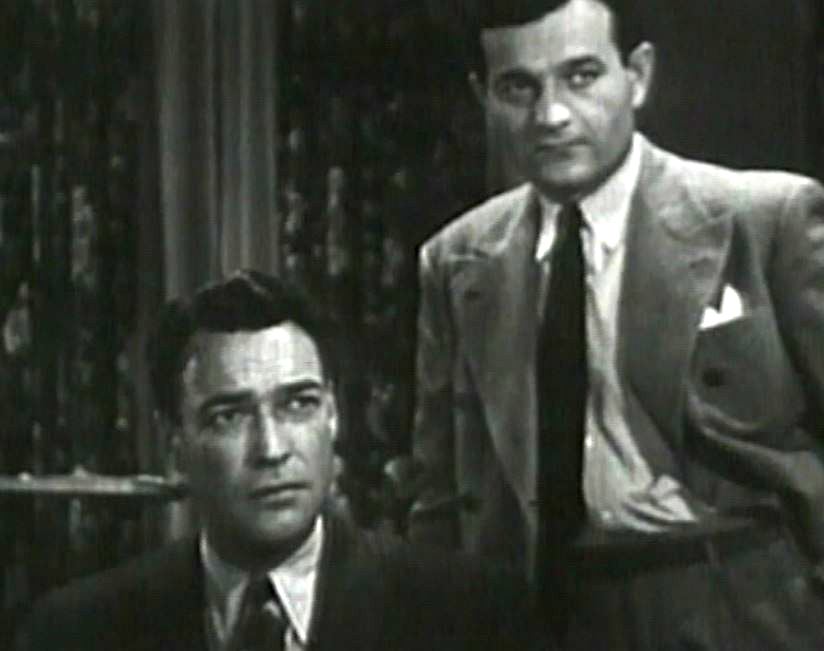
A par-for-the-course Poverty Row crime drama which could have used some beefing up in the story department; everything that happened in the past with Tony and Jerry and Linda is left maddeningly ambiguous, and a little more creativity by the screenwriters might have the made the characters more interesting. Instead, we don't really care much about the outcome of the situation for anyone, especially David (Charles Quigley)—who gets little screen time despite being the ostensible leading man—and Linda. Marjorie Reynolds (HOLIDAY INN) is OK as Linda, but the best acting comes from Ward McTaggert (pictured with Reynolds) as the villainous Tony. Howard Masters makes a somewhat intriguing kid brother—it's hard to tell if he's giving a nuanced performance or just has no idea how to act. Not a waste of time, but not necessarily one to search out. [YouTube]
Friday, June 19, 2015
FASHION MODEL (1945)
 There is trouble at the fashion house of Madame Celeste. One night, the obnoxious but rich Mrs. Van Allen keeps everyone past closing as she chooses a dress while insulting all the models and trying the patience of her milquetoastish husband. Stock boy Jimmy (Robert Lowery) is dating wholesome model Peggy (Marjorie Weaver), but when sluttish model Yvonne makes a pass at him, she and Peggy tangle. Later, when the Van Allens have finally left, Jimmy opens the dumbwaiter and finds Yvonne's dead body. There is no lack of suspects: Yvonne had caused problems for Madame Celeste and her husband Jacques, who is the real designer behind the Madame Celeste name; Yvonne was also dating the older, wealthy Mr. Davis who had given her a very expensive brooch that he now wants back; and because Jimmy was overheard telling Peggy he'd strangle Vvonne to get her off his back, he's the prime suspect. When Madame Celeste's husband is found dead in a delivery truck driven by Jimmy, Jimmy's arrested, but Peggy dresses up as his sweet old granny and springs him; together, they try to find the real killer.
You might not guess from that summary, but this B-thriller is primarily a comedy, and it throws everything but the kitchen sink at the screen trying to keep us amused. It works on occasion, especially near the end when Jimmy and Peggy, pretending to be mannequins, are put in a store window and undressed by an addled window dresser (see picture at right), much to the amusement of a growing crowd on the street. Lowery and Weaver make an appealing couple, and Weaver has a little more backbone than the average B-heroine. Tim Ryan is about average as the bumbling cop, and Lorna Gray makes for a nicely nasty Yvonne. I also enjoyed the short appearances of Nell Craig as Mrs. Van Allen. The mystery plot itself is fun with (for me) an unexpected twist in the identity of the culprit. Enjoyable B-fluff. [Netflix streaming]
Wednesday, June 17, 2015
TRIUMPH OF THE SON OF HERCULES (1961)
aka TRIUMPH OF MACISTE
 This Italian muscle man movie is very much like all the others. We have a hero named Maciste who is referred to in the American print as a son of Hercules in order to grab the audiences that made the Steve Reeves Hercules films popular here. The actor playing him, Kirk Morris, at left, is appropriately muscled and a little more baby-faced that the average peplum hero, and he is exceptionally good at looking pained and sweaty during his torture scenes. The plot involves a wicked queen who is sacrificing young women to the gods, with muscled hero Maciste helping to lead a revolt.
What's a little unusual about this one is that it takes place not in Italy but in the ancient city of Memphis in Egypt. Prince Iram, the rightful but exiled ruler, sees a series of omens that indicate now may be a good time to try and topple Queen Tenefi (who we know is decadent because she takes milk baths and has doves fluttering around—not to mention the human sacrifices at the Mountain of Thunder) and when Maciste helps save Antea and her villagers from being dragged off to sacrifice, Iram enlists him to head off to Memphis and stop the sacrifices. A silk merchant helps sneak Maciste and his men into the city but then betrays them. Maciste is chained to two horses to be split in half, but after a good lot of sweating and muscle-bulging, the queen lets him go and uses magic to erase his memory and make him her slave (another plotpoint used in other peplum films). There is plotting galore by various factions, but given the title, it's no spoiler to note that eventually, Maciste regains his memory, exerts his muscles a few more times—I counted at least four separate scenes of Morris sweating and straining—and triumphs against Queen Tenefi, with some help from the exploding Mountain of Thunder. Generally predictable and padded-out in places, but no worse than average. [Streaming]
 This Italian muscle man movie is very much like all the others. We have a hero named Maciste who is referred to in the American print as a son of Hercules in order to grab the audiences that made the Steve Reeves Hercules films popular here. The actor playing him, Kirk Morris, at left, is appropriately muscled and a little more baby-faced that the average peplum hero, and he is exceptionally good at looking pained and sweaty during his torture scenes. The plot involves a wicked queen who is sacrificing young women to the gods, with muscled hero Maciste helping to lead a revolt.
 What's a little unusual about this one is that it takes place not in Italy but in the ancient city of Memphis in Egypt. Prince Iram, the rightful but exiled ruler, sees a series of omens that indicate now may be a good time to try and topple Queen Tenefi (who we know is decadent because she takes milk baths and has doves fluttering around—not to mention the human sacrifices at the Mountain of Thunder) and when Maciste helps save Antea and her villagers from being dragged off to sacrifice, Iram enlists him to head off to Memphis and stop the sacrifices. A silk merchant helps sneak Maciste and his men into the city but then betrays them. Maciste is chained to two horses to be split in half, but after a good lot of sweating and muscle-bulging, the queen lets him go and uses magic to erase his memory and make him her slave (another plotpoint used in other peplum films). There is plotting galore by various factions, but given the title, it's no spoiler to note that eventually, Maciste regains his memory, exerts his muscles a few more times—I counted at least four separate scenes of Morris sweating and straining—and triumphs against Queen Tenefi, with some help from the exploding Mountain of Thunder. Generally predictable and padded-out in places, but no worse than average. [Streaming]
Monday, June 15, 2015
YOU'RE A BIG BOY NOW (1966)
 Bernard Chanticleer (Peter Kastner, at right) is 19, a virgin, lives with his well-off parents, and works as a page at the New York Public Library; wearing roller skates, he zips around retrieving material from the basement and sending it upstairs in a dumbwaiter. His buddy Raef (Tony Bill) is much slicker and more sociable, and is always giving Bernard advice about getting out of his rut. Bernard's mom (Geraldine Page) is a rather nightmarish overly-protective type, and his father (Rip Torn), who is a department head at the library, is both stern and also not quite living in the real world. Mom and Dad decide to let him live alone in Manhattan in a boarding house run by the eccentric Miss Thing (Julie Harris), who is instructed by Bernard's mom to keep a close eye on her son's comings and goings. His dad's secretary, the sweet Amy (Karen Black), has a crush on Bernard but he's oblivious; he only has eyes for the mysterious blond waif Barbara Darling (Elizabeth Hartman) whom he keeps seeing around the city. When he finds out she's an actress in a off-Broadway avant-garde play, he sends her a fan letter and she replies, initiating a relationship that, we can tell, won't last long, and it doesn't, culminating in an NYC street chase involving a Gutenberg Bible and a prosthetic leg.
 This early Francis Ford Coppola film is mostly delightful, tricked out with some 60s style effects—hand-held camera, surreal subjective touches—that have dated but are not too irritating. At heart, it's a standard coming-of-age story and Kastner is perfect as the geeky bespectacled hero, who, in my eyes, is geekier when he takes his glasses off. Karen Black (at left) was, as far as I know, never again to play such a vanilla, mainstream role; she's young and lovely and totally right as the sweet girl who doesn't give up—though whether Bernard is worth the wait may be debatable as his character is far more acted-upon than active, and though he's likeable, his personality is left rather vague. Torn and Page are a little too caricatured, and Harris is your standard slightly nutty old maid, though I enjoyed the very handsome Tony Bill, and Elizabeth Hartman's take on the heartless breaker-of-hearts is just different enough to be refreshing. Also featured: Dolph Sweet as a cop who is sweet on Harris, Michael Dunn as an actor friend of Hartman's, and some footage from Coppola's earlier DEMENTIA 13 and Roger Corman's THE PIT AND THE PENDULUM.
One area in which the movie falls down a bit is in tone. It begins with lots of vaguely surreal touches, mostly dramatizing Bernard's inner daydreaming state. My favorite scene has him looking at racist graffiti that says, "N-----s go home"; he riffs on where home is, which is the heart, and on where the heart is (according to the Robert Burns poem, my heart's in the highlands) and sees the graffiti as "N-----s go to the Highlands," then imagines a merry band of African-Americans in kilts, dancing in Scotland. Yes, too much of this might have sunk the movie in leaden whimsy, but I could have used a little more. By the end, I suppose the point that is being made is that, in the climactic chase scene, his real life has actually become a bit surreal—though the last sequence of Bernard and Amy in a pretzel factory is just plain puzzling. If you don't have an aversion to 60s shenanigans, this is well worth a look. [TCM]
Friday, June 12, 2015
MYSTERY PLANE (1939)
 In the fall of 1923, young Tommy Tompkins goes to see his hero, WWI ace pilot Brandy Rand, in a barnstorming exhibition, and manages to get Rand to visit him afterward and look at his scrapbooks of Rand's exploits. The pilot is clearly touched by the boy's devotion. Fifteen years later, Tommy, known as "Tailspin Tommy" for his daring in the air, is a pilot working at an independent airport run by Paul Smith. They're testing a device they hope to sell to the military that would automatically drop bombs over a target, and when Tommy and his sidekick Skeeter take the plane up, the device works, but when the plane malfunctions, Tommy has to pull it out of a, yep, tailspin to save the device, the plane, and himself. The Army brass is impressed, as is a group of crooks hoping to get their hands on the device to sell to the highest bidder. And they've snagged Rand, now an alcoholic mess, to help them. Tommy and Skeeter are shanghaied by the bad guys, and Tommy is shocked to find his former hero involved. Even worse, when Tommy's best gal Betty Lou is kidnapped, he may be forced to work with the villains.
Tailspin Tommy was a comic book character who was the star of a couple of serials in the early 30s, and who was brought back by B-studio Monogram in four short films, all in 1939. The later DANGER FLIGHT is straightforward kiddie matinee material, with Tommy the head of a boys' club. This one is a little less aimed at kids, and despite the poor reviews this film has on IMDb, I found it to be fast-paced and enjoyable. John Trent is the all-American straight arrow hero and manages not come off as an insipid drip; Milburn Stone (pictured above to the right of Trent) is a notch above the usual comic sidekick; Marjorie Reynolds is serviceable as Betty Lou; best is George Lynn as Brandy, who makes his character very sympathetic. There are some good ass-whooping fisticuffs at the climax. [DVD]
Thursday, June 11, 2015
SECRET OF THE PURPLE REEF (1960)
 Set in the Caribbean, this film begins with a priest giving us some plot exposition via a melodramatic eulogy for sailor Robert Christopher who was declared dead when his ship, the Cloud, vanished mysteriously at sea. His older son Mark (Jeff Richards, at left) has returned to the islands to help his younger brother Dean (Richard Chamberlain) get to the bottom of the situation, as much-needed insurance money is being withheld. The brothers talk to Tom Webber (Peter Falk), an unsavory troublemaker who was the last person to see Christopher alive; Tom's own ship, the Dagger, foundered at Purple Reef and the Cloud picked he and his men up and dropped them off on shore, never to be seen again. At least that's the story Tom tells; Mark and Dean don't quite believe him, and, along with old family friend Tobias (Robert Earl Jones, father of James Earl), the more they start digging, the more they become sure that foul play was involved.
 Just after I discovered the charms of 50s B-actor Jeff Richards in ISLAND OF LOST WOMEN, this movie appeared on Fox Movie Channel so I felt compelled to watch it, even though it was a widescreen film that Fox aired in a typically awful pan-and-scanned version. The film itself is no great shakes, though it's watchable—faint praise, indeed. Frankly, the biggest obstacle to enjoyment is the MST3K "rock climbing" problem (when MST3K ran Lost Continent, they made fun of the lengthy scenes of men climbing rocks, undoubtedly there to pad out the running time); there are endless shots of Richards and Chamberlain buzzing through the Caribbean in a small motorboat. I'm sure the actors had a good time, but I got bored by the second one of these clips, and there are several. Also, as reviewer Dinky4 notes on IMDb, the film wastes the physical assets of the two actors—for a movie set in the Caribbean, it's a bit of a shock that they never take off their shirts, though they get their pants wet a lot. Chamberlain (with Richards at right) has little to do but follow Richards like a puppy dog, so the movie rises and falls with Richards, who is in almost every frame. I enjoyed his presence, but he seems a bit bored with the proceedings. The potential love interest, played by Margia Dean, comes off as a second-rate Suzanne Pleshette; in fact, I frequently wished that Pleshette had been cast, as I'm sure her more passionate performance would have kicked Richards into gear a bit more. British actor Terence de Marney is fine as an old drunk who may hold the key to the mystery. The score is a combination of traditional orchestration and some jaunty steel drum music that sometimes feels inappropriate over some somber scenes. Pretty much for Richards and/or Chamberlain fans only. [FXM]
Wednesday, June 10, 2015
ISLAND OF LOST WOMEN (1959)
 Thanks to DVDs and Turner Classic Movies, I have caught up in recent years with B-movies of the 50s and early 60s, and one thing I've learned is this: if the title promises voluptuous scantily-clad women, there will also be at least one hunky scantily-clad man present. That's the only reason I watched this little flick and I was not disappointed. It even works fairly well on its own as a low-budget cross between Gilligan's Island and Forbidden Planet. Radio journalist Jeff Richards and pilot John Smith are flying to Australia for a conference when their plane loses both an engine and radio contact at the same time. They head for a small island when they hear a voice over a loudspeaker warning them away. Smith makes an emergency landing on the beach anyway, and the two are met by a kindly-looking older man (Alan Napier) who reluctantly agrees to let them stay until they can fix their plane. Much to the delight of Richards and Smith, Napier has three lovely daughters (Mercuria, Venus, Urana) who have been raised in isolation on the island—luckily, they have managed to master the basics of modern hair style and make-up.
  Between chatting up the young women and working on the plane, Richards and Smith (pictured above) discover that Napier is a former atomic scientist who regretted his role in the creation of the bomb and disappeared to get away from the world. And yet, in the movie's biggest plothole, he is still working with uranium—thanks to solar power panels that power everything in his island home. When Napier realizes that Richards will tell the world about his hideaway, he destroys their plane with a hand-held flamethrower and manages to drive away a search plane, so the guys start building a raft in secret, with help from the daughters, all of whom develop little crushes on the men. In the end, the flamethrower plus the uranium equal trouble, leading to a nuclear explosion. Not to worry: everyone survives, Napier sees the error of his ways, and an Air Force plane takes them all back to civilization.
There is potential here for a decent sci-fi adventure film, but I'm guessing the low budget put the kibosh on any effective special effects—the few that are present are not very special. The disillusioned scientist and his daughters are right out of Forbidden Planet, and the homemade cave in which they live is pretty cool, but there is little logic in any of the relationships, nor consistency in character. Yes, I admit it, I stayed for the whole thing because of the two hunks. Richards is dark, beefy and hairy; Smith is blond, slim and smooth. I am far from the first reviewer to notice that the two men do seem more taken with each other than with the girls. They both go a little ga-ga for the innocent babes, but the only pressing of flesh is during massages; Venus starts in on Richards, but Smith finishes him off, so to speak. Napier (Alfred on TV's Batman) is OK but the three women are pretty much interchangeable except when Urana, the youngest (Diane Jergens), acts like a brat. It's difficult to wholeheartedly recommend this, but there is something almost cutely goofy about it that makes it memorable. [TCM]
Monday, June 08, 2015
SECRET AGENT X-9 (1945 serial)
 This 13-chapter serial is set on Shadow Island, off the coast of China, the last area of neutrality in the Pacific War theater. Lucky Kamber runs a tavern/gambling joint called the House of Shadows where spies of various persuasions frequently cross paths. Kamber is friendly with Nabura, a Japanese "dragon lady" who is in charge of broadcasting propaganda from Lynn Moore, an Australian Tokyo Rose who sends dispiriting messages to Australian troops. However, Lynn is actually working for the Allies, sending coded messages in her broadcasts to Allied Command. Into this hornet's nest comes Phil Corrigan, aka Secret Agent X-9. His mission: to find out what's behind the secret Japanese project known as "722." We find out right off the bat that it's a chemical formula which, when mixed with distilled water, becomes a cheap fuel that could help the Japanese gain a distinct advantage in the war. But the Japanese don't actually have the formula; they need to get it from an American professor, so they plot to hire an agent to have plastic surgery done so he'll look like the professor, head off to America, and steal the formula. X-9 is onto them, they're onto X-9, and Kamber is stuck having to maintain official neutrality as spies from both sides run rampant.
 This spy story with echoes of CASABLANCA in the setting and characters starts out as a fast-paced, entertaining thriller, but once all the plot threads are laid out—around Chapter 4—a creeping repetitive numbness sets in as the filmmakers seem to be simply marking time until they can get enough chapters to ensure a good run at weekend matinees around the country. Part of the problem is that everyone seems to know what everyone else is up to, but they act like they don't. Also, despite the set-up of interesting characters, few of them get fleshed out in any way that would make us truly like or dislike them. Lloyd Bridges makes a fun and breezy hero as X-9 and Keye Luke (pictured with a gun at right) is fine as his sidekick. Sadly, for the most part, they are the only interesting actors in the whole thing. Nabura, who is in the serial as much if not more than X-9, should be either creepily sinister or campy fun, but Victoria Horne gives a disappointingly monotone performance, with eyes aimed down at the floor almost the entire time. Cy Kendall, usually a welcome presence as a heavy in B-films of the 40s, isn't given much to do as Lucky Kamber, who spends most of the serial playing X-9 and Nabura against each other, hoping for a big payoff for himself no matter which side wins in the end; Jan Riley as Lynn—who somehow gets top billing above Bridges in the title role—is flat-out amateurish.
 I enjoyed Nabura's two main henchmen, the German Bach (George Lynn) and the Japanese Takahari (Clarence Lung), both of whom I would steer clear of in a dark alley. There are two characters who appear in every chapter doing the exact same thing: Papa Pierre (Ferdinand Munier) is a landlord who listens in to X-9's conversations, and Solo (Samuel S. Hinds) is an old man who sits at the bar playing tiddlywinks. Both characters do become more interesting by the last couple of chapters—in fact, the last two chapters are quite good, though it's a bit of a slog getting through 3-1/2 hours to that last half-hour. The cliffhangers are generally fun—a truck going off a cliff (a literal cliffhanger), a ship blowing up, a room in which the floor slides back to reveal a pit with swords and knives sticking up. And I like that one of X-9's better tricks from early in the serial is repeated to even better effect at the end. Pictured at top are Horne, Bridges and Kendall. [DVD]
Thursday, June 04, 2015
TWO-LANE BLACKTOP (1971)
 Two young men, identified in the credits only as the Driver (James Taylor) and the Mechanic (Dennis Wilson), appear to do nothing but race their tricked-out '55 Chevy for pocket money. Starting in California, they hit the road heading east and have occasional encounters with the middle-aged driver of a yellow Pontiac GTO (Warren Oates), who is also heading east, picking up a variety of hitchhikers along the way. Oates, who acts like he's got something to prove, challenges Taylor and Wilson to a race to Washington, DC, with the winner getting the loser's car as a prize. Oddly, the men end up meeting each other frequently along the way, sometimes clashing, sometimes bonding. A hitchhiker, called the Girl in the credits (Laurie Bird), hooks up with both Wilson and Taylor before giving Oates a shot, but ultimately in Arkansas, she leaves all three for a motorcyclist. And that's about it for plot. In fact [spoiler], the movie ends before any of them make it to Washington.
 The phrase "existential road movie" is invariably used to describe this film, and that's exactly what it feels like. On some level, this is a character drama, though we don't get very far under the skin of any of the characters with the possible exception of the GTO driver, whom we discover is an insecure man who continually makes up fictitious stories about himself. Early on, he says he's left his wife and family to go on the road, but by the end, we realize it's possible and even probable that he made that up, too. By the last scene, Oates has even taken on the lives of Taylor and Wilson when he tells a hitchhiker that he took a '55 Chevy and turned it into a prime racing car. The director, Monte Hellman, deliberately picked non-actors for the rest of the primary roles; Taylor is flat and boring, delivering his lines like an amateur, and Bird isn't much better, but Wilson (at right), a founding member of the Beach Boys, is very good. He doesn't necessarily "act" more or better than the others, but he always looks like he's in character, and like his character might actually have an interior life. Harry Dean Stanton, early in his career, has a memorable cameo. Though there's not a lot to this movie, it kept me interested, and visually it is often gorgeous. [DVD]
Monday, June 01, 2015
ROPE OF SAND (1949)
 Paramount really wanted this to be another CASABLANCA. The cast includes Peter Lorre, Paul Henreid, and Claude Rains, with Rains playing a rather amoral character who winds up being helpful to the hero just as his Captain Renault character was; some of the action is set in an exotic café that looks like Rick's; there are ceiling fans, gaming tables, a bottle of Veuve Clicquot, an African setting, and a character named Renault, though in this case, a female. But calling attention to Casablanca does this film no favors, even though it's a fairly well done action melodrama in its own right. Diamanstadt in South Africa is basically a company town for the Colonial Diamond Company, which owns acres and acres of desert land rich in diamonds. Many people are tempted to trespass in the hope of finding loose diamonds in the sand, but they are always caught and punished by police chief Vogel (Henreid). Mike Davis (Burt Lancaster) is a safari guide for tourists, and when Ingram, one of his clients, runs off into the restricted territory, Davis goes after him. Ingram discovers a handful of diamonds but starving and dehydrated, dies when taken back off the land, and Davis refuses to tell Vogel the spot where the diamonds were found, despite a beating. Davis is unable to get work, and eventually comes back to Diamanstadt, intending to go back and claim the diamonds that Ingram didn't get. But still standing in his way is Vogel.
Rather than Casablanca, this really calls to mind TREASURE OF THE SIERRA MADRE, though this film is not as rich in acting or moral ambiguity. Lancaster is a solid lead, sort of an anti-hero, though cleaned up to be a full-fledged hero by the end, and Henried is more effective here as a sadistic villain (torturing Lancaster in the picture above) than as a suave but passive hero in Casablanca. French actress Corinne Calvet takes Ingrid Bergman's place as the exotic heroine, and she's quite good as a tart hired by a diamond company supervisor (Claude Rains) to get information out of Lancaster. Lorre is a weasely little fellow who pops in now and again, and Sam Jaffe is an alcoholic doctor whom both sides try to use to their advantage. There is eye candy in the person of the handsome John Bromfield as one of the diamond company guards. The film is a little slow getting going as all the story parts are put in place, but a vicious fight in the desert between Lancaster and Henried near the climax is quite exciting, and it's fun to see how all the just desserts are arranged. [DVD]
Subscribe to:
Posts (Atom)
