Monday, January 06, 2020

THE SEVENTH COMMANDMENT (1961)

Ted has just graduated from night school; to celebrate, his hot-to-trot girlfriend Terry (who looks like a femme fatale in training) is waiting in her car for him. The two roar off, making out while driving, and get in a car crash. When Ted comes to, he sees the driver of the other car, apparently dead, hanging out of his window. Not able to deal with the situation, he has a mental break of some sort, wanders off in a daze, and develops amnesia. The first person he runs across is Noah, an itinerant preacher who takes him under his wing. Soon, Ted (calling himself Tad) has become a faith healer. Over time, he makes a name for himself and is on a crusade to raise money for a children's hospital, with Noah as his assistant. Meanwhile, Terry has become an alcoholic slattern; it turns out that the other driver in the accident didn't die, but Terry was charged with drunk driving and her life spiraled downward. Now she lives in squalor with an alcoholic sleazebag named Pete. After reading about Tad's crusade, she realizes that he is actually Ted, and vows to get revenge. When she confronts Tad/Ted, he eventually remembers his past; when he mentions being responsible for the other driver's death, Terry decides to blackmail him—even though she knows the driver didn't die. She gets some money from Tad, but when she and Pete blow it all on clothes and booze, she decides on a more permanent situation: she'll force Ted to marry her so she'll always have access to money.

Now things get really sleazy: Ted starts burning with lust for Terry and they shack up together while he’s supposedly on "vacation." One night, she gets him so drunk that he passes out—she then calls a shady justice of the peace (at midnight, mind you) and has him perform a marriage ceremony while she holds the mostly unconscious groom up. (In the funniest moment in the movie, the oblivious justice asks if he can be the first to kiss the bride.) After leaving Ted on the couch, Terry has sex with Pete in the bedroom ("It’s your weddin’ night, ain’t it?" he growls). The further crimes and degradations shouldn't be spoiled, but suffice to say that the Lord seems to take a hand in the climax.

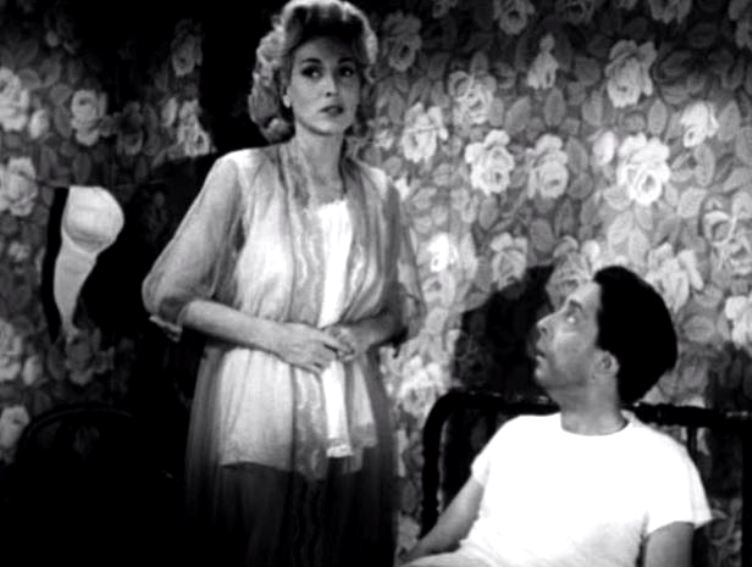
The title is odd; the seventh commandment is the one against adultery, but that would seem to be the least of the sins that go on here. But, no matter, this is a fun grade-Z crime movie posing as a religious story, or vice versa. Tad's healing powers are presented as real—or at least, we don't see the fakery if it exists—and he exhorts his congregation to give, not with the clinking of coins, but "the rustle of green leaves"; all his followers pull out their dollar bills and shake them in the air. The low-budget movie feels appropriately shabby and grimy and Terry and Pete come off as awful people. Pete is physically abusive, at one point saying to Terry, "I don’t like to beat you up, but sometimes I gotta!" Terry's way of consoling Ted when she leaves their room is to say, "If you get lonesome for me, you can pray to pass the time." The DVD is being marketed as film noir, and it does have some noir conventions, primarily the conflicted hero, but it's more an exploitation melodrama. I feel shallow saying this, but I wish at least one of the two male leads was attractive—both Ted and Pete are drab, unattractive men, even as Terry is quite a looker, albeit in a cheap noir way. Interesting flick, with a wild ending. Above left are pictured Lyn Stratten as Terry and Jonathan Kidd as Ted. [DVD]

Thursday, January 02, 2020

WUTHERING HEIGHTS (1958)

Like a true classic movie fan, I started the new year by watching something old, though in this case, not a traditional theatrical movie, but a recording of a live TV film of Wuthering Heights, first broadcast in 1958. I wouldn't normally review something like this but I found this version, despite its murky look and primitive production values, to be superior to the classic 1939 version with Lawrence Olivier and Merle Oberon. Both films tell the same story from the first half of the Emily Bronte novel. Young Catherine Earnshaw and her brother Hindley live at Wuthering Heights on the wild and windy moors. When their father returns from a trip to London with the young orphan boy Heathcliff, Hindley immediately takes a disliking to him, but Heathcliff and Cathy hit it off quite nicely. Years later, the two seem to be in a romantic but non-sexual relationship when Cathy is injured on the moors and stays with the Linton family until she recovers. She and Edgar Linton become involved, and when the jealous Heathcliff, who is constantly abused by Hindley, overhears Cathy talk about marrying Edgar, he leaves without hearing her say that it's Heathcliff she really loves ("I am Heathcliff!" she exclaims). Years later, Cathy is married to Edgar when Heathcliff returns, having made a small fortune, to exact revenge against both Hindley and Cathy.

The 1939 movie comes off as rather tame and bloodless, even though the novel concerns itself with tempestuous feelings of love and vengeance. Here, the young Richard Burton (in his early 30s) makes a perfect Heathcliff—even though he overacts a bit, as was par for the course for TV drama back then, he comes off as rough and passionate, more so than Olivier did in 1939. The same goes for Rosemary Harris who makes a far better Cathy than Oberon did. They are paired perfectly, even though Harris was a last-minute substitute for the original actress—Harris had only four days to learn her lines. Denholm Elliot is fine as Edgar, and the young actors are quite good—Cathy is Patty Duke, who a year later would achieve fame on Broadway and the movies as Helen Keller in The Miracle Worker; young Heathcliff is Michel Ray who would leave acting in the mid-60s. John Colicos is the villainous Hindley and Cathleen Nesbit is the family maid Ellen. This was originally broadcast mostly live on May 9, 1958—there are times when costume changes between scenes happen far more quickly than could really have happened, and a voice at the end does note that "some portions" were prerecorded.  This episode of the DuPont Show of the Month program, like most live television of the era, was considered lost but a kinescope copy was found recently and was aired on Turner Classic Movies. I hope they air it again as it really does deserve to be seen. [TCM]

Monday, December 30, 2019

DOUBLE HOLIDAY (2019) / ALWAYS AND FOREVER CHRISTMAS (2019)

The calendar tells me I can write one more Christmas blog post, so I'll sneak in two movies here. In Hallmark's Double Holiday, business rivals Rebecca and Chris, both of whom are under consideration for a big promotion, are assigned to work together to plan a large-scale holiday party that their boss hopes will cinch a development deal with a foundation that will be building a number of community centers. The two have shared a cubicle for a year, rather uneasily, as Rebecca (Carly Pope) thinks that Chris (Kristoffer Polaha, at right) is a bit too laidback and whimsical. But, as this is a Hallmark movie, we know by about three minutes in that the two will soon be romantically entwined and a kiss will occur in the final minute of the film. One of the things that melts her heart is that Chris, who grew up in a single-parent household, mentors kids at one of the pre-existing community centers. An added element here is that Rebecca is Jewish, and Chris works his way into the good graces of her extended family by showing up for various Hanukkah functions and inviting the family to give a Hanukkah prayer at the climactic holiday party. Hallmark was touting this inclusion of Hanukkah as a big departure for their Christmas movies, but the Hanukkah elements are minimal and in all other aspects, this is an average Hallmark Channel movie. Kristoffer Polaha is cute and charming and carries the movie (Rebecca’s family members are sweet people but not well developed as characters). Carly Pope is a bit too brittle to be appealing, so I stuck with this solely because of Polaha.

In Lifetime's Always and Forever Christmas, Lucy (Lexi Lawson) is a Los Angeles-based social media marketing executive who is spending December in her hometown of Stowe, Vermont, helping her retiring parents prepare to empty out and sell their Christmas shop (called Forever Christmas) which her late grandfather started almost fifty years ago. After her folks leave for a Hawaiian vacation, Lucy meets Carol (Beth Broderick), a seasonal employee who talks vaguely about a husband who lives up north and deals in imports and exports (hint, hint). She seems to know a lot about the shop, and helps Lucy develop a sort of sixth sense she calls "Christmas magic" about how to match up customers with the perfect gift. Lucy begins to get caught up in the small town's holiday spirit, helped along by Scott (Mark Ghanimé), the handsome owner of the diner across the street, and she even helps encourage a romance between her shy employee Randall and Rose the mail carrier. But she fights her feelings for Scott, who seems to be angling to get her to stop the sale of the store and keep it open as it is. Despite Scott and Carol, Lucy finalizes the sale to a businessman who wants to turn the building into a store for trendy athletic gear, but on Christmas Eve she has a change of heart. Can she use her new gift for Christmas magic to conjure up a happy ending for all?

As with Double Holiday, it was the charming male lead who kept me interested, but there is a lot of weak writing to contend with. Carol (the Mrs. Santa Claus figure) is downright drab, though Broderick tries hard to make her magical. Scott, Randall and Rose are sadly under-developed. And the plot twist with the new owner that makes everything work out (sorry, spoiler!) is downright ridiculous. But its overall tone is sweet, Lexi Lawson is OK, and Mark Ghanimé (pictured with Broderick) is, have I already said, handsome and charming. Both of these underachieving movies are good examples of why the Christmas TV-movie industry needs to stop churning out so daggone many movies each year and concentrate on making better ones. These movies can be both comforting and original if the filmmakers were allowed a bit more time for writing and more leeway in presenting interesting and diverse characters and storylines.

Friday, December 27, 2019

CHRISTMAS AT THE PLAZA (2019)

Jessica (Elizabeth Henstridge) is a historian and archivist with some kind of nebulous academic job who is assigned to work on a project at the famous Plaza Hotel in New York. She is supposed to do research in the Plaza historical archives and come up with a public display about Christmases over the years at the hotel. When she settles on using the theme of tree toppers, as a different one was made every year, she discovers that in 1969, there apparently was no tree topper made, and makes it her mission to figure out why. She ends up working with Nick (Ryan Paevey), another nebulously employed guy (it's mentioned in passing that he has a Christmas decorating business, but what does he do the rest of the year?) who is in charge of putting up the Christmas décor at the Plaza. At first, she resists his obvious charms (handsome, friendly, works with his hands) but soon an attraction grows between them. However, being a Hallmark movie, there are silly romantic complications: Jessica's slimy career-driven boyfriend wants to take her home to meet his parents for Christmas, and Nick's long-ago-dumped obnoxious girlfriend shows up at an awkward moment. Of course, it all comes out fine in the end: the tree topper mystery is solved, and Jessica and Nick finally kiss.

I enjoyed this Hallmark Christmas movie for its setting at the Plaza hotel and for the performances of the two leads, especially the hunky Paevey (pictured) who is the most perfectly scruffy/smooth soap opera actor ever. Bruce Davison is fine as the head bellman who is keeping a Christmas secret, but Julia Duffy (well-remembered as the scatterbrained Stephanie on the Vermont Bob Newhart show) is given nothing to do as Ms. Clark, Jessica's supervisor at the hotel, except be involved in a running joke about her name with Kenny the desk clerk (Nelson Wong). Otherwise, this film could stand as an example to Hallmark for showing just how tired their formula has gotten. Work-challenged woman stuck with blah boyfriend? Check. Hunky down-to-earth guy who works with his hands? Check. One seeing the other in what appears to be an intimate moment with an ex and misinterpreting things? Check. Opening sweeping shot of a snowy cityscape? Check. Minority actors in bland supporting roles? Check. Painfully underdeveloped characters?  Check. The twist with the Plaza archives has potential, but it turns into just another predictable plotline involving a character with a secret (Hint: Bruce Davison). Their writers need some new templates, and maybe Hallmark could stand to make a dozen or so fewer movies each year. But this one did introduce me to Ryan Paevey, so yeah for that. [Hallmark]

Monday, December 23, 2019

TWINKLE ALL THE WAY (2019)

Single mom Cadence (Sarah Drew) has her own business as an event planner and as the holidays approach, she has a big event on deck: staging a Christmas Eve wedding for a friend's family. Meanwhile, single dad Henry (Ryan McPartlin), normally a house painter, has his own seasonal decorating business with his mother Twinkle and his brother Lex and as the holidays approach, they have a big event on deck: a Christmas Eve party for the town's richest lady. But back at the elementary school where both Cadence and Henry have their adorable kids enrolled, the two are thrown together by chance to design the sets for the upcoming Christmas pageant. She's all about planning and scheduling every little detail, but Henry takes a much looser improvisational approach to his work, leading to some friction in the beginning, but after sparks of irritation fly, sparks of attraction fly, and it looks like the two might couple up. But the various traumas in their pasts lead to hesitation. On Christmas Eve, a blizzard threatens to put the kibosh on both of their outside projects, potentially cancelling both the wedding and the party, but when most of the town loses power and everyone winds up sheltering at the elementary school, a little scheduling and a little improvisation might save the day—and their budding relationship.

This is a Lifetime Christmas movie rather than a Hallmark movie. As you can see by the plot description, it seems like it could have as easily been at home on Hallmark with its vanilla lead characters (pictured above) stumbling into a holiday romance, and no kissing until the last minute of the movie. But there are some differences. First, no one here has to give up a big-city career—they both already live in the same small town. Second, there are two small children rather than just one. The customers of both the lead characters are African-American, which is slightly more representation than at Hallmark. But most importantly for moving these romances into the 21st century, there is an out gay couple: Henry's brother Lex (Brian Sills) and his husband Danny (Mark Ghanimé), and they (pictured at right) even get the final fadeout kiss rather than Cadence and Henry. There is no big deal made about the secondary roles being black or gay (nothing about the roles would necessarily indicate minority actors), but that itself is part of the point. Otherwise, however, this is about par for the course for TV Christmas movies. Drew and McPartlin are fine, the kid actors are fine. Lesley Ann Warren plays Henry's mom Twinkle and though she is also fine, she is mostly wasted in a role that any older actress could have played—she doesn't get to shine in a Lesley Ann Warren way. A minor quibble: the blizzard that shuts down the town looks like about 2 inches of snow and a moderately stiff breeze which never comes off as dangerous. But this film gets extra points for representation bravery. [Lifetime]

Thursday, December 19, 2019

ROAD TO CHRISTMAS (2018)

Martha Stewart, oops, I mean Julia Wise is a lifestyle maven who runs her empire from Los Angeles but returns home to Vermont every December to make a Christmas TV special. Her trusted assistant Maggie has a big idea: do the Christmas Eve show live. Julia's nervous about it; Maggie assures her she'll have a teleprompter so she won't have to memorize anything, but Julia still insists on getting some extra help from her son Danny who has produced shows for her in the past. Maggie steels herself to resent the help, but Danny turns out to be handsome and charming, and actually has a pretty good idea for the show: the two of them will travel from L.A to Vermont and film short human interest stories to insert into the live show. Along the way, Maggie gets the idea to reunite Danny with his two brothers as a surprise for Julia. But this proves tricky as there is some simmering resentment in both Derek, worker at a ski resort, and David, owner of a small but thriving pet shop, at the fact that Danny's job producing seemed to anoint him as Mom's favorite, or something like that. This resentment, other obligations, and an approaching blizzard all threaten to derail Maggie's plan, but since this is a Hallmark Christmas movie, we know that all these obstacles will be overcome on the way to a happy ending.

Or will they? I actually had my doubts for a while because, while the basic Hallmark template is intact (busy businesswoman meets cute with down-to-earth guy—Danny is now a nature documentary maker—who helps her solve all her problems with a kiss on Christmas Eve), there are a couple of interesting differences in this one. For one, Derek (Cardi Wong) is Asian—it turns out that all three brothers are adopted. It's not unusual in a Hallmark Christmas movie for the heroine to have a non-white sidekick, but Derek's role is a little more substantive than usual. Even more interesting, David (Jeff Gonek, at right) is gay; it doesn't take much reading between the lines to see that his relationship with pet shop co-owner Bradley is more than just a business one. Plus, Bradley has a theater degree (!) and near the end, David breaks out in a theatrical impression of James Stewart as George Bailey in It's a Wonderful Life. Though some viewers might miss these cues, for those of us who catch them, there is a added degree of fun. I found Jessy Schram to be rather ho-hum as Maggie, but Chad Michael Murray (above left), slightly higher in star power than usual for a Hallmark non-Hall of Fame movie, is delightful as the sly and patient Danny. Though the set-up with the brothers is nicely done—I could see them starring in their own Hallmark series called The Three Wise Men—the writing is generally weak with lots of plotholes and awkwardly delivered exposition. There's a mini-meltdown scene when Maggie finds out that Danny isn't planning to stay on with Mom's production company, but we were never clued in by anyone or anything that he might stay on. Still, the brothers made this one worth sticking with. (Hallmark)

Tuesday, December 17, 2019

WRITE BEFORE CHRISTMAS (2019)

Jessica, owner of a music shop and something of a frustrated musician herself, buys five different Christmas cards to give on five different days to her boyfriend Wes. When he makes a dinner date with her at a restaurant known informally as the "proposal palace," she assumes that marriage is in the offing. But instead, he breaks up with her—and as it happens, she admits to her best friend Mimi that she really didn't feel all that passionately about him. So she takes the cards meant for Wes and sends them to five important people in her life: her aunt Lila who raised her, her brother Carter who is spending his first Christmas away from home in the military, her favorite boy band singer Jax whose career has sputtered out after he left his band, her friend Mimi, and Mrs. Smith, her first music teacher who inspired her as a child. Each of the cards has an impact on the recipients. For example, Jax is inspired to regroup with his band and record a new Christmas song. Carter gets the courage to pursue a relationship with Angie, a fellow soldier. Mrs. Smith, however, has passed on but her son, a handsome photographer named Luke, finds Jessica and gives her his mom's cello as a gift, which inspires her to audition for a small orchestra. But all is not Santa and mistletoe for everyone: Luke and Jessica feel an attraction but her ex-boyfriend shows up to put a kink in their relationship. Aunt Lila has a bit of a crush on a man who walks his dog down her street every day, but how will she contrive to meet him?

Well, it's a Hallmark movie so you know that everything will be Santa and mistletoe by the end. I give this Christmas romance a couple of extra points for a plot that is a bit more original than most. The five cards mean that there are three or four more plotlines than usual, though all of them are equally vanilla and predictable. I was kinda hoping that maybe Aunt Lila's dog-walking boyfriend might be a serial killer, or that Jax had a hidden fentanyl addiction, but no luck—the dog walker is just another lonely middle-aged widower and Jax is the squeakiest-cleanest pop star ever, though I have to say that his brother/manager had a slightly dissolute look about him. The two leads are a notch above the norm as well; Torrey DeVitto is wholesome without being bland as Jessica (and the actress can actually play the cello—her dad is Liberty DeVitto who was Billy Joel's regular drummer for years); Chad Michael Murray does his cocky-but-sweet bit to a tee. Grant Show (Melrose Place) is fine as the dog-walker, but Lolita Davidovitch outshines them all as the aunt—she can cry on cue and not come off as phony. A cute dog, always a plus, plays an important role in the proceedings. And as usual, the sets look great, overflowing with Christmas cheer. Better than average, which in my estimation of the Hallmark canon, is a pretty strong compliment. [Hallmark]

Thursday, December 12, 2019

A BRAMBLE HOUSE CHRISTMAS (2017)

Finn Conrad (who is a famous children's book illustrator under the name Finn Knightly) and his sister Molly are understandably upset when their long-estranged father dies—he walked out on his family when they were children—and leaves most of his estate ($100,000) to his caretaker Willa. He's also left her an all-expenses-paid Christmas vacation to a bed and breakfast in Oregon called Bramble House, where he spent several happy Christmases. The siblings suspect that Willa is a gold-digger who somehow conned their father out of his money, so they get an injunction stopping Willa from collecting the money and they have until Dec. 31 to serve it. Finn decides to go to Bramble House, meet Willa—not telling her that he is Conrad's son—and get her to admit to her scheme. But we know what Finn doesn't: Willa took care of Mr. Conrad for two years while she was caring for own son, Scout, who had a dangerous heart condition. Scout is OK now, but Willa still has huge medical bills to pay, and Conrad left the money to her for that purpose. When Finn arrives, he immediately hits it off with Scout, who happens to be reading one of Finn's books, and slowly, he and Willa strike sparks. When Finn gets the whole story, he decides to call off the injunction, and even makes plans for a possible future with Willa, but Finn's sister decides that Finn is being taken advantage of, and she arrives at Bramble House—on Christmas Eve, no less—determined to serve the injunction.

Because this was broadcast on Hallmark Mysteries & Movies rather than the Hallmark Channel, it's a slightly less whimsical, more serious Christmas romance than usual. Instead of a harried businesswoman escaping the big city to find a down-to-earth, small-town man who works with his hands, we have a woman escaping two years of caring for the health of others finding a sensitive man who works with his hands (albeit through art rather than carpentry). The usual misconceptions and miscommunications occur, but with less humor. The complicating wrinkle here is not a romantic rival but the hero's sister. Still, of course, the happy ending is preordained, and the kiss still has to wait until practically the fadeout. The two leads manage to be likable and sympathetic without getting sentimental. David Haydn-Jones, though handsome, has an appealing lived-in look to him and Autumn Reeser similarly seems mature but not too blandly motherly. There is a subplot involving the keeper of Bramble House (Teryl Rothery) who has to accept that she can no longer run everything by herself which actually might make a fine central narrative to a Christmas movie someday though it doesn’t really fit the Hallmark template. Young Liam Hughes is fine as Scout. Perhaps nothing special, but still a comfortable holiday movie.

Monday, December 09, 2019

NOSTALGIC CHRISTMAS (2019)

It's Christmas time, and if you read this blog, you know the Hallmark Christmas movie drill: driven big-city gal meets small-town, down-to-earth guy who works with his hands; sparks fly, complications ensue; she comes to appreciate the slower life; they kiss; the end. In the first of our holiday movies up for review, we have Anne (Brooke D'Orsay), a big-city toy buyer for a department store chain. After she wraps up a presentation of the latest snazzy, gimmicky toy of the season, she heads off to her hometown in Maine to help her father Bill who is retiring and closing up his toy shop where he sells old-fashioned wooden toys that he makes. When she was young, she made toys as well, and Bill has found a bunch of them and is giving them away with purchases. Once in town she is corralled by an old friend into helping plan the town's Christmas displays and activities, and finds herself working with (as the Hallmark web site puts it) 'handsome local widower' Keith (Trevor Donovan). He is also dealing with a retirement problem: the woman who runs the town mill, where he is a foreman (you didn't think he wouldn’t work with his hands, did you?), is retiring and trying to sell the land, which would throw much of the town out of work. Will Anne decide she wants to stay and run the toy store? Will Keith be able to keep the mill open and thereby avoid having to leave town? But more importantly, will Anne and Keith kiss by Christmas Day?

I mock these movies because it's so easy (predictability and generically vanilla characters), but the difference between me turning a movie off at the 20 minute mark (when the first ad comes) and sticking with it to the end is usually a matter of two things: an attractive male lead and good chemistry between the male and female leads. This one has both. I liked Brooke D'Orsay in Miss Christmas last year, and I remember Trevor Donovan as country singer Eddie Arnold in the underrated TV series Sun Records—which sadly was not renewed before it could finish its story. One minus: no one in the supporting cast really gets to shine. Another minus: weak writing—with particular reference to the last-minute machinations to save the mill. And there's that terrible generic title. But it's snowy and Christmassy and there's Trevor Donovan (pictured) as the manly but sensitive guy, so I didn't feel too guilty about finishing this one. [Hallmark]

Thursday, December 05, 2019

MATCHLESS (1967)

Former soldier Perry Liston (Patrick O'Neal, at right) is now a reporter for a New York paper who writes a column under the name "Matchless"—a nickname he was given in the service. We meet him in China as he is mistaken for a spy and tortured. Since he has no information to give, he is tossed into a cell to await execution along with Hank, a real spy (Henry Silva), and an old Chinese man on the verge of death. When Liston tries to comfort him, the old man, with his dying breath, gives Liston a ring which can make the wearer invisible for 20 minutes and which cannot be used again for 10 hours. Liston uses it and makes his escape, naked, as it were, since his clothes would still be visible. He materializes in the home of the lovely O-Lan, mistress to one of the torturers but actually an American spy. She helps him get back to the States where he is tortured again because the Americans think he must be a spy. When that all gets straightened out, he is recruited by the Americans and paired with the beautiful spy Arabella (Ira von Furstenberg) to steal some dangerous chemicals from British millionaire bad guy Gregori Andreanu (Donald Pleasance) who lives in a castle with robot servants. But on their trail is the escaped Hank and the lovely but evil Tipsey (Nicoletta Machiavelli), who don't seem to be working for anyone but themselves. Shenanigans follow—subway chase, fixed boxing match—climaxing with a long car and motorcycle chase in which the cars wind up on the top of a moving train.

The 1960s spy spoofs are odd ducks, partly because the movies that they are spoofing, the early James Bond films, already had a sense of humor about their material, and later, especially in the Roger Moore years, largely became exercises in campy style. This movie stands out a bit from the Flint (James Coburn) and Matt Helm (Dean Martin) movies because it substitutes magic for science –instead of a nifty electronic gadget, Liston gets a magic invisibility ring. This leads to several scenes playing on the fact that when Liston reappears, he's naked. Aside from the comic tone present throughout, we also get Donald Pleasance as a villain who I can only describe as restrainedly campy. When he gets angry, he snaps on a pair of ostentatious sunglasses, a gesture that never failed to get a chuckle from me. O'Neal is no better than average in the lead, more or less sleepwalking through the one-dimensional character he plays. (Yes, I wish someone younger and handsomer and with a better body had played the occasionally naked hero.) The two lead women outshine him, and Henry Silva seems to be having fun playing the snarling Hank whose motivation was never clear to me. The 60s look of the movie is just right, and I loved the credit sequence featuring close-ups of beakers filled with bubbling, colorful fluids. This might have worked better as a campy superhero movie, but it was generally fun and undemanding, though the dubbing of this Italian film is bad, even though it looks like all the actors were speaking English. [TCM]

Monday, December 02, 2019

A BLUEPRINT FOR MURDER (1953)

Young Polly Cameron is taken to the hospital suffering from seizures, yelling "Don't touch my feet!" Her stepmother Lynn (Jean Peters) and her visiting uncle Cam (Joseph Cotten) sit with her overnight and she seems to be on the road to recovery, but the next night, the seizures return and she dies in the hospital. The apparent cause is encephalitis, but Cam's lawyer’s wife, Maggie says the symptoms sound like strychnine poisoning. Then Cam discovers from Lynn's younger stepson Doug that his father (Cam's brother) died in similar circumstances. Maggie’s husband Fred notes that Lynn is in line for an inheritance from her dead husband, but the two stepchildren were ahead of her; now, only young Doug is in her way. Cam comes to the conclusion that Lynn has done in both her husband and Polly, and fears that Doug may be next on her list. When an autopsy is performed, strychnine is indeed found in her system and the police officially question her, but despite the fact that the last medicine given to Polly was obtained by Lynn—and therefore could have been tampered with—the police determine there is not enough solid evidence to charge her. Cam has conflicting feelings; he has come to care for her, but also believes that she may well have committed murder. When Lynn announces that she is taking young Doug off to Europe for a trip, Cam worries that Doug will be the next victim of poisoning and he books passage on Lynn's ship, hoping to protect the boy and possibly to entrap Lynn at the same time. This mystery is stymied by drab production and direction. It feels more like a TV movie than a theatrical one, even in its length of only 75 minutes. There is little suspense, since the case against Lynn is awfully airtight and no other suspects are presented. Some nice tension is worked up in the last 20 minutes when Cam plots to poison Lynn on the ocean liner with a suspicious tablet he finds in her possession, but the conclusion is fumbled (not story-wise but in presentation) and disappointingly anti-climactic. Joseph Cotten, Gary Merrill (as Fred) and Catherine McLeod (as Maggie) do what they can with underwritten roles, but Jean Peters is very good as the possible cold-blooded poisoner. If all you expect is a TV movie of the week, you may be satisfied with this. It's watchable but so much more could have been done to make this a real nail-biter. Pictured are Peters and Cotten. [TCM]

Friday, November 29, 2019

BEAUTY AND THE DEVIL (1950)

aka BEAUTY OF THE DEVIL

Henri Faust, a scholar and would-be alchemist, is retiring after fifty years of teaching at the university. But he now feels like he gave up the simple joys of life, including love, by devoting his life to scholarship, and he realizes how much knowledge (including the secret of creating gold) he still lacks. The demon Mephistopheles appears in the form of a handsome young man and tries to drive a bargain with Faust: the demon will give him a kind of "do-over" existence as a young man with the ability to find love, power and more knowledge, but if he needs to call on Mephistopheles for help, Faust must sign his soul over in blood. Faust agrees and suddenly, he becomes the young form of the devil, and Mephistopheles takes on the form of the old Faust. The young Faust is in for a wild ride as he is arrested (when he enters his own house to get some money and is taken for a thief), falls in love with a gypsy fortune teller named Marguerite, discovers the secret of alchemy and is able to make gold from sand, and falls in with a powerful prince (and takes the princess as a lover). But ultimately, as we know this is the Faust legend, he is going to have to make a decision about the things of the world vs. his eternal soul.

French director René Clair brings his fizzy whimsy and visual flair to this tale; the narrative gets a bit convoluted at times but the rich look of the film is always a delight, as are the performances. Even though there are several characters, acting-wise it is largely a two-man show. Michel Simon, one of France's most prolific actors, has a field day as the aged, doddering Faust and then as the still-aged but sly Mephistopheles. The remarkably handsome Gérard Philipe (pictured) is perhaps even better as the sly devil and then the confused but ambitious youth. The switching of the actors in their roles is a small stroke of genius, even if it does sometimes lead to some plot confusion—I was uncertain how the world at large was reacting to the devil-as-Faust since he does seem to undergo a change in character. I also like that the demon is not The Devil; we see Mephistopheles ask Lucifer for his help at times. At a little over 90 minutes, the film drags in the middle but you'll be glad to have stuck with it by the end. A favorite quote, from the demon to Faust: "Your knowledge only serves to measure your ignorance." BTW, the literal translation of the French title, "The Beauty of the Devil," fits the film better, as the ostensible beauty of the title, Marguerite, actually has little to do here. [Criterion Channel]

Wednesday, November 27, 2019

TERROR BENEATH THE SEA (1966)

Reporters Ken and Jenny are present at a demonstration being given by the Navy to show off its new homing torpedo. As they watch on a monitor, Jenny has a minor freak-out when she has a premonition of something bad, and moments later the gathered reporters see a strange blurry figure swim past the camera. Commander Brown has his own little freak-out and shuts down the demo, but Ken and Jenny decide to go diving to investigate on their own. She sees a man-sized amphibious creature and snaps a picture of it, but she loses the camera and the Navy men don't believe her, so she and Ken go back underwater to find the camera. Instead, they are captured by silver-skinned monsters (who bear a resemblance to the Creature from the Black Lagoon) and taken to a scientific facility on the ocean floor where they meet the insane Dr. Moore. In an attempt to start a single world government, he has been successfully turning human beings into genderless "water cyborgs," the silver creatures, whom he can control with the flip of a dial. Moore has Prof. Howard kidnapped to come and witness his latest transformation: turning Ken and Jenny into cyborgs. Lucky for them, it's a fairly long process, and in the meantime, Commander Brown and his men take a sub down to save the reporters and the professor (and mankind) from becoming water-breathing eunuchs.

This is quite a little gem. It's a Japanese film made with several American and European actors in lead roles. Ken is played by Japanese actor Sonny Chiba who went on to a long career in martial arts movies. Jenny is played by Peggy Neal, a blond American actress who lived in Japan. I was prepared to give the film points for featuring an interracial romance, but the two seem to be just good friends. But wait, there's more! The silver creatures (face pictured above) are creepy from afar, but up close, you can see the bends and folds of their costumes. The transformation scene we see, in stop motion, is effective and surprisingly graphic, if a little too long. The sets are bright and colorful and the miniatures look exactly like miniatures, which frankly is a plus in a movie like this. This transfer seems to be wrong; it looks like a full screen print zoomed in to be widescreen, so the close-ups are super close. But even that is kinda fun; the two Navy men (German actors Franz Gruber and Gunter Braun) frequently have their faces so close it's like they're pressed up against each other, burning with barely disguised lust. (See the picture on the right). The last 20 minutes are padded out with some tedious fights, but for the most part, this is colorful campy fun. [DVD]

Monday, November 25, 2019

THE 5,000 FINGERS OF DR. T (1953)

Young Bart Collins lives in middle-class comfort with his widowed mom Heloise. The bane of his existence is his martinet piano teacher, Dr. Terwilliker; the movie opens with Bart asleep at the piano, in the middle of a dream that he is being chased through a surreal landscape by several men with large, colorful nets. Tewilliker wakes him up and chastises him for falling asleep while practicing Terwilliker's "Happy Fingers" exercises. After Dr. T leaves, Bart's mom leaves to go shopping and, like Dr. T, exhorts him to keep playing. The only sympathetic person around is the plumber, August Zabladowski, who is in the kitchen fixing the sink. Once again, Bart nods off at the piano and has an even more surreal dream. Bart is imprisoned in the Terwilliker Institute, forced to practice constantly and soon to take his place in a huge concert involving 500 boys playing a gigantic auditorium-sized piano. His mom, seemingly under hypnosis, works for Dr. T and is soon to be married to him. Bart's only friend is August, who somewhat reluctantly serves as a father figure, even has he has to get all the plumbing in the Institute finished so the civil inspectors will let the place open for the arrival of the other 499 boys. But soon the two are working together and they invent a sound-capturing device to use at the concert that they hope will pull the piano music out the air and ruin the concert.

Often, the books and movies we consume when we are young remain favorites of ours for the rest of our lives; even when, as adults, we can see their weaknesses, we still enjoy them, perhaps out of a sense of nostalgia. I have a very fond memory of seeing this movie on TV when I was 11 or 12 and laid up at home for a week with the flu, and was quite taken with the adventure and fantasy elements. When this was first released on home video in the 90s, I bought a copy and was sorely disappointed. Now, after another 25 years, I've watched it again and this time my feelings have moderated a bit. The film has become a cult classic, largely due to the wild production design by Dr. Seuss, who also co-wrote the screenplay. In terms of production, the movie is certainly more than watchable, with a visual vibe similar to that of the later Willy Wonka and the Chocolate Factory: the giant piano, a huge curved ladder that leads nowhere, two roller-skating men with conjoined beards, dazzling sets, colorful costumes, and a wild dance number held in a dungeon featuring zombie-like musicians (pictured at right) are all worth seeing. Unfortunately, the story is muddled without a coherent theme; is this musical—with mostly unmemorable songs—actually anti-music? Anti-parents? Anti-fascist?

The performances are all over the map. Rettig is fine as the boy and old pro Conried gives it a good shot as Dr. T, though there is still room for him to go further over the top. The best song by far is the campy "Do-Mi-Do Duds," sung by Conried while he's getting dressed by his assistants: "I want my undulating undies with the marabou frills/I want my beautiful bolero with the porcupine quills." But Mary Healy is unmemorable as the mom (slightly better as the fantasy mom who gets to be a little wicked) and her real-life husband Peter Lind Hayes is pretty bad as August; drab and passive, giving us no confidence in his skills as a hero, a father figure, or even as a plumber. I know the character is supposed to grow into his better self but Hayes plays August with the same low-energy level all the way through. August does get the best line: listening to Bart complain about parents, he replies,"If kids had their way, almost no parents would be born at all." Having said all that, I still enjoyed watching the movie—at 90 minutes, it doesn't quite wear out its welcome—though I think to some degree, I'm still experiencing it as the movie that captivated me as a child. I'm a little surprised that, with all the Seuss movies of the last few years, a remake has never been done. [TCM]

Friday, November 22, 2019

THEY RAID BY NIGHT (1942)

Norway has been occupied by the Nazis, and the Germans are hunting down members of the Free Norwegians resistance movement. In England, Capt. Robert Owen (Lyle Talbot) is put in charge of a mission to parachute into Norway to free General Heden whom the Nazis are holding in prison. Owen insists on informality and on being called Bob by his two partners, Eric and Harry, and the three parachute into Norway with the cover story of being friends up in the mountains on a vacation. When they are caught by Gestapo agents in the apartment of a resistance fighter, the three commandos turn the tables, tie up the Nazis, and dress in their uniforms in order to enter the prison and free Heden. They wind up hiding out in the woods before meeting a boat which is to take them to England. However, Heden is injured in the escape and Eric goes back into town to find a doctor. He meets his former fiancée Inga; bitter over the death of her father when Eric escaped before the occupation, she's become a collaborator and contacts the Gestapo. Eric is captured and tortured, and eventually tells the Nazis where their rescue boat will be. How many members of our trio will survive, and will Heden get his freedom?

This is a Poverty Row thriller which means, among other things, cheap sets and uninspired camerawork. But the proceedings were intriguing enough for me to stick with it, despite some weaknesses in writing. The script feels like it was being written day by day as the movie was being shot. They never really get a chance to use their mountaineers cover story, and the circumstances of Eric's background with Inga are vague. But things move along at a decent clip, and the actors are competent. Talbot, an old pro, was past his prime but does a good job as the chipper American (his character is supposed to be Canadian, but I never bought that), Nordic-looking George Neise (Eric) is believable as the less-experienced freedom fighter, and Charley Rogers (Harry) is used mostly as comic relief with his Cockney accent. June Duprez is Inga, Victor Varconi is the chief Nazi, and Sven Hugo Bork is Dalberg, a German officer who plays in important role in the climax. The occasional background music is silly or inappropriate (often Beethoven trotted in for no reason) but if you like these cheapies, it's worth a viewing. Pictured from left: Rogers, Neise and Talbot. [YouTube]

Monday, November 18, 2019

MASTERSON OF KANSAS (1954)

In the 1870s, Bat Masterson, the sheriff of Dodge City, is headed for a showdown with the tubercular gunfighter Doc Holliday.  But federal marshal Wyatt Earp, friend to both men, stops it in order to bring Masterson's attention to a more pressing matter: the possibility of an Indian uprising. Amos Merrick, who brought about a treaty with the Indians by giving them a reserve outside of Dodge City, has been accused of the murder of an Army officer, and he has found refuge with the Indians. The cattlemen of Dodge City resent Merrick giving up land they say they need for their cattle—and we eventually learn that one of the cattlemen is the guilty party in the murder. Masterson goes to Chief Yellowhawk and talks him into giving Merrick up to "the white man’s justice," but Yellowhawk also says that if Merrick dies, many white men will as well, including Masterson. Merrick is indeed found guilty based on the testimony of Clay Bennett, though Yellowhawk tells Masterson that Bennett was seen miles away from the site of the murder at the time it happened. Masterson, with help from Merrick's daughter Amy and the reluctant Doc Holliday, vows to clear Merrick's name before he is executed.

To me, Masterson, Earp and Holliday are just names out of the mists of American legend; I actually know them more as characters on TV westerns of the 50s and 60s (on separate shows, Gene Barry played Masterson and Hugh O'Brien was Earp—with Doc a regular character on his show). I've also seen GUNFIGHT AT THE O.K. CORRAL which features all three men. I know little of the real history of these people, but that doesn't stop me from enjoying these undoubtedly fanciful renderings of the Wild West. The likeable George Montgomery is fine as Masterson; Bruce Cowling has the small role of Earp, who pops in and out of the story as events warrant; the scene-stealer is James Griffith who makes Holliday a more memorable character than Masterson; he comes off as simultaneously slimy and sympathetic. Nancy Gates has the fairly bland role of Amy, and Jay Silverheels, better known as Tonto in the Lone Ranger show, is Yellowhawk. There's not a lot of action here, though the final showdown, as our legendary trio try to stop the lynching of Merrick, plays out nicely. Directed by William Castle before he took to grade-B horror and exploitation films. A bit sluggish at times but OK for whiling away a Saturday afternoon. Pictured above are Griffith and Montgomery. [TCM]

Friday, November 15, 2019

THE PHANTOM PRESIDENT (1932)

In an opening that sets a whimsical tone for the proceedings, a White House tour guide sings a patriotic song on his tour, and the portraits of past presidents sing along. We settle in on a backroom meeting of a group of politicians who are promoting the boring, stodgy T.R. Blair (George M. Cohan) as a presidential candidate, but even they admit he lacks flair, personality, and sex appeal (this last criticism comes from a very masculine women clearly coded as a lesbian). In his private life, he wants to propose to Felicia (Claudette Colbert), the former president's daughter, but though she's fond of him, she can't take his proposal seriously. Meanwhile, Doc Varney and his medicine show come through town; Varney (also Cohan, at left) is the spitting image of Blair but with a much more gregarious personality. When Felicia meets up with him, she thinks he's Blair who has somehow become a more magnetic person. The politicians come up with a plan: substitute Varney for Blair in public appearances, and get Blair elected. Blair, jealous of the attraction between Varney and Felicia, plans to get rid of Varney after the election by shipping him off to an island in the Arctic. Some plans come to fruition, some don't.

The plot will be familiar to modern audiences as it's similar to that of DAVE, the Kevin Kline movie. But the importance of this film is historical: it's one of only two sound films that Cohan, famous songwriter and song-and-dance man of the stage, made in his career. Surprisingly (and disappointingly), Cohan is nothing like James Cagney played him in the biopic YANKEE DOODLE DANDY. Of course, he was over 50 when he made this film, and so probably past his peak as a live performer, but he seems rather listless here. The difference between Blair and Varney is actually not all that much—mostly, as Blair, Cohan frowns and looks serious, and as Varney, he smiles and seems lackadaisical rather than truly madcap. Colbert is OK, and Jimmy Durante, as Varney's huckster buddy, is definitely an acquired taste—some love him, some hate him. I can generally tolerate him, and here, he actually has a couple of moments of anarchy that are reminiscent of the Marx Brothers. Some interesting support is given by George Barbier and Sidney Toler as two of the corrupt politicians. There is an odd production number set at a political convention in which delegates from Harlem are told that Blair will move the White House from Pennsylvania Avenue to Lenox Avenue. The various effects used to allow both of Cohan's characters to appear in the same shot are nicely done. The political satire may not be especially sharp but it is, sadly, still relevant. Of interest only to film buffs, I would think. [DVD]

Tuesday, November 12, 2019

JIVARO (1954)

Rio (Fernando Lamas) runs a trading post in a Brazilian village and he pilots a small cargo boat up and down the Amazon River. His friend Jerry (Richard Denning) had big plans to build a rubber plantation and bring his fiancée Alice (Rhonda Fleming) over from the States to live in jungle luxury, but Jerry has become a drunkard, dreaming of finding a legendary lost treasure in the land of the headhunting Jivaro people, and taking Maroa, a native girl (Rita Moreno), as a mistress. He asks Rio to finance a trip into the jungle to the Valley of the Winds where he thinks the treasure lies, but Rio tells him to shape up. While downriver in another village, Rio meets the lovely Alice who has come to visit Jerry, though the letter from Alice telling Jerry this was intercepted and torn up by the jealous Maroa, so her visit is a surprise. Rio agrees to take her back with him on the overnight trip; he gets her drunk on warm beer and the two become friendly. Back in the village, Jerry is nowhere to be found. Alice stays in his hut and discovers evidence of his affair. The next day, a burly prospector named Tony (Brian Keith) offers to take Alice up the river to a mine he's working, saying he can show her Jerry's plantation from there. She goes, only to be stranded with Tony (on purpose), who tries to assault her. He is stopped by the timely intervention of Rio who is clearly establishing himself as her protector. But when they get the news that Jerry has led a small group into dangerous Jivaro territory to find the lost treasure, Rio and Tony join forces to accompany Alice through the jungle to find him.

The exotic jungle melodrama had been an established film genre for years, at least as far back as 1932's RED DUST with Gable and Harlow, and in the 40s it remained alive in many B-films (the Tarzan and Bomba movies) with B-stars (Maria Montez, Sabu). But in the 50s, as movies tried to fight back against the popularity of television, exotica returned in Technicolor, widescreen, and with big budgets. This one is not terribly well-remembered today; it was shot in 3D but by the time of its release, the 3D fad had already faded so it was released in traditional form. But recently, the 3D version was found, restored, successfully shown at a 3D film festival and is now available on home video. I don't have a 3D screen or player so I can only report on the 2D DVD version (which looks clear and colorful), but the 3D gimmicks that were thrown in are obvious: early on, a native thrusts a shrunken head directly at the camera, not once but twice, and later on, fiery arrows are shot right at the audience. In 2D, this is a colorful if sometimes sluggish melodrama, notable for the presence of mostly bare-chested and very sweaty men, and a couple of nifty fisticuffs scenes. Fleming feels out of place here (as did many female stars who were cast as helpless women searching for their unworthy men in the jungles), dolled up in full make-up and well-coiffed hair. Lamas (pictured with Fleming), however, is quite an attraction here; he's masculine but not bombastically so, always wearing a shirt open to the waist (except when he's not wearing a shirt at all), and quite (sweatily) handsome. He and Fleming do work up some good chemistry in the last half of the movie. Keith, in one of his first major roles, does well as the villain—and gets to show off his beefy physique. Moreno mostly skulks around with a guilty face, and Lon Chaney Jr. gets fourth billing even though his "likeable lug" character only has about five minutes of screen time. OK viewing for a lazy weekend afternoon, or for fans of 50s adventure movies. [DVD]

Thursday, November 07, 2019

THE ABDICATION (1974)

Sweden, 1654. In a beautiful candle-lit ceremony, Christina (Liv Ullmann), the queen of Sweden, abdicates. As she leaves the castle, her demeanor changes from solemn to joyful; she lets down her hair and laughs, runs through wheat fields and does a little spin reminiscent of Maria bursting into song in opening of THE SOUND OF MUSIC. Alas, Christina does not sing, but instead goes striding purposefully from Sweden to the Vatican. She has abdicated in order to convert to Catholicism, and has assumed that she will be given special treatment by the aging pope himself. However, her arrival causes consternation amongst the cardinals who are afraid that her conversion is not sincere, but the equivalent of a 17th century publicity stunt—in the year it took her to get the Vatican, scandal spread about her supposed licentious merry-making, not to mention rumors of a same-sex love affair in which she indulged. Christina is subjected to a lengthy investigation, conducted by Cardinal Azzolino (Peter Finch), and the two play a sort of power game with each other during which we see flashbacks to her earlier life. The two are combative at first, but soon they warm to each other. She admits having had deep feelings for two of her friends, Magnus and Ebba (who eventually become a couple themselves) and claims she has always been disappointed in love and will remain a virgin—unless she gives herself to Azzolino. He seems to be considering such an arrangement (she suggests that she fake her death and the two could live together), but when the pope dies, he rethinks their situation.

This has a reputation as an interesting failure—some ravishing sets and cinematography, but a sluggish pace, an awkwardly fractured narrative, and two mismatched actors. It's based on a two-character play, though one can't complain that it's stagy; its main strengths are its elaborate settings and its visual style. Though I usually love Ullmann, her Christina comes off as unstable and unsympathetic—her two moods are haughty and imperious—and we never get any sense of what has given her such a strong desire to convert. Finch's character, which he embodies more smoothly that Ullmann does hers, is more traditional, but my belief in their desire ebbed and flowed. The theoretically important character of Christina's mute dwarf jester, who accompanies her everywhere, is muted partly due to a tragic off-screen circumstance—Michael Dunn, who plays the dwarf in flashback scenes, died during filming, and was replaced by a far less charismatic actor in the present scenes. The flashback scenes of Christina's escapades with her friends are interesting but not developed very much. This is certainly not a disaster but it does make promises it can't fulfill. Directed by Anthony Harvey, better known for THE LION IN WINTER, and based on this film, one suspects that Harvey had less to do with the brilliance of that earlier film than his leading actors (Katharine Hepburn and Peter O’Toole) did. [TCM]

Monday, November 04, 2019

MADONNA OF THE DESERT (1948)

Trusting nice-guy rancher Joe (Don Castle) keeps a small statue of the Madonna in his modest, out-of-the-way home where he lives with his cranky but good-hearted old-timer associate Pete. Somehow, an article about the statue, which claims that it's actually a valuable antique, appears in an art collecting magazine and is brought to the attention of small-time crook Nick (Sheldon Leonard). He drives out to Joe's ranch to see if he can acquire it (legally or not). When no one answers the door, Nick enters, grabs the Madonna, and starts to leave just as Joe and Pete appear. Nick claims he was just going to step outside and appraise it in the sunlight. Pete is suspicious but Joe seems to buy his story. When Nick asks if he can buy it, Joe tells him it's not for sale—his friends and family believe that the statue brings luck and even, according to some, miracles. But Nick is not so easily dissuaded; back in town, he has a copy of the Madonna made and sends his gal Monica (Lynne Roberts) to switch statues. She connives to have her car break down near his ranch and, being the Good Samaritan type, Joe takes her to his home while Pete fixes the car. But the Madonna is gone—Joe has loaned it to some friends to display on an altar at a wedding ceremony. He takes her there and when she tries to swap the statues, she knocks over a nearby candle which sets both the altar and her on fire, but miraculously, though her clothes are burned, she is not. Monica is invited to stay the night and she begins to have second thoughts about the theft. But a wild card enters the situation: Tony (Don Barry), an ex-con who has no use for Nick. He's heard about the statue and shows up at the ranch, posing as a drifter looking for some work, which nice-guy Joe gives him. The stage is now set for third-act double-crosses and switches and fisticuffs, and perhaps a proclamation of love.

This little-known B-crime melodrama is actually a pretty decent film. The hook, a religious icon that may have miraculous powers, is different, and the characters of Joe and Monica are fleshed out just enough so that we come to care about them. The two actors are also quite good. Neither went far beyond B-movies—though Castle, who was considered a Clark Gable lookalike early in his career, became a producer of the Lassie show in the 1960s—but both are fine here, especially Castle who does a good job balancing nice-guy dumb vs. nice-guy smart. Sheldon Leonard is always an asset, and Paul Hurst, memorable in the small role of the deserter who gets shot in the face by Scarlett O’Hara in Gone with the Wind, makes the cranky Pete feel like a fully formed character. Recommended for B-movie buffs. [YouTube]