Monday, May 30, 2011

NIGHT TRAIN TO PARIS (1964)

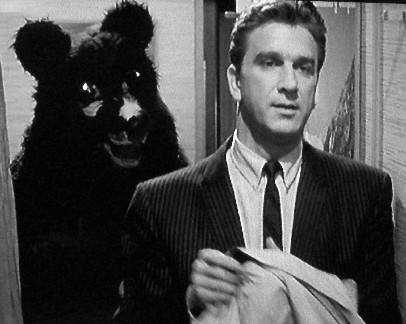
On a London street on New Year's Eve, an old man passes a computer tape filled with defense secrets to another man then tries to skulk away, but he's caught by a pudgy man in glasses (Eric Pohlmann) and quickly dispatched. The man with the tape (Hugh Latimer) and his lovely assistant (Aliza Gur) go to Leslie Nielsen, Latimer's old friend who now works as an airlines PR man, to get a flight to Paris to deliver the tape to the proper authorities. All flights are filled, but Nielsen gets them booked on a train chartered by a ski club, traveling with a fashion photographer as a cover. But the pudgy assassin kills Latimer and the photographer, leaving Nielsen traveling with Gur on the train which is ferried across the Channel--along with a bunch of drunken skiers and a man in a bear suit (pictured with Nielsen) who proves to be handy when Nielsen discovers that the assassin is on the train. There are other complications until the final tense chase at the French port of Dunkirk.

This hour-long black-and-white B-movie is a pleasant surprise. For a cheapie second feature, it's filmed in a remarkably stylish fashion, using the wide screen effectively, and has a very nice jazzy score that gives it a James Bond feel. Nielsen is no Bond, but makes an excellent hero, alternately befuddled and confident. Gur is a fine 60s fashion plate who may have a secret or two of her own. The train setting with the revelers and the bear reminds me of the climax of Trading Places. This movie has escaped critical attention (not listed in Halliwell or Maltin) but with its appearance on DVD, this might change. No buried gem, but with appropriate expectations, fun. [DVD]

Friday, May 27, 2011

THE GLEIWITZ CASE (1961)

Practically every review I've run across of this film says that it was ahead of its time, and it was. It's billed as a re-enactment of an historical event, but today a re-enactment tends to mean one of those rather awful documentary shows on the History Channel which have actors presenting the destruction of Pompeii or a Civil War battle, done with a low budget, bad script, and overbearing narration. This is artfully done; it does more than just follow the facts, but resists the temptation to make a melodrama with fully fleshed-out characters and big actor turns. The event is an attack on a German radio station in August of 1939, supposedly carried out by a Polish commando unit but actually staged by Nazis as an excuse to invade Poland--the action which started World War II. The main character is Nazi officer Alfred Naujocks (played by Hannjo Hasse) who masterminded the incident and who gave testimony about it after the war at Nuremberg. We watch as he collects six soldiers-in-training who have spent time in Poland and can speak the language, and prepares them for their mission. One of the men goes to the radio station, posing as an engineering troubleshooter, to scope out the place. A Polish prisoner (Hilmar Thate, pictured) is chosen to be a fall guy; complete with fake credentials, he will be left dead at the scene, supposedly one of the commandos killed by the SS when they respond to the attack.

There aren't any real surprises as everything goes pretty much as planned. We spend a lot of time with the prisoner (though I don't think he has any dialogue) especially in a long scene showing him being driven blindfolded to the radio station. There are no real character insights, though we do get a strange (and to my mind, misguided) flashback scene that seems to try to explain the character of Naujocks. The director, Gerhard Klein, has a keen visual sense, using lots of artfully composed close-ups and off-kilter shots, and though not a lot happens here in terms of narrative, the film is never boring (perhaps partly because it's very short, around 70 minutes). Very interesting and unusual. [DVD]

Tuesday, May 24, 2011

THE GOOD BAD GIRL (1931)

A tired old plot gets an uninspired turn around the block in this lifeless film. Mae Clarke is tired of being the kept woman of gangster Robert Ellis; she’s carrying on an affair with James Hall (at first, the two deliberately don’t exchange information about their lives, not even their names, à la Last Tango in Paris, but that interesting little kink is not explored). Ellis doesn’t want to lose her, especially when he kills a man and wants her to give him an alibi, but she refuses to and marries Hall. Ellis tries escaping to Philadelphia but is caught and goes to jail, but when headlines crop up connecting Clarke to Ellis, Hall, under pressure from his wealthy parents, leaves her. She has a baby which Hall's mother tries to take from her, then Ellis escapes from jail and vows revenge against Clarke. The climax which sorts things out is as predictable as everything else. Clarke is OK, but both of her men are drab, cardboard figures. The melodramatic story was done to death in the early 30s and is not presented in any interesting fashion here. The only fun in the film is the mild comic relief of Marie Prevost as Clarke's friend and Paul Porcasi as her gangster boyfriend. Prevost's best line, when asked if Ellis has gone to Philadelphia: "No one goes to Philadelphia unless they have to." [TCM]

Saturday, May 21, 2011

WESTERN PACIFIC AGENT (1950)

In a small California town, a thuggish hobo named Frank (known by reputation as the West Coast Kid) arrives and asks his father, kindly and respected storekeeper Joe, for another handout. Joe, fed up with his son's bad ways, refuses, so Frank splits and decides to get some cash another way: he murders Pops, a drawbridge operator, and Bill, a railroad paymaster, so he can get his hands on the payroll money. A railroad agent, Rod Kendall, comes to town to investigate. All he has to go on is a fingerprint and the knowledge that the killer has a nervous habit of chewing on toothpicks. Rod gets some help from town doofus Elmer, who can identify the killer, and from Bill's grieving sister Martha. Frank, in hiding in hobo camps and on railroad cars, finds out that because the serial numbers of the stolen bills have been released by the authorities, all that money is useless to him. It isn't long before Joe realizes that it's his son who is the main suspect, and soon everything is tidied up in a climax involving a shootout and a chase up the drawbridge.

This hour-long crime film sounds better in summary than it plays out. The plot is decent, the production values are mid-to-low B, and there is some clever dialogue here and there, but the acting is fairly weak, especially from the leads, Kent Taylor as Rod and Sheila Ryan as Martha (who, to be fair, is given almost nothing to do except marry Rod at the very end). The reason to watch is Mickey Knox (pictured) who gives a solid performance as the vicious, nervous Frank. Morris Carnovsky is good as the father, and Sid Melton is bearable as the sparingly-used comic relief character Elmer. This film actually has Knox say, "Come and get me, copper!" and "They'll never take me alive!" Best dialogue: when Elmer, collecting evidence in a notepad, asks a woman her name, she says, "None of your puny business!" As she walks away, he replies, "How do you spell puny?" That's as funny as it gets. [DVD]

Thursday, May 19, 2011

QUADRILLE (1938)

Carl, an American movie star (meant to be a Cary Grant/Errol Flynn type, I think) arrives for a quick press jaunt in Paris. He is met by Philippe, a newspaper editor, and Claudine, a writer for a New York paper and a good friend of Paulette, a famous actress with whom Philippe has been living for six years, and to whom he is on the verge of proposing marriage. The handsome Carl sweeps Paulette off her feet; they have a one-night stand after which he leaves, to return in two days. Philippe finds out and isn't quite sure what to think or do; Claudine makes a play for Carl herself; Philippe considers going ahead and marrying Paulette and making Claudine his mistress; Paulette makes a half-hearted stab at suicide, but, this being a romantic comedy, happy endings are in store for all, though not necessarily the ending an American audience will expect.

Sacha Guitry is a French actor, director and playwright, well known in his homeland, but not so known here, probably because he never came to Hollywood and didn't make any English language films. I was glad to finally have the chance to see a Guitry film now that Criterion has issued a 4-movie set. He wrote the film and plays Philippe, and, aside from seeming a bit too old for the part (he looks a good 10-15 years older than the other members of the "quadrille"), he does a fine job. But the real joy in watching this, in addition to witty dialogue and an occasional visual fillip, is in seeing how very differently things play out in this French film than they would have in a Hollywood film of the same era. No bones are made about the live-in relationship between Philippe and Paulette, and the fact that Carl sleeps with Paulette is equally crystal clear--he begins undressing her while she's on the phone with Philippe. The movie makes light of infidelity and suicide, and the ending, while not as unconventional as the other elements, probably would not have flown in America. The other actors, none of whom I'd heard of but all of whom are good, are Gaby Morlay as Paulette, Georges Grey as Carl, and Jacqueline Delubac as Claudine (pictured above with Guitry and Grey). I thought this was great fun, but most critics say this is the weakest film in the boxed set, so I’ll have to check the others out. [DVD]

Monday, May 16, 2011

DECISION BEFORE DAWN (1951)

A tense and complex wartime spy story, a bit different from the average spy film. In 1944, Richard Basehart, who was wounded in combat, has been assigned to an American intelligence unit headed by Gary Merrill. They're experimenting with a new strategy: recruiting German POWs to be parachuted back into Germany to bring back information. When some of the prisoners hold a kangaroo court and kill a German who had been making defeatist remarks (even though by this point, Germany was indeed clearly on the ropes), Oskar Werner, a friend of the dead man, volunteers for a mission, thinking that he can help his country by helping to end the war sooner and save lives. Another POW (Hans Christian Blech) also volunteers, for more mercenary reasons (money), and Basehart becomes the third man, the radio operator. Their mission is to get troop movement info that could help a German general who wants to surrender to the Allies. Once back in Germany, Werner uses an assumed identity to get access to an officer who knows the troop plans. He meets up with a sympathetic woman (Hildegarde Neff), but also soon realizes that an SS man is suspicious of him. After Werner is recognized by a family friend and finds out that his father is still alive, he has mixed feelings about his work. In the tense climax, all three men wind up on the run from the Gestapo.

Though Basehart is top-billed, this is Werner's show all the way and he carries it off very well, creating an interesting, three-dimensional character whom we care about but who is also ambiguous enough that we think he might conceivably betray his mission. It doesn't hurt that Werner (pictured above) is a handsome and charismatic actor. At times, the film reminded me of The Sound of Music: the Americans are stationed in a working French abbey complete with nuns all around, and near the climax, Werner and Basehart are discovered hiding in the shadows by a young boy who seems about to give them up to the Nazis. There is some inventive camerawork and excellent use of location shooting in bombed-out post-war Germany. This was nominated for the Best Picture award, but has been largely forgotten since, but it is worth searching out; it's on DVD as part of Fox's Heroes of War collection. [FMC]

Friday, May 13, 2011

GOODBYE GEMINI (1970)

Blonde twins Jacki and Julian (Judy Geeson and Martin Potter, pictured at right) arrive in London with their big teddy bear Agamemnon to stay at the house of an old family friend. When she’s not as accommodating as they’d like, Julian arranges for her to have a fatal accident on the stairs. With the house to themselves, they leap into the decadent lifestyle of swinging London, becoming part of a circle that includes a closeted gay politician (Michael Redgrave), a not-so-closeted gay art dealer (Freddie Jones), a young man of indeterminate sexuality named Clive (Alexis Kanner) and his supposed girlfriend Denise (Marion Diamond) who nevertheless starts flirting with Julian, who himself does some heavy-duty flirting with his own sister—if you find overtones of incest to be a “yuck factor,” this movie’s not for you. Julian is raped by two drag queens, and pictures are taken of the event. Clive tries to blackmail Julian with the pictures (he needs money to pay off a gambling debt), but Julian and Jacki kill him and separate to go on the run. Jacki, who thought they were just scaring Clive, is traumatized and wanders the streets where she is befriended by Redgrave who seems to genuinely care for her, but who also can’t afford to have his name attached publicly to a murder scandal. Meanwhile, where is Julian?

This is pretty much the definition of kinky, at least mainstream cinema kinky. In the beginning, it has some promise, feeling like a Shirley Jackson novel updated to the sexy, druggy 60s, but the narrative unravels quickly. The twins act like addled amoral children, talking frequently to the teddy bear and blithely unconcerned with the consequences of any of their actions. It’s not really worth doing psychological readings of the characters, though it does seem like Julian’s incestuous feelings are hiding his inner homosexuality. Sometimes the movie looks interesting (the 60s colors, some odd camera angles) and at least two of the supporting performances are worth seeing: Redgrave, who manages to give his character some shadings of depth, and Jones, who adds some much needed humor now and then. A stronger screenplay would have helped make this something more than just a period novelty. [DVD]

Monday, May 09, 2011

CHLOE (1934)

After fifteen years away, Mandy returns to the swamp near the Colonel's turpentine plantation seeking revenge for the lynching of her husband Sam (for which, as we find out, the Colonel wasn't actually responsible). Jim ferries Mandy and her mixed-race daughter Chloe down the river to Mandy's old shack which has been empty all this time--though Mandy, a voodoo practitioner who talks to animals, believes that a bat she finds in the shack is the soul of Sam. While Mandy plots her revenge, the mild-mannered mixed-race Jim falls in love with Chloe, but she falls in love with Wade, a white man who is works with the Colonel. (Wade meets her when he and Jim save her from an assault by a drunk who leers at her and says, "High yellow! That always was my meat!") The Colonel hears rumors of Mandy's plot but dismisses them, proclaiming that voodoo is just "a mixture of savagery, gin, mumbo-jumbo and drumbeats"--to which his niece replies, "Sounds like the menu at Sing-Sing!" Well, it turns out that Chloe is really the Colonel's daughter, originally named Betty Ann, whom he had assumed drowned in a tragic accident as a child--it was really Mandy's daughter who died, but Mandy took Betty Ann as her own and let others think it was Betty Ann who died). When all this is about to be revealed, Mandy kidnaps Chloe to use in a voodoo sacrifice. The presence in the woods of the drunken would-be rapist complicates matters; can Jim and/or Wade save our heroine?

That’s a lot of plot for a Poverty Row movie that doesn't even run an hour. Most of the film is rather laughable (even more laughable is that has a reputation as a horror movie simply because it involves voodoo), but the sexual and racial politics are interesting, to say the least. For starters, Chloe (pictured above) is played by a white actress, Olive Borden, which does make some sense given what we discover about her parentage. Jim is treated as a black man but looks as white as Wade (Reed Howes), his rival. In fact, the actor who plays Jim is the white Philip Ober (married at one time to Vivian Vance). That leaves Georgette Harvey, as Mandy, and Richard Huey, as the Colonel's servant, as the only black actors in major roles here. Jim's a nice, good-looking guy, and whenever he shows up, we hear the theme song, "Love is Calling You," leading us to believe that he and Chloe will wind up together, but of course when it comes out that she's white, we know that Wade will win Chloe's heart--by which time she's reverted to being called Betty Ann. The circumstances behind Sam's lynching remain unclear, I thought deliberately, but probably due to sloppy writing. As far as the acting, Ober does a nice job in an understated style. Harvey commands the camera, but overdoes the nutty revenge stuff a bit. There is almost constant background music, which grows irritating. Still, this is one of those loony bits of "underground" old Hollywood that needs to be seen to be believed. [DVD]

Saturday, May 07, 2011

MEN IN EXILE (1937)

An unofficial remake of the pre-Code melodrama SAFE IN HELL, this time with a male lead. Jimmy (Dick Purcell) is an ex-con taxi driver who gets shanghaied by some crooks into driving a getaway cab in a jewelry store robbery. After a clerk is killed, Jimmy knows the cops won't believe that he was forced into participating, so he escapes to a Caribbean island where he is beyond the laws of extradition. Smuggler Rocky Crane helps Jimmy get settled, but then wants Jimmy to help him run guns to the local revolutionary group and Jimmy refuses to join in. He gets a job at a hotel run by the crusty Mother Haines, and falls for her daughter Sally (June Travis), who is worried about Rocky's evil influences on her brother Danny (Alan Baxter). There's also Colonel Gomez, the ruler of the island, who thinks that Jimmy and/or Danny might know the names of the chief revolutionaries. Eventually, Rocky is busted on a gunrunning trip thanks to his wife Rita (Veda Ann Borg) who is sleeping with Danny on the sly. Rocky breaks out of jail and comes to kill Danny, but Danny kills Rocky instead. The political and the personal mix when Jimmy is arrested for Rocky's murder; Gomez doesn't seem to care all that much who gets executed for the murder, but he does still care about the shadowy rebels.

This is typical Warners B-movie fare for the time. The good news is that there is a fair amount of action and it's all over in just under an hour; the bad news is that the potentially interesting plot is rushed through. The interesting news (SPOILER!) is that the film ends with Jimmy able to stay on the island, not having to return to the States to make the case for his innocence, a far cry from the downbeat ending of the original, in which the main character was a prostitute charged with the death of a client. The unwholesome atmosphere of the original was one of its pluses; here, everything has been sanitized and questions of morality mostly simplified. The romantic leads are boring; Alan Baxter (pictured) shows some promise in his early scenes, but he isn't given much to do. Directed by John Farrow, Mia's father. Worth a look for B-movie fans. [TCM]

Wednesday, May 04, 2011

THE CAPTAIN HATES THE SEA (1934)

An odd little comedy-drama, a GRAND HOTEL-type story set on an ocean liner. The captain of the title (Walter Connolly) is actually a relatively minor character here; he does in fact hate his current job of running a cruise ship which always seems filled with pathetic souls trying to escape the bad circumstances or boredom of their own lives--except for the articulation of this pessimistic philosophy, Connolly is mostly comic relief. Among the passengers: John Gilbert, an alcoholic writer who has given up on Hollywood (think F. Scott Fitzgerald) and is trying to dry out and get a start on a novel; former cop Victor McLaglen who is after fellow passenger Fred Keating who is in possession of some stolen bonds; John Wray, a well-to-do man who is upset with the gossip about his wife (Wynne Gibson) who was formerly known for her loose morals; Akim Tamiroff, a South American revoluntionary; Helen Vinson, a librarian who flirts with both Gilbert and Keating, but who is ultimately revealed to be Keating's partner in crime (though she wants the bonds more than she wants Keating); and Alison Skipworth as a brassy old broad who also happens to be filthy rich. Everyone crosses paths with everyone else, including the comic relief crew members Leon Erroll as the steward who is always pissing off the captain, and Walter Catlett as the bartender, who eventually becomes chummy with Gilbert, who begins drinking again almost as soon as the ship leaves the dock.

Most of the storylines aren't terribly compelling, but the actors all give good performances. Vinson, Skipworth, and Catlett are always fun and don't disappoint here. I'd never heard of Keating before; this was his first film and he only made a handful more, mostly B-pictures. He's fairly handsome and does a nice job here. I've never been a huge McLaglen fan, though he's excellent in John Ford's THE INFORMER, and he's OK in what amounts to the second lead--though he's actually billed above Gilbert (both pictured above). Truly, the reason to watch this film is Gilbert, in what was his final film before succumbing to his real-life alcohol problems and dying of a heart attack only two years later at the age of 38. Gilbert is excellent, underplaying the kind of role that John Barrymore overplayed in GRAND HOTEL; the character knows he's more or less been licked by life, but he accepts his fate quietly and stoically and even with good humor. The only real surprise in terms of plot is the outcome of Tamiroff's story, and once that happens, the other stories take rather predictable turns. Still, this is a must-see for Gilbert fans. [TCM]

Tuesday, May 03, 2011

WHEN WERE YOU BORN (1938)

On a ship about to arrive in San Francisco, astrologer Anna May Wong does a quickie horoscope reading for passenger Lola Lane and predicts that she will have good luck; she promptly wins the shipboard lottery. The message isn't so good for James Stephenson: he only has 48 hours to live. Sure enough, a day later, Stephenson, a wealthy importer of exotic goods, is found dead in his apartment. It appears to be a suicide but the cops soon discover it was murder, and they ask Wong for help in the investigation. The suspects include his fiancée Margaret Lindsay (who is also an old college pal of Wong's), his butler, his business partner, and the man that Lindsay was actually in love with (Anthony Averill), all of whom were in the apartment at one time or another the night of the murder. Wong goes about asking everyone when they were born, and from that she is able to spin a remarkable amount of information. Drug smuggling and bad investments play parts in possible motive theories. Wong tells the cops that two more people will die before the killer is found, and that's what happens.

This is a fairly routine B-mystery, worth seeing for its two novelties: the astrology angle and the appearance of Anna May Wong, Asian-American actress of the 20s and 30s who has become something of a cult star. She has the lead role, though she unfairly gets only second billing to Lindsay. The film opens with a short lecture by occult philosopher Manley P. Hall about the astrological signs--I'm guessing that horoscopes weren't quite as solidly a part of pop culture then as they are now. The predictions Wong makes based on birthdays and birth hours are, of course, always right, but also always ridiculous; she's like Sherlock Holmes, except instead of noticing physical and psychological details, she notices what sign the moon was in when a suspect was born. Her consistent correct predictions get tiresome, and honestly, Wong gives a rather lifeless performance, but it's still interesting to see her in a leading role. Charles Wilson does a nice job as the inspector, who becomes a convert to Wong's ways a little too easily, Jeffrey Lynn plays a reporter, and John Ridgely, a personal favorite B-actor, has two lines as a cop who calls in a tip which ends up helping to break the case open. [TCM]

Sunday, May 01, 2011

SECRET CEREMONY (1968)

Mia Farrow is a waifish young girl whose mother has recently died, leaving her alone in a large house in London, theoretically in the care of two aunts whose idea of care is to visit her occasionally and steal knick-knacks. One day on the bus, Farrow sees Elizabeth Taylor, a lonely, high-class prostitute who bears a resemblance to Farrow's mother. Taylor has her own sorrow, having lost her daughter through an accidental drowning. Farrow follows Taylor around like a puppy, insisting that Taylor is her mother. When she sees how the girl lives, Taylor takes on the persona of the mother; at first, she seems inclined to behave like the aunts and steal some of Farrow's riches, but soon she begins to feel real compassion for her, as though they truly were mother and daughter. Soon, however, Farrow's possibly incestuous stepfather (Robert Mitchum) arrives, to seduce (or re-seduce) Farrow, and maybe Taylor while he's at it. Eventually, Farrow claims to be pregnant--with Mitchum the presumed father--but Taylor discovers that she has been stuffing a doll in her dress to look as though she was with child. What happens in the last 15 minutes results in two deaths and allows the murderous survivor to get away scot free.

This is a crazy movie, not quite camp, which might have worked better as a play. Farrow and Taylor are incredibly mannered in the first 20 minutes or so (much of which plays out with very little dialogue), the fault I assume of the director, Joseph Losey, who may have felt he was doing something avant-garde; if this was made today, it wouldn't be a star-driven film but a moody independent film (with a pre-jail Lindsay Lohan and a post-"Single Man" Julianne Moore, maybe). The movie looks great, with interesting use of color and good sets. Unfortunately, the bizarre acting and confused plotting work against this as effective entertainment. For 60s film buffs only. [TCM]

Friday, April 29, 2011

CHASING YESTERDAY (1935)

Sylvestre Bonnard, an old archeologist who still teaches at the University, lives a quiet life, surrounded by his beloved old books and tended to by his cranky but loving housekeeper Therese. His one regret is that he never married his childhood sweetheart, Katharine, now dead. When M. Coccoz, a penniless door-to-door bookseller, arrives, Bonnard helps him out by buying his entire suitcase full of books, and he tells Coccoz of his attempt to find a long-lost book from his youth, "The Golden Legend." He still cherishes a short love note Katharine wrote to him on a torn-off corner from a page of the book, and Coccoz's visit motivates Bonnard to head back to his hometown to find the book. It turns out to be missing from the family library, but he does meet Katharine's teenage daughter, Jeanne, who lives a miserable life feeling oppressed by M. Mouche, her guardian, and Mlle. Prefere, the uptight headmistress at the school where she is being trained to be a teacher. Bonnard sets out to brighten the girl's life, ultimately hoping to adopt her, but he is stymied by Mouche and Prefere. The guardian agrees to sell him the right to raise the girl, but Bonnard will have to sell all of his old books. The sale doesn't go as well as expected, but a return visit from Coccoz, who has found "The Golden Legend" and a secret about Mouche, winds up giving Bonnard the upper hand.

This potentially interesting storyline is let down by slow pacing, a dreary and repetitive musical score, and lack of characterization. As Bonnard, O.P Heggie (the hermit in BRIDE OF FRANKENSTEIN) looks like Frank Morgan as Prof. Marvel in THE WIZARD OF OZ, but doesn't have the playful spark that Morgan would have had. Etienne Giradot, as Mouche, also lacks any real presence, so their conflicts play out in lackluster scenes. However, there are some good performances to save the day. Anne Shirley (pictured with Heggie) has personality to burn as Jeanne, Helen Westley is quite amusing as the housekeeper, and Elizabeth Patterson does a nice job as the headmistress, who blooms under Bonnard's attention, thinking briefly that he is romancing her. Also with John Qualen as Coccoz and Trent Durkin as a young man who catches Jeanne's fancy. One of a number of films from the 30s with senior citizens as lead characters (though Heggie was only 59, he looks considerably older and in fact died the next year). [TCM]

Sunday, April 24, 2011

THE KING OF KINGS (1927)

Hollywood movies about Jesus Christ are usually epic films which wind up, perhaps because of too much concern for reverence, being rather slow and dull. This early silent telling of the last days of Jesus, directed by Cecil B. DeMille, is reverent but compelling. It begins, oddly, with a royal banquet at which the courtesan Mary Magdalene is irritated because her current favored lover Judas Iscariot is missing--seems he's been swept off his feet by some carpenter from Nazareth. She saddles up her zebras (I kid you not; they’re gifts from some Nubian prince) and heads out to break up the apostles' meeting. When we first see Jesus, he is curing a little blind boy (the future Gospel writer Mark), and we don't see Jesus' face until the boy does, appearing out of a fog as his eyesight returns. Judas is a would-be kingmaker, interested in Jesus as a political figure; he tells Jesus that he should tend to the rich and mighty to curry favor instead of to the powerless poor. When Mary shows up, Jesus exorcises the Seven Deadly Sins right out of her (each sin personified as a ghostly figure). For his part, Judas thinks that any of Jesus’ followers should be able to perform miracles, but when he tries to cure a “lunatic” boy, he has no luck until Jesus takes over the task. The rest of the film pretty much conforms to the familiar Gospel narratives: Peter finds a fish with a gold coin in its mouth which is used for payment of back taxes; Jesus brings Lazarus back from the dead (a scene with a horror-movie feel--pictured below--as a wrapped-up body rises up from a slab and slowly unwraps itself), stops the stoning of Mary Magdalene, and rages against the merchants at the temple; Judas betrays Jesus to the high priests. There is no suspense since we know the rest of the story by heart, and the film builds up to the Crucifixion, with its thunder and lightning and earthquakes, followed by a brief Technicolor sequence of the Resurrection and Jesus' appearance to the apostles.

The movie looks beautiful, in a Sunday-school kind of way, like a bunch of vintage Bible illustrations come to life. There’s a nice scene in which Caiaphas plunks out thirty pieces of silver for Judas, and a beautiful shot after the Last Supper showing a glowing chalice with a soft-focus dove flitting around it. Soft focus is the de facto means for showing Christ’s divinity--he is usually seen with a luminous glow about him. H.B. Warner plays Christ as passive but not a wimp, just someone who is for the most part resigned to his fate. At almost 50, he was too old for the part, especially when we see him with his mother, played by Dorothy Cumming who was not yet 30, but he does look a lot like the Jesus of old Bible cards. Joseph Schildkraut, as Judas (pictured above with Warner), almost steals each scene he's in, a bit like the same character is a scene-stealer in JESUS CHRIST SUPERSTAR. The Criterion restoration has a lovely newly-written score which is mostly unobtrusive and appropriate. Though I like the modern KING OF KINGS for its epic feel (and the handsome Jeffrey Hunter), this movie is the one to beat for good old fashioned religious moviemaking, with just enough of the secular (the scantily-clad Mary Magdalene) to keep things interesting. [DVD]

Saturday, April 23, 2011

5 AGAINST THE HOUSE (1955)

Four college buddies (2 Korean War vets, played by Guy Madison and Brian Keith, class clown Alvy Moore and studious Kerwin Matthews) take a quick trip to Reno where law student Guy Madison tries out a system for winning which fails, but the four witness a botched robbery attempt. Back on campus, Madison devotes his attentions to his girl friend, nightclub singer Kim Novak, and Keith tries to overcome his hair-trigger temper, exacerbated by his war experiences. But when they get hit by the "mid-semester whim-whams," Matthews, inspired by their Reno visit, comes up with a foolproof system for robbing the casino. He gets Keith and Moore involved, promising to pull it off as a spring break experiment, intending to give the money back. Madison and Novak go along for the ride, unaware at first of the plans for the heist, but by the time they get to Reno, Keith has gone a little bit nuts and insists at gunpoint that they all go along with the plan, and keep the money once they get it. Of course, the heist doesn't quite go as planned. Though released as part of a film noir set from Columbia, this isn't noir at all, it's a straight-ahead crime caper, with the added twist of college kids (albeit very mature looking kids--most of the actors were in their 30s, with Matthews the youngest at 29) and a crazy war vet being the protagonists instead of career criminals looking to pull off a last big job. The heist actually takes second place to characterization, and the planning is more exciting than the actual crime. All the actors are fine, though Madison, meant to be the central character, winds up the least interesting of the four guys--most surprising is Alvy Moore, best remembered as Hank Kimball on Green Acres, who is a solid comic relief sidekick. The very young Novak (pictured) is lovely, though the film might have been leaner without her character, who has little bearing on the film. [DVD]

Thursday, April 21, 2011

THE MISSING JUROR (1944)

[Spoilers included] A train hits a car which we saw being rolled onto the track; the dead man in the driver's seat was a juror in the infamous Wharton murder trial in which a jury found Wharton guilty, but just hours before he was to executed, someone confessed that Wharton had been framed. He is freed but soon has a nervous breakdown, is institutionalized, and kills himself by setting his room on fire. Now, it appears as if someone is avenging Wharton by killing off the jurors; the man in the car is the fourth to wind up dead, with a fifth reported missing. Reporter Joe Keats investigates, and interviews juror Alice Hill, an interior designer, and Jerome Bentley, a foreign gentleman with a fancy beard and heavy accent. Joe develops a thing for Alice, and when another juror is found dead, Joe digs deeper. The mysterious Bentley claims he knows who the killer is, and agrees to arrange a meeting with Joe and the killer in a steam room, but instead Joe winds up trapped in the room and almost boils to death. Of course, [1st Spoiler] the killer is Bentley, but [2nd spoiler] Bentley is actually Wharton, who faked his death in order to pull off this revenge. Meanwhile, Bentley/Wharton is setting a trap for Alice; can Joe get the cops to believe his theory in time to save her?

This B-mystery is generally fun, even though the Bentley/Wharton subterfuge should be crystal clear to any viewer from early on. Part of the problem is that George Macready, who plays the part(s), is too distinctive in looks and accent to be hidden behind a beard and monacle. An early edition of Halliwell's film guide says this is part of Columbia’s "I Love a Mystery" series, but it's not, even though the reporter is played by Jim Bannon, who was the lead in that series (and Macready also appears in the first film). For a B-lead, Bannon suffices--he's breezy and confident--and the whole thing moves at a quick pace. Janis Carter is fine as the femme lead and Jean Rogers steals a scene or two as her assistant, a perky gal from Texas. You may recognize wrestler Mike Mazurki in a small role as a masseur. [TCM]

Saturday, April 16, 2011

VICKI (1953)

This noir melodrama tries hard to conjure up comparisons to the classic film LAURA, and even if it can't quite live up to that, it's still an enjoyable little movie. The stylish opening scene shows billboards featuring the model and singer Vicki Lynn (Jean Peters), who seems to be the rage of New York and, as we learn later, was about to head out to California for an acting job; as a "Laura"-like theme plays, we see the police taking her dead body out of her apartment. Richard Boone is a cop who is determined to find her killer. As in LAURA, we learn Peters' story in flashbacks. There are several suspects including Peters' sister and roommate Jill (Jeanne Crain), an actor she had dated (Alex D'Arcy), and a columnist (Casey Adams) who wrote about her frequently, but Boone is certain that the killer is her PR man (Elliott Reid) who discovered her as a waitress at a late-night diner, worked hard to get her modeling career off the ground, and was about to be left with a broken contract when she decided to leave New York. However, the plot thickens with two developments: 1) the seedy telephone operator at Peters' apartment building (Aaron Spelling) took a powder after the discovery of her body; 2) Reid finds out that Boone had been unnaturally obsessed with Peters, spying on her when she was a waitress and having turned his apartment into a shrine to her. I will admit I was surprised at the final solution.

With all the controversy about what constitutes film noir, I'm inclined to take the view of Justice Potter concerning pornography: I may not be able to define it, but I know it when I see it. This movie, with its focus on sexual obsession, fatalism, conflicted characters, and the night world, feels a lot like noir to me, even if it seems too brightly lit to fit the visual noir mold. The B-ish cast works well, especially Peters and Reid; Crain (pictured above to the left of Peters), playing a good girl, is bland, and Boone wildly overdoes the obsessed cop bit, harshly screaming at people right and left. He almost leers at Reid when he tries to break him and calls him "pretty boy," which gives his character a delightful little sex-kink subtext. I liked Carl Betz, who gained fame as the husband on The Donna Reed Show, as a darkly handsome cop, and it's fun to see Spelling (long before his TV tycoon days) as a geek. Technically this is a remake of the Victor Mature/Betty Grable film I WAKE UP SCREAMING, but clearly it was trying to ride a LAURA vibe at the box office. [FMC]

Thursday, April 14, 2011

HIGH WALL (1947)

Dorothy Patrick works for Herbert Marshall, a publisher of religious books, and is also his mistress, even though she has a husband (Robert Taylor) who hasn't yet returned from the war (an injury required brain surgery and he still isn't fully recovered). However, Taylor comes home unexpectedly and catches Patrick at Marshall's apartment. He goes into a rage, blacks out, and wakes up with his wife's dead body next to him. After he drives himself and her body off the road and into a creek, he confesses to murder, even though he doesn't actually remember what happened. At a psychiatric hospital, his doctor (Audrey Totter) discovers his current problems are due to a blood clot, so he has another operation. Totter takes a personal interest in his case, even temporarily adopting Taylor's son to keep him out of state care. She talks him into undergoing "narcosynthesis," in which he is given sodium pentothol (a "truth serum") to uncover his memories of what happened during his blackout. Soon they discover what we figured out a long time ago: Marshall killed her and framed Taylor. Taylor breaks out of the hospital, with some help from Totter, and goes after Marshall in an archetypal film noir manhunt through rainy night streets.

This is a fairly solid film noir in the tradition of THE BIG CLOCK or PHANTOM LADY in which a man has to clear his own name by hunting down a killer. The noir visuals are nice, especially an atmospheric scene in a church late in the film. The wooden Taylor is the weak link, but luckily the other actors compensate. Marshall (reminiscent of the Charles Laughton character in THE BIG CLOCK) is good as the respectable bad guy who is desperately trying to cover this tracks; the best scene in the movie involves his startlingly sudden murder of a janitor who has figured out the score and is trying to blackmail him. Totter (pictured above), whom I liked so well as a femme fatale in TENSION, is also fine, though she's more fun when she's bad. Some familiar faces in the background include John Ridgely, Warner Anderson, and H. B. Warner. [TCM]

Sunday, April 10, 2011

PARRISH (1961)

Another Troy Donahue/Connie Stevens movie from the Warner Bros. Romance Collection. This one is a family saga with Donahue as the title character, a teenager who moves with his mother (Claudette Colbert) to Connecticut tobacco country so she can take a job as a companion to the daughter of tobacco farmer Dean Jagger. Jagger doesn't trust the good-looking lad around his spoiled girl (Diane McBain), so Donahue finds work in the fields and lodgings with the family of fellow worker Connie Stevens. He and Stevens begin dating, though she continues seeing her steady boyfriend, but soon Donahue is also "dating" McBain. Colbert falls for and marries Karl Malden, a big shot tobacco farmer and something of a rival of Jagger's. Stevens gets pregnant by one of Malden's married sons (Hampton Fancher, pictured), McBain marries another of Malden's sons, and Donahue, after a stint in the Navy, returns to Connecticut and works for Jagger, helping to fight the unscrupulous Malden in his attempt to snatch up all the farming land, with poor Colbert torn between the two. The plot keeps bouncing back and forth between the sex and tobacco plotlines, and there seems to be plenty of material there for a TV series. Donahue, though undeniably handsome, looks puffy and soft and not at all the kind of guy who has the backbone to stand up to everyone around him, though I will say his best scene is a verbal confrontation with Fancher over Stevens' honor. Colbert's heart isn't in this, her final film role (though she appeared in a TV-movie 25 years later); though most of the young men and women playing family members of the warring clans are OK, the best acting is done by Dean Jagger. If you enjoy the glossy, well-produced soap operas of this era, you'll like this, though I think it would have been better with someone other than Donahue as the focus of the story. [DVD]

Thursday, April 07, 2011

QUIET PLEASE, MURDER (1942)

A mild-mannered bespectacled man (George Sanders, at right) chats with a librarian in a rare book room at the New York Public Library while admiring a rare copy of Hamlet that's on display. But Sanders isn't as mild as he looks: he guns down the librarian, smashes the glass case, and steals the book. He's a world-class forger who makes copies of stolen rare books and sells them on the black market. The glamorous but aloof Gail Patrick is his fence; she sells one of the Hamlets to the German Sidney Blackmer, who collects rarities for the Nazis, but he finds out it's a fake and wants his money back. Enter square-jawed all-American detective Richard Denning who is hot on Patrick's trail for a different client. She agrees to help him expose Sanders if he'll protect her, but then she double-crosses Denning by telling Blackmer that Denning is the forger and she arranges a confrontation at the library one night just before closing. That night, Denning, Blackmer, and Patrick go to the library, but Sanders has a trick in store: he shows up with a bunch of his cohorts claiming to be policemen, hoping to get rid of both Blackmer and Denning and steal a few more rare books while he's at it. At closing time, a shot rings out, a man is killed, and Sanders and his fake cops keep everyone in the building even as an air raid blackout is called. The rest of the film consists of cat-and-mouse games played in the dark building between Sanders and Denning. We're never quite sure who Patrick feels loyalty to, and the presence of a mute thug, a prissy air-raid warden, and a lovely young librarian with a GI fiancé complicate matters.

This little-known B-mystery is quite interesting and unusual, for its setting and for its psychological discussions. As a library worker myself (at a reference desk and in cataloging), I liked the setting; for a B-movie, the library sets are convincing, though they're not elaborate enough to be stand-ins for the real and very impressive New York Public Library. At one point, the librarian (Lynne Roberts) gives Denning a little lecture explaining the Dewey Decimal System, and near the end, a Dewey call number winds up being a major clue to the whereabouts of the stolen books. But more interesting are the conversations between Sanders and Patrick about their particular kink: sado-masochism. Sanders claims they are both, psychologically speaking, "a couple of horror shows" who find "pleasure in fear and pain," searching out situations which could lead to terrifying results. When Patrick slips up, Sanders insists it's her conscience deliberately putting her in harm's way. In a strange moment near the end, Sanders seems almost sexually excited about the possibility of getting the death penalty. Sanders also says that Blackmer is a sadist, though that plot thread is unexplored; perhaps just his ties to Nazis are supposed to be enough to prove that claim.

Actingwise, the movie belongs to Sanders and Patrick, with Blackmer holding his own. Denning, though a serviceable B-film hero, is out of his league; someone like Bogart or Alan Ladd would have given the movie even more of an edge. The ending has a Maltese Falcon feel, with Denning uncertain about whether or not to give Patrick up. He doesn't, but of course the Production Code steps in and has fate take a punishing hand. The WWII blackout setting is unusual; most air raid scenes in movies are set in London, though U.S. cities did indeed have blackout air raids. At the conclusion, there is a brief propaganda spiel about American soldiers and the girls they've left behind on the homefront. This film is hard to find, but it's worth catching on Fox Movie Channel. [FMC]