Thursday, January 31, 2013

THE SEARCH FOR BRIDEY MURPHY (1956)

In the 50s and 60s, there was a lot of interest in Edgar Cayce, known as the "Sleeping Prophet," a psychic who would go into a hypnotic trance and produce proto-New Age teachings on metaphysical topics. In conjunction with this craze, a man named Morey Bernstein published a book in which he claimed to have used hypnotism to send a neighbor back into a past life as a woman who lived in 19th century Ireland named Bridey (Bridget) Murphy. This film is a dramatization of the book, though using the word "dramatization" may be a bit of a stretch, as this mostly consists of scenes of Bernstein putting the woman (here named Ruth Simmons) into a trance on a suburban living room couch; he asks her questions; she, with eyes closed, responds; and we see misty flashback recreations—without spoken dialogue—of Bridey's rather uneventful life. The movie starts with the actor Louis Hayward as himself, strolling around the set and delivering a prologue explaining that they aren't making any reality claims for the story we're about to see. His character is a suburban businessman who has no interest in hypnotism until he sees someone at a party use hypnotism as a parlor trick. Hayward studies hypnotism and, though he himself is not susceptible to it, learns to use it on others. Soon he puts his neighbor (Teresa Wright) into trances, takes her back to her childhood and beyond, to her previous life as Bridey. Nothing much happens to Bridey: she falls in love with a young man named Brian, marries him, grows old, and dies, though she is able to give Hayward the names of people and places she knew and a brief description of the afterlife—she also speaks in an Irish brogue while in trance.

Aside from a brief debate among psychologists and religious leaders about the implications of Wright's experience, there are really only two dramatic complications. One is when Wright's husband (Kenneth Tobey, hero of the original THE THING FROM ANOTHER WORLD) begins objecting to the hypnosis sessions—he is talked into letting them continue. The climax of the film comes about when suddenly, Hayward can’t bring Wright out of her trance. As befits this rather passionless film, the suspense lasts about a minute. An online critic calls this a cross between a radio play and a stage play, and that's about right, though it also feels like a 50s TV drama. Wright does the most she can without going over the top in her trances. James Kirkwood Sr., father of the co-author of A Chorus Line, plays the older Brian in the trance visions. [Netflix streaming]

Tuesday, January 29, 2013

DARK CITY (1950)

Cops raid a bookie joint and though the head of the operation, an unhappy WWII vet (Charlton Heston), escapes, he's pissed off because he believed he was paid up on his protection money. His cronies (the older Ed Begley, the cocky Jack Webb, the slow-on-the-uptake Harry Morgan) are left high and dry, and they wind up engaging a traveling salesman (Don DeFore) in a rigged poker game; the first night, they lose to him to build up his confidence, only to fleece him the second night. Because the money he lost belonged to his company, DeFore kills himself. Soon, Begley is found hung in his apartment, an apparent suicide, but a police captain (Dean Jagger) thinks it was murder, and sure enough DeFore's brutish and mentally ill brother is on their trail, trying to pick off the players one by one.

This is a solid film noir, though Heston, in his big studio debut, is a little lightweight for a noir hero. We get some gloomy backstory (he was court-martialed for accidentally killing his best friend in a fight over Heston's wife, from whom he is now divorced) and he feels conflicted about the crooked poker game in the first place, but he never really seems to be in great moral turmoil, though he does go to DeFore's widow to help her out financially. Lizabeth Scott (pictured with Heston) as Heston's squeeze, a nightclub singer, doesn't have a lot to do, but she does a nice job with her songs, including "I Don’t Want to Walk Without You." The supporting cast is great, with Webb in particular doing a nice job in a role that is 180 degrees away from his best-known part as Joe Friday on Dragnet—and of course Harry Morgan was not only his co-star here but also in the 1960s incarnation of Dragnet. DeFore was mostly known for light comedy but is surprisingly good in a serious turn here, and Viveca Lindfors is fine as his widow. There are a number of good setpieces, including the opening raid, the foggy nighttime streets that evening, and the chase and fight at the climax, but Begley's paranoid scene just before his murder is exceptional, and reason enough to watch the film.  [DVD]

Thursday, January 24, 2013

LOVE NEST (1951)

Soldier William Lundigan returns to New York City to find his wife (June Haver, pictured at left with Lundigan) has used their nest egg to buy an apartment building that's falling apart. She knows he wants to write a novel about his experiences in Paris ("What's the name of that restaurant where the existentialists don’t hang out?"), but he winds up spending all his free time fixing up the apartments and dealing with the tenants, including Frank Fay, an older man who says he is an estate evaluator but who is actually a serial swindler of widows, now at work on another lonely tenant (Leatrice Joy). Then along comes an old Army buddy of Lundigan's, a busty WAC (Marilyn Monroe) of whom Haver becomes immediately jealous, though Monroe seems more interested in another one of Lundigan's friends  (Jack Paar). Plot complications ensue, including: 1) the arrival of a federal agent looking to bust Fay for his past misdeeds even though he insists he's found real love with Joy; 2) an attempt to re-wire the entire building before it gets condemned; and 3) an incident in which Lundigan spends the night in Monroe's apartment—innocently, of course, though Haver doesn't see it that way. 

This is a cute sitcom-ish movie with a perfectly pleasant couple at the center, one plus being that neither Lundigan nor Haver is the traditional wacky/screwball type. The film does have an odd little edge, provided by Fay who plays the swindler in a low-key fashion, keeping us off balance about his real agenda: Is he sinister? Is he just lonely? Does he really love Joy? And when he offers the couple the money to fix the wiring, will he really come through? The ending is almost downbeat, saved by a clever epilogue. Fay was at one time married to Barbara Stanwyck, had his career almost derailed by alcoholism, and is best known for originating the lead role in HARVEY on Broadway (taken in the movie by James Stewart). He only did a handful of movies, so it's worth seeing this film just to catch one of his performances. It’s also interesting for other supporting players:  Monroe before she became a leading player, Paar before his TV hosting days, and Leatrice Joy (who was married in the 20s to John Gilbert) long after her silent film career. Cute and a little strange. I liked this odd exchange: Monroe, paying rent money to Lundigan: "It seems strange giving money to a man you know"; Lundigan: "I bet it does." [FMC]

Wednesday, January 23, 2013

A TRAGEDY AT MIDNIGHT (1942)

The police are irritated at radio sleuth John Howard who continues to make them look like fools by putting together clues to unsolved crimes and announcing the guilty parties on the air, so the police commissioner assigns Roscoe Karns to get some dirt on him. The next morning, Howard wakes up to find not his wife (Margaret Lindsay) but a female corpse in his bedroom. The body is that of a former actress who lived in Howard's apartment building and was friendly with another neighbor, a doctor (Miles Mander) and his wife. With the cops on Howard's trail (though Karns doesn't think Howard is guilty), Howard and his wife do some digging around and find out that the actress had another apartment, taken under a different name, and possibly had a couple of mystery men in her life, who might now be after Howard, along with the cops. Can Howard and Lindsay, with the help of houseboy Keye Luke, find the killer before the killer finds them?

This was obviously an attempt by the low-budget Republic Studios to start its own "Thin Man" series—Howard calls his wife "Mommy" and Lindsay complains about the low-lifes they wind up hanging out with; the surprise is that it almost works. The production values are considerably higher than for the usual Republic film of the era: well-appointed sets, good acting, solid direction and cinematography.  Howard (Cary Grant's rival in THE PHILADELPHIA STORY) makes a fine B-movie William Powell; Lindsay is OK, though she tries a bit too hard. Keye Luke is also good, though he has to do some silly dialect stuff (turning his "R"s into "L"s); he calls himself "smart China boy" and gets off one of the better lines: after seeing the dead woman, he tells Howard it's too bad they killed a beautiful woman when there are so many ugly ones in the world (not PC, but I chuckled). The film falters in its writing: the story gets muddled quickly, and the identity of the killer is fairly obvious. But the movie never slows down and the action scenes are pulled off nicely (especially the finale at the radio studio).  It's too bad Howard didn’t get to play the character, Greg Sherman, again. [Netflix streaming]

Monday, January 21, 2013

LOVE AND PAIN AND THE WHOLE DAMN THING (1973)

What was it about the early 70s and doomed romances?  This film is like a less eccentric HAROLD AND MAUDE which turns into LOVE STORY. Timothy Bottoms is a shy, aimless, asthmatic college-age kid from a rich family whose father, a Pulitzer-prize winning historian, sends him on a cycling tour of Spain one summer, hoping he'll find himself. His asthma keeps him constantly catching up with the other cyclists, so he impulsively quits the group and hops on a bus tour where he sits next to Maggie Smith, a plain-looking woman probably near 40—she lives with aunts and older boarders, as we learn in a very amusing phone call—who whistles tunelessly to herself and reminds me of an older, less neurotic version of the Julie Harris character in THE HAUNTING. He's sweaty and wheezing and is responsible for getting a melted Almond Joy bar stuck to Smith's ass, but over a few days' time, the two become friendly. After a drunken night at a bar, he makes an ill-timed pass at her but they remain friends. We know something is wrong with her because she has spells of slurred speech and takes brightly-colored pills, and one night she tries, rather half-heartedly, to commit suicide. After their relationship becomes sexual, Bottoms rents a car and trailer and talks Smith into leaving the bus tour and motoring about with him. After some misadventures (including her brief flirtation with a Spanish duke who lives in a small castle), he proposes to her and she tells him she's dying of some fatal disease. Will they make the most of the time they have left together or are they too afraid to make a go of it?

I had my doubts in the beginning—Bottoms seems too mannered to be a believable character and Smith has too much spark to really come off as a dowdy spinster—but eventually the film works. Smith is amusing and it's fun to watch her being won over, bit by bit, by the charming and vulnerable Bottoms—he comes off a bit like a continuation of his character in THE LAST PICTURE SHOW. The film's tone is a little wobbly; despite an underlying seriousness, many scenes are funny, though rarely laugh-out-loud so, and the film is at its best when it's being light. The last 10 minutes are almost disastrous; it's like the movie was running too long and they just chopped a 20 minute conclusion in half, so the ending, though satisfying plotwise, is very unsatisfying in the way it plays out. The photography of the Spanish countryside is lovely and director Alan Pakula displays some stylish moves now and then. [DVD]

Friday, January 18, 2013

CAPTAIN JOHN SMITH AND POCAHONTAS (1953)

This would-be historical epic, made on a budget way too low to provide any epic qualities, begins with Captain John Smith (Anthony Dexter), one of the founders of the Jamestown colony in Virginia in 1607, telling his story to King James I. Smith's men are at odds with Wingfield (James Seay) and his followers, who are out for private glory and gold rather than settling a new land, so Smith is accused of mutiny and held on board a ship headed back to England. He manages to escape, swims to shore, and witnesses a band of Indians preparing to attack. Smith blames Wingfield's brutal treatment of them for the attack, but he joins Wingfield in fighting the Indians off, though they wind up with few supplies. Smith takes two men, Rolfe (Robert Clarke) and Fleming (Alan Hale Jr.), and sets out to make peace with the Indian chief Powhatan (Douglass Dumbrille). They have a friendly encounter with Powhatan's daughter Pocahontas (Jody Lawrence) while she's bathing in a pond, but Powhatan still decides to kill the white men. As Smith is about to be beheaded, Pocahontas throws herself on Smith and begs her father to spare his life. Powhatan agrees to, but Smith must marry Pocahontas in order to cement the peace between the Indians and the settlers. Back in Jamestown, Pocahontas teaches the British how to live off the land; meanwhile, Wingfield's men find gold and plot to keep it, leading to tensions with Smith's men and the Indians. After some action involving gold and weapons, Smith goes back to England, and Pocahontas stays in Jamestown, having fallen in love with Rolfe.

This plays like a dramatized documentary that I might have seen back in elementary school in the 60s. The actual events are, I'm guessing, simplified and/or fictionalized; the sets are adequate; the acting is all over the place. Dexter (pictured on the right with Seay on the left) is wooden; Dumbrille seems to be trying for threatening but dignified, though he often just seems constipated; Seay—who I know as Kris Kringle's doctor in MIRACLE ON 34TH STREET—is sufficiently schemey-evil but not very energetic; Hale (the Skipper on Gilligan's Island) is cheery and hearty in his few scenes; Lawrence barely registers at all. Best is Clarke who is far more appealing than Dexter—it's a shame the movie didn't center on him. Directed by Lew Landers, an old pro at B-movies, with little visual flair. This movie doesn't crop up much, though oddly it is out on a burn-on-demand DVD. Even though it's not a particularly good film, I’m thankful that TCM aired it last Thanksgiving week. [TCM]

Wednesday, January 16, 2013

PRIVATE HELL 36 (1954)

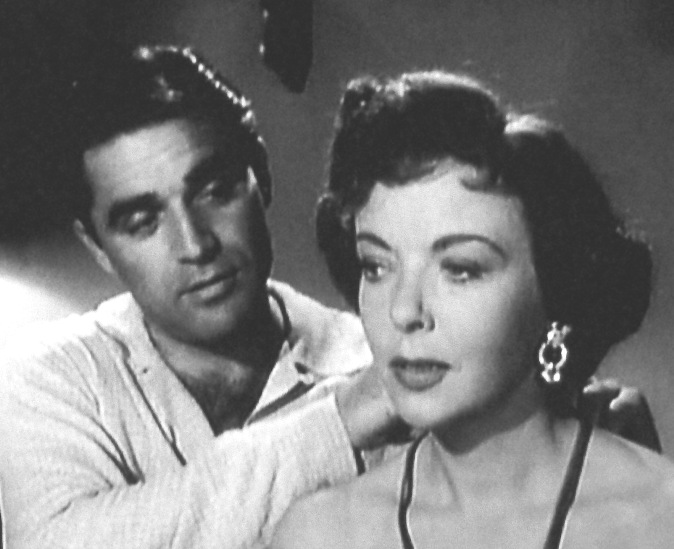
In New York City, a man gets out of an elevator carrying a briefcase full of money and leaving behind a dead body. A year later in Los Angeles, one of the "hot" bills, a fifty, shows up when cops Steve Cochran and Howard Duff break up a drugstore robbery. They track the bill to a shady lady singer (Ida Lupino) who got it as a tip from a drunk. Cochran, who finds himself falling for Lupino, gets her to help them out when they discover more of the bills in circulation at a nearby racetrack, hoping she can identify the guy in the crowds. When she does, the cops go on a wild chase which ends with the crook's car careening off a cliff. The cops find his dead body and the missing money scattered around the wreck. As they collect it, Cochran decides to hold back about $80,000 for the two of them, figuring their boss (Dean Jagger) will never know the difference. Cochran rents a trailer (#36, hence the title) to stash the money; Duff begins to have second thoughts, and a mystery figure contacts Cochran by phone, indicating he knows they have the money and trying to get in on the action. The violent climax plays out at Trailer #36.

This is a nifty B-noir, or more precisely, half-police procedural, half-noir. Because we get to know Cochran and Duff (pictured at left) as average cops investigating a fairly run-of-the-mill crime in the first half-hour, the moment when Cochran goes rogue packs a punch, especially because he's so charming, and uses that charm to romance Lupino, who, though a tough gal, becomes quite likeable. Duff's character could have been rounded out a bit more, and maybe been made more ambiguous—he goes along with the plan reluctantly because he can't bring himself to cross his partner, so it's almost too clear too quickly that Duff is the good cop to Cochran's bad, or at least amoral, cop. The two have good chemistry and give nicely naturalistic performances. Early on, Duff says to Cochran, "Sometimes I wonder why we go steady," and Cochran replies, "Because I'm irresistible." And generally, Cochran is, which is why we continue to emphasize with him for so long. Lupino (above with Cochran) is great in a role, like Cochran's, that shows her character change over time, from crusty distruster to admirably tough dame. Early on, as the cops question her, she says dismissively, "I’ve seen this all on Dragnet." Jagger is very good as the chief. Dorothy Malone plays Duff's wife and Richard Deacon has a small part as the druggist who gets robbed. An early film for director Don Siegel (INVASION OF THE BODY SNATCHERS, DIRTY HARRY) and a good one all around. My only quibble: the title; though the film climaxes at the trailer, the film skimps on any suggestion that anyone's going through hell, though Duff is clearly conflicted. [Netflix streaming]

Monday, January 14, 2013

JAZZ HEAVEN (1929)

This is a cute little romantic comedy with some music and dance but not a lick of jazz at all. Barry is a struggling songwriter who plays piano day and night in his apartment, keeping other tenants awake. The landlady threatens to throw him out and keep his piano for the rent payments he's missed, but her husband Max, a night watchman at a nearby office building, is more sympathetic. One morning as Barry is banging away at a melody, Ruth, the young lady next door, hears him and begins humming along, finishing the tune. He runs next door, drags her to his room, and forces her to re-create her song, and Our Lovers have just Met Cute. From this point, a number of plotlines are put in motion: 1) It turns out that Ruth works for two song publishers, Kemple & Klucke, and both of them enjoy flirting with her; in fact, they wind up placing a bet as to which one can get her to go out on a date; 2) The landlady kicks Barry out when she catches Ruth in his room, but Max agrees to get Barry a new room across the street, and even promises to get his piano to him as well—leading to a Laurel & Hardy-ish piano-moving scene; 3) Max lets the lovebirds into an unused radio studio room in the office building so they can work on their song, but by accident, their session winds up transmitted that night; the song is a big hit and the radio station owner wants to hire the two and buy the rights to the song. However—4) the radio station owner can't figure out who the singers were, and 5) Kemple & Kluck might also want the song. Not to mention the jealousy sideline when Barry thinks Ruth is sweet on Kemple and/or Klucke, when all she's trying to do is sell them his song.

That’s a lot of plot for a 70 minute movie, but still the pace slows too often in the way that many early talkies do: the actors sometimes deliver dialogue too slowly and deliberately, as if the director was afraid that the audience might have a hard time keeping up. The worst offender is Sally O'Neil as Ruth who is stiff and rarely seems natural. Johnny Mack Brown as Max is much better, though his Southern accent sounds forced (even though the actor really did come from Alabama). But they have enough chemistry that you root for the couple. There is a long vaudevillian comedy routine between Kemple (Joseph Cawthorne) and Klucke (Albert Conti), and Max (Clyde Cook) has his own slapstickish business with the aforementioned piano. Barry's song, "Someone," is a nice little ditty, and there is a dance number in a nightclub, but this isn't a musical, and as I noted earlier, there's not even a hint of jazz. Cute and harmless. [TCM]

Friday, January 11, 2013

RUTHLESS (1948)

Millionaire philanthropist Zachary Scott is giving a party to announce his new international peace institute; his childhood friend Louis Hayward arrives late with his girlfriend Mallory who resembles someone from Scott and Hayward's past. This triggers a flashback to the beginnings of the romantic triangle of Scott, Hayward and Diana Lynn when they were teenagers. Scott's parents are divorced and both are remote figures in his life, with his mother actively oppressive; Scott tries to run away and Lynn's family takes him in. In college, Hayward, in love with Lynn, asks Scott to intercede for him, but Lynn confesses that she loves Scott instead. However, soon Scott is running in even higher social circles and secretly dates Martha Vickers, who has family connections that Scott can use to further his career. Later, Scott does the same thing when he decides he wants to take control of an independent utilities company run by Sydney Greenstreet—he seduces Greenstreet's younger wife (Lucille Bremer). Back at the party in the present day, as Scott tries to seduce Hayward's date, a drunken Greenstreet barges in to seek revenge.

The amazing thing about this melodrama, which is structured a bit like CITIZEN KANE, is that it shows what B-movie director Edgar G. Ulmer was capable of with a decent-sized budget. Ulmer is known for films made on shoestring budgets which usually had some interesting elements that transcended their Poverty Row origins (DETOUR, BLUEBEARD), but with this one he seems to have had a higher budget and the film is both a little quirky and Hollywood-glossy. Performances are decent across the board: Scott (pictured with Lynn) is good, especially at conveying a certain ambiguity about his actions and motives; Hayward is just OK partly because he is less fleshed-out; Greenstreet and Bremer are quite good in roles that require them to stretch a bit outside their usual screen personas. This film sometimes gets placed on lists of noirs but it's really only tangentially related to noir by visual style, in the same way that KANE is. [Netflix streaming]

Wednesday, January 09, 2013

HIS GREATEST GAMBLE (1934)

Phillip Eden is a gambling playboy with a difference: he has a small daughter in tow, Alice, who is devoted to him and whom he has stolen away from his ex-wife Florence. One night, after Phillip has lost his last dollar and is cooking some soup at the stove, his former mistress Bernice arrives at his shabby apartment to tell him that Florence is on his trail and will be arriving soon to take Alice back. Phillip ties Bernice up in the apartment and goes on the run with his little girl, not realizing that the stove never got turned off—the place fills with gas and Bernice dies. Eventually the police catch up with Phillip in Italy and he's sentenced to fifteen years in prison. Florence takes Alice, who over the years forgets about Phillip. Eleven years later, Alice's former nurse visits Phillip to tell him that Alice had an accident and can no longer walk; she suspects that Alice could recover, but her mother has willfully turned her into an invalid and has discouraged her from dating Stephen, a charming young newspaperman. Phillip breaks out of prison and goes to see Alice. Florence tries to send him away but he pretends to be John, a brother of Phillip's, and ingratiates himself not only with Alice, but also the butler and Stephen, Alice's would-be beau. Can Phillip free Alice from her mother’s influence before the police catch on to who he really is?

This rarely-seen drawing-room melodrama is nothing special, but it has its moments. It would be a lot more interesting if someone other than the uninteresting Richard Dix played the lead—he's not terrible, but he's just so colorless and sluggish. Growing a mustache when he adopts the brother persona helps a bit. The movie feels like a non-comedic spin on the philosophy at the center of YOU CAN’T TAKE IT WITH YOU and AUNTIE MAME—one (specifically, Alice) should not live life afraid, but instead live freely and fully. Dorothy Wilson, who has a quirky but pretty face, is fine as the daughter; Erin O'Brien-Moore is good as the unsympathetic mother; Bruce Cabot is the boyfriend; Eily Malyon, who often plays sinister maids, is fine in the small role of the non-sinister nurse. If only someone like Ronald Colman or William Powell had been given the lead.  [TCM]

Monday, January 07, 2013

CRIME AND PUNISHMENT USA (1959)

A crowd gathers to watch the police arrest a man for the murder of an elderly pawnbroker in her own shop, and in the midst of the commotion, young law student Robert passes out on the sidewalk. His friend Rafe gets him back to his apartment to recover where he is visited by his mother and his sister Debbie, who is about to marry an older man in order to get some financial help for the family. We find out that Robert is no longer in school, though he did have an article published arguing that extraordinary people should be above the law. Robert goes to the police in order to get back some items he had pawned and Lt. Porter engages him in a philosophical discussion about his article. When Porter suggests that even extraordinary people would be plagued by guilt about a crime, Robert says that their consciences wouldn't bother them because the crime would have been done for a good reason. Robert has become a suspect in the murder and Porter plays a lengthy cat-and-mouse game with him to get him to crack. Meanwhile, Fred, a man from Debbie's past, has shown up. Debbie worked for him until Fred's wife discovered they were having an affair—she fired her, leading, in Robert's mind, to Debby's sad plan to marry for money. He wants to get in touch with her, though Robert tries to stop him. In the midst of all this turmoil, Robert becomes friendly with Sally, a young woman whose alcoholic father has just died (and to whom earlier Robert had given a hand) and they sleep together. He confesses to Sally that he murdered the old lady—now it’s just a matter of conscience willing out.

This is a scrappy black-and-white B-movie adaptation of Dostoevsky's classic (which I started years ago but never finished) and it's not bad. Set in the slightly seedy environs of Santa Monica, you get a sense of lots of sun but also lots of personal darkness among the characters. We don't see the murder as we do in the 1930s adaptation and the central relationship between the killer and the cop doesn't play out as well here—their scenes together go on too long and are dramatically slack. But George Hamilton in his first movie role is good as Robert, channeling Anthony Perkins in his twitchy neurotic mode. Frank Silvera as the cop is adequate but alternates between sleepwalking and heading over-the-top. Marian Seldes (pictured above with Hamilton), who went on to a long and distinguished career in the theatre, is Debbie, and the lesser-known Mary Murphy is fine as Sally. The movie has a loud jazzy score by Herschel Burke Gilbert that works better than Duke Ellington's intrusive score for ANATOMY OF A MURDER. [TCM]

Friday, January 04, 2013

ACCIDENT (1967)

One night, outside the house of Oxford don Dirk Bogarde, a car accident occurs. When Bogarde goes out to help, he finds his student, Michael York, dead, and York's fiancee, Jacqueline Sassard, drunk and nearly unconscious. He takes her in and hides her upstairs while he tells the police what he knows about York. In an extended flashback, we learn that York had come to Bogarde to get the confidence to come on to Sassard, an aristocratic German student. He does, but then Bogarde himself starts to fall for her, despite having a pregnant wife (Vivien Merchant) and two kids. To make matters worse, another married don (Stanley Baker) begins an affair with Sassard, even spending the night with her in Bogarde's house when Baker assumes the house is empty. Back in present time, the triangle of Sassard and the two dons is resolved in a way that leaves no one unscathed.

Joseph Losey, an artsy filmmaker, directed this from a script by Harold Pinter, a writer known for his obscure narratives and the importance of silences and pauses in dialogue scenes. Nothing much happens on the surface; as Pinter has said, the real drama happens between the lines. What I like best about the movie is how it becomes clear that all the characters are "acting" their parts, rarely letting what they really feel show. Bogarde (pictured above with York) is especially good, keeping his loves and lusts and jealousies simmering beneath his mild-mannered demeanor. All the characters except York stumble about causing accidents of one kind of another, hurting people but not really caring. Bogarde reignites an old affair with the provost's daughter; Baker carries on with Sassard even though his wife finds out; Sassard, the biggest cipher in the movie, seems to love no one, but is the one who pays the least for her behavior. Only the young York (in his first movie) seems principled, but he becomes the victim of a literal accident. The movie is interesting but rather bloodless, though Bogarde and Baker give excellent performances, especially in a long scene of a drunken house party. Harold Pinter has a cameo comic-relief role as a TV producer, and Alexander Knox stands out in the small role of the provost. [TCM]

Wednesday, January 02, 2013

HEMINGWAY'S ADVENTURES OF A YOUNG MAN (1962)

Where to start? With me, I guess. I love Hemingway, especially his short stories, particularly the collection In Our Time which can be read as a short story cycle about a young man coming of age. Many of the stories in that collection name the central figure as Nick Adams and it's generally accepted that even the stories with a differently named character (such as "Soldier's Home" with Harold Krebs) can be read as being about Nick Adams. This film is essentially a cobbling-together of the In Our Time stories into one episodic narrative, and as such it largely duplicates the experience of reading the collection in one sitting. I have avoided this movie for years because of the truism that movies are never as good as the books they're based on. This is certainly no substitution for reading the original stories, and there is a substantial loss of dramatic tension in the last half, but it's not horrible—faint praise, I know...

Nick (Richard Beymer, pictured) grows up in the woods of Michigan with a sensitive, passive father (Arthur Kennedy) and overbearing mother (Jessica Tandy). We see the father, a doctor, heading over to an Indian settlement to tend to a difficult birth, despite the fact that the husband (Simon Oakland) has earlier humiliated Dr. Adams in front of Nick. While drinking with a buddy (Michael J. Pollard) during a windstorm, Nick decides to leave town and ride the rails by himself. He spends some time with a banged-up, washed-up boxer (an unrecognizable Paul Newman, below with Beymer) who is tended to, with obvious love and devotion, by his former manager (Juano Hernandez); Nick later becomes an assistant to another washed-up fellow, a promoter of burlesque shows (Dan Dailey). In New York City, Nick tries to get a job as reporter, but is told he doesn't have enough life experience, so he signs up with an ambulance corps in Italy and is promptly wounded. In the hospital, he falls in love with his nurse but she is gravely wounded during a bombing raid; he gets a priest to marry them on her deathbed, but she dies in his arms. Back in Michigan, Nick gets a hero's welcome but also finds that his father committed suicide. Unable to live with his mother, he leaves once again for New York hoping he has enough experience to make his way.

I assumed that Richard Beymer (Tony in WEST SIDE STORY) would be the biggest problem; he was a scrawny, mannered actor who rarely brought much force to his roles, but he's actually OK here as the somewhat passive central figure. The nature of the film's structure means that none of the other actors is on screen for very long, but they all do what they can. Newman and Hernandez are the most memorable, and Kennedy and Tandy are perfect as the parents. The Italy sequence, shot on location—and based in part on Hemingway's novel A Farewell to Arms—is impressive in terms of production values, but weak dramatically, despite a good performance from Ricardo Montalban as a friend of Nick's. It's telling that the first half, full of short, disjointed episodes, comes off better than the second half which is more a single piece. [TCM]

Monday, December 31, 2012

SHADOW OF A WOMAN (1946)

After caring for her ailing parents then having them both die, Andrea King, on the verge of a nervous breakdown, is sent out West for a rest cure and meets the charming Helmut Dantine, a doctor of what would today be called alternative medicine (though, as he is at pains to point out, he is not an M.D.). They hit it off and are married within a week. Soon, King realizes that Dantine may be hiding some unsavory secrets: on their honeymoon, a man tries to shoot him (he blames Dantine's care or lack thereof for his wife's recent death) and two men are following him; then, when they head to his home in San Francisco, she finds out that he lives with his unfriendly sister, her crippled adult son (John Alvin) and Dantine's own sickly young son by a previous marriage. The topper, so she thinks, is that he is caught up in a nasty divorce proceeding—the two men following him are working for the ex-wife's lawyers—but there's actually something even worse: Dantine may be slowly poisoning his little boy. The plot and characters are interesting but the movie's low-budget prevents this from being the Hitchcockian thriller it wants to be. King and Dantine are both wooden—though at least Dantine looks creepy enough when he has to; the best acting is done by Alvin as the sister's son and William Prince as the lawyer. Dantine's health-food regimen is ahead of its time, though here it's shown to do more harm than good. The movie has its moments but by the home stretch, it's a bit of a slog. And the title has nothing to do with the movie, until they try really hard to make it mean something in the fade-out. [TCM]

Thursday, December 27, 2012

WEST OF BROADWAY (1931)

Jerry, a wounded WWI soldier and rich playboy, sneaks away from his hospital boat while it's docked in New York City to rendezvous with his fiancée Anne, but finds out that she's dumped him for someone else. Later (could be days, weeks or months, it's unclear) at a party he's throwing at his Manhattan mansion, he hires Dot, a "party girl," to be his companion for the evening. When they run into Anne, she says that Dot is pretty "in a shoddy way," and the drunken Jerry tells her that he's going to marry Dot. That night, he does; the next morning he tries to pay her off to get a divorce but she says no. Jerry heads off to his Arizona ranch; when Dot finds him, he tells her he only has six months to live. What follows is a see-sawing game of "I want you/I don’t want you" between the two which is finally resolved in a courtroom. 

John Gilbert's talkies have gotten a bad rap, and like many early 30s movies, they haven’t all aged particularly well, but Gilbert himself is just fine here. The script doesn't give the characters much motivation for the silly hoops they have to jump through, and if this had been made a few years later, it might have been turned into an amusing screwball comedy like BRINGING UP BABY or THE PALM BEACH STORY. Gilbert makes for a sympathetic cad; Lois Moran is fine as the confused Dot whose past is unclear—she admits to being a bit of a gold digger, but takes umbrage at hints that she's "easy"; El Brendal gets the thankless comic relief role of Gilbert's Swedish sidekick; Ralph Bellamy is a ranch hand who falls for Dot. The oddest scene involves Brendal and Asian ranch cook Willie Fung trying to communicate with each other through belly-rubbing—get a room, guys! The acting and look of the film are A-level, but the script and direction are strictly from B-movie talent. And speaking of B-movies, the handsome Kane Richmond, later known for his roles in adventure serials, has a small role here. [TCM]

Tuesday, December 25, 2012

CAROL FOR ANOTHER CHRISTMAS (1964)

Daniel Grudge (Sterling Hayden) is a rich man spending Christmas Eve alone in his big house, listening to old Andrews Sisters records, lost in memories of his son Marley, a soldier who was killed in a Christmas battle during WWII. He's a strict isolationist who blames American idealism for getting us into foreign wars and getting his son killed; he's against the United Nations, and has recently hurt the career of a professor at a local university who had become involved in an exchange program with a university in Poland. His nephew Fred (Ben Gazarra) arrives to try to get him to change his mind about the program. They argue about international affairs; Fred says we need the U.N.'s diplomacy because as long as countries are talking, they're not fighting, but Grudge says that butting in and trying to help what he snarlingly calls "the needy and oppressed" of other countries just gets us into wars, and is instead in favor of the stance of "mutually assured destruction," in which all sides have enough weapons to destroy each other and so theoretically won't use them. After Fred leaves, Grudge has a vision of his dead son seated at the dinner table and suddenly finds himself with the Ghost of Christmas Past, a WWI soldier (Steve Lawrence) on a transport ship full of dead soldiers. Grudge is taken back to his own past as an officer in post-war Hiroshima where he and a nurse (Eva Marie Saint) visit a doctor who is caring for several young women whose eyes and faces were burned away when they looked up at the blast. The Ghost of Christmas Present (Pat Hingle) takes him to a camp full of starving displaced persons. In a vision of the future, The Ghost of Christmas Yet to Come (Robert Shaw) shows him a post-nuclear civilization which has adopted Grudge's belief against getting involved with others; a madman called the Imperial Me (Peter Sellers) espouses his philosophy of killing off other bands of survivors, followed by killing each other off until only one Me will be left. Of course, if you know your Dickens, you can guess how Grudge's philosophy changes the next morning.

This adaptation of "A Christmas Carol" is quite unusual in many respects. It was produced as a TV-movie and aired only once, sponsored by Xerox and blatantly presented as propaganda for the United Nations. Written by Twilight Zone's Rod Serling in his heavily didactic mode, it was the only television work directed by Joseph L. Mankiewicz (ALL ABOUT EVE, CLEOPATRA). It's stagy but imaginatively shot and well-acted, the biggest surprise being singer Steve Lawrence (pictured above left with Hayden) who does a very nice job with Serling's preachy dialogue. Sellers (pictured at right) is a bit over-the-top (as is the entire future segment) but that's partly because he's not a character but a stand-in for an idea—isolationism taken to a personal extreme. The Christmas aspect of the plot is relatively minor, and Grudge's transformation at the end is not played with giddy joy—in fact, his change is much more subtle than Ebenezer Scrooge's, and not one that Grudge seems happy about. Perhaps the most you could say is that he becomes more tolerant of both his nephew Fred and the United Nations. I remember seeing ads for this show when I was a child and because of Serling's involvement, wanted to see it but didn't. I’ve been waiting over forty years, and thanks to Turner Classic Movies' airing over this holiday season, I can cross this off my need-to-see list. If not exactly a classic, it is interesting and intermittently compelling. [TCM]

Monday, December 24, 2012

MIDNIGHT CLEAR (2006)

Over the past few years (as I'm sure I've said on this blog before), it has been difficult to find good Christmas movies.  The ones in theaters are all either bloated overdone kids movies (some OK, like ELF, some bad, like THE POLAR EXPRESS) or snarky plastic confections (the SANTA CLAUSE movies, CHRISTMAS WITH THE KRANKS). The made-for-cable movies, which I’ve been reviewing on my blog for the past few years, are mostly sappy romances; they're watchable but forgettable. On my shelf of must-watch Christmas DVDs (about twenty), the most recent one is THE REF from 1994. It seems that now I must turn to independent Christian filmmakers for interesting Christmas movies. A few years ago I discovered a religious indie called NOELLE, which I reviewed on my other blog and which I liked very much. This year, I found MIDNIGHT CLEAR. It sat in my Netflix streaming queue for months, having two strikes against it: it was made by Dallas Jenkins, son of Jerry B. Jenkins, the fundamentalist Christian co-author of the "Left Behind" series, and it stars a Baldwin brother other than Alec. But I finally got around to watching it and am pleased to report that it has earned a place on my Christmas DVD shelf.

It takes place on Christmas Eve and focuses on the separate but related stories of five characters in a small Texas town. Lefty (Stephen Baldwin, pictured below) has hit bottom: he's a divorced homeless alcoholic who has just been fired from a factory job and his ex-wife's lawyers are threatening to ban him from seeing his kids. Eva (K Callan, Clark Kent's mother on Lois & Clark) is an older woman who is alone at Christmas—though she has told people that she has family coming in—and is preparing to commit suicide with an overdose of prescription pills. Mary (Mary Thornton) is a wife and mother whose husband Rick suffered brain damage a year ago in a car accident and is in a long-term nursing facility; she's coping but is angry that so few members of the community have even tried to visit Rick, who is not in a coma but who is essentially non-communicative. Mitch (Mitchell Jarvis) was in the accident with Rick but not hurt badly; still, he misses his buddy's leadership with the church youth group of which he is now in charge, and is not happy that his pastor is making them go caroling, targeting folks who haven't been to church in a while. We don’t find out much about the fifth character Kirk (Kirk B.R. Woller) except that he runs a small gas station & convenience store outside of town and doesn't like his life very much—when folks come in and say "Merry Christmas" to him, his reply is an unenthusiastic "Yup." In the trend of recent indie films, most of the characters cross paths at some point. As Mary and her son are on the way out of town to spend Christmas with her family, her car breaks down in front of Kirk's shop and she tries to get him to help her out.  Mitch and the carolers wind up their unsuccessful evening of trying to get people back to church by calling on Eva. And so on. The stories have upbeat endings, even if they're not the endings that the characters would wish for.

Jenkins based this on a short film he made which itself was based on a short story by his father, and for all the unsubtle messages associated with writers of Rapture fiction, this (or at least this version of the original material) is surprisingly low-key. Though some of the characters are churchgoers, and the film's climax is set at Christmas Eve service, I don't recall Jesus being mentioned once. There are no angels, no fiery epiphanies, and no sermonizing (not even any snow, and very few seasonal decorations); and not all of the characters wind up at church in the end. As one critic noted, this is a very humanist Christmas story, all about making connections with people and the different ways in which a helping hand can be given (and received). Kirk's story has virtually no tie to the church, and Lefty's and Mary's only tangentially. The acting is good all around. That Callen can pluck your heartstrings with just a look and a pause is no surprise. Thornton is also very good; Jarvis (above left) has the least to do but is fine; Woller is, from start to finish, stuck in a very taciturn Gary Cooper-ish mold but he does what he can to hint at his character's inner feelings. The real surprise is how good Baldwin is. It's largely his movie to carry, at least in the first half, and he's excellent at conveying the emptiness and confusion inside Lefty which leads him, like Eva, to a suicide attempt which is the most powerful scene in the movie. We don’t know enough about his character to really sympathize with him—he seems to have brought on all of his problems himself—but we do empathize with his plight. Loneliness and/or loss are at the core of all the stories here, and somewhat predictably, it is someone else reaching out that helps the lonely people begin to heal. Still, despite the predictability of the outcomes, the way they all begin to rebound is sometimes surprising. The movie is not a comedy, but there are occasional light touches; at one point, when a seedy guy is very secretively selling Baldwin a gun in his garage, Baldwin says, "Why so dramatic? Are we on TV?" I hate to oversell this, but at the least, it's a solid non-romance, non-kiddie Christmas story that should satisfy most fans of the season.  [DVD]

Friday, December 21, 2012

TRADE WINDS (1938)

Rich socialite Joan Bennett is called away from a party to the morgue to ID her sister, who killed herself. She goes to the man she thinks is responsible (Sidney Blackmer) and after being egged on by him, shoots him dead, then drives her car off of a ferryboat, making it look like she committed suicide. But instead, she changes her hair color and identity and goes to Hawaii. When clues crop up that she's alive and well, playboy detective Fredric March is sent along with somewhat bumbling detective Ralph Bellamy to Hawaii to find her and bring her to justice. They go from Hawaii to Saigon to Singapore, and are soon joined by March's secretary (Ann Sothern) who wants to claim the reward for catching Bennett for herself. Meanwhile, March meets up with Bennett and they fall in love; even Sothern, who finagles a job as Bennett's personal assistant, comes to like Bennett. With another cop breathing down their necks, Bennett gives herself up, but back in the States, March works feverishly to try and prove her innocence. This is an overlooked little gem of a romantic comedy/mystery, not manic enough to be a screwball, but with an energetic cast and a witty screenplay—Dorothy Parker and her husband worked on the script. The solution to the mystery feels a bit rushed, but otherwise, this is fun and worth watching. [TCM]

Wednesday, December 19, 2012

DOWN ARGENTINE WAY (1940)

Argentinean horse owner Don Diego (Henry Stephenson) sends his son Ricardo (Don Ameche) to New York to sell some horses, but instructs him not to sell any to Binnie Crawford (Charlotte Greenwood) because of a betrayal he suffered years ago at the hands of her brother. Once there, Ricardo is smitten by the lovely Glenda who wants to buy Don Diego's prize horse Carmelita, but just as he's about to finalize the sale, he discovers that Glenda is Binnie's niece and stops the deal but doesn't tell her why. Perturbed, she, accompanied by Aunt Binnie, follows him back to Argentina where shenanigans, misunderstandings, and musical numbers occur until this Romeo & Juliet couple finally get together. This lightweight musical is the first of the Fox Technicolor musicals of the 40s, the first big-budget movie to feature Betty Grable as a lead, and contains the first appearance of Carmen Miranda, who appears as herself—she has no dialogue, sings two nightclub numbers, and vanishes from the movie. The romance is clearly inspired by the Astaire/Rogers musicals but there are too many odd and unmotivated plot twists, and I never really cared much if Grable and Ameche got together. But Grable (pictured) is lovely and dances well, and Ameche is dashing and nails his accent for which I give him bonus points. Leonid Kinskey is amusing as a gigolo who squires Greenwood around Buenos Aries, and J. Carroll Naish has a small but important role as a horse trainer. I found some of the broken English dialogue amusing: "Allow me to deduce myself"; "He has a memory to forget" (about a forgetful person); a hotel room is described as having "a beautiful look over the city." The Nicholas Brothers provide, as they often did, the real highlight of the movie with their athletic dancing. The colorful DVD print is gorgeous. [DVD]

Friday, December 14, 2012

TRENT'S LAST CASE (1952)

Manderson, a rich American businessman living in England, is found dead in the garden of his estate, an apparent suicide. Crime reporter Philip Trent sneaks into Manderson's mansion and, with the implicit permission of Inspector Murch, begins his own investigation. Manderson's widow Margaret mentions that her late husband had been moody lately; is it because he suspected that she was having an affair with Marlow, one of his trusted private secretaries? Bunner, the other secretary, testifies at the inquest that Manderson was about to fire Marlow, but was it really Bunner he didn't trust? Had there been threatening letters from someone? And what about Cupples, Margaret's seemingly harmless uncle, whom the butler overheard arguing with Manderson the night before his death? Margaret finally tells Trent that her husband caught her and Marlow kissing and that's why he killed himself. But could Marlow have killed Manderson, then gone to great lengths to make it look like suicide? Or could Margaret have done it herself? Eventually, a long flashback scene shows us most of what really happened, though in a clever twist, it turns out that there is one last puzzle piece needed to wrap the case up.

This is based on a 1920s novel famous for being one of the first satires of the detective genre, but this version, though fairly light in tone, is hardly satirical; the screenplay makes it into just another B-mystery, albeit one acted quite good-naturedly with a standout performance by Orson Welles as Manderson, not seen until the lengthy flashback sequence begins an hour into the 90-minute movie. As usual, Welles makes the most of his screen time, pretty much wiping everyone else into the dustbin. Michael Wilding is cheerful but unmemorable as Trent, and the lovely Margaret Lockwood (pictured with Wilding) never gets a handle on her character. John McCallum is a little better as Marlow, but more fun are Hugh McDermott as the possibly unreliable Bunner and Miles Malleson as Cupples who plays a surprisingly crucial role in the case. There is never much at stake here, but the film is mildly enjoyable and gets even better when Welles arrives. [TCM]