Wednesday, July 30, 2014

THE DEMI-PARADISE (1943)

aka ADVENTURE FOR TWO

A rather weak stab at wartime propaganda, the sole purpose of this British film is to make the Russians, who were their allies at the time the film was made, seem likable. Unfortunately, the movie is too long and has a lead performance (by the normally reliable Lawrence Olivier) that belongs in a different movie. Olivier plays a Russian engineer who is sent to England in 1939 (pre-war) to oversee production of his new ice-breaker ship propeller. His first impression is that the British are a bland, depressing people. He stays with the shipbuilder's family and his harsh edges are worn off a little, largely through the development of his relationship with the shipbuilder's daughter (Penelope Ward) who falls for him. The middle third of the film is a comedy of manners as Olivier stumbles through an assortment of awkward social situations and begins charming people almost despite himself. Things peak at a historical pageant that Olivier finds to be evidence that the British are living in the past. Ward calls him out as priggish and conceited, he calls her out as hypocritical and heartless, and he goes back to Russia to keep working on the propeller, leaving things unsettled.  Two years later, with war raging and the Russians and British as allies, Olivier returns with new propeller plans and is impressed with British resolve in the face of German aggression. This time, the pageant (pictured at left) is given to raise money for Olivier's home village. Olivier changes his mind about the Brits and about Ward, though at the end of the film, he returns to Russia with their romance still up in the air.

Olivier is entertaining, but he’s a showboater here, using a comically overdone Russian accent, keeping his character at a distance from the audience, whereas the other actors are more naturalistic. Ward is vivacious but doesn’t bring much else to the role, so the romance remains tepid. In a large supporting cast, old pro character actors Margaret Rutherford and Felix Aylmer stand out, and I also liked Jack Watling as a handsome worker, comedian Leslie Hanson playing himself, and Edie Martin as an old lady who, suspicious of Olivier, gives Ward a copy of Crime and Punishment to read—during the war, she comes around to liking him (of course). Parts of this film are fun, even some of Olivier's performance, but the main problem is that, at almost two hours, it’s just too long. [TCM]

Monday, July 28, 2014

THE ANGEL LEVINE (1970)

Tailor Morris Mishkin (Zero Mostel) is at the end of his rope. An observant Jew, he thinks God has abandoned him: he's applied for welfare because of a fire at his store, his sickly wife Fanny (Ida Kaminska) has been practically on her deathbed for ages and shows no signs of getting better—or worse—and one afternoon, he witnesses a black man who has just snitched a woman's fur coat run into traffic, get hit by a car, and die. After his wife has another one of her attacks and Morris has called the doctor, he discovers the dead thief, Alexander Levine (Harry Belefonte), in his kitchen (Harry Belefonte) claiming to be an angel who is on probation and has until the next morning to help Morris regain his faith. As Levine and Morris engage in philosophical and theological debates (it turns out that Levine is a Jew), Levine also tries to re-connect with his girlfriend Sally (Gloria Foster) to show that there will be something good he's left behind before he has to leave Earth for the last time.

Though not as whimsical as THE BISHOP'S WIFE or IT'S A WONDERFUL LIFE, this is still in the tradition of fantasy movies about angels and faith, though ultimately it has a much more ambiguous ending and a cutting edge to its philosophizing. If we see Morris as a George Bailey figure, he doesn’t get much satisfaction in the end: his wife, who rallies in the presence of Levine, has a setback after Levine leaves; his money and faith situations are not resolved, and Levine himself can't get Sally to believe that he's got a new outlook on life. The big question for most viewers will be, is Levine an angel or a con man? Many critics are unhappy about the ending, in which [spoiler] Morris looks for Levine the next morning and is startled by a single black feather which dances about in the air just above his head. My initial interpretation: Morris had earlier commented that Levine didn't have wings, and in this moment, one could assume that he did indeed earn them. But I'll admit that the logic, if you will, behind accepting that ending is unclear. Unless I missed something, Levine never transcends his thuggish earthly outlook and never really brings Morris back to his faith, though it can be argued that Morris has never completely lost it, as he wears a yarmulke and kisses the mezuzah when entering his apartment. But of course, he could be simply going through the surface motions of his religion. I embrace the ambiguity even as I share the frustration that the film violates the conventions of its genre.

This is a very stagy film, based not on a play but a short story by Bernard Malamud; most of it is set in Morris' apartment with an occasional detour outside. The direction and cinematography don't let things get too closed-in; in fact, it's in the exterior sequences where things go awry—especially in a strange scene in which Morris watches from outside a drugstore window while Levine creates a scene so he can swipe a prescription drug for Fanny that Morris can't afford. It's an important scene, showing that Levine can't seem to come up with a miracle outside of his earthly criminal ways, but it's irritating, played out in silence except for an overblown musical score. The acting, however, makes this worth seeing. Mostel downplays for perhaps the only time he ever did on screen and he creates a character we care about. Belafonte, who I don't think I’ve ever seen as an actor, does even better with the angel, a flawed, human and rather sexy angel—or an idealistic, unhappy and sexy con man. Kaminksa, so good in the Holocaust drama THE SHOP ON MAIN STREET (directed by Jan Kadar who directed this as well), is fine, as is Milo O'Shea—who usually plays Irishmen—as a Jewish doctor. Certainly not for all tastes, but a nice change of pace in the fantasy/religion realm. [TCM]

Friday, July 25, 2014

LIANE, JUNGLE GODDESS (1956)

The members of a German expedition in Africa (it's unclear what they're actually doing there) are sorry that Jacqueline, their doctor, is set to go back to Hamburg, mostly because she's the only female in the group. She has a bit of a crush on handsome, blond Thoren, but it's nasty old Keller who tries groping her. Meanwhile, Thoren is attacked by a native tribe and about to be killed when a nubile (and mostly naked) white teenage girl stops them. She seems to be the ruler of the tribe, and the next day Thoren runs into her when she swings, Tarzan-style, over a lake and drops in to bathe. Two of the other men in the expedition trap her in a net and bring her back to camp where the tribe attacks them but are driven off. She speaks no English, but when it's discovered that she is wearing a necklace with the letter "L" on it, it is eventually thought that she might be the heiress to a German shipping magnate named Amelongen—as a 2-year-old, the girl, named Liane, was lost and presumed dead in a shipwreck—so Thoren and Jacqueline take her with them to meet her grandfather and try to establish her lineage. In their way: Amelongen's slimy secretary Schöninck who is currently the heir and who tries his best to discredit Liane's claims.

This is presented as a jungle adventure, but only about the first half (or less) is set in Africa; once it gets to Hamburg, it becomes a typical "clashing heirs" melodrama, so if you're looking for a female Tarzan movie, this will disappoint you. On its initial release, this was advertised as "Adults only" material because Liane (Marion Michael) is topless for most of the African scenes. Michael is certainly attractive but it's a little disconcerting to realize that she was only 16 at the time. In most of the shots, her long hair covers her breasts, but not always. Aside from the few seconds of bare skin, and some shots of topless natives dancing, there is nothing else graphic or particularly adult about the movie. Hardy Kruger (pictured with Michael) is good as Thoren, and the only other cast member to stand out is Reggie Nalder as Schöninck, probably best known as the vampire in the TV-movie of Salem's Lot; his face, disfigured by burns, makes him perfect for the role of the almost Nazi-like sinister secretary. This was actually made and released in Germany in 1956, but wasn't issued in the States until 1959. [DVD]

Wednesday, July 23, 2014

NIGHT LIFE OF THE GODS (1935)

One night as the well-off Lamberts and their friends are indulging in some postprandial relaxation, a series of explosions rock the house, but it's just the experiments of eccentric uncle Hunter Hawk (Alan Mowbray, at right). Most of his relatives can barely put up with him, though his young niece Daphne, whom he lovingly calls Daffy (Peggy Shannon), admires him. As it happens, Hunter has finally finished his latest invention: a ring that can turn people to stone, and can bring stone statues to life. He proceeds to turn the whole obnoxious family to stone, except for Daphne and Meg (Florine McKinney), the gardener's flighty daughter who insists that she’s 900 years old and has a crush on Hunter. Hunter and Meg head off to the Metropolitan Museum and bring to life the statues of several Roman gods, including Bacchus, Neptune, Mercury, and the Venus de Milo, and they all head out to experience, as the title says, the night life. Of course, the gods are rambunctious and cause much trouble before order is restored (via a trick ending).

This strange little fantasy is based on a novel by Thorne Smith who wrote a series of bawdy adult fantasies in the 30s; if he's remembered today, it's because of the movie adaptation of his novel Topper with Cary Grant. This is not another TOPPER, but it is fun, and about as bawdy as the Code would allow—both Mercury and Venus are brought to life naked or nearly so, though they are both immediately covered up. I must admit that it's difficult to judge the look and style of the film because the print I saw on YouTube was very murky—supposedly the film has been restored by UCLA but it hasn't been released commercially yet—and it ran at least ten minutes shorter than the IMDb running time. For a high-B production, probably intended as a second feature, the effects were OK, though the acting was nothing special; Mowbray is usually a welcome presence in a movie's supporting cast but he makes for a drab leading man, especially when he's supposed to be the love interest of a sexy woman almost 15 years younger than him. But many of the lines are amusing, especially when delivered drily by Mowbray's butler (Gilbert Emery). When Mowbray announces that his family has turned to stone, Emery says, unflappably, "So I see, sir." The next morning, he asks, "The family—should I give them breakfast or dust them?" When a woman sees the bunch of half-clad gods entering a nightclub, she says, "That's what we get for bringing liquor back." I'd love to get a chance to see a clean print of this. Even in this print's diminished state, it's cute, clever fun. [YouTube]

Monday, July 21, 2014

HAVING A WILD WEEKEND (1965)

aka CATCH US IF YOU CAN

In the wake of the success of the Beatles' film A HARD DAY'S NIGHT, it's not surprising that other British Invasion bands got their own movies. This one, which features the Dave Clark Five, is a little different. The band, like the Beatles, came off as playful, stomping, fun-loving guys, but the movie they're in is anything but dumb fun. The Five play TV stunt men who have been hired to appear in an ad campaign for meat, in support of Dinah, the young and lovely model whose face has already appeared on a slew of billboards with slogans like "Meat for Go!" Dinah (Barbara Ferris) hits it off with Steve (Dave Clark), the most serious of the stuntmen and, feeling hemmed in by the demands of her bosses, she takes off in a car with Steve during an ad shoot; they plan to visit a nearby island, and on the way they wind up in a number of situations: publicly subverting the meat campaign, being asked for pot and heroin by some stoned homeless hippies, getting in the middle of military war games, and meeting a hip, middle-aged  couple who collect pop culture ephemera. Meanwhile, the chief ad executive tells the press that Dinah has been kidnapped, so everyone (the ad men, the police, the rest of the stuntmen) goes looking for them.

It feels a bit as if the screenwriter took the five-minute segment from HARD DAY'S NIGHT in which George Harrison winds up in an advertising executive's office mocking their latest teeny-bopper star and spun a whole movie out of it. There is a lot of comic potential here, but first-time director John Boorman (DELIVERANCE, EXCALIBUR) is in a serious, almost somber mood that winds up giving the whole enterprise a schizophrenic feel. It's in black and white and most of the scenes with Ferris and Clark, which make up more than half the film, are kin to the serious social issue British films of the era (ROOM AT THE TOP, BILLY LIAR) with little laugh-out-loud humor. But the film is punctuated with wacky setpieces mostly involving the rest of the Dave Clark Five, bouncing on trampolines and holding wild parties; the most successful sequence is a costume party which features people dressed up as pop icons (Harpo Marx, Jean Harlow, the Frankenstein monster). But the wacky scenes feel out of place here, partly because Ferris and Clark are very good in their roles, as are Robin Bailey and Yootha Joyce (pictured with Clark) as the couple they spend most of the movie with. Some nice tidbits: Joyce calls Clark "saturine and well-built"; Bailey remarks that "young people are callously hopeful"; one message of the movie is delivered by Ferris to Clark: "Why can't you enjoy the journey?" The ending is downbeat, though certainly not tragic, and it's no surprise that this didn't do well at the box office given the way it was promoted as a rollicking rock & roll comedy (there are Dave Clark Five songs used in the background, but the guys never play music onscreen). Boorman's use of arty cinematography feels much more self-conscious than Richard Lester's in the Beatles movies. Not recommended for a feel-good lark, but very interesting if approached as a fairly serious meditation on mass media. [Warner Archive streaming]

Friday, July 18, 2014

BILLY THE KID (1930)

The oft-told story of Billy the Kid, romanticized outlaw figure of the Old West, focusing on a fictionalized version (using some of the actual names) of the Lincoln County War. A band of settlers led by Tunston and McSween arrive at territory overseen with an iron fist by Donovan. He tells them they're not welcome, but they stay despite his threats, and when Billy the Kid (Johnny Mack Brown) and his Mexican buddy Santiago arrive, they align themselves with the settlers and Donovan and his men back down a bit, especially after Pat Garrett (Wallace Beery), a friend of Billy's, becomes sheriff, and there is peace for a time. But after Tunston's fiancée Claire (Kay Johnson) arrives from the East, trouble starts. Violence flares, Tunston is killed, and Billy and his friends try to protect McSween. In the end, after a lengthy shootout, Billy is starved out of hiding—Garrett fries up some bacon outside the cave where Billy's holed up and Billy gives himself up. The outlaw is offered an amnesty but doesn't take it, and in the end, Garrett lets Billy escape, taking Claire with him off into the sunset.

I’m used to Hollywood versions of historical events being glamorized and falsified, but I admit I was taken aback by this ending, especially when most folks, if they know nothing else about Billy the Kid, know he was killed by Pat Garrett. As is usual with this story, Billy is played by someone too old (the Kid was 21 when he died and Brown, pictured, was 26 and looked more like 30), though Brown is fine in the role, and Beery is also good as Garrett, underplaying instead of engaging in his usual scene-stealing. Johnson is a blank as the Sweet Flower of Eastern Womanhood, though supporting players Roscoe Ates (as comic relief) and James Marcus (the bad guy Donovan) stand out. Compare this with the 1941 Robert Taylor version ; the later movie is better but this one is more than passable if taken as just a western tale. [TCM]

Wednesday, July 16, 2014

WATERFRONT (1939)

This tepid B-melodrama begins on the New York docks as Jimmy (Dennis Morgan), head of the Waterfront Club, a social club for dock workers, gets into a fistfight with hotheaded Mart Hendler (Ward Bond) who thinks Jimmy lords his position over everyone else. But it's innocent Frankie who winds up in the hospital, getting an accidental punch in the jaw from a very contrite Jimmy. Jimmy's gal Ann (Gloria Dickson), concerned with Jimmy's anger issues which were passed onto him from his late father, has Father Dunn talk to him. The talk works for a while and Jimmy agrees to marry Ann, leave the docks, and take up ranching out west. But at a Waterfront Club party, a drunken Hendler starts another fight and accidentally kills Jimmy's kid brother Danny. Hendler goes on the run, chased by both Jimmy and the cops. When Jimmy finds out where Hendler's hiding, he forgets his promises, takes a gun, and goes to mete out his own justice. Like most Warner Bros. B-films of the classic era, this is fairly well produced and has a decent cast—it's Dennis Morgan's first starring role and he's handsome and charismatic enough, though the character as written is predicable and not all that sympathetic. Dickson (pictured with Morgan) is about average, but Bond is very good as the villain. Frank Faylen and Marie Wilson are enjoyable as another waterfront couple. OK if not a standout. [TCM]

Monday, July 14, 2014

THE FLEET’S IN (1942)

We are warned right away via musical number: "Hey there, mister, you better hide your sister 'cause the fleet's in!" Shy sailor Casey Kirby (William Holden) gets roped into kissing a movie star for a publicity photo and all his fellow sailors start jokingly referring to him as the Navy's best ladies’ man. Jake (Leif Erickson), who fancies himself a real stud, bets Casey's buddy Barney (Eddie Bracken) that Casey can't get the Countess of Swingland (Dorothy Lamour), a singer at a San Francisco dance hall, to kiss him in public; apparently, she has the reputation of being a real ice queen. Barney really needs to win the bet so he does everything he can to get Casey and the Countess together. Thus begins a series of misadventures between Casey and the Countess: first he misinterprets her interest—she lets him accompany her one night in order to escape the attentions of a rich old geezer—then she learns about the bet but doesn't understand that Casey is really falling in love with her. For good measure, the Countess's brash roommate and fellow singer (Betty Hutton) gets interested in Barney.

This cute Paramount musical was filmed in late 1941 before Pearl Harbor, though it was released in early 1942, after the United States entered the war, so it occupies a strange narrative place. In the movie, there is no mention of war; in fact, Holden refers to having one last short stint in the Pacific before his Navy duties are over, something that probably would have rung false to moviegoers of 1942. The plot is a variation on the Astaire/Rogers movies in which a mismatched couple slowly fall in love. This doesn't have the wit or visual style of those films; it relies more on physical comedy, and your tolerance for the wacky stylings of Betty Hutton will determine how much of this you will sit through. I lasted til the end but just barely. The very young William Holden (pictured to the right of Bracken) is quite comely and creates an interesting character: he's not shy in the obvious comical way that most actors of the time would have been, but instead he seems more like a thoughtful, quiet young man still figuring out his place in the world. Lamour is brittle and fairly unappealing; I didn't know what Holden saw in her that made him continue with his mild pursuit. I'm not a fan of Hutton, and this movie didn't change my mind, but she does have one good number, "Arthur Murray Taught Me to Dance in a Hurry." I like Bracken and he's fine here, managing the tricky task of being the comic sidekick without going overboard and becoming irritating. Jimmy Dorsey and his band perform backup throughout and there are two standards in the soundtrack, "Tangerine" (which became a hit again in the disco era) and "I Remember You." Also with Gil Lamb, a tall Ray Bolger-type dancer, and Big Band performers Jimmy Dorsey, Helen O'Connell and Bob Eberly. Cute but not essential. [TCM]

Friday, July 11, 2014

DJANGO (1966)

"Spaghetti Western" is the term for an Western film shot in Italy, by Italian directors and with an Italian cast, though set in the American Old West and featuring an American or British star in the lead role. The plot typically involves a loner hero or anti-hero who arrives in a town and is caught between two battling factions. He usually kicks the bad guys' asses then leaves town. I have seen very few of these except for the archetypal one, THE GOOD THE BAD AND THE UGLY which was Clint Eastwood's breakout movie role, but I saw that years ago on a tiny tabletop TV, not letterboxed, so my memory of it is very dim. So I'm calling DJANGO my first spaghetti Western.

Django (Franco Nero, pictured) comes into a very muddy town dragging a coffin behind him. The nearly-empty frontier town has been ruined by a war between a gang of Mexican bandits and a group of proto-Ku Klux Klan Southerners led by Major Jackson. Django sees a woman being whipped by some ugly men; she's Maria, a prostitute who has made the mistake of selling herself to both the Mexicans and the Confederates. The Mexicans who are whipping her are shot to death by a gang of Confederates, but when they decide to burn her at the stake, Django kills the Confederates and takes her back to the saloon/brothel which is about the only going concern left. Django is on neither side in the small war; out for revenge against Major Jackson, he seems to buddy up to the Mexicans, but later he steals a huge fortune in gold from the bandits. There are a couple of startling scenes of slaughter and a torture scene in which a monk has his ear cut off and is forced to eat it. Ultimately, Django is punished by having both his hands broken, and yet in the tense climax, he manages to come out on top anyway.

This is violent and nihilistic, and entertaining. The character of Django is the perfect anti-hero: we can't really condone much of what he does, but because everyone else around him is pretty much evil and he seems to be acting out of a need for personal vengeance, we're on his side most of the time. Nero is handsome and charismatic; even though he is caked in mud all through the movie, everyone else is even filthier. No one else comes close to being very likeable—Maria has been wronged, for sure, but we never get to know her very well; Nathaniel, the saloon owner and pimp, seems harmless; and everyone else is a bastard. Though there is lots of violence, it's not as gory as it would have been if made twenty years later; for example, the ear slicing scene is not nearly as graphic as Quentin Tarentino's similar moment in RESERVOIR DOGS. The presence of a machine gun seems anachronistic, but why bother about details? I don't think I’ll be going on a spaghetti Western jag anytime soon, but I did enjoy this. [DVD]

Tuesday, July 08, 2014

HERCULES AND THE PRINCESS OF TROY (1965 TV-movie)

The women of Troy are being sacrificed one by one to appease a giant sea monster. Some families are fleeing Troy, but they often wind up captured, tortured and enslaved by pirates. Hercules, Diogenes and young Ulysses, on the ship Olympia, come across a pirate ship; they board, kick a lot of pirate ass, and free the slaves, but when Hercules hears their stories of what's happening in Troy, the three decide to go open up a tin of whoop-ass on the sea monster. In Troy, Princess Diana, who will soon become queen, welcomes the three, but soon Diogenes suspects that someone is out to stop Diana from taking the throne. On the day of the sacrifice ritual, Diana is chosen, but Hercules is trapped in a pit. Will he escape in time to save her, and get rid of the sea monster once and for all?

Well, of course—he's Hercules! This pleasant peplum diversion, under an hour in length, was a pilot for a TV series which never sold, though this was eventually broadcast as a TV-movie. It's one of the few sword-and-sandal flicks to feature mostly English-speaking actors who don't seem to be dubbed. Despite the low budget, it doesn't look bad. The monster, not seen until the climax, is a little goofy-looking (see picture at left), but for TV, it's effective enough. Gordon Scott, who also played Tarzan a few times, is a fine Hercules. Mart Hulswit is a little on the wimpy side for Ulysses, and Paul Stevens verges on nerdy as Diogenes, the thinking sidekick (all three pictured above right). Diana Hyland is the Princess who, despite her importance to the plot, doesn't have much to do. There are a couple of interesting fantasy elements: Herc gets to ride an invulnerable horse (we see a spear bounce right off of it) and Diogenes comes up with a substance that burns on contact with water to fight the sea monster. [DVD]

Monday, July 07, 2014

THE MAGIC CARPET (1951)

In this tepid Arabian Nights tale, the Caliph is assassinated in the middle of a ceremony to anoint his new-born son as his successor. The wicked Ali is installed as Caliph, with the just-as-wicked Boreg as his Grand Vizier, and in the confusion they assume that the son is dead and will never be able to challenge them. However, they don't know that the baby has been spirited away via a magic flying carpet to a protector, Ahkmid the physician, who adopts the boy but doesn't tell him about his heritage. Years later, with Ali proving to be a bad ruler, the grown boy, now called Ramoth, becomes a Robin Hood-style vigilante called the Scarlet Falcon who steals money from the unjust tax collectors and gives it back to the people. Over time, Ramoth works his way into the royal palace as personal physician to Ali in order to commit mischief, but when Boreg discovers the truth about Ramoth's background and kills the kindly Ahkmid, Ramoth discovers not only that he is the true Caliph, but also how to use the magic carpet, and he devotes all his time to getting revenge.

This came late in the Arabian Nights fad, didn't have as big a budget as the Jon Hall & Maria Montez films of the 40s (such as ALI BABA AND THE FORTY THIEVES), and didn't have actors who were willing to commit whole hog to slightly campy melodrama. In the lead, John Agar (above) looks fine but is quite wooden; the same can be said for Lucille Ball (at left, in purple), who plays not his romantic interest, but the wicked Caliph's sister—she seems to be playing herself, or at least an early version of the persona she would use as Lucy Ricardo. Patricia Medina (Agar's actual love interest) is OK, as are Gregory Gaye as the Caliph and George Tobias as Agar's buddy. If you need a reason to sit through this, it might be for Raymond Burr who strikes the right tone as Boreg: he is sinister and seems to having at least a little bit of fun, whereas everyone else is going through the motions. The swashbuckling and fisticuffs scenes are fine, though the magic carpet itself isn't really used enough to justify being the title object. [TCM]

Thursday, July 03, 2014

RIDERS OF THE PURPLE SAGE (1941)

Young James Gillette, who works as a ranch hand for Mary Howard, is about to be whipped and driven out of the county by some vigilantes who accuse him of cattle rustling. Cowboy George Montgomery comes riding up with his gun out and stops the men; Howard is grateful but standoffish as she has developed a dislike for gun play since her father was shot dead years ago. It turns out that the judge (Robert Barrat), the leader of the vigilantes, is also behind the cattle rustling as a way of getting people off their land and grabbing it for himself, which is what he wants to do with Howard's ranch. Montgomery sticks around as he is looking for the man who seduced and abandoned his sister Millie years ago, and while he and Gillette are on the track of the rustlers, they capture a masked rider who turns out to be not only a female but also the grown daughter of Montgomery's late sister, raised by one of the vigilantes. They take her to a secret hiding place that Gillette calls Surprise Valley; it's takes a rough trip through rocky mountains to get there, and it's protected by a gigantic rock that, if loosened, might cause an avalanche (hint, hint). When Montgomery finds out that it was the judge who kidnapped Millie, he heads out for an all-or-nothing confrontation with the judge and his vigilantes.

This is based on a novel by Zane Grey which is considered one of the most popular and influential western novels ever; it has been filmed at least five times, as far back as 1918 and as recently as 1996 (for TV). I know the title mostly because of its adoption by a Grateful Dead country-rock band, the New Riders of the Purple Sage. I was a little disappointed that the story was nothing special—perhaps an early version of the "loner on the range" plotline—but the movie itself is entertaining. I'm a big fan of George Montgomery's 40s movies; he's a solid B-movie substitute for Clark Gable or Tyrone Power, and he's very good here. Howard is mostly unmemorable and Gillette is handsome but bland, but other supporting actors are worth catching, including Barrat, Kane Richmond as the judge’s son (pictured to the right of Montgomery), and Richard Lane as a vigilante. Little Patsy Patterson does a nice job as Howard's daughter though she never appeared in another film, and Oscar O’Shea is decent comic relief as a loveable old coot. The last fifteen minutes, including Montgomery facing a whole gang of vigilantes as he tries to rescue the kidnapped Patterson, are exciting. [FMC]

Wednesday, July 02, 2014

SCREAMING EAGLES (1956)

In June of 1944, the paratroopers of the 101st Airborne Division are stationed in England, anxious to be part of the Allied invasion of France. Newcomer Tom Tryon is cocky and egotistical (and, as we discover, had a rough childhood and is still recovering from a Dear John letter), so he has a little problem fitting in, though his Southern buddy (Martin Milner) keeps trying to intervene for him. The lieutenant in charge (Jan Merlin) also steps in to smooth things over, and when D-Day comes, the group is more tightly bonded. Once they've parachuted into France, they separate into smaller groups to carry out sabotage missions. During a run-in with Germans, Merlin is blinded and Tryon has to help lead him along with them until they get to a nearby village. Once there, with the help of a young French woman (Jacqueline Beer) and a captured German radio operator, they pull a scam on the invading Germans and Tryon becomes a hero. This is a routine war melodrama in which a rough-edged loner learns a lesson about teamwork. On that level, it's fine, but I think the title is misleading. It promises action in the skies, and there is none of that at all—they're only in the air long enough to get from England to France. Tryon makes for a decent sullen lead, and Milner (pictured above sitting with Tryon) is good in support, as are most of the other actors, including Alvy Moore (Hank Kimball in Green Acres), Mark Damon, Paul Burke, and Edward G. Robinson Jr. Tryon's plotline is ignored for a long stretch in the middle, which allows more focus on the action. Nothing special, but not a chore to sit through either. My favorite line, spoken by Tryon to the philosophical Merlin: "Are you just gonna sit there and talk about life and stuff?" [TCM]

Monday, June 30, 2014

BORN TO BE BAD (1950)

Joan Fontaine arrives at the fancy San Francisco apartment of Joan Leslie; Leslie’s boss, a publisher, has asked Leslie to take Fontaine (his niece) in while she attends business school. An orphan, Fontaine was raised by a maiden aunt and comes across to everyone in the big city as wide-eyed, innocent, and a little scared, but as we soon find out, nothing could be further from the truth: her sweet, shy girlish exterior hides an ambitious, conniving woman. First, she toys with Robert Ryan, a Hemingwayesque author—he falls for her but also catches on to her wiles fairly quickly, observing that she has two sides: the realistic young lady and the fictional personality who wants what she knows she cannot have. Later he says to her, "If you ever draw an honest breath, I want to be there to see it." Despite all this, he still lusts for her, calling it just a "sex attraction." But after a short affair with Ryan, she moves on to Leslie's millionaire fiancé (Zachary Scott). Fontaine plants the seeds of doubt in Scott's mind that Leslie may want him only for his money, and next thing you know, Scott marries Fontaine, though she still tries to keep Ryan as a lover. He's tempted but demurs, telling her "I'm not cut out to be a back street boy" [insert pop music pun here]. Nevertheless, soon the two are at it again. You know it's only a matter of time before her cheating ways are exposed, and when they are, it makes for a satisfying climax.

Though sometimes referred to as a film noir, this is really a romantic melodrama and a very enjoyable one. I'm not a big Fontaine fan; she's OK here, giving her phony simpering an edge, but I couldn't help imagine how much better someone like Lauren Bacall or Audrey Totter or Lana Turner would have been. But the supporting cast is a great one. Ryan, in potentially dangerous good guy/bad guy mode, is at his most appealing, not just physically but as a character. He seemed too smart to let himself be used by Fontaine the way he is, but he's also the heart of the movie. Even if you've not been a fan of Ryan's in the past, I think you'll like him here. Scott is almost as good as the nice-guy millionaire who can't quite figure out what’s going on. I also enjoyed Mel Ferrer as Gobby, a bohemian artist who is friends with everyone, who paints a portrait of Fontaine, and is also the only one who knows what's going on all the time. The character is coded (fairly openly) as gay, so he winds up as the passive observer who, in an amusing scene at the end, is the only one to get anything good out of his relationship with Fontaine. Virginia Farmer has a small but crucial role as Fontaine's Aunt Clara. Well acted, nicely shot, this feels like a low-rent ALL ABOUT EVE—not a slam, but actually a compliment. One last detail: it seems like there are more kiss-clinches in this movie than I can remember in any non-romance film I've ever seen; I hope Fontaine and her leading men had lots of breath mints handy. [TCM]

Friday, June 27, 2014

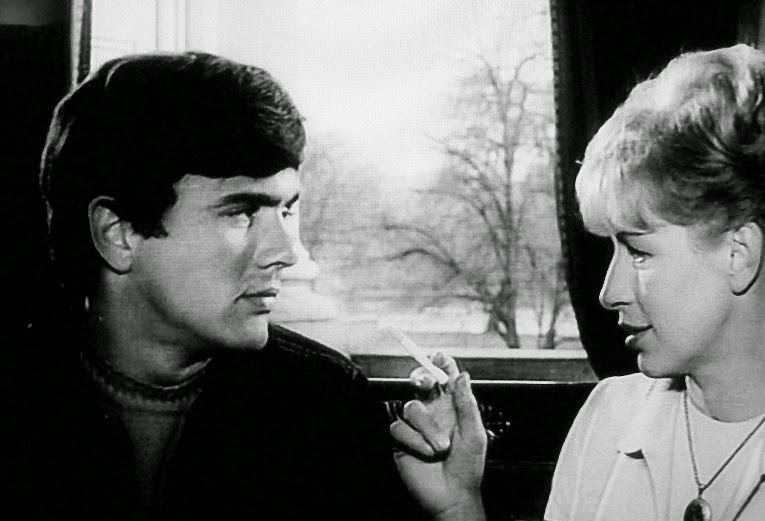
PERFECT UNDERSTANDING (1933)

Judy (Gloria Swanson), an American in London visiting Lord Portleigh, an old family friend, falls for the handsome Nick (Lawrence Olivier); he throws over Stephanie for Judy and they agree to marry. That night, the cook sees her husband, the butler, kissing the maid and stabs her (superficially, as it turns out). This makes Judy afraid of jealousy in marriage, and she insists that she and Nick sign this pledge: "Never be husband and wife, but lover and mistress; above everything else, to remain individual." They marry and have a wonderful honeymoon period traveling all over Europe, but eventually Nick agrees to join friends George and Kitty (and, unknown to him, Stephanie) at Cannes while Judy goes to London to prepare their home. Nick enters a contest in which the men get drunk and race speedboats and in the process is injured. He recuperates at Stephanie's place and winds up engaging in a night of ill-considered passion with her. When he sees Judy he confesses and despite their pledge, she's consumed with jealousy. She goes to commiserate with old friend Ivan (John Halliday), a famous explorer who has been nursing an affection for her for some time. He's leaving on a trip the next day and asks her to join him. She has a long dark night of the soul, walking the streets of London thinking things over, and decides not go, but the note she writes Ivan in appreciation of the evening is found by Nick and misinterpreted; when she denies an affair, he slaps her and leaves. Soon Judy is pregnant, but as she and Nick are on the verge of reconciling, he suddenly suspects that the child might be Ivan's and leaves again. Of course, as this a comedy, things eventually get worked out—in the divorce court.

This is one of several movies from the pre-Code days that took as a subject the search for a better kind of marriage, one that wouldn’t degrade either partner and would allow a certain amount of freedom in matters of work and play. Of course, the real subject is, a better kind of marriage is poppycock and traditional marriage still works best. The plot is predictable and the dialogue no better than it needs to be, but the movie is worth seeing for its two stars. Silent star Swanson (pictured with Olivier) only made a handful of talkies after this one, but she's fine here, as is Olivier who wasn't terribly self-important yet. He's quite handsome and a little bit scrawny as we see in the Cannes beach scenes. Halliday adopts a thick accent and it seems to hamper his acting a bit. Swanson's real-life husband Michael Farmer plays George, and despite the overwhelming critical consensus that he can't act, I thought he was OK. Nora Swinburne is Stephanie and Nigel Playfair has some fun as Lord Portleigh. The director, Cyril Gardner, gives the movie some nice stylistic touches—long tracking shots, montages, interesting shots—but the background music is almost never-ending and occasionally got on my nerves. Future director Michael Powell wrote the screenplay. [TCM]

Thursday, June 26, 2014

THE WITCH’S CURSE (1962)

aka MACISTE IN HELL

In 1550s Scotland, Martha Gunt is being burned as a witch; she goes to her death proclaiming that the presiding judge, Parrish, is getting revenge against her because she wouldn’t sleep with him and she as she dies, she curses the village, specifically the very ground she is burned on. One hundred years later, a gnarled tree has grown at the spot of her death; the curse causes girls from the town to hang themselves from the tree, which then blooms after their deaths. A descendent of the witch, also named Martha, has arrived in town to marry her boyfriend Charley and spend their honeymoon in the old Gunt castle, but when the villagers get wind of this, they grab their torches and head to the castle to kill Martha, hoping this will lift the curse.

Up to now, this has been a standard 60s horror film as ground out by Hammer Films or American International. But suddenly, who should show up in the middle of the night but Maciste, the Italian muscular, shirtless action hero, riding a horse and ready to kick some torch-wielding villager ass. He saves Martha and Charley from death, but cannot stop the officials from carting her off to jail, where she's to be burned as a witch the next day unless Maciste can break the curse. He heads off to the witch's tree, uproots it enough to go down into the ground beneath it, and enters Hell itself where he looks for the old witch Martha to try and convince her to call off the curse.

There is something almost charming about this odd sloppy hybrid. They don't even try to explain what the Hercules-era Maciste from Italy is doing in 17th century Scotland. The moment when the loinclothed hunk comes riding out of the night to save Martha is jolting in a fun way. The first shots of Hell, with dozens of underdressed people writhing in torture, are impressive, though as Maciste travels on, Hell feels rather sparsely populated. He runs across the old witch Martha who, in a nice touch, is hanging around with Judge Parrish, the man who put her to death. Among his hellish adventures: he meets Prometheus who has his intestines eternally pecked at by an eagle; gets his hands badly burned, then healed by a mysterious lovely lady; loses his memory then has it restored by looking into a magic pool to see his exploits of the past—by way of scenes from previous Maciste movies; and has to deal with an avalanche and some stampeding bulls. Kirk Morris—actually, an Italian actor named Adriano Bellini (pictured)—is likeable and boyishly cute in addition to being lithely hunky. And while I’m on the subject, Angelo Zanolli is quite handsome as Charley, who stands by his new bride even to the extent of climbing up to the stake with her as she's about to be burned. Something a little different for horror and/or peplum fans. [DVD]

Wednesday, June 25, 2014

LA BATAILLE DU RAIL (1946)

aka THE BATTLE OF THE RAILS

This WWII fiction film about French railway workers who became part of the Resistance by sabotaging rail traffic in the occupied zone is unusual in a few ways. It's not a documentary, though it often feels like one—and it is rumored that some actual footage of sabotage missions made it into the final film. Many of the actors were non-professionals. Perhaps in the service of verisimilitude, none of the characters is developed, and only one, the chief guy in the office who is also directing the resistance efforts, is in enough scenes to become familiar to us. Instead of a narrative, the film is structured in chronological episodes just before, during and after D-Day, ending with the liberation of the town of St. Andre. In the beginning, we see small acts of smuggling—of packages and people—followed by the fairly subtle delaying of the arrival of trains packed with German soldiers. As the narrator tells us, the railmen's acts of sabotage were "grains of sand" to make grit in the Nazi war machine. The film does build to a climax of sorts when the railroad workers hear about the Allied landing; the last part of the movie follows the huge concerted effort to stop soldiers, tanks and weapons from reaching Normandy; the French get some help from an RAF air raid.

Even though we don't get to know any of the characters (who also remain mostly nameless), we do feel for them as individuals working against the evil of the Nazis. One remarkably well-done sequence occurs fairly early in the film; after some trains have been blown up, the Nazis, unable to pin down any saboteurs, take several workers hostage and eventually line them to be killed by a firing squad. The camera looks down the row of men facing a wall (pictured), as one by one they are picked off. Another notable scene near the end shows a train derailment that looks very real. This is an early work by director Rene Clement (FORBIDDEN GAMES, PURPLE NOON); his style is solid and assured, perhaps because he had shot a number of actual documentary films before this one. The print on the DVD from Facets is not in the best shape, and some of the subtitles are a little off when it comes to translating idioms; "Bon appétit" is shown as "Good appetite," and later odd phrases include "Ain't that a lark!" and "I like to realize…" But this is an oddity worth seeing. [DVD]

Monday, June 23, 2014

ENEMY AGENTS MEET ELLERY QUEEN (1942)

Police sergeant Velis (James Burke) boards a train to New York; he is escorting Reese, a suspect in the murder of Dutch jewel merchant Van Dorn and they're handcuffed together. Also on board are the very Germanic Heinrich (Sig Ruman) and his henchman who manage to knock Velis out and get Reese away from him, at which point they throw Reese off the train to his death. As it happens, Ellery Queen (William Gargan) and his secretary Nikki (Margaret Lindsay) are also on the train and when Velis is fired by the chief inspector (Charley Grapewin) who is also Queen's father, Queen agrees to help Velis get his job back by digging into the mystery. It winds up involving a mummy case imported from Cairo which has diamonds in it that are being smuggled away from the Nazis by Van Dorn's widow (Gale Sondergaard), and that's what Heinrich and his men are after. I like Gargan but there is so much going on and so many characters that he winds up fading into the background. Even the scene-stealing Sondergaard doesn't get much of a chance to shine. Familiar faces include Gilbert Roland as the mysterious Mr. Gillette, Minor Watson as Commodore Lang, an old friend of the Queens, and James Seay as a Marine who is handy with his fists and who helps Queen out in the fisticuffs-filled finale. This works better as a spy thriller (or a wartime propaganda piece) than as a detective series entry, as there is little to make this seem distinctively an Ellery Queen story.  (YouTube)

Friday, June 20, 2014

CREATURE OF DESTRUCTION (1967)

This low-budget movie which went directly into television syndication is a remake of 1956 low-budget horror film THE SHE-CREATURE, which, while it had an interesting plotline, was no great shakes itself. In this version, the sinister looking (because of his goatee) Les Tremayne performs a show at a seaside resort in which his lovely assistant (Pat Delaney) helps him read minds and make predictions. One night, he predicts that there will be a murder on the beach—and there is. There are more predictions and more murders, and the resulting publicity winds up being good for the resort, so the owner (Neil Fletcher) enters into a business deal with Tremayne—who insists he's a real psychic—publishing a quickie book about the situation. However, the cops (led by Roger Ready—yes, that is the actor's name) get a handsome Air Force officer (Aron Kincaid) who just happens to be an expert on parapsychology to help them investigate. It turns out that Tremayne puts Delaney into a past-life regression trance which triggers the appearance of one of her prehistoric selves, a googly-eyed sea monster which goes on a beachside killing orgy.

Even by TV-movie standards, this is cheap and mostly lame. A quickie from American International which needed a few new films to flesh out its syndication package, it's a few steps above Ed Wood but don't expect much out of this. The saving grace is Les Tremayne who had a lengthy career in movies, radio and TV, working regularly up to 1990. Though he may be a bit embarrassed about the production around him, he gives a nicely understated performance, sinister but not histrionic. Kincaid (pictured) was pleasant enough as beach movie eye candy, but here he just seems wooden, and his character, who would seem to be the hero, mostly just observes and predicts bad things—and the fact that all his dialogue is post-dubbed doesn't help. The monster itself is a very bad knock-off of the Creature from the Black Lagoon with ping-pong balls for eyes. Most of the night scenes are clearly cloudy-afternoon scenes with no attempt made to darken them. For trash connoisseurs and fans of wooden hunks only. [DVD]

Thursday, June 19, 2014

SINFUL CARGO (1936)

aka YELLOW CARGO

Drug enforcement agent Conrad Nagel is re-assigned to Immigration and sent to Los Angeles to stop a ring of smugglers who are bringing in "Asiatics" illegally. The suspicion is that some bigwig Hollywood type might be behind it, and sure enough, Nagel immediately suspects the owners of Globe Productions, a new company whose big boss, a guy named Brace, is elusive, and whose only director (Jack La Rue) isn't doing much directing. To get an in, Nagel's cover story is that he's a Broadway actor looking for work so has a good reason to hang around Globe's offices. Also suspicious is reporter Eleanor Hunt who, along with her bumbling cameraman (Vince Barnett), haunts Globe's offices trying to get an interview with anyone—she reasons that studios always want publicity, and when one doesn't, it's as newsworthy as "man bites dog." It turns out that Globe is, in fact, a front for the smugglers: they take a small boatload of extras dressed in Chinese garb out to a nearby island to shoot a scene, send the extras back on a commercial boat, and bring the illegal immigrants back on their private boat, seeming to be the same extras that went over. Nagel disguises himself as an extra to investigate, the same day that Hunt and Barnett hide on the island to get pictures. What could go wrong?

This Poverty Row B-movie is a little better than average, partly due to the interesting storyline—though as usual with these cheapies, there are some plotholes here and there to ignore. Nagel, who had a long career as a supporting player and B-star, is fine—he played the same character, Alan O'Connor, in three other movies. La Rue and Barnett are familiar faces to the classic movie fan; La Rue (pictured above with the gun) was very busy, mostly as a villain, credited in more than 50 movies just between 1933 and 1940. I could have done with a little less comic relief from Barnett, and Hunt seems almost like an amateur, but overall this is a fun hour. One highlight is a little girl in the Globe waiting room who wants to know what Shirley Temple has that she doesn't. The movie's director, Crane Wilbur, plays Brace, the head of the ring. [DVD]