Thursday, April 27, 2017

THE WOMAN WHO WOULDN’T DIE (1965)

aka CATACOMBS

Ellen Garth (Georgina Cookson) is the wealthy owner of a textile company. She runs things with an iron fist, much to the consternation of her secretary Richard (Neil McCallum) who seems to be devoted to her but who is actually being blackmailed by her—he tried forging her name to some checks and when she discovered his duplicity, she kept the checks in a safe to ensure that he remains a compliant assistant. He gripes a lot to Raymond (Gary Merrill), her husband, who is generally content to live off her money but is not happy with the way she runs her home life; she's prone to lots of aches and pains, and, as a practitioner of the exotic religion Suplianism, she frequently puts herself into a coma-like trance to ease her pains. She's also a highly-sexed woman and places many demands on him in the bedroom. When her beautiful young niece Alice (Jane Merrow) arrives from art school in Paris, she starts what seems to be an innocent flirtation with Raymond, and he responds with increasing passion until the two are in the middle of an affair. Soon, Raymond and Richard are collaborating on a plan to get rid of Ellen—when she leaves for a scheduled trip to Rome with Richard, they plan on killing her off in what will look like a car accident (she has a well-known penchant for reckless driving) and they even hire a look-alike actress to help pull off the stunt. But you know what they say about the best laid plans of mice and men.

If you’ve seen the twisty French thriller DIABOLIQUE, you'll know more or less what's going on when it seems like the dead Ellen (or her ghost) keeps popping up to ruin everyone's plans. But even if this is a familiar plot device, you can still have some fun figuring out who's running the scam. This B-film second feature is bland looking and two of the leads are disappointing: Merrill looks a little too old and tired for the part, despite characters frequently telling us how attractive and strong he is (saying doesn't make it so). Merrow looks the part of the art school kitten, but her performance seems mostly phoned in. Luckily, Cookson makes a great brittle bitch, and McCallum does nicely as the vengeful assistant. The only other character of importance is Ellen's faithful housekeeper Christine (Rachel Thomas). The original British title, CATACOMBS, refers to a rather oblique clue to the mystery, a postcard of Roman catacombs that is sent from Rome—theoretically from Ellen though, as we know, actually from the actress. At times, the movie tries for a Hitchcock feel, but in its last 20 minutes, the pace, which should pick up, slows to a deadening creep which makes the climax, when it finally comes, a little anti-climactic. [TCM]

Monday, April 24, 2017

SPRING PARADE (1940)

Young farm girl Ilonka (Deanna Durbin) brings her goat to market and while there has her fortune told: she will find her true love in Vienna; he will be an artist; and love will "hit you with a stick." She doesn't really believe the prediction, but when she lies down for a nap in a hay wagon, the wagon driver takes off for Vienna, not realizing she's asleep in back. The driver Latislav (S.Z. Sakall) is a baker who dreams of becoming the royal baker—he already bakes salt bread rolls for the Emperor—and he lets Ilonka stay and work at the bakery with his two very young nephews and Jenny (Anne Gwynne), his assistant. When the Army band goes marching by in the mornings, Jenny flirts with a handsome drummer named Harry (Robert Cummings), even though she's practically engaged to Count Zorndof. Through a comedy of errors, Harry winds up on a date with Ilonka rather than Jenny. He's embarrassed by her "country hick" ways in the big city, so they don't exactly hit it off right away, though later, when Ilonka realizes that Harry is an aspiring composer, she begins to think that he might be the artist she is destined to be with. Thanks to Ilonka's meddling, comedies of errors continue until the Emperor himself has to straighten things out.

I'm not a big Durbin fan, though to be fair I've only seen a couple of her movies. She doesn't bring much to the table except pleasantness—she has pleasing looks, a pleasing voice, and, generally, a pleasant persona. She's not bad but she leaves a bit of a personality hole in the middle of this operetta-ish tale. Actually, her character is fairly obnoxious in her single-minded drive; she seems more in love with the idea of fulfilling her fortune than with Harry. I've always found Cummings to be rather bland as well, though he's more fun here than usual. Sakall (pictured with Durbin) is Sakall—if you like his cuddly Germanic grandpa shtick (and I generally do), you'll like him here. Gwynne is fine, and good support is offered by Henry Stephenson (as the Emperor), Franklin Pangborn, Reginald Denny and Allen Joslyn. There are a few songs, including a fun dance number in the opening with Durbin and Mischa Auer and a song based on the Blue Danube Waltz. The two nephews are played by child actors Billy Lenhart and Kenneth Brown, who were known professionally as Butch and Buddy, and they are fun—when Sakall introduces them to Durbin, one of them asks, "Did you win her at the fair?" Fluffy and light and painless. [TCM]

Thursday, April 20, 2017

GENTLEMAN’S FATE (1931)

Rich, handsome John Gilbert is about to propose to Lelia Hyams when he gets a call from his guardian that changes his life: Gilbert isn't really an orphan, but the son of an unsavory bootlegger who is dying and wants to see Gilbert before he dies. When he visits his father on his deathbed, Gilbert also discovers he has a brother (Louis Wolheim), a gruff underling of his father's who wants Gilbert to join the business. After Dad dies, Gilbert does slowly get involved in the business, trying to keep his activities secret from Hyams, but when he agrees to take a rap and go to jail, she leaves him. Soon, in a trajectory that will be familiar to anyone who has read or seen The Godfather, Gilbert has taken over the bootlegging racket with gusto, and even killed a man who worked for his rival (John Miljan). Miljan doesn't take kindly to this and send his ex-moll (Anita Page) to spy on Gilbert; instead she falls in love. But when Miljan plans a more exacting revenge, a romantic ending is not in the cards. Gilbert is fine here, as is the bulldog-faced tough guy Wolheim who died of cancer before this film was released. Marie Provost provides nice comic relief as a secretary. Favorite exchange: "Say, Mike, are you plastered?"; "Sister, I'm stuccoed!" [TCM]

Tuesday, April 18, 2017

THE MIND BENDERS (1963)

We first see Prof. Sharpey, a well-regarded research scientist at Oxford, looking dazed on a train station platform. In a train compartment, he still seems out of it, and eventually he throws himself off the train and is killed. It turns out that government agent Hall (John Clements) suspected him of being a spy, and Sharpey had a satchel full of money with him on the train, so Hall questions Sharpey's colleague Longman (Dirk Bogarde); the two had been working on sensory deprivation experiments where a subject is immersed in a tank of warm water and shut off from all sight, sound, and touch for hours at a time. Longman believes that rather than espionage, Sharpey was behaving strangely because of the "reduction of sensation" trials. One scientist, in filmed testimony, was heard in the tank babbling about seeing angels, and Longman himself says their experiments are concerned with "physics of the soul." Longman agrees to be put in the tank himself so Hall can observe, but Hall colludes with Longman's friend and assistant Tate (Michael Bryant) and the two attempt to brainwash Longman just to see if it can be done. When he comes out of the tank in a weakened mental state, they plant a hypnotic suggestion in his mind: that he finds his wife repulsive and has never really loved her. Six months later, unfortunately, the brainwashing has worked too well.

Don’t let the title or advertising fool you—this is not a movie about recreational drugs, and though technically it could be considered science fiction, its traditional sci-fi elements are minimal. It winds up being a cross between "Who's Afraid of Virginia Woolf" and "The Manchurian Candidate"; an interesting if stagy marital melodrama, fueled by the brainwashing experiments. Though the set-up is plausible, what is not plausible, and comes close to ruining the movie for me, is that Longman's friend Tate would not have realized in six months time that the hypnotic suggestion had worked. The last third of the film, set at a drunken party at which all the principal figures, including Longman's pregnant wife (Mary Ure) and his current mistress, come together, is basically a long night's journey into day in which the damage that the experiment has done finally comes to light. This whole thing winds up feeling misguided—either more personal backstory or more science-fiction (at times it feels like an early version of ALTERED STATES) might have make things gel better. Bogarde is a bit too intense, though Bryant and Ure are fine. Not particularly believable or compelling; though not awful, this can be skipped. Pictured are Bogarde and Bryant. [TCM]

Friday, April 14, 2017

THE VANISHING SHADOW (1934 serial)

We're back in Serials-land: more cliffhangers, more fisticuffs, more repetition of action, and more weak writing. If this is your thing, keep reading—it's perhaps the earliest adventure serial I've seen and though it's nothing special, it does have a couple moments of interest. Professor Van Dorn is a slightly loony scientist who has created several inventions including a Destroying Ray which, yes, destroys things—only living things, leaving inanimate objects unharmed—a ray that burns through metal, and a huge but clunky robot. Stanley Stanfield is an engineer working with Van Dorn who has invented a Vanishing Ray machine which, when strapped onto a person, causes them to vanish—but leaves their shadow visible (so the title is a complete lie: the shadow NEVER vanishes!). Stanley's father, a crusading newspaper editor, was driven to an early death by corrupt businessman Wade Barnett, and now Barnett wants Stanley's newspaper stocks so he can take over the paper and stop it from continuing to muddy his reputation. But Barnett's daughter Gloria, ashamed of her father, has taken a false name and, when Stanley comes to her rescue when she faints in middle of a busy street, the two become friendly and she agrees to help him deal with her father.

All of the above happens in the first 20 minutes. The rest of this 4-hour serial consists of repetitive episodes in which Barnett and his chief goon Dorgan try to get their hands on the stocks, Stanley uses the Vanishing Ray to spy on people, and Van Dorn wrecks havoc with his inventions. I must admit that the central conflict, over stocks and bonds, is different from the usual serials concern with taking over the world, but it's a rather low-key plot that moves incredibly slowly. The hero, played by Onslow Stevens, seems more perturbed than heroic, and in fact spends most of the last two climactic chapters tied to a chair as things happen around him. Richard Cramer enjoys himself as the thug Dorgan. Van Dorn (James Durkin, gleefully over-the-top at times, and pictured above with Stevens) is on the good guys' side, but is also a little insane and quite bloodthirsty. When he agrees to work with Stanley against Barnett, he says enthusiastically that he wants to be "judge, jury and executioner." Barnett (Walter Miller) keeps promising his daughter that he'll reform, but despite the fact that he keeps breaking that promise over and over again, she keeps giving him the benefit of the doubt. Barnett's affection for his daughter, and his attempt to make sure that his thugs don’t hurt her, provides an interesting plotpoint here and there. Ada Ince, as Gloria, has little to do and is not very good at doing what she does. The robot is seen early on, but doesn't get unleashed until near the end. It's goofy and not all that scary looking, even though all the characters are scared shitless of it. At seven or eight chapters, with a brisker pace, this might have been more fun. As it is, recommended for viewers who are already fans of the classic-era serial. [YouTube]

Thursday, April 13, 2017

CHEYENNE (1947)

aka THE WYOMING KID

We are told that Wyoming Territory in 1867 is a magnet for "lawless hordes" drifting west; however, there are no hordes in this movie, just a small gang of bandits and a mysterious outlaw named The Poet who steals money and gold from Wells Fargo wagons and leaves short poems instead. Jim Wylie (Dennis Morgan) is a gambler who gets into a spot of trouble in Laramie, but instead of getting arrested or run out of town, a Wells Fargo agent asks him to go to Cheyenne where the Poet is supposedly headed and work undercover on exposing him. Jim takes a coach to Cheyenne with the sexy chorus girl Emily (Janis Paige) and the attractive but standoffish Ann (Jane Wyman). Along the way, their coach is beset by small-time bandits, led by Sundance (Arthur Kennedy). Ann berates Jim for not using his gun to stop the robbery, but as it turns out, Sundance and his men wind up with no money, just another note from the Poet. That night, Jim spots two men he recognizes from the gang, follows them back to Sundance's hiding place, and claims that he is the Poet. But his plan is upset a bit when he is surprised to discover Ann negotiating with Sundance on behalf of the Poet—Ann says she's The Poet's wife! She goes along with his deception for her own reasons, but who really is the Poet? And what is it he wants?

That’s about as far as I should take the plot summary because the coming plot twists are what make this worth watching. Some are predictable, some are surprising—a fairly major character is killed off halfway through—so the elements of a crime thriller tend to override the Western genre conventions. The acting is solid; Morgan, Kennedy, Paige, and Bruce Bennett, who plays a Wells Fargo inspector, are all fine. Paige is the very personification of vivacious and when she's off screen, the movie's energy level suffers a bit. Wyman is rather flat, partly perhaps due to the secrets the character is keeping, but even when all that's out of the way, her performance still feels lacking—perhaps in comparison to Paige. Alan Hale has some fun as a sheriff, and you'll recognize Barton MacLane and John Ridgely. Paige (pictured above with Morgan) gets to sing a couple of songs, and Max Steiner wrote chipper but wildly overused theme music that plays whenever we see the stagecoach on the road, which is often. This could use some judicious editing, especially in the last half-hour, but it's certainly watchable. [TCM]

Monday, April 10, 2017

THE TENDER TRAP (1955)

Frank Sinatra is a wealthy playboy theatrical agent who lives in a fancy high-rise penthouse in Manhattan and is dating (let’s be more honest than they could be in 50s Hollywood and say, "sleeping with") as least four different women, and he's turned rotating through them into a fine art. He seems most serious about professional violinist Celeste Holm, but even she is often left dangling. However, his schedule is shaken a bit by the entrance of two people in his life. First, his childhood best friend (David Wayne) arrives to stay with him for a couple of weeks—his wife suggested that after eleven years of marriage, they take a short vacation from each other. Not sure whether this is a sign of long-term dissatisfaction, Wayne seems generally at odds, and may be at least a little jealous of Sinatra's swinging lifestyle. The second interloper in Sinatra’s life is struggling actress and singer Debbie Reynolds who lands a starring role in a new musical and becomes Sinatra's newest client. Reynolds is lovely and lively, and though she still lives with her parents, she knows what she wants: a husband, three kids, and a house in Scarsdale, and on a timetable to boot. As Sinatra starts ignoring Holm to spend time with Reynolds, Wayne finds himself smitten with Holm.

What makes this silly non-farcical romantic farce worth watching is the cast. I've never found Sinatra to be a particularly compelling actor, but he's perfect here, where he seems to be barely acting—the playboy life he leads fits exactly the persona Sinatra projected for most of his life. Reynolds is her usual bright and cheery self, though the platitudes about marriage that she has to mouth are disturbing, and Holm is fine as the one mentally mature person in the bunch. The revelation for me was David Wayne, whom I mostly know from his later role as Ellery Queen’s father on TV and from his earlier role as what I interpreted as the gay best friend who acts like he's in love with Katherine Hepburn in ADAM’S RIB. His role here is substantial—and sometimes, he's more interesting than the Sinatra character—and he's up to the challenge. The look of the movie is a little strange; based on a play, the film remains quite stagy, so many of the scenes are basically 3 or 4 people walking around the apartment talking. But the movie is shot in widescreen so we get a big empty expanse around the actors. Granted, the apartment is well-appointed and very modern, but visually the film is fairly inert. Carolyn Jones (Morticia Addams) has a small role as Sinatra's dogwalker. If you can get past the 50s attitudes about women and marriage, this is OK. [TCM]

Friday, April 07, 2017

OVER THE MOON (1939)

Jane (Merle Oberon) has been taking care of her ailing grandfather and living in his large but decrepit mansion in isolated rural Yorkshire. She's been feeling sorry for herself as she has also wound up as caretaker to his servants who are either also ailing or act like it, and she thinks that life is passing her by. Freddie, the young local doctor (Rex Harrison), has taken a shine to Jane and, when the old man dies, offers to sell his practice so they can get married and move to London. But when it turns out that the grandfather has left her 18 million pounds, things change. Jane makes headlines as a "Cinderella" girl, and attracts various hangers-on who want a piece of her fortune. Freddie is turned off by all the hubhub and the two go their separate ways. He winds up in an unfulfilling job attending to rich hypochondriacs in Switzerland, and she goes to Monte Carlo and deals with gold-digging men. Of course, true love will eventually win out. This early Technicolor romantic comedy produced by Alexander Korda (then Oberon's husband) is cute but undistinguished. The plot is similar to the template that would become screwball comedy, but this is played too slowly to be mistaken for that, and the direction lacks style or fizz. Still, the leading pair is fine, and the supporting players (Ursula Jeans, Robert Douglas, Wilfrid Hyde-White, Ethel Griffies) carry some of the dead spots. [Criterion streaming]

Tuesday, April 04, 2017

ATTACK FROM SPACE (1965)

First, a word about me and Japanese sci-fi movies: I tend not to watch them unless they are accompanied by the guys and gals and robots of Mystery Science Theatre 3000, in which case, try to keep me away. ("Gamera is really neat/Gamera is full of meat!") I have seen and appreciated the classics GODZILLA and MOTHRA, and a handful of others—I watched GOKE, BODY SNATCHER FROM HELL because, you know, that title. But typically, the cheap effects, the laughably bad monsters, the presence of young children as major characters, and the terrible dubbing (these movies would be improved quite a bit if they were released in subtitled versions with the original Japanese audio), all make this genre more suited to an evening of campy commenting than serious entertainment, scares, or awe. This movie was recommended to me by YouTube based on the number of public domain B-movies I've seen, so I watched it unaware for a few minutes of what it was. By the time I realized what it was, I couldn't take my eyes from the screen.

In the opening sequence, a narrator tells us that the Sapphirians, an alien race bent on conquest of the universe, are heading to Earth to start a nuclear war that will destroy us. However, from the peaceful planet Emerald comes a humanoid hero called Starman to save us. Starman has a heavy-duty wristwatch which lets him pretty much do everything that Superman can, including fly through space in just tights and a cape. On Earth, a group of men are already at work clearing the way for the Sapphirians by kidnapping Dr. Yamanaka, creator of a super-powered spaceship, and two of his children, to force him to work on a super-duper ship for them. The Sapphirians are a militaristic Nazi-like group who warn the world what they're up to, then destroy a mountain in the Himalayas to show what they're capable of.  As this is a Japanese 60s movie, the kids get involved by plotting with one of Yamanaka's assistants to free their father, being held under hypnotic control. Eventually Starman finds the ship, boards it, and kicks off a 15 minute ass-whooping scene in which he uses fists, martial arts moves, and guns to decimate the Sapphirians. Yamanaka, his young son, and his assistant escape in a spaceship; after Starman has finally kicked hundreds of Sapphirian asses, he flies the daughter through space to join her dad and destroys the Sapphirian ship.

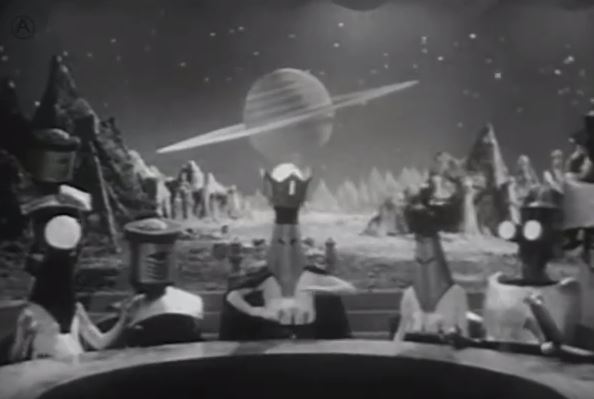
Before this movie turned into a typical Japanese SF kiddie-movie, it grabbed me with its opening sequence. It mostly consists of tediously delivered exposition, but the visuals—of the surface of the planets, ships drifting through space, the cheap but almost nightmarish look of the peace council on Emerald (pictured above right), and the shots of the glowering Starman flitting through the galaxy—are dreamy and almost surreal. I discovered later that the movie is actually two episodes of a TV show knit together, and that Starman had other small and big-screen adventures. This helps explain why the movie feels like an old-fashioned movie serial with occasional sequences that barely feel related to each other. In fact, in my notes, I scribbled down this observation: "Imagine if Ed Wood had been hired by Toho Studios to make a 12-chapter sci-fi serial, but then was told he had to cut it down to 75 minutes." Actually, this film’s technical aspects are several notches above those of an Ed Wood movie, and the production design, though distinctly low budget, shows some flair. But there is an overarching slap-dashedness to everything that makes you think any moment now, the set will fall over on an actor. Big chunks of plot are dispensed with in a few sentences of spoken exposition. One scene of the bad guys face-checking a crowd of a hundred or so troops to find a disguised intruder plays out at length, practically in real time, and then it turns out that the intruder isn't even there. I have read that Starman's crotch was stuffed to make him seem more masculine (see picture at left), but I will leave verification of that to others who might have known the actor. This movie deserves a drubbing from MST3K—and apparently it has been mocked by the Rifftrax gang—but I still found it to be a semi-delightful surprise. If for nothing else, it should be seen for its epic concluding fight scene, with lots of fists that don't come anywhere near connecting with a jaw, and for the obvious dummies that Starman tosses hither and yon. [YouTube]

Monday, April 03, 2017

THE SHOOTING (1966)

Will (Warren Oates, at right), a former bounty hunter, returns to his camp to find his simple-minded buddy Coley (Will Hutchins, pictured below) cowering in fear in his tent: someone shot their buddy Leland Drum to death at the campfire. Now Will's brother Coigne has vanished—he and Drum may have been involved in the accidental death of a child in town. Will realizes that he's been followed to the camp, and indeed a woman in a black hat (Millie Perkins) arrives soon after. She explains that she's following someone but has had to shoot her injured horse and now needs a horse and a guide to keep going. She rather arrogantly demands that Will and Coley accompany her, and even though Will realizes that the horse she shot wasn't actually injured, they agree to help her. Will also picks up on the fact that the woman is signaling their presence to someone, and soon that someone shows up, a hired gun named Billy (Jack Nicholson). Relations between the four are a bit frosty and even tense, with Billy constantly at odds with Coley, and Will trying to keep things smoothed out. Eventually when the woman's horse goes lame, she takes Coley's horse and makes him stay behind in the burning hot desert. Will seems to sense that this journey will not end well for any of them, and he's right.

This is often referred to as an "existential Western" and by golly if it ain't. The plot outline is recognizably drawn from Western movie motifs—revenge, gunfights, lone woman in the company of men, wandering cowboys—and the landscapes (shot in Arizona) are just as lovely and foreboding as in any John Ford film. But aside from the laying out of a skeletal plot, nothing much really happens, and certainly, with the exception of Will, the characters don't get developed to any degree. It is often remarked upon that the director, Monte Hellman, had directed a stage version of Waiting for Godot in a Western setting before he made this film, and while this isn't as vague as Godot, there are similarities in the sense that people are waiting for something to happen and it doesn't happen. Except here, the people don’t wait in one place, they keep moving, and ultimately something does happen in the last five minutes, so fans of plot-driven narratives (most of us) will not be totally stymied, even if we never get a full recitation of the backstory of the characters. Oates is the main reason to stick with the film—he gives a grounding performance that gives us something to hang on to in this desolate, meaningless universe, um, I mean, in the lonely desert. Hutchins, probably best known for the 60s TV Western Sugarfoot, is surprisingly good in the "juvenile" role. Perkins is a bit stiff and artificial; Nicholson is Nicholson.

Hellman shot another Western back to back with this one, RIDE IN THE WHIRLWIND, with Nicholson and Perkins (Jack also wrote the screenplay). It shares a similar tone of uncertainty with THE SHOOTING but while it has a somewhat more traditional story, it's also less interesting. Cameron Mitchell and Nicholson are two cowboys on the run, mistakenly assumed to be part of a group of outlaws. They take refuge with an isolated family (Perkins is the daughter) and try to hold out there while the law passes by. There is more gunplay here than in  THE SHOOTING, but despite having a more coherent plot, it feels longer and harder to get through. The two films are available on a nice Criterion DVD set. [DVD]

Friday, March 31, 2017

THE DEATH KISS (1932)

A well-dressed woman strolls up to a duded-up stranger on the street, kisses him on the mouth and walks away, saying she just couldn't resist. But it turns out that the kiss was a signal to a thug in a car who shoots the man dead. Then the camera pulls back and we see that we've been watching a movie scene being shot. But when they go to restage it for another take, the corpse doesn't get up. In fact, the actor, Myles Brent, has actually been shot dead. All the guns on the set are examined and contain blanks, so it appears he was shot by someone in hiding. The cops are called but studio writer Franklyn Drew (David Manners), who really wants to write detective novels, shows up and decides to compete with the police, with some sidekick help from Gully, the security guard. Among the suspects: the actress Marcia Lane—the one who bestowed the 'death kiss' on Brent, who was Brent's ex-wife and who might be in line for a big insurance payoff; studio manager Steiner (Bela Lugosi) who, with his thick European accent and slicked-back hair just seems a little sinister in general; Grossmith, the head of the studio; the director (Edward Van Sloan); and Chalmers, a former gaffer who was fired for showing up to work drunk but who was given a job on set out of pity by Lane. Soon another studio worker is found dead at his home after drinking poison; the cops assume it's suicide (since there is a suicide note) but Drew and Gully notice clues that indicate it's murder. Will the killer strike again?

This pre-Code B-mystery was marketed as a horror film to take advantage of Bela Lugosi's presence, but he actually has a fairly small role—though it’s fun to see him in a straight role for a change. It's also fun to see Lugosi reunited with his DRACULA co-stars Manners and Van Sloan (both of whom are pictured at right). I'm a fan of Manners so I enjoyed seeing him get a lead role for a change—though he is technically the leading man in movies like DRACULA, THE MUMMY and THE BLACK CAT, he is overshadowed in those by the villains and/or, as in DRACULA, by the leading lady. He gives his character enough personality that I'm sorry there weren't more Franklyn Drew mysteries. Ames is a bit of a sleepwalker here, and Van Sloan, like Lugosi, vanishes for long stretches, but there a number of good supporting performances from Alexander Carr (Grossmith), Harold Minjir (his flamingly gay assistant), Vince Barnett (Gully) and Al Hill (an assistant director). I'm not sure why this was put on Blu-Ray; the audio commentary by Richard Harland Smith is very good but the film itself hasn't been given much of a restoration. It does, however, have a handful of scenes featuring hand-tinting, including a startling moment when a film being projected catches fire and a burst of yellow-orange suddenly appears. Flashlights and guns also glow yellow in a couple of scenes. [Blu-Ray]

Thursday, March 30, 2017

CYCLOTRODE X (1966/1946)

Professor Chambers has invented the Cyclotrode, a rather ill-defined McGuffin device that can wreck havoc with electrical power. Though he's developed it at his university for use by the government, a criminal mastermind known as the Crimson Ghost (who dresses in a huge grinning skull mask and—one can only assume since the film is in black & white—red robes) is after it for his own nefarious uses. When the machine and its inventor are taken, our hero Duncan Richards goes after them, knowing only that the Ghost is one of Chambers' university colleagues. This is a 100-minute condensed version of a 167-minute serial from 1946 called THE CRIMSON GHOST; it was released in the mid-60s during a period when old movie serials were considered campy fun, and it's a slam-bang affair, with all the fat trimmed. There isn't much more to the narrative than I've summarized above, but the movie is filled with incident, with cliffhangers arriving every ten minutes or so. At some point, a death ray is introduced, and at the climax, out of the blue, Duncan (Charles Quigley) and his chief assistant Diana (Linda Stirling) bring along a Doberman to help out. The skull face of the Crimson Ghost is indeed creepy, though the fact that we see him constantly, and that he basically just stalks about in his hideout and sends others to do his dirty deeds, makes him much less scary by the halfway point. Clayton Moore, later TV's Lone Ranger, is Ashe, the Ghost's main henchman, and he's actually more charismatic (and better looking) than the hero (he's on the left in the picture above, with Kenne Duncan as Chambers in the middle and the Crimson Ghost at right). The identity of the Ghost doesn't really matter since the characters of the suspects are all basically interchangeable. The best gimmick in the film is a necklace that the Ghost puts on those he has forced into doing his bidding; if anyone tries to remove it, he or she is instantly killed. As crowded as this film is with action, I doubt I'm missing much by not viewing the original serial—unlike the case of the more drastically edited SHADOW OF CHINATOWN. [Paramount Vault streaming]

Wednesday, March 29, 2017

SHOW GIRL IN HOLLYWOOD (1930)

Composer Jimmy Doyle (Jack Mulhall) is sweet on fledgling song-and-dance girl Dixie Dugan (Alice White); he wanted her for the lead in his new show Rainbow Girl, but his producers said no. Now, the show has closed and Frank, a Hollywood director (John Miljan), hears Dixie sing at a club and decides to use her in his next picture. She goes to Hollywood and becomes friends with Donny (Blanche Sweet), an actress from the silent days who is forgotten at 32, and former wife to Frank, though Dixie is unaware of that. Dixie is also unaware that Frank is the next thing to washed up, and sure enough, he's soon fired from the film. The producers decide to hang on to Dixie, they turn her film into an adaptation of Rainbow Girl, and Jimmy is brought out to the studio to work on the script. But soon Dixie, egged on by Frank who wants revenge against the studio, becomes a demanding diva and it seems like the picture might wind up getting shut down for good. Can Jimmy and Donny get Dixie away from the villainous Frank and salvage her movie career?

This early sound musical is almost done in by the weak lead performance from Alice White (pictured) who is way too cutesy early on, and later is too artificial to be effective as a bitch. But there are a few pleasures to be had. The best performance is by Blanche Sweet, who was in fact, like her character, a silent movie star whose career was about over—though in real life, she was 34. She sings a sad song about her chosen career: "There’s a tear for every smile in Hollywood/Every mile's a weary mile in Hollywood." Miljan is appropriately repugnant as the bad guy and Ford Sterling is fine as the movie producer. There's an interesting scene showing how a big production number is filmed, and a handful of stars (Al Jolson, Ruby Keeler, a very young Walter Pidgeon) appear briefly as themselves. The last song, "Hang on to a Rainbow" was originally shown in color, though the current print has it in black & white. [TCM]

Monday, March 27, 2017

DICK BARTON, SPECIAL AGENT (1948)

Dick Barton, a kind of scruffy, rougher-edged Bulldog Drummond-type adventurer, was the lead character in a popular British radio show of the post-war years. Along with his sidekicks Jock and Snowy, Barton ran down crooks and spies in serial adventures for seven years. This is the first of three Barton films that Hammer would make with the character. Barton, with Jock and Snowy (and a bagpipe) in tow, heads to Echo Bay for a vacation at Rosemary Cottage with his girlfriend Jean and fluttering housekeeper Betsy sent ahead to tidy up. But really, Barton is on a mission to find some smugglers, and on the road, he is shot at by a nasty thug named Roscoe who keeps insisting he never misses. But he misses Barton, who nevertheless plays dead long enough for Roscoe to assume he finished his job. Roscoe and his buddy Regan run a fresh fish shop, but their leader in illegal activities is Dr. Casper, a German disguised as a Swedish biologist. When the folks at Rosemary Cottage have local fish for breakfast, they discover stolen property (gems, jewels, silk stockings) inside the fish, and Barton knows they have their men. But when Schuller, a Nazi war criminal, shows up, we know something more sinister is going on: the smuggling is mostly a front for a plan to poison England's entire water supply. Caught up more or less unwittingly in all this is young Adele, working as Casper's secretary, assuming he really is just a biologist, and her boyfriend Tony, an innocent lad with a secret in his past who is being blackmailed into helping out.

Though obviously a low-budget affair seemingly aimed at the young teen matinee crowd, this does have its charms. At 70 minutes, it's chock full of cliffhanger incidents making it feel like a longer serial that has been trimmed way down for easier consumption. Unfortunately, short as it is, some of the non-action scenes feel like padding, and the comic relief, which is plentiful, only works on occasion. In particular, the duo of Jock and Snowy get very old very quickly. The nervous Betsy (Beatrice Kane), always threatening to faint, is actually quite funny, and the young lad Snub (Ivor Danvers), who idolizes Barton via his magazine exploits, is a welcome presence; when asked, as he is frequently, what he's doing mixed up in these dangerous activities, he replies smartly, "I'm a Barton Boy!" The acting is nothing special, though I did enjoy Don Stannard (pictured with Danvers) as Barton—he's energetic, handsome, and throws himself into the character with abandon.  My favorite scenes: when Barton is captured and bound up in a knight's outfit, and when a warehouse full of bad guys pile on top of Barton to beat the hell out of him, only to wind up beating each other up when he wiggles out. I'm on the fence about whether I want to see more of these films, but this one was fun. [YouTube]

Friday, March 24, 2017

OPERATION CROSSBOW (1965)

In 1942, British Intelligence gets reports that Germany is working on long-range rocket bombs (what became the V-1 and V-2) which could be devastating to England, and, if rumors are true, even to the United States. Though some are skeptical, Richard Johnson is assigned to head up an investigation of intelligence material, and soon photographic evidence is found of rocket launching sites behind enemy lines. Unfortunately, even though the Allies can bomb them, they can be rebuilt quickly, so a small squad of three agents are parachuted in to pose as engineers from occupied countries—as they are crucial to the German effort—and help sabotage the rocket project. The men (George Peppard, Tom Courtenay and Jeremy Kemp) infiltrate the factory using IDs of dead engineers, but face constant danger of being unmasked, especially when the wife of the man Peppard is impersonating (Sophia Loren) shows up at his boarding house. This is an underrated spy thriller with a nice balance of talk and action, and even a little bit of historical accuracy; the Richard Johnson character, Duncan Sandys was real, as was Hannah Reitsch (Barbara Reuting), the German pilot who helped test the rockets, and of course, the rockets were real, and did real damage. Churchill is a character, and though the actual operation seems to be fictional, it is true that some of the rocket factories were destroyed by Allied bombers, as happens in the climax to the film. There's not exactly an all-star cast—Sophia Loren, the biggest name, has an important but small role—but Peppard (pictured) provides a handsome face and solid leading-man heroics. There is strong support from Johnson, Courtenay and Kemp, and from John Mills, Trevor Howard, Lilli Palmer, Paul Henried and Helmut Dantine. The action and suspense sequences are handled well by director Michael Anderson. Recommended. [TCM]

Wednesday, March 22, 2017

DELUGE (1933)

Scientists Samuel S. Hinds and Edward Van Sloan are mystified by the strange weather being experienced all over the globe—strong storms, an unexpected eclipse, rapidly dropping barometers, earthquakes. Ships and planes are grounded, and people are warned to take shelter. The end of the world is predicted; soon, the entire west coast of the USA collapses, as does Louisiana, and the Arctic Ocean floods into the Great Lakes. Even New York City isn't spared; between quakes and floods, Manhattan is basically washed away. We focus on one family:  lawyer Sidney Blackmer, his wife (Lois Wilson), and their two young children, who live outside of New York. As the winds and quakes hit his neighborhood, Blackmer takes his family to the relative safety of a nearby stone quarry, but he is washed away from them and wakes up the next morning in a post-apocalyptic landscape and assumes they are dead. Meanwhile, champion swimmer Peggy Shannon washes up unconscious and nearly naked and is found by two ruffians who are just barely surviving in a shack. Both men (Fred Kohler and Ralfe Harolde) seem to have lust on their minds, but they take her unmolested to their shack where she recovers. Eventually, Harolde attempts to rape Shannon and Kohler attacks and kills him, not out of any noble instinct, but because he wants Shannon for himself. She escapes, collapses, is found by Blackmer who takes her in, and they slowly fall in love and consider themselves "married."

Not far from Blackmer's retreat, two groups of people are struggling to survive. Kohler falls in with a ragged group of thugs who use physical force to get what they want, but a more civilized community is trying to rebuild, and we discover that Wilson and her two children are recovering here. Matt Moore, who has been Wilson's caretaker, tells her that in these new conditions she must marry someone when she gets healthy (I assume to build up the population and discourage unbridled male lust) and of course he hopes it will be him. But she holds out hope that Blackmer is still alive. Moore's men are after Kohler's gang, and soon Kohler manages to kidnap Shannon. A three-way confrontation is in store between Kohler's men, Moore’s men and Blackmer, leading to the destruction of the thugs and the assimilation of Blackmer and Shannon in Moore's group. But when Blackmer and Shannon find each other alive, more tension brews.

This film, long considered lost, is one of the first big-scale disaster/apocalypse films, though today's viewers may not consider its scale to be very sizeable. These films tend to be judged on their effects; Richard Harland Smith, who does a fine audio commentary on the Blu-Ray, complains about people who call the effects here "primitive," but they are primitive, and it does the movie no favors to ignore that. They will seem especially unconvincing to a modern audience, but to classic movie fans, the effects (mostly model work, mattework and stock footage) are effective enough. (RKO sold some of the effects footage to Republic for use in its adventure serials.) What unbalances the movie is that all the disaster is presented at a speedy pace in the first 15 minutes. Once Blackmer wakes up to a flat and watery world (pictured at right), the film slows down and becomes a typical survival melodrama. In a modern disaster film, there would be some prelude and backstory early on, and the disaster spectacle would play out closer to the halfway point. The acting ranges from bland (Blackmer is not very charismatic) to very good (the little-known Peggy Shannon as the swimmer). Given the remark about Wilson having to marry, it would have been interesting to go into the philosophy behind the survivors' new way of life. As it is, no attempt is made here at discussions of religion or division of labor, just as no explanation is given for the apocalyptic deluge itself—though there is an odd opening statement which refers to God's promise to Noah not to flood the world again, explaining that this film is just playing with this idea. The tantalizing idea of a three-way relationship between the leads is brought up in the novel this film was based on, but even though this was a pre-Code film, that concept isn't even touched here. The print, the only known English language one in existence, has not been cleaned up very well, but it's watchable. An interesting find. [Blu-Ray]

Monday, March 20, 2017

DEVIL’S CARGO (1948)

Earlier in the 1940s, the Falcon series featured George Sanders as a playboy detective named Gay Lawrence; soon, the role was taken over by Sanders' real-life brother Tom Conway, playing Tom Lawrence, Gay's brother. But by 1948, the character known as the Falcon seemed to have no relation at all to the original. Here, his name is Michael Watling and he's apparently an amateur magician—no doubt because the actor playing him, John Calvert (at left), was a professional magician. This film begins with the murder of Lucky Conroy, followed by a visit from Delgado, Conroy's apparent killer, to Watling (lounging in his bathtub). Delgado confesses to the murder, saying Conroy was having an affair with his wife, and gives Watling a key for safekeeping. A lawyer named Mallon is keen to take Delgado's case, even after we discover that Delgado's wife Margo was the beneficiary of Conroy's life insurance. Soon, Delgado, while in jail, is found dead—poisoned—and a couple of people show an interest in Conroy's key. Watling lets a thug named Naga steal the key and follows him to a bowling alley where Naga opens a locker and is killed by an explosion. As is often the case in Poverty Row mysteries, the plot becomes a bit too convoluted to follow clearly, so I was left to contemplate Calvert's occasional (and rather pedestrian) magic tricks and the antics of his dog Brain Trust. Actually, this isn't a bad way to spend an hour, but it's not in the same league as the earlier Falcon movies. Calvert gives a very low-key performance which is occasionally effective, but he's no replacement for George Sanders, or even for Tom Conway. The supporting cast includes Lyle Talbot, Roscoe Karns and Rochelle Hudson. Low-key is indeed the key to the proceedings. Perhaps the most interesting thing stylistically here is that there is no dialogue for the first five minutes. [Streaming]

Thursday, March 16, 2017

TWELVE O’CLOCK HIGH (1949)

In England in 1949, American Harvey Stowell (Dean Jagger) sees an antique mug in a shop window and buys it, as it reminds him of his days in England as a major in the Air Force during World War II. He then visits an empty, muddy patch of land which used to be an Air Force base, and we flashback to 1942 when he was part of the 918th Bombardment Group, the only group conducting daylight bombing raids, and consequently suffering heavy casualties. After a particularly grueling mission, General Savage (Gregory Peck) orders another mission which the group's leader, Col. Davenport, thinks is suicidal. Savage asks to have Davenport replaced because he identifies too strongly with his men, and General Pritchard agrees, installing Savage in Davenport's place. He's a hard-ass and it takes a while for him to mold the recalcitrant men—one navigator kills himself as Davenport predicted might happen. Several men ask for transfers, and Savage has Stowell delay the requests for a few days so he can work on the men, toughening them up and gaining respect. Slowly, most of the group comes around, especially when Savage begins flying some of the missions with his men. (The antique mug from the beginning of the movie crops up as a signal that a man has been assigned to a new mission.) But, also slowly, Savage begins reacting like Davenport did, over-identifying with his men, and when a couple of deaths hit him hard, he shows signs of a nervous breakdown.

This well-respected war film is not a traditional war film—though there are a couple of battle scenes, the focus is on the relationships of the men with each other and with their commanding officers, and on the qualities that make (or might un-make) a good leader. The movie's strengths are in its relatively low-key approach to the psychological plot points, and the superb non-grandstanding performances, beginning with Peck and Jagger (pictured above; both nominated for Oscars with Jagger winning for supporting actor) and including Gary Merrill as Davenport, Hugh Marlowe (who may well do the best acting of his career here as an injured flier), Millard Mitchell, Paul Stewart and Bob Patten. This is one of the few war movies with no major female character, and no romantic complications. The tone is serious but not glum in this film which was one of the first to consider the psychological costs of war. Highly recommended. [DVD]

Tuesday, March 14, 2017

SWEET ADELINE (1934)

One night in Hoboken at Schmidt's Beer Garden, Schmidt announces he has re-named his chili "liberty beans" because of the Spanish-American War (90 years before Freedom Fries!). He also fires Sid (Donald Woods), the young composer who plays piano at his establishment because Sid has defied him in continuing to date his daughter Adeline (Irene Dunne). She wants to sing and act professionally, and when Sid gets backers to stage the operetta he's writing, he tries to get his producers to replace Elysia (Wini Shaw), the star they already have, with Adeline. But complications ensue: Major Day (Louis Calhern), the main backer, starts flirting with Adeline and eventually asks her to be his mistress, leading to a fight between Day and Sid; another producer comes to suspect that Elysia is a spy; at last, during the opening performance, someone sabotages the huge swing that Adeline uses in the play, causing an onstage injury. I generally like Dunne and Woods, but they both seem to be operating at low power here. Supporting performances by Calhern, Hugh Herbert and Ned Sparks give the movie some life, as do the production numbers, particularly "When We Were Young," which was inspired by Busby Berkekely’s wild Gold Diggers numbers. A minor musical to pass the time. Pictured from left: Woods, Dunne, Calhern. [TCM]

Friday, March 10, 2017

BATTLE OF THE WORLDS (1961)

Eve heads out to the beach with good news for her swim trunks-clad scientist boyfriend Fred: they're being transferred from the barren island observatory where they work now to a better assignment someplace else. She's also happy that they will no longer be working for the cranky old man who heads the observatory, Professor Benson (Claude Rains). They celebrate this news by deciding to get married. Meanwhile, two astronomers think they have discovered signs of a strange object heading for Earth. When Fred visits the eccentric Benson in his elaborate greenhouse, Benson is already aware of the planet-sized object which he has dubbed "the Outsider." Once the public is aware, experts predict that the Outsider will collide with Earth, but Benson claims it will not. He turns out to be correct, but what it does instead is quite strange: it goes into orbit around Earth and begins shooting out flying discs aimed at our planet. We soon discover that the saucers are unmanned, and that the Outsider seems to be, rather than a planet, a vehicle for a race of aliens. The military wants to destroy it, but Benson wants to learn what it is and accompanies a small group of scientists, including Fred and Eve, to land on the Outsider. They have a short amount of time to explore before the planet will be destroyed, and of course the recalcitrant Benson puts himself in harm's way by breaking off from the others. When told he is putting himself in danger, he says, "What importance does life have if to live means not to know?"

This Italian sci-fi film has big ambitions but is hobbled by a low budget, a flawed script, and poor English language dubbing. The idea of a spaceship that looks like a planet is good and would be used in later science-fiction movies. But much of the plotting feels half-hearted or perhaps unfinished. The relationship between Eve (Maya Brent) and Fred (Umberto Orsini, in yellow at left) is given a big build-up in the first 20 minutes, but it soon sputters out to the point where they actually break up (I have no idea why—perhaps I missed a plotpoint). A sequence set on a Mars base seems designed mainly to take up time in the middle of the movie. The special effects are colorful but cheap and will certainly be disappointing to current day viewers. As the narrative approaches the climax, it gets interesting but is not really allowed to develop beyond getting to the end of the movie. What's good about it? Well, a nice eerie atmosphere is sustained throughout due to cinematography, sets and the musical score. There is quite a bit of debate about the late-career performance of Claude Rains—many critics find him hammy and unbearable, but I join those who believe that he is the movie's main saving grace. In the first part of the film, when his character holds forth in his greenhouse, he seems to be sleepwalking through the role, but by the last half-hour, he is giving a full blooded performance, even if we can tell that he thinks the proceedings are generally beneath him. This is only the second film for director Antonio Margheriti (aka Anthony Dawson) who would go on to helm many low-budget films—sci-fi, horror, exploitation—and would reach his peak with a series of cheap but colorful films in the mid-60s, the best of which is WILD, WILD PLANET. This is a public domain movie so there seems to be no official video release; most of the DVDs out there are poor in quality, but the print I saw on a YouTube channel was at least presented in widescreen, even if it was a bit blurry at times. [YouTube]