 An undoubtedly heavily fictionalized version of the lives of composer Robert Schumann and his wife Clara—though all I know about the two of them I know from this film. We begin in 1839 as young concert pianist Clara Wieck (Katherine Hepburn), playing for the King of Saxony with Franz Liszt in the audience, chooses a song by the unknown Schumann (Paul Henreid) for her encore. Her father is incensed because he knows Schumann wants to marry Clara against his wishes. Clara goes to court to get free of her father, and when Liszt testifies that Schumann has real talent, the court finds in her favor and they marry. Ten years and seven children later, the young Johannes Brahms (Robert Walker) arrives to take lessons from Robert, who has not lived up to his promise. It happens to be New Year's Eve and when the Schumann's maid quits, Brahms sticks around to help them throw their party. Brahms moves in, helps with the children, and even sweet talks the maid into returning—and he falls in love, chastely, with Clara. But soon Schumann becomes ill with severe headaches and the ringing of sharp, dissonant tones in his ears, and Clara goes back to the concert stage to make money. Eventually, when the opera he has been working on for years is rejected, Schumann is institutionalized. A sad ending is in store for all, though after his death, Clara works tirelessly to expose her husband's music to the world. As MGM biopics of the era go, this one is fine, largely due to the production values and the acting of Hepburn and Walker (pictured above). Henried is OK but I've never found him to be an exciting or inspiring actor. Henry Daniell is fine as Liszt (though nothing like the other movie Liszt I know, Roger Daltry in LISZTOMANIA). The music, by Schumann and Brahms, is lovely. Fans of the high classical biopic style of the 40s will like this. [TCM]
Tuesday, March 22, 2016
SONG OF LOVE (1947)
An undoubtedly heavily fictionalized version of the lives of composer Robert Schumann and his wife Clara—though all I know about the two of them I know from this film. We begin in 1839 as young concert pianist Clara Wieck (Katherine Hepburn), playing for the King of Saxony with Franz Liszt in the audience, chooses a song by the unknown Schumann (Paul Henreid) for her encore. Her father is incensed because he knows Schumann wants to marry Clara against his wishes. Clara goes to court to get free of her father, and when Liszt testifies that Schumann has real talent, the court finds in her favor and they marry. Ten years and seven children later, the young Johannes Brahms (Robert Walker) arrives to take lessons from Robert, who has not lived up to his promise. It happens to be New Year's Eve and when the Schumann's maid quits, Brahms sticks around to help them throw their party. Brahms moves in, helps with the children, and even sweet talks the maid into returning—and he falls in love, chastely, with Clara. But soon Schumann becomes ill with severe headaches and the ringing of sharp, dissonant tones in his ears, and Clara goes back to the concert stage to make money. Eventually, when the opera he has been working on for years is rejected, Schumann is institutionalized. A sad ending is in store for all, though after his death, Clara works tirelessly to expose her husband's music to the world. As MGM biopics of the era go, this one is fine, largely due to the production values and the acting of Hepburn and Walker (pictured above). Henried is OK but I've never found him to be an exciting or inspiring actor. Henry Daniell is fine as Liszt (though nothing like the other movie Liszt I know, Roger Daltry in LISZTOMANIA). The music, by Schumann and Brahms, is lovely. Fans of the high classical biopic style of the 40s will like this. [TCM]

Monday, March 21, 2016
BOMBA AND THE JUNGLE GIRL (1953)
 I've been working my way through the Bomba the Jungle Boy movies—this one is number 8 out of 12. As with most classic-era series movies, the films tend, after the first few, toward a certain sameness so after my review of the third film I quit writing them up. But I decided to do a brief review of this one for two reasons: 1) the title is misleading; 2) we get some backstory information about Bomba. The film opens with Bomba musing about jungle life; all the animals around him have mothers and fathers, but he knows little about his origins, only that he was raised in the jungle by a naturalist named Cody Casson, now long dead. But among Casson's belongings is a faded diary which notes that Bomba's parents were named "Hastings" and that they lived in a nearby village, so Bomba sets to find out what he can, helped by Linda (Karen Sharpe), the daughter of a government official. Long story short, he finds out that his mother and father were casualties of a village coup, conducted by the current chief of the tribe, and Bomba helps the legitimate heir regain his title, much against the wishes of the chief and his wicked daughter. As I implied above, the title doesn't mean anything; Linda is no more a "jungle girl" than any of the other female leads in the other Bomba films. Sharpe is attractive and shows more fortitude than most of her predecessors, but she never gets into a leopard skin bikini or any other exotic jungle garb. Johnny Sheffield was 21 when he filmed this, though he doesn’t really seem appreciably older than he did in the first Bomba movie three years earlier. But he does look stockier and a little less excited to be darting around the jungle. Indeed, the crocodile fight scene reuses footage from an earlier film, and the shots of Bomba swinging through the jungle are also from earlier movies. With four more movies to go, I suspect I'll find that Bomba's glory days are over, but this one was still enjoyable enough for a Saturday morning diversion. (The colorized still above features Sheffield at far left and Sharpe at far right.) [DVD]
Thursday, March 17, 2016
TOMORROW WE LIVE (1943)
aka AT DAWN WE DIE
 This propaganda thriller is set during the French occupation in the coastal village of St Pierre-le-Port where a jaunty fellow named Jean-Baptiste (John Clements, pictured at right) arrives during a period of successful Resistance activity—the Free French have managed to destroy German oil supplies and slashed the tires of Nazi vehicles. Despite his casual appearance, Jean-Baptiste is actively hiding from the Nazis and seeking out underground members; he has information that could help the British attack a Nazi military port. He is given forged papers and a job at a shipyard—and is told not to work too hard. The mayor and his daughter seem like collaborators, but they actually head up the town's Resistance band, and they plot to get Jean-Baptiste smuggled out to England along with a small group of British soldiers. The first half of the film is fairly light in tone with the Germans depicted as foolish and easy to trick, and a scene in a movie theater shows townspeople openly ridiculing newsreel footage of Hitler. But later, when a tavern keeper who informed on Free French activities is shot dead and an important supply train is successfully sabotaged, the Nazis start taking hostages. In the spirit of the film's two titles (TOMORROW WE LIVE being the British name, AT DAWN WE DIE being the American), the ending is both grim and hopeful. This is a fairly absorbing film of its type, almost archetypal in its situations and outcomes. The acting is OK, with Greta Gynt as the mayor's daughter the standout, and the cinematography is nicely done. [DVD]
 This propaganda thriller is set during the French occupation in the coastal village of St Pierre-le-Port where a jaunty fellow named Jean-Baptiste (John Clements, pictured at right) arrives during a period of successful Resistance activity—the Free French have managed to destroy German oil supplies and slashed the tires of Nazi vehicles. Despite his casual appearance, Jean-Baptiste is actively hiding from the Nazis and seeking out underground members; he has information that could help the British attack a Nazi military port. He is given forged papers and a job at a shipyard—and is told not to work too hard. The mayor and his daughter seem like collaborators, but they actually head up the town's Resistance band, and they plot to get Jean-Baptiste smuggled out to England along with a small group of British soldiers. The first half of the film is fairly light in tone with the Germans depicted as foolish and easy to trick, and a scene in a movie theater shows townspeople openly ridiculing newsreel footage of Hitler. But later, when a tavern keeper who informed on Free French activities is shot dead and an important supply train is successfully sabotaged, the Nazis start taking hostages. In the spirit of the film's two titles (TOMORROW WE LIVE being the British name, AT DAWN WE DIE being the American), the ending is both grim and hopeful. This is a fairly absorbing film of its type, almost archetypal in its situations and outcomes. The acting is OK, with Greta Gynt as the mayor's daughter the standout, and the cinematography is nicely done. [DVD]
Tuesday, March 15, 2016
LOVE LETTERS (1945)
 In Italy during the war, Roger has had his buddy Alan writing love letters to Victoria, his girl back home, but with Roger's name attached. (These two never heard of Cyrano de Bergerac?) Alan's ready to stop because he finds himself falling for this woman he's never met—he refers to her as a "pin-up girl of the spirit." Roger eventually goes home and marries Victoria, but later when Alan returns to London, he finds out that Roger has died in an accident. At a party before Alan leaves to claim the rural property left to him by an aunt, his friend Dilly introduces him to a woman named only Singleton, a woman with amnesia who remembers nothing about her past. But when Alan tells his story about his yearning for Victoria, Dilly reacts strangely. Long story short, Singleton is Victoria, who was put on trial for the murder of Roger, who was found stabbed to death with Victoria holding a knife and remembering nothing about the incident or her past, and her guardian Beatrice paralyzed by a stroke. It appeared to have been self-defense and with Victoria now a victim of amnesia, she was sentenced to one year at a sanatorium. Eventually, Alan finds out about her past but has fallen deeply in love with her and marries her, agreeing not to push to get Singleton to recall her previous life. But slowly, Singleton begins to remember snatches of her life. What will happen when she remembers it all?
That’s a lot of plot summary for a fairly straightforward story of amnesia and love. All the little kinks along the way are mildly interesting, but ultimately this feels overblown and tedious. The performances do not help: Jennifer Jones is disastrous as Victoria, and Joseph Cotten can't do much with his blandly-written character. That they manage to develop some chemistry is mostly to Cotten's credit. The supporting cast is better: Gladys Cooper as Beatrice and Cecil Kellaway as the caretaker of Alan's farm are both good, and I wish there was more of them, particularly Cooper (pictured with Cotten) who only has a couple of scenes. Ann Richards is fine as Dilly and I like Robert Sully (Lucille Bremer's boyfriend in MEET ME IN ST. LOUIS) as Roger—at least he has some spunk even though his character is unlikable—but he's only around for the opening scene. The title song was nominated for an Oscar, and the sets and cinematography are above average, but the pluses are not enough for me to recommend this one. [DVD]
Friday, March 11, 2016
THREE CASES OF MURDER (1955)
 Three completely unrelated stories of murder, all of which could have been episodes of Twilight Zone or the Alfred Hitchcock Show for their touches of the supernatural and the ironic. The opener, "In the Picture," is set in an art museum. We see a painting of a gloomy landscape dominated by a large house; we hear the glass around the picture break and then notice a man in old-fashioned garb (Alan Badel) sitting in the room, staring at the painting. He suggests to a museum worker (Hugh Pryse, pictured at right to the left of Badel) that the painting would look better if there was a candle burning in one of the house's windows. They walk up to take a better look at the painting and suddenly they are actually *in* the painting. What happens next leading to our first murder is best left unspoiled. The second story, "You Killed Elizabeth," involves two roommates, the gregarious John Gregson and the loyal wingman Emrys Jones. Gregson is a hit with the ladies, but he has also developed a blackout drinking problem. While Gregson is out of town, Jones starts up a relationship with Elizabeth Sellars, but Gregson returns, makes his own play for her, and winds up engaged to her, enraging Jones. Eventually, after one of Gregson's blackouts, Elizabeth is found dead and Gregson wakes up with blood on his hands. Who's the killer, the stud or the wingman?
 The final tale, "Lord Mountdrago," is based on a story by W. Somerset Maugham and centers on a battle of wills between two politicians: the esteemed and powerful Mountdrago (Orson Welles) and the self-styled voice-of-the-people upstart Owen (Alan Badel). In Parliament, Mountdrago humiliates Owen, and Owen vows revenge. Immediately, Mountdrago begins having surreal nightmares which, in real life, Owen seems to be aware of. For example, one night, he dreams that he gets up to debate a bill and instead breaks into a chorus of "Bicycle Built for Two" (which leads to a full-on musical number in the halls of Parliament). The next day, Owen makes a puzzling reference to the song to Mountdrago. A psychiatrist tells Mountdrago that apologizing to Owen will get rid of the dreams, but Mountdrago decides to murder Owen in his dreams and see what happens in real life.
 Most critics find the middle weak, but I think that's only because it lacks the atmosphere of the uncanny that the other two have. All three are satisfying stories with generally good performances, especially from Badel who, in addition to playing a lead in stories 1 and 3, has the small role of a bartender in story 2. "In the Picture" drags a bit getting to its climax, though the tilted camera angles used in the world of the painting are inspired. "Mountdrago" actually seems a bit rushed—I would have loved a few more minutes of Welles (pictured with Badel) chewing the scenery (in a relatively subtle way). John Gregson reminded me of a British John Payne. Andre Morrell, who appeared in several 60s Hammer movies, plays the shrink in the last story. A solid anthology film, if not quite of the caliber of DEAD OF NIGHT. [Criterion streaming]
Thursday, March 10, 2016
THE FLIRTING WIDOW (1930)
 Pity poor Phyllis Faraday; she's in love with Bobby, but because of her tradition-bound father, she cannot marry until Celia, her older sister, does. However, Celia is a free spirit who doesn't care a whit about tradition—when we first see her, she's dressed in a tie and pants and has a short haircut—and is unlikely to take a husband. But when she finds out the pickle that Phyllis is in, she hatches a plan: she tells the family she's engaged to be married to (the imaginary) Col. John Smith who is off fighting in Arabia. She even writes a love letter to him which she discards when no one is looking. Weeks later, after Phyllis and Bobby have married, Celia puts a notice in the paper announcing the death of Col. Smith, and she hopes that will be the end of the charade. What she doesn’t know is that her love letter actually did get sent, and there really is a Col. John Smith, and when he reads her letter—in which she calls him Wobbles as a pet name—his curiosity gets the best of him and he shows up at the family home to meet her. When he finds out that the fake Col. Smith is dead, he claims to be a friend of Smith's who read Celia's letter and the game between Smith and Celia is on.
Though this is a rather stagebound early sound film, if you stick with it long enough, you'll enjoy yourself. It does take a while to warm up to the stodgy British family members, all overplayed a bit as though the actors were in front of a live audience, but once the plot mechanics start moving—especially when Basil Rathbone shows up as the deceased lover—it becomes quite fun. Dorothy Mackaill, whom I think of as a melodramatic pre-Code actress, is surprisingly bright and frothy as Celia, though I can picture someone like Myrna Loy being more suited to the part. William Austin does well with the showy, campy role of the upper-class sissy/twit; when he says to Celia, "In that outfit, you look almost like a man," she replies, "With that mustache, so do you—almost." Austin also gets to give the movie its title when, after the family reads that Smith has died, he says, rather cheerfully, "Makes the old gal a widow before she's a wife!" Speaking of good lines, when Rathbone first shows up, he gives Mackaill a necklace to wear, claiming it came from Smith: "He bid you wear this always [long dramatic pause]… on your bosom." Also with decent performances from Lelia Hyams as another sister, Emily Fitzroy as an aunt who helps Celia pull off her scam, and Anthony Bushell as Bobby. Nicely done. [TCM]
Monday, March 07, 2016
PLANET OUTLAWS (1953/1939)
 After a brief opening narration about the preponderance of UFO sightings, we cut to a dirigible crash in the Arctic. Centuries later, the wreck is found and the bodies of the two fliers, Buck Rogers and his young friend Buddy, are found in suspended animation (some gas kept them alive and fresh and young). They're reanimated and immediately drawn into a battle between Darth Vader and the Jedi…wait, between galactic villain Killer Kane and the rebels fighting him from the Hidden City (two small mountains open and close to let people in and out of the city). Rogers flies a spaceship to Saturn to get help. Unfortunately, an envoy from Kane convinces the Saturians that Rogers is just an outlaw rebel, but Rogers does get through to Prince Tallen and help is on the way. Eventually, we see mindless zombies, a disappearing ray and a Kane spy smuggle himself into the Hidden City, but Rogers and the rebels prevail, and we get a final bit of narration about democracy and God's blessing of America.
As I've noted here before, I'm a big fan of the idea of movie serials but my experience of them is not always pleasurable. This may partly be a function of not finding the ideal way to watch them. At the rate of one episode a week, as they were originally seen in theaters in the 30s and 40s, I tend to get bored and drift away, not finishing the serial. But watching an entire 3-4 hour serial in one sitting is almost impossible, as the repetition of the chapter formula becomes numbing. The two I've liked best (DRUMS OF FU MANCHU and SECRET AGENT X-9) vary the formula a bit, staying relatively fresh from chapter to chapter, and I've watched them a third way: 2 or 3 chapters at a time over a few weeks. This film presents a fourth way of consuming serials—it’s a 70-minute condensation of the four-hour Buck Rogers serial from 1939. As such, it certainly is lean and mean and moves quickly. On the other hand, it feels jagged and incomplete as entire plot lines get excised with some plot references not making sense. Buster Crabbe and Jackie Moran (pictured) are good as Buck and Buddy, and I always like seeing Henry Brandon, who here plays a baddie. Phillip Ahn plays the Prince, interesting in an era when Asian actors were few and far between in Hollywood. Constance Moore barely registers as Buck's female associate. The sets, costumes and effects are slightly better than the norm for a 30s serial, though by the time this film was put together 15 years later, they would have seem hopelessly outdated. I'm not sure such a condensation—cramming in all the exciting moments at the expense of story and character—is the perfect way to truly experience a serial, but it was a fun, speedy ride. [Streaming]
Friday, March 04, 2016
SANDCASTLES (1972 TV-movie)
 Plotline #1: We see young, pretty orchestra member Bonnie Bedelia moping around, bemoaning her loneliness. Her music is the most important thing in her life, but she does seem to want to be with someone. Plotline #2: Good-natured Herschel Bernardi runs a popular beachside diner called Papa Bear's but needs $20,000 for his mortgage and if he can't pay, he'll lose the place. So he invites his regulars for a free crowd-sourcing dinner, asking them to contribute to a fund to save the diner. They come through and Bernardi sends his bartender (Jan-Michael Vincent) to the bank with the money. Vincent is a blond, laid-back surfer-type dude who spends his off-time building sandcastles on the beach near the diner, and both Bernardi and his partner (Mariette Hartley) are like parental figures to him, but on a whim, Vincent decides to take the cash for himself and take off. He immediately regrets this, calls Bernardi and confesses, then says he'll hitchhike back with the money that night. He gets a ride with a drunk and obnoxious salesman (Gary Crosby).
 On the highway near Papa Bear's, Crosby veers wildly to avoid hitting a car, driven by Bonnie Bedelia of plotline #1. Vincent is thrown from the car and Crosby speeds away. Bedelia comes to Vincent's aid, but, covered in mud and unrecognizable, he dies in her arms. She is taken in by Bernardi and Hartley, who don't realize that Vincent was killed and are waiting for him to show up with the money, which is still in his backpack, now in Crosby's possession. The next day, wandering the beach, Bedelia sees Vincent working on his elaborate sandcastles and, not recognizing him as the dead boy from the night before, she falls for him. But it's not long before she realizes he's a ghost on a mission: get the money back from Crosby to give to Bernardi.
I don't typically review made-for-TV movies here, but this is one from the "golden age" of TV movies, one which had quite a bit of buzz in its day, and one I never saw as a teenager but which many of my friends did. Perhaps the most interesting thing about it now is that it was shot on videotape, giving it the visual feel of a play or a soap opera. For a 75 minute movie, it has a lot of narrative, much of it difficult to buy. Of course, you have to accept the whole ghost thing, but why would Vincent say he's been brought back to find the money but also say that he can't leave the beach? Why did he take the money in the first place? He's not a terribly rounded character, but the theft feels wrong and is completely unmotivated. Why is Bedelia, who is attractive and pleasant, alone? And what the hell is Crosby's motivation? He finds the money, starts to give it back, then decides he's being treated shabbily by Bernardi and keeps it, only to ultimately give it up—prodded by his (long-suffering) wife. He is a thoroughly slimy character with Crosby doing almost too good a job at making him unlikable. The two people who make this worth seeing are Bernardi and Hartley; their characters aren't really fleshed out any more than the others, but the actors bring them to life and make us care about them. This film has been hard to find, but I ran across it on Fox Movie Channel in a very good videotape print. [FXM]
Wednesday, March 02, 2016
MR. COHEN TAKES A WALK (1935)
aka FATHER TAKES A WALK
 Jake Cohen is the patriarch of the Cohen family, owners of the successful Empire department store in London. But with his older son Sam running day-to-day operations and his younger son Jackie working in the advertising department, Jake has gotten bored with sitting behind the desk as a figurehead. When he goes for a walk down the street to greet customers, Sam tells him that's undignified, so Jake winds up walking all the way down to Levy's small clothing store and volunteers to help him out. In the midst of his career frustration, Jake is hit hard by two events: his wife dies suddenly, and Jackie announces he wants to marry Sally O'Connor, an Irish Catholic girl he met on a transatlantic ship, rather than Julia, the girl everyone assumed he'd marry. When Jake meddles in Jackie's affairs by telling the O'Connors that the marriage can't take place, Jackie leaves the family business and takes a job with a rival. This late-midlife crisis finally takes its toll and Jake hitches a ride out to the country and "takes a walk" that lasts several days. Along the way, he helps out a homeless man, rewards a do-gooding minister, and even picks up a stray dog. Meanwhile, back at the store, Sam has badly mishandled a conflict between staff and management, and a strike is imminent. Can Jake get back to London in time to ward it off, and more to the point, does he even care anymore?
This British film is light and sweet and doesn't wear out its welcome. It reminds me of any number of 30s movies about patriarchal businessmen who either feel old and in the way, or are pushed out of the way by the younger generation, or who are on the verge of ruin (SWEEPINGS, THE MILLIONAIRE, LOOKING FORWARD). The unique aspect of this one is that there's a Jewish family at the center, but that aspect of the story isn't played up too much until the end—thankfully, the stereotypes are kept to a minimum—though Warner Bros. apparently felt like they had to reduce what little Jewish identification there was in the US, as the name "Cohen" was taken out of the title. The cast is mostly unfamiliar faces and names (Paul Graetz as Jake, Mickey Brantford as Jackie, Kenneth Villiers as the hobo who gets cleaned up and gets a job at Empire), but they're all fine. The light tone is undone only once—Mama's death, which is jarringly melodramatic. I liked the opening line: at the store, Sam asks a clerk, "Have you seen my father?" The clerk replies, "Yes, I think he's in ladies underwear." Pictured are Brantford and Graetz. [TCM]
 Jake Cohen is the patriarch of the Cohen family, owners of the successful Empire department store in London. But with his older son Sam running day-to-day operations and his younger son Jackie working in the advertising department, Jake has gotten bored with sitting behind the desk as a figurehead. When he goes for a walk down the street to greet customers, Sam tells him that's undignified, so Jake winds up walking all the way down to Levy's small clothing store and volunteers to help him out. In the midst of his career frustration, Jake is hit hard by two events: his wife dies suddenly, and Jackie announces he wants to marry Sally O'Connor, an Irish Catholic girl he met on a transatlantic ship, rather than Julia, the girl everyone assumed he'd marry. When Jake meddles in Jackie's affairs by telling the O'Connors that the marriage can't take place, Jackie leaves the family business and takes a job with a rival. This late-midlife crisis finally takes its toll and Jake hitches a ride out to the country and "takes a walk" that lasts several days. Along the way, he helps out a homeless man, rewards a do-gooding minister, and even picks up a stray dog. Meanwhile, back at the store, Sam has badly mishandled a conflict between staff and management, and a strike is imminent. Can Jake get back to London in time to ward it off, and more to the point, does he even care anymore?
This British film is light and sweet and doesn't wear out its welcome. It reminds me of any number of 30s movies about patriarchal businessmen who either feel old and in the way, or are pushed out of the way by the younger generation, or who are on the verge of ruin (SWEEPINGS, THE MILLIONAIRE, LOOKING FORWARD). The unique aspect of this one is that there's a Jewish family at the center, but that aspect of the story isn't played up too much until the end—thankfully, the stereotypes are kept to a minimum—though Warner Bros. apparently felt like they had to reduce what little Jewish identification there was in the US, as the name "Cohen" was taken out of the title. The cast is mostly unfamiliar faces and names (Paul Graetz as Jake, Mickey Brantford as Jackie, Kenneth Villiers as the hobo who gets cleaned up and gets a job at Empire), but they're all fine. The light tone is undone only once—Mama's death, which is jarringly melodramatic. I liked the opening line: at the store, Sam asks a clerk, "Have you seen my father?" The clerk replies, "Yes, I think he's in ladies underwear." Pictured are Brantford and Graetz. [TCM]
Monday, February 29, 2016
BROADWAY HOSTESS (1935)
 At an audition for a nightclub singing spot, blond Dorothy (Marie Wilson) is terrible, but Tommy the pianist (Phil Regan) hears Winnie (Wini Shaw), fresh off the bus from Wapakoneta, Ohio, and talks the boss into listening to her. Not only does she get hired, she attracts the attention of gambling boss Lucky Lorimer (Lyle Talbot) who decides to go legit and become her manager. Soon Winnie is the toast of the town and has fallen in love with Lucky, though he only has eyes for snooty heiress Iris (Genevieve Tobin). Iris enjoys Lucky's company but when he proposes marriage, she laughs in his face. Meanwhile, Winnie can't see what a crush her pianist Tommy has on her. After Lucky's rejection, he vows to break into high society to get Iris' attention, and he does, as the owner of a sparkling new casino for the rich, but Iris's dissolute brother Ronnie causes lots of headaches when he gets drunk and belligerent, and as a topper, steals thousands of dollars of his father's jewels and gives them to Lucky as collateral for his sizable gambling debt. When they are reported as missing, Lucky gives them to the police, but they arrest him for the theft. Winnie, whose career has been on a downswing, goes into debt paying his sizable bail (and not letting him know that she did it). Once he's free, Lucky marries Iris, then when he finds out that Winnie paid his bail (and an unscrupulous lawyer made off with the money), he secretly bankrolls a big Broadway show for her. But the dissolute brother is not done making trouble, and now he has a gun.
Enough plot for you? There's really too much here for a 75 minute movie—the last third feels very choppy and rushed—and I haven't even mentioned the supporting characters and the musical numbers. There are several songs and two big dance numbers choreographed by Bobby Connolly in a Busby Berkeley style, or as much of his style as a B-movie can afford, and they are pips indeed, though not necessarily in a good way. In one, a song that begins with Winnie and Tommy on a simple stage suddenly shifts to an elaborate suburban home set; the last one, "Playboy of Paree," steals directly from Berkeley, with dancers festooned in balloons superimposed to appear as if they are dancing inside a huge glass of champagne, and dancers' faces shooting out at the screen. For me, they both rank as nice tries, but they're missing that effortless glitter and flow that Berkeley could accomplish in his sleep. Shaw (pictured with Talbot) is a fine singer, but she's a big zero in the acting and charisma departments; Tobin is good, though her character seems a bit underwritten. Talbot, one of my favorite B-actors, is appropriately handsome and charming. The comic relief here is nicely done by two pros: Allen Jenkins as Lucky's sidekick who goes by the name Fishcake, and Spring Byington as a rich widow who Jenkins romances. Phil Regan is almost as charming as Tommy. An actor named Donald Ross is ineffectual as the drunken brother, and in fact, Ross never made another movie. Ward Bond and Dennis O'Keefe have bit parts. I enjoyed this movie but I'm not sure I’d want to sit though it again. [TCM]
Friday, February 26, 2016
PAYMENT ON DEMAND (1951)
 Bette Davis is married to successful attorney Barry Sullivan; they have a nice house, a circle of sociable friends, and two daughters, one of whom (Betty Lynn) is seriously dating Brett King, a pleasant but lower-class Czech lad, which bothers Davis. One evening, seemingly out the blue, Sullivan asks Davis for a divorce. She, unable to understand why success and money don't satisfy him, is upset that he can't pinpoint his free-floating frustration with his life. In a series of flashbacks, we see their relationship grow. Early on, she directs a client toward her struggling husband instead of to his more knowledgeable friend (Kent Taylor), and years later, when this fact becomes known, it drives a wedge between Sullivan and Taylor, and is the start of the slow fracturing of Davis and Sullivan's marriage. Back in the present day, Davis has her attorney hire an investigator who snaps pictures of Sullivan in a compromising position with his young mistress (Frances Dee)—or perhaps would-be mistress, it's a little ambiguous. Thanks to the threat of making the pictures public and ruining Dee's life, Davis gets everything she wants in the divorce settlement. She goes on a cruise and does a little flirting with fellow passenger John Sutton, but when it turns out he's married and is just looking for a fling, she's disappointed. Back home, at Betty's wedding to Brett, she sees Sullivan and breaks down in a teary mess, regretting everything that's happened. Can there be a happy ending in store for these two "kids"?
Well, yes, in the last moments of the film, there is a strong hint at a rather improbable happy ending which makes a hash of much of what has gone before. Fans of romantic melodrama (what they called "women’s pictures" back then) will enjoy this, though fans of Bette Davis may not. Released just one year after her career-crowning performance in ALL ABOUT EVE (though actually filmed just before EVE), Davis merely idles at half-speed until her crying jag scene at the end, which is so realistic it's almost painful to watch—you really feel for her character and her regret over the many ways in which she has subverted her own attempts at happiness. Her scenes with Sullivan are fine, though she never quite strikes the sparks she did with her other leading men of the 1940s. Stage actress Jane Cowl plays an older woman who has lived her life very much like Davis and who becomes a kind of warning to her; in Cowl's last scene, she's set up in a nice house in the Caribbean living with a "protégé" who writes poetry—and is most likely gay. Cowl's warning: "When a woman starts getting old, time can be an avalanche, and loneliness a disaster." Stylistically, the most interesting thing about the film is the flashback technique. Each flashback plays out in a very stagebound fashion; for example, in a scene in which Davis and Sullivan get in a car and go for a drive, the car roof is a scrim which, when lighted from above, becomes almost transparent and we can see the night sky through it. The same for a scene set in a house where the walls are briefly invisible as the lighting changes. For this kind of film, it's well done but a bit bloodless. [DVD]
Wednesday, February 24, 2016
THE MILKY WAY (1969)
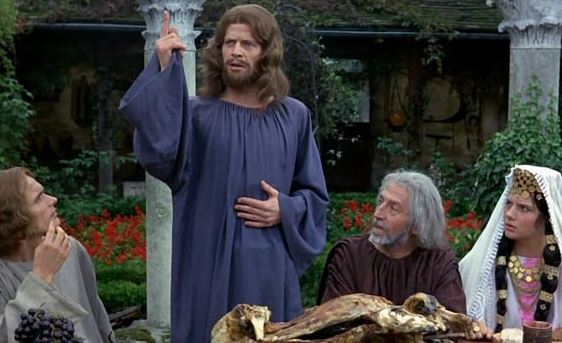 Two men, the older Pierre and the younger Jean, about whom we know and learn little, go on a pilgrimage to a town in Spain where the remains of St. James are kept. Along the way, they run into a number of people of various religious stripes, but mostly heretics who differ with the Church on some of the basic doctrines—the Holy Trinity, the human/divine nature of Christ, the transformation of the host into Christ's body at Communion, free will vs. predestination, etc. Oh, yeah, and Pierre and Jean travel through time and space—well, time at least, as all their encounters seem to be taking place in France and Spain. They run into the pope, the Marquis de Sade, a 4th century heretic named Priscillian, and even Jesus and the Virgin Mary. We see a lengthy argument between a priest and a policeman about whether the host becomes Jesus, or whether Jesus is folded up in the host like meat in a pastry. We see a "holy orgy" in a forest; half-naked women appearing out of nowhere in the bedrooms of two young men in an inn being harassed by a priest; a man in a sinister-looking black and red cape who foretells that Pierre and Jean will have sex with a prostitute who will bear them children; a headwaiter at a fancy hotel lectures his waiters on dogma; and finally, Jesus commits a miracle by curing two blind men—or does he?
When this film, directed by the noted surrealist Luis Bunuel, came out, there was apparently quite a bit of controversy and confusion over it, with some critics angry that it made no sense. This seems like an odd reaction given: 1) the definition of surrealism, and 2) what Antonioni (L'AVVENTURA), Resnais (LAST YEAR AT MARIENBAD), and Fellini (JULIET OF THE SPIRITS) were doing earlier in the 60s. From today's vantage point, it seems much less strange, and to this raised-Catholic viewer, it seems obvious that it's not the narrative that's important, but the spirited debates over Catholic dogma and heresy. Bunuel was raised Catholic, proclaimed himself an atheist, and remained interested in—and apparently conflicted about—religion all his life. I assumed he was mocking, fairly gently, both the faith that comes up with these inexplicable mysteries and the heretics who insist on different (but similarly inexplicable) interpretations of these articles of faith. Paul Frankeur (as Pierre) and Laurent Terzieff (as Jean) are fine in the lead roles, but they ultimately don't have much to do but witness and react—and note well that their names can be anglicized as Peter and John. Bernard Verley (pictured above) makes for a nice, somewhat testy Jesus, and Denis Manuel and Daniel Pilon sort of take over as our guides in the last half as two provocateurs who are definitely not of the modern age. Interesting, entertaining, and nicely ambiguous. [DVD]
Tuesday, February 23, 2016
HANDS OF A STRANGER (1962)
 A small time crook is gunned down on the street and dies on the operating table; the surgeon (Paul Lukather) notes that his hands were so strong, they had to be pried from a streetlight against which he fell. That same night, successful concert pianist James Stapleton is in a car accident and his hands are mangled beyond repair. Lukather removes the pianist's hands and replaces them with the hands of the dead thug. When Stapleton's overly protective sister (Joan Harvey) realizes what has happened, she becomes hysterical but she eventually comes around and she and the doctor don't tell Stapleton that his hands are not his. Unfortunately, he soon discovers this on his own and can't bring himself to try and play again, which makes his gold digging girlfriend split. When he confronts her, he accidentally sets her place on fire, killing her. This is just his first act of revenge, and wait until he discovers that his sister is dating his surgeon!
This is a variation on the much-adapted French novel "The Hands of Orlac"; the 1935 MAD LOVE with Peter Lorre is the one to beat. This does not beat it, but B-movie fans may like it for its use of shadows and low angle shots. Horror fans will not be impressed by the lack of gore, though tension is generally kept high—except in the talky two-shots that make up much of the middle of the movie. It's disappointing that characters are not developed very well—it would seem to be a no-brainer to do something with the potential for incestuous feelings between the pianist and his sister, but it's left there for the audience to do the heavy lifting, if so inclined. Stapleton (known later in his career as James Noah; pictured above with Harvey and Lukather behind him) is good as the high-strung pianist, and the climax with the central triangle on stage at a concert plays out nicely. The other actors range from so-so to bad, but it's fun to see a young Sally Kellerman in a very small role. [DVD]
Thursday, February 18, 2016
BORDER INCIDENT (1949)
 In the Imperial Valley of Southern California, Mexican migrant workers (called braceros) are in demand during harvest season, but the process of getting legally cleared for work is lengthy and some workers pay to be smuggled over the border. Tragically, the smugglers sometimes unload groups of braceroes near a canyon, then rob and kill them. An American customs agent (George Murphy) and a Mexican investigator (Ricardo Montalban) join forces to flush out the smugglers. Montalban poses as a bracero and befriends James Mitchell, a real bracero, to find the smugglers and get across the border, while Murphy poses as a wanted American criminal who wants to join forces with the smuggler, Howard Da Silva. But the best laid plans often go astray as they do here, and when Murphy is exposed, both he and Montalban wind up in danger.
 This is labeled film noir mostly because it was directed by Anthony Mann (T-MEN, RAW DEAL) and because the cinematography (by John Alton) is full of deep shadows, though most of it was shot not in the city but the desert and there is no real femme fatale—excepting one deceitful woman, a minor character though crucial to the plot. To me it feels more like a crime film, and a surprisingly brutal one for the time. There's a realistic scene of torture, and the death of one character in an open field, run over by a plow, is startling and may have influenced a similar scene in the Coen Brothers' BLOOD SIMPLE. The movie opens well, with a scene of unlucky braceros being attacked at night, then takes a turn toward the Dragnet-like documentary style police procedural and soon the film bogs down a bit as the plot machinations get set up. But the last half-hour sets things right again. Performances are solid, with the honors going to bad guy Da Silva and his sadistic right-hand man Charles McGraw. Also with familiar supporting actors Sig Ruman as a German barkeep who is involved with the smugglers and John Ridgely as a U.S. agent. If you can stick with it through the slow middle section, you'll be rewarded with a strong climax. (Pictured are Da Silva, McGraw and Montalban) [TCM]
Wednesday, February 17, 2016
ONE IS A LONELY NUMBER (1972)
 In an awkward, overly mannered opening, we watch the break-up of the marriage of the Browers, James and Amy. She (Trish Van Devere) seems to think all she has to do to make things better is to apologize for throwing his copy of Milton out the window; he (Paul Jenkins), a college professor, vaguely alludes to having been unhappy for some time. He moves out of their San Francisco apartment and leaves Amy to fend for herself. She gets some guidance from her best friend Jane and from middle-aged Gert (Janet Leigh) who heads a divorcée support group. As an Art History major who's never held a job, Amy has a hard time finding employment—and has to deal with a major league asshole at an employment agency who keeps hitting on her to the point of assault—but does get a summer job as a lifeguard at a city pool. She strikes up a friendship with an older grocer on her block (Melvyn Douglas), coming to rely on him for company and advice, and eventually sticks her toe back in the dating pool with a slick, handsome businessman from out of town (Monte Markham, pictured at left with Van Devere). But she deludes herself into thinking that her husband will come back to her before the divorce is finalized, and when that proves to be far from certain (he's living with a student), her recovery from separation trauma no longer seems to be a sure thing.
 I suspect this is one of the first movies to take divorce and its aftermath seriously as its main plotline. It was also riding the feminist zeitgeist wave—albeit concerning white and middle-to-upper class feminism—and shows what I'm guessing were some realistic concerns of the time for divorced women: unprepared for the work world, facing a wide range of men in the dating world, not quite believing that their husbands would really leave for good. Van Devere (later married to George C. Scott) has a delicate, 60s flower child feel about her that fits the role, and for the most part, she's fine, though she's a bit artificial in scenes of strong emotion. Douglas downplays and Leigh overplays (being bawdy for comic relief), both to good effect. Some critics fault Markham as being weak in the somewhat problematic role of the playboy suitor, but I think he's right on the mark, and bests Van Devere in their scenes together. Plotlines get tied up in mostly satisfying ways, and even, in the case of her relationship with father-figure Douglas, somewhat unpredictable ways. Fun trivia note: the guy who plays the employment agency jackass (Jonathan Goldsmith, pictured at right) is now the Most Interesting Man in the World for Dos Equis Beer. [TCM]
Friday, February 12, 2016
THE MIDNIGHT WARNING (1932)
 Bill Cornish, a celebrated G-man, visits his old friend Steve, a doctor in town for a political convention being held across from his hotel. Steve shows Bill a strange discovery: he found a human ear bone in his room's fireplace. After sharing this puzzling find, Steve collapses in a dead faint. After Steve recovers, the hotel doctor says it must have been vertigo, but Bill quickly realizes that Steve was grazed by a bullet that came from an apartment across the street, and Bill soon suspects something's up because the doc didn't find the obvious bullet wound. Bill and Steve head off to search the apartment room and wind up following a woman from the room. She's Enid Van Buren, and she tells Bill and Steve that she and her brother, who had fallen ill, had come to town a couple of weeks before; she left him in the care of the hotel doc and left town for a few days. When she returned, not only was her brother missing, but the room they had (the room that Steve is staying in) was completely different, and the doctor and the manager both claim that her brother was never there. Who fired at Steve? Is Enid crazy? Is Enid dangerous? Or is it the hotel doc and manager who are not to be trusted?
The missing visitor is a plot which has been used in movies (SO LONG AT THE FAIR), TV (I remember an episode of The Big Valley which used it) and folklore (known at Snopes as "The Vanishing Hotel Room"). So if you've run across this storyline before, you’ll know where this is going, but you still could get some fun out of seeing how the plotline develops. Unfortunately, this Poverty Row production plods along with uninspired acting and direction, and the lack of a musical score makes it even harder to sit through. There are a couple of unusual plot twists—Bill can read lips, and he can do it even better with new high-powered binoculars which are treated like something of which James Bond might have been jealous. Once the mysterious doings are figured out, plotholes galore open up. For the record, the mostly unknown actors in the cast include William ‘Stage’ Boyd (not the same guy who starred as Hopalong Cassidy years later) as Bill, Hooper Atchley as Steve, and Claudia Dell as Enid. None of them stand out, nor do the villains. There is one creepy scene of the heroine in a dark mausoleum (pictured), and overall, it's not difficult to sit through, but you'll miss nothing if you don't. (It's on YouTube under its later reissue title, EYES OF MYSTERY)
Wednesday, February 10, 2016
CONQUEST OF SPACE (1955)
 On a space station called the Wheel (because that's what it looks like), General Merritt (Walter Brooke) is the head of a group of men who are building—and will later ride on—a spaceship to the moon. They've been up there away from Earth and family for a year and some of them are getting antsy, especially the general's son Barney (Eric Fleming) who goes over his dad's head to get a transfer off the Wheel. But after the team gets orders to head to Mars instead, in order to find new resources for an Earth that is running out of steam, Barney changes his mind and stays on. The gruff Irishman Mahoney is too old to get a slot on the ship, but he stows away. The others are a working-class lug from Brooklyn, a Japanese botanist, and a Slavic scientist. They get to Mars successfully, but suddenly the general gets an attack of religious fundamentalism, questions the appropriateness of the entire enterprise, and they wind up crash-landed and at odds with each other.
This may not have quite been an "A" movie but in looks it's certainly heads and shoulders above the average sci-fi film of the era; it avoids coming off like a kiddie matinee flick and tries to tackle adult ideas. Unfortunately, it fumbles the biggest idea: is off-Earth exploration incompatible with being a Christian? The philosophical quandary comes up with no warning halfway through the movie and is dispensed with fairly quickly—it feels like during filming, the director, Byron Haskin, decided he needed one more point of conflict (aside from the generation gap, family, and ageism) and threw in the religious angle, then almost as quickly decided to abandon it. Actually, it's not fully abandoned: in a strange scene near the end, when the astronauts desperately need water, it snows—on Christmas morning. I wonder if Stanley Kubrick saw this, as a handful of images—the movement of vehicles in space, a body floating toward the sun—seem to have influenced some visuals in 2001. The acting is about par for the course; Brooke, Fleming and Benson Fong as the botanist are fine, but the guy from Brooklyn (Phil Foster) really grates on the nerves. William Hopper plays a scientist on the Wheel, and we see Rosemary Clooney do a song-and-dance number which the astronauts watch on a big TV screen. Produced by George Pal (WAR OF THE WORLDS, THE TIME MACHINE). Worth seeing for its sets and effects, though you will have to put up with some weak dialogue. [Paramount Vault on YouTube]
Monday, February 08, 2016
THREE FACES EAST (1930)
 During World War I, soldier Valdar (Erich von Stroheim) gets a medal from the Belgian king for services rendered; when he leaves the Army, he winds up as a trusted butler to the improbably named British Navy bigshot Sir Winston Chamberlain. At the same time, nurse Frances Hawtree (Constance Bennett), working for the British in France, is actually a German agent. Her new assignment: go to London, infiltrate the home of Sir Chamberlain, find important naval secrets, and pass them on to master spy Blecher. One of Chamberlain's sons recently died at the front and Frances poses as his grieving fiancée; she is accepted into the household with open arms by everyone except the dead man's brother Arthur (Anthony Bushell) who knows that his brother already had a fiancée that the rest of the family didn’t know about. It turns out that Valdar is a German spy and Frances' contact (a Muslim prayer with the phrase "three faces east" is the password they exchange). He flirts with her a bit—in a very Prussian Von-Stroheim way—but won't let her meet Blecher. Just as Frances begins pulling off her plan, Yates, another house guest, gets suspicious of her. Soon, we're not quite sure who is on what side: could either Frances or Valdar (or both) be double agents? Is Yates what he seems to be? And who is Blecher?
I've discovered that were lots of WWI spy movies made in the early 30s, perhaps out of an odd sense of nostalgia or an uneasy feeling about the future—most of these movies could have been made 10 years later as WWII spy stories without much change in plot or even dialogue. This one tries to be a little trickier than the average, but if you know your movie stars of the era, you’ll know the outcome. Still, I appreciated the little twists and turns of the plot here, though I wish someone besides the somewhat one-note Constance Bennett had the lead role. Stroheim is fun; his character is a little warmer than usual—he flirts with Bennett and even gets to smile in a couple of scenes. I liked him enough that [Spoiler alert:] I wished he'd be able to get away scot-free, though he doesn't. Bushell is fine, and William Courtenay has a couple of good moments as Yates. One standout scene that achieves good tension involves Bennett sneaking around at night, breaking into a safe, then getting her high-heel shoe stuck in a floor grate. [TCM]
Wednesday, February 03, 2016
A CHALLENGE FOR ROBIN HOOD (1967)
 Roger de Courtney (Peter Blythe) is known for his cruelty—we see him shoot and kill a Norman man, right in front of his young son, for hunting royal deer. John, Roger's father, leaves his estate to be split between the wicked Roger and his somewhat less wicked brother Henry, but with his dying breath, John adds their goodhearted cousin Robin (Barrie Ingram) as an heir. This infuriates Roger who, in short order, murders Henry and frames Robin for the crime. Robin goes on the run, along with the sympathetic Friar Tuck, hiding in Sherwood Forest, and is accepted into a group of rebel Saxons who, get this, rob from the rich (the decadent landowners) and give to the (overtaxed) poor. Soon Robin is leading the band and eventually sets off on a mission to rescue Lady Marian, being held prisoner by Roger and the Sherriff of Nottingham.
I must admit I sometimes wonder why filmmakers keep doing Robin Hood stories when the 1939 Errol Flynn ADVENTURES OF ROBIN HOOD is so darned good. Hammer Films, usually known for horror movies, made the occasional adventure film and this was not their first time around with Robin and his Merry Men; Hammer made two previous versions in 1954 and 1960, the latter (SWORD OF SHERWOOD FOREST) featuring Richard Greene who played Robin Hood on TV for several seasons. This version would seem custom made for kids, though it lacks, until the end, the rousing swashbuckling that younger viewers might like. Ingram is hopelessly miscast as Robin—he's not particularly handsome or charming or charismatic. In fact, two other actors in the cast—Leon Greene who plays the hulking Little John, and Eric Flynn who is Alan-a-Dale, might have been more effective in the lead role. Peter Blythe is good as the evil Roger who, as he seems to lose his grasp on reality, recalls Vincent Price as Prospero in MASQUE OF THE RED DEATH. At one point, Alan starts strumming a lute and a production number almost breaks out, putting me in mind of the "Brave Sir Robin" song in MONTY PYTHON AND THE HOLY GRAIL. Once this movie gets going, it's OK, but it never really overcomes the weakness of its leading man. Pictured above are Will Scarlet (Douglas Mitchell), Alan-a-Dale, Little John and Robin Hood. [TCM]
Monday, February 01, 2016
TWO WEEKS WITH LOVE (1950)
 At the turn of the (20th) century, the Robinson family heads off for two weeks at a Catskills resort called Kissamee. There's Father (Louis Calhern), Mother (Ann Harding), two young boys, and two girls: the younger Melba (Debbie Reynolds) and her 17-year-old sister Patti (Jane Powell). Melba is excited about meeting up again with Billy (Carlton Carpenter), the son of the resort manager, but Billy only has eyes for Patti. Unfortunately, Patti only has eyes for Demi (Ricardo Montalban), a handsome Cuban visiting the resort for the first time. And, of course, Demi seems to be enthralled by a visiting starlet (Phyllis Kirk). This romantic roundelay is played out in tedious detail, with the climax occurring when Patti's dad finally buys her a corset so she can feel like a grown-up. Yes, this entire movie hinges on whether or not Patti will get to wear a corset.
This seems to have been an attempt by MGM at making another MEET ME IN ST. LOUIS, and it just goes to show you how difficult it is to set out to make a masterpiece. This has a decent cast—though Jane Powell, fun as she is, is no Judy Garland—and colorful sets and costumes, but it just lies there on the screen with everyone trying way too hard to breathe life into the flaccid story. When you remember that ST. LOUIS hinged on whether or not the Smith family would move to New York, it might not seem such a far stretch to hope that an equally entertaining movie could spring from the story of whether or not Jane Powell will get a corset. But it's not to be. Powell is part of the problem, or more to the point, her character is. Patti is whiny, obnoxious, self-defeating, and very hard to care about. By the halfway point, I was ready for her to drown in the lake and let the movie focus on the much more appealing Debbie Reynolds. In fact, the high point of the movie is the song "Aba Daba Honeymoon," performed by Reynolds and the lanky, quirkily cute Carlton Carpenter. Most of Powell's songs are operatic in style and uninteresting. There's a cute scene of all the camp kids singing together—which is directly reminiscent of scenes in ST. LOUIS—and a fun moment when a whole lot of fireworks hidden under a bed go off by accident. Otherwise, this is eminently skipable; you can see most of the "Aba Daba Honeymoon" number in the compilation movie THAT'S ENTERTAINMENT. [TCM]
Friday, January 29, 2016
SLIGHTLY FRENCH (1949)
 This film opens on what looks like a Parisan wharf with a lady of the evening and her pals dancing with various men until a voice yells, "Cut!" and we discover we're on a movie set. Tyrannical director John Gayle (Don Ameche) winds up working his French leading lady right into a nervous collapse, and when she announces that she's taking a six-month rest cure, JB, the studio boss, fires John and halts production, which bothers producer Doug Hyde (Willard Parker) who is also John's close friend. While at a carnival with his assistant Louisa (Janis Carter)—who is also his sister—John is impressed by a young performer he sees taking on the roles of Brazilian, Chinese and French dancers; when he visits her in her dressing area, he finds out that she's actually a rough-edged Brooklyn girl named Mary O'Leary (Dorothy Lamour). Soon, a plan develops: John will train Mary to take over the movie role, and he and Doug will pass her off as Rochelle, a legitimately French entertainer, to try and get JB to rehire John and finish the picture with "Rochelle" in the lead. But, of course, complications ensue: John falls in love with Mary, who finds him obnoxious, and she seems to be falling for Doug. Meanwhile John is still a hardass on the set and JB might still fire him. Louisa is the only one who really knows what’s going on.
This is an example of a rare breed: a classic-era musical from Columbia Pictures. And that's its main problem: there's no one thing that's really wrong with it, but it wasn't made by MGM, Warner Brothers or Fox, and is missing that extra intangible something that those studios' musicals had. The opening, the Paris street number, is fun and feels like a parody of AN AMERICAN IN PARIS, except that movie wasn't made until two years later. The songs are a notch above the off-brand musicals of the time, particularly the 30s standard "Let’s Fall in Love" by Harold Arlen. Until the plot stalls at about the one-hour mark, things move along nicely, and there are some cute lines: "He'll take it as hard as a Wisconsin winter"; "Sure, I'm as gay as May" (a reference, of course, to being happy); Louisa invents a new word, "Insinuenndo."
The bland acting doesn't help. In an MGM musical, the acting might not be much better, but you’d be distracted by the color and the general gloss of the production. This is in black & white and the general look is, well, not glossy, though it doesn't look cheap, either. I'm not a big fan of Lamour—she's serviceable here and does do a good job with all the accents she has to do. Ameche is awfully one-note as the jackass director. The supporting players are better: Willard Parker makes Doug such a nice guy, I was rooting for him to win the girl; I love Janis Carter and once again, I wish she was onscreen more often. Overall, it’s fun if not quite bubbly; I kept wanting Gene Kelly and Debbie Reynolds in the leads. [TCM]
Wednesday, January 27, 2016
THE MONSTER WALKS (1932)
 This Poverty Row thriller begins quite nicely: on a stormy night, in a room lit only by candles, a man and woman stand at the deathbed of Dr. Philip Earlton. The woman, Emma, pulls the sheet up over his face and suddenly a sharp shriek rings out from outside the room. The movie pretty much goes downhill from there, becoming a tepid old dark house thriller with the added attraction of an ape in the basement. It turns out that the shriek came from Yogi the ape, the devoted pet of the dead man, who, according to Emma, has sensed that his master has died. Others in the house include the dead man's wheelchair-bound brother Robert; Emma and her son Hanns, both servants in the house; Philip's daughter Ruth who is the heir—though the estate goes to Robert in the event of her death; and Ted Clayton, Ruth's handsome (B-movie handsome, that is) boyfriend. Ruth feels unsettled in the house, and with good reason: someone seems to be out to kill her, and it might be Yogi, who apparently never liked her. At one point, she wakes up to an ape hand reaching out from behind her bed trying to strangle her. Others try to tell her that she was probably just having a nightmare, but faithful housekeeper Emma agrees to switch rooms with her, and the next morning, Emma is found dead. Who exactly is this monster who walks?
There's not a lot to recommend this film except to die-hard fans of early horror/mystery films. The best thing, aside from the atmosphere of the first 10 minutes, is the performance of Mischa Auer as Hanns, a character who remains mysterious until the climax—his violin-playing, usually of Brahms' Lullaby, is a plotpoint. He's also the only actor who gets to express anything resembling real emotion, and Auer (pictured with Martha Mattox as Emma) does a fine job. Sheldon Lewis as Robert is clearly channeling Lionel Barrymore, which does him no favors, and Rex Lease (who appeared in dozens—maybe hundreds—of B-westerns, rarely in a starring role) as the mildly heroic Ted is a big zero. For a change, the ape is real, not a guy in a suit, though he's also not very scary, basically confined to jumping and dancing in a small cage. Willie Best plays the stereotyped scared-witless black servant; the less said, the better. Much of the dialogue is presented in a ponderous fashion, as though that delivery alone will create tension—it doesn't. There is a little fun to be had with the secret passages and such, but mostly this is a bland movie that might be good only as a curtain-raiser for a better thriller, like THE CAT AND THE CANARY. [YouTube]
Monday, January 25, 2016
ROMAN SCANDALS (1933)
 I would guess this is one of the earliest sound films to use the device of a dream to trigger a bizarre plot. In the small town of New Rome, Eddie Cantor is expelled from town for taking the side of some impoverished shanty-town folks against crooked politicians. While trekking off into exile, he falls asleep and dreams he's in ancient Rome. A slave, he is sold to David Manners, a good-natured sort who is in love with Gloria Stuart. The three wind up fighting corruption in Rome, personified by Edward Arnold (always a reliable figure of corruption) and Verree Teasdale as the Emperor and Empress. There are several pleasures in this pre-Code musical; some are the one-liners sprkinled throughout. When Cantor tells Arnold about Mickey and Minnie Mouse, he replies with incredulity, "A mouse has a sweetheart?" When Cantor is surrounded by hungry lions, he says he'd like to feed them and a young woman replies, "You will!" Some strange Busby Berkeley production numbers enliven the proceedings: Cantor, in blackface, sings "Keep Young and Beautiful" (the same song Annie Lennox resurrected on her first solo album Diva) in a sprawling beauty spa; Ruth Etting (the singer Doris Day portrayed in LOVE ME OR LEAVE ME) sings "No More Love" surrounded by busty Goldywn Girls, in chains and naked except for their long, long Barbie doll hair strategically swirled around their torsos. Another song is called "Put a Tax on Love." When Cantor (pictured at right between two guards) wakes up from his dream, he manages to foil the real-world villains of New Rome, and the final number is a utopian song that finds all the poor people living communally in the streets of the town. Billy Barty has a bit part as a shrunken Eddie Cantor, and Lucille Ball and Paulette Goddard are among the Goldwyn Girls—though I didn’t catch them. [DVD]
Thursday, January 21, 2016
ATROCITIES OF THE ORIENT (1948)
 This film, a post-war propaganda piece about the outrages committed by the Japanese in the Philippines, was apparently released under this title in 1959 as an "adult" exploitation movie, pieced together from two 1948 films, BEAST OF THE EAST and OUTRAGES OF THE ORIENT. I could not find authoritative proof about the mixing of the two movies, but that would help explain why this film's plot is hard to follow (in addition to the poor shape of the print). We begin on Luzon as peaceful Filipinos go about their lives, singing and engaging in community rituals. But the Japanese invade, launching brutal attacks on the ground and in the air against the native Filipino population. The movie follows two brothers, Carlos and Antonio, both soldiers in the resistance effort being carried out in the summer of 1944. Carlos hates his brother for marrying the woman he loved, but we have seen Antonio shoot her dead just as the Japanese break into her house so she won't have to undergo the rape and torture in which the Japanese soldiers indulge. Carlos's men are ordered by their superiors to surrender but they refuse, and Carlos sends three volunteers to clean out a Japanese sniper nest. They do, but they also die in the effort. Eventually, the Japanese force Carlos and his men to surrender. Meanwhile, Antonio's men meet up with another division, led by a woman, Colonel Eve. He has his doubts about Eve's leadership, but when he sees her kill a soldier whose careless behavior led to the deaths of other men, he not only respects her but falls in love with her. Eventually, Allied troops arrive and liberate the island.
The title promises one of those grindhouse exploitation movies with lots of gore and a little nudity. This one does feature rape, beheading, bayoneting, and massacres, but not in graphic fashion. One brief scene of bare-breasted women covering themselves with their arms as they run away from Japanese soldiers seems like it was spliced in from another source. And speaking of splices, this print is crazy with odd cuts and jolting edits, so this is certainly not the film that moviegoers would have seen in theaters. The dialogue, in English and spoken by Filipino actors, is occasionally hard to decipher. There is also some weird comic relief, provided mostly by a couple of bumbling soldiers. A scene in which a Japanese solider is disciplined by his commanding officer for trying to molest a Filipino nurse is out-and-out slapstick, and completely wrong tonally. But then, there isn't much right about this movie. One can see the germ of an interesting storyline—and the feminist twist involving Colonel Eve was quite unexpected—but both the scripting and the direction seem amateurish, with the acting only a slight notch above. Frankly this would have been more interesting with a little less restraint. Why go for the grindhouse if you've got the equivalent of a PG movie? [Streaming]
Tuesday, January 19, 2016
AMONG THE MISSING (1934)
 Mr. Abbot files a missing persons report about his Aunt Martha (Henrietta Crosman) who disappeared just before she was supposed to finalize the sale of her house, which she was being forced into by her nephew. Meanwhile, we see Martha sitting on a park bench with her few belongings, wondering where to spend the night when she winds up befriending Tommy, a young man (Richard Cromwell) who is looking for a lost puppy. Actually, Tommy is the junior member of a trio of thieves led by Gordon (Arthur Hohl), owner of an antique shop. Tommy works at Gordon's store as a cover, and reluctantly takes Martha to the shop so she can spend the night in the room in the back. When the cops come nosing around, Gordon sees that the presence of a granny-figure defuses suspicion, so he hires her as a housekeeper. Soon, Martha realizes that Tommy is caught up in criminal behavior—she even supplies him with an alibi when the cops arrive in the middle of the night chasing the thieves—and she tries, with the help of Judy, a young woman who lives nearby and who is sweet on Tommy, to get him to quit the gang. He slowly softens toward Martha, but decides he needs to participate in one last job, and of course, things go wrong and Martha herself winds up taking the rap for the jewel robbery. Will Tommy step up and be a man?
This is an example of a genre I call the Grandma movie; seemingly quite popular in the 30s, the main character was, if not an actual grandmother, then a kindly older woman—aunt, maid, spinster—who was able to fix family problems or solve crimes or play matchmaker (which reminds me that sometimes it was a male character, as in a number of mid-30s movies with George Arliss). Actresses such as Louise Dressler, May Robson, Edna May Oliver and Helen Lowell starred in such films—one example is EMMA with Dressler and Richard Cromwell—and they are reminders of a time when older actresses could still have commercial mainstream movies built around them. This one is fairly run-of-the-mill. Crosman is OK as Aunt Martha, though her character is given virtually no backstory except that she's run away from her family, and that makes her less compelling as a lead character. Cromwell (pictured with Crosman) is also OK; he always looks rather petulant which makes it hard to care about him even as we sense that we're supposed to. Arthur Hohl, a character actor who usually hovered in the background, winds up being the most interesting character almost by default. The look of the movie, lots of shadows and some striking lighting, might attract noir fans. As a donut lover, I appreciated a running bit about Crosman making homemade donuts which Cromwell ignores at first until he begins to warm up to the old lady. [TCM]
Friday, January 15, 2016
CAPTURED IN CHINATOWN (1935)
 A long-simmering feud between the Wong and Ling families erupts in violence in Chinatown, but when Tom Wong and Joy Ling declare their love for each other (to quote a classic 50's song, just like Romeo and Juliet), the families decide to meet to make peace. It is agreed that Tom will give Joy a valuable family necklace to seal the deal, but two fences get small-time crook Zamboni to infiltrate the house where the peace ceremony is taking place. Dressed in a Chinese robe, he steals the necklace, stabbing Tom while he makes his getaway, and when it is assumed that a Ling family member was behind the theft, the feud is back on.
That is the interesting 20 minutes of this film, with nice B-movie atmosphere and characters we care about. The rest of the film focuses on reporter Bob Martin, his gal pal and fellow reporter Ann Martin, and his trusty sidekick Tarzan the Police Dog. This is one of three Poverty Row movies that starred Tarzan, a German shepherd. The dog is well trained, and definitely more appealing the two lead actors, Charles Delaney (who is flat out terrible) and Marion Shilling (who is just boring). There's a lot of clomping around by police, reporters, and members of the Wong and Ling families before the resolution which, of course, results in the restoration of the necklace and the uniting of the clans. Though the dog performs admirably (selling newspapers on the street, delivering messages and guns, fighting villains), most of the actors do not, nor did the writers. Someone named Robert Walker plays one of the bad guys, but he's no relation to the better known Robert Walker of STRANGERS ON A TRAIN fame. Interestingly enough for the era, most of the Chinese characters are actually played by Chinese actors. [Streaming]
Wednesday, January 13, 2016
THE MAGIC BOW (1946)
 This heavily fictionalized biopic of Italian violin virtuoso Nicolo Paganini begins in Genoa when the young struggling musician is paid to play violin in front of a prisoner's cell. The prisoner's lovely and wealthy daughter, Jeanne de Vermond (Phyllis Calvert), tells Nicolo (Stewart Granger) that her father loves violin music, but actually he uses the sound of the music to cover up the sound of him filing away the bars in his window so he can escape. Nicolo goes to Parma, wins a Stradivarius in a contest by playing a difficult piece of music, and meets up with Jeanne who invites him to play at a party, but he is mostly ignored by the partygoers and he leaves in a huff, but not before the sexy singer Bianchi (Jean Kent), an old flame of Nicolo's, renews their relationship. The rest of the film charts the ups and downs of Nicolo's career and love life. He wants to marry Jeanne, but she is commanded by Napoleon to marry an army officer (Dennis Price). The two men duel over her and the wounded Nicolo loses her, but winds up taking up with Bianchi for a time until fate conspires to have Jeanne enter his life once more.
This is not terribly exciting, but as a piece of typical Hollywood biofluff (even though it's a British film), it's not bad. Granger is OK as Paganini, and does a very good job of faking playing the violin in several scenes—actually played by Yehudi Menuhin with some close-up shots of violin-playing hands supplied by David McCallum’s father who played violin for The Royal Philharmonic Orchestra. The movie has the feel of a B-plus budget, but generally the sets are fine and the number of extras in any given scene adequate; most impressive is the scene in which Napoleon's soldiers march into town during a concert by Paganini. What truly kept me entertained throughout was the performance of Cecil Parker as Germi, Paganini's manager—he's designed as a comic relief character, but Parker fleshes him out as much as he can to the point where I really cared more about him than either of the two women in Paganini's life. Favorite line, spoken to Jeanne by her mother, who disapproves of Paganini: "We de Vermond women never kiss anyone of lower station." [Netflix streaming]
Tuesday, January 12, 2016
THE RED MENACE (1949)
 Bill is an ex-GI who is having a rough time adjusting to life back home, and the latest kick in the head is getting cheated out of money in a real estate scam. He complains to Veterans Affairs but doesn’t get satisfaction. Earl, a member of the local chapter of the Communist party, gives Bill a sympathetic ear and takes him to a bar where hot Commie totsies provide a little more than an ear; Mollie winds up taking him home that night and, between seductive moves, starts to propagandize about trying to end the exploitation of mankind. The next morning, Bill has left but her apartment shows signs of a late night, and who should show up but Mollie's good Catholic mother who is trying to talk her out of her fallen ways. But Mollie believes that her father died young due to the ravages of worker exploitation and sticks with the party. Nina, a genuine Russian, takes up the case of Bill—they become close and he joins the party, even going to "Worker’s School," where classes in Marxism are taught by Nina.
 Meanwhile, not everything is Red Heaven in the party. Henry, a poet who writes well-received agitprop poems for the paper The Toilers, is criticized for implying that not all of Karl Marx's ideas were original, and is soon persona non grata around the offices; an Italian worker named Reachi raises serious objections to the party line at a meeting and winds up dead, though the newspaper blames his death on anti-Communist agitators; Mollie is ostracized for continuing to see Henry, for whom she seems to have a thing; Sam, a young African-American reporter for the Toiler, becomes disillusioned. Yvonne, the most dyed-in-the-wool of all the party members, is practically driven mad by all the turmoil, and she cracks when Immigration agents question her passport. Finally, Bill and Nina try to leave the party by getting out of town, but become paranoid thinking that the Party is chasing them.
 Yes, this is overwrought anti-Communist propaganda, probably one of the first such films of the Cold War era, but it's actually a well-made movie: good acting, some nice directorial touches (from R.G. Springsteen), and characters that are more interesting than the B-film norm. Bill (Robert Rockwell) isn't blindly bamboozled into the party—yes, the sex may have clouded his thinking a bit, but he knows what he's getting into. Nina (Hanne Axman, pictured at right with Rockwell) and Henry (Shepard Menken) seem a bit rounder than the average duped-commie characters. The hard-core party members are all cartoonish, but Betty Lou Gerson as Yvonne has a couple of good moments including an incredibly fun scenery-chewing mad scene near the end (pictured above left). The movie is quite quotable: the narrator refers to the Communists as casting "a spell of Marxian hatred and revenge" and calls the basis of Marxist thinking "sugarcoated atheism." When Bill tries to, um, press his advantage with Nina, she slaps him and he replies, "The party's getting rough." Sam (Duke Williams) is asked to brand Henry a "decadent psycho-poet" in the newspaper. By the time that Mollie's mom’s priest gets in the act, telling her that the way to defeat Communism is to "live Christianity and American democracy every day of our lives," the lecturing from parental figures has gotten a little out of hand—priests, moms, dads, federal agents and sheriffs all pop up to give advice. Still, this is watchable both as a fairly compelling melodrama and as slightly campy outdated propaganda; that it can be both is a compliment. [DVD]
Friday, January 08, 2016
THE MAN WITHOUT A BODY (1957)
 Karl Brussard is a rich older man dying of a brain tumor who doesn't want to leave this mortal coil yet, and so is sent to Europe to see Dr. Merritt, who has been experimenting with brain transplantation—this is mentioned as casually as if he'd been experimenting in, oh, trying out different parking spots at work. The doc has transplanted the brain of a monkey that had been dead for six years into the head of another monkey and kept it alive and breathing by artificial means. Through silly oddball circumstances, Karl decides to go to France, steal the head of the prophet Nostradamus (dead for almost 400 years), and have Merritt and his assistant Lew bring it back to life so Karl can then (get this) talk the brain into thinking that it's not Nostradamus but is actually Karl Brussard. That way, when Nostradamus's brain gets into Karl's head, he'll still be Karl. But of course when you're mucking about in God's domain, things rarely work out so well.
 As a B-horror film, this looks and feels like what you would expect, but the laughably bizarre script drops it down a notch (or amps it up a bit, depending on your view). Old pro George Coulouris tries his best as Karl, but the character is not presented consistently; in the beginning, he has several spells of physical and mental weakness, but later in the film, these seem to vanish altogether for the sake of the plot. Robert Hutton is undistinguished as the doctor. There is an equally poorly-written subplot involving a young woman named Odette who, in the beginning, seems like Karl's gold-digging wife, but is actually a ward or a patient or something. She hits it off with Lew (Sheldon Lawrence), causing jealousy to rear its ugly head. The climax has Nostradamus's head (pictured) grafted onto the body of Lew, and a dying Karl chasing it/him through the streets of London. The head effect is at times unintentionally comical, which does not do wonders for the attempted atmosphere of doom and gloom. And don't get me started about the ridiculous set that is supposed to be Madam Tussaud’s wax museum. [Netflix]
Wednesday, January 06, 2016
TONIGHT’S THE NIGHT (1954)
 In the Irish village of Rathbarney (where, we are told, the main interest is drinking), the beloved 84-year-old squire is injured in a horse jump; on his deathbed, he forgives all debts, gives money to several friends, and leaves his estate to a distant relative (David Niven) who lives in London. When Niven arrives to take on the job of squire, he seems friendly but quickly proves to be a pain in the ass to the villagers by withdrawing the squire's bequests, cancelling the cancelling of the debts, and going after the poachers—who the former squire tolerated by assigning them specific properties on which to poach. The villagers decide to kill the squire and hold a lottery to pick the killer—who turns out to be the village doofus (George Cole). Not having a lot of confidence in him, others group together and, when they discover Niven has a heart condition, decide to try and scare him (literally) to death by dressing up as the castle ghost who, legend has it, appears on O'Leary Night, which is coming up. Still others, unbeknownst to the rest, make their own plans, all of which leads to pandemonium that night.
This little gem is one I'd never heard of but ended up enjoying quite a bit. One problem is the completely nondescript title; the original British title, Happy Ever After, is no better. Apparently it has also been known as Stranger in Town which is a little more specific. It's a fairly dark little comedy with no completely sympathetic character: Niven does a great job at being charming on the surface but a thorough bastard underneath; Barry Fitzgerald (pictured with Niven) does his usual heavily-accented, twinkly-eyed sweet scoundrel; Yvonne DeCarlo is the potential love interest; George Cole makes the village idiot almost charming. But lack of likable characters is not a negative here; it's a bit refreshing to see a comedy from this era that shows everyone to be motivated by their baser instincts, and in places it feels like an Ealing comedy with Alec Guinness, like THE LAVENDER HILL MOB. The movie bogs down a bit in the middle, but the O'Leary Night sequence is pulled off nicely. There's a tavern song, "My Heart Is Irish," which fulfills the demand that every movie about the Irish have some moment in which the characters celebrate their Irishness. A cute little film. [TCM]
Monday, January 04, 2016
THE GIANT OF MARATHON (1959)
 In 490 B.C Greece, muscle-bound Athenian peasant Phillipides (Steve Reeves) becomes an Olympics champion and is made head of the Sacred Guard (who are referred to as custodians of Athens' liberty), but secretly Theocritus and Kreusos want to take over the Guard for their own ends. Theo sends the sexy Karis to seduce Phillipides, but he has fallen in love with Andromeda (Mylene Demongeot, pictured with Reeves), daughter of Kreusos who is already promised to Theo. Basically, Theo and his pals are plotting to give Athens up to King Darius when he leads the Persian Army in an invasion on the beaches of Marathon. But when news of the invasion reaches Phillipides, he heads off on a mission to get soldiers from their rival city of Sparta to help hold off the Persians.
 Based on historical events, this plays out like an early version of the movie 300 (see also THE 300 SPARTANS, based like 300 on the Battle of Thermopylae, which occurred ten years after the Battle of Marathon). But as with those films, no one will see this for a history lesson: we just wanna see our muscleman Reeves flex and sweat and kick some bad-guy ass, and he certainly does. This is one of the bigger-budget sword-and-sandal films and it shows, with good set design and effects, and even a slightly better screenplay than normal. The plotline is clear and some of the characters feel a little more fleshed-out than you find in the average peplum film. Among the highlights: Karis getting the shit slapped out of her by Theo, and later, though mortally wounded, dragging herself off to warn Phillipides about Theo's betrayal; a well done rockslide; some surprisingly graphic underwater deaths when the Athenians plant spears in the sea floor to do damage to the Persian ships. Reeves is at his best here, even more so than in the original HERCULES. The director of record is Jacques Tourneur (CAT PEOPLE) but it was apparently finished by Mario Bava (BLACK SUNDAY, HERCULES IN THE HAUNTED WORLD). Like all these Italian productions of the time, the English dubbing is a bit off-putting, but the widescreen print available on DVD distracts the viewer from that. [DVD]
Saturday, January 02, 2016
NAVY SECRETS (1939)
 First, we see headlines about a crippling Navy spy ring being investigated. Then we see sailor Craig Reynolds and his fiancée Fay Wray in a cab as Reynolds is heading back to his ship after a short vacation with Wray. He leaves her with flowers and gifts, but as soon as he's out of sight, she dumps them in the trash. When Reynolds gets to the ship, he is taken to the brig, ostensibly for being late, but in reality, he is being investigated for possibly being part of a Navy spy ring that is leaking top secret info. Chief Petty Officer Grant Withers, a buddy of Reynolds, manages to get out with an envelope to pass along to interested parties, and he enlists Wray's help. It seems for a while that Reynolds may just a fervent stamp collector, or so claims everyone Withers comes into contact with. Meanwhile Withers and Wray begin a mild flirtation. Soon we're not sure who’s good and who's bad. Certainly given the WWII backdrop, the Germanic, Nazi-ish fellow (William von Brincken) who is interested in Reynolds' stamps must be bad, but what about Wray? Is Reynolds really guilty or just a patsy? And what is Withers' role in all this: just a buddy, or maybe a investigator, or maybe a spy himself?
Plotwise, this B-movie keeps a lot of balls in the air, and its main strength is that it maintains some ambiguity about people's motives throughout, though honestly in the end, it all plays out exactly as you suspect it will. This Monogram sub-B film looks cheap and lacks a background score, but the acting is OK. The action (such as it is) stops dead around the halfway point so Wray and Withers can flirt on a park bench and get comically interrupted by a kid riding a bike. It has potential to be a cute scene but it's awkwardly staged. I watched because Amazon Instant gave Craig Reynolds (pictured with Wray), a favorite of mine, second billing, but after the opening scene in the cab, he is not seen again. Withers and Wray are fine and have nice chemistry. Watchable but nothing special. [Streaming]
Subscribe to:
Posts (Atom)
