Tuesday, September 05, 2017

THE ECHO MURDERS (1945)

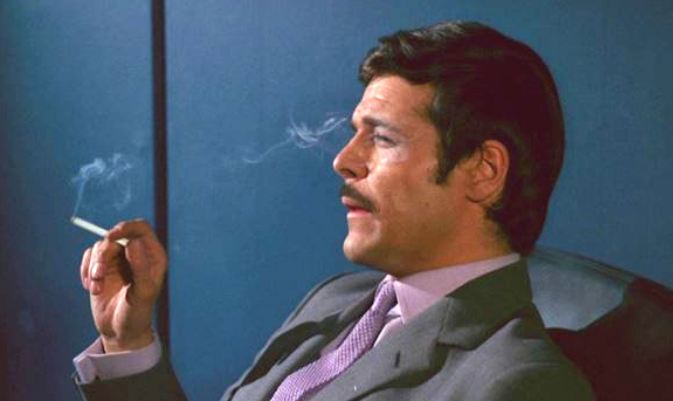
This 70 minute film set during WWII is part mystery, part spy/action movie and is so crammed with incident that I'm not sure I got all the details right in my notes, but here's what I think happened:  Duncan is a wealthy man who owns a mine on the coast of Cornwall. Someone is setting off explosions at the mine in hopes of getting him to sell the land. He's also being blackmailed by his slimy secretary Rainsford who wants to marry Duncan's daughter Stella, who is interested in another worker, Warren. Duncan dismisses Warren, trying to blame the mine's problems on him, but Warren remains committed to Stella. Meanwhile, someone badly wants to get his hands on the mine plans which are kept in Duncan's safe. Feeling besieged, Duncan records a Dictaphone message asking detective Sexton Blake for help. He sends off the wax cylinder, but an intruder kills him that night. Did I mention the apparent suicide of a man named Fox who jumped or was pushed off a cliff? Or the two suspicious men who were confederates of Fox, one of whom, while casing the house to get to the safe, saw Duncan murdered? And when Blake arrives, one more puzzle piece is presented: an eccentric neighbor named Beales who heads up a local Health & Strength club, though he doesn't seem all that healthy himself. Beales' property is right above a big echoey cave on the beach where Fox's body was found, and where other odd things occur. Soon there will be another murder meant to look like a suicide, and even Blake himself will be tortured and reported dead before the culprits are caught in an explosion of guns and fisticuffs.

Sexton Blake is a pulp fiction detective and adventurer; his address on Baker Street might lead you to believe that he's a Sherlock Holmes knock-off, but based on the two Blake movies I've seen—the earlier one is reviewed here—Blake is far more of a man of action than Holmes. This film has action galore, of the B-movie variety, and even though the plot is convoluted, I could keep up with enough of it to stay interested. For most of the film's running time, you're not quite sure who's good and who's bad, or at least bad enough to commit murder and possibly be plotting with Nazis. There's even a few clever lines. Someone refers to the health society as "all orange juice and sandals," and a Cornwall cop tells Blake he's actually excited about all the fuss: "Murder is like a breath of fresh air." David Farrar, best known as the troublesome hunk in BLACK NARCISSUS, is quite good as Blake—he also played Blake in the earlier MEET SEXTON BLAKE which I hope to catch soon. The only other actor of note in the cast is Dennis Price (memorable in KIND HEARTS AND CORONETS) as Warren, but he spends a good chunk of the movie languishing in jail. Otherwise, the acting is typical for a B-film of the era. Enjoyable. [Amazon streaming]

Friday, September 01, 2017

PIRATES OF THE PRAIRIE (1942)

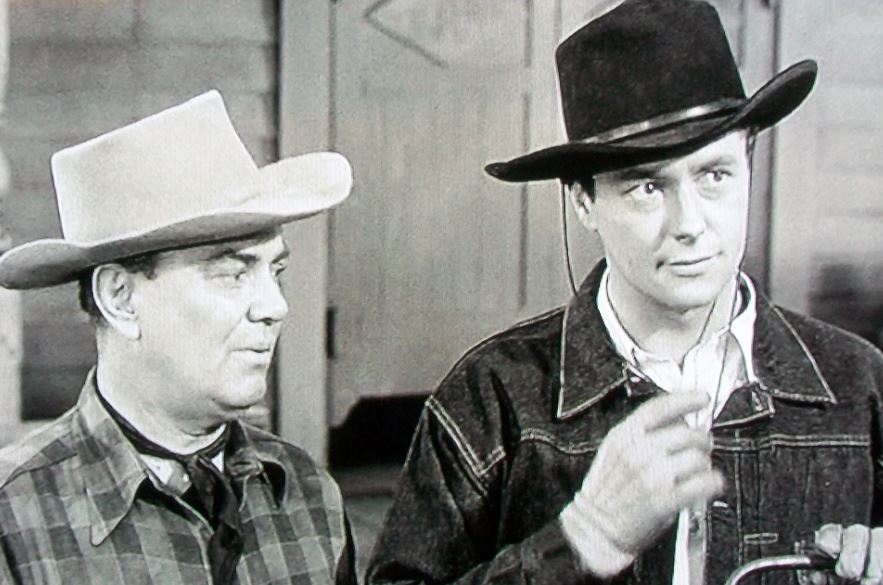
Deputy Marshal Larry Durant (Tim Holt) is instructed to go undercover to investigate a land grab. The frontier towns of Spencerville and East Spencerville are separated by "a dry gulch and a feud"; in the absence of elected officials, a vigilante group has been established in Spencerville to keep the peace, but they have turned a blind eye to the grabbing of property in anticipation of the arrival of the railroad. Some folks could become rich selling their ill-gotten land to the government and Durant wonders if some of the vigilantes are behind the shady doings. Durant arrives in town posing as a gunsmith and gets the attention of Lew Harmon (Roy Barcroft), second-in-command of the vigilantes—and the mastermind behind the land swindle. Harmon, suspicious of Durant, tells him a gunsmith isn't wanted in town, and his men trash Durant's storefront, but Durant stays put, with the help of the simple-minded Ike (Cliff Edwards) who lost his farm to Harmon. Durant also starts a tentative friendship with Helen Spencer, daughter of John Spencer, the head of the vigilantes (who is not aware of the machinations of Harmon and his cohorts). It turns out that there is no feud between the two towns—Harmon has used this fiction as a way to flex his power as an illegitimate lawman. When the federal surveyors come to the area, they decide to build the railroad and its depot in East Spencerville, which would ruin Harmon's big plans. The stage is thus set for shoot-outs, bar brawls, night raids, and a cold-blooded murder before the good guys prevail.

This strikes me an absolutely average B-Western of the era. It's competently done but a little slack here and there, with some shots looking like they should have been retaken, and some of the editing feeling a bit ragged. The plot is nothing out of the ordinary but serviceable enough. Same for the acting: Holt is blandly heroic but a little cold, Barcroft is stereotypically villainous, and Edwards provides fairly unobtrusive comic relief. Nell O’Day, as Helen, the love interest, hasn't much to do, and only Charles King, as a particularly nasty henchman of Harmon's, stands out of the supporting cast. Edwards (pictured above to the left of Holt), known for his ukulele playing, gets a couple of songs. And it's all over in just under an hour. [TCM]

Tuesday, August 29, 2017

TORMENTED (1960)

Noted jazz pianist Tom Stewart (Richard Carlson) is renting a beach bungalow on a resort island. He spends a lot of his free time in a deserted lighthouse while he prepares for a big concert performance, and for his marriage to his wholesome sweetheart Meg. Unfortunately, one night his old flame, sexy nightclub singer Vi Mason (Juli Redding), sneaks onto the island and threatens to expose their sordid past if he doesn't call the wedding off. They discuss the issue up in the lighthouse, and when the railing gives way, Vi falls. Grasping on with one hand, she begs Tom to save her; he reaches out but pulls back and she falls to her death. Soon, Tom feels haunted by Vi's ghost: seeing her body in the water, he carries it to be the beach but it turns to seaweed; his wedding ring goes missing; Vi's watch appears in his house; phantom footprints walk next to him on the beach; a record of Vi singing a song called "Tormented" plays even after Tom takes it off the phonograph; creepiest of all, her disembodied hand and head pop up from time to time. Soon everyone notices Tom's a little off; not just Meg but Meg's kid sister Sandy (Susan Gordon) and the good-natured—but nosy—blind landlady (Lillian Adams). Despite Tom's odd behavior, and despite her father's dislike for Tom, Meg insists on going through with the wedding, but the arrival on the island of an unsavory character (Joe Turkel) who brought Vi over from the mainland and wonders what's happened to her changes Tom's plans.

I discovered this low-budget thriller from Bert I. Gordon when it was mocked on Mystery Science Theater 3000; their version is lots of fun, but I have come to appreciate the movie on its own merits. Part of the fun is figuring out if there really is a ghost or if a guilty Tom is just losing his mind—though he definitely wants Vi out of the way, he doesn't plan on killing her, and when she does die, he doesn’t directly cause it, he just pauses long enough in helping her that she loses her grip. His guilt here isn't strictly speaking based on him breaking a legal code but a moral code. Some critics say Carlson's performance is on the wooden side, but I think he does a nice job sliding back and forth between acting distracted because of guilt and feeling that his relationship with Meg and her sister will somehow redeem him. Is there a ghost? By the wedding scene near the end, you'll probably have decided, but until then, it's a toss-up. The other actors don't give Carlson much support: young Susan Gordon, only 11 at the time, is OK but tries a little too hard in her more melodramatic moments—possibly the fault of her dad, the director. Lugene Sanders is pretty bad as Meg, so much so that I wondered why Tom didn’t run off with Vi (the answer: Meg's family has money). Juli Redding is fine in her limited screen time as Vi, and Lillian Adams as the blind lady who is the first to figure out what might be going on, is serviceable. Joe Turkel, fine as the young tough who tries to blackmail Tom, went on to cult fame as the ghostly bartender in THE SHINING and as Dr. Tyrell in BLADE RUNNER. The wedding scene plays out nicely but feels truncated (did what we see really happen or was it all in Tom's mind?) so we can rush to the climax, back in the lighthouse. If you're in the mood for a Chiller Theater B-movie, this will do nicely. But also go ahead and catch the MST3K version as well. Pictured are Carlson and Redding in the flesh (at top right) and with Redding in ghostly form. [DVD]

Friday, August 25, 2017

AN AMERICAN TRAGEDY (1931)

Young Clyde Griffiths (Phillips Holmes) comes from a humble background—he grows up living in the Skid Row mission his parents run—but wants better things. We see him working as a bellhop in a Kansas City hotel, flirting with a rich girl but dating a lowly hotel maid. While out with his drunken friends, he is involved in a car crash that kills a pedestrian; he manages to run away fast enough to avoid any connection and leaves town. He eventually winds up in New York and gets a job at his uncle's shirt factory. He’s making money, but finds the work boring and beneath him. Invited to his uncle's house, he fails to make a good impression due to his sullen personlity. But at the factory, he becomes smitten with new worker Roberta Alden (Sylvia Sidney, pictured with Holmes) and though it's against the rules, the two see each other on the sly. He pressures her to have sex, and soon she is pregnant and pressing him for marriage. But he has since met the rich and lovely Sondra Finchley (Frances Dee) and, seeing a much better future with her, begins to fantasize about killing Roberta by faking a canoeing accident. One summer day, the two go out to a deserted part of a lake and he starts to act on his impulse. At the last minute, he stops himself, but the canoe tips anyway and she drowns. He rather heartlessly leaves the scene to go partying with Sondra and her moneyed crowd, but soon the police are able to draw a web of circumstantial evidence around him.

It's difficult to know how to approach this film critically. Based on a classic novel by Theodore Dreiser, directed by the stylish Josef von Sternberg, and filmed in the pre-Code era when filmmakers could deal with most of the movie’s "unsavory" themes (premarital sex, abortion, a crime of passion), there was definitely potential here for a classic movie. However, this just scratches the surface of the novel, coming off like a bland Reader's Digest condensation, and with very few of the visual flourishes one might expect from Sternberg. In the novel, Clyde's upbringing is crucial to an understanding of how his personality develops, but the movie skips over almost all of that. Holmes does manage to make the character passive, callow and unfeeling (his masculinity is questioned often enough that it made me wonder if Sternberg was suggesting some sexual orientation conflict) but we wind up with very little sympathy for him; Roberta is only lightly sketched as a character, and Sondra is barely present, so there is really no one in the story for us to identify with. Perhaps if I hadn't read the novel, my reaction would be different. The 50s film version, A PLACE IN THE SUN, is glossier with rounder characters, though still no match for the book, which admittedly gets hard to plow through in the last third. Interesting mainly as a pre-Code relic. [DVD]

Wednesday, August 23, 2017

AMERICAN GUERRILLA IN THE PHILIPPINES (1950)

In 1942, two American Navy men, Ensign Chuck Palmer (Tyrone Power) and sailor Jim Mitchell (Tom Ewell), are stranded on the island of Leyte in the Philippines after the fall of Bataan—when General MacArthur made the famous claim, "I shall return." The two attempt to get to the island of Mindanao to rejoin their troops but in the city of Tacloban, they find chaos as the Americans are preparing to surrender and the natives are desperate for help. The colonel there gives them some money so they can buy a boat and try to make it across the gulf, and Palmer uses his influence to help Jeanne, a French woman married to a Filipino, get medical assistance for a relative. She thanks him, but also warns him that the monsoons will make it difficult on the water, and suggests he stay on the island and become part of the resistance. They leave with a small crew, and their boat does indeed get destroyed. Stuck eight miles from shore, they are eventually rescued by a group of villagers who hide the men from the Japanese. Resistance fighter Miguel (Tommy Cook) joins the Americans and after a few months in hiding, they finally get assistance from businessman Juan Martinez, a supporter of the guerrillas and also the husband of Jeanne, for whom Palmer is carrying a bit of a torch. Palmer winds up on a spy mission to Mindanao, and then is sent back to Leyte in charge of radio communications, important in setting up MacArthur's return. As the months pass, Palmer becomes fully invested in the resistance. In the climax, a fierce Japanese attack is interrupted by American air forces—MacArthur has indeed returned.

A common complaint about this movie, based on the real-life experiences of Iliff David Richardson, is that it's not exciting, and I have to agree; until the ending, there are few battle scenes. But there is often well-built tension, and the characters are a bit more fleshed out than is the norm for a WWII movie. Power is very good in the lead, and Tommy Cook makes for a sympathetic sidekick. Tom Ewell is in what might normally be a comic relief part, but to his credit, he plays the comedy down in favor of characterization. Fritz Lang directed, and though there are few interesting stylistic flourishes, the film is well shot and the narrative remains clear throughout. The romantic angle, a slow-burning attraction between Palmer and Jeanne, feels forced, but it pays off nicely in a sweet Christmas Eve scene. Despite the word "guerrilla" in the title, the action here is more along the lines of spying and resisting than death and destruction. Recommended. Pictured are Power (wounded) and Cook. [Amazon streaming]

Monday, August 21, 2017

BABES IN ARMS (1939)

Back in the 20s, Joe and Florrie Moran were a hot ticket on the vaudeville circuit, but now their bookings are few and far between, and they live in Seaport along with a big community of "has-been" performers. Joe leads the adults in floating the idea of a comeback tour, but soon many of them are in danger of losing their homes, so his son Mickey (Mickey Rooney) and his pal Patsy (Judy Garland) have another idea: they get a bunch of the kids in town to contribute their talents to a newcomers show put on in a barn—yes, this is the granddaddy of the "Hey, kids, let’s put on a show" musical genre. Problems rear their ugly heads: the head of the social welfare board (Margaret Hamilton) complains that the kids aren't getting their education; a former child star known as Baby Rosalie joins the gang but she starts throwing her weight around, which then threatens the chaste romance developing between Mickey and Patsy; eventually, they even have to face an oncoming hurricane! But of course, in the best MGM fashion, things work out for the kids in the end, and a Broadway debut is assured.

With Busby Berkeley as director, one might assume some spectacular dance numbers are in store, but sadly he keeps his excesses in check. That’s not to say that there isn't some good musical fun here. There are two songs better known for their appearances in SINGIN' IN THE RAIN: Mickey and Judy do a nice simple duet on "Good Morning" and Judy sings a rousing "Broadway Rhythm"; Garland does a sad reading of "I Cried for You"; the title song, sung by the kids as they wield torches in the streets, feels like pro-military propaganda, which given the world situation at the time, it may well have been. Unfortunately there's also a cringe-worthy minstrel show bit with blackface that no longer plays well. Despite it being a musical comedy, it's got some surprisingly serious moments, mostly involving the parents' financial situation. One of the production numbers, which climaxes with Mickey and Judy as Franklin and Eleanor Roosevelt, has the line, "We don't have Il Duce, we don't have Der Fuehrer, but we have Garbo and Norma Shearer." Also with Charles Winninger, Guy Kibbee and Johnny (Bomba the Jungle Boy) Sheffield. [DVD]

Wednesday, August 16, 2017

GOLD (1934)

German scientist Achenbach, with his assistants Holk and Becker, is preparing for the trial run of his room-sized alchemy machine that will turn lead into gold. It's not clear that the economic ramifications of this, if successful, have really been thought through, though the machine sure looks cool. But Becker is secretly a saboteur, and just as the experiment begins, he substitutes an explosive for the lead; the machine blows up, killing Achenbach but leaving Holk (Hans Albers) determined to get revenge. The Scottish industrialist Wills, who has built a similar (and bigger) machine in a lab in his underground coal mine, asks Holk to come and work with him; Wills needs Holk's expertise to finish up. As it happens, the sabotage was the work of Wills (Michael Bohnen), who felt there was only enough room in the world for one alchemy machine. When Holk figures out what's up, he is torn between helping to finish the machine for Achenbach's posthumous glory, and destroying the machine once and for all. He goes to work, becoming friendly with Wills' daughter Florence (Brigitte Helm) who doesn't especially like her father. On the night of a huge party at Wills' castle, Holk dramatically locks himself in the machine room and does indeed make gold from lead. When the world gets wind of this, newspaper headlines are torn between forecasting universal prosperity and predicting huge inflation and the collapse of world economic systems. One of the coal miners asks, if Wills can make gold, why people can't just print money. As the social upheaval becomes greater, Holk decides this alchemy is misguided and tries to destroy the machine, very much against Wills' wishes.

I'm sure, given that this was made in Germany at the dawn of the Third Reich, that there are allegories and symbols galore here which refer to German fascism and the economy and other social issues, but I leave the sorting-out of that to those with more historical knowledge. What I liked about it is its look, much of which seems borrowed from Fritz Lang's Metropolis. Although this director, Karl Hartl, had a lengthy career, having made films through the 1950s, the only other movie of his I've heard of is F.P. 1 DOESN’T ANSWER which appears to be another sci-fi-ish thriller. Though it doesn’t reach METROPOLIS's wild stylistic heights, it has a more solidly built narrative with fleshed-out characters and a more satisfying ending. The acting is fine all around, though Helm (the iconic Maria in METROPOLIS) has a fairly thankless role. The finale is genuinely suspenseful and exciting. Some of the machine footage made its way into the 50s B-film THE MAGNETIC MONSTER. An enjoyable early SF film. [DVD]

Monday, August 14, 2017

THE 13TH MAN (1937)

District Attorney Sutherland, who is facing competition in an upcoming election, has put twelve high-profile crooks behind bars recently and now he announces he is about to do the same for a thirteenth. Among the men who worry that they might be the 13th man: Martin, Sutherland’s chief rival; Crandall, who runs race track gambling; Cristy, a nightclub owner; Dr. Gorman, whose career stumbled when Sutherland exposed his crooked dealings; and even Baldwin, publisher of the local paper, who has published some negative stories about Sutherland. One night at a boxing match, all the above men are present, and just as one of the boxers is knocked out, Sutherland drops dead in his seat, apparently of a heart attack. But radio commentator Swifty Taylor and his reporter buddy Jimmy Moran soon figure out that Sutherland was killed by a poison dart to the neck. The two work to crack the case, and when Jimmy is killed while following a lead about a dart gun, Swifty (and his girlfriend/secretary Julie) work even harder to expose the killer, an event which happens when Swifty gathers all the suspects in his studio during a live broadcast.

This is a moderately compelling B-crime/newspaper film with an interesting leading man (Weldon Heyburn) who was saddled with a badly-written character. I found Swifty to be unlikable and irritating, though Heyburn tries his best to make him lively. Better is Milburn Stone as Jimmy, and I was very sorry to see him leave about two-thirds of the way through. Inez Courtney (pictured with Heyburn) is fine as the love interest, though few of the suspects are able to stand out in any way. Still, the plot was never confusing, and I only figured out the killer moments before Swifty exposed him. This was the first movie from the re-opened Monogram Pictures, which had been merged with another studio two years earlier. Good production values put this a notch above the average low-budget film of the time. There's even a decent song, "My Topic of Conversation" sung by B-movie chanteuse Eadie Adams—not to be confused with Edie Adams who was married to Ernie Kovacs and was best known for her sexy TV ads for Muriel cigars in the 60s. [YouTube]

Friday, August 11, 2017

LOVE FROM A STRANGER (1937)

aka A NIGHT OF TERROR

Working girl Carol Howard (Ann Harding) shares a flat in London with her good friend Kate and Carol's Aunt Lou, who is a general pain in the neck. One day, Carol wins a life-changing amount of money in a French lottery; she quits her job, sublets her apartment, and looks forward to traveling. Her fiancĂ© Ronny, however, is not happy—he fears that he will resent her wealth, and he does not want to quit his job and live the high life. On the same day that she and Ronny have a spat over her winnings, a man named Gerald (Basil Rathbone) comes to look into subletting her apartment and the two hit it off. He takes her to dinner that night and when she and Ronny officially split, she and Gerald become an item. Gerald has a surface charm, but there is also something off-putting about him and both Kate and Ronny pick up on. Ronny discovers that Gerald's stories his past can't be verified, but eventually Carol marries Gerald and they move to an isolated country house. She makes him the sole legal heir to her fortune—and that's when even Carol notices that Gerald is a little strange: he has a cellar that he uses as a darkroom for his photography hobby, but he gets over-the-top angry if anyone tries to enter it; once in a while, he has a rather batty moment which he blames on shellshock from the war; he is also diagnosed with a heart problem. When he insists that Carol join him on a rather sudden and mysterious trip out of town, Ronny and Kate smell danger, but Carol still seems willing to give her husband the benefit of the doubt—until the local doctor shows up with a copy of a book about serial killers that makes Gerald uncomfortable.

To say more would spoil the last 15 minutes of the movie (based on an Agatha Christie story), and it's a humdinger of an ending. It's not really a spoiler to note that Gerald is indeed not altogether right—we get hints of this from the get-go—and Rathbone's performance, eccentrically creepy, is startlingly modern in its modulations until he goes totally off the beam at the end. Harding is about average in the first half, playing the vaguely menaced wife as a passive victim, but she too gets to shine in the final sequence, the "night of terror" to which the American title refers. Indeed, the last half of this film feels like a cross between GASLIGHT and NIGHT MUST FALL, and the tension builds nicely to the end. Grieg's "In the Hall of the Mountain King" plays spookily on the soundtrack whenever Rathbone has one of his spells. Production values are on the B-side, and the first third of the film is a little slow, but when the acting moves to front and center, the film's faults fade. Binnie Hale and Bruce Seton are good as Kate and Ronny, and Joan Hickson, who would play Christie's Miss Marple on TV in the 80s, has a small role as a maid. This public domain film is not in good shape, but thriller fans should seek it out anyway. [YouTube]

Monday, August 07, 2017

TARZAN’S HIDDEN JUNGLE (1955) & TARZAN’S FIGHT FOR LIFE (1958)

As HIDDEN JUNGLE opens, we see Tarzan (Gordon Scott) taking a leisurely morning swim with some hippos, and later, when he has rescued a baby elephant shot by two hunters, he philosophizes to his chimp pal, "Cheeta, why man always want to kill?" The two hunters work for Burger (Jack Elam) who has been hired by to collect animals for their hides and fat. But because Tarzan has been stymieing them when possible, they decide to head across the river to the territory of the Sukulus, who worship jungle animals, meaning there is an abundance of game for the men to hunt. However, Sukululand is dangerous for white men, so Burger and his associate DeGroot pass themselves off as wildlife photographers and get Dr. Celliers, the only outsider trusted by the Sukulu, to let them come with him as he delivers medicine. Their plan is to split off and kill as many animals as they can to take back to their camp. After they leave, Celliers' daughter (Vera Miles) finds out about the scam and recklessly heads off to find them, but her jeep gets stuck in mud. It's up to Tarzan to bail out the good guys and being justice to the bad guys.

FIGHT FOR LIFE uses a medical subplot of HIDDEN JUNGLE as its main story. Dr. Sturdy has been supplying medical care to a village of natives, but Futa, the local witch doctor, has slowly been convincing the natives to distrust the doctor, and has even gotten most of the doc's associates to leave his employ. Sturdy's daughter Ann is upset about the situation and wants to leave, but her fiancé Ken, just back from two years of study in England, understands why the doctor can't just give up. Tarzan, friend to the natives and their ruler, tries to intervene but can't fully counteract Futa's influence. Two medical emergencies arise: Tarzan's mate Jane get appendicitis, and the young boy destined to rule the native tribe falls ill. Futa has some medicine stolen from Dr. Sturdy to use as backup in case his magic fails to work on the boy, but Futa can't read the label on the stolen jar: Virulent Poison.

After the aging Johnny Weissmuller was eased out of the Tarzan role, the younger Lex Barker took over for a run of five decent films. Gordon Scott came next, and these are the first and third of his five movies in the role. Scott is beefier than Barker but less effective as an actor, so on balance there seems little difference between the two. By the end of Scott’s run, he had become a fairly somber Lord of the Jungle, but these films both still have a kiddie matinee feel, especially FIGHT FOR LIFE in which Tarzan suddenly has a Jane and a Boy who were not present in Scott's first two movies. The special effects are rather sparse—in HIDDEN JUNGLE, when one character is tossed into a Sukulu lion pit, it's clearly a stuffed dummy than lands among the lions—and as is usually the case, the use of African stock footage is too obvious. Acting standouts, such as they are, include Vera Miles in the first film—though she looks more like a young Mariette Hartley than like herself a few years later in PSYCHO—and Woody Strode in the second film as Ramo, a native torn between loyalty to Sturdy and the ravings of the witch doctor. Neither is essential viewing, thought the FIGHT FOR LIFE plot is slightly more interesting. [DVD]

Thursday, August 03, 2017

SECOND CHORUS (1940)

At a New England university, Fred Astaire and Burgess Meredith are the oldest students enrolled—they keep deliberately flunking so they can stay on as rival trumpet players in the college band, the University Perennials. The lovely Paulette Goddard shows up at a performance and flirts a bit with Astaire, but it turns out she's serving him with a notice from a collection agency. The two guys get her fired, but then ask her to be their manager. She gets them gigs, and is so successful that famed bandleader Artie Shaw (playing himself) is a little worried; when he comes to a show, the guys think he's there to consider them for his band, but actually he's there to offer Goddard a job as manager, which she takes. As Astaire and Meredith continue competing for Goddard's favors, and for spots in Shaw's band, Goddard gets an eccentric rich man (Charles Butterworth) who shows up at all of Shaw's shows to sponsor a big Broadway concert, with the only question being, which of our two scamps will shine at the show and ultimately win Goddard's heart?

In his second starring role after he and Ginger Rogers called it a day, Astaire seems notably to be floundering. This independent film, distributed by Paramount, looks shabby compared to his RKO films. The plot and casting are strange: Astaire, 40 and pretty much looking it—though to be fair, he looked 40 when he was in his 30s—is not a good fit for his eternal college student role, and knockabout comedy isn't really Meredith’s forte. Goddard is fine, and dances well with Astaire, but oddly there are very few dance numbers compared to an average Astaire film. The two main ones, however, are worth seeing. Astaire and Goddard dance to a cute slangy song called "I Ain't Hep to That Step but I'll Dig It" and the film closes with "Dear Mr. Chisholm," in which Astaire serves as a dancing band conductor. Butterworth does his usual befuddled bit, and Artie Shaw shows he's not much of an actor, but he does provide a bit of a no-nonsense hard edge in his scenes. Because the film is in the public domain, there are lots of copies available, none in great shape. The one I saw on Turner Classic was OK but a bit murky at times. Pictured above are Astaire, Meredith and Shaw. [TCM]

Tuesday, August 01, 2017

CHASE A CROOKED SHADOW (1958)

Heiress Kimberly Prescott (Anne Baxter) has just returned to her family's Spanish villa after the death of her brother Ward in a car accident and the subsequent suicide of her father, owner of a South African diamond company. She gets a sympathetic visit from her uncle Chandler (Alexander Knox), but after he leaves that night, a man shows up claiming to be Ward (Richard Todd). Kim insists she's never seen him before, but he insists equally strongly that he survived the accident and had amnesia for a time. Kim calls the local police inspector Vargas (Herbert Lom) and when she goes to find pictures of the real Ward, all she can find are pictures of the man who claims to be him. The next morning, Kim finds that her loyal maid Maria is gone—supposedly visiting family—and has been temporarily replaced by the mysterious Mrs. Whitman. Kim is further puzzled when Uncle Chandler arrives and appears to recognize Ward. We soon discover that her father had sold the company before he died, but millions of dollars worth of diamonds are missing from a company vault, and it seems like Ward would like to get his hands on them, and perhaps thinks that Kim knows where they've gone. Is Ward an imposter trying to terrorize Kim? Or did Ward really survive the crash and Kim has gone nuts?

And that's about all I can spill of the plot of this nifty, twisty thriller. Just when you think you know what’s going on, another twist crops up, and then another. It's tricky but leads to a satisfying ending. The Spanish coast makes for a lovely backdrop and the noir-like night scenes are nicely inky black. The entire cast is good, especially Baxter and Todd (pictured) in their cat-and-mouse scenes with each other. The director is Michael Anderson who I know for LOGAN'S RUN and the TV mini-series of THE MARTIAN CHRONICLES. The producer is Douglas Fairbanks Jr. who appears at the very end to ask the audience not to spoil the ending for other viewers. I wouldn’t dream of offending that fine swashbuckling actor, so I won't. [TCM]

Thursday, July 27, 2017

A WOMAN OF EXPERIENCE (1931)

It's Vienna, 1914, just after the declaration of war. We follow the path of a paper flier, asking for women to do their part in the war effort, blowing down a busy street and landing at the feet of Elsa (Helen Twelvetrees), a lowly prostitute. Wanting to do her patriotic duty, she applies for hospital work, but is told a woman of her character—or lack thereof—isn't wanted. But Capt. Muller sees her and thinks she might do for some potentially dangerous spy work; after all, as he tells her, she is alone and doesn't believe in God, so what does she have to lose? Muller and Major Schmidt assign her to cozy up to (i.e., become the mistress of) Otto (Lew Cody), an Austrian captain who may be a traitor. But the night she starts flirting with Otto, she also runs into (literally, in the street into his carriage) the handsome naval officer Karl (William Bakewell). The next night, she stands Otto up to spend the night with Karl—and the next night, and the next night.  Soon, it gets back to Schmidt that Elsa is shirking her duty and she gets a gentle reminder about whom she's supposed to be sleeping with. Elsa talks Karl into volunteering for submarine duty, clearing the way to get herself back into the arms of Otto, which she does. Can she catch the spy in the act of spying? And if so, can she still win back the man she loves?

This melodrama is notable mostly for an interesting visual style from director Harry Joe Brown, beginning with the unusual opening sequence of the piece of paper in the breeze. A scene at a party features the camera zooming up through a line of scantily-clad dancing women. The accident that brings Elsa and Karl together is poorly staged but most of the film looks good. I've never found Twelvetrees to be a particularly effective actress and she is similarly bland here. Her leading men, especially the very handsome Bakewell (pictured with Twelvetrees), are better, as are C. Henry Gordon and H.B. Warner as the spymasters, and Zasu Pitts lends her comedic talents to the supporting role of Elsa's maid. Though this was produced in the pre-Code era, and the title character's profession is made fairly clear, her path to redemption (love of a good man and/or death) is very much an element of Production Code films. [TCM]

Tuesday, July 25, 2017

TARZAN IN ISTANBUL (1952)

Here's an oddity: a Tarzan movie made in Turkey, and outside the constraints of copyright. Years ago, a man and his family were on safari in Africa and found a treasure chest full of diamonds which they hid on Death Mountain so they could come back and claim it. But a tribe of vicious natives slaughtered the mother and father, though the young son escaped into the jungle. Now, an adventurer named Tekin has found the skeleton of the man, with notes and a map showing the location of the treasure. He goes back to Istanbul, contacts the man's brother Camil, and rounds up a party to retrieve the diamonds.  Tekin and Camil are accompanied by the pilot Tevik, his female assistant Netzla, her goofy friend Aziz, and a guide named Kundo. Though they all seem friendly enough, some tensions are established: Tevik is interested in Netzla though she doesn't return his interest, and Kundo is scheming with his buddies (who are following the expedition in secret) to get hold of some of the treasure for themselves. When a lion menaces Netzla, Tarzan (the lost boy in the jungle grown up) comes swinging in to save her. Camil figures out that Tarzan is his nephew, so he insists on giving the jungle man a share in the diamonds. This does not sit well with Kundo who, when they find the diamonds, tries to take them all. Tarzan, however, has a say in the expedition's outcome, as does that vicious native tribe that killed off Tarzan's parents.

This sticks close to the Hollywood template for a 40s-50s Tarzan movie and in fact actually improves on at least one thing: the stock jungle footage matches up much better with the studio-shot footage, partly because the action was filmed on location—in the Belgrad Forest in Turkey—rather than on a set. The acting is about on a par with Hollywood B-acting, and Tarzan (Tamer Balci) himself fits in nicely with the others who played the Lord of the Apes (Johnny Weissmuller, Buster Crabbe, Gordon Scott, etc.). The usual antics are present—Tarzan fights a lion, wrestles a crocodile, horses around with a chimp, yells for his animal friends (using the original Johnny Weissmuller yell), and saves the white woman from danger. Aziz provides comic relief, and fewer of the jungle interlopers survive than usual. The title is misleading in that we never actually see Tarzan in Istanbul—in the last minutes of the film, Tarzan is seen accompanying the survivors on a ship approaching the city but we never see him land. The print I saw on Amazon streaming was in terrible shape, with lots of splices and much pixilation, but apparently it has been issued in a cleaned-up state on Blu-Ray. An interesting novelty. [Amazon]

Friday, July 21, 2017

PAINTING THE CLOUDS WITH SUNSHINE (1951)

In this variation on the Gold Diggers movies of the 30s (with a hint of Betty Grable's MOON OVER MIAMI), three showgirls (Virginia Mayo, Lucille Norman and Virginia Gibson) head for their next gig in Las Vegas and decide to get serious about landing rich husbands. Norman still holds a torch for Dennis Morgan whom she's left back in Hollywood because his gambling has become a problem. Handsome dancer Gene Nelson distracts Norman, but Gibson secretly pines for Nelson. But Nelson has a secret: he's from a rich banking family. When his uncle (Tom Conway) finds out that Nelson is cavorting with gold diggers, he heads to Vegas to break things up. Finding this out, the girls try to spruce themselves up to seem above reproach, but a case of mistaken identity has Mayo assume that Conway is actually an interior decorator come to help them look good, and Conway winds up falling for Mayo. Meanwhile, Morgan sneaks into Vegas hoping to patch things up with Norman. This colorful musical looks good, and there are some good dancing scenes, mostly involving Nelson, but the narrative has outworn its welcome over the years and not much has been done to shake it up. Norman and Gibson are serviceable, and poor Dennis Morgan, though top billed, really has a supporting role; it's Nelson and Mayo who star—and both shine. A subplot involving S.Z. Sakall as a hotel owner having financial troubles and Wallace Ford (unrecognizable under grizzled "old prospector" makeup) as a man who adds to those problems is silly and bogs down any energy the main plot builds up. A must for fans of Nelson and Mayo, a so-so way to pass the time for others. Pictured above are Conway, Nelson and Mayo. [TCM]

Tuesday, July 18, 2017

THE SKY'S THE LIMIT (1943)

In an opening sequence so perfunctory that I assumed it was a dream, we see Fred Astaire as a WWII fighter pilot with the Flying Tigers in China. On a 10-day promotional trip around the country before they head back to the front, Astaire, tired of not enjoying his time off, slips off the train out West somewhere, buys some cowboy clothes, and heads off to Manhattan for some fun. Looking out of place at a high-class club, Astaire is attracted to Joan Leslie, a society page photographer (who sings in clubs on occasion) who is chomping at the bit to do something more important for the war effort. He gets her attention by doing what we would call "photobombing" her attempts to snap celebrities. When that doesn't work, he walks her home that night, takes a room in her apartment building, and sneaks into her kitchen to make her breakfast the next morning; in other words, he resorts to what we would stalking—though because he's charming and she's attractive, we (and she) are supposed to find the situation amusing. And eventually, she does. But because he keeps his war hero status secret, she thinks he's unemployed and starts trying to get him a job. And there's the little matter of her boss (Robert Benchley) who has flirted with her for years.

I had avoided this one for years because of its lukewarm reputation. I'm not sorry I saw it, but it is, in fact, one of the weaker Astaire movies. I can only really recommend it for one reason: a great Astaire solo number that I'd never even seen excerpted before. He does a drunken dance to "One for My Baby (and One More for the Road)" that ranks among his best. He takes the song at a surprisingly jaunty clip, and the climax, in which he jumps up on a bar and smashes glasses, bottles and mirrors, may have inspired Michael Jackson to take dancing destruction even further in the (suppressed) ending to his video for "Black and White." Otherwise, I found it difficult to find his stalking funny, and he and Leslie don’t have much chemistry. Joan Leslie has her fans, but I rarely find her more than adequate. The usually reliable Robert Benchley doesn't even get to provide much fun here. Robert Ryan plays a pilot buddy of Astaire's. There is one interesting element added to the mix: name-dropping. Astaire rhymes "Shining hour" with "Mischa Auer," refers to a celeb photo caption as saying "Ginger Rogers and friend," and later mentions James Cagney and Rita Hayworth. [TCM]

Friday, July 14, 2017

SING, YOU SINNERS (1938)

The Beebe family is just your run-of-the-mill small town family with a mom and her three sons. But two of her boys are grown men—Dave (Fred MacMurray) has a steady job and a steady girlfriend whom he'd like to marry, but he wants to wait until brother Joe (Bing Crosby) makes something of himself before he moves out and leaves his mom and his 12-year-old brother Mike (Donald O’Connor) at the mercies of Joe's lackadaisical ways. The three boys work nights as a singing group at a restaurant, but Joe can't seem to hold down a reliable job. Dave makes Joe feel bad enough that he leaves home and heads out to California looking for a sure thing. Some money won at gambling gets him a swap shop. Thinking his business is a keeper, he sends for Ma and Mike to join him. When Dave and his girl (Ellen Drew) visit, they discover that his business is already a bust: he's sold it to buy a racehorse. So Dave pitches in to save Joe's butt one more time. Just when it looks like the horse, named Uncle Gus, might pay off, gamblers pay little Mike, who is serving as their jockey, to throw the race. Joe tells him not to, and in fact Uncle Gus wins. A scene of fisticuffs with the bad guys ensues, but since this is a comedy, there's a happy ending for the Beebe family.

A pleasant family movie, a little rowdier than your Andy Hardy type of film, this was interesting for me because of the brotherly chemistry between Crosby and MacMurray. In fact, Crosby feels a little off here, in sleepwalking mode on occasion, but also because his character is not particularly likeable, even at the end, and MacMurray and the young O'Connor carry much of the movie and provide most of the easy charm that would come from Bing. Elizabeth Patterson, a workhouse supporting actor who usually played spinsters or cranky aunts gets a bigger role here than usual as the mother and does a nice job. The brothers' musical numbers are fun, and one of Bing's big 30s hits, "I've Got a Pocketful of Dreams," is performed a couple of times. "Small Fry" is an odd one, with the three guys dressed as a poor Southern family. From my 21st century perch, it was amusing to hear Crosby refer to "junk in the trunk," meaning literally, he put a bunch of (rummage sale) junk in the trunk of his car. The ending feels rushed, but otherwise, a nice easy escapist movie. [TCM]

Monday, July 10, 2017

ZETA ONE (1969)

aka THE LOVE FACTOR

I warn you that this summary will not make much sense. This film wants to be three things: a James Bond spoof, a sci-fi movie, and soft-core porn, but it doesn't really work on any of those levels. It's very bad, almost amateurish at times, but for that reason, it's sort of fun to watch if you're in an MST3K mood. Secret agent James Word (Robin Hawdon), in a very mod zippered black shirt and thin mustache, arrives home after a mission to find a sexy blonde woman named Ann (Yutte Stensgaard) waiting for him. She claims to have been sent by his bosses to debrief him, though he's not sure she's being upfront. They play an excruciatingly long game of strip poker, eventually climb into bed (where he is, I assume, literally debriefed) and he tells her about his last mission: tracking down a gang of often-naked, often-large breasted women from the planet Angvia (get it?) who need to kidnap Earth women to keep the population growing. Another man (James Robertson Justice, who seems quite embarrassed to be present) and his thugs (including the fey Charles Hawtrey, a famous British comedian known for his appearances in the "Carry On" film series) are also following these women, as is some handsome guy in glasses who vanishes from the film after his two short scenes. After this situation is set up, things stop making narrative sense. Justice and his men torture a nude woman, we watch a couple of strippers at work, and 50s starlet Dawn Addams plays Zeta, the head of the Angvians who gives orders from a vaguely defined, colorful room (which reminded me of the setting from ZARDOZ where Sean Connery is tortured, or whatever happens to him). In the exciting finale, a horde of women wearing only string bikini bottoms and dark purple pasties run around a park zapping men unconscious with bizarre arm movements.  The movie ends (I think, but I'm not sure) with Ann turning out to be an Angvian, and she enlists James to be a stud to all the Angvian women. Lying in Arabian Nights pleasure in a satin bathrobe, surrounded by buxom women, he looks happy but plumb tuckered out in the final fade.

This film is based on a Barbarella-like SF serial that ran in something called Zeta Magazine; it's difficult to find much information about this, though cover images from the magazine do come up in Google searches. My theory about what happened: Tigon, a short-lived British studio mostly known for low budget horror movies, put this into production as a spy spoof with a sci-fi angle. But the spy comedy, which was a popular niche genre in the mid-60s, was probably dying on the vine by 1969, so they turned it into a sex farce, or at least threw in a lot of tits. At least once, we see full frontal female nudity as well, though of course, the male never gets naked—though he is shirtless on occasion. I also believe that the ridiculously long—almost 20 minutes—opening, in which Hawdon and Stensgaard do work up a little physical chemistry, came about because the producers realized that their film, after editing, came out to barely an hour, so they padded it out with the poker game, pushing the balance of the movie toward sex rather than spy or SF. Still, there are some pleasures to be had here, even if the viewer is not an admirer of the female form:  it's pop-art colorful; there are a few chuckles, particularly in the scene with a mean-spirited talking elevator; it has a wild theme song; I loved the set for the "self-revelation room," even though it consists solely of aluminum foil with psychedelic colors projected on it. I must admit the reason I watched this was that I had just seen WHEN DINOSAURS RULED THE EARTH and had enjoyed seeing the handsome Robin Hawdon prancing around in a loincloth. He's not quite as appealing here, and soon he left the business to write plays and novels. Can I recommend this? Not really, because today, teens, frat boys and dirty old men have lots of arousing options other than a low-budget titty movie from the 60s. But I'm not sorry I watched it. [Netflix streaming]

Friday, July 07, 2017

WHEN DINOSAURS RULED THE EARTH (1970)

Hammer had a big hit with the caveman/dinosaur flick ONE MILLION YEARS BC, itself based on a 1940 movie, so they went back to the caves for this sequel of sorts, but the absence of Raquel Welch hurt the film's prospects, though Veronica Vetri, outfitted like Welch in a primitive animal-skin bikini, gives it her best. The sun-worshipping Rock Tribe is in the middle of sacrificing some buxom blondes when the moon makes its first appearance in the sky, throwing all into chaos. Sanna (Vetri), one of the blondes, manages to escape into the sea and is rescued by Tara (Robin Hawdon), a handsome fisherman from the Sand Tribe. He takes her back with him but the group—which has its own share of buxom, bikinied women—isn't crazy about her, believing she somehow caused the disruption in the sky caused by the moon, so she has to live more or less in exile, though Tara visits her frequently. She comes to be buddies with a baby dinosaur, though all the tribes live in danger of dinosaur attacks—not to mention a giant crab! In the end, a tidal wave sorts everyone out. As in ONE MILLION YEARS BC, there is no real dialogue here, just an occasional spurt of primitive caveman jargon (you'll get really tired of hearing "Akita!"), and the plot is barely present, despite being based on a story treatment by J.G. Ballard. But the stop-motion effects, supervised by Jim Danforth (who went on to have a long career in special effects), are on a par with the best of FX master Ray Harryhausen; these scenes are what make the movie watchable. Well, that and the physical charms of Vetri and Hawdon. The two have a fairly active sex scene, Vetri bares her breasts at least once, and I quite enjoyed the loinclothed Hawdon. There's also a jealous Sand Tribe woman who has it in for Sanna even more than the rest of them. A killer snake and a man-eating plant also cause problems for the skimply-dressed Sanna. The problem of the co-existence of dinosaurs and humans is, for me, a non-issue in these movies, despite the fuss that some critics make. This is a decent "turn off your mind, leave your libido running at half-speed, and enjoy" flick.  [Blu-Ray]

Wednesday, July 05, 2017

MIDNIGHT MANHUNT (1945)

Jelke (George Zucco) goes into a fleabag hotel, skulks around a bit, then enters Joe Wells' room, shooting him and stealing a portfolio of gems worth a million dollars. Jelke leaves but Joe, still clinging to life, drags himself out of the hotel to the alley behind the Last Gangster Wax Museum and dies there, leaving a trail of blood. A cop named Murphy finds the body—Joe was a notorious crook who hadn't been seen for five years and was presumed dead—and calls his precinct, but when he goes back to get Joe, the body is gone. Reporter Sue Gallagher (Ann Savage) has found the body and props it up in a poker game display in the museum, hoping to keep Joe from the cops until she has time to enter an exclusive story for her paper. Also on the scene: Mr. Miggs, the owner of the museum; Clutch, his malapropism-inclined assistant; and Pete Willis (William Gargan, pictured), a rival reporter who can't decide whether to try and outsmart Sue or help her with her story—and win her heart while he's at it.

This B-thriller has a very cheap look but the plot (a corpse that keeps disappearing and appearing) is a little ahead of its time, and the acting is decent all around. The all-in-one-night setting gives it a pleasing unity even if some of the antics involving the body (which we rarely see) are unmotivated. Gargan and Savage are a nice lead duo though the romance element is lacking. Zucco doesn't get much to do but I always like seeing him. Surprisingly, I liked eternal Bowery Boy Leo Gorcey as Clutch—he handled his wordplay well: when someone needs glasses, he says, "I'd advise you to see an optimist"; he wants the museum patrons to "get proper enumeration for their money"; most politically incorrectly, he says of a woman who has gone to bed, "She's retarded for the evening." A solid hour of entertainment for fans of second-feature flicks. [YouTube]

Thursday, June 29, 2017

THE RED DRAGON (1945)

In Mexico City, a man named Wyans is working on a top-secret atomic bomb project. After an attempt is made to steal his papers, Dorn, his secretary, asks Inspector Caverro to bring Charlie Chan (Sidney Toler) in to help out, but before Chan arrives, Dorn is found at a luncheon party, sitting at his typewriter, shot to death, with just the typed-out phrase "THE$MOST" as a clue. Two oddities: there is Red Dragon brand Chinese ink on the desk; also, although one shot was heard, two bullets were fired, one into the wall, and no gun found, and no one seen leaving the room after the murder. Chan brings his son Tommy (and chauffeur Chattanooga Brown) to help him crack the case, and soon after Wyans' typewriter goes missing, Wyans calls Chan to say he knows how the murder was done, but he is killed in the same way—2 bullets, one shot, no gun—before he can talk. Among the suspects are Marguerite, who has a shady wartime past; the Countess Irena, a club singer; a smuggler, a gunrunner, and a Nazi propagandist. Chan digs up secrets and hidden relationships before another murder and a final gathering of suspects.

As Charlie Chan, Sidney Toler was the successor to Warner Oland after Oland died in 1938, and Toler made 22 Chan films, six more than Oland. However, Oland is better known in the part, perhaps because most of his Chan films were shot for major studio 20th Century Fox, whereas not long after Toler took over, the movies were done at low-budget studio Monogram. But Toler is perfectly acceptable as more or less an Oland clone—though, of course, an actual Asian actor would have undoubtedly been more desirable. Here, in the seventh Monogram film with Toler, he seems a little more lively than Oland was in his last few efforts—though Toler himself would pass away (from cancer) just two years later, and Roland Winters would get the part for last six movies in the canonical series. This is certainly not in the first rank of Chan movies, but neither is it at the bottom of the barrel. The Poverty Row production values are not distracting, though the writing is not strong—we are told at one point that no one is what they seem to be, but the characters are so surface that we don't really have a strong sense of how they're supposed to appear. I like Benson Fong as Tommy, and Willie Best does what he can with the black sidekick stereotype. Fortunio Bonanova makes an above-average policeman associate for Chan. There are better and worse Chans, but this is painless pleasure viewing. In the colorized publicity photo above are, from left, Fong, Toler and Bonanova. [DVD]

Wednesday, June 28, 2017

BEST FOOT FORWARD (1943)

The students as Winsocki Military Academy are getting ready for senior prom and graduation exercises, but cadet Bud Hooper (Tommy Dix) is in a pickle: he sent movie star Lucille Ball (playing herself) a fan letter and asked her to be his date at the prom, never dreaming that she might accept. But she has, egged on by her agent (William Gaxton) who is worried that her career has hit a slump and that this could be good publicity. The problem is that Hooper also asked his longtime girlfriend Helen (Virginia Weidler), and she accepted as well. Hooper tells Helen that he's sick and not to come, but he feels bad about the subterfuge. Ball arrives on a train, expecting a big fanfare welcome, but Hooper and his pals have decided that the best solution to his predicament is to pass Ball off as Helen. (Did it not occur to them that Winsocki might benefit from a movie star appearance, and keep everything above board? To me, this is a major narrative stumbling block, but I was not asked to contribute to the screenplay.) Good-naturedly, Ball agrees to the plan, but who should show up later that day but Helen, come to minister to her sick boyfriend. From here, the complications pile up, leading to a mob scene the night of the prom during which Ball's adoring fans rip her clothes to shreds trying to get some souvenirs.

If you can get past the irritating plot mechanics (the decision not to exploit Ball's presence at the academy, the constant fluctuations of Helen's and Bud's moods, the threat of expulsion for Hooper and his friends), this has a number of enjoyable elements. Ball is great fun, gamely playing herself as a star in decline when in reality, she was just the opposite. Nancy Walker provides several bright spots (singing, dancing and clowning) as a plain-Jane blind date. The production numbers are bright and colorful, especially "The Three B’s" (not Beethoven, Bach & Brahms but barrelhouse, boogie-woogie & blues), and Harry James and his band provide fun versions of "Two O'Clock Jump" and "Flight of the Bumblebee." However, the acting in general is B-movie level. Tommy Dix (pictured with Ball), who was brought in with a handful of others from the original Broadway stage show, is not lead material—he has pretty much one look, glum resignation. Weidler was 16 and at an awkward stage between child actor (THE PHILADELPHIA STORY) and grown-up starlet, and she doesn't quite know which direction to take here—this would, in fact, be her last film, though she managed to appear in over forty films beginning at the age of 4. Gaxton was a big stage star, but his charisma does not translate to film. Fine in smaller roles are June Allyson (in her first movie), Gloria DeHaven, Jack Jordan (another transfer from the stage who, despite pleasant looks and decent acting, never made another film), Chill Wills, Sara Haden and Henry O’Neill. Colorful and glossy and generally fun, but not in the top rank of Arthur Freed's MGM musicals. [TCM]

Monday, June 26, 2017

ROBIN HOOD AND THE PIRATES (1960)

This Italian adventure takes the mythical English outlaw hero and plunks him down in the middle of a Hercules movie, sort of. Though all the men are fully clothed, this has the feel of a peplum (sword and sandals) film. The story plays out as a sequel to the 1938 Errol Flynn classic, though it messes with the canonical lore a bit. The exposition that is delivered over the first half-hour tells us that when Robin took off to join the Crusades, his father became ruler of Sherwood, but Robin was kidnapped by a band of pirates and held for ransom. The news that gets back to Sherwood is that Robin is dead, and his father's wicked assistant Brooks imprisons the Merry Men, kills Dad, and takes over as lord of the land. When we join the story, the pirates run into a huge storm and they abandon ship, with the leader One-Eye (who wears an eye patch but who actually has two healthy eyes) giving Robin Hood his freedom. They all wash up on shore, very near Sherwood (as a road sign in Italian indicates), and Robin gets the pirates to help him in his mission to bring down Brooks in exchange for a share of Brooks' gold. Complications arise in the persons of Karen, a good girl whom Brooks intends to marry against her will but who actually falls for Robin, and Lizbeth, Brooks' daughter, a bad girl who hates Karen and wants Robin for herself.

Though I have to dock this movie for some ludicrously inept swordplay, there are a few points of interest. One major character, Sweet Pea, is a black woman, one of four Saracens held captive by the pirates; though she's just in the background for much of the film, she takes center stage at the end, triggering a revolt of the peasants just as Robin is about to be hanged. (I couldn't find the actress’s name but she bore a resemblance to Nell Carter of the 80s TV show Gimmie A Break.) She's fun—and her comic relief pursuit of One-Eye is successful in the end. The burly One-Eye makes for a decent sidekick, and his fighting entreaty, "Come at me!" feels quite modern, just needing a "Bro!" at the end. Lex Barker as Robin Hood is a disappointment, more or less sleepwalking his way through his role, and being surprisingly awkward in his swashbuckling. All the actors are dubbed, and whoever does the voice of Brooks seems to trying for Claude Rains. The final brouhaha, led by Sweet Pea is fun. While some of the earlier action scenes aren't very exciting, the rousing score tries to trick you into thinking they are. The film was shot widescreen (2.35:1), but the version I saw on Amazon Instant Video, while apparently widescreen, has been distorted to fit a 1.85:1 screen—I had to adjust my TV's viewing ratio to make the people look normal. [Streaming]

Friday, June 23, 2017

SUCCESS AT ANY PRICE (1934)

A gangster known as One-Eyed Mike is shot (through his good eye) and killed; his kid brother Joe (Douglas Fairbanks Jr., pictured), ambitious but restless, tells his gal Sarah (Colleen Moore) that he's gonna hit the big time, but legally. Sarah, a secretary at an advertising agency, gets him an office-boy job with her boss Merritt but he clashes with some of the upper-class college grads working there who Joe sees as lazy and entitled. Joe also strikes up a flirtatious conversation with Merritt's mistress Agnes (Genevieve Tobin)—her perfume gets him all hot and bothered and their racy dialogue implies the beginning of a sadomasochistic relationship. Eventually Joe is allowed to write ad copy for a cosmetic product, is a hit, and gets a promotion. During the Depression, Joe's drive and conniving put him ahead of the game and he winds up screwing Merritt out his job and his mistress—Joe dumps Sarah and marries Agnes. Soon life near the top starts to spin out of control and Joe decides he wants to start all over. But suicide might be the more attractive choice. This is a fairly compelling melodrama with Fairbanks the highlight. He dares to make his character both appealingly energetic and quite unlikable. Tobin is very good, as is Frank Morgan as Merritt. Joe's sudden ethical change of heart near the end is unconvincing, but it doesn't ruin the film. [TCM]

Tuesday, June 20, 2017

CALTIKI, THE IMMORTAL MONSTER (1959)

A group of archeologists is investigating the ruins of the lost city of Tikal and trying to understand why the city was abruptly abandoned by the Mayans back in the first century. Two men go out to explore a cave in the ruins but only one, Neito, returns, collapsing after fleeing an erupting volcano. His camera contains pictures of the two men at an underground lake which is the only clue that Dr. John Fielding has to what happened. Within the circle of scientists, there is personal trouble brewing: John and his wife Ellen are having marital problems related to his work, and Max, John's assistant, has the hots for Ellen and now has hope that she might respond to his flirting, though in theory Max has his hands full with Linda, a native woman who is part of their group. When our merry band gets to the lake, they find skeletons and gold at the bottom, but they also find a huge blob-like monster that sucks Max's arm into itself, resulting in all the flesh on his arm being torn off. Max is tended to, but he begins acting crazy and becomes a threat to the scientists. They soon discover that radiation from a comet that returns every thousand years or so feeds the blob monster and makes it grow, and coincidentally, that very comet is now on its way toward Earth.

I remember this title from the Chiller Theater era of the 1960s; I think the one time it aired, it was a second feature and didn’t start until after 1 a.m, and I (being 10 or 11 years old) fell asleep through most of it so its always retained a sense of mystery to me. Now I know that it's a fairly run-of-the-mill dubbed monster movie—made by Italians though set in Mexico—with a handful of gory moments and a romantic triangle story that would have bored me back then. It's notable mainly for being an early work of director Mario Bava, who is credited only as cinematographer though he actually finished the film when the director of record, Riccardo Freda, left. There are a few stylistic touches that signal Bava's presence—particularly the well-shot opening scene—but overall the low budget works against effective visuals. The monster is very disappointing looking in the beginning, though its victims are nicely grisly, and in the last 20 minutes, as Caltiki grows and reproduces, it is presented more effectively, even if the use of miniatures is obvious. Gerard Haerter (pictured) takes acting honors, such as they are, as Max who deteriorates mentally throughout the film. Sadly, a good print of this is hard to find in the U.S.; though there is a region 2 DVD that is in fine shape, I had to watch it on YouTube in a murky, non-letterboxed form, which may made my viewing experience less than optimum. I'd be willing to watch it again if a good region 1 DVD is ever issued. [YouTube]

Friday, June 16, 2017

ROSIE THE RIVETER (1944)

During World War II, Rosie the Riveter was a pop culture propaganda figure created to encourage and empower the homefront women who were 1) taking over the manual labor jobs that were left empty when the male workforce emptied out, and 2) working at defense plants producing aircraft and weapons for the war. This B-movie, rather surprisingly, handles the wartime propaganda very lightly and focuses more on a romantic comedy angle. The story, clearly inspired by the 1943 classic THE MORE THE MERRIER, is set in a defense factory town where, due to the huge influx of workers, housing is scarce. Rosie (Jane Frazee) and Charlie (Frank Albertson) arrive simultaneously at a boarding house run by Grandma Quill, both wanting the last available room. While they argue, two more workers, Vera (Vera Vague) and Kelly (Frank Jenks), show up, having already been promised rooms by Grandma's rambunctious grandson Buzz (Carl Switzer). The solution: the two men, who work the midnight shift, will share the room during the day, and the women, on the day shift, will sleep there at night. Of course, complications ensue: Rosie already has a fiancĂ©, Wayne, a boring stick-in-the-mud who is the personnel manager at the factory where they all work, but after getting stuck at the top of a Ferris wheel with Charlie, sparks fly; Vera finds herself getting sweet on Kelly; Grandma's adult daughter Stella keeps moving in and out depending on how mad she is at her husband, and teenage granddaughter Stella is constantly using the roomies' phone to make and break dates—when asked what would be so bad about spending one evening dateless, she replies, "That shouldn't happen to a dog!"

The outcomes are predictable; not only does the stick-in-the-mud get dumped, but Charlie, who's been desperate to be a Marine, finally gets his wish. This plotpoint is really the only time that a propaganda message is highlighted, and it leads to the song "Rosie the Riveter" being turned into a big patriotic production number at the end. This Republic Pictures film has production values a cut above the norm, and if the script is occasionally weak, the acting is fine. The Vera Vague story is interesting: the actress' real name was Barbara Jo Allen, and Vera Vague was a character she did in comedy routines on the radio. It proved so popular that she adopted the name herself in some of her movies where the shrill character was appropriate to the role. In this film, her character is called Vera and she is billed as Vera Vague, a little trick that she did quite a bit in the 40s. Switzer (Alfalfa in the Our Gang movies) and Louise Erickson are good as the kids, as is Maude Eburne as the grandmother. [Streaming]

Monday, June 12, 2017

DICK BARTON AT BAY (1950)

After watching the first Dick Barton movie, I was unsure about continuing in the series, but here I am, the second of three under my belt. This begins with an agent named Phillips being chased through alleys until he arrives at a phone booth where he stops to call government agent Dick Barton (Don Stannard), but is shot and tossed in the river before he can finish his message. The men responsible for the agent's death, led by Russian agent Volkoff, want to get their hands on Professor Mitchell and his death ray—it can destroy airplanes in the sky by exploding all combustible materials in the plane. Just after Mitchell demonstrates his ray for the British, Volkoff and his men steal the machine and kidnap Mitchell and his daughter Mary. They have plans to use the ray to bring down a flock of planes carrying a bunch of military experts, but they need Mitchell to help them work the ray. Dick and his faithful sidekick Snowey (George Ford) are on the chase, with a three-fingered thug and a ruthless Chinese assassin among their irritants, not to mention the beautiful but dangerous Anna (Tamara Desni), Volkoff's chief associate.

This is a little less of a "Boy’s adventure" story than the first film, though an admiring teenager plays a small role in the finale. Mostly it's a fast moving, if occasionally far-fetched, spy thriller, and the committed performance of Stannard as Dick Barton helps immensely; he may just have been copying the performers who played Barton on the radio, but he has a nice touch that combines a no-nonsense tone (he barks, "Buck up, Snowey!" to give his sidekick a needed boost of courage) with a light touch (able to joke a bit here and there). To the movie's credit, the strained comic relief of the first film is turned down a notch or two here. The climax, at an isolated lighthouse, is appropriately rousing and filled with fisticuffs (if awkwardly staged at times). Patrick Macnee, John Steed in the 60s TV show The Avengers, plays the ill-fated Phillips in the opening moments. Watchable, certainly, and good enough to push me on to find the third film. Pictured above are Snowey, Mary and Dick. [YouTube]

Friday, June 09, 2017

PIERRE OF THE PLAINS (1942)

A handsome French-Canadian trapper named Pierre (John Carroll) is riding through the woods, singing a merry tune about Saskatchewan, when he runs into his Indian pal Crying Loon who is trying unsuccessfully to hide his drunken state. Pierre heads into town to give a thrashing to Clerou (Sheldon Leonard), the trader who gave the Indian booze in exchange for his horse—it's illegal to sell the natives alcohol. The destructive fistfight is the last straw for the sheriff who orders Pierre to leave the district, but Pierre promises to shape up, claiming that he's getting married to Daisy (Ruth Hussey), a barmaid with whom he's had a longtime dalliance. Daisy is getting married, but, as her kid brother Val explains, the groom is Durkin (Bruce Cabot), a guide for the Mounties—we know all we need to know about Durkin's standing when we find out that Clerou, the shifty trader, is his best man. As the wedding is about to begin, an Indian woman and her children appear at the door, and she is revealed as Durkin's wife. Though Durkin claims he's being framed (by Pierre, he assumes), Daisy calls off the wedding and clearly Durkin has it in for Pierre. Later, Val gets in an altercation with Clerou who pulls a gun. They scuffle, the gun goes off, Clerou drops dead, and Val is arrested. A lawyer (Reginald Owen) is called in to prove Val's claim of self-defense, but he's constantly drunk, so Pierre and Daisy pull off a scheme to sneak Val out of jail. More complications occur, leading to a confrontation by the river between an unarmed Pierre and an armed and angry Durkin. Someone hiding behind a tree shoots and kills Durkin, but Pierre is arrested for his murder. Can our carefree trapper wriggle out of yet another predicament?

This MGM B-film is the kind of thing I typically enjoy: short running time, good production values, and a cast of familiar character actors including a very handsome lead actor. I'm not sure what went wrong here, but the 57-minute running time drags, despite lots of action and incident. Maybe there's too much plot crammed in, with not much done concerning backstory, and some loose ends left hanging. We have to take it as a given that Pierre and Daisy had any kind of relationship; Durkin and Daisy have no chemistry whatsoever; the brother Val vanishes from the story as soon as he is sprung from jail; I never did quite understand why the visiting Celia (Evelyn Ankers) and her father (Henry Travers) were there except to provide a minor plot point late in the game. The drunken Indian character—as written and as acted—is a disgrace, though he is important to the climax. So what did I like about this? Well, I'll watch almost anything with B-leading man John Carroll (pictured with Sheldon Leonard), and despite the forced accents, he gives a solid, energetic performance. Phil Brown, who plays Val, found fame late in his career playing Uncle Owen in the first Star Wars film. Hussey and Leonard are enjoyable. And I like the fact that, under the strict morals of the Production Code, Durkin's killer gets away scot-free. [TCM]

Wednesday, June 07, 2017

ERIK THE CONQUEROR (1961)

In 786, the Scottish King Lotar sends Sir Rutford to negotiate peace with some newly arrived Viking settlers, but instead Rutford and his men kill the Viking king and massacre the settlers.  The king's young son Eron is spirited away by Vikings, but his other son Erik is discovered by Lotar's wife Alice; after her husband is killed (supposedly by a Viking but actually by Rutford), she takes Erik in and raises him as her own—you see where this is going, right? Twenty years later, Eron (Cameron Mitchell) is chosen by Olaf, the aging king of the Vikings, to lead an invasion of England—Olaf assumes that Eron will be driven by a desire for revenge. Meanwhile in England, Erik (George Ardisson, pictured) has been made a duke, a move spearheaded by Queen Alice, and is chosen to lead troops against the Vikings. When the two meet at sea, Eron is victorious and kidnaps the British queen; Erik escapes and is washed up on a Viking shore and is assumed to be a Viking by the villagers. Eventually, Eron and Erik face each other during a swordfight; when Eron sees a Viking tattoo on Erik, he realizes that they are brothers, but Eron winds up shot in the chest by an arrow (from the conniving evil Sir Rutford). Will Erik be able to avenge not only his Viking parents but also his brother? (And did I mention the love plot?: Eron and Erik are in love with two Viking sisters—played by real-life twin sisters—who play a role in the climactic action)

Italian director Mario Bava is mostly known for his horror films, giallo thrillers and peplum (HERCULES IN THE HAUNTED WORLD). This is none of the above—despite scenes of men showing off their physiques, this is not really a sword-and-sandal movie; it's what might be called a mock- or faux-historical adventure. Bava and his screenwriters make mincemeat of history and that's fine. It might as well take place in Middle Earth or Westeros for all that the background setting matters. There are villages and castles and statuesque women in robes and swordfights. As in most Bava films, there is also beautiful use of visual texture and color, particularly greens and purples. Mitchell and Ardisson are fine in the leads, but acting is never the most important thing in a Bava film, especially given the wall-to-wall dubbing. The action scenes are well-handled and the plot is surprisingly elaborate. Recommended for fans of 60s action movies. Bava's later KNIVES OF THE AVENGER functions as a thematic sequel, featuring Vikings, Cameron Mitchell, and family intrigue. [DVD]

Monday, June 05, 2017

SONG OF SCHEHERAZADE (1947)

In 1865, a Russian naval ship is stuck in 116 degree heat in the becalmed waters of the Mediterranean, so the captain (Brian Donlevy) gives his men shore leave in Morocco. One of the men is Nikolai Rimsky-Korsakov (Jean-Pierre Aumont), an aspiring composer whose constant work on his opera irritates the captain. In town, Nicky and his buddy, the ship's doctor, see a piano in the villa of Madame de Talavera (Eve Arden) and Nicky can't resist entering the room and playing. That evening, after enduring teasing from the sailors, particularly the obnoxious upper-class Prince Mischetsky (Phillip Reed), he goes to a club to work on his music but begs the lovely dancing girl Cara (Yvonne De Carlo) to pretend that they are on a date. As they chat, she mentions that she seems to be always telling men stories from her life that she never finishes, which puts them in mind of the Arabian Nights story of Scheherazade. After Nicky leaves, we find out that Cara is the daughter of Madame de Talavera; the family has fallen on hard times and, unknown to her mother, Cara is dancing at night to make money. Cara's family winds up entwined with the sailors: as Nicky starts to fall for her, Mischetsky also gets interested; Madame finds herself the unwitting object of the affections of a very young sailor (Terry Kilburn) who wants to desert the navy to elope with her; even the captain is not immune to the forceful personality of Madame. What will happen when the weather improves and the navy has to return to Russia?

In theory, this is another musician biopic in an era when that genre was popular, but it makes less of an effort than most to tell a convincing story. Other than the fact that Rimsky-Korsakov was, as a young man, in the Russian navy, little else about this has even the slightest feel of truth. The fluffy story that has been concocted must have sounded fun in outline, but it hasn't been especially well fleshed out. The pleasures here are in the bright Technicolor settings and some of the performances. Aumont is fine, if low-key, as the composer; Donlevly sleepwalks through a thankless role; but De Carlo is good and Arden brings the movie to life with her witty, snarky delivery. When her daughter pretends that she's been taking night classes, Arden replies, "In my day, girls made love at night." We hear "Flight of the Bumblebee" and "Song of India" and music from Scheherazade, and De Carlo gets to do a couple of nice (though not dazzling) dance numbers—the bland choreography is often focused on by the film's critics. Not quite an A-budget film, this is still entertaining for the undemanding viewer, and more rewarding for fans of Eve Arden (pictured above with Aumont). [DVD]

Friday, June 02, 2017

BRITISH INTELLIGENCE (1940)

In 1917 France, British troops walk right into a German trap and espionage is suspected, thought to be the work of legendary German spy Strendler. Pilot Frank Bennett (Bruce Lester) is sent on a mission over enemy lines, is shot down, and is nursed back to health in a French hospital by Helene von Lorbeer (Margaret Lindsay). He falls for her, but she leaves abruptly; we find out she's actually a German spy, and her next mission is to be planted in home of Bennett's father, a government official. She poses as a refugee and is given the job of maid in the house. Her password, "Always forward, never backward," is delivered by Valder, the Mitchell butler (Boris Karloff); she is to ferret out military secrets and he will be her liaison with Strendler. (At least one other spy has infiltrated Bennett’s circle—a secretary—which made me wonder why they needed Helene.) As things seem to running smoothly for the Germans, Frank returns home and recognizes Helene as his lost love; she tells him she's actually a British double agent. Guess who else seems to be a double agent? Valder! But then who or what is Strendler? The rest of the plot plays with these varying seemingly shifting loyalties until a fairly predictable ending.

This is a remake of THREE FACES EAST, itself a remake of a silent film and based on a play. Warner Bros. did this re-purposing fairly frequently in the 30s and 40s to provide material for their B-movie unit. This follows the 1930 version very closely, so if you know that film, there will be no plot surprises. Karloff proves a solid replacement for Erich von Stroheim, and Lindsay is better than Constance Bennett, and the whole thing is nicely done and briskly paced, as most products of the Warner B-unit were. The World War I setting was kept, though the ending features a rousing propaganda speech fitting for WWII. It is rather stagy, mostly being set in rooms in houses, though there is a German zeppelin raid over London at the climax. This is worth your time (71 minutes) if only to see Karloff (pictured) do a nice job in a non-horror role. [DVD]