Monday, February 25, 2019

ASSIGNMENT: PARIS (1953)

In Budapest, an American named Anderson has been found guilty of spying and sentenced to twenty years of hard labor—supposedly he admitted it at his trial, but Nick (George Sanders), chief editor at the Paris office of the New York Herald-Tribune, thinks the whole thing is a set-up. He sends reporter Jeanne Moray (Marta Toren), who has connections in Budapest, to the Hungarian embassy to get a comment from the ambassador, but another reporter, the hot-headed American Jimmy Race (Dana Andrews) scoops her. We soon discover that Jeanne is Nick's mistress, taking the place of fashion editor Sandy Tate (Audrey Totter). Sandy's a good sport about it, but Jimmy starts sniffing after Jeanne; will a romantic rectangle develop? (No, these plot points are brought up but never developed, except for the budding romance between Jimmy and Jeanne.) Hungary announces that they will hang the next person guilty of spying, but Jeanne has been involved in her own bit of espionage—while in Budapest, she tried to get her hands on a photo of Odey, the Hungarian prime minister, at a secret meeting with Tito, the head of Yugoslavia, at which plans were being made to break away from the Soviets. Meanwhile, Borvitch, a Hungarian diplomat, is trying to find the underground leader Gabor Czeki, who has escaped to Paris, and he thinks Jeanne knows where he is—she doesn't but she suspects he's close by (and he is). Meanwhile, Barker, the Tribune's Budapest editor, has a heart attack and Jimmy is sent to help him out. While there, he discovers that Anderson is dead and manages to get the information out to Nick in a coded news broadcast. He also discovers the Ordy-Tito photo; naturally, Budapest doesn't want that news to get out and when they find out what Jimmy's been up to, he is arrested as a spy and tortured in an attempt to get him to make a fake confession. Will he escape? Can Jeanne and Nick help him, or is he on his own?

This is interesting primarily for the fact its heroes aren't spies or soldiers, but journalists. However, this also means that it’s a fairly talky movie and action scenes are absent—the somewhat anti-climactic conclusion plays out like the ending of Steven Spielberg's Bridge of Spies even down to the visuals, but Spielberg was more effective at sustaining tension. The film was publicized as having been shot on location in Europe, but since most of it plays out in Hollywood studio interiors, skimpy use is made of the real locations. Dana Andrews and Marta Toren (a Swedish actress who was being pushed as the new Ingrid Bergman—which she was not) are OK in the leads, though Andrews' obnoxiously pushy behavior toward Toren, which we are supposed to find charming, dates badly in the #metoo era. Two supporting players outshine the stars and are the reason to watch this. The wonderful noir bad girl Audrey Totter is a good girl here, playing a somewhat cynical, world-weary character who can still summon up the energy to help the heroes fight the Commies. George Sanders is also quite good as the editor who, after spending most of the movie in offices, ordering people around, gets to rescue Andrews, who is more or less incapacitated at the climax. See it for Totter and Sanders. Pictured are Totter and Toren. [DVD]

Tuesday, February 19, 2019

NIGHT WAITRESS (1936)

At Torre's Fish Palace on the San Francisco waterfront, waitress Helen Roberts (Margot Grahame) has just resumed her job after being put on probation (for vague involvement in an unspecified crime which we assume couldn't have been too bad because she has that put-upon, innocent, good-girl look). She's trying to avoid trouble, but trouble finds her in the person of Martin Rhodes (Gordon Jones), a handsome schooner captain who used to run bootleg booze but now stays within the law, more or less. He's waiting for a phone call about a job from a man named Rigo. The call comes, but it comes from the man's brother, Mario. Rigo was tortured to death by men trying to find a cargo of smuggled gold, and now Mario is trying to get that information to Martin. Mario says he'll meet Martin at the restaurant some evening, but the evening he arrives, he's too early. When Mario realizes that a couple of thugs have followed him, he draws a crude map on a napkin and asks Helen to give it to Martin. Mario is killed, and Helen is now sought by the crooks. When a thug breaks into Helen's apartment, he gets the napkin but in trying to escape, he falls to his death from the window. Now the cops want Helen as well, so she winds up hiding out with Martin on his schooner and together they try to figure out where the gold is.

This B-film is a little rough around the edges but essentially likable, partly due to the male lead and partly to a good story that's not too simple and not too complicated. The twists and turns of the plot are easy to follow but not always predictable. I like Jones quite a bit, though here, I had to put aside some discomfort with the way his character harasses the waitress—he's not mean or crude, but he is jackassishly aggressive in the first half of the film as he flirts with this woman who is clearly vulnerable and would rather be left alone. But he strips down to his underwear near the end, and he sings a cute novelty song, "The Monkeys Have No Tails in Zamboanga," so all is forgiven. Margot Grahame (pictured with Jones) was a fairly big name in England but never quite made it in Hollywood—here, she's attractive but colorless. The familiar faces of Marc Lawrence, Billy Gilbert and Don Barry show up, as does Anthony Quinn in one of his first film roles as a violent thug. Solid if unremarkable B-crime film. [TCM]

Friday, February 15, 2019

WALK EAST ON BEACON! (1952)

An opening narration tells us that the FBI protects us from a "worldwide conspiracy which seeks, through subversion, to destroy established governments everywhere"—in other words, the Communists. This film, based on a story written for Reader's Digest by J. Edgar Hoover himself, is the story of one FBI operation that broke open a Russian sleeper cell, a group of spies living in the U.S waiting patiently for their signal to begin espionage activities. The case is triggered when the wife of a taxi driver writes an anonymous letter to the FBI office in Boston claiming that a man named Robert Martin has been forcing her husband to pass along messages in a spy ring. Agents tail Martin to a docked Polish freighter but a different man wearing his clothes leaves. Martin, considered not effective enough, is chastised by Laschenkov who has been sent to Boston to take over Martin's duties. His mission is to extort information from Prof. Kafer, a refugee scientist and the leader of a American military project called Falcon, something involving national defense and the possibility of space travel (though since it's a McGuffin, it doesn't really matter what it's about). The Russians make contact with Kafer and tell him they can get his son out of East Berlin in exchange for information on Project Falcon—their instruction to him to "walk east on Beacon Street" gives the movie its title. He turns to the FBI to help him, and they do, though the comings and goings of the spies and the G-men got a little confusing to me.

Most of this is shot documentary style on actual Boston locations which keeps the proceedings fairly low-key, until, of course, the filmmakers decide they need an action scene or two. George Murphy, as the main FBI agent, delivers an appropriately low-key performance, leaving more attention-getting moments to Finlay Currie as the professor and Virginia Gilmore and Karel Stepanek as two of the more important commie spies. It certainly makes it seem as though Boston was absolutely honeycombed with spies, though the screenplay heavily fictionalized the original Hoover story. The film is featured on DVD as part of a film noir set, though it most assuredly is not noir. As a period anti-Communist propaganda piece, however, it's worth seeing. Pictured are Jack Manning and Vilma Kurer as the taxi driver and his wife. [TCM]

Wednesday, February 13, 2019

INVITATION TO THE DANCE (1956)

Gene Kelly started shooting this ballet anthology film (think FANTASIA with live-action dancing instead of animation) in the glow of the success of his hit movie SINGIN' IN THE RAIN. It took him the better part of two years to shoot and edit it—while still working on movies like BRIGADOON and IT'S ALWAYS FAIR WEATHER—and release was delayed by a year or more while it was tinkered with by Kelly and MGM. Though it was treated with some grudging respect by critics, it was a commercial flop, and could be seen as the beginning of the slow decline of Kelly's career, though his past work never lost its luster. Today, it may still not be seen as a neglected masterpiece, but it does feel ahead of its time, and has weathered the years better than some of Kelly's later directorial efforts (like Tunnel of Love. Gigot or even Hello Dolly!).

Each of the three segments features Kelly and some renowned ballet dancers of the era in wordless stories acted out through dancing, sometimes balletic, sometimes more like Broadway dancing. They each feel a bit like the extended dance numbers he executed for AN AMERICAN IN PARIS and SINGIN' IN THE RAIN, but without vocals. The first, titled "Circus," features Kelly as a whiteface clown in a circus troupe who has an unrequited crush on a dancer who only has eyes for a handsome tightrope walker. This has a straightforward melodramatic narrative but it unfolds at a pace which I found a bit too leisurely. "Ring Around the Rosy," possibly inspired by the play and movie La Ronde, follows a flashy bracelet handed off from person to person as romantic trysts occur; a husband buys it for his wife who then gives it to a handsome artist who then gives it to a model who then gives it to her boyfriend, etc. until it winds up back in the husband's hands again. This is the most interesting section of the movie, and Kelly is just of one of the many dancers here. The final segment, "Sinbad the Sailor," was probably calculated to be the most commercial part of the film as it features Kelly dancing against and with cartoon backgrounds and characters, but for me it was slow going. Kelly is a modern-day sailor who rubs a lamp and conjures up a genie. The two enter a storybook (as the animation takes over) and they encounter Arabian Nights characters. It's a little weird that the genie is a 12-year-old kid (David Kasday), and their palling-around scenes feel a little unsavory. Though the animation is well done, the whole bit felt tired and ineffective. However, if my initial description of FANTASIA in dance piques your interest, you would enjoy this, as would most classic movie fans, if only for the novelty. [TCM]

Monday, February 11, 2019

THE TELL-TALE HEART (1941)

Edgar Allan Poe's definition of a short story has remained something of a standard even today: it should be able to be read in one sitting and everything in it should build toward "a single effect." His famous story "The Tell-Tale Heart" fulfills this proclamation well. It's short (usually 5-8 pages) and has no extraneous material (with virtually no character development) to get in the way of its singular effect, to tell a story of a man driven mad by guilt. The bulk of Poe's fiction is of the short form and, because the short film genre never took off commercially in Hollywood, most Poe film adaptations have been fleshed out into full-length films (such as the American International Poe movies of the 60s) using added material—or, in the case of THE MASQUE OF THE RED DEATH, combining two stories—or in the cases of adapting Poe’s poetry, using just a title with little or none of the original work's content (see THE CONQUEROR WORM or THE HAUNTED PALACE which was actually based on a Lovecraft story despite the Poe title). I reviewed a full-length British version of this story last year, and it wasn't bad, but this 20-minute film is better at producing and maintaining that famous "single effect."

A young man (Joseph Schildkraut, pictured) lives with an old man (Roman Bohnen) as his general caretaker, but the old man, who has a creepy looking milky eye, is cranky and abusive, and one night, the young man plots the old man's murder. He carries it out, burying the body beneath some floorboards in the living room, but the next day when two policemen come looking for the old man, the young man is suddenly aware of the loud beating of a heart under the floor and can't figure out why the police don't seem to hear it. When I read this story as a kid, I imagined the ending to be quite literal, with [Spoiler] the young man ripping open the floor and tearing a beating heart out of the old man's body. Of course, it's actually the story of a killer caught by his own guilty conscience. This film is practically nothing but atmosphere—there is little dialogue and no character details except the old man's foul personality (which incidentally is the opposite of the story in which the narrator admits that the old man was harmless and claims it was that milky eye than unnerved him so). Close-ups of water dripping, a clock ticking, and footsteps are used to indicate the young man’s sudden sensitivity to sound, and the dead man's heartbeat is accentuated by thumping musical chords that get louder and louder. Because there is no narration, we lose practically all of the young man's motivation, so a deeper psychological reading is impossible to do here, but Schildkraut is quite good as the central character, getting across his madness with his eyes. I saw this on TCM, which shows older short films quite a bit, but it's also available as an extra on the DVD of Shadow of the Thin Man. [TCM]

Wednesday, February 06, 2019

MR. WONG IN CHINATOWN (1939)

A Chinese woman who refuses to give her name comes to see renowned San Francisco detective James Lee Wong (Boris Karloff) at his home, but before he can meet with her, she is shot in the neck by a poisoned dart, dying instantly, leaving only the name "Captain J" scrawled on a piece of paper as a clue. The police arrive, trailed by pesky reporter Bobbi Logan (Marjorie Reynolds) who sneaks in through a window and is eventually handcuffed to a chair by Inspector Street (Grant Withers), her rather half-hearted boyfriend. The dead woman is identified as Princess Lin Hwa, who recently arrived in the States on board the ship The Maid of the Orient on a secret mission to purchase arms for a rebel group in China. A bank account she had for the purchase has been drained, and Wong and Street try to track down the culprit. The Mr. Wong movies are mostly second-rate rip-offs of the Charlie Chan movies, but that doesn't mean they can’t be fun. This one, however, is a bit of a chore to sit through. As usual, Karloff is fine, and Withers and Reynolds are OK. But the plot becomes a bit convoluted and the pacing is slack. At one point near the end, some wild fisticuffs threaten to break out, but they peter out quickly. In the supporting cast, the only standout is Angelo Rossito (who had a long career in movies from 1932's Freaks to 1985's Mad Max Beyond Thunderdome) as a mute dwarf who Street keeps calling, "the little fella." With the comic shenanigans of Street and Logan pushing Wong himself into almost a supporting role, this is one of the lesser entries in the series. The plot was reused in a later Charlie Chan film, THE CHINESE RING. Pictured are Withers, Reynolds and Karloff. [DVD]

Tuesday, February 05, 2019

WAR OF THE SATELLITES (1958)

A U.N.-backed project headed by scientist Van Ponder (Richard Devon) is attempting to put a manned satellite into orbit, but on the first eight attempts, the satellite has hit something called the Sigma Barrier—shown as a wavy blur in outer space—and exploded, killing the crew. After the ninth flight meets the same fate, the U.N. calls for the project's termination, but when a necking teenage couple sees a small capsule zoom through the sky and crash in the woods, they investigate, find the capsule and take it to the authorities. It contains a message (in Latin!) from aliens warning us to abandon space exploration. As you can imagine, Americans don’t take kindly to that and the American ambassador manages to get the U.N. to support one more flight. This time, Ponder himself decides to go up in the satellite. However, when he is reported killed in a car crash, support wavers until Ponder shows up, claiming that he survived and is still game to go. What's actually happened is that an alien force has taken on his form and plans on sabotaging the flight. When alien intervention causes a series of natural disasters around the world, Ponder says they should stop, but his associate Dave (Dick Miller, pictured) is still gung-ho. Just before the satellite is to take off, Dave discovers Ponder's wrecked car and begins to suspect that something's not right. Still, Ponder and Dave and Sybil Harrington (Susan Cabot) and a small crew head up to try and break though the Sigma Barrier. When Dave sees Ponder split into two people, he's sure something's not right, and it's up to him to try and save the satellite and the crew.

Roger Corman was inspired to make this low-budget quickie by the news of the Russian launch of the Sputnik satellite. Supposedly this went from an idea in Corman's head to a released movie in eight weeks, and it shows, not so much in the acting or the sets (both of which are of variable quality as they are in most B-movies) as in the writing. Why would we keep sending up manned satellites that keep getting destroyed, over and over? How would this tenth flight be any different? (We're not made privy to any plans they have to overcome the barrier.) Why does the alien Ponder keep splitting in two for no particular purpose that I could see? Devon is a rather sinister looking fellow with an odd accent from the get-go, which somewhat undermines his transformation to sabotaging alien. Dick Miller, a Corman mainstay, plays it straighter here than I've ever seen him and he's quite good. Corman himself has a cameo as a mission control guy. The spaceship effects and sets, though laughable today (they strap themselves into lounge chairs), are not bad considering, but the U.N. set is ridiculously sparse. On balance, this is still B-movie-fun enough to recommend, especially for fans of Miller, who passed away last week at the age of 90. [DVD]

Tuesday, January 29, 2019

SNOW WHITE AND THE SEVEN DWARFS (1955)

aka Schneewittchen und die sieben Zwerge

I don't guess anyone needs a summary of the Snow White story. This German version plays out much like the famous Disney cartoon of 1937, except this is live action, with children wearing beards playing the dwarfs. Where the action differs from the Disney film, it does so in a way that makes it hew more closely to the original Grimm Brothers version. The Queen visits Snow White at the dwarfs' home three times. The first time, she appears as a peddler and when she talks Snow White into trying on a belt, the Queen tightens it so much that Snow White collapses. When the dwarfs return home, they cut the belt off and she recovers. The next day, the Queen returns selling decorative combs and when she plunges a poisoned one into Snow White's hair, Snow White collapses. Again, the dwarfs save her by simply removing the comb. Finally, the Queen disguises herself as an older peddler and manages to talk a reluctant Snow White into eating a poisoned apple which causes her (temporary) death and her placement in a glass coffin. The prince is a somewhat problematic character here. In the cartoon, he meets her early on and they fall for each other. Here, he comes to the castle, glimpses her from a tower window, becomes enraptured, and sends her a necklace and a promise to help her if she ever needs it. Later, he exclaims, "I love Snow White and I cannot live without her"—even though he's never even met her! The Hunter goes to him for help to save her, but they are rather ineffective—it takes them several months to find her, which we know because we see the seasons change with leaves and then snow falling on her coffin. And (spoiler) what saves her isn't the prince, but the dwarfs dropping the coffin which revives Snow White.

The 1960s was the golden age of the Kiddie Matinee, when suburban theaters would routinely show movies based on fairy tales on Saturday and Sunday mornings, sometimes accompanied by cartoons or a second film. But typically, these weren't big Hollywood movies or even old Hollywood movies, but B-budget films made in Mexico or Spain or Germany and dubbed (rather badly) into English. Sometimes the results were practically surreal, as with K. Gordon Murray's infamous Santa Claus, a Mexican import which features Santa teaming up with Merlin to battle the Devil. This dubbed German film was made in 1955 but didn't hit the American kiddie show trail until 1965. I'm not 100% sure I saw this in a theater, but I think I saw it on TV a couple of years later.

The sets are artificial and the costumes somewhat threadbare, but for me as a kid, that added to the appeal of the movie: it seemed like something my friends and I could have put together in someone's basement. Oddly, the occasional outdoor Bavarian location shot (including Neuschwanstein Castle) actually works against the movie, breaking the spell of the artificial fantasy. The actors are, well, present and accounted for, if not much else. Snow White is pretty but not beautiful; the Prince looks like a worn-out blond Nelson Eddy; the Queen (pictured above left) doesn't look as menacing (or as attractive) as she should. The child dwarfs are fine, and the Hunter is the best actor of all. I realize that some of my plot critiques above are probably more critiques of the original story, but still, those plotholes should have been at least papered over. There are a few songs, the most memorable being a "Whistle While You Work" sort of thing that goes, "Think la-la-la, sing la-la-la," and got stuck in my head for a couple of hours. For nostalgia lovers only. [YouTube]

Friday, January 25, 2019

THE NAKED AND THE DEAD (1958)

In a Honolulu bar in 1943, Sgt. Croft (Aldo Ray), the leader of a U.S Army platoon, sits apart from his men as a strip show is about to start. Croft is talked about as a good soldier but not an easy man to know or like. As it happens, the stripper is the object of the lust of the manic (and probably horny) Lt. Wilson—they "knew" each other back in the States—but just as the show starts, it's raided and the military men all quickly leave. The platoon ships out as part of an effort headed by General Cummings (Raymond Massey) to reverse a deadly trend and start taking back some important Pacific islands from the Japanese. We see the apparently unfeeling Croft kill a Japanese prisoner after he's taken important papers from him; then he sets out to gun down a group of stripped-down Japanese prisoners until Cummings's assistant Lt. Hearn (Cliff Robertson) stops him. The stage is now set for the main personal conflicts: Cummings, who is proud of the fact that he can usually predict how many soldiers will be killed in any one mission, is a believer is instilling fear in his men as a way of using power; Hearn, younger and greener, thinks that gaining respect is more important than using fear; Croft is a near-psychopathic sadist whose men have a measure of respect for his battleground skills but don't respect him as a man.

Though there a few battle sequences, the bulk of this movie, based on Norman Mailer's well-regarded novel, is devoted to the clash of the American soldiers. In the way of 1950s movies, we are given some simplistic psychological backgrounds to help explain the men: Croft married the woman he was in love with, but caught her cheating on him, a trauma he has never gotten over; Cummings may have a sexual dysfunction involving impotence or possibly homosexuality; Hearn, the least damaged of the three, was a bit of a playboy but is otherwise a thoughtful and humane man who respectfully disagrees with Cummings' outlook on power. The other characters who get caught in the psychological crossfire are played by Richard Jaeckel, James Best, William Campbell, Robert Gist, L.Q. Jones (as the aforementioned Wilson) and the unlikely duo of Jerry Paris (next-door neighbor Jerry Helper on The Dick Van Dyke Show) and comedian Joey Bishop as the new guys, both Jewish. Many critics were disappointed in this movie because it couldn't match up to the novel, infamous for its obscene language (and for Mailer's euphemistic use of "fug" for another obscenity starting with "F"), but I haven't read the book, and taken on its own terms, it's a fairly average war film. Ray (pictured with Robertson) gives the best performance, with Jones and Gist leading the support. Robertson is fine but colorless, and Massey is a bit over-the-top. It's way too long; the first 45 minutes, getting to know the men and their conflicts, are engrossing, but doldrums set in as the men go to battle, and the last half-hour, despite some good moments, drags. Still, it doesn't deserve to be forgotten just because it's not as powerful as its source material. [TCM]

Friday, January 18, 2019

FLIGHT TO NOWHERE (1946)

In Honolulu, a man who has just attended a party is shot, and we see the killer remove some paper from his pocket. The man was an agent and that paper was a secret map of uranium deposits which foreign spies want badly, and which federal agent Bob Donovan is determined to get back. Meanwhile, in Los Angeles, pilot Hobie Carrington (Alan Curtis) is hired by the Countess de Fresca to fly her and some friends to Death Valley for a weekend stay at a resort. Hobie is initially reluctant to do so, but after some half-hearted flirting and the promise of a free dinner, he accepts the charter. The motley crew includes the lovely Catherine Forrest (Evelyn Ankers); her brother Claude, a former POW; Jan Van Bush, who is sweet on Catherine; and the somewhat mysterious Gerald Porter (Jerome Cowan). Before the plane takes off, Donovan tells Hobie, a former wartime spy, that all his passengers were at the party in Hawaii where the agent was shot, and asks for Hobie's help to find out if any of them have the map. In Death Valley, the group meets up with a mining executive named Walker, and Hobie runs into his ex-wife Irene. Soon the question becomes who doesn’t have the map. Hobie sees an envelope with Japanese characters on it in the Countess' purse. He steals it, but the Countess retrieves it. Irene agrees to steal it back, and it turns out that Claude has been trying to sell it to Walker. Meanwhile Jan tries to force himself on Kathy and Hobie comes to her rescue. Porter is revealed to be a G-man, but is he really? Walker is murdered, and everyone—including agent Donovan—winds up in Las Vegas where a ring with an encoded secret about one of the group turns up. More deaths occur (someone is killed by a horse, another person blown up in a plane) before all is cleared up.

Typical for a B-action film, there is more narrative than the filmmakers can handle, leading to plot holes and unmotivated action. I was even confused about the moral status of Claude, the former POW turned traitor—he seems more weak and confused than evil, though he does get punished for his sins. There's a stray plotpoint involving the fact that the Countess is recognized by Irene as a fake—she's a former chorus girl—that comes to nothing. The fight scenes are awkward, and some dialogue glitches were left in (a fairly common B-movie happening). Still, at around 70 minutes, this is entertaining enough for B-movie fans. I wouldn't go quite so far as to say that leading man Alan Curtis is charmless, but he tends to fade into the background, especially with such a large cast of characters surrounding him. Ankers (pictured with Curtis) is fine, though Cowan, usually an asset, is not used well here until the climax. The rest of the supporting cast is OK. It appears that actual location shooting was done in Las Vegas (before it was a bustling town), so that's kind of fun to see. [YouTube]

Wednesday, January 16, 2019

DAMON AND PYTHIAS (1962)

In 400 B.C., the city-state of Syracuse is under control of the dictator Dionysius. Currently, he is hunting down members of the Pythagorean cult, who believe in pacifism and the unity of all men as brothers, a view Dionysius sees as dangerous to his rule. When one fawning informer tells the nobleman Cariso that he is a friend, Cariso has him killed, saying "When a slave can call a master a friend, this world has ended." The roguish Damon (Guy Williams) plays both sides, accepting money to inform on the whereabouts of Arcanos, a Pythagorean leader, then going to Arcanos and telling his group to flee. In Athens, the leader of the Pythagoreans has died and Pythias (Don Burnett) is sent to bring Arconos back to replace him, though his pregnant wife Nerissa is upset to the point of illness about him leaving. In Syracuse, Damon robs Pythias, but then Pythias hires him to track down Arcanos. Though the two become friendly, Damon betrays Pythias to Cariso, but when Pythias gets the best of him in a fight, he refuses to kill Damon because of his pacifist beliefs, and Damon ultimately offers himself as a potential sacrifice. When Damon asks to be released briefly to visit his wife, Damon offers to be kept prisoner in his place, to be killed if Pythias doesn't return. Has Damon become a Pythagorean? Will Pythias keep his word? And if he does, will Cariso be able to delay his return long enough to have Damon killed?

Though based on an Greek legend, this movie is clearly comparing the Pythagoreans to early Christians, presenting them as a persecuted group preaching peace and love, hiding in the shadows and using a symbol to identify themselves to each other (not the cross, but a five-pointed star in a circle). The film was marketed as a sword-and-sandal adventure movie but, though there are some chases and fights (and sandals), this works more as a movie about religious persecution, like SIGN OF THE CROSS without nudity or sadism. The fabled friendship of the title characters could use some beefing up. There's a scene early on in which it looks like Damon is going to invite his new friend to be part of a threesome with his girlfriend—but no, they just all go to sleep—but their friendship is portrayed as rather shallow, and it comes as something of a surprise when Damon makes his offer to be a potential sacrifice for Pythias. Guy Williams (TV's Zorro, though I know him best as the dad on Lost in Space) does a nice job as the rogue who converts to a believer in brotherhood; Don Burnett is less effective, a little wooden and passive. If you come to this looking for beefcake, you'll be disappointed; though tunics are worn, there are no bare chests and not much in the way of muscle—Williams would be better described as a little on the beefy side rather than muscular. Still, a nice change of pace for the genre. I was disappointed that TCM showed a pan-and-scanned print even though a widescreen version is available on DVD from Warner Archive. [TCM]

Thursday, January 10, 2019

OPERATION EICHMANN (1961)

In a series of shorts scenes set between 1941 and 1945, narrated by a concentration camp inmate named David, we see Adolf Eichmann (Werner Klemperer, at left) set the machinery in motion for a "final solution" to the Jewish problem. His plan is to destroy all six million Jews in the lands under the Reich's control in order to divert food to German soldiers. At Auschwitz, already a prison camp, workmen wonder why they are installing shower heads not connected to water, but we know that they will be connected to containers of Zyklon B, an industrial-strength pesticide that will be used to gas Jews to death. When the Nazis realize that disposal of bodies will be a problem, they install crematoria to turn the bodies to untraceable ash. In 1945, with the Reich collapsing, Eichmann, under an assumed identity, escapes with his mistress Anna (Ruta Lee) to Spain but soon realizes that he is being followed by Israeli agents—including a grown-up David (Donald Buka)—and makes his way to Kuwait and then Argentina. Some of the agents on his trail, notably David's friend Jacob, who managed to survive Auschwitz with David, want to assassinate Eichmann, but David spoils their plans because he argues for bringing him to justice. It's not really a spoiler to note that eventually, he is caught and tried in Jerusalem.

This B-film was rushed into production after Eichmann's arrival in Israel in May of 1960 and was released in March of 1961, a month before Eichmann's trial would begin, though the movie opens with an abstract shot of Eichmann in darkness except for a spotlight, making a belligerent statement in a courtroom. Unfortunately, the rush resulted in a rather static and undramatic picture. The acting is generally fine. There is the risk that baby boomer audiences will associate Werner Klemperer too closely to the comic Col. Klink on Hogan’s Heroes, but his solid performance carries no trace of Klink. John Banner, who was Klink's bumbling assistant Schultz, plays the relatively small role of Rudolf Hess, Commandant of Auschwitz. Donald Buka (ar right), as the grown-up Davis, is mostly just called upon to look stoic and solemn. Though I chuckled when I saw Ruta Lee's name in the opening credits, thinking she lacked the chops for role of the mistress, she gives maybe the best performance in the movie after Klemperer. Eric Braeden (of The Young & the Restless and The Rat Patrol) has a small but crucial role in the last half-hour.

One problem is in the staginess of the movie, confined almost completely as it is to studio shots on sets that range from adequate to cheap, and the tone which comes close to exploitation. The film is well shot but lacks tension or gravitas. In a startling scene early on, we follow the first batch of Jews into the gas chamber and watch as they begin dying, a moment that even Spielberg couldn't quite bring himself to include in SCHINDLER'S LIST. The most effective scene in the movie is in the middle, when Eichmann is trying to get one last load of prisoners (including the young David and Jacob) transferred to Dachau before he flees Germany. His driver rebels, saying, "To call you insane is a generosity" and Eichmann orders a slaughter of the prisoners with soldiers shooting through the slats on the trucks. Afterward, a handful of survivors slowly exit the trucks, all of them children. The ending, as the agents chase Eichmann on the streets, is rushed and ineffective. But the movie itself is worth seeing as an interesting novelty. The same historical incidents are dramatized in the 2018 movie Operation Finale. [TCM]

Friday, January 04, 2019

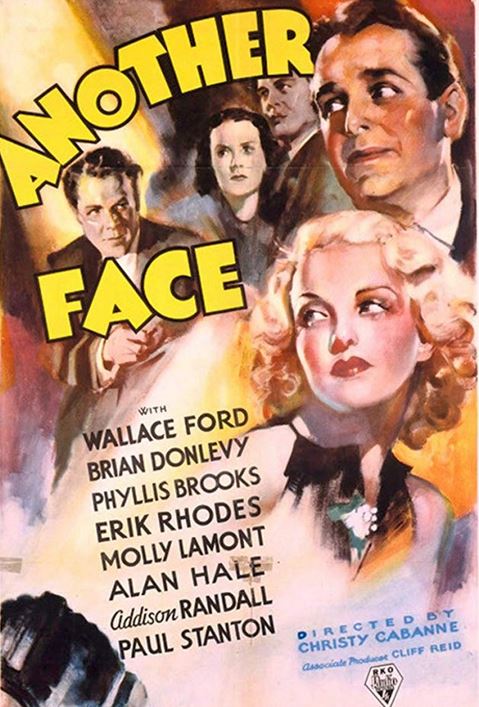
ANOTHER FACE (1935)

Infamous gangster Broken Nose Dawson, a rather ugly chap, is wanted for murder but he arranges with a plastic surgeon to have his looks altered and comes out looking downright handsome. But once a gangster, always a gangster, and Dawson kills everyone who knows he had the surgery, even the doctor, except for Mary, the nurse, who, disgusted that she was forced to be a part of the whole thing, leaves town before the killing starts and heads out to California to be with cowboy star Tex Williams, who fell in love with her when she treated him after a fall from a horse during a show in New York. Coincidentally, Dawson also heads west, under the identity of playboy Spencer Dutro, with plans to become an actor. Arriving at Zenith Studios, he tries out for a gangster part only to be told he's not the gangster type. But PR man Joe Haynes thinks he can make a success of Dutro by marketing his playboy background. Soon, Dutro is treated as a rising star, but one day, Mary recognizes Dutro as Dawson and troubles ensue.

This is an uneasy blend of comedy and drama, unusual for its day, and it doesn't quite come together successfully, partly due to the character of Dawson, played by Brian Donlevy. Had we seen Dawson become more civilized and more sympathetic, the mix might have been more palatable. Or if someone like James Cagney had played Dawson, he probably could have had us rooting, to some degree, for the bad guy. But the characterization is flat, as is Donlevy's performance. The de facto good guy is Wallace Ford as PR man Joe and he's fine, but again his character is fuzzy and occasionally unpleasant, as in the long sequence in which Joe keeps Mary locked up in his office closet to protect her from Dawson while he tries to work a PR angle around the situation. He's wooing an actress, played by Phyllis Brooks, but she's another bland and unfocused character. This leaves Mary, the put-upon nurse (Molly Lamont) and her cowboy Tex (Jack Randall) as the two most sympathetic characters, but they don't really have all that much screen time, so the upshot is that we spend most of the movie with folks we don't really care about. What I enjoyed most about this movie was seeing Erik Rhodes; he's mostly known for playing comically exotic foreigners (THE GAY DIVORCEE, TOP HAT) but here, he's as American vanilla as they come, and it's fun to see him playing against type. Best line delivery: Hattie McDaniel, maid to Phyllis Brooks, hears Brooks tell someone on the phone about her upcoming marriage to a "publicity director," and she disgustedly mumbles, "Press agent." [TCM]

Wednesday, January 02, 2019

LAZY RIVER (1934)

Bill (Robert Young), Tiny, Gabby, and Armand are prison buddies. Armand, a Cajun, implies that his family runs one of the biggest shrimp fishing businesses in New Orleans, and his mother knows nothing about his current circumstances. When a breakout goes bad, Armand is killed and the other three are given early release for not participating in the action. The three head down the Bayou, hoping to connect with Armand's family and make some easy money, but the reality is that Armand's mom, known as Miss Minnie, is widowed and is just days away from losing her choice dock property (and therefore her business) to a shady Chinese man named Sam Kee. Ambrose, an old moneyed friend of the family, arrives in the nick of time, the night before her dock is to be auctioned off, and promises to give her the money she needs to hang on to her land, but Kee and his men kill Ambrose that night and the auction goes on. Suspecting foul play, Tiny sneaks onto Sam's boat, breaks into his safe, and steals enough cash to allow Miss Minnie to keep her dock. Things seem to sort themselves out nicely: Bill is sweet on Armand's sister Sarah (Jean Parker), and he and his friends help get the family business back on its feet. But let's not forget slimy Sam Kee who needs the land for his illegal smuggling of immigrants and is plotting his revenge. And, oh yeah, it turns out that Bill has a wife…

Robert Young (way before Father Knows Best and Marcus Welby M.D.) was a comely youth and his fresh-faced appeal is the main reason for watching this predictable melodrama. But his buddies, played by the stalwart character actors Nat Pendleton (Tiny) and Ted Healy (Gabby), are fun, and I ended up feeling like I knew them as well as I knew Bill. Parker's character is not especially memorable, but I enjoyed the support of C. Henry Gordon (as the villainous Sam), Maude Eburne as Miss Minnie, and Irene Franklin as a fun-loving cook who flirts with Gabby. There is a very cute scene of Young and Parker floating up, yes, a lazy river, while she serenades him. Watchable for those in the mood for an old-fashioned romantic drama. [TCM]

Monday, December 31, 2018

CHRISTMAS BELLS ARE RINGING (2018)

I guess I have time for one more Hallmark Christmas movie. This one manages to be thoroughly average in general while being below average in at least one area and above in another. Emilie Ullerup works as a freelance photographer, but she is hoping to get a regular gig at a Boston newspaper by winning a competition for best Christmas photo spread. It is suggested that she "find something we've never seen" and since she's heading to Cape Cod for her widowed father's marriage, she decides to make a Cape Christmas her theme. Though she is 100% behind her dad's new relationship, she is still dealing with grief over her mother’s death, especially when Mom was a gifted photographer and several of her photos still line the walls of a local gallery. She also comes to realize that she is conflicted about the promise of the Boston job—she would be settling down but might find herself creatively stifled. And finally, one last problem arises: the presence of a former summertime boyfriend (Josh Kelly) who lives on the Cape working in his family's real estate business but is considering a move to London for a new career.

This pretty much embodies the Hallmark template: successful woman facing a life change leaves big city at Christmas, goes to small town and finds guidance with family, new friends, and hunky down-to-earth guy. But this also illustrates how tired the conventions get, especially when Hallmark has produced 37 new movies this year—technically new, but mostly very familiar re-workings of the same old plot and character beats. Everything feels just a little too tired (yet another unrealistic Christmastime business competition rears its ugly head) and undeveloped, and the writer and director can't find anything new here except the Cape Cod setting—and already some viewers have expressed dismay that the movie was obviously shot in Canada and not the very recognizable real Cape Cod (though this didn't bother me). There is one new Hallmark aspect: an interracial couple is featured briefly, but not long enough to really register as an important plot point. I am of two minds about another problem: the lack of any real melodramatic conflict. On the one hand, it's a bit refreshing that the conflicts that exist are fairly low-key and there's no last-minute romantic obstacle in the form of a former boyfriend or girlfriend. On the other hand, the lack of tension makes the last half-hour go by awfully slowly to the inevitable happy ending. The main pluses here are the two leads. I'll watch Josh Kelly in almost anything—he has the sweet, non-threatening masculinity thing down pat. I'd never seen Emilie Ullerop before but she is right in the mold of the blond Hallmark heroine and she and Kelly have good chemistry. It's an odd note on which to end the holiday season: I feel lukewarm about this movie but I'd recommend it as a good intro into the Hallmark Christmas movie mindset. And, you know, Josh Kelly. [Hallmark]

Thursday, December 27, 2018

THE CHRISTMAS TRAIN (2017)

Tom (Dermot Mulroney) used to be a war correspondent but now has settled down and writes human interest stories—on topics like he-and-she closets. Four days before Christmas, he is taking a train from Washington D.C. to Los Angeles to be with his girlfriend Lelia. She's pissed that he isn't flying, but he's hoping to get a good story out of observing the people on the train. It's also clear that he isn't all that excited about seeing Lelia again. Also on the train: Max Powers (Danny Glover), a famous film director, and his faithful assistant and script doctor Eleanor (Kimberly Williams-Paisley); Misty, a friendly psychic; Agnes (Joan Cusack), an eccentric and occasionally nosy woman who is a regular train rider; young couple Steve and Julie who are planning a wedding on the train, despite Steve's parents objections; Higgins, an older, laid-off railroad worker; Kenny, a friendly bartender; and Kelly, a man still grieving his wife's death, trying to force himself to read Dickens' "A Christmas Carol." On the train, Max introduces Tom to Eleanor, hoping he can help her with a script about train travel, but it turns out that the two had a long-term relationship while they were both reporters; according to Tom, she left him in Jerusalem with no notice, and both still have scars from their shared past. Soon they seem to be striking sparks again, but the haughty and unlikeable Lelia joins the train at one of its stops, with marriage on her mind. Of course, other complications set in. Among them: a petty thief steals small but important items, like Julie's wedding ring, Kenny's railroad car model, and Tom's favorite pen; the minister who was supposed to marry Steve and Julie can't make it, and worse, Steve's parents are threatening to disown him; Agnes seems to be keeping a secret about her past. Then, on Christmas Eve, the train gets stuck in snow in the mountains, ruining everyone's hopes for a happy holiday. But can this delay actually help the passengers and their dilemmas?

This Hallmark Christmas movie is a little different from the usual. It's based on a book by best-selling author David Baldacci and it has slightly higher star power with the presence of Mulroney, Glover, and Cusack. Of course, the plot doesn't diverge too much from the Hallmark template: we still have the white upper-middle class couple who have to overcome their problems by Christmas day, the ethnic sidekicks (in addition to Glover, there's the African American psychic and the Chinese bartender), and plenty of snow and Christmas decorations. The plot is a bit quirkier than usual, with a twist ending that I liked at first, but later came to see as outlandish and a bit shoddy. The performances are good all around: the leading couple has good chemistry, Joan Cusack is amusing as Agnes, Anthony Konechny as Steve is a handsome All-American blond type, and Nelson Wong as Kenny is charming. Overall, a welcome deviation from formula, even if the formula reinstates itself by the end. Pictured from left are Williams-Paisley, Mulroney and Glover. [Hallmark]

Wednesday, December 26, 2018

CHRISTMAS AROUND THE CORNER (2018)

Claire (Alexandra Breckenridge) is a venture capitalist whose latest IPO for a company called Mistletoe doesn't launch well. It's almost December and she has a lot of vacation time stacked up so to relax and recharge, she decides to take the month off and head to a small town of Glastenbury, Vermont, famous for its Christmas celebration. Her late mother talked a lot about her visits to the town, but the two of them never got to go together. When she gets to town, she discovers two things: 1) the bed & breakfast at which she is booked is above the Fortenbury Bookstore and part of the arrangement is that she will work as a kind of co-manager with Mrs. Tumulty, the manager (Jane Alexander) while she's there; 2) the town council has cancelled the Christmas displays because of a catastrophic flood earlier in the year, and the small business owners are all feeling a bit depressed because of the lack of tourists. Claire, being good at marketing, starts sprucing up the dusty bookstore and trying to get the town back in the Christmas spirit, and she makes a third discovery: Mrs. Tumulty's nephew, who owns the bookstore building, is a hunky blacksmith named Andrew (Jamie Spilchuk). Sparks fly between the two until she makes a fourth discovery: Andrew is selling the building to the head of the town council who plans on getting rid of the bookstore. By now, Claire has a lot invested in the store and she puts up a fight for its future.

The pluses of this Lifetime Christmas romance: Breckenridge and Spilchuk are easy on the eyes and have a nice rapport; the bookstore setting is fun (especially for me as I used to work in retail bookselling); two of the supporting characters are an Anglican priest and his African-American husband (and their new baby)! However, there are minuses: Jane Alexander, who I normally love, is wasted as her character is basically just an onlooker; the ending is rushed; and the plot is driven by what seems to me to be a ridiculously preposterous notion, that a B&B guest would be expected to help manage a retail establishment. I can't believe that the writer (Michael J. Murray), who seems to specialize in Christmas TV-movies, couldn't come up with a better plot device, like having Claire be related to someone (other than Andrew) at the bookstore. I had a hard time getting past this, but I admit the presence of the same-sex couple—who show up in several scenes and who would never make it into a Hallmark film—made me eventually warm to the movie. [Lifetime]

Tuesday, December 25, 2018

THE HOLLY AND THE IVY (1952)

Martin Gregory (Ralph Richardson) is a widowed village vicar, aging and but still active, tended to by his eldest daughter Jenny (Celia Johnson, with Richardson at left). She is in love with local boy David and they want to marry, but he is about to be transferred out of the country for two years, and Jenny feels that she cannot leave her father alone—she hasn't even told him that she and David are serious about each other. This Christmas, for the first time in years, Martin will have a full house of relatives for Christmas Eve. His son Michael (Denholm Elliott) is in the Army and, despite getting in trouble for sneaking into his barracks late after a date, manages to wangle a 48-hour pass. His other daughter Margaret (Margaret Leighton), who has been out of touch for years, makes a last-minute decision to come, despite having a secret she is loathe to reveal and which has driven her to drink. There is also Aunt Bridget, a cantankerous spinster, and Aunt Lydia, a widow who is much more pleasant but also becoming more pessimistic about life—she has a lovely line about enjoying the holiday, especially the "dark green and glittering Christmas tree," but facing up to how much magic goes out the season as one ages. The last visitor is cousin Richard, friend and godfather to Margaret, the only person present who knows the agony which has caused her to isolate herself—she bore a child out of wedlock (who later died) and she feels she cannot talk to her vicar father about it without him being blinkered and judgmental. We discover that the family members, though they love the vicar, feel like they cannot be honest with him—both aunts are heartily in favor of Jenny asking Margaret to come and do her part caring for Martin—and the vicar remains oblivious to their concerns, in part because of his obligations to his congregation. After the long day's journey into Christmas Eve during which secrets come tumbling out, will Christmas morning help heal wounds?

This British film is difficult to find—it’s never been released as a region 1 DVD, or even on VHS as far as I know. I first saw it on cable back in the early 80s and remember being a bit disappointed that it didn't really feel like a Christmas movie. But having finally found it streaming online earlier this year (TCM also aired it this season), I must revise my opinion. Though the genre it most belongs to would seem to be dysfunctional family melodrama, it actually references Christmas quite a bit: a tree, sparse but realistic decorations, two lovely scenes of carolers (the "Good King Wenceslas" moment in particular is nicely shot as we see the serious faces of family members listening as they process knowledge that is causing them discomfort), and Aunt Lydia's observation noted above. There’s not a lot of humor here, and the funniest line is rather dark comedy; at one point, Richard says to a pouting Michael, "Cheer up, old boy, in a hundred years, we'll all be dead!" The happy ending feels in this day and age like a too-neat wrapping up of plotlines, but remember this was 1952 when an ambiguous or depressing ending would have been unique (outside of film noir or tragedy).

It's based on a play and does look and feel rather stagy, with most of the action occurring in rooms in the vicar's home, but it never feels closed in or artificial. The acting is excellent all around, with main honors going to Richardson (whose old-age makeup consists of an odd-looking white hair wig) and Johnson. Leighton is fine but her character could have stood more development. It's startling to see a very young and cute Denholm Elliott (above right), whom I know mostly from roles he played 25 to 30 years later. Though a relatively happy ending is in store for all, the bulk of this film is not exactly upbeat. One character is well on the way to becoming an alcoholic; two characters confess to being atheists, which would probably been seen as marks against them back in 1952. At least two of the central issues of the movie are still concerns today. The vicar is told that his children kept things from him because of religion, but he retorts that because of religion, he should be a more sympathetic listener. Whether or not he would have been remains an open question. Also, there is talk about the meaninglessness of life, how we fill our lives with events just to keep going even though we're ultimately doomed to fail. The vicar's response is rather more reflective of Eastern religions: the root of all evil is that we keep wanting. These kinds of discussions don’t feel very Christmassy, but still everything comes together for a very satisfying movie, watchable in any season. [TCM]

Friday, December 21, 2018

MISTER SCROOGE TO SEE YOU (2013)

On Christmas Eve, 1844, a year after the cranky miser Ebenezer Scrooge (David Ruprecht, at left) was visited by three ghosts and became a generous Christmas-loving man, Jacob Marley's ghost sends him, with no explanation, to the small town of New Britain, Wisconsin in the year 2013 to work some redeeming magic on Timothy Cratchit VI. The head of the Scrooge and Cratchit financial company, Tim (Matt Koester) has become a cold-hearted moneyman just like Scrooge was. When Tim and his associate Ron (David Koester) visit the Dinner Belle for a cup of coffee, they run into the diner's owner, Belle (Shannon Moore), who remembers Tim from high school. Their reunion is not a happy one. Tim's company is in the middle of a neighborhood renewal project and she is behind on her mortgage payments; he is there to let her know that he will boot her out if she can't pay up by the end of the year. Scrooge, out of his element, stumbles into the diner and Belle takes pity on him, giving him coffee and helping him to get current with customs and lingo (ordering elaborate drinks at the coffeehouse and saying things like, "I’m stoked!"). When he produces a partnership document from 1844, he takes it to Tim's office and claims half-interest in the company. Scrooge immediately begins making friends of the employees and changing the mood in the office from unpleasant to fun, much to the chagrin of Tim (though Ron actually warms to Scrooge and his influence). As it gets closer to Christmas, will Scrooge eventually figure out why Tim is so cold and thaw him out by Christmas Eve?

Like JOURNEY TO PARADISE, this is another problematic production from the sincere but overly ambitious Christian entertainment company Salty Earth Productions and director Steven F. Zambo. There are so many things wrong with this film that pointing them all out could easily take three more paragraphs. The low-budget sets look terrible (which the sets in PARADISE did not); the acting is generally poor—again, as in the previous movie, the Koester brothers (at right, David and Matt) excepted; the story is filled with so many plot holes that you pretty much just sigh and accept it as an almost hallucinatory avant-garde narrative: Why does Marley send Scrooge to 2013 without explaining what he's supposed to do? How has Belle stayed in business at all when she seems to be a terrible manager? There's a plotline involving a pastor and his homeless buddies who Belle feeds for free that really has no payoff and serves little purpose except to show that Belle's heart is in the right place. The biggest problem is a spoiler that involves the ending which I'll save for my last paragraph. The score is bland and the featured song by Michael Schroeder is awful (as it was in PARADISE). And once again, the Christian elements, mostly absent from the Dickens' original, feel uncomfortably added to the mix. In only one scene does Scrooge spout religion, and the actor's voice bizarrely drops to an artificially serious tone, which made me laugh out loud.

So you might ask, why go on at length about this shoddy film? Well, 1) the plot does have promise; as I've noted before, updatings of A Christmas Carol are always fun; 2) Matt Koester is a better actor than his material calls for; 3) the humor as Scrooge adjusts himself to the 21st century is cute; 4) I appreciate their attempt at multiculturalism by including a Latina character as Belle's friend and employee. As a fan of Christmas movies, I find this (and PARADISE) interesting for going against the Hallmark grain of vanilla romance stories, which leads me to the SPOILER: Belle and Tim were friends in high school but Belle keeps insisting that she didn't feel romantic about him. The reason, which comes out of absolutely nowhere in the last few minutes, is that Tim is Belle's brother! Better than that, they're twins! He grew up as an adopted orphan, but we are given no reason for why he would have been given up and Belle kept. In this case, a Hallmark romance ending would have been preferable. I hope if Salty Earth does any more Christmas movies, they give the screenplay a more thorough going-over for plausibility and coherence. [Amazon Prime]

Wednesday, December 19, 2018

CHRISTMAS FOR A DOLLAR (2013)

During the Depression, single dad William Kamp (Brian Krause) is just barely getting by—at Christmas time, he has survived the latest round of layoffs, but it's still a challenge to raise five kids, the youngest of whom, Norman, has polio and walks with a leg brace. There's also his oldest, Verna, a senior in the town's one-room schoolhouse; handsome teenager Warren; young Ruthie who dotes on the family dog (the last child, Russell, is given no personality or quirks and might as well be invisible). The good news at Christmas is that dad has saved up a dollar in change so that all the kids can dip into it in order to get presents for each other. The bad news constitutes the bulk of the storyline: 1) Warren has been offered a part-time job as an auto mechanic but even though his income would help the family, William won't let him consider it, mostly out of pride that he alone should be the family breadwinner. Warren is also sweet on a friend of Verna's but is too shy to even talk to her; 2) Ruthie clashes with the new teacher, young Miss Mayfield, who won't let her bring her dog to school. She is also desperate to win a school contest for performing the most kind and thoughtful acts for others during the holiday season, but snotty brat Lenny cheats to stay ahead of her in the tally; 3) Verna would like to become a nurse but the family's financial insecurity won't allow her to apply to colleges, even though Miss Mayfield thinks she has promise; 4) Norman is entranced with a horse belonging to cranky neighbor Mrs. Rathbone, but when he sneaks onto her property to spend time with the horse, he winds up in quite a bit of trouble, exacerbated by villainous bully Lenny.

As this is a Christmas movie, there is little doubt that most of their problems will work out in the end. What is a bit surprising, however, is despite the fact this was made by two religious film companies (one Catholic, one Mormon), the religious elements are kept to a minimum, pretty much confined to the conclusion, at church on Christmas morning. The tone is well-balanced; there is sadness (they're still mourning their mother) and a little humor (Lenny's comeuppance, Warren's shyness), and the children's problems are treated seriously but an upbeat Waltons-like atmosphere prevails. The acting is mostly fine. Old pro Brian Krause is a solid anchor, as is Nancy Stafford, best known for continuing roles on St. Elsewhere and Matlock, as Mrs. Rathbone who thaws very slowly toward the family. Heather Beers is the weak link as the schoolteacher, who seems altogether too modern for the 1930s heartland. James Gaisford is fine as Warren, as is Ruby Jones as Ruthie. Best of all is 10-year-old Jacob Buster as Norman; he is vulnerable but strong, and he doesn't overuse either a smile or a scowl, coming off as a kid weighed down by his circumstances but not ready to give up. The movie is bookended with cute scenes showing Norman daydreaming riding the horse and facing bad guys just like his hero Hopalong Cassidy does. One could quibble with the low-budget sets and costumes, but if you’re looking for a slightly sentimental Christmas story that will leave you just a tad teary, this will work. [DVD]

Monday, December 17, 2018

JOURNEY TO PARADISE (2010)

Channel 7 in the small town of Paradise, Wisconsin is known as Paradise 7 and has been in business for years, run by the Collins family. But as Christmas approaches, trouble is brewing. A larger Wisconsin media company apparently wants to muscle in and Lucy Collins (Hannah Fager) wants to bring in a new associate producer to pump up their ratings. During a holiday station party, a handsome guy from Chicago arrives at the studio. Lucy assumes he's there about the position, though we can tell from his behavior that he's there for some other reason. Still, Joe McNamara (Matt Koester) goes through an informal interview and Lucy decides impulsively to hire him on the spot. The family even offers him temporary use of a small apartment above the studio. The family and staff all love Joe, except for Lucy's obnoxiously protective brother Mike who doesn't trust him and has frequent altercations with him. Mike may be onto something; we see Joe clandestinely watching videos that Lucy had made and sent to her fiancé while he was in the military—we know that she is no longer engaged and that it's a topic that has made her less interested in celebrating Christmas. Soon, we discover that Joe has his own unresolved pain; when he interviews a pastor on TV about a Christmas event, Joe goes off on a tangent, questioning the idea that God is truth and has all the answers, and making the interview go off the rails. Despite all this, sparks fly between Lucy and Joe, but they're both going to have to reveal their past secrets to each other if they want to build a relationship.

There are a lot of problems with this low-budget, almost amateur movie, but I slowly warmed to the film almost despite itself. As a Christmas romance, it's more religious and dramatic than the kind that Hallmark shows. It was produced by Salty Earth Productions, whose mission statement is to provide "entertainment […] to share Christ, Jesus with the world." Oddly, however, the explicitly religious material feels shoehorned into the story—there are only really two or three scenes in which God or Jesus are even brought up. The one scene that doesn't work at all involves Joe walking through the small town, thinking about his conflict while an awful country song about Jesus being the reason for the season plays and images of the Bible and of nativity sets are superimposed over the visuals. I don't object to the content (duh, it’s a Christmas movie!) but the sledgehammer style feels so out of place in what is otherwise a relatively thoughtful narrative about dealing with loss and building a new life. I like the fact that at the end, Joe's spiritual quandary is still not completely resolved.

Other good and bad things here: the two leads are both fine, though they have not gone on to work in many other films. Matt Koester has done stage work and has appeared in couple of other Salty Earth productions, but I'm surprised that Hannah Fager, who looks and acts the part of the TV-movie Christmas heroine to a tee, has no other acting credits on IMDb. On the other hand, the rest of the cast is almost uniformly amateurish (though Daniel Koester, Matt's real-life brother, shows promise as the aggressive Mike). The story idea, which I don’t want to spill too much about, is original and interesting, but important plot points are ignored or brought up so late in the proceedings that they feel plopped in at the last minute. One more draft of the screenplay would have been beneficial. Worst of all is the dog puppet that the weatherman insists on carrying and using all the time. Though fairly serious in tone (what with its themes of spiritual searching and dealing with guilt from the past), there are many moments of humor, not all of which come off. At 2 hours, it's way too long, but for reasons I can't quite articulate, I have a soft spot for this local Wisconsin production, and I'd watch it again. [Amazon Prime]

Thursday, December 13, 2018

ROMANCE AT REINDEER LODGE (2017)

Molly (Nicky Whelan) is essentially married to her big-city job at a software company, and she’s not a fan of Christmas [diehard Hallmark movie fans already know where this is going, so they can skip to paragraph 2], so she's planned on working at the office through the holidays. When the boss decides to close the offices for two weeks as a reward for everyone's hard work, Molly is not happy. On a whim, she enters a radio contest for a holiday trip to Jamaica and she wins. However, once she gets on the plane, she realizes she's headed for Jamaica, Vermont, to an old-fashioned inn called Reindeer Lodge, known for the reindeer who visit during Christmas week. Thinking she got on the flight in error, she tries to make the plane go back, but the contest really was for Jamaica, Vermont. Jared, a handsome stranger (Josh Kelly), watches in amusement as all this plays out. He is headed for the lodge for some mysterious purpose, and the only other lodgers are Greg, an aspiring photographer who is planning to put together a book of photos of the lodge, the town, and the reindeer, and his wife Kayla. Once there, the visitors eventually learn the sad truth: the lodge has fallen on hard times, partly because the reindeer's migration patterns seem to have changed and they no longer visit.  Despite the general gloom, Molly and Jared begin a tentative flirtation, and Molly comes up with an idea for a silent auction of Greg's photographs to help save the lodge. But what will happen when she discovers that Jared is there as a representative of this father's firm to foreclose on the property?

There is absolutely nothing original about this movie—it could serve as a template for the average Hallmark Christmas romance. Even the Christmas atmosphere feels a bit forced. But I stuck with it because of the charm of the leading man, Josh Kelly. He's handsome and hunky like most Hallmark men, but he also has a sly look that plays about his face on occasion which suggests that there might be more to the character than we see on the surface. Everyone else is average, never rising above adequate, even Beth Broderick as co-owner of the inn. Nicky Whelan is amusing in the opening scenes as she expresses frustration with her situation, but soon she is as vanilla as everyone else. Little in the script rings true, partly because the backstory of the inn isn't fleshed out very well, and the return of the reindeer at the last minute (c'mon, not a spoiler—you knew darn well it would happen) doesn't feel as climactic as it should, maybe because they look like CGI reindeer. Still, Josh Kelly. I'll recommend this one just for him. [Hallmark]

Wednesday, December 12, 2018

CHRISTMAS ENCORE (2017)

Charlotte (Maggie Lawson) is about at the end of her rope—she's been trying for years for her big break in acting, but all she gets is TV ads so she lives with a roommate and relies on her job as a waitress in a coffeehouse to get by. When her friend Rachel visits from Chicago and encourages her to apply for a job at her event-planning company, she hems and haws a bit but finally gives in, realizing this means the end of her dreams. Meanwhile, over at the Grand Theater, a small off-Broadway company is preparing their annual production of A Christmas Carol. The head of the troupe, and the director, is TV action star Julian Walker (Brennan Elliott), who would like to leave Hollywood behind and stay in New York—his late father founded the company. When Charlotte waits on Julian at the coffeehouse, she is mortified—years ago, she auditioned for a part in the TV show that shot Julian to fame, but his improvisation during her audition threw her off and she didn't get the part. Despite some chemistry between them, she has always blamed Julian for her failure. Julian gets her agent to send her to tryouts, but when she discovers Julian is directing, she leaves in a huff. But later, sensing this could be her last shot, she goes back, auditions, and wins the lead of a modern-day female Scrooge. Just as things seem to looking up for Charlotte, however, two complications arise: 1) Julian's old celebrity girlfriend shows up; 2) the owner of the theater building threatens foreclosure.

Despite being centered on a production of Dickens' famous Christmas story, this Hallmark Christmas movie seemed to be a bit lacking in holiday atmosphere—it could have just as easily been set at Easter or Halloween. Even the element of the Scrooge-like property owner feels thrown in and is dealt with almost too easily. Lawson is fine as the romance heroine, but when she is playing Charlotte "acting," she’s not at all believable as someone who could come swooping in and win a role just like that. In her few short scenes as the female Scrooge, she's terrible. Elliott is more consistent as Julian, but I'm shallow enough to be disappointed that he's not more attractive than he is. Nice-looking, yes, but not a vanilla Hallmark hunk. In the supporting cast, the only real standouts are David Tompa as Gary, Charlotte's friendly boss, and stalwart character player Art Hindle (with over 150 acting credits on IMDb) as Sid, a member of the theater group who becomes the first connection between Charlotte and the Grand Theater folks, though by the last half of the movie, he's just a background face despite getting first billing after the romantic leads. Mercedes de la Zerda has been directed to have not an ounce of nuance as the villainous ex-girlfriend. Finally, this has absolutely zero feel for New York or off-Broadway. They should have just set it in Toronto (where it was probably filmed). I'd have to say overall that this one, though perhaps not awful, is thoroughly run-of-the-mill, uninspiring, lackluster, and any other synonyms for "mediocre." [Hallmark]

Monday, December 10, 2018

CHRISTMAS AT HOLLY LODGE (2017)

Stop me if you've heard this before—on the other hand, don't, because then this would be a very short review. Sophie (Allison Sweeney) runs a Colorado ski lodge that has been in her family for years. But now, thanks to a couple years of no snow, she's gotten behind in her mortgage payments and may lose the property by the first of the year, even though this year, the lodge is snowy and busy. Meanwhile, Evan (Jordan Bridges) arrives for a quick visit at the height of the Christmas season; Sophie and he click right away and she talks him into staying the whole week of Christmas, but what she doesn't know is that he is there as an emissary for a real estate company looking to buy the lodge cheap and replace it with a prefab chain lodge. But the longer Evan stays, the more he comes to appreciate the extended family experience of the people who have been coming to Holly Lodge every year, and he secretly tries to find a way to help Sophie hang on to her property. Of course, when she finds out who he really is, she is angry and upset, and certain she'll lose the lodge.

Hallmark needs a few new plot templates for their Christmas movies—this story is so well-worn and predictable (and its "twists" telegraphed so far in advance) that I almost switched it off in the first half-hour. But I stuck with it because of the two leads. Sweeney and Bridges have great chemistry and both are quite attractive (in a very vanilla way, which is not meant as an insult—Bridges in particular makes vanilla look sexy). Oddly, their chemistry falters near the end, when they actually are allowed to kiss—Hallmark doesn't let their leads kiss until the final moment. But generally, the two are among the better Hallmark players. Sheryl Lee Ralph (a Tony nominee for the original production of Dreamgirls) is fine as the chief supporting player; Toby Levins is a scruffy standout as a handyman pal of Sophie's. Both characters get their own (brief) storylines, and either one could probably carry their own TV-movie. I liked it OK, and less demanding Hallmark movies fans will love this one. Pictured are Bridges, Sweeney and Ralph. [Hallmark]

Friday, December 07, 2018

A CHRISTMAS CAROL (2000)

It wouldn't seem like we need any more film or TV versions of Charles Dickens' "A Christmas Carol"—Wikipedia lists almost 100 from the silent era to now, including sitcom, animated and drama show versions (Bewitched, Family Guy, Mr. Magoo) and loose adaptations (Ebbie, An American Christmas Carol). But there are least three reasons why we'll keep getting them: 1) people watch them; 2) writers and actors of each generation want a shot at doing their own versions; 3) it's interesting to see the variations that get worked on the basic outline and details of the original story. There are certain characters and story beats that always remain: Bob Cratchit, Tiny Tim, three ghosts, a movement toward empathy and charity. It's what changes that can make a new version fun or relevant.

In this version, made for British TV, Eddie Scrooge is a low-life loan shark who, with his assistant Bob Cratchit, goes about on Christmas Eve making life miserable for some of his clients. At the apartment of a single mom with three kids who is behind in her payments, Eddie takes her TV set and gleefully throws it off a balcony. He pesters an elderly couple, brushes aside charity requests, and ignores the mother of his former partner Jacob Marley who was murdered a year ago under mysterious circumstances that Eddie may know something about. As usual, Eddie rebuffs his nephew Dave's yearly request for Eddie to join him and his wife for Christmas dinner. The only somewhat tender side we see of Eddie is the regret he feels for letting his girlfriend Bella get away; when he refused to leave his thuggish life behind, she turned down his marriage proposal. That night, in his high security apartment in a rough inner-city neighborhood, the late Jacob Marley shows up on his mission of reform, with the promise of three ghosts who will help. The first major difference in the structure of Dickens' story is that Marley himself becomes the Ghost of Christmas Present; Past is Eddie's dad, and Future is a child who is... well, that would be a spoiler. The second major difference is that after the visits of each ghost, Eddie wakes up on Christmas Eve all over again, and ventures out in mostly half-hearted attempts to change his behavior. It isn't until Future's visit that Eddie has a sincere desire to change.

The cast is composed almost completely of actors I'm not familiar with. The shaved-headed Eddie is Ross Kemp, known in England for his iconic tough-guy role in the soap opera East Enders (pictured with the three ghosts at top right). He was generally good, though his final transformation scenes aren't as fizzy or giddy as tradition would dictate. The only actor I knew was Liz Smith (the dotty old lady in The Vicar of Dibley) who played the elderly woman, but I was impressed by Ray Fearon as Marley and Daniel Ainsleigh as Dave (pictured above). The best metamorphosis was turning the symbolic children of Want and Ignorance into real teens who are homeless and near death from pneumonia. I was a little confused by some of the details of the Bob Cratchit/Tiny Tim storyline, and there's one character (Eric, maybe) who pops up quite a bit but didn't have a Dickens parallel that I could discern. The look of the movie is drab and colorless, but it's worth checking out if you can find it—I saw it on This TV, one of those free cable channels that mostly shows reruns and movies. My only warning: the British accents can get a bit heavy, and subtitles were not an option.

Wednesday, December 05, 2018

BUREAU OF MISSING PERSONS (1933)

Capt. Webb (Lewis Stone) may seem kindly and avuncular, but he runs the Bureau of Missing Persons which he considers one of the toughest assignments within the police department. Homicide cop Butch Saunders (Pat O'Brien) has let his temper get the best of him one too many times and is transferred to the bureau, which he dismissively refers to as "kindergarten" and a "school for pansies." Webb tries to set him straight: they look for people who might be dead (even, as we find out later, chopped up into pieces), missing on purpose, or victims of amnesia and it can take a subtle touch to work with both the found people and the people looking for them. Butch gets an education as we see several cases play out: an actress pulls a missing persons publicity stunt at the behest of her agent; a married man who has gone missing may be in hiding with his mistress; a lonely old man becomes the victim of a "serial vanisher" who works her way into a household and gets some money before she leaves. After a rough start, Butch gets the hang of it and successfully reunites a 12-year-old violin prodigy who ran away from his rich parents because he wanted to live the life of an everyday boy. Soon a woman named Norma Roberts (Bette Davis) needs help finding her husband who left their hotel room after a spat and hasn't returned. Butch takes a personal interest in the case as he finds himself falling for Norma, but when cracks appear in her story, he discovers that she's not quite who she seems to be.

When Bette Davis made this film, she wasn't yet the star she would become just a couple of years later, and her role, though sizeable, wasn't really worthy of top billing—she doesn't even appear until about halfway through the 75 minute movie. But when it was re-released in 1936, her name was moved to the top of the cast list. Davis is fine, and her fans won't be disappointed, but the real stars are O'Brien and Stone who both do good work. The supporting cast includes Glenda Farrell as Butch's estranged wife (who shrieks "Butchy-wootchy!" at him to make his life miserable), Ruth Donnelly as a secretary who has a secret, and the always welcome Allen Jenkins as a case worker. It's interesting to see Hugh Herbert, who usually plays stammering comic-relief doofuses playing against type as a relatively subdued and serious case worker. Favorite line: O'Brien yelling at Farrell, "Why don’t you break out in hives and scratch yourself to death?" A solid classic-era Warners comedy-drama. Pictured are Jenkins and O'Brien. [TCM]

Monday, December 03, 2018

NAVY BORN (1936)

aka MARINERS OF THE SKY

On a ship in the Pacific Ocean, Navy pilot Red Furness (William Gargan) reads a telegram to his nervous buddy Tex Jones: Tex is now the father of a baby boy, whom the other pilots all start referring to as the Admiral. The happy Tex can't wait to get home to San Diego, but by the time he gets home, there is sad news: his wife has died from complications and his wealthy sister-in-law Bernice (Claire Dodd) is determined to take custody of the baby. To send this story completely into soap opera territory, Tex himself, dazed and confused over the idea that his son might be taken away from him, stumbles into traffic and is hit by a car. In his dying words to Red, he asks that Red take care of the baby. Before Tex's in-laws can act, Red and his navy pilot buddies (Steve, a womanizer, and Bill, who has no defining character traits other than completing the trio) have spirited the baby away to their bachelor rooms, hiding him from both the in-laws and Navy brass. They eventually get Red's Aunt Minnie to take care of the baby and the rest of the plot consists of playing keepaway with the kid while Red does his best to woo Bernice over to the idea of his guardianship—and maybe to the idea of a romance. I saw this B-movie under the title MARINERS OF THE SKY and was very disappointed as there is not much "sky mariner" action here, and what there is isn’t terribly well done. But as a domestic comedy-drama, it’s serviceable. I usually like Gargan and he's the movie’s chief asset, remaining charming throughout. Dodd is fine and Douglas Fowley is a standout as the horndog Steve. Addison Randall makes a good impression in his brief scenes as Tex—the actor would, under the name Jack Randall, make a string of B-westerns before his untimely death in 1945. In order to pad it out to 70 minutes, a strange plot twist involving the baby being kidnapped is thrown in, but it doesn’t really add much. Pictured are Randall and Gargan.[YouTube]