Monday, August 14, 2023

DOUBLE DOOR (1934)

The wealthy Rip Van Brett was taken seriously ill but recovered thanks largely to his personal nurse Anne Darrow. The two have fallen in love and Rip has brought Anne to his family mansion in Manhattan for their wedding. Rip's half-sister Caroline, simple but kind, is happy for them, but his other half-sister Victoria is on fire with anger. She thinks Rip is marrying beneath his station to a gold digger, and is particularly upset that Rip is giving the family's valuable pearls to Anne when she insists that they should belong to her. But all her attempts to stop the marriage, including spitefully ordering the organist to stop playing the wedding march, fail. We learn a few things during the wedding: Victoria does not hide her distaste for Anne from anyone, least of all Anne; John Lucas, the doctor Anne worked for and a friend of Rip's, was (and may still be) in love with Anne, and the feeling may have been reciprocal; some years ago, Caroline wanted to marry but Victoria was able to scotch that and Caroline has remained a lonely and passive inhabitant of the house ever since. Most importantly, we learn that there is a secret soundproof locked room, behind two doors, which Victoria's father had built to escape the street sounds of Manhattan, and which Victoria locked Caroline in as punishment many years ago, and the threat of that room keeps Caroline subservient to Victoria. After their marriage, Anne tries to talk Rip into leaving the mansion but Victoria forces him into staying in the house to serve as the estate manager, holding over him the fact that she controls the family money. Anne begins visiting John to vent about her intolerable situation, and soon Victoria plants doubts in Rip's mind about Anne’s faithfulness. Eventually, Victoria overplays her hand and Rip finally decides to leave, but Victoria has one more plan: lock Anne away in the double door room to make it look like she's run off with John.

This little-known Gothic melodrama (at various times, it made me think of GASLIGHT, REBECCA, and THE LITTLE FOXES) is a gem. Based on a play, it is fairly stagy, with most of the action taking place in the mansion, but the tension builds throughout with little relief, comic or otherwise, until the climax which apparently was considered quite shocking on the Broadway stage. It's effective here, too, even though it leads to a rather abrupt end. It's got atmosphere and bad behavior to burn, but its secret weapon is Mary Morris who plays Victoria (and also played her on stage). She takes her villainy seriously, perhaps a bit too much as when it's over, you may look back and think of her as having given a strident one-note performance. But she is still very effective, getting help from the director who often fills the screen with a shadowy, sinister close-up of her scowling face. The rest of the cast is threatened with being wiped off the screen by her presence, but most of them hold their own. Kent Taylor, who wound up as a bland B-character actor, shows handsome leading man potential here as Rip; Evelyn Venable, whose career peaked that same year as Fredric March's leading lady in DEATH TAKES A HOLIDAY, makes a good damsel in distress; Anne Revere is excellent as the put-upon Caroline whom you keep hoping will show some spine. New Zealand actor Colin Tapley is good as John, though I wish he'd gotten a little more screen time. Also with Guy Standing and Halliwell Hobbes. This Paramount film has been unearthed by Kino Lorber on Blu-ray and I highly recommend this for classic film buffs. Pictured are Venable and Morris. [Blu-ray]

Thursday, August 10, 2023

THE SERVANT (1963)

The young and callow aristocrat Tony (James Fox) seems to have no visible means of support, except for being part of some vague plan to clear jungles in Brazil to build cities. On Tony's first day in his ritzy but empty new townhouse, Barrett (Dirk Bogarde), the manservant he's hired, arrives to find Tony in a sitting room, passed out in the noonday sun. On the surface, their relationship is pretty strictly master and servant, but we can tell from the start that Barrett has designs on Tony, not necessarily sexually, but in terms of power dynamics, with Barrett carefully studying Tony's ways and moods. Barrett gets a bit cocky with Tony, though never enough that Tony feels the need to discipline him—indeed, we get the impression that Tony has very little gumption or is passionate about anything, even seeming rather middling toward his blond upper-class girlfriend Susan (Wendy Craig). Soon, Barrett gets Tony to hire Vera (Sarah Miles) as a maid, claiming she's his sister, though we know that she's really Barrett's lover, and soon Tony's lover as well. When Tony and Susan return from a weekend house party, they find Barrett and Vera romping in the master’s bedroom. The truth comes out about Vera, as does the truth about Tony and Vera, leading Susan to leave. Tony fires Barrett who soon comes back groveling for his job. Tony rehires him, but very quickly, in a scene right out of Edward Albee, their roles begin to reverse, with Barrett the strong one and Tony dependent on Barrett.

This psychological thriller, in velvety black & white, is a bit drawn out (the 2 hour movie could stand to be about 15 minutes shorter) but builds a slowly menacing atmosphere. Though we can predict from early on that the servant will gain control of the master, their relationship does go through stages with Tony at one point seeming to shake himself out of monied decadence and stop Barrett's plan. But that turns out to be just a bump in the road to the end which leaves no doubt about who is in control. There is little action here—some reviews refer to an orgy in the film's last section, but it's just hookers lying around a drawing room, mostly drunk or high, with not a speck of flesh or lascivious behavior to be seen—so the acting and camerawork must do the heavy lifting, and for the most part, successfully. Fox (pictured to the left of Bogarde) looks and acts like the perfect stereotype of the upper-class dissipated twit, a bit like Wodehouse's Bertie Wooster if he'd been getting high and was being gaslighted by Jeeves. (I guess at times, Jeeves could be accused of gaslighting Bertie, but for his own good.) Craig, whose character is a little underdone, is fine. Bogarde and Miles both come off as human and even complex, and not just cardboard villains. Most of the movie is set in the townhouse but rarely seems stagy. There are flowers present everywhere but I couldn't decide if that meant something symbolic or not. It's persuasively set in the winter; there is real snow outside and real breath that hangs in the air. A breathy song called "All Gone" sung by Cleo Laine is used effectively throughout, and there's one song performed in a bar by a gruff folk singer that has the line, "Ride me, baby, til my face turns cherry red"—I only know that because I had the subtitles on. [Blu-ray]

Tuesday, August 08, 2023

HONOR AMONG LOVERS (1931)

High-powered businessman Jerry Stafford (Fredric March) is expected at a meeting but when he fails to show up, his secretary Julia Traynor (Claudette Colbert) takes the reins and gets Jerry's agenda passed without him. We soon learn that Jerry and Julia spend a lot of time together which fires up the jealousy of her boyfriend Philip (Monroe Owsley). One working Saturday, Jerry asks Julia to break her lunch date with Philip for lunch with him, followed by attending the big college football game. She agrees to lunch (in his office at his desk) but says she must go to the game with Philip. Reluctantly Jerry calls a rather slatternly looking woman from his little black book to go to the game. Both couples wind up at a roadhouse after the game and the jealous Philip decides to marry Julia the next day. When Jerry finds out, he fires Julia but hires Philip as a business consultant. By their first anniversary, Philip and Julia are financially comfortable, but Philip has a mistress, and he is awaiting word on a big deal that Jerry was against. At a dinner party, Jerry sees Julia, intuits how unhappy she is, and kisses her, asking her to go on a cruise with him. That night, Philip confesses to Julia that his big deal went badly, and he's lost money that he stole from others, including Jerry. Julia goes to Jerry to ask for the money to bail out her husband; he gives it to her while also comparing her to a common whore: "At least the women in the streets don't pretend to be decent." The situation among the three grows more unsettled until gunplay enters the picture.

This melodrama plods along with unsympathetic characters and predictable plot turns, but the pre-Code aspects of the film may prove interesting to fans of that era. Morally, no one is exactly a paragon of virtue here, as the possibility that Julia would have had sex with Jerry in exchange for money is strongly implied. March is the best actor here, looking fairly dashing with a mustache and slicked-back hair. The more I see of Colbert, the less impressed I am. She's adequate here, but never makes her character feel emotionally involved enough to care much about. Monroe Owsley, looking at times like Pee-Wee Herman, continues his string of passive, dissipated men. Better is Charles Ruggles in a fairly well fleshed-out comic relief sidekick role. The small role of his scatterbrained girlfriend is played by Ginger Rogers, whom I did not recognize at all. The film's pace is on the slow side until the ending which feels a bit too fast. Directed by Dorothy Arzener, one of the era's few female filmmakers. Watchable but not a must-see. Pictured are March and Colbert. [Criterion Channel]

Thursday, August 03, 2023

GALILEO (1975)

For two years in the mid-1970s, the American Film Theatre produced a number of films based on well-regarded stage plays, featuring name stars in the leads. Some, like Edward Albee's A Delicate Balance (with Katherine Hepburn) and The Iceman Cometh (with Lee Marvin), were basically shot as if being performed on a stage, with camera movement and close-ups included to make it more film-like. Some, like this adaptation of Bertolt Brechet's play from 1945, are a little less stagy while retaining a play-like performance. The opening shots are from the catwalks above a theater stage where we see technicians prepping the performance space on a stage, but after three choirboys sing an introduction, the rest of the movie is more or less naturalistic (except when those boys keep returning to provide exposition or commentary). We begin in 1609, when Galileo is a famous math teacher who is already a believer in the Copernican heliocentric theory of our cosmos (with the sun at the center rather than the earth) which goes dangerously against church wisdom. The town fathers of Padua back him as long as he helps keep their coffers full with money from his inventions. We see him sell them the idea of the telescope without bothering to tell them that it had already been invented elsewhere. By 1610, headlines state that Galileo has "abolished Heaven" because people using telescopes have discovered celestial phenomena that prove his heliocentric theory is correct. When the church begins to attack him, he assumes that having demonstrable truth on his side will let him win the day, and even the official Vatican astronomer says that Galileo is right. But the church declares his theory to be heretical, and that unrestricted research is dangerous. Will Galileo recant, as he is asked to by the Pope? 

This is largely a kind of greatest hits version of Galileo's life, featuring a string of incidents separated sometimes by several years, beginning when he was in his 40s and continuing to 1642, the year of his death. My summary may make it sound a bit too educational (i.e., boring) but it’s not. Chaim Topol (Tevye in FIDDLER ON THE ROOF) embodies Galileo quite well; he's earthy, intellectual, and very human, especially at the end when he expresses his sorrow for recanting because he was afraid of the physical pain that might have been in store for him. The large supporting cast includes Colin Blakely, Michael Gough, Tom Conti, Edward Fox, and in what are essentially cameos, John Gielgud and Clive Revill. Revill and his wife Georgia Brown, in the most theatrical scene, are troubadours who get a musical number during an April Fool's Day revel in which they sing about Galileo's troubles ("Independent spirit spreads as do diseases"). At 150 minutes, it does drag a bit in the middle, but as experiments go, this is worth watching. It's a shame the American Film Theatre films (which were presented as Fathom Events are today, for just a couple of days at a time) didn't continue, because this one (directed by Joseph Losey) got the mix of theatre and cinema almost right, even of not all of them did. [Blu-Ray]

Tuesday, August 01, 2023

PANIQUE (1946)

Monsieur Hire (Michel Simon) is a bit of a misanthropic cold fish. He makes his living as Dr. Varga, an astrologer, and is not well liked by his neighbors. Alice (Viviane Romance, pictured), a young woman just released from a 6-month stretch in prison, comes to town and moves into an apartment across an alley from Hire, and she is a bit unnerved to find Hire frequently watching her from his window. She is in a relationship with another villager, Freddy (Paul Bernard), and, as we find out, she was in prison because she took a criminal rap for him. A carnival comes to town and in the process of setting up, Mme. Noblet is found dead, murdered and half-buried, and the gossiping villagers suspect everyone. Meanwhile, the unfriendly loner Hire develops a crush on Alice and has taken to following her around town. Eventually, Hire warns her that he knows that Freddy killed Mme. Noblet and stole 700 francs from her. At first, she refuses to believe it, but soon, Freddy confesses to her that he is the murderer. Alice at first seems horrified by his confession, but before long, the two decide to frame the unlikable Hire as the killer by hiding Noblet's purse in his apartment. Things soon fall apart for all concerned.

Based on a novel by popular mystery writer Georges Simenon, this certainly skirts film noir territory in terms of themes and plot even if it doesn't have that notable urban noir look—though the village nighttime scenes are striking. No one in the central triangle is likable and I found my sympathies, such as they were, shifting from time to time. We are set up to like Alice, despite her misguided love for the slimy Freddy, but the moment when she hears Freddy's confession is one I’ll remember for a long time: as Freddy talks, the camera holds a close-up on her face as she seems to be shocked by what she hears, but we soon realize that what she was really pondering was how to help Freddy get away with it. Our feelings about her go through another shift later and the final 15 minutes becomes a study in mass hysteria. The director, Julien Duvivier, is clearly critiquing the witch hunt/lynch mob mentality that undoubtedly affected many French citizens during the war, primarily with regard to Jews but also to punishing supposed collaborators, but the movie never becomes coldly symbolic as we come to have complicated feelings about most of the characters. The three chief actors are all fine, especially Romance, with Simon having the toughest character, a man we dislike while still having some empathy for him. Despite the connection to Simenon, this isn't primarily a crime film as much as a noirish psychological thriller, and a fine one. [Criterion Channel]

Friday, July 28, 2023

SIGN OF THE GLADIATOR (1959)

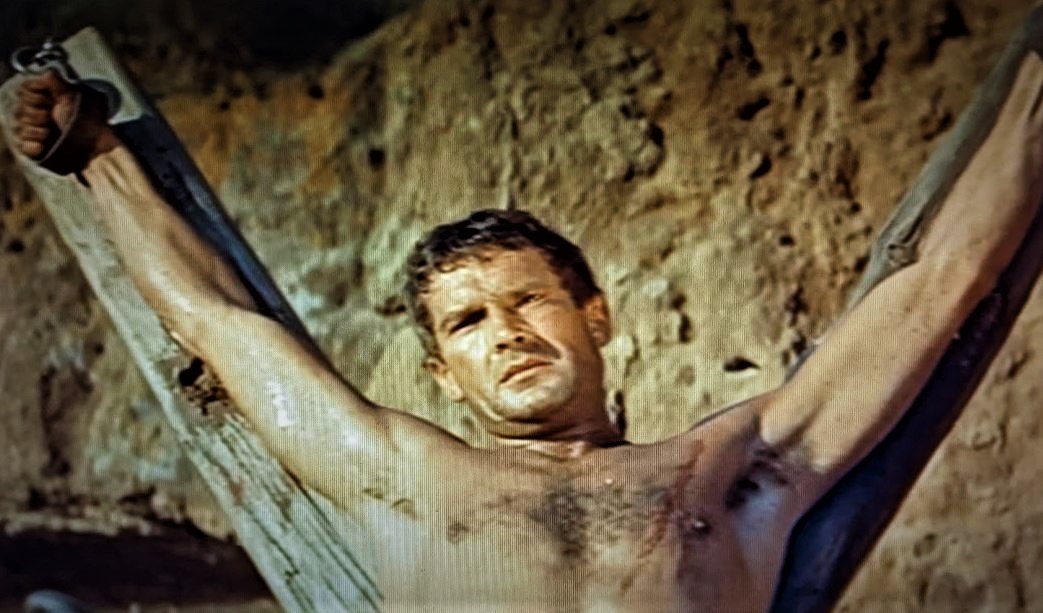
King Odenathus of Syria has always been an ally to Rome, but when he is murdered, Queen Zenobia breaks their treaty and attacks Roman troops near the royal city of Palmyra. Marcus Valerius, a valued Roman commander, is captured, enslaved, crucified on an X-shaped cross in the hot sun and tortured by the slave boss before he comes to the attention of Zenobia, who makes him a palace slave. Valerius makes contact with Julian, a Roman spy in Palmyra (side plot note: Julian is in love with Bathsheba, a vestal virgin and sister of the dead king, who will eventually be sacrificed). Learning that Julian is with a small group of Romans outside the city, Valerius pretends to switch sides and offers his personal services to the queen, with the proof being that he betrays the Romans to the Syrians—they play along with their capture and are rescued (by a small group of Christians if I'm not mistaken)  just before they are ordered to be put to death. But Valerius and Zenobia find themselves falling in love and Valerius tries to get Palmyra and Rome to negotiate. Upsetting his plans is Zemanzius, the queen's prime minister, who is actually working with Prince Shapur of Persia toward their own takeover of Palmyra. Events build to a climactic battle that tests the tie between Valerius and Zenobia.

Zenobia and Odenthaus are based on actual historical figures, but I suspect little else here is. Still, the narrative is richer than most of the later sword and sandal films that came in the wake of the huge success of the 1958 Hercules movie with Steve Reeves. Though certainly aligned with the peplum genre (togas, torture, sexy queens, sacrifices), in some ways this is more like the Hollywood biblical adventures of the 50s, with more attention paid to politics and character development than one would see in later genre films. There are no real muscle men; the lead actor, Georges Marchal (pictured), is handsome and beefcakey (and shirtless on occasion) but he's no Hercules. The sex kittenish Anita Ekberg is quite attractive as Queen Zenobia (with her breasts occasionally threatening to escape her robes) but her acting is rather bland, and she doesn't have the gravitas of a queen—she comes off more like a court concubine. Jacques Sernas as Julian makes for a handsome buddy to the hero, and Folco Lulli (Zemanzius) is an OK villain. Chelo Alonso makes an impression as the scheming lover of Zemanzius, especially when she does an erotic belly dance for the court. There are no gladiators in sight—the original title was SIGN OF ROME—and the action is confined to the last 15 minutes. The battle is well done, though to an unnerving degree, it all looks fairly dangerous for both the horses and the men. [Amazon Prime]

Wednesday, July 26, 2023

THE BLACK ABBOT (1963)

Pay attention, there might be a quiz. Lord Harry Chelford, whose mother died under mysterious circumstances a couple of years ago and who may be going mad, needs an heir and he wants the much younger Leslie Gine to marry him, though she's actually sweet on Dick Alford, the estate manager. Lord Harry also believes the legend that there is a buried treasure somewhere on his estate. Meanwhile, Arthur, the family's attorney and Leslie's brother, is being blackmailed by his bookie Gilder who wants Leslie for himself. Mary, Harry's former secretary, wants Harry for his money and claims to know where the treasure is. Thomas, the butler, seems always to be engaging in suspicious behavior. The family doctor breezes in and out. Oh yeah, and there’s the title character, a mysterious robed figure who stabs a man to death in the opening scene. This brings Scotland Yard in to try and sort out all the threads and find out: who is the Black Abbot? Where is the treasure? Who is the robed older woman wandering around at night? 

This German krimi, based on an Edgar Wallace story, is ridiculously convoluted but, when you clear away the red herrings, fairly easy to follow. The tangled romances, brought in perhaps to make things feel even more Gothic than they would, wind up having little to do with the outcome, but here, it's really the atmosphere that matter most. It's not immediately clear who the good guy is going to be, but if you’ve seen other krimi films, you’ll know that the presence of Joachim Fuchsberger as Dick marks him as the hero. His usual sidekick, Eddi Arent, is a comic relief cop. In the crowded supporting cast, Werner Peters is a standout as the slimy bookie Gilder, and Klaus Kinski brings his unsettling creepiness to the relatively unimportant role of the butler. Though the pace drags a bit, the ending is nicely done. Lovers of the Gothic melodrama should especially like this one. Pictured are Fuchsberger (Dick) and Grit Boettcher (Leslie). [YouTube]

Monday, July 24, 2023

VIVA LAS VEGAS (1964)

Before I sat down to watch this, I only had one Elvis Presley movie under my belt, Blue Hawaii, which I saw on the pool deck of a Turner Classic Movie cruise ship in bright Caribbean sunshine with a cocktail by my side, so my attention was not exactly riveted on the screen. Hence, I remember very little about it except that Angela Lansbury played Elvis' mother and it seemed to have been shot on real Hawaiian beaches. On a recent long holiday weekend, I decided to give this one a shot, mostly because I like Ann-Margret, his leading lady. Elvis stars as himself… er, no, as a young, handsome hotshot race car driver who dreams of driving his own car in an upcoming race in Las Vegas. He has finally gotten together enough money to buy a new engine for the car, but he promptly loses it when Ann-Margret, playing a young, sexy swimming instructor at the Sands Hotel in Vegas whom Elvis is flirting with, pushes him in the water. The money gets sucked up into the pool filter so, because he has to start from scratch, he and his assistant (Nicky Blair) get jobs working at the Sands. They both end up entering a Sands talent show, he to win money for his engine, she to get enough money to give her aging fisherman father so he can buy his own boat. There's also the little matter of the climactic Las Vegas race which pits Elvis against Italian champ Cesare Danova (who himself is also making a play, somewhat half-heartedly, I thought, for Ann-Margret).

As I assumed going in, the plot here isn't really the point, it's watching pretty people sing and dance, while occasionally getting a mini-travelogue of Las Vegas in the mid-1960s. A well-filmed car race is the topper. One thing I was wrong about was Elvis himself. I never thought of him as much of an actor, and he certainly was never an Oscar nominee for any of his 30-some movies, but within the limits of his carefully-curated persona, he acquits himself well enough here. He sings, he dances, he exudes a relatively healthy masculine self-confidence, and there is never for a second any doubt that he'll get the girl. That is one of the movie's weaknesses: his romantic rival, Danova, is a wet rag who never registers any chemistry with Ann-Margret. (Of course, the fact that Elvis and Ann-Margret were apparently engaged in an affair during filming may also be a factor in the chemistry thing.) The screenplay is also on the weak side, generating little tension and giving our characters no personality aside from the actors provided with their pre-existing personas. The factor that leads to Elvis finally getting his engine is pretty much a deus ex machina. But generally, it's a painless experience, and every time that Ann-Margret is on screen, she wipes everything else away. William Demerest is able to make a bit of an impression as Ann-Margret's father. And that title song, performed twice, once over the opening credits and once by Elvis on camera, is spectacular. [TCM]

Wednesday, July 19, 2023

THE WAYWARD BUS (1957)

In California, Johnny drives a ramshackle bus on a once-a-day trip from the small town of Rebel Corners to Sun Juan. His wife Alice runs a small roadside diner and drinks too much. They seem disgruntled with each other, but not enough for either one to force a crisis. But Alice seems to have it in for Norma, the young waitress who works for them. She has dreams of being in show business and thinks that Alice is jealous of her for wanting a better life. The two have a physical confrontation which leads Norma to leave on the bus to San Juan, and drives Johnny into saying that he's leaving Alice. Among the other passengers: the sexy adult entertainer Camille (who longs for domestic tranquility), traveling businessman Ernest (who, though quite a bit older, is smitten with Camille until he discovers what her career is), Van Brunt (a cranky old bastard who lets everyone know he has an important reason to be in San Juan by 3:00), and a bickering couple with a wayward daughter named Mildred, who starts to flirt with Johnny. The bulk of the film is the bus trip which should only take a couple of hours but is held up by bad weather and later, a landslide which blocks the road. By the time they reach San Juan that evening, relationships are forged or broken and people’s lives are changed, mostly for the better.

This is based on a John Steinbeck novel; except for The Grapes of Wrath, I haven't read much Steinbeck, but this feels a lot like the 1940s movie of his novel Tortilla Flat and the 1980s film of his Cannery Row, stories about a diverse group of people held together by a central character. Tortilla had Spencer Tracy and Cannery had Nick Nolte, both giving slightly larger-than-life performances to anchor their films. This has Rick Jason playing Johnny; he's not bad, but he doesn't have the age or feel of authority that Tracy and Nolte had. I kept hoping he'd get better, but at the beginning, he's as good as he gets. When his circle consists of just his wife and employees, he commands attention, but he has a hard time holding it when other more colorful folks are around him. Somewhat surprisingly, the two sex kittens, Joan Collins (Alice) and Jayne Mansfield (Camille), give the best performances here, and their characters are the most interesting, whether due to the writing or acting, I'm not sure. Dan Dailey (Ernest) and Delores Michaels (Mildred) are the only other acting standouts here. All the characters, even the most annoying ones, are ultimately treated humanely by the screenplay, and the conflicts that arise all feel predestined to get smoothed out by the end. The mudslide scene is handled well. Watchable, but a hard movie to truly like. Pictured on the bus: Jason driving with Mansfield and Collins on the left. [Criterion Channel]

Monday, July 17, 2023

COYOTE CREEK CHRISTMAS (2021)

My Christmas in July review:
Paige is a big city event planner working her way up the corporate ladder. She's happy for some down time to go celebrate Christmas with her parents in the small mountain town of Coyote Creek where they run a very successful (and very large) inn. But when she learns that Mom and Dad are scaling back a bit on the holiday plans this year, she's quite upset and decides she will "plan" the inn's Christmas as an "event" to add to her portfolio. She settles on the theme of Christmas Around the World and plans for German cookies, Japanese food (fried chicken), Icelandic traditions, etc. and throws herself into the planning. What her parents are deliberately keeping from her is that they are in the middle of selling the inn so they can spend their senior years traveling. And who are they selling to? A real estate development firm run by the Bailey brothers (not George and Harry from It's a Wonderful Life, but wouldn't that have been fun?). Jack, the more driven brother, sends Dylan, the handsome single father, out to the inn to finalize the sale and start making plans for a razing and rebuilding of the site to suit a corporate buyer. But the parents ask Dylan not to tell Paige about the plans yet. Really, Hallmark viewers need to know nothing more—big city folks in a small town, family property, corporate plans, pretty gal, handsome guy—a happy ending for both the couple and the property is in the bag by the 115 minute mark at least (out of 120). Dylan pals around with Paige and helps with the Christmas plans, Dylan's precocious son Noah (who loves using Word-of-the Day words in conversation) takes a shine to Paige, and in the end, things work out all around, with the promise of Dylan and Paige getting together and (probably) staying in Coyote Creek.

But getting to the ending is not as smooth a ride as it should be. The good points: Ryan Paevey, he of the handsome face, deep voice, and unthreatening masculinity (at left), is great. Janel Parrish, born in Hawaii of Chinese and American parents, is also quite good until her poorly written character betrays her (more on this later). The parents (Linda Minard and Cameron Bancroft) are fine. Paige's sidekick Quinn (Naomi King) is fun and gets her own same-sex romance on the side, though honestly it feels like a last-minute thing added by the writers to kill five minutes of running time. There's also a cute bit involving a Christmas marmot and Coyote Creek folklore. The Christmas décor and aura are perfect.

The bad points: The big conflict that surfaces around the 90-minute mark is when Paige discovers the plans for selling the inn. Though the secretiveness is all due to the parents, she turns into a bitch and takes out her anger pretty much solely on Dylan. In my eyes, this made her almost irredeemable, and it kind of stunk up the somewhat forced happy ending. (Maybe after the writers' strike, the Hallmark writers will come back energized with some new ideas and stronger characters.) I was confused about Quinn's place in the proceedings—I assumed at first that she was Paige's sister, but Quinn kept referring to Mom and Dad as "your parents" to Paige, so I guess she's just an old friend who works at the inn—or maybe not even that; I can’t remember if she actually works there or is just around all the time. The kid playing Dylan could have been reined in a bit, unless the plan is that he'll be a gay English major at some point, but he is enthusiastic. By Christmas Eve, the inn is so deluged with guests that they have to set up "glamping" tents outside to accommodate everyone, a stupid plot point—I guess overbooking is cool by these people—that's not needed. I’d probably watch this again, but I'd bail at the 90-minute mark and imagine a different ending in which Dylan and Paige get together but also go back to their big-city jobs and let Mom and Dad sell out. Pic above right: Mom, Dad, Quinn, Paige, Dylan and Noah. [Hallmark]

Friday, July 14, 2023

RHAPSODY (1954)

Elizabeth Taylor announces to her wealthy, disapproving father (Louis Calhern) that she is leaving his home in France to go to a conservatory in Zurich. She says she wants to polish up her piano style, but mostly she wants to be where her boyfriend (Vittorio Gassman) is as he finishes up his violin studies. Taylor gets a room in a boarding house where she hits it off with another first-year piano student (John Ericson), which triggers Gassman's jealous streak. Ultimately, Taylor bombs her audition, and as Gassman's studies become more intense, his ego grows. At a rehearsal for a concert with the Zurich Philharmonic, Gassman butts heads with the conductor, and decides that he shouldn't see Taylor at all until after the concert, which leaves room for Ericson to step in and spend time with her. The concert becomes a star-making event for Gassman, but when he starts paying too much attention to orchestra groupie Barbara Bates, Taylor tries to kill herself. Ericson devotes himself to her during her recovery and eventually the two get married, but it's clear that Taylor is still carrying a torch for Gassman. Eventually, the paths of all three cross again, and Taylor is going to have to choose between the now famous Gassman and the depressed Ericson.

This is a fairly slow-moving romantic melodrama which fans of classical music may enjoy for its interludes of Rachmaninoff and Tchaikovsky. The whole point of the film seems to be to showcase Taylor's beauty, and she does indeed look beautiful, both in her close-ups and in her colorful wardrobe. Gassman and Ericson try their darndest to compete with Taylor for focus (narrative if not visual); the handsome Gassman is more successful, giving a fairly strong performance, with Ericson (pictured with Taylor), more appealing looking than handsome, struggling a bit with the passive second-lead male role, but he's OK. Old pro Calhern is welcome in a couple of short scenes. Look for a young Stuart Whitman as one of the musical students. There's a fun scene early on in which Gassman and his buddies take over a small diner for an impromptu concert. I was impressed with the skill with which both Gassman and Ericson appear to play their respective instruments (especially the vigorous workout Ericson gives the piano in the final sequence), though the music is actually played by professionals. Of its kind, the MGM sheen makes it watchable, but probably not for casual classic-era fans. [TCM]

Thursday, July 13, 2023

FORTY GUNS (1957)

This Samuel Fuller western opens with a stunning opening shot of three men in a small wagon headed down a desert road in Arizona as a huge party of forty men on horses comes stampeding down the road, parting to go around the wagon. The forty men are the Dragoons, men who work for powerful rancher Jessica Drummond (Barbara Stanwyck). The three men in the wagon are U.S. Marshal Griff Bonnell (Barry Sullivan) and his brothers Wes and Chico, armed with a warrant for the arrest of a man named Swain, who happens to be one of Jessica's Dragoons. In the main storyline, Griff and Jessica begin as antagonists but grow to respect each other, and even fall in love. Getting Swain turns out to be easy, as Jessica insists that she's not the unlawful type. But her vulnerable spot is her reckless brother Brockie (John Ericson) who has just killed the town's blind marshal and gone on a spree of destruction just for kicks. He is temporarily put in his place by Griff but hard feelings remain. In another plotline, Wes is asked to stay in town and take the marshal's place, which he is tempted to do as he has fallen in love with the gunsmith's daughter. Griff's youngest brother, Chico, gets blind drunk and has to be tossed in a trough to sober up, but he soon outgrows his rowdy ways and proves his mettle with his brothers. Brockie continues to cause friction, despite Jessica's attempts to keep him out of trouble, becoming the catalyst for a brutal final shootout.

Between a nice visual style, characters with some depth, and mostly fine acting, this is one of the more interesting westerns of the classic era. Barbara Stanwyck (pictured) had staked a solid claim in the genre in 1950's intense psychological western THE FURIES; here, she is less showy but more realistic, and perfect in the part of the powerful woman whom you expect to be a one-note villain (especially when she is described in a barroom song as "a high-riding woman with a whip") but becomes anything but. John Ericson is believably scary as the out-of-control Brockie. The solid supporting cast includes Dean Jagger as a sheriff mostly under the control of Jessica (at one point she has to remind him, "I'm your boss, not your partner"), Gene Barry as Wes, Robert Dix as Chico, and Eve Brent as the gunsmith's daughter. I was less taken with Barry Sullivan as Griff—he's wooden and uncharismatic, and not worthy of Jessica. But he doesn't really hurt the movie much. The black & white cinematography is beautiful throughout and the climax is genuinely thrilling. Highly recommended. [Criterion Channel]

Tuesday, July 11, 2023

BACK PAGE (1933)

Ambitious reporter Jerry Hampton (Peggy Shannon) has a scoop, an article about an illicit love nest suicide, but her editor kills it because it involves the rich and influential J.H. Smith. Her boyfriend Brice (Russell Hopton), also a reporter, wants to get married but she's not ready to settle down, so he advises her to get a job on a small-town paper where she can have an impact. Brice's uncle Martin Blake (Edwin Maxwell) is the president of the bank in the small California town of Apex, where the retiring head of the local paper is looking for someone to take over. Sam (Claude Gillingwater) is reluctant to hand over the reins to a woman, and her first act is to antagonize the paper's biggest advertiser Nathan Young (David Callis) by writing about his brother's divorce. When he threatens to pull his ads, she claims that she is about to accept competing ads from mail order companies out of town, and Nathan caves. Sam is won over and Nathan becomes her platonic buddy, running her around town on errands and getting involved in her investigation into a local oil well operation. Blake, the bank president, has encouraged the people of Apex to invest in the well, but Sam smells a rat, and sure enough, the well supervisor comes to Jerry and tells her the well is a bust. Blake has announced he will buy up the townspeople's shares, at a fraction of what they paid (which you may recall was a strategy in old man Potter's bag of tricks in It's a Wonderful Life), and suspicious Jerry, along with Nathan, starts nosing around and soon breaks the news that the well is actually fully functioning. The citizens celebrate and Apex becomes a boom town, but the angry Blake gets his revenge by calling in loan payments that he knows the paper cannot make. He plans to take over the paper, firing Jerry and, to add insult to injury, installing her boyfriend Brice as editor. Can Jerry out-scheme Blake and keep her job and her boyfriend?

This is a rather delightful movie, if you keep your expectations on a low-budget pre-Code level. The plot is complex enough to keep you interested but not so convoluted as to cause confusion. It manages to stymie some expectations one might have about its heroine: she is strong and independent, she sustains a non-romantic friendship with a male, and her boyfriend is not jealous of her commitment to a work life. The movie has a low-budget look but that winds up being almost a plus, as the newspaper office has an authentic small-town feel to it. Generally, the acting is fine. Peggy Shannon eventually became an alcoholic and died less than ten years later, but she fits her role here perfectly. Maxwell does his usual good work in a villainous role; Hopton disappears in the middle of the story, but makes a good impression when he’s around. Sterling Holloway has a comic relief role as a (possibly gay) gossip columnist; many reviewers of this film find him irritating, but I don't mind him. This is the kind of story that lends itself to a typical melodramatic treatment, but the tone is kept fairly light and upbeat. I viewed this on DVD as part of a set from Flicker Alley called In the Shadow of Hollywood: Highlights from Poverty Row, and it's been given a spectacular restoration. The audio commentary, as most are these days, is hit and miss. The commentator misidentifies actor Claude Gillingwater as Gillingworth throughout, and is repetitive with her social context points. I recommended the movie if not the commentary. Pictured are Callis and Shannon. [Blu-ray]

Friday, July 07, 2023

MAN-EATER OF KUMAON (1949)

The jungles of Northern India are inhabited by tigers (so we are told) and typically their prey does not include humans. Collins (Wendell Corey) is an American doctor who is tiger hunting to escape painful memories of his recent divorce. He wounds a tiger which loses a claw but gets away. The natives know that the tiger in its weakened state will have a hard time hunting and will be a threat to people and must be hunted down, but Collins, showing signs of malaria, refuses. When the tiger begins killing villagers, they know that it will never return to its natural prey, and soon in a nearby village, a young pregnant woman named Lali (Joy Page) is attacked and severely injured by the tiger. Her husband Narain (Sabu) fetches Collins to help her; she survives but her unborn child does not. When a tiger print with a missing claw is found in the dirt, Collins eventually decides to stay in the village to hunt the tiger down. Meanwhile, there is some melodrama involving native customs which say that Narain must leave Lali because she can no longer bear children, though he does not want to, and Lali ends up going off to offer herself as bait to catch the tiger. The ending, while satisfying, is remarkably anti-climactic. I watched this because Sabu (The Jungle Book, Cobra Woman) was top billed, but unfortunately Wendell Corey has more screen time. Though he's not exactly a bad actor, Corey must be the most unappealing and uncharismatic actor to become a leading man, and his drab performance sinks the movie. Sabu and Joy Page (the young refugee who Bogart helps in Casablanca) and the tiger all try to get some juice into the proceedings, to no effect. Morris Carnovsky, a respected stage actor whose screen career was eventually hurt by the blacklist, is fine (though made up in what I call 'duskyface') as Ganga Ram, Nairan's father. The print I saw on YouTube was missing roughly ten minutes of footage but it didn't seem to hurt the narrative flow too much, and honestly, anything to make this film shorter is fine by me. Based loosely on the real-life experience of author and hunter Jim Corbett. For Sabu completists only. Pictured are Sabu and Page. [YouTube]

Wednesday, July 05, 2023

THE ROYAL HUNT OF THE SUN (1969)

Spain, 1528. Explorer Francisco Pizarro goes to the king to get backing for a third trip to Peru to find the hidden gold of the Incas that Spain is certain exists. King Carlos can't afford to bankroll what he assumes will be another futile trip, but he gives Pizarro two priests (to convert the natives) and sends Estete, a royal representative, along. Pizarro raises money and men on his own with help from fellow explorer Fernando De Soto who accompanies Pizarro to Peru. By 1530, Pizarro's men arrive and meet with Incan king Atahualpa, who calls himself Lord of the Earth and Sky and Son of the Sun. Pizarro, claiming also to be a god, demands that Atahualpa hand over all the Incan gold to take back to Spain. After Pizarro's men slaughter most of the king's guards, Atahualpa agrees to be kept captive until his men have filled a room with gold for the Spaniards. Over time, Pizarro finds himself respecting the king. In the end, Atahualpa refuses to guarantee that his men will not harm Pizarro's men as they leave, so Atahualpa is sentenced to die. Putting on the mask of the Sun King, Atahualpa assures everyone that, if he is put to death, he will rise alive the next morning, and Pizarro comes to believe that, if Christ could be resurrected, perhaps Atahualpa can too. 

Like ALFRED THE GREAT which came out the same year, this tries to be both an epic and a philosophical chamber drama at the same time. Admittedly, the deck here is stacked against the epic, as this is based on a play (by Peter Shaffer, author of Equus and Amadeus) and there are few large-scale scenes of conflict or adventure. Robert Shaw (Pizarro) and Christopher Plummer (Atahualpa) give it their all, and at times their conversations, mostly about religion, achieve some actorly grandeur. Interestingly, Shaw outshines Plummer here. Plummer gives a very eccentric performance as Atahualpa, full of strange gestures and hissing and odd verbal squeaks, and though he does make the character seem otherworldly, he also remains cold and unknowable. Shaw lets us see the inner confusion of Pizarro who seems not to be concerned much with the spiritual until he confronts the Incan king. The outdoor scenes, shot in Peru, are splendid looking, and despite the intense focus on the two strong leads, there are some noteworthy supporting performances: Nigel Davenport as De Soto, Leonard Whiting (Zefferelli's Romeo) as Martin, a young associate of Pizzaro's, and Michael Craig as Estete. Not easy to find, but worth seeing, especially as an example of a kind of film (or indeed, play) that isn't made anymore. Pictured, from left, Shaw and Plummer. [DVD]

Monday, July 03, 2023

TEVYA (1939)

It's impossible to experience or discuss this film without making reference to the musical Fiddler on the Roof, an adaptation of stories about Tevye the Milkman written in Yiddish in the 1890s by Sholem Aleichem. [Most sources, including the 1971 film of Fiddler and the subtitles on this film, spell the milkman’s name Tevye; this movie's title spells it closer to the Hebrew transliteration. Out of tradition (pun intended, if you know the musical), I will spell it here with the final 'e'] Tevye and his family live in a village in Ukraine, and are one of the few Jewish families in the area. We see Tevye's daughter Chava being admired by the young men of the village, but unknown to all, including her father, she's in love with Khvedka, a gentile scholar who brings her books to read. When a friendly priest drops by to tell Tevye about rumors that a Jewish girl is about to marry a gentile, Tevye says that if that happened to him, either he would die or she would. When Chava hears this, she faints. Sure enough, the very next day, Chava marries Khvedka. Tevye goes to the priest's house in an attempt to stop him from marrying the two, and his wife Goldie warns, "Be careful—if you start in on your quotes, we'll be lost." But his efforts are in vain; Khvedka's parents call Tevye and his wife "disgusting pests." At home, Tevye declares Chava dead, not to be remembered or mentioned, and goes as far as sitting shiva (a funeral ritual) for her. Chava loves her husband, but over the next couple of years, his family starts treating her like a servant. When her mother is on her deathbed, Chava has to watch from outside in the rain. When the Tsar decrees that all Jews must be expelled from their villages, Tevye has no choice (the priest tells him he could convert, but he's not about to do that) so he packs up to leave. When Chava hears the news, she breaks away from Khvedka and his family, and returns to her father, desperately hoping he will take her back.

There is humor here and there—when Tevye's horse refuses to get up and work, he asks it, "How long is your sabbath?"—but this is a darker version of the stories than Fiddler was. In the musical, Tevye had three daughters, all of whom defy his wishes and marry as they please. Here, there is only one other daughter, Tseytl, whose sickly husband (whom we never see) dies and she winds up living with her two children with Tevye and Goldie. The matchmaking business, a big part of Fiddler, is absent here, as are most of Tevye's conversations with God. Because the Tevye of Fiddler is often played as larger-than-life (Zero Mostel, Topol, Harvey Fierstein), it's interesting to see here that Maurice Schwartz, a famous actor of the Yiddish stage (pictured), underplays the character a bit, making him more human and less a blustering force of nature. The other performances are generally fine, though Miriam Riselle as Chava wrings a bit too much melodrama out of her situations. I wasn't sure what to make of the husband, Khvedka (the name in the subtitles though most sources call him Fedye). Leon Liebgold plays him quite sympathetically, right up to the scene where Chava leaves him, but I wondered why he let his family run roughshod over her. The film is in Yiddish and the locations look authentic, but it was actually filmed on Long Island and directed by Schwartz. Fans of Fiddler should try to catch this. [Blu-ray]

Friday, June 30, 2023

BATTLE OF THE CORAL SEA (1959)

In March of 1942, days after the Allied defeat at Corregidor, Lieutenant Commander Jeff Conway (Cliff Robertson, pictured at right) of the USS Dragonfish risks his submarine's safety to pick up a couple of battle survivors on a raft, an act that, though successful, doesn't sit well with his superior officers. His next assignment is to keep track of several Japanese ships which appear to be converging on New Guinea where a naval victory would assure the Japanese of dominance over the Coral Sea and put Australia at risk. He is told that, if need be, he should be prepared to scuttle the sub and sacrifice his men to stop the enemy from getting ahold of his orders. Lt. Len Ross has jerry-rigged a camera so he can take pictures through the ship's periscope and things are going well until they get caught in a minefield and the Japanese attach depth charges to the ship. Conway burns his orders and shoots the photographs out into the sea depths, then he and the crew surrender. They wind up on a POW camp island where the overseer, Commander Mori, is proud of being civilized (even though he overworks Ross, who has pneumonia) and he refuses to use torture to get Conway to spill the beans on his mission. The Americans get friendly with two British POWs (Patricia Cutts and Robin Hughes), and all are a little less friendly to Karen Philips (Gia Scala), a translator working for Mori while claiming to be neutral. Conway figures they can hold out until May 4th, by which time the Allies will already have met to begin an offensive attack, but when Mori admits that his more passive attempts to get information have failed, a new commander is called in who is anxious to use torture and death to get what he wants. Karen finally takes sides with the Allies, and soon they are executing a plan to escape by fashioning bows and arrows, and hijacking a Japanese ship.

The title of this film is misleading in a couple of ways: 1) this is not a war action movie, so don't expect the usual genre scenes of combat; 2) there was a real Coral Sea battle, but we don't see it in the movie until the final few minutes when it is recreated via newsreel footage and miniatures. I enjoyed the movie for what it is, essentially a POW camp escape story (with a slight, if less slapstick, Hogan's Heroes aura). Cliff Robertson is convincingly commanding and stoic while playing down any macho bluster. Gia Scala is quite good as the translator; occasionally she reminded me of Ingrid Bergman, especially around her eyes. Hughes and Cutts are fine, and Gordon Jones (as a beefy torpedoman) and Gene Blakely (as Lt. Ross) provide good support. It's a bit of a slow burn for action fans, but the escape and final battle are fairly satisfying. [TCM]

Wednesday, June 28, 2023

THE MYSTERIOUS MR. M (1946 serial)

In the latest of a string of murders committed by someone who leaves a note signed "Mr. M," three small-time crooks are found dead in a river, their brains paralyzed by an unknown chemical. Police chief John Blair and detective Kirby Walsh are mystified, but we soon discover that the chemical is a drug called hypnotrine, a truth serum and mind control drug developed by Anthony Waldron, a man who has been assumed dead for years. Waldron, hiding out in his grandmother’s mansion, and being assisted by his brother Derek and sister Marina, is trying to get ahold of Prof. Kittridge's new invention, a super-engine that will allow submarines the size of ocean liners to be built (a fact that is explained in literally every chapter of this serial). Waldron is calling himself Mr. M, but soon, he starts getting phonograph records with whispered instructions from someone else using the Mr. M handle, who is masterminding his own search for the engine plans and blackmailing Waldron into working for him. As the police investigate, Kittridge winds up dead, and one of his assistants, Jim Farrell, is injected with hypnotrine by Waldron to help him—it turns out that Kittridge had farmed out the production of various parts of the engine to a number of people and companies, and the Waldrons have a long road ahead of them. As it happens, Jim's brother Grant is a government agent, and after Jim winds up dead during a confrontation, hypnotrine is found in his blood, and Grant vows to track down Mr. M. Grant and Kirby and Shirley Clinton, an insurance investigator team up under Chief Blair to find the engine plans first, and to bring Mr. M to justice, not knowing that there is more than one Mr. M.

Most of the above and more happens in the first chapter. It's thick with exposition but still manages to be exciting. More exposition follows, but a nice variety of locales and minor characters keep things moving fairly well over the next 12 chapters. At one point, Kirby is captured, injected with hypnotrine, and has an experimental electronic device implanted in his ear, allowing Waldron to send him orders remotely. Among the cliffhangers: an oil field set ablaze, a building set ablaze, a plane with an unconscious pilot, fisticuffs and car chases, and the apparent fatal shooting of a major character. The script is a notch above the average, though the plot recaps that open each chapter are delivered as exposition from one character to another (often someone reporting developments to the desk-bound Chief Blair) and that gets tedious. Oddly, in the onscreen billing for each chapter, the two bad guys, Edmund McDonald (Anthony) and Danny Morton (Derek), are billed first and third, far above the good guys, Dennis Moore (Grant) and Richard Martin (Kirby), who get seventh and eighth billing (second billing goes to Pamela Blake (Shirley) who gets a big action scene in the disabled plane). I liked the acting throughout, especially Morton and Martin; also Jane Randolph as Marina and Byron Foulger as the mousy lawyer Wetherby.

This serial came late in the serials era, though they were still being released through the early 50s, and this was the last one produced by Universal. The general view is that the later serials were losing steam, but I have not necessarily found that to be the case. I quite enjoyed SECRET AGENT X-9 and MANHUNT OF MYSTERY ISLAND, both from the late 40s. I think a bigger reason for the demise of the serial was television, where if the shows weren't exactly like serials, they were serialized, even if each segment was a stand-alone story. The plot of this serial contained more variety in incident than usual, with some plot strands lasting only a couple of chapters, and some characters came and went throughout—and one of the top-billed characters is surprisingly killed off before the last chapter. There is also a trick involved in the unmasking of the real Mr. M in the last chapter. I did like this, and I can actually imagine watching it again. At top left are good guys Richard Martin and Pamela Blake; at right, bad guys Danny Morton and Edmund MacDonald  [DVD]

Tuesday, June 27, 2023

DEATH IS NIMBLE, DEATH IS QUICK (1966)

American Interpol agent Tom Rowland (Brad Harris) and his buddy, detective Joe Walker (Tony Kendall), are back in another Eurospy movie, the second in the Kommissar X series after KISS KISS, KILL KILL. In Ceylon (now Sri Lanka), three men attempt to kidnap Babs Lincoln, daughter of a wealthy American businessman, resulting in the death of Rogers, an American diplomat, by a fatal karate chop administered by a big bald bruiser named King (Dan Vadis). As it happens, Rowland gives a public demonstration of his impressive karate skills in Singapore and he is tapped to investigate the kidnapping attempt, apparently being masterminded by a mysterious criminal organization called the Golden Cats. When Walker is hired by Babs' father to keep an eye on her, the two wind up working together on the case. As Walker prepares to take a shower in his hotel room, the water comes streaming out blood red, and it turns out to be infected with man-made bacteria that can eat human flesh. As is often the case with these 60s spy films, the plot becomes labyrinthine and hard to follow, but turning off your narrative logic senses will help you enjoy the proceedings which include the following: a beachside chase between a jeep and a train, a thrilling rooftop chase between Tom and King, a cab that is used to gas backseat passengers to death, an assassination attempt foiled by a flashing mirror, more karate attacks, a bizarre amphibious tank that patrols a creepy swamp filled with dead trees, and eventually a climactic sequence of elephants versus a plane.

I'm finding these Kommissar X movies quite fun, almost as much fun as the classic James Bond films, taking into account their lower budgets and less creative screenwriters. Harris and Kendall have a nice 'antagonistic buddies' chemistry, and though in theory, it's Kendall whose character is Kommissar X—though that name is never used in the film—it's Brad Harris (pictured to the left of Kendall) who gets the lion's share of the action and attention here. Vadis makes an effective and imposing bad guy, and Siegfried Rauch is nicely repellent as the secondary villain Nitro, though of course, neither one of them is the chief bad guy whose identity is kept secret until near the end. The finale takes place in another supervillain secret island lair, though it feels oddly truncated. The German title, Drei gelbe Katzen, means Three Yellow Cats, but the English dub always refers the group, definitely more than three people, as the Golden Cats—the 'three' may refer to a ceramic bauble of three cats which is sometimes left at the scene of a crime. Enjoyable. [YouTube]

Friday, June 23, 2023

THE BITTER TEA OF GENERAL YEN (1932)

During the Chinese civil war of the 1920s, Shanghai is in chaos. Bob, a missionary, is about to marry Megan, his childhood sweetheart whom he hasn't seen in three years. On her arrival in Shanghai, her rickshaw driver is hit and killed by the car of the warlord General Yen. Megan is upset that Yen seems unconcerned that he has caused a death (as in Casablanca, human life is apparently cheap) but for good or ill, they have made a brief connection. As the missionaries spout cruel comments about their charges, Bob decides to postpone the wedding briefly to go off and save some orphans. He goes to Yen to get a safe passage document, but Yen gives him a note which mocks him for leaving his bride-to-be. Bob and Megan get to the orphanage, but street battles separate them and an injured Megan is saved from further harm when she is taken onto the private train of General Yen. While recovering at his home, she sees a brutal mass execution carried out from her window even as she sees scenes of luxury in his palatial house. Megan has been reported dead so Yen decides to keep her around. She tries to sneak letters out to Bob, but Yen's mistress Mah-Li gives them to Yen instead. Yen says he will send her back to Shanghai once things have calmed down in the streets, but he engages in a slow burn seduction with Megan, and soon she is having erotic dreams of a suave and loving Yen saving her from a demonic Yen. But even as she begins to fall for him, she cannot convince him to show mercy to Mah-Li when it is discovered that she is the lover of one of Yen's henchmen, and has been feeding information to Yen's enemies. In the end, Megan agrees to stay with the isolated warlord and she dresses as a courtesan to serve him tea, but he has poisoned the tea, and after he dies, she says she will never leave him, and will see him again in the afterlife.

This early Frank Capra film is a footnote in movie history as the first film to play at Radio City Music Hall, but it still holds interest as an example of fine pre-Code moviemaking. The shimmering black & white photography is gorgeous, and though the sets may not be as elaborate as those at MGM (this was shot at Columbia, at the time not quite a grade-A studio), they are effective. Romance between races would soon be banned by the Production Code, and some critics believe that the portrayal of love between an Anglo woman and a Chinese man doomed the movie at the box office. Barbara Stanwyck is as fine as ever as Megan; the Danish actor Nils Asther dons what we would call "yellowface" to play Yen, but he plays his role with some subtlety and I don't think his performance is as jarring to modern viewers as those in the Charlie Chan or Mr. Moto movies. There are Asian actors in a handful of roles, including Toshir Mori as the complicated mistress. Walter Connelly plays an American money man who has raised a good deal of cash to finance Yen's ambitions, and Gavin Gordon is the unlikeable Bob. Given how interracial romance was treated through most of Hollywood’s classic era, the ending here in which Megan still pines for Yen after his death is almost shocking. [DVD] 

Wednesday, June 21, 2023

KWAIDAN (1964)

We popped this award-winning Japanese anthology film in the DVD player as a Friday night Chiller Theatre pick. Not a good choice. Despite its reputation, this is not a horror film in any meaningful way. We gave up after the slow first half-hour. But the next night, with genre expectations gone, we enjoyed it for what it is: a beautifully shot, deliberately paced rendition of four ghost stories (more or less) with a tone of unease rather than horror. The film dramatizes four supernatural stories of Japanese folklore, originally collected and retold by Lafcadio Hearn. In "The Black Hair," a samurai reduced to poverty leaves his wife to make a more financially beneficial marriage with a woman from a high-class family. But after several years, he soon realizes that his new wife is selfish and a life lived just for material satisfaction is not fulfilling, so he leaves to go back to his first wife. She welcomes him home, though oddly, she seems not to have aged, and their home is just as it was. As he learns, appearances can be deceiving. The second story, "Woman of the Snow," has a beautiful, if patently artificial, setting, with a winter skyscape of clouds that look like eyes. During a snowstorm, a woodsman and his apprentice take shelter in what seems to be an abandoned hut. The next morning, a woman with long black hair appears and breathes frost onto the older man's face, killing him. She spares the younger man but tells him he must never tell anyone about the incident. Of course, in folklore, we all know what eventually happens when someone is told not to do something: they do it. Consequences follow. 

The third story is the longest and has the slowest pace, and its title,"Hoichi the Earless," is a bit of a spoiler, but it's worth sitting through. We first see two clans in a sea battle, and the losing clan dies out when all the women kill themselves in disgrace. The shoreline is said to be haunted by ghosts of the clan. A blind servant named Hoichi is known for singing a ballad of the battle, and one night, a samurai arrives and takes Hoichi to the shoreline where what appears to be a mighty court of people listen to him play his song. He does this night after night until two of his friends realize he is playing to the ghosts of the losing clan, and they fear that he will be taken by the dead as one of them. The set and effects make this a very effective sequence. The last story, "In a Cup of Tea," is the least. Its tale of a writer whose creativity is stymied when he sees a vision of a face in his tea is both predictable and muddled. Overall, the film, directed by Masaki Kobayashi, is too long—the version I saw on a Criterion DVD is 161 minutes, and a 3 hour cut is available elsewhere—but its slow pace is part of what makes it evocative. Kobayashi's use of vivid color and studio sets bring to mind the films of Michael Powell and Emeric Pressburgerer, like Black Narcissus or Tales of Hoffmann. Well worth watching for its look and atmosphere. [DVD]

Monday, June 19, 2023

AND NOW TOMORROW (1944)

At her engagement party, socialite Emily Blair (Loretta Young) falls ill with meningitis; when she recovers, she has lost her hearing. The doctors don't know how long it will last, so she puts off marriage to Jeff Stoddard (Barry Sullivan). She spends months visiting doctors all over the world but gets nowhere (though she kicks ass at lip-reading). On her return train trip to her hometown, she is pulled out of the way of a runaway luggage cart by Dr. Merek Vance (Alan Ladd), who has a practice at a free clinic in Pittsburgh. He's a hometown boy visiting his mentor, Dr. Weeks (Cecil Kellaway), who has, coincidentally, asked him to work on Emily's case. At first, she assumes that this free clinic physician couldn't possibly help her, and on Merek's part, he resents her family because years ago, Emily's father laid off Merek's father just before Christmas. But she agrees to try his treatment and he agrees to stay in town for a few weeks to see if it works. Their relationship remains a bit prickly, but eventually they warm a bit to each other. Soon, Merek stumbles on an unpleasant fact: Emily's fiancé Jeff is having an affair with Emily's sister Janice (Susan Hayward).

This small town soap opera is, refreshingly, short on showy melodramatics, and allows the relationship between Emily and Merek to develop at a leisurely pace, perhaps a bit too leisurely as, at just 90 minutes, things bog down a bit in the final third. But if thwarted romances and medical dramas are in your wheelhouse, you'll like this. I like Young better in her 1930s movies where she seems bright and energetic. Here, she seems artificial at times, and she doesn’t really inhabit her character. But she's OK, and better are Ladd and Kellaway. Sullivan and Hayward are fine, even though, for the most part, they remain cardboard characters—though you can feel Hayward trying to make something meatier of her role. Grant Mitchell and Beulah Bondi provide solid support. Good line, early in the film: at a diner, Ladd asks for coffee, "hot, strong, and made this year." The cook replies, "You won’t like ours." Pictured are Ladd and Young. [DVD]

Wednesday, June 14, 2023

THE CARPET OF HORROR (1962)

A man seated at a desk near a statue of Kali is killed when a gloved person tosses a large round tablet on the carpet near the desk. The tablet dissolves into gobs of hissing gas, choking the man to death. Scotland Yard doesn't know what to make of it, except that the gas causes facial scarring and seems to be a poison found in India. Meanwhile, in another house, John Milner, a minor member of a large crime gang run by a mysterious, never-seen boss, has a list of all the gang's members that Scotland Yard would like to get ahold of. Detective Harry Raffold (Joachim Fuchsberger) is on the grounds when another gas tablet attack occurs, killing John. Ann (Karin Dor), the victim's daughter and now an heiress, sees Harry try unsuccessfully to stop the killer, and soon he has appointed himself Ann's protector (and suitor) and delves into the poison gas case as well. The gang's hideout is a basement beneath a car repair shop where they gather to see instructions from the mysterious boss which appear typed out on a large TV screen. Ann moves into a boarding house run by Mabel (Eleonora Rossi Drago), who may or may not be interested in a fling with Harry. The Colonel (Carl Lange) is a possibly sinister fellow boarder. After a series of increasingly outlandish events—and more gassings, although one character is racing against the clock to develop an antidote—the boss is finally exposed and defeated, and Harry and Ann, who get engaged in the back of a taxi, can live happily ever after.

This German krimi film has the usual genre markings including an unknown but all-knowing villain, a crime gang, a trap door, and a convoluted plot. Nevertheless, I found this to be quite fun. I've become quite a fan of Fuchsberger (pictured) and he's in good form here. Harry Raffold seems like the kind of character who might have been brought back for more adventures, though essentially, he is very much like all the other heroes that Fuchsberger plays in these krimi films. Dor is a notch above the usual krimi heroine and the rest of the cast is fine, especially Drago who keeps you guessing about what her role in all this might be. The ridiculous title might give you pause (though the German title is almost as silly: Der Teppich des Graunens = Carpet of Dread), but I recommend this. The print I saw is dubbed in English but the German text on the screen is untranslated. [YouTube]

Monday, June 12, 2023

THR TRUTH ABOUT SPRING (1965)

Gruff small-time fisherman John Mills lives on his small boat with his tomboyish teenage daughter (Spring, played by Hayley Mills, John's real daughter). The pair can be con artists when they need to, as when we see the two pretend to be starving in order to get food and supplies from a bigger boat. While in dock in the Florida keys, they get a visit from a nearby yacht from young handsome James MacArthur who is looking to buy some fish for his uncle and the uncle's young female guests. A recent law school graduate, James decides he's bored on the yacht (and intrigued by Hayley) and when Mills invites him to stay a while, he does. Mills' ulterior motive is to get James to help him (in legal matters and otherwise) find a lost treasure marked on a map in his possession that two other groups of men (which include Lionel Jeffries, Harry Andrews and Niall MacGinnis) also want to find. Ultimately, as sparks fly between James and Hayley, everyone winds up on an island beach, digging up an old wreck that may or may not have anything valuable in it. The most surprising thing about this movie is that it's not a Disney production. It is family-friendly, it has Hayley Mills (from the Disney films Pollyanna, The Parent Trap, and In Search of the Castaways), and it has a fairly strong supporting cast, but it's from Universal via the British company Rank. Though certainly watchable, that hard-to-define Disney magic is missing. Hayley Mills was almost 20 and James MacArthur (pictured with Hayley Mills) was closing in on 30, but her maturity and his youthful looks help make them seem more evenly matched. She seems to be having fun, though MacArthur (who had his own batch of Disney films in his past) feels a little less into the proceedings. John Mills is good as always, and the other stalwart British supporting players are fine. At times, it verges on a Home Alone-ish feel, with villains who never seem very threatening, and I suppose that's what makes this ideal viewing for children—there is a little bit of innocent romance and a little bit of danger and a little bit of adventure. Adults may feel differently, especially since it feels rather long at around 100 minutes, and though it's harmless, you might prefer to rewatch Mills in The Moon-Spinners or MacArthur in Swiss Family Robinson. [Blu-Ray]

Thursday, June 08, 2023

THE ADVENTURES OF DUSTY BATES (1947 serial)

It's a foggy night in London as the ship Tilbury Pride heads for a dock along the Thames. Young Dusty Bates (Anthony Newley), an orphan who has run away from his abusive adoptive parents, has stowed away on the ship following his Uncle Hank. Dusty, in hiding, sees a couple of sailors, Tod and Walrus (nicknamed for his mustache) conniving to hide some smuggled jewels in a crate to be taken off the ship and put into a warehouse where they can retrieve them when they're not being watched by dock police. When Dusty is found, he asks to stay with his uncle Hank, but Hank suggests that Captain Ford and his wife, who have two children of their own, take Dusty in until more permanent arrangements can be made. At first, Ford's son David resents having to share his room with the newcomer, but soon, David and his sister Gill initiate Dusty into their "secret" club which involves minor adventures, the details of which must all be kept secret. However, Dusty sets them off on a major adventure when he finds out that Uncle Hank is implicated in the smuggling—he was the unwitting carrier of the jewels onto the boat—and he and the Secret Three try to find the jewels before Tod and Walrus. What they don't know: 1) the head of the shipping company is also after the jewels, and 2) Captain Ford, though completely innocent, is being set up to take a fall if the smuggling effort is exposed. Can the Secret Three get the jewels and avoid getting caught by the villainous forces after them?

As a fan of classic-era Hollywood serials, I was surprised to discover that the British were apparently making their own serials, or at least this one—I couldn’t find much information about other such serials. It follows the American pattern of a serialized narrative in chapters of 15-25 minutes each, with cliffhangers at the end of each chapter to bring audiences back the next week. But there are differences. This one is explicitly aimed at children, or as the opening credits before each chapter put it, "An adventure story for children of all ages." With only five chapters, the total serial runs just two hours instead of the three- or four-hour running times that American serials typically had. The cliffhangers are not quite as exciting as the Hollywood ones, but they also don't cheat the viewers by showing our heroes being blown up, only to cheat an escape in the next chapter. The longer serials fell into repetitive patterns with the story stalling around chapter 3 in order to fill out the long running time (rather like streaming television shows today); this narrative went along at a brisk pace with little repetition. Though one might be tempted to dismiss this as kiddie matinee stuff (which, of course, is what the Hollywood serials basically were except with adults in the leads), the children are put in real danger; the primary villainous pair of Tod and Walrus might seem a bit like comic relief, but they're never slapstick bad guys as in the Home Alone movies. The kids mostly go through their adventures on their own, though Uncle Hank gets drafted into the secret society near the end. Anthony Newley went on to a strong showbiz career as an actor in movies and on the stage, and also found fame as a composer (songs for WILLY WONKA and the lyrics to the theme from GOLDFINGER). Bernard Lee, M in the early James Bond movies, has the relatively small role of the captain. I quite liked John Longden (Tod), Tony Arpino (Walrus), and Ronald Shiner (Squeaky, Hank's comic relief buddy. Recommended for serial fans. Pictured are Arpino and Longden. [DVD]

Monday, June 05, 2023

THE CRIME OF DR. CRESPI (1935)

At the Taft Clinic, the senior surgeon, Dr. Crespi (Erich von Stroheim), gets a call from Estelle Ross, wife of Stephen Ross, another renowned surgeon. He has been gravely injured in a car accident and she asks Crespi to operate on him. At first, Crespi turns her down because of their past love triangle; Crespi had been in love with Estelle, and he remains bitter that she married Stephen, Crespi's assistant at the time. Soon he relents, and the operation seems successful, but we find out that Crespi was actually using Stephen as a test subject for an experimental drug. After injection, Stephen becomes paralyzed and appears to be dead but is still aware of everything around him. By the time the drug wears off, Stephen will be buried alive. Crespi manages to stop an autopsy before the doctor would notice that the body was still alive, but cringing underling Dr. Thomas (Dwight Frye) notices that Crespi had filled out a death certificate while Stephen was still alive. Will Thomas have the wherewithal to report Crespi, and if so, will Stephen be rescued from his premature burial? The best thing about this Poverty Row melodrama is the stark set; necessitated by the low budget, it gives the movie an interesting and eerie feeling which, for the most part, the acting and writing can't do (and neither can the music because there is essentially no background score). Stroheim is playing Stroheim, as he usually did, and his one-note performance robs the film of a strong central figure. However, supporting players Dwight Frye, Paul Guilfoyle, Jean Brooks, and Geraldine Kay bring their characters to life enough to keep the viewer's interest. There is a subplot involving a romance between a doctor and a nurse that is mostly played for comic relief, and with a running time of barely more than an hour, this ends up feeling a little long. But it remains watchable for its almost expressionistic visual style, and for giving Frye a fairly normal and sympathetic role. Pictured are Stroheim with Harriet Russell as Estelle Ross. [Blu-ray]

Thursday, June 01, 2023

WILD GIRL (1932)

This pre-code melodrama is framed as if we're flipping through a photo album, with scene transitions done by page turns instead of wipes or fadeouts. The credits feature the actors introducing themselves in character. In the small mountain town of Redwood City, young tomboyish wild child Salomy Jane (Joan Bennett) is well liked by the townsfolk, and is being pursued by several men—though in the film's intro, she tells us that she likes trees better than men. Rufe, a scruffy sort, is feuding with Jack, a slick gambler, over Salomy. Phineas Baldwin, a mayoral candidate and supposed member of the Purity League, is planning on driving the saloon's ladies of leisure out of town, even as he eventually aggressively nuzzles Salomy though she adamantly refuses his advances. While Salomy engages in some innocent skinny dipping in the woods, she meets a handsome and gallant stranger (Charles Farrell) who is looking for Baldwin, whom he blames for driving his sister to suicide. When Baldwin assaults Salomy, the stage is set for revenge, murder, robbery, and a lynching. The biggest reason a classic movie buff might have for wanting to see this is that the young Joan Bennett is blonde (pictured with Farrell); the first sight of her this way is a bit of a shock to anyone who knows her from her later work (especially as the matriarch in Dark Shadows). Only 22 when she made this film, Bennett is surprisingly light and fizzy and quite good as the title character. Her wildness, as we discover quickly, is much more about energy and innocence and has nothing to do with sexual behavior. Charles Farrell, who could be a bit dull in romantic lead roles, is very good as the Stranger, maintaining the character's mysterious aura throughout. A youngish Ralph Bellamy is Jack and Morgan Wallace is appropriately slimy as Baldwin—his final comeuppance scene is a standout. Eugene Pallette has fun as Yuba Bill, the stagecoach driver. He is partly comic relief, though his character is important to the story. The visual style gives the whole thing a kind of fairy tale or folklore feel, and some  location shooting was done in the Sequoia National Park in California. The director is Raoul Walsh, best known for a string of 1940s movies (WHITE HEAT, HIGH SIERRA, THEY DRIVE BY NIGHT) and he gives the film a light touch even as it deals in sordid melodrama. [TCM]