Tuesday, September 12, 2023

LAST SUMMER (1969)

Peter (Richard Thomas) and Dan (Bruce Davison), two young people of indeterminate age (high school seniors or college freshmen, perhaps), are spending the summer with their families on Fire Island, whiling away their days on the sunny beaches. They meet a young woman named Sandy (Barbara Hershey) who is trying to help an injured seagull, and the three soon bond over their amateurish attempts at the gull's rehabilitation, at one point trying to get it to fly with string attached to it, like a kite. They drink beer, calling it a truth serum; they have a three-way grope session in a theater while watching a French movie; they complain about their miserable and unloving parents (who, as in a Peanuts cartoon, aren't seen except for one brief faraway shot). In an odd, somewhat slapstick but also sexually charged scene, the three get high and wash each other's hair. Eventually, Sandy kills the seagull after it bites her. Soon, the three come to the attention of Rhoda (Catherine Burns), a lonely and somewhat younger girl. She seems both desperate to become their friend but also desperate to not come off as desperate, so her behavior is a bit off-putting, but eventually, the three bond with her, though she always seems to be in the group but not of the group, like a toy for the three to play with, almost like the seagull. Sandy makes contact through a computer dating service with an older man, and as the others make plans to accompany her on the date, she decides to pass Rhoda off as her. The outcome of the date is that the man, a bit drunk, gets mugged by some local bullies as the four friends run. Peter starts to develop feelings for Rhoda, but she criticizes them for treating people like they're made of plastic. The film ends with a violent confrontation in the woods as Rhoda, still wanting to be with the three, follows them into the woods one afternoon, only to be raped by Dan, with Peter and Sandy both holding her down.

Virtually every review of this movie reveals the ending so I don't think it’s a spoiler to mention it. This scene initially got the movie an X rating, though it was later trimmed to get an R. The acting by all four is fine (Burns got an Oscar nomination), but the film feels a bit glib about its social observations, which can be summed up as: adolescents are horny, irresponsible and violent. Even in the beginning, I didn't find any of them particularly sympathetic. Hershey gives the best performance—with her physical beauty, she wouldn't have had to act much to be the most compelling person on screen, but act she does and she alone gives her character some depth. I suppose it's refreshing that this doesn’t turn into a social message movie that tries to figure out these aimless youths, but I also ended up not sure why I spent an hour and a half in their company. Pictured from left: Davison, Hershey, and Thomas in the hair-washing scene. [TCM]

Friday, September 08, 2023

ELECTRA (1962)

Some context from Greek mythology which is not spelled out clearly in this movie: Agamemnon was a Greek king who fought in the Trojan War, as presented in the Iliad. Leaving for Troy, he sacrificed his daughter Iphigenia to appease the gods, ensuring a safe voyage, which did not sit well with his wife Clytemnestra. As the movie begins, Agamemnon returns home victorious after some ten years, received by Clytemnestra and her lover Aegisthus who has become the de facto king of the land. In a bathhouse, Clytemnestra ensnares Agamemnon in a net and Aegisthus kills him with a sword. Though the king's two young children, Electra and Orestes, don't witness the murder, Electra has a premonition of doom. Time passes. So that neither child can be a threat to the queen, Orestes is sent away to wander the land, as Aegisthus is sure that on his own, he will not make trouble, and Electra is married off to a peasant farmer, an outcome seen as shameful by the people. But eventually, Orestes, encouraged by his friend Pylades, seeks out Electra and they commit, somewhat waveringly, to exact revenge on the king and queen. If you know anything about Greek tragedy, you know the outcome: there is death but the revenge rings a bit hollow.

This is the first of three films that Michael Cacoyannis made from the plays of Euripides (THE TROJAN WOMEN came a few years later), and if the narrative is bit murky at times, the film is gorgeous to look at, shot in widescreen black & white, mostly outside on Greek locations. The problem I had with THE TROJAN WOMEN, which was stagy acting in natural settings, is avoided here—the acting all around is quite good and though things may tip into the direction of the melodramatic at times (there are lots of close-ups), overall the humanity of the characters is served well by the actors. There is no mention of the gods here, so the psychological underpinnings of the story remain in the forefront. Irene Papas is often called the greatest Greek actress and based on the evidence here, I'd believe it. She is strong without being overpowering, emotional without going over-the-top. Giannis Fertis, as Orestes, can't match her in power, but he doesn't have to, as his story mostly serves as support to hers, and he's fine in his own right. Aleka Katselli (Clytemnestra) is also very good, and since one or another of the three is almost always on screen, we're in good acting hands. I especially like the way Cacoyannis uses the Greek chorus, a band of women dressed in black who circulate around Electra and occasionally comment on the action. They are choreographed beautifully at all times. This 1960s foreign language (Greek) film has suffered from neglect, probably because the sexiness and glamor of the era are absent, but I would recommend this wholeheartedly, in particular as an example of how to open up a stage play. Pictured are Papas and Katselli. [DVD]

Tuesday, September 05, 2023

STROMBOLI (1950)

After the war, displaced persons camps were set up all over Europe for some of the millions who were refugees from the Nazis or otherwise forced from their homes. Karin (Ingrid Bergman), a young Lithuanian woman, is at one of the camps in Italy. At night, local men congregate at the camp fence to flirt with the women, but one young man, a fisherman named Antonio (Mario Vitale), hangs back a bit and serenades Karin specifically. Though they barely know each other, he wants to marry her. When her request for a visa to Argentina is turned down, she somewhat reluctantly agrees to marriage to get out of the camp. He takes her to his home on the island of Stromboli. Any romantic images of a bucolic island life are shattered when she arrives and finds the island is bleak and rocky and has an active volcano at its center. Karin tries to spruce up their dilapidated stone home but can only do so much, as Antonio has no money and fishes in a communal group. She goes to a local woman to have a new dress made, but discovers that the woman is the local prostitute and soon she is seen as a bit suspect herself. She goes to the village priest for guidance but he has little to offer. The lighthouse keeper is sympathetic but also helpless. When she discovers she is pregnant, she is determined to leave the island, but Antonio is just as determined that she stay. One night, when Antonio has locked her into her room, the volcano begins to erupt. The lighthouse keeper helps her escape but as she struggles up the mountain, she seems to realize that she really has no option but to face life as it is, and in the morning, she heads back to the village.

This movie caused a bit of a sensation on its initial release because Ingrid Bergman had left her husband to live with, and make movies with, Italian director Roberto Rossellini, and her 'immoral' behavior caused her to be condemned in Congress. But viewers hoping for a scandalous movie out of this, their first collaboration, would have been disappointed. Despite the aura of immorality around the narrative and its production, any salaciousness would have to come from the viewer's imagination. This is a fairly drab looking film (despite the occasional nicely framed view of the island setting) with a dull, plodding narrative. We get some hints about Karin's background that she's no pure innocent, but she is otherwise just a humbled person looking to live a better (and certainly, a livelier) life. Similarly Antonio seems like a good and simple sort who gets into his marriage over his head, and his response is to behave rather brutally. The ending on the volcano is often assumed to be about a spiritual epiphany that allows Karin to return to the village a happier person, but that conclusion comes off as murky and unearned. Mario Vitale was a fisherman who was discovered by Rossellini; he's fine here, holding his own with Bergman (who herself seems a little tamped down), and went on to a short acting career. The opening was filmed at a real displaced persons camp, and the rest was shot on Stromboli with mostly locals in other speaking roles. Overall, a bland melodrama that feels beneath the talents of Bergman, though she tires hard. [Criterion Channel]

Thursday, August 31, 2023

A MAN AND A WOMAN (1966)

This French film was a runaway hit in the 60s, possibly because it had the cachet of an artsy new wave movie, but was essentially a very accessible soap opera romance featuring attractive stars. (The insanely catchy theme song by Francis Lai, which became a radio hit, could be another reason.) I gave this a mini-review over twenty years ago, disappointed that I had seen an English dub, but I recently found a DVD of the film with the original French audio and English subtitles at my library, so I gave it another shot. The plot is simple: a young widow and young widower meet while dropping their children off at a boarding school. Anne (Anouk Amiée) is a script girl whose husband, a stuntman, was killed in a stunt accident; Jean-Louis (Jean-Louis Trintignant) is a race car driver whose wife killed herself when he was badly injured in a race track accident. They get to know each other over a period of a couple of weeks. As he races at Monte Carlo, she follows the press coverage and impulsively sends him a telegram expressing love. When the race is over, he impulsively drives all night to see her in Deauville. They begin to make love, but memories of her husband cause Anne to halt the proceedings. She decides they should end their relationship and takes a train back to Paris by herself. Jean-Louis has one more crazy romantic gesture left to get her to change her mind.

This came off to me as a glossy 60s version of a glossy 50s romantic melodrama. The main difference is that this film fragments the narrative in ways that may have been new and different in 1966. For example, the characters' tragic backstories are filled in piecemeal, like visual flashbacks with little verbal explanation given. The film alternates between black & white and color for no obvious purpose—some critics say that color changes reflect past versus present, or inside versus outside, but those patterns aren't followed. Apparently it just was a solution to a budget problem, but it seemed profound to viewers at the time (the same applies to Lindsay Anderson's IF a couple years later). Amiée and Trintignant are excellent in the lead roles—good-looking, charming, and able to overcome the vagueness of their character's backgrounds and personalities; even though almost every scene features one or both of them, you never feel like you know them. This is basically a two-actor show, but I liked Simone Paris as the boarding school mistress who subtly encourages the romance. The racing scenes were too numerous for my taste, but it is, for the most part, gorgeously photographed. A number of shots of the leads together look like they were taken from glossy TV ads, but probably this movie influenced the later ads. The finale is giddily romantic and satisfying, right out of a classic-era Hollywood romance. Original title: Un homme et une femme. [DVD]

Wednesday, August 30, 2023

THE MYSTERY SQUADRON (1933 serial)

Fred Cromwell and 'Jellybean' Cook (named for his prodigious appetite for jellybeans) are two ace air show pilots who are contacted by old friend Hank Davis to take on a big job. Davis is working as an engineer for Stephen Gray who is building a dam in New Mexico and is facing opposition in the form of a villain who calls himself the Black Ace. He leads a band of fliers known as the Mystery Squadron who attack the site with planes decked out with flamethrowers. They have thrown construction into chaos and Davis wants Cromwell and Cook to investigate and fight back. When the two arrive at the dam, they are mistaken for members of the Mystery Squadron by Gray's feisty daughter Dorothy, but soon she joins the two in their pursuit of the Black Ace. We find out the rationale for the attacks: the Ace operates a secret gold mine that would be destroyed by the building of the dam. But there are plenty of suspects who might be the Black Ace. The most obvious are Johnson, a rival contractor, and Collins, a foreman who is actively working with the Squadron. But things are a bit fishy at the local hotel. The owner, Martin, seems unfriendly to Cromwell and Cook, and Flint, the local doctor, is allied with Martin. Or might the Ace be someone closer to Gray’s construction team? The prime era of the serial is generally considered to be from the late 1930s into the early 1950s. This one, from 1933, is fairly primitive even compared to the low-budget production limitations of most of the later serials, but in terms of narrative, it stands up with the best of the genre. Considering the narrow focus and settings of the plot (one threatened dam, one hotel, one mountain hideout for the bad guys), the chapter-ending cliffhangers are varied, including fisticuffs (though the fact that flesh punch noises aren't dubbed in is disappointing), planes set on fire, gunfights, and a car crash. (A little cheating goes on from time to time in terms of the escapes.) As is par for the course, the heroine (Lucile Browne) is often stuck on the sidelines, but she does take center stage a couple of times to perform heroics. Eventually, it seems that practically every secondary character is plotting against Gray, even those who may have no direct connection with the Black Ace, and that got a little confusing for me. 

But the two leads, Bob Steel (Cromwell) and Guinn 'Big Boy' Williams (Cook) are excellent, and Williams' occasional comic relief, mostly involving jellybeans, never gets too irritating. I like the fact that, at the hotel, the two rarely take the stairs, opting instead to leap over the railing to the first landing. The supporting actors are fine, though the biggest name in the cast, J. Carroll Naish, is largely wasted as Collins. Considering the title organization, there are not as many dogfights in the air as you might imagine. The special effects are definitely cheesy—most of the plane sequences involve obvious miniatures, and one scene involving mass destruction of planes is especially unconvincing—but frankly that added to the serial's appeal to me. I will say that the repetitive trips up and down the secret passage at the hotel got tedious, but the identity of the Black Ace, which I figured out just before we're told, is a good reveal. Recommended for serials fans. Pictured are Steele, Williams, and Bob Kortman. [DVD]

Monday, August 28, 2023

THE COOL ONES (1967)

After we endure a terrible dance number being broadcast live on the TV variety show Whizbam, we cut to Cliff Donner, a washed-up one-hit wonder pop singer who is about to start a job as a record company employee. The owner of Stan's Cellar (picture the jazz club in Bell Book and Candle) talks him into doing one last gig, which he does. Back on Whizbam, Glen Campbell (yes, the real Glen Campbell, months before his first top 40 hits) is singing when Hallie, one of the writhing go-go girls behind him, leaps out of her cage and wrestles him for the mic, trying to take center stage as a singer. She is immediately fired and, depressed and brooding, she wanders through the nighttime streets, singing "This Town" (a song also recorded by Frank Sinatra). Hallie winds up at Stan's Cellar where Cliff, who saw her performance and thinks she has talent, saves her from the unwanted attentions of a drunk. When it turns out that the kids at home loved watching the brouhaha and started a dance craze called the Tantrum, Stan, a former talent agent, gets Cliff to help him turn her into a star. Though the two hit it off, he is reluctant to return to performing, but agrees to just to give her a start. Stan brings his brother, Tony Krum, an eccentric but powerful producer, in on the plan and it's his idea to concoct a romance, a quickie marriage and a divorce between Hallie and Cliff for publicity. When Cliff, who was actually falling for Hallie, finds out what's going on behind his back, complications ensue.

The opening of this movie was so bad, I almost gave up right away. It's a writhing psychedelic 1960s attempt at a 1930s Busby Berkeley production number. But I’m glad I stuck with it because it eventually becomes a colorful, fun satire of the music business. This is one of those cases where the whole is greater than the sum of its parts. The acting is only so-so (with one exception), the writing is fairly weak, and the music is mostly not memorable. But it all manages to come together into a fun distraction for a Saturday afternoon. The very handsome Gil Peterson and the peppy Debbie Watson are OK as Cliff and Hallie; Peterson's slight tendency to underact and Watson's tendency to chew the scenery make them work well together. Phil Harris, Robert Coote and George Furth are mostly going through the motions in supporting roles. But Roddy McDowell is having a field day as the producer, clearly based on Phil Spector. He's rich, he dresses in purple (even his limo is purple), and when he lands in his private jet, he turns to his pilot, snaps his fingers and says, "Park it, Sky King!" There are diegetic songs such as the ones in performance settings, and a couple of non-diegetic songs in which characters just burst out into song and dance. The best of these is "High" by Lee Hazelwood (These Boots Are Made for Walkin'), a long and elaborate number sung by our lead couple and their friends at a ski resort. Best lyrics: "We’re gonna get high up here/We're gonna stay high up here!" Oddly, Peterson sings slightly updated versions of some old standards like "Birth of the Blues" and "Secret Love." There are some fun visual gags, including an office full of buxom secretaries and a rock band composed of children who are constantly trying to audition for Tony. One teenager uses a line from West Story to a combative adult—"You were never my age!" This is no masterpiece, but with its colorful sets and mockery of the music biz, it snuck up on me. (As did, I must admit, the blond and pretty Gil Peterson, for whom this appears to be the high point of his career). Pictured are Peterson, McDowell and Watson. [TCM]

Thursday, August 24, 2023

NOON WINE (1985)

Texas, 1890s. Royal Thompson and his wife Ellie live on a small, struggling dairy farm, raising two young sons. The work is hard and Ellie has spells of sickness involving headaches and fatigue. One hot summer afternoon, a tall Swede named Olaf Helton, shambling and a bit disoriented, shows up and asks for work. Royal decides that pawning off jobs such as butchering and cleaning would be a good thing, so he hires Helton on the spot. Helton is quiet but nervous, a man of few words whose only real pleasure in life seems to be playing the same song, over and over, on a harmonica, of which he has several. He quickly becomes indispensable, though Ellie finds him a bit off-putting, especially after he physically assaults the two boys for messing with his harmonicas. Soon, however, the four settle into a routine that lasts for nine years until a bounty hunter named Homer Hatch shows up looking for Helton, claiming he's an escapee from an asylum where he was committed after he killed his own brother with a pitchfork for losing one of his harmonicas. Thompson is unmoored: if Hatch is telling the truth, Helton is a potential menace to him and his family, but given the past nine years, maybe Olaf is no longer dangerous. Or Hatch could be lying for some reason. Either way, Thompson's loyalty is to Olaf, which leads him down a potentially self-destructive path.

From the beginning of this made-for-TV movie, based on a novella by Katherine Anne Porter and originally aired on PBS's American Playhouse, it seems clear that violence will rear its head, probably at the film's climax. When Olaf's not playing his harmonica, he seems to always be at a quiet simmer that could boil over at any time. But when the violence does occur (a plot point I won't spoil), it happens at about an hour into this 90-minute movie, and it comes from an unexpected place. The last part of the film deals with the effects of  the violence on everyone involved. The ending is not happy but is narratively satisfying, drawing on the themes in Porter's story of betrayal and guilt. Fred Ward (pictured as Thompson) rarely had a lead role, opting mostly for character parts, but he carries the film very well here. Stellan Skarsgard (so good in HBO's Chernobyl a few years ago) does what he can with the role of the inarticulate Helton; the character remains a cipher to us so Skarsgard can't really deepen our understanding of him, but he does make him a character we have sympathy for, even as we're not sure he deserves it. Lise Hilboldt is fine as Ellie, as is Pat Hingle as the sweaty and unlikable hatch. Jon Cryer (best known for the sitcom Two and a Half Men) is one of the sons; the other, Brent Hadaway, is just as good but appears not to have pursued an acting career. The director, Michael Fields, captures the hot smothering feel of a Texas summer, but this is Ward's piece and he’s the best reason for watching. [DVD]

Tuesday, August 22, 2023

LA BANDERA (1935)

One night on a Paris street, a man on the run collides with a drunken couple and leaves a bloodstain on the woman’s dress. This is how we know that Pierre (Jean Gabin) has killed someone. In Barcelona, his wallet is stolen; left flat without money and still, he assumes, with the police looking for him, he signs up for the Foreign Legion, which was, in cultural memory at least, the place for desperate men to get a new start in life. Pierre becomes friends with a handful of men including Fernando Lucas (Robert Le Vigan), whom all the men like, partly because he seems to have money to burn. But Pierre comes to suspect that Fernando is actually a cop on his tail and after a bar brawl, he manages to have Fernando transferred to a different company. Soon, Pierre meets and falls for an Arabian dancing girl named Aisha (Annabella) but before long Fernando is back on the scene and they briefly squabble over Aisha before the two are thrown together again defending a fort in the desert from the enemy (I was never clear if they were revolutionaries or bandits or just an enemy tribe) where their personal conflict has to take a back seat to defense and survival, and Fernando comes to see Pierre in a different light. This felt to me like a cross between Les Miz and BEAU GESTE: Javert chasing Valjean in the Foreign Legion. I have a weakness for desert adventure films of the classic era, but this one takes a while to actually get to the desert. Before that, it's a kind of noirish character study, though we never really get to know either Pierre or Fernando very well. For me, one of the big weaknesses of the film is that we know nothing about the murder that Pierre committed. He doesn't seem like the killer type, and we're led to think that the killing was justified, but we never know. This also makes Fernando's single-minded search a bit inexplicable. But I guess it's all about the archetypes. Gabin is fine but Le Vigan is even better, livelier as an actor and more interesting as a character. In the end, the story is just as much about Fernando as it is about Pierre. Directed by Julien Duvivier (PEPE LE MOKO) with an interesting visual style. Pictured from left are Gabin and Le Vigan. [DVD]

Friday, August 18, 2023

KING OF CHINATOWN (1939)

During the first 15 minutes, we are introduced to a sizable cast of characters. At the center is Baturin (Akim Tamiroff), the head of illegal activities in Chinatown but also a contributor to local charities. His main assistant is a man known only as the Professor (J. Carroll Naish). Baturin and his men are terrorizing Chinatown merchants into paying protection money, but Dr. Ling (Sidney Toler) rebels. Ling's daughter Mary (Anna May Wong) is a surgeon who is about to leave the local hospital to go to China with her lawyer boyfriend Bob Li (Philip Ahn) and oversee medical services in the war against the Japanese. One night, at a boxing match set up as a benefit for Chinatown playgrounds, gangster Mike Gordon (Anthony Quinn) double-crosses Baturin by fixing a match, so Baturin orders a hit on Gordon. But the Professor sees an opportunity to get rid of Baturin and partner up with Gordon to run the show, so instead they hit Baturin in an incident that happens one night right in front of Ling's store. When Baturin is badly hurt, Mary fears that her father had something to do with it, so she asks to be Baturin's surgeon. The operation is a success and when he is sent home to recuperate, Mary goes along to see him through his convalescence. Baturin, who wants to reform, soon begins to have special feelings, somewhere between romantic and paternal, for Mary, and she comes to feel protective of him. Of course, Gordon and the Professor are biding their time, kicking their protection racket into high gear as they wait to finish off Baturin. This B-thriller came from an A-studio, Paramount, so it feels a notch above the average B-movie of the day. The sets are good and the acting from character actor pros like Tamiroff and Naish is fine. Even the screenplay is pretty solid. It's nice to see Asian actors like Wong and Ahn here, though we still get some yellowface with Sidney Toler essentially doing his Charlie Chan character as a shopkeeper. Also with Roscoe Karnes, Bernadene Hayes and Ray Mayer in semi-comic relief parts. I’m still not a big fan of Wong's (pictured above with Ahn) but her stolid woodenness fits her role here. [Criterion Channel]

Wednesday, August 16, 2023

BRICK BRADFORD (1947 serial)

Dr. Tymak is in the midst of inventing a missile-intercepting ray which might be a step toward world peace; however, if it fell into the wrong hands, it could be used for sinister purposes. Handsome adventurer Brick Bradford (Kane Richmond) and his associates (scientist Dr. Salisbury, his daughter June, and all-around sidekick Sandy) are called on to protect Tymak and his men, whose experiments take place in an isolated house in the wilderness. But soon, the middle of nowhere is like Grand Central Station when Laydron and his crook buddies move into a cabin nearby with the intention of stealing the ray to sell it to the ubiquitous "foreign power" which is always an off-screen presence in these serials. Tymak uses a rare mineral which he has named lunarium—he obtained it from a meteorite and now needs more, but it only exists on the moon. By chance, Tymak has invented the Crystal Door, an "entrance to the fifth dimension," through which one can pass and wind up on the moon. Our heroes head there followed quickly by Laydron and his thugs, where they all wind up at the mercy of Queen Khana, ruler of Lunarland, who assumes they are members of a rebel group who have been sent into exile. But they manage to get some lunarium from a volcano and make it back to Earth. Next destination, through an invention called the Time Top (shaped like the toy): 200 years in the past, to find an important scientific document that was buried with some pirate treasure. Of course, the bad guys manage to follow there as well. Finally, back in the present day, Byrus, one of Tymak's trusted colleagues, betrays him to help Laydron get the missile interceptor.

This 15-chapter serial is known among fans for its distinct three-part structure: on the moon, in the past, and back in present. Three screenwriters are credited so it is often assumed that each one wrote primarily one section. The plus is that this structure does make Brick Bradford a little unusual. The minus is that after the novelty of the moon and the past, the last 5 or 6 chapters revert to the usual serial shenanigans and drag interminably. Kane Richmond is one of my favorite B-leads of the classic era and stars in two of my favorite serials, THE LOST CITY and SPY SMASHER; he’s a smidge older here but still in good hero shape. Busy character actor Rick Vallin (pictured above to the left of Richmond) plays Sandy and pulls off the rare feat of balancing comic relief with serious ass-kicking ability. The two have good chemistry and John Merton (as Tymak) is a better-than-usual egghead figure. The rest of the acting is lackluster. Linda Johnson as June is barely present. The villains are so bland, they almost don't seem villainous. Especially disappointing is Charles Quigley—he was fine as one of the heroes in DAREDEVILS OF THE RED CIRCLE, but as Laydron, he blends in with his henchmen. 

The Crystal Door effect is primitive but it works, though the moon and past-time settings are not so effective—the typical California exteriors with cheap interiors. The last half consists of captures and escapes, though Byrus's switch to the dark side juices things up for a little while. The banter between Richmond and Vallin, though not exactly witty, is fun. The chapter-ending cliffhangers are so-so; they include potential death by cold, death by death ray, and death in a burning building. The chases and fisticuffs are about average; in a later chapter, one character even says, "Here we go again!" as he leaps at a bad guy. Oh, and for good measure, there’s an invisibility device that one around one’s neck. The bad guys are a dumpy lot, and the moon folk are dressed in capes and white t-shirts that do not flatter them. Despite the novelty of the first seven or eight chapters, I would only recommend this to people who are already fans of the serials. [YouTube; I opted to watch a colorized version of this despite my dislike of colorization because it looked slightly better than the various black & white prints floating around out there]

Monday, August 14, 2023

DOUBLE DOOR (1934)

The wealthy Rip Van Brett was taken seriously ill but recovered thanks largely to his personal nurse Anne Darrow. The two have fallen in love and Rip has brought Anne to his family mansion in Manhattan for their wedding. Rip's half-sister Caroline, simple but kind, is happy for them, but his other half-sister Victoria is on fire with anger. She thinks Rip is marrying beneath his station to a gold digger, and is particularly upset that Rip is giving the family's valuable pearls to Anne when she insists that they should belong to her. But all her attempts to stop the marriage, including spitefully ordering the organist to stop playing the wedding march, fail. We learn a few things during the wedding: Victoria does not hide her distaste for Anne from anyone, least of all Anne; John Lucas, the doctor Anne worked for and a friend of Rip's, was (and may still be) in love with Anne, and the feeling may have been reciprocal; some years ago, Caroline wanted to marry but Victoria was able to scotch that and Caroline has remained a lonely and passive inhabitant of the house ever since. Most importantly, we learn that there is a secret soundproof locked room, behind two doors, which Victoria's father had built to escape the street sounds of Manhattan, and which Victoria locked Caroline in as punishment many years ago, and the threat of that room keeps Caroline subservient to Victoria. After their marriage, Anne tries to talk Rip into leaving the mansion but Victoria forces him into staying in the house to serve as the estate manager, holding over him the fact that she controls the family money. Anne begins visiting John to vent about her intolerable situation, and soon Victoria plants doubts in Rip's mind about Anne’s faithfulness. Eventually, Victoria overplays her hand and Rip finally decides to leave, but Victoria has one more plan: lock Anne away in the double door room to make it look like she's run off with John.

This little-known Gothic melodrama (at various times, it made me think of GASLIGHT, REBECCA, and THE LITTLE FOXES) is a gem. Based on a play, it is fairly stagy, with most of the action taking place in the mansion, but the tension builds throughout with little relief, comic or otherwise, until the climax which apparently was considered quite shocking on the Broadway stage. It's effective here, too, even though it leads to a rather abrupt end. It's got atmosphere and bad behavior to burn, but its secret weapon is Mary Morris who plays Victoria (and also played her on stage). She takes her villainy seriously, perhaps a bit too much as when it's over, you may look back and think of her as having given a strident one-note performance. But she is still very effective, getting help from the director who often fills the screen with a shadowy, sinister close-up of her scowling face. The rest of the cast is threatened with being wiped off the screen by her presence, but most of them hold their own. Kent Taylor, who wound up as a bland B-character actor, shows handsome leading man potential here as Rip; Evelyn Venable, whose career peaked that same year as Fredric March's leading lady in DEATH TAKES A HOLIDAY, makes a good damsel in distress; Anne Revere is excellent as the put-upon Caroline whom you keep hoping will show some spine. New Zealand actor Colin Tapley is good as John, though I wish he'd gotten a little more screen time. Also with Guy Standing and Halliwell Hobbes. This Paramount film has been unearthed by Kino Lorber on Blu-ray and I highly recommend this for classic film buffs. Pictured are Venable and Morris. [Blu-ray]

Thursday, August 10, 2023

THE SERVANT (1963)

The young and callow aristocrat Tony (James Fox) seems to have no visible means of support, except for being part of some vague plan to clear jungles in Brazil to build cities. On Tony's first day in his ritzy but empty new townhouse, Barrett (Dirk Bogarde), the manservant he's hired, arrives to find Tony in a sitting room, passed out in the noonday sun. On the surface, their relationship is pretty strictly master and servant, but we can tell from the start that Barrett has designs on Tony, not necessarily sexually, but in terms of power dynamics, with Barrett carefully studying Tony's ways and moods. Barrett gets a bit cocky with Tony, though never enough that Tony feels the need to discipline him—indeed, we get the impression that Tony has very little gumption or is passionate about anything, even seeming rather middling toward his blond upper-class girlfriend Susan (Wendy Craig). Soon, Barrett gets Tony to hire Vera (Sarah Miles) as a maid, claiming she's his sister, though we know that she's really Barrett's lover, and soon Tony's lover as well. When Tony and Susan return from a weekend house party, they find Barrett and Vera romping in the master’s bedroom. The truth comes out about Vera, as does the truth about Tony and Vera, leading Susan to leave. Tony fires Barrett who soon comes back groveling for his job. Tony rehires him, but very quickly, in a scene right out of Edward Albee, their roles begin to reverse, with Barrett the strong one and Tony dependent on Barrett.

This psychological thriller, in velvety black & white, is a bit drawn out (the 2 hour movie could stand to be about 15 minutes shorter) but builds a slowly menacing atmosphere. Though we can predict from early on that the servant will gain control of the master, their relationship does go through stages with Tony at one point seeming to shake himself out of monied decadence and stop Barrett's plan. But that turns out to be just a bump in the road to the end which leaves no doubt about who is in control. There is little action here—some reviews refer to an orgy in the film's last section, but it's just hookers lying around a drawing room, mostly drunk or high, with not a speck of flesh or lascivious behavior to be seen—so the acting and camerawork must do the heavy lifting, and for the most part, successfully. Fox (pictured to the left of Bogarde) looks and acts like the perfect stereotype of the upper-class dissipated twit, a bit like Wodehouse's Bertie Wooster if he'd been getting high and was being gaslighted by Jeeves. (I guess at times, Jeeves could be accused of gaslighting Bertie, but for his own good.) Craig, whose character is a little underdone, is fine. Bogarde and Miles both come off as human and even complex, and not just cardboard villains. Most of the movie is set in the townhouse but rarely seems stagy. There are flowers present everywhere but I couldn't decide if that meant something symbolic or not. It's persuasively set in the winter; there is real snow outside and real breath that hangs in the air. A breathy song called "All Gone" sung by Cleo Laine is used effectively throughout, and there's one song performed in a bar by a gruff folk singer that has the line, "Ride me, baby, til my face turns cherry red"—I only know that because I had the subtitles on. [Blu-ray]

Tuesday, August 08, 2023

HONOR AMONG LOVERS (1931)

High-powered businessman Jerry Stafford (Fredric March) is expected at a meeting but when he fails to show up, his secretary Julia Traynor (Claudette Colbert) takes the reins and gets Jerry's agenda passed without him. We soon learn that Jerry and Julia spend a lot of time together which fires up the jealousy of her boyfriend Philip (Monroe Owsley). One working Saturday, Jerry asks Julia to break her lunch date with Philip for lunch with him, followed by attending the big college football game. She agrees to lunch (in his office at his desk) but says she must go to the game with Philip. Reluctantly Jerry calls a rather slatternly looking woman from his little black book to go to the game. Both couples wind up at a roadhouse after the game and the jealous Philip decides to marry Julia the next day. When Jerry finds out, he fires Julia but hires Philip as a business consultant. By their first anniversary, Philip and Julia are financially comfortable, but Philip has a mistress, and he is awaiting word on a big deal that Jerry was against. At a dinner party, Jerry sees Julia, intuits how unhappy she is, and kisses her, asking her to go on a cruise with him. That night, Philip confesses to Julia that his big deal went badly, and he's lost money that he stole from others, including Jerry. Julia goes to Jerry to ask for the money to bail out her husband; he gives it to her while also comparing her to a common whore: "At least the women in the streets don't pretend to be decent." The situation among the three grows more unsettled until gunplay enters the picture.

This melodrama plods along with unsympathetic characters and predictable plot turns, but the pre-Code aspects of the film may prove interesting to fans of that era. Morally, no one is exactly a paragon of virtue here, as the possibility that Julia would have had sex with Jerry in exchange for money is strongly implied. March is the best actor here, looking fairly dashing with a mustache and slicked-back hair. The more I see of Colbert, the less impressed I am. She's adequate here, but never makes her character feel emotionally involved enough to care much about. Monroe Owsley, looking at times like Pee-Wee Herman, continues his string of passive, dissipated men. Better is Charles Ruggles in a fairly well fleshed-out comic relief sidekick role. The small role of his scatterbrained girlfriend is played by Ginger Rogers, whom I did not recognize at all. The film's pace is on the slow side until the ending which feels a bit too fast. Directed by Dorothy Arzener, one of the era's few female filmmakers. Watchable but not a must-see. Pictured are March and Colbert. [Criterion Channel]

Thursday, August 03, 2023

GALILEO (1975)

For two years in the mid-1970s, the American Film Theatre produced a number of films based on well-regarded stage plays, featuring name stars in the leads. Some, like Edward Albee's A Delicate Balance (with Katherine Hepburn) and The Iceman Cometh (with Lee Marvin), were basically shot as if being performed on a stage, with camera movement and close-ups included to make it more film-like. Some, like this adaptation of Bertolt Brechet's play from 1945, are a little less stagy while retaining a play-like performance. The opening shots are from the catwalks above a theater stage where we see technicians prepping the performance space on a stage, but after three choirboys sing an introduction, the rest of the movie is more or less naturalistic (except when those boys keep returning to provide exposition or commentary). We begin in 1609, when Galileo is a famous math teacher who is already a believer in the Copernican heliocentric theory of our cosmos (with the sun at the center rather than the earth) which goes dangerously against church wisdom. The town fathers of Padua back him as long as he helps keep their coffers full with money from his inventions. We see him sell them the idea of the telescope without bothering to tell them that it had already been invented elsewhere. By 1610, headlines state that Galileo has "abolished Heaven" because people using telescopes have discovered celestial phenomena that prove his heliocentric theory is correct. When the church begins to attack him, he assumes that having demonstrable truth on his side will let him win the day, and even the official Vatican astronomer says that Galileo is right. But the church declares his theory to be heretical, and that unrestricted research is dangerous. Will Galileo recant, as he is asked to by the Pope? 

This is largely a kind of greatest hits version of Galileo's life, featuring a string of incidents separated sometimes by several years, beginning when he was in his 40s and continuing to 1642, the year of his death. My summary may make it sound a bit too educational (i.e., boring) but it’s not. Chaim Topol (Tevye in FIDDLER ON THE ROOF) embodies Galileo quite well; he's earthy, intellectual, and very human, especially at the end when he expresses his sorrow for recanting because he was afraid of the physical pain that might have been in store for him. The large supporting cast includes Colin Blakely, Michael Gough, Tom Conti, Edward Fox, and in what are essentially cameos, John Gielgud and Clive Revill. Revill and his wife Georgia Brown, in the most theatrical scene, are troubadours who get a musical number during an April Fool's Day revel in which they sing about Galileo's troubles ("Independent spirit spreads as do diseases"). At 150 minutes, it does drag a bit in the middle, but as experiments go, this is worth watching. It's a shame the American Film Theatre films (which were presented as Fathom Events are today, for just a couple of days at a time) didn't continue, because this one (directed by Joseph Losey) got the mix of theatre and cinema almost right, even of not all of them did. [Blu-Ray]

Tuesday, August 01, 2023

PANIQUE (1946)

Monsieur Hire (Michel Simon) is a bit of a misanthropic cold fish. He makes his living as Dr. Varga, an astrologer, and is not well liked by his neighbors. Alice (Viviane Romance, pictured), a young woman just released from a 6-month stretch in prison, comes to town and moves into an apartment across an alley from Hire, and she is a bit unnerved to find Hire frequently watching her from his window. She is in a relationship with another villager, Freddy (Paul Bernard), and, as we find out, she was in prison because she took a criminal rap for him. A carnival comes to town and in the process of setting up, Mme. Noblet is found dead, murdered and half-buried, and the gossiping villagers suspect everyone. Meanwhile, the unfriendly loner Hire develops a crush on Alice and has taken to following her around town. Eventually, Hire warns her that he knows that Freddy killed Mme. Noblet and stole 700 francs from her. At first, she refuses to believe it, but soon, Freddy confesses to her that he is the murderer. Alice at first seems horrified by his confession, but before long, the two decide to frame the unlikable Hire as the killer by hiding Noblet's purse in his apartment. Things soon fall apart for all concerned.

Based on a novel by popular mystery writer Georges Simenon, this certainly skirts film noir territory in terms of themes and plot even if it doesn't have that notable urban noir look—though the village nighttime scenes are striking. No one in the central triangle is likable and I found my sympathies, such as they were, shifting from time to time. We are set up to like Alice, despite her misguided love for the slimy Freddy, but the moment when she hears Freddy's confession is one I’ll remember for a long time: as Freddy talks, the camera holds a close-up on her face as she seems to be shocked by what she hears, but we soon realize that what she was really pondering was how to help Freddy get away with it. Our feelings about her go through another shift later and the final 15 minutes becomes a study in mass hysteria. The director, Julien Duvivier, is clearly critiquing the witch hunt/lynch mob mentality that undoubtedly affected many French citizens during the war, primarily with regard to Jews but also to punishing supposed collaborators, but the movie never becomes coldly symbolic as we come to have complicated feelings about most of the characters. The three chief actors are all fine, especially Romance, with Simon having the toughest character, a man we dislike while still having some empathy for him. Despite the connection to Simenon, this isn't primarily a crime film as much as a noirish psychological thriller, and a fine one. [Criterion Channel]

Friday, July 28, 2023

SIGN OF THE GLADIATOR (1959)

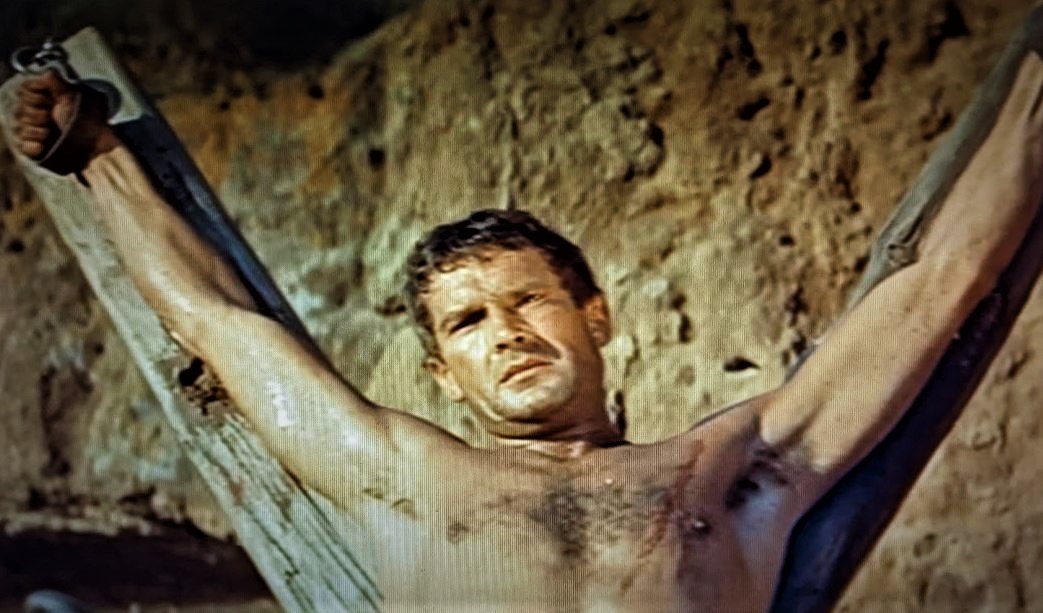
King Odenathus of Syria has always been an ally to Rome, but when he is murdered, Queen Zenobia breaks their treaty and attacks Roman troops near the royal city of Palmyra. Marcus Valerius, a valued Roman commander, is captured, enslaved, crucified on an X-shaped cross in the hot sun and tortured by the slave boss before he comes to the attention of Zenobia, who makes him a palace slave. Valerius makes contact with Julian, a Roman spy in Palmyra (side plot note: Julian is in love with Bathsheba, a vestal virgin and sister of the dead king, who will eventually be sacrificed). Learning that Julian is with a small group of Romans outside the city, Valerius pretends to switch sides and offers his personal services to the queen, with the proof being that he betrays the Romans to the Syrians—they play along with their capture and are rescued (by a small group of Christians if I'm not mistaken)  just before they are ordered to be put to death. But Valerius and Zenobia find themselves falling in love and Valerius tries to get Palmyra and Rome to negotiate. Upsetting his plans is Zemanzius, the queen's prime minister, who is actually working with Prince Shapur of Persia toward their own takeover of Palmyra. Events build to a climactic battle that tests the tie between Valerius and Zenobia.

Zenobia and Odenthaus are based on actual historical figures, but I suspect little else here is. Still, the narrative is richer than most of the later sword and sandal films that came in the wake of the huge success of the 1958 Hercules movie with Steve Reeves. Though certainly aligned with the peplum genre (togas, torture, sexy queens, sacrifices), in some ways this is more like the Hollywood biblical adventures of the 50s, with more attention paid to politics and character development than one would see in later genre films. There are no real muscle men; the lead actor, Georges Marchal (pictured), is handsome and beefcakey (and shirtless on occasion) but he's no Hercules. The sex kittenish Anita Ekberg is quite attractive as Queen Zenobia (with her breasts occasionally threatening to escape her robes) but her acting is rather bland, and she doesn't have the gravitas of a queen—she comes off more like a court concubine. Jacques Sernas as Julian makes for a handsome buddy to the hero, and Folco Lulli (Zemanzius) is an OK villain. Chelo Alonso makes an impression as the scheming lover of Zemanzius, especially when she does an erotic belly dance for the court. There are no gladiators in sight—the original title was SIGN OF ROME—and the action is confined to the last 15 minutes. The battle is well done, though to an unnerving degree, it all looks fairly dangerous for both the horses and the men. [Amazon Prime]

Wednesday, July 26, 2023

THE BLACK ABBOT (1963)

Pay attention, there might be a quiz. Lord Harry Chelford, whose mother died under mysterious circumstances a couple of years ago and who may be going mad, needs an heir and he wants the much younger Leslie Gine to marry him, though she's actually sweet on Dick Alford, the estate manager. Lord Harry also believes the legend that there is a buried treasure somewhere on his estate. Meanwhile, Arthur, the family's attorney and Leslie's brother, is being blackmailed by his bookie Gilder who wants Leslie for himself. Mary, Harry's former secretary, wants Harry for his money and claims to know where the treasure is. Thomas, the butler, seems always to be engaging in suspicious behavior. The family doctor breezes in and out. Oh yeah, and there’s the title character, a mysterious robed figure who stabs a man to death in the opening scene. This brings Scotland Yard in to try and sort out all the threads and find out: who is the Black Abbot? Where is the treasure? Who is the robed older woman wandering around at night? 

This German krimi, based on an Edgar Wallace story, is ridiculously convoluted but, when you clear away the red herrings, fairly easy to follow. The tangled romances, brought in perhaps to make things feel even more Gothic than they would, wind up having little to do with the outcome, but here, it's really the atmosphere that matter most. It's not immediately clear who the good guy is going to be, but if you’ve seen other krimi films, you’ll know that the presence of Joachim Fuchsberger as Dick marks him as the hero. His usual sidekick, Eddi Arent, is a comic relief cop. In the crowded supporting cast, Werner Peters is a standout as the slimy bookie Gilder, and Klaus Kinski brings his unsettling creepiness to the relatively unimportant role of the butler. Though the pace drags a bit, the ending is nicely done. Lovers of the Gothic melodrama should especially like this one. Pictured are Fuchsberger (Dick) and Grit Boettcher (Leslie). [YouTube]

Monday, July 24, 2023

VIVA LAS VEGAS (1964)

Before I sat down to watch this, I only had one Elvis Presley movie under my belt, Blue Hawaii, which I saw on the pool deck of a Turner Classic Movie cruise ship in bright Caribbean sunshine with a cocktail by my side, so my attention was not exactly riveted on the screen. Hence, I remember very little about it except that Angela Lansbury played Elvis' mother and it seemed to have been shot on real Hawaiian beaches. On a recent long holiday weekend, I decided to give this one a shot, mostly because I like Ann-Margret, his leading lady. Elvis stars as himself… er, no, as a young, handsome hotshot race car driver who dreams of driving his own car in an upcoming race in Las Vegas. He has finally gotten together enough money to buy a new engine for the car, but he promptly loses it when Ann-Margret, playing a young, sexy swimming instructor at the Sands Hotel in Vegas whom Elvis is flirting with, pushes him in the water. The money gets sucked up into the pool filter so, because he has to start from scratch, he and his assistant (Nicky Blair) get jobs working at the Sands. They both end up entering a Sands talent show, he to win money for his engine, she to get enough money to give her aging fisherman father so he can buy his own boat. There's also the little matter of the climactic Las Vegas race which pits Elvis against Italian champ Cesare Danova (who himself is also making a play, somewhat half-heartedly, I thought, for Ann-Margret).

As I assumed going in, the plot here isn't really the point, it's watching pretty people sing and dance, while occasionally getting a mini-travelogue of Las Vegas in the mid-1960s. A well-filmed car race is the topper. One thing I was wrong about was Elvis himself. I never thought of him as much of an actor, and he certainly was never an Oscar nominee for any of his 30-some movies, but within the limits of his carefully-curated persona, he acquits himself well enough here. He sings, he dances, he exudes a relatively healthy masculine self-confidence, and there is never for a second any doubt that he'll get the girl. That is one of the movie's weaknesses: his romantic rival, Danova, is a wet rag who never registers any chemistry with Ann-Margret. (Of course, the fact that Elvis and Ann-Margret were apparently engaged in an affair during filming may also be a factor in the chemistry thing.) The screenplay is also on the weak side, generating little tension and giving our characters no personality aside from the actors provided with their pre-existing personas. The factor that leads to Elvis finally getting his engine is pretty much a deus ex machina. But generally, it's a painless experience, and every time that Ann-Margret is on screen, she wipes everything else away. William Demerest is able to make a bit of an impression as Ann-Margret's father. And that title song, performed twice, once over the opening credits and once by Elvis on camera, is spectacular. [TCM]

Wednesday, July 19, 2023

THE WAYWARD BUS (1957)

In California, Johnny drives a ramshackle bus on a once-a-day trip from the small town of Rebel Corners to Sun Juan. His wife Alice runs a small roadside diner and drinks too much. They seem disgruntled with each other, but not enough for either one to force a crisis. But Alice seems to have it in for Norma, the young waitress who works for them. She has dreams of being in show business and thinks that Alice is jealous of her for wanting a better life. The two have a physical confrontation which leads Norma to leave on the bus to San Juan, and drives Johnny into saying that he's leaving Alice. Among the other passengers: the sexy adult entertainer Camille (who longs for domestic tranquility), traveling businessman Ernest (who, though quite a bit older, is smitten with Camille until he discovers what her career is), Van Brunt (a cranky old bastard who lets everyone know he has an important reason to be in San Juan by 3:00), and a bickering couple with a wayward daughter named Mildred, who starts to flirt with Johnny. The bulk of the film is the bus trip which should only take a couple of hours but is held up by bad weather and later, a landslide which blocks the road. By the time they reach San Juan that evening, relationships are forged or broken and people’s lives are changed, mostly for the better.

This is based on a John Steinbeck novel; except for The Grapes of Wrath, I haven't read much Steinbeck, but this feels a lot like the 1940s movie of his novel Tortilla Flat and the 1980s film of his Cannery Row, stories about a diverse group of people held together by a central character. Tortilla had Spencer Tracy and Cannery had Nick Nolte, both giving slightly larger-than-life performances to anchor their films. This has Rick Jason playing Johnny; he's not bad, but he doesn't have the age or feel of authority that Tracy and Nolte had. I kept hoping he'd get better, but at the beginning, he's as good as he gets. When his circle consists of just his wife and employees, he commands attention, but he has a hard time holding it when other more colorful folks are around him. Somewhat surprisingly, the two sex kittens, Joan Collins (Alice) and Jayne Mansfield (Camille), give the best performances here, and their characters are the most interesting, whether due to the writing or acting, I'm not sure. Dan Dailey (Ernest) and Delores Michaels (Mildred) are the only other acting standouts here. All the characters, even the most annoying ones, are ultimately treated humanely by the screenplay, and the conflicts that arise all feel predestined to get smoothed out by the end. The mudslide scene is handled well. Watchable, but a hard movie to truly like. Pictured on the bus: Jason driving with Mansfield and Collins on the left. [Criterion Channel]

Monday, July 17, 2023

COYOTE CREEK CHRISTMAS (2021)

My Christmas in July review:
Paige is a big city event planner working her way up the corporate ladder. She's happy for some down time to go celebrate Christmas with her parents in the small mountain town of Coyote Creek where they run a very successful (and very large) inn. But when she learns that Mom and Dad are scaling back a bit on the holiday plans this year, she's quite upset and decides she will "plan" the inn's Christmas as an "event" to add to her portfolio. She settles on the theme of Christmas Around the World and plans for German cookies, Japanese food (fried chicken), Icelandic traditions, etc. and throws herself into the planning. What her parents are deliberately keeping from her is that they are in the middle of selling the inn so they can spend their senior years traveling. And who are they selling to? A real estate development firm run by the Bailey brothers (not George and Harry from It's a Wonderful Life, but wouldn't that have been fun?). Jack, the more driven brother, sends Dylan, the handsome single father, out to the inn to finalize the sale and start making plans for a razing and rebuilding of the site to suit a corporate buyer. But the parents ask Dylan not to tell Paige about the plans yet. Really, Hallmark viewers need to know nothing more—big city folks in a small town, family property, corporate plans, pretty gal, handsome guy—a happy ending for both the couple and the property is in the bag by the 115 minute mark at least (out of 120). Dylan pals around with Paige and helps with the Christmas plans, Dylan's precocious son Noah (who loves using Word-of-the Day words in conversation) takes a shine to Paige, and in the end, things work out all around, with the promise of Dylan and Paige getting together and (probably) staying in Coyote Creek.

But getting to the ending is not as smooth a ride as it should be. The good points: Ryan Paevey, he of the handsome face, deep voice, and unthreatening masculinity (at left), is great. Janel Parrish, born in Hawaii of Chinese and American parents, is also quite good until her poorly written character betrays her (more on this later). The parents (Linda Minard and Cameron Bancroft) are fine. Paige's sidekick Quinn (Naomi King) is fun and gets her own same-sex romance on the side, though honestly it feels like a last-minute thing added by the writers to kill five minutes of running time. There's also a cute bit involving a Christmas marmot and Coyote Creek folklore. The Christmas décor and aura are perfect.

The bad points: The big conflict that surfaces around the 90-minute mark is when Paige discovers the plans for selling the inn. Though the secretiveness is all due to the parents, she turns into a bitch and takes out her anger pretty much solely on Dylan. In my eyes, this made her almost irredeemable, and it kind of stunk up the somewhat forced happy ending. (Maybe after the writers' strike, the Hallmark writers will come back energized with some new ideas and stronger characters.) I was confused about Quinn's place in the proceedings—I assumed at first that she was Paige's sister, but Quinn kept referring to Mom and Dad as "your parents" to Paige, so I guess she's just an old friend who works at the inn—or maybe not even that; I can’t remember if she actually works there or is just around all the time. The kid playing Dylan could have been reined in a bit, unless the plan is that he'll be a gay English major at some point, but he is enthusiastic. By Christmas Eve, the inn is so deluged with guests that they have to set up "glamping" tents outside to accommodate everyone, a stupid plot point—I guess overbooking is cool by these people—that's not needed. I’d probably watch this again, but I'd bail at the 90-minute mark and imagine a different ending in which Dylan and Paige get together but also go back to their big-city jobs and let Mom and Dad sell out. Pic above right: Mom, Dad, Quinn, Paige, Dylan and Noah. [Hallmark]

Friday, July 14, 2023

RHAPSODY (1954)

Elizabeth Taylor announces to her wealthy, disapproving father (Louis Calhern) that she is leaving his home in France to go to a conservatory in Zurich. She says she wants to polish up her piano style, but mostly she wants to be where her boyfriend (Vittorio Gassman) is as he finishes up his violin studies. Taylor gets a room in a boarding house where she hits it off with another first-year piano student (John Ericson), which triggers Gassman's jealous streak. Ultimately, Taylor bombs her audition, and as Gassman's studies become more intense, his ego grows. At a rehearsal for a concert with the Zurich Philharmonic, Gassman butts heads with the conductor, and decides that he shouldn't see Taylor at all until after the concert, which leaves room for Ericson to step in and spend time with her. The concert becomes a star-making event for Gassman, but when he starts paying too much attention to orchestra groupie Barbara Bates, Taylor tries to kill herself. Ericson devotes himself to her during her recovery and eventually the two get married, but it's clear that Taylor is still carrying a torch for Gassman. Eventually, the paths of all three cross again, and Taylor is going to have to choose between the now famous Gassman and the depressed Ericson.

This is a fairly slow-moving romantic melodrama which fans of classical music may enjoy for its interludes of Rachmaninoff and Tchaikovsky. The whole point of the film seems to be to showcase Taylor's beauty, and she does indeed look beautiful, both in her close-ups and in her colorful wardrobe. Gassman and Ericson try their darndest to compete with Taylor for focus (narrative if not visual); the handsome Gassman is more successful, giving a fairly strong performance, with Ericson (pictured with Taylor), more appealing looking than handsome, struggling a bit with the passive second-lead male role, but he's OK. Old pro Calhern is welcome in a couple of short scenes. Look for a young Stuart Whitman as one of the musical students. There's a fun scene early on in which Gassman and his buddies take over a small diner for an impromptu concert. I was impressed with the skill with which both Gassman and Ericson appear to play their respective instruments (especially the vigorous workout Ericson gives the piano in the final sequence), though the music is actually played by professionals. Of its kind, the MGM sheen makes it watchable, but probably not for casual classic-era fans. [TCM]

Thursday, July 13, 2023

FORTY GUNS (1957)

This Samuel Fuller western opens with a stunning opening shot of three men in a small wagon headed down a desert road in Arizona as a huge party of forty men on horses comes stampeding down the road, parting to go around the wagon. The forty men are the Dragoons, men who work for powerful rancher Jessica Drummond (Barbara Stanwyck). The three men in the wagon are U.S. Marshal Griff Bonnell (Barry Sullivan) and his brothers Wes and Chico, armed with a warrant for the arrest of a man named Swain, who happens to be one of Jessica's Dragoons. In the main storyline, Griff and Jessica begin as antagonists but grow to respect each other, and even fall in love. Getting Swain turns out to be easy, as Jessica insists that she's not the unlawful type. But her vulnerable spot is her reckless brother Brockie (John Ericson) who has just killed the town's blind marshal and gone on a spree of destruction just for kicks. He is temporarily put in his place by Griff but hard feelings remain. In another plotline, Wes is asked to stay in town and take the marshal's place, which he is tempted to do as he has fallen in love with the gunsmith's daughter. Griff's youngest brother, Chico, gets blind drunk and has to be tossed in a trough to sober up, but he soon outgrows his rowdy ways and proves his mettle with his brothers. Brockie continues to cause friction, despite Jessica's attempts to keep him out of trouble, becoming the catalyst for a brutal final shootout.

Between a nice visual style, characters with some depth, and mostly fine acting, this is one of the more interesting westerns of the classic era. Barbara Stanwyck (pictured) had staked a solid claim in the genre in 1950's intense psychological western THE FURIES; here, she is less showy but more realistic, and perfect in the part of the powerful woman whom you expect to be a one-note villain (especially when she is described in a barroom song as "a high-riding woman with a whip") but becomes anything but. John Ericson is believably scary as the out-of-control Brockie. The solid supporting cast includes Dean Jagger as a sheriff mostly under the control of Jessica (at one point she has to remind him, "I'm your boss, not your partner"), Gene Barry as Wes, Robert Dix as Chico, and Eve Brent as the gunsmith's daughter. I was less taken with Barry Sullivan as Griff—he's wooden and uncharismatic, and not worthy of Jessica. But he doesn't really hurt the movie much. The black & white cinematography is beautiful throughout and the climax is genuinely thrilling. Highly recommended. [Criterion Channel]

Tuesday, July 11, 2023

BACK PAGE (1933)

Ambitious reporter Jerry Hampton (Peggy Shannon) has a scoop, an article about an illicit love nest suicide, but her editor kills it because it involves the rich and influential J.H. Smith. Her boyfriend Brice (Russell Hopton), also a reporter, wants to get married but she's not ready to settle down, so he advises her to get a job on a small-town paper where she can have an impact. Brice's uncle Martin Blake (Edwin Maxwell) is the president of the bank in the small California town of Apex, where the retiring head of the local paper is looking for someone to take over. Sam (Claude Gillingwater) is reluctant to hand over the reins to a woman, and her first act is to antagonize the paper's biggest advertiser Nathan Young (David Callis) by writing about his brother's divorce. When he threatens to pull his ads, she claims that she is about to accept competing ads from mail order companies out of town, and Nathan caves. Sam is won over and Nathan becomes her platonic buddy, running her around town on errands and getting involved in her investigation into a local oil well operation. Blake, the bank president, has encouraged the people of Apex to invest in the well, but Sam smells a rat, and sure enough, the well supervisor comes to Jerry and tells her the well is a bust. Blake has announced he will buy up the townspeople's shares, at a fraction of what they paid (which you may recall was a strategy in old man Potter's bag of tricks in It's a Wonderful Life), and suspicious Jerry, along with Nathan, starts nosing around and soon breaks the news that the well is actually fully functioning. The citizens celebrate and Apex becomes a boom town, but the angry Blake gets his revenge by calling in loan payments that he knows the paper cannot make. He plans to take over the paper, firing Jerry and, to add insult to injury, installing her boyfriend Brice as editor. Can Jerry out-scheme Blake and keep her job and her boyfriend?

This is a rather delightful movie, if you keep your expectations on a low-budget pre-Code level. The plot is complex enough to keep you interested but not so convoluted as to cause confusion. It manages to stymie some expectations one might have about its heroine: she is strong and independent, she sustains a non-romantic friendship with a male, and her boyfriend is not jealous of her commitment to a work life. The movie has a low-budget look but that winds up being almost a plus, as the newspaper office has an authentic small-town feel to it. Generally, the acting is fine. Peggy Shannon eventually became an alcoholic and died less than ten years later, but she fits her role here perfectly. Maxwell does his usual good work in a villainous role; Hopton disappears in the middle of the story, but makes a good impression when he’s around. Sterling Holloway has a comic relief role as a (possibly gay) gossip columnist; many reviewers of this film find him irritating, but I don't mind him. This is the kind of story that lends itself to a typical melodramatic treatment, but the tone is kept fairly light and upbeat. I viewed this on DVD as part of a set from Flicker Alley called In the Shadow of Hollywood: Highlights from Poverty Row, and it's been given a spectacular restoration. The audio commentary, as most are these days, is hit and miss. The commentator misidentifies actor Claude Gillingwater as Gillingworth throughout, and is repetitive with her social context points. I recommended the movie if not the commentary. Pictured are Callis and Shannon. [Blu-ray]

Friday, July 07, 2023

MAN-EATER OF KUMAON (1949)

The jungles of Northern India are inhabited by tigers (so we are told) and typically their prey does not include humans. Collins (Wendell Corey) is an American doctor who is tiger hunting to escape painful memories of his recent divorce. He wounds a tiger which loses a claw but gets away. The natives know that the tiger in its weakened state will have a hard time hunting and will be a threat to people and must be hunted down, but Collins, showing signs of malaria, refuses. When the tiger begins killing villagers, they know that it will never return to its natural prey, and soon in a nearby village, a young pregnant woman named Lali (Joy Page) is attacked and severely injured by the tiger. Her husband Narain (Sabu) fetches Collins to help her; she survives but her unborn child does not. When a tiger print with a missing claw is found in the dirt, Collins eventually decides to stay in the village to hunt the tiger down. Meanwhile, there is some melodrama involving native customs which say that Narain must leave Lali because she can no longer bear children, though he does not want to, and Lali ends up going off to offer herself as bait to catch the tiger. The ending, while satisfying, is remarkably anti-climactic. I watched this because Sabu (The Jungle Book, Cobra Woman) was top billed, but unfortunately Wendell Corey has more screen time. Though he's not exactly a bad actor, Corey must be the most unappealing and uncharismatic actor to become a leading man, and his drab performance sinks the movie. Sabu and Joy Page (the young refugee who Bogart helps in Casablanca) and the tiger all try to get some juice into the proceedings, to no effect. Morris Carnovsky, a respected stage actor whose screen career was eventually hurt by the blacklist, is fine (though made up in what I call 'duskyface') as Ganga Ram, Nairan's father. The print I saw on YouTube was missing roughly ten minutes of footage but it didn't seem to hurt the narrative flow too much, and honestly, anything to make this film shorter is fine by me. Based loosely on the real-life experience of author and hunter Jim Corbett. For Sabu completists only. Pictured are Sabu and Page. [YouTube]

Wednesday, July 05, 2023

THE ROYAL HUNT OF THE SUN (1969)

Spain, 1528. Explorer Francisco Pizarro goes to the king to get backing for a third trip to Peru to find the hidden gold of the Incas that Spain is certain exists. King Carlos can't afford to bankroll what he assumes will be another futile trip, but he gives Pizarro two priests (to convert the natives) and sends Estete, a royal representative, along. Pizarro raises money and men on his own with help from fellow explorer Fernando De Soto who accompanies Pizarro to Peru. By 1530, Pizarro's men arrive and meet with Incan king Atahualpa, who calls himself Lord of the Earth and Sky and Son of the Sun. Pizarro, claiming also to be a god, demands that Atahualpa hand over all the Incan gold to take back to Spain. After Pizarro's men slaughter most of the king's guards, Atahualpa agrees to be kept captive until his men have filled a room with gold for the Spaniards. Over time, Pizarro finds himself respecting the king. In the end, Atahualpa refuses to guarantee that his men will not harm Pizarro's men as they leave, so Atahualpa is sentenced to die. Putting on the mask of the Sun King, Atahualpa assures everyone that, if he is put to death, he will rise alive the next morning, and Pizarro comes to believe that, if Christ could be resurrected, perhaps Atahualpa can too. 

Like ALFRED THE GREAT which came out the same year, this tries to be both an epic and a philosophical chamber drama at the same time. Admittedly, the deck here is stacked against the epic, as this is based on a play (by Peter Shaffer, author of Equus and Amadeus) and there are few large-scale scenes of conflict or adventure. Robert Shaw (Pizarro) and Christopher Plummer (Atahualpa) give it their all, and at times their conversations, mostly about religion, achieve some actorly grandeur. Interestingly, Shaw outshines Plummer here. Plummer gives a very eccentric performance as Atahualpa, full of strange gestures and hissing and odd verbal squeaks, and though he does make the character seem otherworldly, he also remains cold and unknowable. Shaw lets us see the inner confusion of Pizarro who seems not to be concerned much with the spiritual until he confronts the Incan king. The outdoor scenes, shot in Peru, are splendid looking, and despite the intense focus on the two strong leads, there are some noteworthy supporting performances: Nigel Davenport as De Soto, Leonard Whiting (Zefferelli's Romeo) as Martin, a young associate of Pizzaro's, and Michael Craig as Estete. Not easy to find, but worth seeing, especially as an example of a kind of film (or indeed, play) that isn't made anymore. Pictured, from left, Shaw and Plummer. [DVD]

Monday, July 03, 2023

TEVYA (1939)

It's impossible to experience or discuss this film without making reference to the musical Fiddler on the Roof, an adaptation of stories about Tevye the Milkman written in Yiddish in the 1890s by Sholem Aleichem. [Most sources, including the 1971 film of Fiddler and the subtitles on this film, spell the milkman’s name Tevye; this movie's title spells it closer to the Hebrew transliteration. Out of tradition (pun intended, if you know the musical), I will spell it here with the final 'e'] Tevye and his family live in a village in Ukraine, and are one of the few Jewish families in the area. We see Tevye's daughter Chava being admired by the young men of the village, but unknown to all, including her father, she's in love with Khvedka, a gentile scholar who brings her books to read. When a friendly priest drops by to tell Tevye about rumors that a Jewish girl is about to marry a gentile, Tevye says that if that happened to him, either he would die or she would. When Chava hears this, she faints. Sure enough, the very next day, Chava marries Khvedka. Tevye goes to the priest's house in an attempt to stop him from marrying the two, and his wife Goldie warns, "Be careful—if you start in on your quotes, we'll be lost." But his efforts are in vain; Khvedka's parents call Tevye and his wife "disgusting pests." At home, Tevye declares Chava dead, not to be remembered or mentioned, and goes as far as sitting shiva (a funeral ritual) for her. Chava loves her husband, but over the next couple of years, his family starts treating her like a servant. When her mother is on her deathbed, Chava has to watch from outside in the rain. When the Tsar decrees that all Jews must be expelled from their villages, Tevye has no choice (the priest tells him he could convert, but he's not about to do that) so he packs up to leave. When Chava hears the news, she breaks away from Khvedka and his family, and returns to her father, desperately hoping he will take her back.

There is humor here and there—when Tevye's horse refuses to get up and work, he asks it, "How long is your sabbath?"—but this is a darker version of the stories than Fiddler was. In the musical, Tevye had three daughters, all of whom defy his wishes and marry as they please. Here, there is only one other daughter, Tseytl, whose sickly husband (whom we never see) dies and she winds up living with her two children with Tevye and Goldie. The matchmaking business, a big part of Fiddler, is absent here, as are most of Tevye's conversations with God. Because the Tevye of Fiddler is often played as larger-than-life (Zero Mostel, Topol, Harvey Fierstein), it's interesting to see here that Maurice Schwartz, a famous actor of the Yiddish stage (pictured), underplays the character a bit, making him more human and less a blustering force of nature. The other performances are generally fine, though Miriam Riselle as Chava wrings a bit too much melodrama out of her situations. I wasn't sure what to make of the husband, Khvedka (the name in the subtitles though most sources call him Fedye). Leon Liebgold plays him quite sympathetically, right up to the scene where Chava leaves him, but I wondered why he let his family run roughshod over her. The film is in Yiddish and the locations look authentic, but it was actually filmed on Long Island and directed by Schwartz. Fans of Fiddler should try to catch this. [Blu-ray]