 The day before an atomic blast test is scheduled to take place in the Yucca Basin in Nevada, Stephen McNally and Paul Kelly break out of a Carson City prison. With Kelly wounded, the two pick up another convict and wind up at a gas station where McNally pistol whips and eventually kills the owner, taking Alexis Smith and her boyfriend hostage. Meanwhile, reporter Keith Andes, who has been assigned to cover the breakout, is on the road having picked up Jan Sterling, a showgirl heading for Reno. Their path soon crosses that of the crooks, and when Smith's car runs out of gas, McNally forces everyone into Andes' car. Even though Smith is estranged from her husband, McNally finds out that he's a doctor so he forces Smith to send for him to patch up Kelly; the whole group holes up in a ghost town waiting for him, unaware that they are at ground zero for the atomic blast which will take place at sunrise. This is a solid, tense thriller that briefly makes you think they might actually blow everyone up, good guys and bad. Aside from the novelty of the setting, the cast of B-actors is the most interesting thing here. Kelly always provides reliable support, especially as a villain; I'm always happy to see the handsome Andes (pictured with Sterling) pop up, and Alexis Smith is one of my favorite B-level leading ladies of the classic era. McNally is serviceable, though as he is the lead baddie, I wish he and Kelly had switched roles. Richard Egan shows up briefly as the doctor and Robert Paige is fine as Smith's lover. My favorite line—socialite Smith to chorus girl Sterling: "You must run into a lot of men in your line of work"; Sterling to Smith: "I run into a lot of men when I’m just loafing." Dick Powell directed; even though the tension comes and goes, it's worth sticking around for the ending. [TCM]
Friday, March 28, 2014
SPLIT SECOND (1953)
The day before an atomic blast test is scheduled to take place in the Yucca Basin in Nevada, Stephen McNally and Paul Kelly break out of a Carson City prison. With Kelly wounded, the two pick up another convict and wind up at a gas station where McNally pistol whips and eventually kills the owner, taking Alexis Smith and her boyfriend hostage. Meanwhile, reporter Keith Andes, who has been assigned to cover the breakout, is on the road having picked up Jan Sterling, a showgirl heading for Reno. Their path soon crosses that of the crooks, and when Smith's car runs out of gas, McNally forces everyone into Andes' car. Even though Smith is estranged from her husband, McNally finds out that he's a doctor so he forces Smith to send for him to patch up Kelly; the whole group holes up in a ghost town waiting for him, unaware that they are at ground zero for the atomic blast which will take place at sunrise. This is a solid, tense thriller that briefly makes you think they might actually blow everyone up, good guys and bad. Aside from the novelty of the setting, the cast of B-actors is the most interesting thing here. Kelly always provides reliable support, especially as a villain; I'm always happy to see the handsome Andes (pictured with Sterling) pop up, and Alexis Smith is one of my favorite B-level leading ladies of the classic era. McNally is serviceable, though as he is the lead baddie, I wish he and Kelly had switched roles. Richard Egan shows up briefly as the doctor and Robert Paige is fine as Smith's lover. My favorite line—socialite Smith to chorus girl Sterling: "You must run into a lot of men in your line of work"; Sterling to Smith: "I run into a lot of men when I’m just loafing." Dick Powell directed; even though the tension comes and goes, it's worth sticking around for the ending. [TCM]

Wednesday, March 26, 2014
HAT, COAT, AND GLOVE (1934)
 Lawyer Ricardo Cortez is in a department store shopping for a new coat; he runs into his estranged wife (Barbara Robbins) who is shopping for a hat; another shopper, buying gloves, is John Beal, a struggling young artist and Robbins' lover. They're all very civilized even though Cortez is still hoping for a reconciliation. She invites Cortez to dinner at her place that evening, but when Beal calls from his Greenwich Village apartment, she leaves to spend the night with him. The next day, Cortez goes to Beal's place, hoping to talk things through, but instead he finds Dorothy Burgess, a former lover of Beal's, who has just faked a suicide attempt in an effort to win Beal back and is in the middle of getting very drunk. At some point, Burgess picks up a gun, Cortez tries to take it away from her, and she winds up shot and killed. Cortez leaves, Beal is arrested, and Robbins (who doesn't know that Cortez was involved) asks Cortez to defend her lover in court, agreeing to return to Cortez after the trial, no matter what the verdict. When the hat, coat and glove of the title come into play in the courtroom, can Cortez keep his cool and save Beal without incriminating himself?
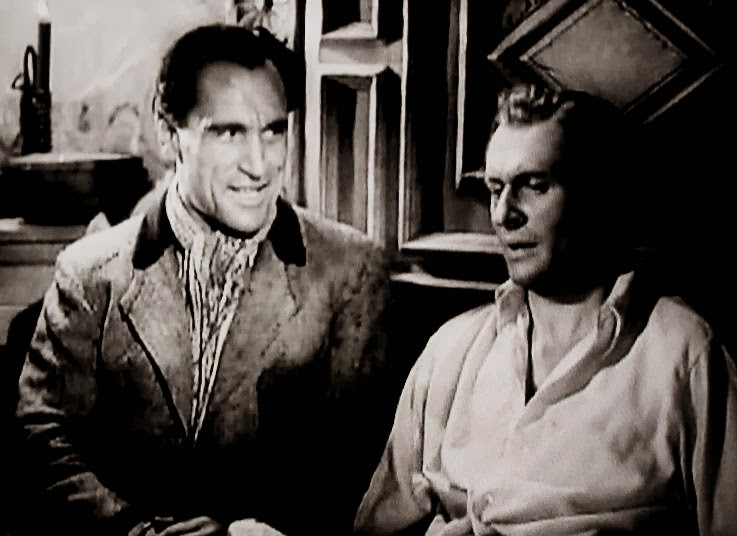
This is a short, fun, fast-moving melodrama which must have sneaked in at the tail end of the pre-Code days—the ending is unpredictable only because under the Production Code, it could never have happened. Of course, the frank bedroom arrangements could also not have been made quite so explicit under the Code. Cortez (pictured to the right of Beal) is one of my favorite 30s actors, never a big star, but always welcome as a slick leading man, lover, or crook, and he's very good here. Robbins is colorless, but Beal and Burgess make the most of their roles, and Margaret Hamilton has a fun scene as a dressmaker who calls herself Madame Du Barry. Favorite line, concerning Beal's choice of gloves: Robbins: "That glove spells quiet dignity"; Cortez: "In fact, it shrieks quiet dignity." [TCM]
Monday, March 24, 2014
VERBOTEN! (1959)
 In the German village of Rothbach during the last days of World War II, David, an American soldier (James Best) is trying to draw out a sniper. When he's wounded, a young German girl named Helga (Susan Cummings) tends to him; he's wary but she insists she's not a Nazi, though they debate the complicity of the German people in Hitler's reign of terror. She and her young brother Franz (Harold Daye) hide him until the Americans come through to finish cleaning out the town. He falls in love with Helga but any relationship with her would be "verboten," or forbidden under military rules. After Germany's surrender, David returns to Rothbach, a civilian now, working for the Army with refugees and no longer forbidden to woo Helga. But Helga is surrounded by people, led by a neighbor named Bruno (Tom Pittman), who belong to a group called the Werewolves; emboldened by rumors that Hitler isn't really dead, they believe that they can rally the people and fight off the occupiers. When Franz begins falling under the spell of the other Nazi youths, she takes him to Nuremberg to witness the war crime trials. He begins to see the light, but can any of them stop Bruno's gang of terrorists?
We're in director Samuel Fuller's territory here, meaning things get sloppy but intense. It's a scrappy little black & white movie, partly scored to Beethoven and Wagner—one effective segment has Wagner playing over scenes of terrorist activities by the Werewolves, who are dismissed by the Army as merely juvenile delinquents. The forbidden romance between Best and Cummings (pictured) never really heats up, and in fact is shunted off to the back burner when the focus switches to her brother and his torn allegiances; it feels like he wants to believe his sister but also feels peer pressure to run with Bruno and his buddies. The actors are fine, especially Best, and Pittman is very good—sadly he died at the age of 26 before this film was released, from injuries sustained in a car accident. Best, handsome in an almost teen-idol way, went on to a long career in TV, probably known best as Sheriff Roscoe in The Dukes of Hazzard. Actual footage of Berlin and Nuremberg is used to good effect, as is a brief shot of concentration camp atrocities shown at the trials. There is one major misstep, and it's right at the beginning: a lush theme song with the refrain, "Our love is verboten," sung by the young Paul Anka. Get past that and you'll enjoy the rest. [TCM]
Thursday, March 20, 2014
SMASHING THE RACKETS (1938)
 FBI agent Chester Morris grabs a female bystander (Frances Mercer) and pushes her to safety while he and his fellow agents nab some dangerous crooks. At first, she's upset but he thaws her out a bit and they go on their separate ways. The DA gets Morris to leave the FBI and take a high-profile job in his office, but Morris soon realizes that it's basically a do-nothing position; he's just there to make the DA's office look good. Frustrated, he almost quits but decides to take on the slot machine racket, which is headed by crooked lawyer Bruce Cabot. In doing so, he runs into Mercer again; her younger sister (Rita Johnson) is dating Cabot. After a child is accidentally killed in a roughing-up that the thugs give a shop owner who doesn't want slots in his store, Morris manages to put an end the racket (though Cabot's nose remains clean), is made a special prosecutor, and then doubles down on efforts to bring Cabot to justice, even if that means trouble for Johnson.
This routine B-crime movie is enlivened by a couple of interesting scenes: in the first, Morris and his associates torture a thug in order to get the thug's buddy to talk; in the second, Morris subjects a gathering of young women (it's unclear if they are waitresses or hookers, but their testimony is crucial to Morris's case) to a viewing of a dead woman pulled out of the river, killed by Cabot's thugs. Neither scene winds up being exactly what it seems, but it's still startling to see them in a movie of this era. Morris (pictured) is fine, but Cabot is better, and it's never a good idea to have the bad guy outdo the good guy. Cecil Kellaway has a small uncredited role, and Libby Taylor gets to play an African-American woman who isn't a maid. [TCM]
Tuesday, March 18, 2014
THE BIG BLUFF (1955)
 Valerie (Martha Vickers) is a rich widow, still fairly young and attractive, with a heart condition that could kill her. Peter, her doctor (Robert Hutton), advises total rest and sends her off for a California vacation with her secretary and companion Marsha (Eve Miller). Marsha gets Peter to agree not to tell Valerie how sick she is, but once they're out West, Valerie finds herself attracted to Rick (John Bromfield, pictured); she thinks he's a hot-blooded stud but we know he's a rather slimy gigolo who is involved with Fritzie, a married nightclub singer whose jealous husband is constantly on the verge of finding out about their affair. It all seems harmless for a time, but soon Valerie is wearing herself out keeping late hours with Rick, and when she collapses one night, Peter tells Rick the truth about her condition. Rick plots to marry her, hoping that she'll die soon after and he'll inherit her money and live with Fritzie. Against Marsha's advice, Valerie does marry Rick, but instead of getting sicker, she gets healthier; Peter says her newfound will to live is strengthening her. Of course, this doesn't go over well with Rick who begins to substitute sugar pills for her medicine. When this has no effect, he decides to murder her using an elaborate scheme that gives him a foolproof alibi—all signs will point to him having been miles away at a motel with Fritzie. But this being a film noir, things don’t quite go as planned.
 This is an underrated little gem, cheaply made and only available in murky public domain prints, but B-movie fans will love it. The situation and characters are stock film noir, though it's difficult to ever see Rick as much of an anti-hero, partly because we never get to know him. Interestingly, there really is no hero here—maybe we're supposed to see Marsha as one, as she always has Valerie's interests at heart, but the way she's played by Eve Miller, she's not especially likeable—and I kinda like that. Even Valerie isn't particularly sympathetic, which may be an acting problem (and I'll get back to that later). The sets and direction are adequate and the acting is all over the map. Some of the performances seem quite bad, but it's possible that the director, W. Lee Wilder (brother of Billy) got what he wanted. Bromfield is right on that edge between charming and seedy and given slightly stronger direction, he could have pulled off a classic noir performance; as it is, he's still the best thing in the movie. Vickers, memorable as the sultry little sister in THE BIG SLEEP, is a big zero here which may or may not be intended. Miller is bossy and unlikeable as the companion, though Hutton is energetic and believable as the doctor. I sound like I'm trashing the actors, but I must admit that the off-kilter acting may be what makes this movie interesting. That and the fun textbook-noir climax. [DVD]
Friday, March 14, 2014
THE PSYCHOPATH (1966)
 A musician on his way to a recital gets a flat tire (we saw an unknown figure puncture the tire); he grabs his violin case and starts to walk, but is viciously rammed against a wall by a car and killed, and a small doll made in his likeness is left by his body. It turns out he was one of four men in town who were part of a post-war commission which accused a German industrialist named Von Strum of collaboration with the Nazis. Von Strum killed himself and, oddly enough, his widow and her son Mark both live in town; she collects dolls, and the two of them seem quite isolated in their creepy house. There are more deaths including a poisoning and a blowtorch to the face, and other suspects turn up; Louise, the daughter of one of the four men, works in a doll store, and her boyfriend, who is interested in helping the police crack the case, is a medical intern who has access to poison. This thriller by Robert Bloch bears some slight resemblance to PSYCHO (which he wrote) and PEEEPING TOM, but it's nowhere near being in their league. The plotting is plain and obvious, the detective (Patrick Wymark) is bland, and the characters are almost all unlikeable. The best acting comes from John Standing, with white-blond hair and a goatee, as the creepy Mark, and Alexander Knox giving the proceedings some class as Louise's father. Margaret Johnston (pictured with Standing) is inconsistent as the widow Von Strum, going over-the-top sometimes and underplaying at other times. There are some nice visual touches here and there from veteran Hammer horror director Freddie Francis, but this is overall too drab to recommend. [TCM]
Wednesday, March 12, 2014
THREE CORNERED MOON (1933)
 During the Depression, we are introduced to a wealthy Brooklyn family, the Rimplegars, on the day when they find out that their fortune is gone due to bad investments. There's Nellie (Mary Boland), the slightly ditzy but well-meaning widowed matriarch; Elizabeth (Claudette Colbert) is the charming, more level-headed daughter, though she seems unable to see what a drain and a drip her boyfriend Ronald (Hardie Albright) is—a struggling would-be writer, he's being kept by her, and at one point contemplates suicide but gets distracted by a head cold; Kenneth (Wallace Ford) is a low-paid law clerk casually working on passing the bar; Douglas (William Bakewell) is an actor (with an affected accent) who only gets single-line parts with an amateur "little theater"; and Eddie (Tom Brown) is a college student who seems to be majoring in playboyism. When Nellie gets the bad news, the family has no idea what to do, but Alan Stevens (Richard Arlen), the family doctor, helps inspire them to dust themselves off and face reality. He rents a room from them to help give them some immediate cash; Eddie gets work as a lifeguard, working so hard that he drives himself almost to collapse; Liz lies about her experience and gets a job at a shoe factory; Douglas gets a real acting job—only one line, but he gets paid; and Kenneth buckles down on his law studying. Even their maid Jenny, who speaks and understands almost no English, stays on without pay. As they slowly get back on their feet, the only suspense is, will Elizabeth stick with the useless Ronald, or finally see that Dr. Stevens is perfect for her?
This is essentially a screwball comedy before the genre existed: rich eccentric characters, some broad physical comedy mixed with witty dialogue, and a romance between two disparate types. One difference from many later screwballs is that it is fairly well rooted in a (somewhat) realistic context—the Depression. Most main characters in movies like BRINGING UP BABY or MY MAN GODFREY don’t really have to worry about money, but this group does, and they rise to the occasion. There are also some slightly darker tones to the proceedings occasionally, as when Eddie collapses and the family thinks he's dying. The acting is good all around. Boland does a nice job playing scatterbrained without too much exaggeration. Arlen underplays a bit too much, perhaps, but the others are fine, the standouts being Bakewell and Brown. Favorite line: when Colbert, in an existential funk, sighs, "What’s it all about?" Boland replies, "It's that cheese you ate last night!" [TCM]; photo, featuring Tom Brown at far right, from Veidtclub.blogspot.com.
Monday, March 10, 2014
WHISPERING CITY (1947)
 There is quite a tangle of characters and situations set out at the beginning of this film noir. In Quebec City, a famous actress lies dying in a hospital after a car accident. She tells reporter Mary Anderson that the death of her fiancé years ago in an accident was actually murder. Anderson looks up a lawyer (Paul Lukas) who knew the actress to get more background. Lukas has his own problems: he is acting as a patron to pianist Helmut Dantine who is struggling to finish a concerto—and on occasion drinks too much and passes out. Dantine is estranged from his shrew of a wife (Joy Lafleur), who records a disc saying that if she's found dead, it will be Dantine's fault. Lukas asks Anderson's editor not to pursue the story on the actress (is he hiding something?), but Anderson keeps digging. Meanwhile, Lukas goes off to murder Lafluer, but discovers she's killed herself. Lukas takes the suicide note and tries to make it look as if Dantine killed her during an alcoholic blackout, then blackmails Dantine by telling him he will clear his name if he "eliminates" the nosy reporter (ah, Lukas is hiding something). And so on… This Canadian indie production is a pretty solid noir, even if the plotting becomes a bit labyrinthine. One interesting point is that Dantine, the noir hero, doesn't really take center stage until halfway through the movie; until then, he seems more like a sideline character. The plot takes some nice twists and turns in the last half, though the climax itself is ineptly staged. Anderson is on the bland side, but Dantine and Lukas (pictured at right) pick up the slack. [DVD]
Thursday, March 06, 2014
ONE GIRL’S CONFESSION (1953)
 Cleo Moore works at a dive waterfront diner for her father's old friend (Leonid Snegoff); he tells her he keeps her on as a favor to her late father, but Moore knows that Snegoff cheated her dad out of money and one night, she steals $25,000 dollars from him and buries it in the woods. She is arrested and confesses but won't say what she did with the money so she's sent to jail. As a model prisoner, she gets an early release and returns to the waterfront to find that Snegoff has left and sold the diner to Hugo Haas, who seems somewhat slimy but who, once Moore proves that she's got gumption, takes a fatherly interest in her. Meanwhile, Moore bides her time before going off to get the buried money because she knows she's being watched by detectives. She begins a flirtation with handsome fisherman Glenn Langan and even considers offering him some of her cash to buy new equipment for his business. When Haas loses his savings and his business to gambling debts, Moore sends him to get the money. He returns empty-handed claiming it wasn't there, but she's sure he’s cheating her, so she plots a deadly revenge.
To say more about the last 20 minutes or so would spoil a good movie. It’s a B-film with second-level talent, but generally the best noir films benefit from a less glossy treatment. Haas wrote and directed as well as acted, and the script could use a rewrite to get rid of some plotholes, but the movie gets by on a good grungy look, a couple of nice plot twists, and strong performances. Moore, a Marilyn Monroe-ish blonde bombshell (pictured above with Langan) has a reputation as a Queen of the B's; this is the first time I’ve seen her in a starring role and, while she's a bit one-note, she fits the part well. This movie is in a DVD set called Bad Girls of Film Noir, and though she isn't truly "bad" here, she is a little rough around the edges. Haas and Langan are as good as they need to be, and Haas' character winds up being the most interesting of the batch, partly because we're not always clear on his motivation from one scene to the next. No other cast members stand out, though baby-boomers will recognize Burt Mustin in a small role—he appeared at least once in practically every 60s and early 70s TV show (I'm not kidding—check IMDb!). I think I'm now a Cleo Moore fan. [DVD]
Tuesday, March 04, 2014
THE COSMIC MONSTER (1958)
 In England, a group of scientists is studying the changes in matter when exposed to powerful magnetic fields. For example, a chunk of copper has its molecules realigned so it becomes flexible. An accident, however, injures one of the researchers and causes strange disturbances in the village, where people are already wary of the experiments. An army brigadier wants to shut things down but agrees to observe the scientists, including American Forrest Tucker and his French assistant Gaby Andre. During one experiment, everything in the lab becomes magnetized and a freak accident creates havoc. In the village, there is strange weather, and a tramp sleeping outside gets his face burned; soon, he's become a monster thanks to a hole being ripped in the "heavyside layer" of the ionosphere. Insects begin mutating (like the giant spider pictured at right) and attacking people; in the best scene, a giant beetle eats a person's face off. A stranger named Smith (Martin Benson), who is an alien, helps the earthlings deal with their self-inflicted problem. Basically, this is a giant-bug movie with elements of DAY THE EARTH STOOD STILL (the benign alien) and the British Quatermass films. The effects are so-so, as is the acting (Tucker doesn't look happy) with the exception being Benson as the alien. One scene of a teacher trapped in her schoolroom builds up some tension, but otherwise this is a run-of-the-mill sci-fi melodrama. Also released as THE STRANGE WORLD OF PLANET X and COSMIC MONSTERS. [TCM]
Monday, March 03, 2014
THE MINOTAUR (1960)
 Here come the storylines: 1) In ancient Crete, young women (mostly lovely and virginal) are regularly sacrificed to the Minotaur, a legendary half-man, half-bull beast that lives in a labyrinth. When the Queen becomes deathly ill, King Minos steps up the sacrifices. 2) Years ago, when the king's daughter Phaedra was born, a twin sister, Ariadne, was also delivered, and because twins were to be sent to the Minotaur, she was spirited away to the village of Attica. Phaedra finds out about her existence and sends Chryone off to Attica to kill her before she can threaten her own ascendancy to the throne. 3) Great hero Theseus of Athens and his sidekick Demetrius of Crete are on their respective ways home from grand journeys when they hear about the pillage of Attica. They manage to save Ariadne but this is just the beginning of their adventures which climax with Theseus going into the Minotaur's maze to save Ariadne.
 This is another peplum film based loosely on mythology, mostly played fast and loose (see also HERCULES, HERCULES AND THE CAPTIVE WOMEN, well, pretty much any Herc movie), though the basics are here—most famously, Ariadne's thread which she spins out so she and Theseus can find their way out of the maze. There are a number of well-done battle scenes here, and the sets and costumes are effective. Unfortunately, Olympic champ Bob Mathias as Theseus is lightweight in acting skill and in physical presence; his sidekick (Rick Battaglia, pictured to the right of Mathias) is only slightly better. Rosanna Schiaffino is good in the dual role of the sisters and Alberto Lupo as Chryone (pictured above left) makes for a nicely slimy villain. The action stops at least three times for dancing girl scenes. There's a interesting segment in which the sea goddess Amphitrite is dragged in to deliver exposition. The Minotaur itself is quite disappointing, looking nothing (to me at least) like a man/bull, but more like a miniature King Kong. The print I saw was not widescreen, much to the film's detriment. [Netflix streaming]
Thursday, February 27, 2014
THE FIGHTING SEABEES (1944)
 In the early days of the Second World War, Wedge Donovan (John Wayne), head of a construction company, has been hired by the Navy to take his men out to islands in the Pacific and build bases and airstrips. They come under fire from the Japanese but because it is illegal to arm civilians, they can't fight back and some of his men come home wounded, and some don't make it home at all. Hot-headed Donovan is understandably upset and Lieutenant Commander Yarrow (Dennis O'Keefe) wants to help, so he takes Donovan to Washington to argue for an official construction brigade before they head out to the Pacific on another job. Reporter Connie Chesley (Susan Hayward), also Yarrow's girlfriend, goes along for the story and starts to fall for Donovan. On the island, the Japanese attack and Donovan tells his men to grab some guns and start shooting. Though the enemy is driven away, Donovan's meddling messes up Yarrow's careful plan of attack, leading to many casualties. Despite this, Yarrow's boss OKs the creation of Construction Brigades (CBs = Seabees) and the workers become full-fledged soldiers with training and weapons. Eventually, while building oil tanks on an island, the men get their first taste of "official" action.
This is an almost completely fictionalized story of the creation of the Seabees, and also a great example of the kind of wartime propaganda movie I enjoy. There is action, with explosions and sacrifice, but there are also relatively rounded characters and humor. Of course, clichés abound: the cocky individual who has to learn his lesson and work as part of a team (Wayne), the more even-tempered buddy who has to help the cocky guy grow (O'Keefe), and the girl in the middle (Hayward). There aren't many surprises but it's well done all around, particularly the battle scene in the middle of the movie. Recognizable supporting players include William Frawley, J.M. Kerrigan and Leonid Kinskey. Wayne even gets a musical number, sort of, when he dances a jitterbug with a hot blonde. [DVD]
Monday, February 24, 2014
THEY CAME TO ROB LAS VEGAS (1968)
 Gino gets out of jail and immediately wants to pull an armored truck robbery; his younger brother Tony isn't so sure. But when the job goes wrong and Gino is killed, Tony decides to get revenge against Skorsky, the head of the armored truck company, who claimed that his security systems were invulnerable. Tony gets a job as a blackjack dealer at a Las Vegas casino, seduces Ann, Skorsky's personal secretary, so that she'll get him the inside info he needs, and gathers a gang to help him. The plan: hijack the truck, take it to the desert between Vegas and Los Angeles, and drive it into an underground garage beneath the sand where they can take their time breaking it open. But little do they know that Skorsky is being watched by the Feds who suspect him of smuggling gold with his legitimate deliveries, so a couple of Treasury agents happen to be on board the truck. Once they get the truck under the sand, the guys start squabbling among themselves, and eventually some Mafia men also get involved. The climax involves helicopters, lots of dead bodies, and lots of cash blowing in the sand.
At the start, this movie has the general feel of a carefree 60s caper movie, but generous amounts of bloodspilling and bad feelings take this off in a darker direction--and it's a half-hour too long. The film looks good (see it in widescreen) and the musical score has a nice Euro-60s feel. Considering the conflicting agendas of the various characters, it's easy to follow, and some of the plot mechanics are ingenious. For example, the garage beneath the desert: I don't for a second believe that could have been done, but the shot of the truck vanishing under the sand is pretty cool. The way they manage to waylay the truck in the first place is also nifty. When the movie sticks to these details, it's fun, but when the characters take center stage, not so much. Gary Lockwood (above) is Tony; as a physical presence, I could watch Lockwood parade around in a snug t-shirt and jeans for the length of an entire movie (which I did while watching MODEL SHOP), but here he mostly wears too many clothes so I had to concentrate on his acting. He's a passive low-key actor, but this part seems to be suited to someone with a little more crazy energy, and I got tired of him having to carry most of the film with his one-note performance. As Ann, Elke Sommer is sexy but just as bland-acting as Lockwood. Jack Palance is OK as the head of the Feds, but Lee J. Cobb is better as Skorsky. Another problem is the moral dynamic. I think we're supposed to sympathize with Tony getting revenge for his brother, but we're not shown enough of their relationship to care, and Tony becomes neurotically focused on breaking open the truck (the fact that he doesn't really care about the money is supposed to make us admire him, but it didn't work for me). Skorsky is a slimeball, leaving us with just the Feds to care about, but we don't really get to know them. This was filmed partly on location, but the desert scenes were shot in Spain, and aside from the lead actors, the rest of the cast is composed of French and Italian actors who are all distractingly dubbed by English-speaking actors. [TCM]
Friday, February 21, 2014
GOOD LUCK, MR. YATES (1943)
 Mr. Yates is a respected teacher at a military academy who, feeling pressure to be overseas with the troops and wanting to impress his students, decides to waive his educational deferment to enter the military. The boys, led by Yates' favorite student Jimmy, throw him a big sendoff, but when he goes to sign up, he is declared 4-F on account of a perforated ear drum. His doctor, a German refugee, tells him that they might be able to fix him up enough to pass muster, and, so he doesn't have to go back to school and lose face, his buddy Joe puts him up at a boarding house. Yates gets a job at a defense plant where most of the other boarders work, but writes to his students as though he's at the local boot camp. Complications begin when Ruth, another boarder, gets sweet on Yates, causing tough guy Charlie to get jealous. Then the boys make an unauthorized trip to the boot camp to see Yates, discover he's not there, and get the Bureau of Missing Persons involved. Throw in the boarders' growing suspicion that the doctor is a Nazi and that Yates is a spy, and you have quite a mess to untangle by the fadeout. Predictable but watchable wartime propaganda B-movie. The message here seems to be, even if you can't fight, you can still do important work for your country, though working as a shipyard welder may not feel as important as being a soldier. Jess Barker is OK as Yates but never feels like a consistent character, as though he's just stumbling through his own life with little forethought; Claire Trevor is OK as Ruth and Scotty Beckett does a fine job as Jimmy, but the acting honors belong to pugnacious Tom Neal as Charlie—at times, I was wishing that the movie was about him. (Pictured at left are Barker and Neal.) [TCM]
Thursday, February 20, 2014
THE CHALLENGE (1938)
 In 1864, the Matterhorn in the Alps has remained unconquered by climbers. Some villagers think that God wants to keep the mountain's secrets away from human eyes, but that doesn't stop men from trying. British alpinist Edward Whymper (Robert Douglas) tries that summer and asks famous guide Jean Antoine Carrel (Luis Trenker) to accompany him. There is tension between them until Whymper is caught in an avalanche and injured, and Carrel saves him. The two bond and Carrell encourages Whymper to return next year. But by then, problems arise, mostly involving nationalistic pride: Whymper wants to go up the Swiss side, but the Italians tell Carrell that the winning climb should come from the Italian side. When the Italian villagers deliberately thwart communication between Whymper and Carrell, they both lead separate expeditions up the mountain. Whymper gets there first, but tragedy strikes on the way down and four of the British climbers are killed. The villagers assume that Whymper cut their rope, but when Carrell goes looking for evidence, he finds that the rope was not cut but broke on its own. Can he get back to town before a lynch mob forms to punish Whymper?
This film, based on real events, feels like an attempt by the British to make their own "mountain movie," a genre that belonged to the Germans—propaganda filmmaker Leni Riefenstahl worked in this genre before she made TRIUMPH OF THE WILL. The scenes on the mountains were directed by Trenker who was in the German HOLY MOUNTAIN with Riefenstahl, and they are fairly good sequences, especially the death fall of the four climbers. The rest of the movie is interesting enough to sit through, though the dramatic tension could use some juicing up. The characters played by Douglas and Trenker (pictured above, Trenker at left), though based on real people, aren't particularly rounded, and their acting is so-so; Trenker especially seems uncomfortable delivering dialogue in English. In fact, much of the story feels like an outline of events rather than a fleshed-out narrative. Favorite line, from one villager to another: "Stir yourself, stir yourself—if you'll pardon the vulgarity." [TCM]
Friday, February 14, 2014
ROMEO AND JULIET (1936)
 Oddly, given my love of movies and plays, I had never seen or read this classic Shakespeare work before, unless you count WEST SIDE STORY. People kept telling me I should see the 1968 Zeffirelli version, but this is the one I remember seeing part of on TV way back when I was 9 years old. I only saw the first 15 minutes, but it got me fired up about Shakespeare and I precociously bought a complete plays volume, intending to whip through them all before high school. I didn’t get very far then, though I have since read most of the canonical plays—except this one. I don't think a plot summary is necessary—after all, the phrase "star-crossed lovers" is practically welded to any description of the story. This classy production from MGM followed hot on the heels of Warner Bros. star-studded A MIDSUMMER NIGHT'S DREAM, and it is the sets, costumes and general production values that are most impressive here, particularly in the scene in which Romeo and Juliet meet at a fancy costume ball—I was struck by how much this sequence looked like the "Dance at the Gym" in WEST SIDE STORY. The acting is more hit-and-miss: Norma Shearer (Juliet), in her 30s, and Leslie Howard (Romeo), over 40, are often criticized for being too old to be playing characters that were written to be teenagers, but there are very few lines or situations left that would mark them as that young, so for me, they worked just fine. Shearer occasionally lets the iambic pentameter get the best of her—she feels especially stagy in her big moment when she contemplates going through with her fake suicide—but overall they have nothing to be ashamed of. Edna May Oliver, whom I usually love, goes way overboard hamming up the character of the Nurse, and speaking of hams, John Barrymore as the doomed Mercutio does seem both too old and too showy. I've never liked Andy Devine and he does little to change my mind here as the comic relief servant to the nurse. Basil Rathbone (Tybalt), C. Aubrey Smith (Capulet) and Reginald Denny (Benvolio) are all fine in supporting roles. Low point: in the Mercutio/Tybalt swordfight, Barrymore clearly cannot keep up with the younger, more athletic Rathbone and the scene suffers, even though it looks like a double was used in a few shots. It's fun to hear some of Tchaikovsky's Romeo & Juliet ballet music as part of the score. Perhaps not the best possible screen Shakespeare, but passable. [DVD]
Thursday, February 13, 2014
SUMMER INTERLUDE (1951)
aka ILLICIT INTERLUDE
 Early Ingmar Bergman, in a light tone before the heaviness of his subjects (religion, meaning of life, death) turned his films dark and solemn. Not that this one is a comedy. Marie, a young ballerina who has been reminded that she is in the middle of her career, receives a package during a rehearsal for Swan Lake; it's the diary of a young man she had a summer fling with several years ago. She is thrown into a reverie remembering the events of that summer. While staying near the ocean with an uncle who keeps trying to press his attentions on her, Marie meets the handsome young Henrik on a ferry. They go fishing and swimming, pick and eat wild strawberries, and eventually make love. Their idyll is tainted not only by her uncle but also by Henrik's aunt, dressed in black and dying of cancer, though she predicts that she'll outlive Henrik. Near the end of the summer, just after he has jokingly told her that she should marry Superman, he dives into shallow water, hurts his back, and dies as a result of his injuries. In her grieving, she announces that she will hate God until she dies, but back in the present, her art proves to be a tool for transcendence. This seems very much a dry run for later Bergman films; it's shot beautifully and acted well enough, but it’s all fairly surface, which isn’t what we expect from Bergman. Maj-Britt Nilsson and Birger Malmsten are exactly right as the doomed lovers, and the tone is also right: like the look of the film, a mix of clouds and sunshine. It's difficult to know what to make of the uncle—he's not exactly a villain but he's not pleasant to be around, either. Probably not for the casual film fan, but a must for Bergman followers, and a nice respite for me from the crappy winter weather of recent days. [DVD]
Early Ingmar Bergman, in a light tone before the heaviness of his subjects (religion, meaning of life, death) turned his films dark and solemn. Not that this one is a comedy. Marie, a young ballerina who has been reminded that she is in the middle of her career, receives a package during a rehearsal for Swan Lake; it's the diary of a young man she had a summer fling with several years ago. She is thrown into a reverie remembering the events of that summer. While staying near the ocean with an uncle who keeps trying to press his attentions on her, Marie meets the handsome young Henrik on a ferry. They go fishing and swimming, pick and eat wild strawberries, and eventually make love. Their idyll is tainted not only by her uncle but also by Henrik's aunt, dressed in black and dying of cancer, though she predicts that she'll outlive Henrik. Near the end of the summer, just after he has jokingly told her that she should marry Superman, he dives into shallow water, hurts his back, and dies as a result of his injuries. In her grieving, she announces that she will hate God until she dies, but back in the present, her art proves to be a tool for transcendence. This seems very much a dry run for later Bergman films; it's shot beautifully and acted well enough, but it’s all fairly surface, which isn’t what we expect from Bergman. Maj-Britt Nilsson and Birger Malmsten are exactly right as the doomed lovers, and the tone is also right: like the look of the film, a mix of clouds and sunshine. It's difficult to know what to make of the uncle—he's not exactly a villain but he's not pleasant to be around, either. Probably not for the casual film fan, but a must for Bergman followers, and a nice respite for me from the crappy winter weather of recent days. [DVD]
Monday, February 10, 2014
KISMET (1944)
 This Arabian Nights story, based on a play from 1911 and remade as a musical in the 50s, has elements in common with the better-known THIEF OF BAGHDAD—including being set in Baghdad—but is not as interesting as that Korda movie. Here, Ronald Colman is the self-proclaimed King of Beggars in Baghdad who is also a magician and a single father, raising a lovely daughter (Joy Page) whom he thinks the world of. At night, Colman disguises himself as a prince and enjoys a dalliance with Marlene Dietrich, who, unknown to him, is married to the cruel, oppressive Grand Vizier (Edward Arnold). There is one more masquerader in the mix: the young and handsome Caliph (James Craig) who wants to be a reformer and strolls the streets at night as the son of the royal gardener. In order to give his daughter a shot at a place in court, Colman pretends to be a visiting prince and makes friends with Arnold, who is about to have Craig assassinated for his meddling; meanwhile, Craig meets and falls for Page. As the plot thickens, narrative coherence plays second fiddle to colorful sets and costumes, comic relief, an occasional song, and the sexy Dietrich doing a writhing dance, her legs painted gold.
 This MGM movie looks great and Dietrich is fabulous, but overall it's a sluggish affair, mostly because of leading man Ronald Colman (pictured at right with Dietrich) who sleepwalks through his role, the film's central one, as though it was beneath him. Craig (above) is charming, though Page, his romantic counterpart, is drab—it might have been fun to let Craig and Dietrich pair off and juice up the proceedings with their energy. Much of the dialogue is padded out in Hollywood/Arabian Nights style with long strings of adjectives and flowery description, and this adds to Colman's problem, as in his mouth, that baroque dialogue falls especially flat. Other supporting players include Harry Davenport, Florence Bates, and Hugh Herbert. It's a bit disappointing that there is little fantasy here, unlike in THIEF OF BAGHDAD, though some of Colman's magic tricks are indeed magical and require special effects to carry off. Not a bomb, but not as light and fizzy as it should have been, not as wondrous or adventurous as THIEF. [TCM]
Thursday, February 06, 2014
CONFESSION (1937)
 At a Warsaw train station, young Lisa (Jane Bryan), a student at a music conservatory, sees her mother off on a short trip and seems a bit at odds over being alone. A handsome stranger slips her and her friend two tickets to see concert pianist Michael Michailow; they go and discover that the stranger is Michael (Basil Rathbone). It turns out he has seen her perform at school and is impressed by both her talent and her looks. He finagles his way into a private lesson with her and kisses her, and despite their age difference—he looks old enough to be her father—she goes out with him that night. At a nightclub, a sultry blond (Kay Francis, pictured) sings a sad song, "One Hour of Romance," and after the song ends, a spotlight catches Michael kissing Lisa. The singer faints and is led backstage, but moments later returns with a gun and shoots Michael dead. At her trial, she refuses to give any reason for her crime until a suitcase with evidence shows up. In the judge's chamber, she tells the sad story of how a misspent evening with Michael led to her marriage breaking up and her daughter being taken from her—and the topper: Lisa is her daughter though she doesn't know it.
This soap opera story is a little more compelling than average, mostly due to the interesting directorial style, mostly gliding traveling shots and odd angles, of German director Joe May who seems to have been influenced at least slightly by Josef von Sternberg. Kay Francis is no Marlene Dietrich, Sternberg's muse, but she's very good here both as the young wife led astray in the flashback and as the sadder but (theoretically) wiser woman in the present day. Rathbone can do a slimy cad in his sleep and he's fine, as is Jane Bryan even though she really only has two facial expressions: mildly happy and mildly distraught. Ian Hunter is Francis' cuckolded war-hero husband; Donald Crisp is the judge; Veda Ann Borg steals a scene without even speaking as one of Rathbone's bimbos. Apparently this is a scene-by-scene remake of a German film called Mazurka. [TCM]
Monday, February 03, 2014
THE LIFE AND TIMES OF JUDGE ROY BEAN (1972)
 In the 1880s there was no law and order in Texas, west of the Pecos River; as we are told, "Only bad men and rattlesnakes lived there." Outlaw Roy Bean arrives at the tiny village of Vinegaroon in the middle of the desert and finds a shabby little shack filled with whores and drunkards. When he sees a book of the laws of Texas in the room, he asks why it's there. "For the whores to piss on," is the reply. The outlaws promptly beat him up, tie him to his horse, set the horse running, and leave him for dead, but a young Mexican woman who lives nearby saves his life, and he goes back and shoots everyone in the whorehouse dead. Bean then decides to be the law west of the Pecos and sets himself up as a judge in the shack. The rest of this episodic movie presents his adventures as he recruits former bad guys to be his deputies, meets up with Grizzly Adams who, preparing to die, gives Bean his beloved pet bear, and sets out to see the famous actress Lily Langtry, with whom he is obsessed—he shoots a drunkard dead who had the gall to deface a poster of her that hangs in his shack. "For Texas and Miss Lily" becomes his battle cry.
This comedy-western, directed by John Huston, has a certain ramshackle, tall-tale, all-over-the-map likability, though at two hours, it goes on a bit too long. There's not much substance to Roy Bean (based on a real person) but Paul Newman holds the screen with authority, making his character charming even when he’s taking his brand of justice too far. The supporting cast is fun, with most members popping up for one or two short scenes: Anthony Perkins (pictured above with Newman) is an itinerant preacher who at one point talks directly to the camera; director Huston cameos as Grizzly Adams; Stacy Keach is Bad Bob, a freaky albino killer; also appearing are Tab Hunter, Ned Beatty and Jacqueline Bisset. Roddy McDowell has a more substantive role as a city-slicker lawyer who becomes Bean's primary nemesis, and Ava Gardner gives the movie a touch of class at the end as Langtry. You can see this was aiming to be another BUTCH CASSIDY, especially with the tacked-on-feeling romance between Newman and his Mexican savior (Victoria Principal in a thankless role)—there's even a song, "Marmalade, Molasses and Honey," sung by Andy Williams, played over a pastoral picnic scene with Newman, Principal, and the bear, but it's not a patch on the ass of "Raindrops Keep Fallin’ On My Head." Still, a generally enjoyable example of freewheeling 70s cinema. [DVD]
Subscribe to:
Posts (Atom)
