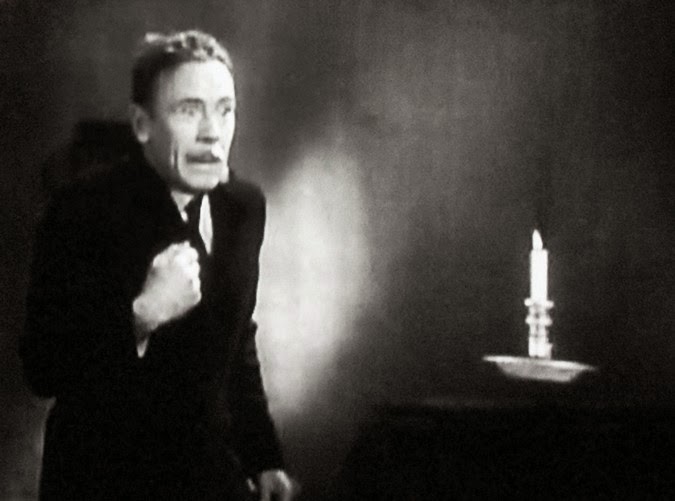
This is mild fun, though long stretches of it are surprisingly melodramatic (just like an operetta!), and as much as I generally like Novarro, I didn't like his character here—his awkward badgering of MacDonald goes on far too long, and when she finally gives in, it feels unmotivated; it's like a poorly done Astaire/Rogers set-up. MacDonald is less imperious than she was later with Eddy, and Charles Butterworth provides some worthy comic relief. It's strange to see Morgan playing a bit against type as a conniving bad guy—he's not really a villain but he's the only person in the story whom we're rooting against. The song that Novarro and MacDonald collaborate on, "The Night Was Made for Love," is repeated in various versions throughout the first half of the movie until you are sick of it. There’s a cute scene of MacDonald singing "Try to Forget" in a freight elevator. The finale, with MacDonald and Navarro singing together on stage, is in color. The primary pre-Code aspect of the film is that the two are shown living together out of wedlock. [Warner Archive Instant]
Wednesday, December 31, 2014
THE CAT AND THE FIDDLE (1934)
This is mild fun, though long stretches of it are surprisingly melodramatic (just like an operetta!), and as much as I generally like Novarro, I didn't like his character here—his awkward badgering of MacDonald goes on far too long, and when she finally gives in, it feels unmotivated; it's like a poorly done Astaire/Rogers set-up. MacDonald is less imperious than she was later with Eddy, and Charles Butterworth provides some worthy comic relief. It's strange to see Morgan playing a bit against type as a conniving bad guy—he's not really a villain but he's the only person in the story whom we're rooting against. The song that Novarro and MacDonald collaborate on, "The Night Was Made for Love," is repeated in various versions throughout the first half of the movie until you are sick of it. There’s a cute scene of MacDonald singing "Try to Forget" in a freight elevator. The finale, with MacDonald and Navarro singing together on stage, is in color. The primary pre-Code aspect of the film is that the two are shown living together out of wedlock. [Warner Archive Instant]
Monday, December 29, 2014
BROADWAY BABIES (1929)
Monday, December 22, 2014
THE CHRISTMAS ORNAMENT (2013)
This is, on the surface, not much different from the run-of-the-mill made-for-TV Christmas movie. But it has several small pleasures that set it apart: the light tone is perfect—it's not a serious melodrama and there is a blessed lack of forced comedy—the two leads have a nice chemistry, and the Christmassy feel of the town is just right, not ridiculously over the top. There are no kids to clutter up the adult story (well, there is one kid who helps out at the Christmas tree lot but he's unobtrusive and even amusing); I have nothing against kids in Christmas movies, but when they're shoehorned in, it usually shows. Martin has the right feel of someone who is stressed but not depressed, and Mathison is charming, handsome and rugged-lite—he also frequently has an intense look in his eyes that, in the beginning, made me think the movie was going to take a strange turn and reveal his character as a serial killer. For a relatively realistic story, the plot takes a slightly magical turn near the end, but I think all good Christmas movies need a touch of magic. Recommended. [DVD]
Friday, December 19, 2014
ZONTAR, THE THING FROM VENUS (1966)
Wednesday, December 17, 2014
MY BLOOD RUNS COLD (1965)
This thriller has a plot right out of Dark Shadows, and the short pre-credit sequence of a woman in colonial-era garb running away from a house while thunderclouds collect just heightens that comparison—though the movie was made a year before Dark Shadows, so it's probably just intended to conjure up a Gothic tone. The movie proper begins with young sexy Julie Merriday (Joey Heatherton) recklessly speeding along in her fancy sports car with her boyfriend Harry (Nicolas Coster) warning her to be more careful. As she passes a truck, she accidentally runs motorcyclist Ben Gunther (Troy Donahue) off the road. They stop to attend to him and take him back to her father's mansion. Ben seems OK, but he calls Julie "Barbara" and insists he knows her, believing that she is the reincarnation of her great-grandmother and he, in a past life, was her lover. Julie's Aunt Sarah (Jeanette Nolan) confirms that Barbara did have an affair with a Ben Gunther, resulting in an illegitimate child. Julie starts to believe Ben's story and the two begin a dalliance, leaving Harry out in the cold. But there is more to Ben than meets the eye…Monday, December 15, 2014
NIGHT SPOT (1938)
For a one-hour movie, a lot of things happen here, so the pace is relatively frantic, which is fine as the tone is light. Parkyakarkus, father of Albert Brooks, is first billed and he's basically a dialect comic who keeps messing up the language, as in, "I resemble that remark." In the beginning, his comic relief is a pain in the ass since I found the plot and other actors fairly interesting, but in the last half, his role diminishes greatly. Lee Patrick plays Marge's roommate, and Jack Carson and Cecil Kellaway have small roles. B-starlet Woodbury is serviceable, but Jones and Lane (pictured above) work very well together, and make the film worth seeing. They have an easy camaraderie and never fall into straight man/funny man roles—they can both be both. A breezy little gem; it's a shame that Lane (who had a long career as Rocky Lane in B-westerns) and Jones (who went on to play the Green Hornet in a 1940 serial) weren't paired up for more of these. [TCM]
Friday, December 12, 2014
GOLD FOR THE CAESARS (1964)
Thursday, December 11, 2014
REDEMPTION (1930)
This is one of silent star John Gilbert's first talkies and it was a notorious bomb. It's often claimed that Gilbert's voice was his downfall, being too high and squeaky for his dark, masculine looks, but in this case, the problem is his silly, overly melodramatic dialogue and the schizophrenic style of the movie; the direction and acting are both stuck in a limbo between silent (florid visual style, exaggerated gestures) and early sound (static camerawork, subtle acting). Sadly, for much of the movie, Gilbert is on the verge of being laughable, though by the end, when Fedya is constantly drunk and sick, Gilbert's performance becomes more naturalistic and achieves some power. To be fair, no one else is particularly good in this, either, except perhaps Adoré. It’s not exactly a terrible movie—it's certainly worth seeing for fans of the actors or the era—but it won’t win Gilbert any converts. [TCM]
Tuesday, December 09, 2014
MALTA STORY (1953)
Pavlow). Her mother (Flora Robson) is upset because her son (Nigel Stock) is suspected of espionage for the Axis. There's another boy/girl plot involving a British officer (Anthony Steel, pictured at left with Guinness) and his fiancée (Renee Asherson), but the focus generally remains on the attempts to keep the Germans away and on the sacrifices that the local populace has to make.This is the kind of WWII flag-waving propaganda film that was popular during wartime—except it was made eight years after the war. My untested theory is that most WWII movies made in the 50s were either star vehicles (John Wayne), big-budget affairs (BRIDGE ON THE RIVER KWAI), or scrappy little action B-films (THE TANKS ARE COMING). This British film doesn't fit any of those categories, instead feeling like the kind of movie made during the war specifically to keep up the homefront spirit (THE IMMORTAL BATTALION, THE LION HAS WINGS). The characters are not particularly well-developed and the budget is low, with little compelling action presented, so I'm not sure why this was made except to bring to light a part of the war that the British perhaps hadn't heard much about. Guinness is very low-key which may have been an acting or directing choice, but I wound up not caring much about his character, and the fact that he vanishes from the narrative for a good chunk of time in the middle doesn't help. Hawkins and Steel are much better, as is Robson in just a couple of short scenes. Nigel Stock (pictured at right) is quietly effective as Robson's traitorous son. It was interesting to learn (in that fictionalized movie way) about the siege of Malta, but somewhere a better movie is waiting to be made about it. [Netflix streaming]
Friday, December 05, 2014
THE FLIGHT THAT DISAPPEARED (1961)
By this time, I flashed on the notoriously bad movie THE STORY OF MANKIND, the entirety of which is such a trial involving mankind and a new bomb, with the whole history of humanity playing out over the course of the film. Here, the trial just takes a few minutes. I won't spoil the ending, which, if you've seen an episode of The Twilight Zone, you'll figure out anyway, but it manages to be both mishandled and satisfying. Actually, like many a B-movie from the 40s and 50s, this is best approached as a TV episode. The film is widescreen but has a bland TV aesthetic and very little in the way of thrills or special effects; still, at 70 minutes, it's watchable. The acting is 50s TV-style, though leading man Craig Hill comes through with a solid performance that is neither as bland as one might expect nor as intense as one might fear. The odd thing about the Examiner's argument is that the blame is placed here not so much on politicians or the military, but on the idea people, the scientists. More imagination could have helped the fantasy segment near the end, but the Examiner and the jury are informally dressed as average earthlings, and the set is just rocks and fog. The Examiner is played by Gregory Morton, whom I recognized as the Russian conductor in BYE BYE BIRDIE. Overall, a predictable novelty. [Netflix streaming]
Wednesday, December 03, 2014
AN IDEAL HUSBAND (1947)
The main reason to watch this is for its look—beautiful Technicolor explodes across the screen in every scene. The women wear gauzy rainbows of pastel colors and the backgrounds are full of beautiful appointments, paintings, and furniture. The plot is drudgery and the acting is weak, especially from Goddard who sticks out like a sore, overacting thumb against the dull underacting of Williams and Wynyard as his wife. The bright spots are Wilding, handsome and charming as the chief spouter of witty epigrams (along with Goddard), and a very young Glynis Johns (pictured) as the looker who is chasing after Wilding and who jokingly spars with Wilding's father, C. Aubrey Smith, over Wilding's playboy nature. Very nice to look at, less pleasant to pay attention to. [TCM]
Monday, December 01, 2014
THE PIED PIPER OF HAMELIN (1957 TV-movie)
This version of the old folktale is a musical done for 50s television, but don't let that scare you away. It has its faults, including a couple too many songs and a happy ending that takes some of the wind out of what has come before, but mostly it works surprisingly well, and is worth at least one viewing if only as a novelty. The town of Hamelin is run with an iron fist by the Mayor (Claude Rains) and his board of counselors. Their current project is the building of a large clocktower in order to win a competition for Royal Clockmaker to the King; the mayor is not only making everyone work long hours on the tower, he's even enlisting the children to help, telling them there is no time for schooling or fun. Meanwhile, on the outskirts of town, a little lame boy named Paul sees something very strange: a piper dressed in multicolored garb (Van Johnson, pictured) comes slithering down a tree like a snake, performs magic, like making flowers grow out of mud and conjuring a rainbow in the air, then spins like a dervish and vanishes.
The Mayor is happy to hear that their rival town in the clock competition, Hamelout, has been flooded. The people ask for help, especially for the care of their children, but the Mayor refuses. However, a side effect of the flooding is that Hamelin becomes infested with rats escaping Hamelout. The townsfolk demand the Mayor do something, and who should show up but the Pied Piper (whose merry music can be heard by the children but not the adults), offering his services to get rid of the rats and asking in return 50,000 guilders, which is the town's entire treasury. Since the Mayor wants to melt most of that down to make gold chimes for the clock, he promises the Piper the money but has no intention of paying him. That night, the Piper plays a sinister-sounding tune—which in this case can be heard by the adults but not the children—and the rats follow him to the river where they drown. When the Mayor refuses to pay (amusingly citing labyrinthe legal language from a long, long scroll of a contract), the Piper plays a tune that only the children can hear, and they follow him out of town into a mountain cliff which splits open to reveal a magical land. The townspeople try to get the kids back but cannot open the cliff. Most versions of the tale end here, but in this one, the Mayor is taught a valuable lesson about hospitality and the Piper brings the children back when the Mayor agrees to help the town of Hamelout.There is more to the story, including a major plotline that features Van Johnson as the friendly schoolteacher Truson (who, because of his sympathy with the children, can hear the same music they hear) and Lori Nelson as Mara, the Mayor's daughter who loves Truson against her father's wishes. Jim Backus appears as the King's emissary, in town to judge the clock contest, and 50s singing star Kay Starr has a cameo as a sorrowful mother looking in vain for her son on the night of their disappearance. Johnson also plays the Piper, and does a fine job in both parts. Doodles Weaver and Stanley Adams (pictured with Rains) provide comic relief as two of the Mayor's counselors. I haven't yet mentioned that: 1) all the songs use music by Edward Grieg, mostly from Peer Gynt, with "In the Hall of the Mountain King" used effectively as the song that catches the rats, and 2) all the dialogue is in rhyme. I thought that would bother me, but I got used to it fairly quickly. I was particularly impressed with Rains, who could have easily done his role in his sleep, but who really gives his all, even when has to sing—and he and his counselors have one of the best numbers, "Prestige." At 90 minutes, it feels a little padded in places, especially the numbers concerned with the romance between Truson and Mara. But it's colorful and though a bit stagy, has a more theatrical than TV-movie feel. Good holiday viewing, though I don't know how today's kids would take to it. [YouTube/DVD]
Friday, November 28, 2014
VALLEY OF THE DRAGONS (1961)
Wednesday, November 26, 2014
THE MYSTERIOUS HOUSE OF DR. C (1966/1976)
In a fairy-tale European village, the kindly but strange Doctor Coppelius spends his days alone in his mansion, creating life-size mechanical dolls that look so real, they can pass as human beings. He keeps nosy villagers away by setting off explosions from time to time, but he also likes some attention, so one day he creates a doll of a young woman (which he names Coppelia) and puts her out on his balcony, passing her off as flesh and blood. Sure enough, the young Franz sees her and is swept off his feet, which makes his girlfriend Swanhilda jealous. Soon, Swanhilda and her friends have snuck into the house and discovered the dolls; Franz comes after her and is rendered unconscious by Dr. Coppelius so he can use the young man in an experiment to transfer a human soul into the doll of Coppelia. Swanhilda poses as Coppelia and tricks the doctor into thinking the experiment has worked. Despite all this trickery, the story comes to a good-natured ending, with Franz and Swanhilda married, and even a love interest for the doctor.
Oh, yeah, I forgot to mention that this is all performed as a ballet, with no dialogue (though there is voice-over narration and some occasional voice-over thoughts from the characters). Based on two stories by E.T.A. Hoffmann, the ballet, Coppelia, with music by Leo Delibes, was first performed in 1870 and has remained popular. As for this film, it was originally made in 1966 as a straight-forward ballet film with no voiceover and released as DOCTOR COPPELIUS. It got good reviews but was pulled from distribution when its releasing company got into financial trouble. In the mid-70s, the director, Ted Kneeland, re-edited the film with narration and two completely extraneous animated sequences involving the doctor's strange dreams, and released it under the current title, but it failed to get much attention and disappeared again, until now when Turner Classic Movies has resurrected it on cable. At over 90 minutes, this remains mostly of interest to ballet fans. Had it been trimmed down to an hour or so and had some of the non-plot motivated dancing scenes removed, it might have become a TV standard for family holiday viewing. The movie looks fantastic with a bright and varied palette of colors used throughout. The sets are stagy but quite elaborate, and the whole thing has the feel of a beautiful childhood dream. The choreography is fine and no one is really called upon to stretch their acting muscles much, though Claudia Corday is quite convincing as Swanhilda and non-dancer Walter Slezak is in fine comic form as Doctor C. The animated sequence, with a voice by Terry-Thomas, features an angelic singing doll, a talking bull, and some space aliens, and is dreadful, but I found the rest of the movie to be a delightful curiosity. The Turner Classic widescreen print is almost pristine. One amusing line: Swanhilda, pretending to be Coppelia, dances with the doctor and thinks to herself, "Nureyev, he's not!" [TCM]
Monday, November 24, 2014
THE MAN WHO COULD WORK MIRACLES (1936)
This fantasy, with a screenplay by H. G. Wells based on one of his stories, is unusual in its feel and tone. It’s far from a big budget Hollywood film, being a middle-budget British film, yet it manages to do a decent job with special effects and sets and such. It begins on the intimate scale of one man and his small world of acquaintances, then expands to include the entire world, then shrinks back at the end. Young, an actor who is always fun to see, does a nice job in the lead, and in addition to Richardson (also always welcome) the cast includes Ernest Thesiger and Edward Chapman, and George Sanders has a small role as one of the cosmic beings. The film walks a fine line between sweet and cynical, but it keeps its balance most of the time. [TCM]
Thursday, November 20, 2014
The Shadow series from Monogram (1946)
In the first film, THE SHADOW RETURNS—he was returning to the screen for the first time since the 1940 serial—Cranston has promised his longtime gal Margo (Barbara Read, credited as "Reed") that he'll marry her, settle down, and quit his crimefighting ways, but suddenly a case crops up: a man named Yomans digs up a grave, takes a bag of jewels out of it, and enters the Hasdon mansion, where a number of people have gathered to buy the gems. But after Yomans enters the house, he vanishes along with the gems, and Cranston helps the police figure out what happened. Every time someone is about to be nabbed, they fall from a balcony and die. Suicide? No, a trick with a whip, Cranston discovers as he collects the suspects in a room to announce the killer's identity. Cranston slips on his Shadow mask a couple of times, and the "old dark house" atmosphere is occasionally effective, but the film mostly tries to set up Lamont and Margo as Thin Man-type screwball romantic detectives, helped and/or hindered by dumb cops and by the Shadow's sidekick Shrewy (Tom Dugan) who spouts way too much tortured punning wordplay. [YouTube]
BEHIND THE MASK is by far the least of the three films, more a comedy than a mystery. Jeff, a newspaper reporter (James Cardwell, who comes off like a B-movie John Garfield), is murdered in his office, and since all the onlookers see a Shadow-like shadow against his glass wall, Cranston has to take on the case to clear his own name. It turns out that Jeff was involved in a bookie operation in which people place their bets by talking into a nightclub jukebox. The best moment occurs when three people dressed like the Shadow are in a room together. There is also a nicely done fisticuffs scene in a back room gymnasium. In this film, Shrewy is played by George Chandler (pictured above right with Richmond in his mask) who does a better job than Dugan, but is also saddled with his own dumb blonde sidekick/girlfriend (Dorothea Kent). Richmond is called upon to act more goofy than mysterious. There's not much to recommend in this one. [Netflix streaming]But the third one is the charm: THE MISSING LADY is a nifty little thriller with a distinct film noir air. A crook known as the Ox bumps off a man named Douglas and steals a precious figurine called the Jade Lady, but the Ox in turn gets it taken from him. The cops hear Cranston talk about finding a missing Lady and think he means an actual person, but there are plenty of other people looking for that Lady, including a curio dealer named Kester, an artist named Field, and a mysterious figure named Blake (James Cardwell) who hires a brassy blonde named Rose to help him track it down. The presence of a couple of femmes fatales and lots of shadowy nighttime scenes give this a noir feel and a slightly more serious tone that puts it a notch above the other two films in the series. There is still too much comic folderol, and this time there are also two batty old ladies who operate the elevators in Cranston's apartment building (where much of the film takes place) and race each other up and down between floors. None of these movies really conjure up the atmosphere that one would expect from a Shadow story—and in MISSING LADY, Cranston only dons the Shadow gear for two very short scenes—but if you're in the mood for some harmless B-mysteries, they'll do. [Netflix streaming]
Tuesday, November 18, 2014
THE HEROES OF TELEMARK (1965)
In Nazi-occupied Norway, Richard Harris is leading a group of fighters in resistance efforts, including the ambushing of Nazi vehicles—we see them use a huge boulder to knock a tank down a slope. When it is discovered that the Germans are using a local hydroelectric plant, isolated in a deep valley, to develop heavy water for use in atomic weapons, Harris heads off to Oslo to enlist physics professor Kirk Douglas to help Harris and his men stop the experiments. They manage to get in and blow up the machinery, but discover later that the Germans have more prefab parts coming, so they make the tough decision to bomb the factory and, more crucially, a ferryboat which is carrying both innocent travelers, including the widow of one of the resistance fighters and her children, and a shipment of the heavy water. This big budget mid-60s war adventure film isn't typically the kind of thing I search out, but the Norwegian resistance aspect intrigued me and I wound up enjoying it. The attempts at fleshing out the characters are about par for the course: Douglas has an ex-wife about whom he is still conflicted—but we don't really care that much—and Harris' character isn’t fleshed out at all. Still, the two actors are good (Harris, pictured at right, was quite a handsome young man) as is Michael Redgrave as the ex-wife's uncle. The action scenes are handled well by director Anthony Mann, and it helps that much of it was filmed on location. Good example of the Resistance action thriller. [TCM]
Thursday, November 13, 2014
THE SOLITAIRE MAN (1933)
The studio, MGM, probably tried to sell this as another TROUBLE IN PARADISE, a sophisticated jewel-thief comedy from 1932 with Herbert Marshall. This is not nearly as witty or fun as that film, but it does have its own more minor-league charms. It's based on a play and is fairly stagy, especially in the long sequence in the plane, but it is fun to watch it all play out. Some of the twists are predictable, some less so. The plane scene is made fun by the trio of Marshall, Atwill, and especially Boland; her character was so irritating at first that I nearly stopped watching, but she quickly became great fun. (That's Boland between Marshall and Atwill pictured above.) Forbes is OK and Allan is unmemorable, but they don't spoil things. [TCM]
Monday, November 10, 2014
WINTER MEETING (1948)
This is more an interesting movie than a truly compelling one. Some find the usually fiery Bette Davis to be miscast, but she's basically playing a variation on her more passive roles in NOW VOYAGER and OLD ACQUAINTANCE, and I think she's fine. More problematic is the male lead, Jim Davis, better known years later as Jock on TV's Dallas. Again, "interesting" is the best word for him; he does a nice job conveying the idea that his character has deep and profound problems under the surface, but I ended up not really caring much about him, whether because of the acting or the writing, I'm not sure. Hoyt is surprisingly good in the prissy gay-best friend role, and Janis Paige is fine in a thankless part. The conversations in this dialogue-heavy movie don't always ring true, and at 100 minutes, it's at least 20 minutes too long, but it's fun for Bette Davis fans, especially since it doesn't seem to crop up all that often. [Warner Archive streaming]
Thursday, November 06, 2014
LULLABY OF BROADWAY (1951)
Subscribe to:
Posts (Atom)