Wednesday, March 30, 2016

THE TIME TRAVELERS (1964)

A group of university scientists led by Preston Foster are conducting experiments in time travel, but they've been ordered to cut their power use, so they conduct one last full-bore push, and it's a success—through a "window" portal, they can see 107 years into the future. But it's not a shiny utopia they see, it's a bombed-out barren landscape with no buildings visible. Two bald, bullet-headed brutes approach the window and try to get in, but the scientists beat them off, then they all pop through the portal into the future. Unfortunately, the portal collapses leaving them stranded. They are given refuge from roving bands of barbarian mutants in an underground chamber protected by a force field. John Hoyt, the leader of the underground humans, tells the scientists that civilization was destroyed by a nuclear disaster and the remaining non-mutants are planning an escape via starship to a distant planet. We get a tour of a factory which turns out androids that provide manual labor for prepping the spaceship, and a young woman whom one of the scientists is sweet on flirts with him by playing a psychedelic color organ. The scientists hope to blast off with Hoyt's people, but the sinister Dennis Patrick scotches those plans so Foster leads an effort to rebuild the portal so they can get back to their own time. Nothing goes as planned, leading to a surprisingly downbeat ending.

Written and directed by Ib Melchior, a minor sci-fi legend, this has the look and acting talent of a well-made TV movie, and little to set it apart from other 60s sci-fi B movies until its strange ending which smacks of a hard science-fiction novel. Most critics don't like the mid-movie tour that we get of the underground world because it brings the narrative to a stop, but I think it's rather enjoyable, especially the color organ scene. The acting is so-so: old pro Foster seems tired and unenthusiastic, but Philip Carey, Merry Anders and Steve Franken are acceptable as the other scientists, leaving Hoyt (in the center of the photo above, in the futuristic powder-blue jumpsuit) and Patrick to take acting honors. Hoyt had a late-career comeback as the grandpa in the TV sitcom Gimmie A Break, and Patrick played Jason McGuire on Dark Shadows. But in a movie like this, it’s not about the acting, it's about the ideas, the sets, and the effects, and all are adequate (one of the androids is pictured at left). The climactic battle between the mutants and the humans is effective and unusually graphic for a 60s movie that would probably have been pitched as kiddie fare. This is worth a spin for sci-fi fans. [Streaming]

Monday, March 28, 2016

JOHNNY DOESN’T LIVE HERE ANYMORE (1944)

First, some context that would not have been necessary in 1944: 1) During World War II, there were often housing shortages in big urban areas as an influx of war workers took up all the apartments and hotels; 2) The term "gremlin" for a mischievous imp came into popular usage during the war when pilots blamed all the little things that went wrong in their planes on gremlins. Now, the story. On an overcrowded train to Washington DC, Kathie (Simone Simon) is reading a magazine feature on gremlins when one suddenly appears and curses her with seven weeks of bad luck. She arrives for her job at an aircraft factory and plans to live with her friend Sally, but bad luck hits: Sally has just gotten married so Kathie has to find another place to live. This time, good luck strikes when she manages to sublet the apartment of a man named Johnny (William Terry) who is leaving for the Marines, but (bad luck) unknown to her, Johnny has given out his key to several buddies so they can use the place for sleeping, showering, or dating. So that's what happens: men, women, and even a child come parading in at all hours to use the place for their own purposes. As Kathie counts down the seven weeks of bad luck and all sorts of folks wind up in and out of the room, she falls for a sailor named Mike (James Ellison, pictured with Simon) until Johnny comes back and is smitten with her. When a Navy officer on 24-hour furlough (Robert Mitchum) winds up with the key so he can meet his wife, various elements collide leading to a raucous scene of fisticuffs, a court appearance, and even a proposal from Kathie for a 3-way marriage.

This may well be, technically speaking, the best, most professional looking movie ever to come out of poverty-row studio Monogram Pictures. It's got good-looking sets, a full musical score, and even special effects that, while a bit shaky at times, make the miniature gremlin scenes come off OK. But it's an odd duck of the movie, uncomfortably stuck between fantasy and screwball comedy. The gimmick of the gremlin wears out its welcome fairly quickly, and indeed the gremlin (voiced briefly by Mel Blanc and sounding exactly like Bugs Bunny) drops out of the story for long stretches. Frankly, the movie works best on the non-fantasy romantic comedy level. The director, Joe May, was an important figure in silent German cinema, but once he fled the Nazis, he only got B-movie work in Hollywood. Still, he gives the movie a fun, quirky and mildly sexy style. All the above men are very good, as are Chick Chandler as another sailor and child actor Billy Laughlin (Froggy in the Our Gang films—this was his only non-Our Gang credit; he was killed in a car accident a few years later). Simon (best known as the mysterious Irena in CAT PEOPLE) is attractive but weak in the acting department and I didn't really care about her increasingly complex circumstances, but Minna Gombell steals a few scenes as the landlord's aggressive wife. It's cute and frothy, and has one of the strangest endings of any movie of its era. [Warner Archive streaming]

Friday, March 25, 2016

THE GOLDEN ARROW (1936)

In Florida, Hortense, the obnoxious daughter of a rich Oklahoma oil man, is throwing a wild party in a hotel room; one partygoer shoots an arrow into a room across the way, putting out their lights. Out in the bay in a yacht is a rival heiress, Daisy Appleby (Bette Davis), who is actually avoiding company. But the next day, reporter Johnny Jones (George Brent) goes out to get an interview and when he's mistaken for a distant acquaintance, he's invited on the yacht where and he and Daisy hit it off, chatting and swimming; she likes him because he seems much nicer than the usual rich fellow. When she finds out Johnny's identity, she's pissed at first but when he agrees not to write the article, she thaws a bit. That night, Daisy attends a dinner party thrown by Hortense's father and, bored by him and her suitors, sneaks off with Johnny and spends the night at an amusement park. While they're hanging upside down on a ride, she proposes to him—she wants a marriage of convenience so she can avoid gold-digging suitors, and he'll be free to finally take time to write a novel. They marry, but what Johnny doesn’t know is that Daisy isn't really an heiress—she's been hired by a cosmetics firm to be their public face. Soon, she starts to develop real feelings for him, but he resents her company's attempts to stage-manage his private life (calling him a "Cinderella in pants") so he starts dating Hortense. Daisy tries to make him jealous but her plan backfires. Still, as we all know, in Hollywood screwball comedies, true love usually triumphs.

This was the first movie Bette Davis was assigned to by Warners after she won an Oscar for DANGEROUS, and I assume this was one of the movies she was referring to when she complained publicly about the poor quality of films she was being forced to make. There's really nothing wrong with it: it's a decently-made romantic comedy of class and misunderstandings, and Davis is fine in it. But it is not the kind of movie you associate with an Oscar-winner, or with the woman who just two years before garnered praise for her fierce performance as a nasty gold-digger in OF HUMAN BONDAGE. This is light and fluffy and full of silly plot twists and turns, and possibly more suited for someone like Kay Francis or Irene Dunne. Still, it is fun to watch, and Davis gives it her all even if she hated every minute of it. Brent is also delightful. I also enjoyed seeing the handsome Craig Reynolds show up as a PR man. Given that the film has been more or less ignored over the years as lesser Davis, it was more fun that I expected. [DVD]

Thursday, March 24, 2016

SATAN’S SATELLITES (1958)

Woo-hoo! Like PLANET OUTLAWS, the Buck Rogers film I reviewed recently, this is another condensed serial; this one cut down to 70 minutes from the 3-hour ZOMBIES OF THE STRATOSPHERE (1952), which I tried to watch last year but got bogged down in. The same problems apply here as to PLANET OUTLAWS: it's fast-moving but feels rather ragged, with the feeling that major subplots are missing—as they undoubtedly are. It's rather a mess from the beginning as we see, with no context, some guy put on a helmet and a jet pack and shoot off into the sky to find out what's behind the arrival of a small rocket from outer space. We eventually find out that the flying hero is the bland and blandly-named Larry Martin, assisted by the equally bland but earthbound Bob Wilson and the lovely but almost completely useless Sue Davis. The Martian Marex (Lane Bradford) and his assistant Narab (a young Leonard Nimoy) have come to Earth and, working with some nondescript earthling thugs, are planning on building a bomb to blow Earth out of its orbit so that Mars can move into its space to be closer to the sun. The craziest thing about the way this film is put together is that, though many scenes of narrative development clearly have been left out, the filmmakers have left in scene after scene of Larry and Bob and Marex and Narab going back and forth in an underwater chamber between two of the Martians' secret hideouts. Except for an exciting underwater knife fight, this gets old fast. Judd Holdren is adequate as Larry, Wilson Wood is forgettable as Bob, and Aline Towne, as Sue, just stands around and wrings her hands. Kinda fun, but I may still tackle the full serial someday. PS—neither Satan nor any satellites are in evidence at any point. [Paramount Vault on YouTube]

Tuesday, March 22, 2016

SONG OF LOVE (1947)

An undoubtedly heavily fictionalized version of the lives of composer Robert Schumann and his wife Clara—though all I know about the two of them I know from this film. We begin in 1839 as young concert pianist Clara Wieck (Katherine Hepburn), playing for the King of Saxony with Franz Liszt in the audience, chooses a song by the unknown Schumann (Paul Henreid) for her encore. Her father is incensed because he knows Schumann wants to marry Clara against his wishes. Clara goes to court to get free of her father, and when Liszt testifies that Schumann has real talent, the court finds in her favor and they marry. Ten years and seven children later, the young Johannes Brahms (Robert Walker) arrives to take lessons from Robert, who has not lived up to his promise. It happens to be New Year's Eve and when the Schumann's maid quits, Brahms sticks around to help them throw their party. Brahms moves in, helps with the children, and even sweet talks the maid into returning—and he falls in love, chastely, with Clara. But soon Schumann becomes ill with severe headaches and the ringing of sharp, dissonant tones in his ears, and Clara goes back to the concert stage to make money. Eventually, when the opera he has been working on for years is rejected, Schumann is institutionalized. A sad ending is in store for all, though after his death, Clara works tirelessly to expose her husband's music to the world. As MGM biopics of the era go, this one is fine, largely due to the production values and the acting of Hepburn and Walker (pictured above). Henried is OK but I've never found him to be an exciting or inspiring actor. Henry Daniell is fine as Liszt (though nothing like the other movie Liszt I know, Roger Daltry in LISZTOMANIA). The music, by Schumann and Brahms, is lovely. Fans of the high classical biopic style of the 40s will like this. [TCM]

Monday, March 21, 2016

BOMBA AND THE JUNGLE GIRL (1953)

I've been working my way through the Bomba the Jungle Boy movies—this one is number 8 out of 12. As with most classic-era series movies, the films tend, after the first few, toward a certain sameness so after my review of the third film I quit writing them up. But I decided to do a brief review of this one for two reasons: 1) the title is misleading; 2) we get some backstory information about Bomba. The film opens with Bomba musing about jungle life; all the animals around him have mothers and fathers, but he knows little about his origins, only that he was raised in the jungle by a naturalist named Cody Casson, now long dead. But among Casson's belongings is a faded diary which notes that Bomba's parents were named "Hastings" and that they lived in a nearby village, so Bomba sets to find out what he can, helped by Linda (Karen Sharpe), the daughter of a government official. Long story short, he finds out that his mother and father were casualties of a village coup, conducted by the current chief of the tribe, and Bomba helps the legitimate heir regain his title, much against the wishes of the chief and his wicked daughter. As I implied above, the title doesn't mean anything; Linda is no more a "jungle girl" than any of the other female leads in the other Bomba films. Sharpe is attractive and shows more fortitude than most of her predecessors, but she never gets into a leopard skin bikini or any other exotic jungle garb. Johnny Sheffield was 21 when he filmed this, though he doesn’t really seem appreciably older than he did in the first Bomba movie three years earlier. But he does look stockier and a little less excited to be darting around the jungle. Indeed, the crocodile fight scene reuses footage from an earlier film, and the shots of Bomba swinging through the jungle are also from earlier movies. With four more movies to go, I suspect I'll find that Bomba's glory days are over, but this one was still enjoyable enough for a Saturday morning diversion. (The colorized still above features Sheffield at far left and Sharpe at far right.) [DVD]

Thursday, March 17, 2016

TOMORROW WE LIVE (1943)

aka AT DAWN WE DIE

This propaganda thriller is set during the French occupation in the coastal village of St Pierre-le-Port where a jaunty fellow named Jean-Baptiste (John Clements, pictured at right) arrives during a period of successful Resistance activity—the Free French have managed to destroy German oil supplies and slashed the tires of Nazi vehicles. Despite his casual appearance, Jean-Baptiste is actively hiding from the Nazis and seeking out underground members; he has information that could help the British attack a Nazi military port. He is given forged papers and a job at a shipyard—and is told not to work too hard. The mayor and his daughter seem like collaborators, but they actually head up the town's Resistance band, and they plot to get Jean-Baptiste smuggled out to England along with a small group of British soldiers. The first half of the film is fairly light in tone with the Germans depicted as foolish and easy to trick, and a scene in a movie theater shows townspeople openly ridiculing newsreel footage of Hitler. But later, when a tavern keeper who informed on Free French activities is shot dead and an important supply train is successfully sabotaged, the Nazis start taking hostages. In the spirit of the film's two titles (TOMORROW WE LIVE being the British name, AT DAWN WE DIE being the American), the ending is both grim and hopeful. This is a fairly absorbing film of its type, almost archetypal in its situations and outcomes. The acting is OK, with Greta Gynt as the mayor's daughter the standout, and the cinematography is nicely done. [DVD]

Tuesday, March 15, 2016

LOVE LETTERS (1945)

In Italy during the war, Roger has had his buddy Alan writing love letters to Victoria, his girl back home, but with Roger's name attached. (These two never heard of Cyrano de Bergerac?) Alan's ready to stop because he finds himself falling for this woman he's never met—he refers to her as a "pin-up girl of the spirit." Roger eventually goes home and marries Victoria, but later when Alan returns to London, he finds out that Roger has died in an accident. At a party before Alan leaves to claim the rural property left to him by an aunt, his friend Dilly introduces him to a woman named only Singleton, a woman with amnesia who remembers nothing about her past. But when Alan tells his story about his yearning for Victoria, Dilly reacts strangely. Long story short, Singleton is Victoria, who was put on trial for the murder of Roger, who was found stabbed to death with Victoria holding a knife and remembering nothing about the incident or her past, and her guardian Beatrice paralyzed by a stroke. It appeared to have been self-defense and with Victoria now a victim of amnesia, she was sentenced to one year at a sanatorium. Eventually, Alan finds out about her past but has fallen deeply in love with her and marries her, agreeing not to push to get Singleton to recall her previous life. But slowly, Singleton begins to remember snatches of her life. What will happen when she remembers it all?

That’s a lot of plot summary for a fairly straightforward story of amnesia and love. All the little kinks along the way are mildly interesting, but ultimately this feels overblown and tedious. The performances do not help: Jennifer Jones is disastrous as Victoria, and Joseph Cotten can't do much with his blandly-written character. That they manage to develop some chemistry is mostly to Cotten's credit. The supporting cast is better: Gladys Cooper as Beatrice and Cecil Kellaway as the caretaker of Alan's farm are both good, and I wish there was more of them, particularly Cooper (pictured with Cotten) who only has a couple of scenes. Ann Richards is fine as Dilly and I like Robert Sully (Lucille Bremer's boyfriend in MEET ME IN ST. LOUIS) as Roger—at least he has some spunk even though his character is unlikable—but he's only around for the opening scene. The title song was nominated for an Oscar, and the sets and cinematography are above average, but the pluses are not enough for me to recommend this one. [DVD]

Friday, March 11, 2016

THREE CASES OF MURDER (1955)

Three completely unrelated stories of murder, all of which could have been episodes of Twilight Zone or the Alfred Hitchcock Show for their touches of the supernatural and the ironic. The opener, "In the Picture," is set in an art museum. We see a painting of a gloomy landscape dominated by a large house; we hear the glass around the picture break and then notice a man in old-fashioned garb (Alan Badel) sitting in the room, staring at the painting. He suggests to a museum worker (Hugh Pryse, pictured at right to the left of Badel) that the painting would look better if there was a candle burning in one of the house's windows. They walk up to take a better look at the painting and suddenly they are actually *in* the painting. What happens next leading to our first murder is best left unspoiled. The second story, "You Killed Elizabeth," involves two roommates, the gregarious John Gregson and the loyal wingman Emrys Jones. Gregson is a hit with the ladies, but he has also developed a blackout drinking problem. While Gregson is out of town, Jones starts up a relationship with Elizabeth Sellars, but Gregson returns, makes his own play for her, and winds up engaged to her, enraging Jones. Eventually, after one of Gregson's blackouts, Elizabeth is found dead and Gregson wakes up with blood on his hands. Who's the killer, the stud or the wingman?

The final tale, "Lord Mountdrago," is based on a story by W. Somerset Maugham and centers on a battle of wills between two politicians: the esteemed and powerful Mountdrago (Orson Welles) and the self-styled voice-of-the-people upstart Owen (Alan Badel). In Parliament, Mountdrago humiliates Owen, and Owen vows revenge. Immediately, Mountdrago begins having surreal nightmares which, in real life, Owen seems to be aware of. For example, one night, he dreams that he gets up to debate a bill and instead breaks into a chorus of "Bicycle Built for Two" (which leads to a full-on musical number in the halls of Parliament). The next day, Owen makes a puzzling reference to the song to Mountdrago. A psychiatrist tells Mountdrago that apologizing to Owen will get rid of the dreams, but Mountdrago decides to murder Owen in his dreams and see what happens in real life.

Most critics find the middle weak, but I think that's only because it lacks the atmosphere of the uncanny that the other two have. All three are satisfying stories with generally good performances, especially from Badel who, in addition to playing a lead in stories 1 and 3, has the small role of a bartender in story 2. "In the Picture" drags a bit getting to its climax, though the tilted camera angles used in the world of the painting are inspired. "Mountdrago" actually seems a bit rushed—I would have loved a few more minutes of Welles (pictured with Badel) chewing the scenery (in a relatively subtle way). John Gregson reminded me of a British John Payne. Andre Morrell, who appeared in several 60s Hammer movies, plays the shrink in the last story. A solid anthology film, if not quite of the caliber of DEAD OF NIGHT. [Criterion streaming]

Thursday, March 10, 2016

THE FLIRTING WIDOW (1930)

Pity poor Phyllis Faraday; she's in love with Bobby, but because of her tradition-bound father, she cannot marry until Celia, her older sister, does. However, Celia is a free spirit who doesn't care a whit about tradition—when we first see her, she's dressed in a tie and pants and has a short haircut—and is unlikely to take a husband. But when she finds out the pickle that Phyllis is in, she hatches a plan: she tells the family she's engaged to be married to (the imaginary) Col. John Smith who is off fighting in Arabia. She even writes a love letter to him which she discards when no one is looking. Weeks later, after Phyllis and Bobby have married, Celia puts a notice in the paper announcing the death of Col. Smith, and she hopes that will be the end of the charade. What she doesn’t know is that her love letter actually did get sent, and there really is a Col. John Smith, and when he reads her letter—in which she calls him Wobbles as a pet name—his curiosity gets the best of him and he shows up at the family home to meet her. When he finds out that the fake Col. Smith is dead, he claims to be a friend of Smith's who read Celia's letter and the game between Smith and Celia is on.

Though this is a rather stagebound early sound film, if you stick with it long enough, you'll enjoy yourself. It does take a while to warm up to the stodgy British family members, all overplayed a bit as though the actors were in front of a live audience, but once the plot mechanics start moving—especially when Basil Rathbone shows up as the deceased lover—it becomes quite fun. Dorothy Mackaill, whom I think of as a melodramatic pre-Code actress, is surprisingly bright and frothy as Celia, though I can picture someone like Myrna Loy being more suited to the part. William Austin does well with the showy, campy role of the upper-class sissy/twit; when he says to Celia, "In that outfit, you look almost like a man," she replies, "With that mustache, so do you—almost." Austin also gets to give the movie its title when, after the family reads that Smith has died, he says, rather cheerfully, "Makes the old gal a widow before she's a wife!" Speaking of good lines, when Rathbone first shows up, he gives Mackaill a necklace to wear, claiming it came from Smith: "He bid you wear this always [long dramatic pause]… on your bosom." Also with decent performances from Lelia Hyams as another sister, Emily Fitzroy as an aunt who helps Celia pull off her scam, and Anthony Bushell as Bobby. Nicely done. [TCM]

Monday, March 07, 2016

PLANET OUTLAWS (1953/1939)

After a brief opening narration about the preponderance of UFO sightings, we cut to a dirigible crash in the Arctic. Centuries later, the wreck is found and the bodies of the two fliers, Buck Rogers and his young friend Buddy, are found in suspended animation (some gas kept them alive and fresh and young). They're reanimated and immediately drawn into a battle between Darth Vader and the Jedi…wait, between galactic villain Killer Kane and the rebels fighting him from the Hidden City (two small mountains open and close to let people in and out of the city). Rogers flies a spaceship to Saturn to get help. Unfortunately, an envoy from Kane convinces the Saturians that Rogers is just an outlaw rebel, but Rogers does get through to Prince Tallen and help is on the way. Eventually, we see mindless zombies, a disappearing ray and a Kane spy smuggle himself into the Hidden City, but Rogers and the rebels prevail, and we get a final bit of narration about democracy and God's blessing of America.

As I've noted here before, I'm a big fan of the idea of movie serials but my experience of them is not always pleasurable. This may partly be a function of not finding the ideal way to watch them. At the rate of one episode a week, as they were originally seen in theaters in the 30s and 40s, I tend to get bored and drift away, not finishing the serial. But watching an entire 3-4 hour serial in one sitting is almost impossible, as the repetition of the chapter formula becomes numbing. The two I've liked best (DRUMS OF FU MANCHU and SECRET AGENT X-9) vary the formula a bit, staying relatively fresh from chapter to chapter, and I've watched them a third way: 2 or 3 chapters at a time over a few weeks. This film presents a fourth way of consuming serials—it’s a 70-minute condensation of the four-hour Buck Rogers serial from 1939. As such, it certainly is lean and mean and moves quickly. On the other hand, it feels jagged and incomplete as entire plot lines get excised with some plot references not making sense. Buster Crabbe and Jackie Moran (pictured) are good as Buck and Buddy, and I always like seeing Henry Brandon, who here plays a baddie. Phillip Ahn plays the Prince, interesting in an era when Asian actors were few and far between in Hollywood. Constance Moore barely registers as Buck's female associate. The sets, costumes and effects are slightly better than the norm for a 30s serial, though by the time this film was put together 15 years later, they would have seem hopelessly outdated. I'm not sure such a condensation—cramming in all the exciting moments at the expense of story and character—is the perfect way to truly experience a serial, but it was a fun, speedy ride. [Streaming]

Friday, March 04, 2016

SANDCASTLES (1972 TV-movie)

Plotline #1: We see young, pretty orchestra member Bonnie Bedelia moping around, bemoaning her loneliness. Her music is the most important thing in her life, but she does seem to want to be with someone. Plotline #2: Good-natured Herschel Bernardi runs a popular beachside diner called Papa Bear's but needs $20,000 for his mortgage and if he can't pay, he'll lose the place. So he invites his regulars for a free crowd-sourcing dinner, asking them to contribute to a fund to save the diner. They come through and Bernardi sends his bartender (Jan-Michael Vincent) to the bank with the money. Vincent is a blond, laid-back surfer-type dude who spends his off-time building sandcastles on the beach near the diner, and both Bernardi and his partner (Mariette Hartley) are like parental figures to him, but on a whim, Vincent decides to take the cash for himself and take off. He immediately regrets this, calls Bernardi and confesses, then says he'll hitchhike back with the money that night. He gets a ride with a drunk and obnoxious salesman (Gary Crosby).

On the highway near Papa Bear's, Crosby veers wildly to avoid hitting a car, driven by Bonnie Bedelia of plotline #1. Vincent is thrown from the car and Crosby speeds away. Bedelia comes to Vincent's aid, but, covered in mud and unrecognizable, he dies in her arms. She is taken in by Bernardi and Hartley, who don't realize that Vincent was killed and are waiting for him to show up with the money, which is still in his backpack, now in Crosby's possession. The next day, wandering the beach, Bedelia sees Vincent working on his elaborate sandcastles and, not recognizing him as the dead boy from the night before, she falls for him. But it's not long before she realizes he's a ghost on a mission: get the money back from Crosby to give to Bernardi.

I don't typically review made-for-TV movies here, but this is one from the "golden age" of TV movies, one which had quite a bit of buzz in its day, and one I never saw as a teenager but which many of my friends did. Perhaps the most interesting thing about it now is that it was shot on videotape, giving it the visual feel of a play or a soap opera. For a 75 minute movie, it has a lot of narrative, much of it difficult to buy. Of course, you have to accept the whole ghost thing, but why would Vincent say he's been brought back to find the money but also say that he can't leave the beach? Why did he take the money in the first place? He's not a terribly rounded character, but the theft feels wrong and is completely unmotivated. Why is Bedelia, who is attractive and pleasant, alone? And what the hell is Crosby's motivation? He finds the money, starts to give it back, then decides he's being treated shabbily by Bernardi and keeps it, only to ultimately give it up—prodded by his (long-suffering) wife. He is a thoroughly slimy character with Crosby doing almost too good a job at making him unlikable. The two people who make this worth seeing are Bernardi and Hartley; their characters aren't really fleshed out any more than the others, but the actors bring them to life and make us care about them. This film has been hard to find, but I ran across it on Fox Movie Channel in a very good videotape print. [FXM]

Wednesday, March 02, 2016

MR. COHEN TAKES A WALK (1935)

aka FATHER TAKES A WALK

Jake Cohen is the patriarch of the Cohen family, owners of the successful Empire department store in London. But with his older son Sam running day-to-day operations and his younger son Jackie working in the advertising department, Jake has gotten bored with sitting behind the desk as a figurehead. When he goes for a walk down the street to greet customers, Sam tells him that's undignified, so Jake winds up walking all the way down to Levy's small clothing store and volunteers to help him out. In the midst of his career frustration, Jake is hit hard by two events: his wife dies suddenly, and Jackie announces he wants to marry Sally O'Connor, an Irish Catholic girl he met on a transatlantic ship, rather than Julia, the girl everyone assumed he'd marry. When Jake meddles in Jackie's affairs by telling the O'Connors that the marriage can't take place, Jackie leaves the family business and takes a job with a rival. This late-midlife crisis finally takes its toll and Jake hitches a ride out to the country and "takes a walk" that lasts several days. Along the way, he helps out a homeless man, rewards a do-gooding minister, and even picks up a stray dog. Meanwhile, back at the store, Sam has badly mishandled a conflict between staff and management, and a strike is imminent. Can Jake get back to London in time to ward it off, and more to the point, does he even care anymore?

This British film is light and sweet and doesn't wear out its welcome. It reminds me of any number of 30s movies about patriarchal businessmen who either feel old and in the way, or are pushed out of the way by the younger generation, or who are on the verge of ruin (SWEEPINGS, THE MILLIONAIRE, LOOKING FORWARD). The unique aspect of this one is that there's a Jewish family at the center, but that aspect of the story isn't played up too much until the end—thankfully, the stereotypes are kept to a minimum—though Warner Bros. apparently felt like they had to reduce what little Jewish identification there was in the US, as the name "Cohen" was taken out of the title. The cast is mostly unfamiliar faces and names (Paul Graetz as Jake, Mickey Brantford as Jackie, Kenneth Villiers as the hobo who gets cleaned up and gets a job at Empire), but they're all fine. The light tone is undone only once—Mama's death, which is jarringly melodramatic. I liked the opening line: at the store, Sam asks a clerk, "Have you seen my father?" The clerk replies, "Yes, I think he's in ladies underwear." Pictured are Brantford and Graetz. [TCM]

Monday, February 29, 2016

BROADWAY HOSTESS (1935)

At an audition for a nightclub singing spot, blond Dorothy (Marie Wilson) is terrible, but Tommy the pianist (Phil Regan) hears Winnie (Wini Shaw), fresh off the bus from Wapakoneta, Ohio, and talks the boss into listening to her. Not only does she get hired, she attracts the attention of gambling boss Lucky Lorimer (Lyle Talbot) who decides to go legit and become her manager. Soon Winnie is the toast of the town and has fallen in love with Lucky, though he only has eyes for snooty heiress Iris (Genevieve Tobin). Iris enjoys Lucky's company but when he proposes marriage, she laughs in his face. Meanwhile, Winnie can't see what a crush her pianist Tommy has on her. After Lucky's rejection, he vows to break into high society to get Iris' attention, and he does, as the owner of a sparkling new casino for the rich, but Iris's dissolute brother Ronnie causes lots of headaches when he gets drunk and belligerent, and as a topper, steals thousands of dollars of his father's jewels and gives them to Lucky as collateral for his sizable gambling debt. When they are reported as missing, Lucky gives them to the police, but they arrest him for the theft. Winnie, whose career has been on a downswing, goes into debt paying his sizable bail (and not letting him know that she did it). Once he's free, Lucky marries Iris, then when he finds out that Winnie paid his bail (and an unscrupulous lawyer made off with the money), he secretly bankrolls a big Broadway show for her. But the dissolute brother is not done making trouble, and now he has a gun.

Enough plot for you? There's really too much here for a 75 minute movie—the last third feels very choppy and rushed—and I haven't even mentioned the supporting characters and the musical numbers. There are several songs and two big dance numbers choreographed by Bobby Connolly in a Busby Berkeley style, or as much of his style as a B-movie can afford, and they are pips indeed, though not necessarily in a good way. In one, a song that begins with Winnie and Tommy on a simple stage suddenly shifts to an elaborate suburban home set; the last one, "Playboy of Paree," steals directly from Berkeley, with dancers festooned in balloons superimposed to appear as if they are dancing inside a huge glass of champagne, and dancers' faces shooting out at the screen. For me, they both rank as nice tries, but they're missing that effortless glitter and flow that Berkeley could accomplish in his sleep. Shaw (pictured with Talbot) is a fine singer, but she's a big zero in the acting and charisma departments; Tobin is good, though her character seems a bit underwritten. Talbot, one of my favorite B-actors, is appropriately handsome and charming. The comic relief here is nicely done by two pros: Allen Jenkins as Lucky's sidekick who goes by the name Fishcake, and Spring Byington as a rich widow who Jenkins romances. Phil Regan is almost as charming as Tommy. An actor named Donald Ross is ineffectual as the drunken brother, and in fact, Ross never made another movie. Ward Bond and Dennis O'Keefe have bit parts. I enjoyed this movie but I'm not sure I’d want to sit though it again. [TCM]

Friday, February 26, 2016

PAYMENT ON DEMAND (1951)

Bette Davis is married to successful attorney Barry Sullivan; they have a nice house, a circle of sociable friends, and two daughters, one of whom (Betty Lynn) is seriously dating Brett King, a pleasant but lower-class Czech lad, which bothers Davis. One evening, seemingly out the blue, Sullivan asks Davis for a divorce. She, unable to understand why success and money don't satisfy him, is upset that he can't pinpoint his free-floating frustration with his life. In a series of flashbacks, we see their relationship grow. Early on, she directs a client toward her struggling husband instead of to his more knowledgeable friend (Kent Taylor), and years later, when this fact becomes known, it drives a wedge between Sullivan and Taylor, and is the start of the slow fracturing of Davis and Sullivan's marriage. Back in the present day, Davis has her attorney hire an investigator who snaps pictures of Sullivan in a compromising position with his young mistress (Frances Dee)—or perhaps would-be mistress, it's a little ambiguous. Thanks to the threat of making the pictures public and ruining Dee's life, Davis gets everything she wants in the divorce settlement. She goes on a cruise and does a little flirting with fellow passenger John Sutton, but when it turns out he's married and is just looking for a fling, she's disappointed. Back home, at Betty's wedding to Brett, she sees Sullivan and breaks down in a teary mess, regretting everything that's happened. Can there be a happy ending in store for these two "kids"?

Well, yes, in the last moments of the film, there is a strong hint at a rather improbable happy ending which makes a hash of much of what has gone before. Fans of romantic melodrama (what they called "women’s pictures" back then) will enjoy this, though fans of Bette Davis may not. Released just one year after her career-crowning performance in ALL ABOUT EVE (though actually filmed just before EVE), Davis merely idles at half-speed until her crying jag scene at the end, which is so realistic it's almost painful to watch—you really feel for her character and her regret over the many ways in which she has subverted her own attempts at happiness. Her scenes with Sullivan are fine, though she never quite strikes the sparks she did with her other leading men of the 1940s. Stage actress Jane Cowl plays an older woman who has lived her life very much like Davis and who becomes a kind of warning to her; in Cowl's last scene, she's set up in a nice house in the Caribbean living with a "protégé" who writes poetry—and is most likely gay. Cowl's warning: "When a woman starts getting old, time can be an avalanche, and loneliness a disaster." Stylistically, the most interesting thing about the film is the flashback technique. Each flashback plays out in a very stagebound fashion; for example, in a scene in which Davis and Sullivan get in a car and go for a drive, the car roof is a scrim which, when lighted from above, becomes almost transparent and we can see the night sky through it. The same for a scene set in a house where the walls are briefly invisible as the lighting changes.  For this kind of film, it's well done but a bit bloodless. [DVD]

Wednesday, February 24, 2016

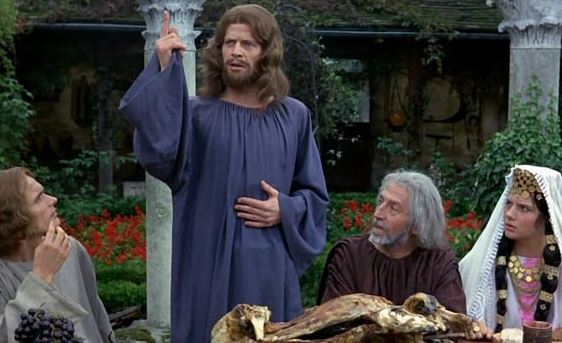
THE MILKY WAY (1969)

Two men, the older Pierre and the younger Jean, about whom we know and learn little, go on a pilgrimage to a town in Spain where the remains of St. James are kept. Along the way, they run into a number of people of various religious stripes, but mostly heretics who differ with the Church on some of the basic doctrines—the Holy Trinity, the human/divine nature of Christ, the transformation of the host into Christ's body at Communion, free will vs. predestination, etc. Oh, yeah, and Pierre and Jean travel through time and space—well, time at least, as all their encounters seem to be taking place in France and Spain. They run into the pope, the Marquis de Sade, a 4th century heretic named Priscillian, and even Jesus and the Virgin Mary. We see a lengthy argument between a priest and a policeman about whether the host becomes Jesus, or whether Jesus is folded up in the host like meat in a pastry. We see a "holy orgy" in a forest; half-naked women appearing out of nowhere in the bedrooms of two young men in an inn being harassed by a priest; a man in a sinister-looking black and red cape who foretells that Pierre and Jean will have sex with a prostitute who will bear them children; a headwaiter at a fancy hotel lectures his waiters on dogma; and finally, Jesus commits a miracle by curing two blind men—or does he?

When this film, directed by the noted surrealist Luis Bunuel, came out, there was apparently quite a bit of controversy and confusion over it, with some critics angry that it made no sense. This seems like an odd reaction given: 1) the definition of surrealism, and 2) what Antonioni (L'AVVENTURA), Resnais (LAST YEAR AT MARIENBAD), and Fellini (JULIET OF THE SPIRITS) were doing earlier in the 60s. From today's vantage point, it seems much less strange, and to this raised-Catholic viewer, it seems obvious that it's not the narrative that's important, but the spirited debates over Catholic dogma and heresy. Bunuel was raised Catholic, proclaimed himself an atheist, and remained interested in—and apparently conflicted about—religion all his life. I assumed he was mocking, fairly gently, both the faith that comes up with these inexplicable mysteries and the heretics who insist on different (but similarly inexplicable) interpretations of these articles of faith. Paul Frankeur (as Pierre) and Laurent Terzieff (as Jean) are fine in the lead roles, but they ultimately don't have much to do but witness and react—and note well that their names can be anglicized as Peter and John. Bernard Verley (pictured above) makes for a nice, somewhat testy Jesus, and Denis Manuel and Daniel Pilon sort of take over as our guides in the last half as two provocateurs who are definitely not of the modern age. Interesting, entertaining, and nicely ambiguous. [DVD]

Tuesday, February 23, 2016

HANDS OF A STRANGER (1962)

A small time crook is gunned down on the street and dies on the operating table; the surgeon (Paul Lukather) notes that his hands were so strong, they had to be pried from a streetlight against which he fell. That same night, successful concert pianist James Stapleton is in a car accident and his hands are mangled beyond repair. Lukather removes the pianist's hands and replaces them with the hands of the dead thug. When Stapleton's overly protective sister (Joan Harvey) realizes what has happened, she becomes hysterical but she eventually comes around and she and the doctor don't tell Stapleton that his hands are not his. Unfortunately, he soon discovers this on his own and can't bring himself to try and play again, which makes his gold digging girlfriend split. When he confronts her, he accidentally sets her place on fire, killing her. This is just his first act of revenge, and wait until he discovers that his sister is dating his surgeon!

This is a variation on the much-adapted French novel "The Hands of Orlac"; the 1935 MAD LOVE with Peter Lorre is the one to beat. This does not beat it, but B-movie fans may like it for its use of shadows and low angle shots. Horror fans will not be impressed by the lack of gore, though tension is generally kept high—except in the talky two-shots that make up much of the middle of the movie. It's disappointing that characters are not developed very well—it would seem to be a no-brainer to do something with the potential for incestuous feelings between the pianist and his sister, but it's left there for the audience to do the heavy lifting, if so inclined. Stapleton (known later in his career as James Noah; pictured above with Harvey and Lukather behind him) is good as the high-strung pianist, and the climax with the central triangle on stage at a concert plays out nicely. The other actors range from so-so to bad, but it's fun to see a young Sally Kellerman in a very small role. [DVD]

Thursday, February 18, 2016

BORDER INCIDENT (1949)

In the Imperial Valley of Southern California, Mexican migrant workers (called braceros) are in demand during harvest season, but the process of getting legally cleared for work is lengthy and some workers pay to be smuggled over the border. Tragically, the smugglers sometimes unload groups of braceroes near a canyon, then rob and kill them. An American customs agent (George Murphy) and a Mexican investigator (Ricardo Montalban) join forces to flush out the smugglers. Montalban poses as a bracero and befriends James Mitchell, a real bracero, to find the smugglers and get across the border, while Murphy poses as a wanted American criminal who wants to join forces with the smuggler, Howard Da Silva. But the best laid plans often go astray as they do here, and when Murphy is exposed, both he and Montalban wind up in danger.

This is labeled film noir mostly because it was directed by Anthony Mann (T-MEN, RAW DEAL) and because the cinematography (by John Alton) is full of deep shadows, though most of it was shot not in the city but the desert and there is no real femme fatale—excepting one deceitful woman, a minor character though crucial to the plot. To me it feels more like a crime film, and a surprisingly brutal one for the time. There's a realistic scene of torture, and the death of one character in an open field, run over by a plow, is startling and may have influenced a similar scene in the Coen Brothers' BLOOD SIMPLE. The movie opens well, with a scene of unlucky braceros being attacked at night, then takes a turn toward the Dragnet-like documentary style police procedural and soon the film bogs down a bit as the plot machinations get set up. But the last half-hour sets things right again. Performances are solid, with the honors going to bad guy Da Silva and his sadistic right-hand man Charles McGraw. Also with familiar supporting actors Sig Ruman as a German barkeep who is involved with the smugglers and John Ridgely as a U.S. agent. If you can stick with it through the slow middle section, you'll be rewarded with a strong climax. (Pictured are Da Silva, McGraw and Montalban) [TCM]

Wednesday, February 17, 2016

ONE IS A LONELY NUMBER (1972)

In an awkward, overly mannered opening, we watch the break-up of the marriage of the Browers, James and Amy. She (Trish Van Devere) seems to think all she has to do to make things better is to apologize for throwing his copy of Milton out the window; he (Paul Jenkins), a college professor, vaguely alludes to having been unhappy for some time. He moves out of their San Francisco apartment and leaves Amy to fend for herself. She gets some guidance from her best friend Jane and from middle-aged Gert (Janet Leigh) who heads a divorcée support group. As an Art History major who's never held a job, Amy has a hard time finding employment—and has to deal with a major league asshole at an employment agency who keeps hitting on her to the point of assault—but does get a summer job as a lifeguard at a city pool. She strikes up a friendship with an older grocer on her block (Melvyn Douglas), coming to rely on him for company and advice, and eventually sticks her toe back in the dating pool with a slick, handsome businessman from out of town (Monte Markham, pictured at left with Van Devere). But she deludes herself into thinking that her husband will come back to her before the divorce is finalized, and when that proves to be far from certain (he's living with a student), her recovery from separation trauma no longer seems to be a sure thing.

I suspect this is one of the first movies to take divorce and its aftermath seriously as its main plotline. It was also riding the feminist zeitgeist wave—albeit concerning white and middle-to-upper class feminism—and shows what I'm guessing were some realistic concerns of the time for divorced women: unprepared for the work world, facing a wide range of men in the dating world, not quite believing that their husbands would really leave for good. Van Devere (later married to George C. Scott) has a delicate, 60s flower child feel about her that fits the role, and for the most part, she's fine, though she's a bit artificial in scenes of strong emotion. Douglas downplays and Leigh overplays (being bawdy for comic relief), both to good effect. Some critics fault Markham as being weak in the somewhat problematic role of the playboy suitor, but I think he's right on the mark, and bests Van Devere in their scenes together. Plotlines get tied up in mostly satisfying ways, and even, in the case of her relationship with father-figure Douglas, somewhat unpredictable ways. Fun trivia note: the guy who plays the employment agency jackass (Jonathan Goldsmith, pictured at right) is now the Most Interesting Man in the World for Dos Equis Beer. [TCM]

Friday, February 12, 2016

THE MIDNIGHT WARNING (1932)

Bill Cornish, a celebrated G-man, visits his old friend Steve, a doctor in town for a political convention being held across from his hotel. Steve shows Bill a strange discovery: he found a human ear bone in his room's fireplace. After sharing this puzzling find, Steve collapses in a dead faint. After Steve recovers, the hotel doctor says it must have been vertigo, but Bill quickly realizes that Steve was grazed by a bullet that came from an apartment across the street, and Bill soon suspects something's up because the doc didn't find the obvious bullet wound. Bill and Steve head off to search the apartment room and wind up following a woman from the room. She's Enid Van Buren, and she tells Bill and Steve that she and her brother, who had fallen ill, had come to town a couple of weeks before; she left him in the care of the hotel doc and left town for a few days. When she returned, not only was her brother missing, but the room they had (the room that Steve is staying in) was completely different, and the doctor and the manager both claim that her brother was never there. Who fired at Steve? Is Enid crazy? Is Enid dangerous? Or is it the hotel doc and manager who are not to be trusted?

The missing visitor is a plot which has been used in movies (SO LONG AT THE FAIR), TV (I remember an episode of The Big Valley which used it) and folklore (known at Snopes as "The Vanishing Hotel Room"). So if you've run across this storyline before, you’ll know where this is going, but you still could get some fun out of seeing how the plotline develops. Unfortunately, this Poverty Row production plods along with uninspired acting and direction, and the lack of a musical score makes it even harder to sit through. There are a couple of unusual plot twists—Bill can read lips, and he can do it even better with new high-powered binoculars which are treated like something of which James Bond might have been jealous. Once the mysterious doings are figured out, plotholes galore open up. For the record, the mostly unknown actors in the cast include William ‘Stage’ Boyd (not the same guy who starred as Hopalong Cassidy years later) as Bill, Hooper Atchley as Steve, and Claudia Dell as Enid. None of them stand out, nor do the villains. There is one creepy scene of the heroine in a dark mausoleum (pictured), and overall, it's not difficult to sit through, but you'll miss nothing if you don't. (It's on YouTube under its later reissue title, EYES OF MYSTERY)