Tuesday, August 29, 2017

TORMENTED (1960)

Noted jazz pianist Tom Stewart (Richard Carlson) is renting a beach bungalow on a resort island. He spends a lot of his free time in a deserted lighthouse while he prepares for a big concert performance, and for his marriage to his wholesome sweetheart Meg. Unfortunately, one night his old flame, sexy nightclub singer Vi Mason (Juli Redding), sneaks onto the island and threatens to expose their sordid past if he doesn't call the wedding off. They discuss the issue up in the lighthouse, and when the railing gives way, Vi falls. Grasping on with one hand, she begs Tom to save her; he reaches out but pulls back and she falls to her death. Soon, Tom feels haunted by Vi's ghost: seeing her body in the water, he carries it to be the beach but it turns to seaweed; his wedding ring goes missing; Vi's watch appears in his house; phantom footprints walk next to him on the beach; a record of Vi singing a song called "Tormented" plays even after Tom takes it off the phonograph; creepiest of all, her disembodied hand and head pop up from time to time. Soon everyone notices Tom's a little off; not just Meg but Meg's kid sister Sandy (Susan Gordon) and the good-natured—but nosy—blind landlady (Lillian Adams). Despite Tom's odd behavior, and despite her father's dislike for Tom, Meg insists on going through with the wedding, but the arrival on the island of an unsavory character (Joe Turkel) who brought Vi over from the mainland and wonders what's happened to her changes Tom's plans.

I discovered this low-budget thriller from Bert I. Gordon when it was mocked on Mystery Science Theater 3000; their version is lots of fun, but I have come to appreciate the movie on its own merits. Part of the fun is figuring out if there really is a ghost or if a guilty Tom is just losing his mind—though he definitely wants Vi out of the way, he doesn't plan on killing her, and when she does die, he doesn’t directly cause it, he just pauses long enough in helping her that she loses her grip. His guilt here isn't strictly speaking based on him breaking a legal code but a moral code. Some critics say Carlson's performance is on the wooden side, but I think he does a nice job sliding back and forth between acting distracted because of guilt and feeling that his relationship with Meg and her sister will somehow redeem him. Is there a ghost? By the wedding scene near the end, you'll probably have decided, but until then, it's a toss-up. The other actors don't give Carlson much support: young Susan Gordon, only 11 at the time, is OK but tries a little too hard in her more melodramatic moments—possibly the fault of her dad, the director. Lugene Sanders is pretty bad as Meg, so much so that I wondered why Tom didn’t run off with Vi (the answer: Meg's family has money). Juli Redding is fine in her limited screen time as Vi, and Lillian Adams as the blind lady who is the first to figure out what might be going on, is serviceable. Joe Turkel, fine as the young tough who tries to blackmail Tom, went on to cult fame as the ghostly bartender in THE SHINING and as Dr. Tyrell in BLADE RUNNER. The wedding scene plays out nicely but feels truncated (did what we see really happen or was it all in Tom's mind?) so we can rush to the climax, back in the lighthouse. If you're in the mood for a Chiller Theater B-movie, this will do nicely. But also go ahead and catch the MST3K version as well. Pictured are Carlson and Redding in the flesh (at top right) and with Redding in ghostly form. [DVD]

Friday, August 25, 2017

AN AMERICAN TRAGEDY (1931)

Young Clyde Griffiths (Phillips Holmes) comes from a humble background—he grows up living in the Skid Row mission his parents run—but wants better things. We see him working as a bellhop in a Kansas City hotel, flirting with a rich girl but dating a lowly hotel maid. While out with his drunken friends, he is involved in a car crash that kills a pedestrian; he manages to run away fast enough to avoid any connection and leaves town. He eventually winds up in New York and gets a job at his uncle's shirt factory. He’s making money, but finds the work boring and beneath him. Invited to his uncle's house, he fails to make a good impression due to his sullen personlity. But at the factory, he becomes smitten with new worker Roberta Alden (Sylvia Sidney, pictured with Holmes) and though it's against the rules, the two see each other on the sly. He pressures her to have sex, and soon she is pregnant and pressing him for marriage. But he has since met the rich and lovely Sondra Finchley (Frances Dee) and, seeing a much better future with her, begins to fantasize about killing Roberta by faking a canoeing accident. One summer day, the two go out to a deserted part of a lake and he starts to act on his impulse. At the last minute, he stops himself, but the canoe tips anyway and she drowns. He rather heartlessly leaves the scene to go partying with Sondra and her moneyed crowd, but soon the police are able to draw a web of circumstantial evidence around him.

It's difficult to know how to approach this film critically. Based on a classic novel by Theodore Dreiser, directed by the stylish Josef von Sternberg, and filmed in the pre-Code era when filmmakers could deal with most of the movie’s "unsavory" themes (premarital sex, abortion, a crime of passion), there was definitely potential here for a classic movie. However, this just scratches the surface of the novel, coming off like a bland Reader's Digest condensation, and with very few of the visual flourishes one might expect from Sternberg. In the novel, Clyde's upbringing is crucial to an understanding of how his personality develops, but the movie skips over almost all of that. Holmes does manage to make the character passive, callow and unfeeling (his masculinity is questioned often enough that it made me wonder if Sternberg was suggesting some sexual orientation conflict) but we wind up with very little sympathy for him; Roberta is only lightly sketched as a character, and Sondra is barely present, so there is really no one in the story for us to identify with. Perhaps if I hadn't read the novel, my reaction would be different. The 50s film version, A PLACE IN THE SUN, is glossier with rounder characters, though still no match for the book, which admittedly gets hard to plow through in the last third. Interesting mainly as a pre-Code relic. [DVD]

Wednesday, August 23, 2017

AMERICAN GUERRILLA IN THE PHILIPPINES (1950)

In 1942, two American Navy men, Ensign Chuck Palmer (Tyrone Power) and sailor Jim Mitchell (Tom Ewell), are stranded on the island of Leyte in the Philippines after the fall of Bataan—when General MacArthur made the famous claim, "I shall return." The two attempt to get to the island of Mindanao to rejoin their troops but in the city of Tacloban, they find chaos as the Americans are preparing to surrender and the natives are desperate for help. The colonel there gives them some money so they can buy a boat and try to make it across the gulf, and Palmer uses his influence to help Jeanne, a French woman married to a Filipino, get medical assistance for a relative. She thanks him, but also warns him that the monsoons will make it difficult on the water, and suggests he stay on the island and become part of the resistance. They leave with a small crew, and their boat does indeed get destroyed. Stuck eight miles from shore, they are eventually rescued by a group of villagers who hide the men from the Japanese. Resistance fighter Miguel (Tommy Cook) joins the Americans and after a few months in hiding, they finally get assistance from businessman Juan Martinez, a supporter of the guerrillas and also the husband of Jeanne, for whom Palmer is carrying a bit of a torch. Palmer winds up on a spy mission to Mindanao, and then is sent back to Leyte in charge of radio communications, important in setting up MacArthur's return. As the months pass, Palmer becomes fully invested in the resistance. In the climax, a fierce Japanese attack is interrupted by American air forces—MacArthur has indeed returned.

A common complaint about this movie, based on the real-life experiences of Iliff David Richardson, is that it's not exciting, and I have to agree; until the ending, there are few battle scenes. But there is often well-built tension, and the characters are a bit more fleshed out than is the norm for a WWII movie. Power is very good in the lead, and Tommy Cook makes for a sympathetic sidekick. Tom Ewell is in what might normally be a comic relief part, but to his credit, he plays the comedy down in favor of characterization. Fritz Lang directed, and though there are few interesting stylistic flourishes, the film is well shot and the narrative remains clear throughout. The romantic angle, a slow-burning attraction between Palmer and Jeanne, feels forced, but it pays off nicely in a sweet Christmas Eve scene. Despite the word "guerrilla" in the title, the action here is more along the lines of spying and resisting than death and destruction. Recommended. Pictured are Power (wounded) and Cook. [Amazon streaming]

Monday, August 21, 2017

BABES IN ARMS (1939)

Back in the 20s, Joe and Florrie Moran were a hot ticket on the vaudeville circuit, but now their bookings are few and far between, and they live in Seaport along with a big community of "has-been" performers. Joe leads the adults in floating the idea of a comeback tour, but soon many of them are in danger of losing their homes, so his son Mickey (Mickey Rooney) and his pal Patsy (Judy Garland) have another idea: they get a bunch of the kids in town to contribute their talents to a newcomers show put on in a barn—yes, this is the granddaddy of the "Hey, kids, let’s put on a show" musical genre. Problems rear their ugly heads: the head of the social welfare board (Margaret Hamilton) complains that the kids aren't getting their education; a former child star known as Baby Rosalie joins the gang but she starts throwing her weight around, which then threatens the chaste romance developing between Mickey and Patsy; eventually, they even have to face an oncoming hurricane! But of course, in the best MGM fashion, things work out for the kids in the end, and a Broadway debut is assured.

With Busby Berkeley as director, one might assume some spectacular dance numbers are in store, but sadly he keeps his excesses in check. That’s not to say that there isn't some good musical fun here. There are two songs better known for their appearances in SINGIN' IN THE RAIN: Mickey and Judy do a nice simple duet on "Good Morning" and Judy sings a rousing "Broadway Rhythm"; Garland does a sad reading of "I Cried for You"; the title song, sung by the kids as they wield torches in the streets, feels like pro-military propaganda, which given the world situation at the time, it may well have been. Unfortunately there's also a cringe-worthy minstrel show bit with blackface that no longer plays well. Despite it being a musical comedy, it's got some surprisingly serious moments, mostly involving the parents' financial situation. One of the production numbers, which climaxes with Mickey and Judy as Franklin and Eleanor Roosevelt, has the line, "We don't have Il Duce, we don't have Der Fuehrer, but we have Garbo and Norma Shearer." Also with Charles Winninger, Guy Kibbee and Johnny (Bomba the Jungle Boy) Sheffield. [DVD]

Wednesday, August 16, 2017

GOLD (1934)

German scientist Achenbach, with his assistants Holk and Becker, is preparing for the trial run of his room-sized alchemy machine that will turn lead into gold. It's not clear that the economic ramifications of this, if successful, have really been thought through, though the machine sure looks cool. But Becker is secretly a saboteur, and just as the experiment begins, he substitutes an explosive for the lead; the machine blows up, killing Achenbach but leaving Holk (Hans Albers) determined to get revenge. The Scottish industrialist Wills, who has built a similar (and bigger) machine in a lab in his underground coal mine, asks Holk to come and work with him; Wills needs Holk's expertise to finish up. As it happens, the sabotage was the work of Wills (Michael Bohnen), who felt there was only enough room in the world for one alchemy machine. When Holk figures out what's up, he is torn between helping to finish the machine for Achenbach's posthumous glory, and destroying the machine once and for all. He goes to work, becoming friendly with Wills' daughter Florence (Brigitte Helm) who doesn't especially like her father. On the night of a huge party at Wills' castle, Holk dramatically locks himself in the machine room and does indeed make gold from lead. When the world gets wind of this, newspaper headlines are torn between forecasting universal prosperity and predicting huge inflation and the collapse of world economic systems. One of the coal miners asks, if Wills can make gold, why people can't just print money. As the social upheaval becomes greater, Holk decides this alchemy is misguided and tries to destroy the machine, very much against Wills' wishes.

I'm sure, given that this was made in Germany at the dawn of the Third Reich, that there are allegories and symbols galore here which refer to German fascism and the economy and other social issues, but I leave the sorting-out of that to those with more historical knowledge. What I liked about it is its look, much of which seems borrowed from Fritz Lang's Metropolis. Although this director, Karl Hartl, had a lengthy career, having made films through the 1950s, the only other movie of his I've heard of is F.P. 1 DOESN’T ANSWER which appears to be another sci-fi-ish thriller. Though it doesn’t reach METROPOLIS's wild stylistic heights, it has a more solidly built narrative with fleshed-out characters and a more satisfying ending. The acting is fine all around, though Helm (the iconic Maria in METROPOLIS) has a fairly thankless role. The finale is genuinely suspenseful and exciting. Some of the machine footage made its way into the 50s B-film THE MAGNETIC MONSTER. An enjoyable early SF film. [DVD]

Monday, August 14, 2017

THE 13TH MAN (1937)

District Attorney Sutherland, who is facing competition in an upcoming election, has put twelve high-profile crooks behind bars recently and now he announces he is about to do the same for a thirteenth. Among the men who worry that they might be the 13th man: Martin, Sutherland’s chief rival; Crandall, who runs race track gambling; Cristy, a nightclub owner; Dr. Gorman, whose career stumbled when Sutherland exposed his crooked dealings; and even Baldwin, publisher of the local paper, who has published some negative stories about Sutherland. One night at a boxing match, all the above men are present, and just as one of the boxers is knocked out, Sutherland drops dead in his seat, apparently of a heart attack. But radio commentator Swifty Taylor and his reporter buddy Jimmy Moran soon figure out that Sutherland was killed by a poison dart to the neck. The two work to crack the case, and when Jimmy is killed while following a lead about a dart gun, Swifty (and his girlfriend/secretary Julie) work even harder to expose the killer, an event which happens when Swifty gathers all the suspects in his studio during a live broadcast.

This is a moderately compelling B-crime/newspaper film with an interesting leading man (Weldon Heyburn) who was saddled with a badly-written character. I found Swifty to be unlikable and irritating, though Heyburn tries his best to make him lively. Better is Milburn Stone as Jimmy, and I was very sorry to see him leave about two-thirds of the way through. Inez Courtney (pictured with Heyburn) is fine as the love interest, though few of the suspects are able to stand out in any way. Still, the plot was never confusing, and I only figured out the killer moments before Swifty exposed him. This was the first movie from the re-opened Monogram Pictures, which had been merged with another studio two years earlier. Good production values put this a notch above the average low-budget film of the time. There's even a decent song, "My Topic of Conversation" sung by B-movie chanteuse Eadie Adams—not to be confused with Edie Adams who was married to Ernie Kovacs and was best known for her sexy TV ads for Muriel cigars in the 60s. [YouTube]

Friday, August 11, 2017

LOVE FROM A STRANGER (1937)

aka A NIGHT OF TERROR

Working girl Carol Howard (Ann Harding) shares a flat in London with her good friend Kate and Carol's Aunt Lou, who is a general pain in the neck. One day, Carol wins a life-changing amount of money in a French lottery; she quits her job, sublets her apartment, and looks forward to traveling. Her fiancĂ© Ronny, however, is not happy—he fears that he will resent her wealth, and he does not want to quit his job and live the high life. On the same day that she and Ronny have a spat over her winnings, a man named Gerald (Basil Rathbone) comes to look into subletting her apartment and the two hit it off. He takes her to dinner that night and when she and Ronny officially split, she and Gerald become an item. Gerald has a surface charm, but there is also something off-putting about him and both Kate and Ronny pick up on. Ronny discovers that Gerald's stories his past can't be verified, but eventually Carol marries Gerald and they move to an isolated country house. She makes him the sole legal heir to her fortune—and that's when even Carol notices that Gerald is a little strange: he has a cellar that he uses as a darkroom for his photography hobby, but he gets over-the-top angry if anyone tries to enter it; once in a while, he has a rather batty moment which he blames on shellshock from the war; he is also diagnosed with a heart problem. When he insists that Carol join him on a rather sudden and mysterious trip out of town, Ronny and Kate smell danger, but Carol still seems willing to give her husband the benefit of the doubt—until the local doctor shows up with a copy of a book about serial killers that makes Gerald uncomfortable.

To say more would spoil the last 15 minutes of the movie (based on an Agatha Christie story), and it's a humdinger of an ending. It's not really a spoiler to note that Gerald is indeed not altogether right—we get hints of this from the get-go—and Rathbone's performance, eccentrically creepy, is startlingly modern in its modulations until he goes totally off the beam at the end. Harding is about average in the first half, playing the vaguely menaced wife as a passive victim, but she too gets to shine in the final sequence, the "night of terror" to which the American title refers. Indeed, the last half of this film feels like a cross between GASLIGHT and NIGHT MUST FALL, and the tension builds nicely to the end. Grieg's "In the Hall of the Mountain King" plays spookily on the soundtrack whenever Rathbone has one of his spells. Production values are on the B-side, and the first third of the film is a little slow, but when the acting moves to front and center, the film's faults fade. Binnie Hale and Bruce Seton are good as Kate and Ronny, and Joan Hickson, who would play Christie's Miss Marple on TV in the 80s, has a small role as a maid. This public domain film is not in good shape, but thriller fans should seek it out anyway. [YouTube]

Monday, August 07, 2017

TARZAN’S HIDDEN JUNGLE (1955) & TARZAN’S FIGHT FOR LIFE (1958)

As HIDDEN JUNGLE opens, we see Tarzan (Gordon Scott) taking a leisurely morning swim with some hippos, and later, when he has rescued a baby elephant shot by two hunters, he philosophizes to his chimp pal, "Cheeta, why man always want to kill?" The two hunters work for Burger (Jack Elam) who has been hired by to collect animals for their hides and fat. But because Tarzan has been stymieing them when possible, they decide to head across the river to the territory of the Sukulus, who worship jungle animals, meaning there is an abundance of game for the men to hunt. However, Sukululand is dangerous for white men, so Burger and his associate DeGroot pass themselves off as wildlife photographers and get Dr. Celliers, the only outsider trusted by the Sukulu, to let them come with him as he delivers medicine. Their plan is to split off and kill as many animals as they can to take back to their camp. After they leave, Celliers' daughter (Vera Miles) finds out about the scam and recklessly heads off to find them, but her jeep gets stuck in mud. It's up to Tarzan to bail out the good guys and being justice to the bad guys.

FIGHT FOR LIFE uses a medical subplot of HIDDEN JUNGLE as its main story. Dr. Sturdy has been supplying medical care to a village of natives, but Futa, the local witch doctor, has slowly been convincing the natives to distrust the doctor, and has even gotten most of the doc's associates to leave his employ. Sturdy's daughter Ann is upset about the situation and wants to leave, but her fiancé Ken, just back from two years of study in England, understands why the doctor can't just give up. Tarzan, friend to the natives and their ruler, tries to intervene but can't fully counteract Futa's influence. Two medical emergencies arise: Tarzan's mate Jane get appendicitis, and the young boy destined to rule the native tribe falls ill. Futa has some medicine stolen from Dr. Sturdy to use as backup in case his magic fails to work on the boy, but Futa can't read the label on the stolen jar: Virulent Poison.

After the aging Johnny Weissmuller was eased out of the Tarzan role, the younger Lex Barker took over for a run of five decent films. Gordon Scott came next, and these are the first and third of his five movies in the role. Scott is beefier than Barker but less effective as an actor, so on balance there seems little difference between the two. By the end of Scott’s run, he had become a fairly somber Lord of the Jungle, but these films both still have a kiddie matinee feel, especially FIGHT FOR LIFE in which Tarzan suddenly has a Jane and a Boy who were not present in Scott's first two movies. The special effects are rather sparse—in HIDDEN JUNGLE, when one character is tossed into a Sukulu lion pit, it's clearly a stuffed dummy than lands among the lions—and as is usually the case, the use of African stock footage is too obvious. Acting standouts, such as they are, include Vera Miles in the first film—though she looks more like a young Mariette Hartley than like herself a few years later in PSYCHO—and Woody Strode in the second film as Ramo, a native torn between loyalty to Sturdy and the ravings of the witch doctor. Neither is essential viewing, thought the FIGHT FOR LIFE plot is slightly more interesting. [DVD]

Thursday, August 03, 2017

SECOND CHORUS (1940)

At a New England university, Fred Astaire and Burgess Meredith are the oldest students enrolled—they keep deliberately flunking so they can stay on as rival trumpet players in the college band, the University Perennials. The lovely Paulette Goddard shows up at a performance and flirts a bit with Astaire, but it turns out she's serving him with a notice from a collection agency. The two guys get her fired, but then ask her to be their manager. She gets them gigs, and is so successful that famed bandleader Artie Shaw (playing himself) is a little worried; when he comes to a show, the guys think he's there to consider them for his band, but actually he's there to offer Goddard a job as manager, which she takes. As Astaire and Meredith continue competing for Goddard's favors, and for spots in Shaw's band, Goddard gets an eccentric rich man (Charles Butterworth) who shows up at all of Shaw's shows to sponsor a big Broadway concert, with the only question being, which of our two scamps will shine at the show and ultimately win Goddard's heart?

In his second starring role after he and Ginger Rogers called it a day, Astaire seems notably to be floundering. This independent film, distributed by Paramount, looks shabby compared to his RKO films. The plot and casting are strange: Astaire, 40 and pretty much looking it—though to be fair, he looked 40 when he was in his 30s—is not a good fit for his eternal college student role, and knockabout comedy isn't really Meredith’s forte. Goddard is fine, and dances well with Astaire, but oddly there are very few dance numbers compared to an average Astaire film. The two main ones, however, are worth seeing. Astaire and Goddard dance to a cute slangy song called "I Ain't Hep to That Step but I'll Dig It" and the film closes with "Dear Mr. Chisholm," in which Astaire serves as a dancing band conductor. Butterworth does his usual befuddled bit, and Artie Shaw shows he's not much of an actor, but he does provide a bit of a no-nonsense hard edge in his scenes. Because the film is in the public domain, there are lots of copies available, none in great shape. The one I saw on Turner Classic was OK but a bit murky at times. Pictured above are Astaire, Meredith and Shaw. [TCM]

Tuesday, August 01, 2017

CHASE A CROOKED SHADOW (1958)

Heiress Kimberly Prescott (Anne Baxter) has just returned to her family's Spanish villa after the death of her brother Ward in a car accident and the subsequent suicide of her father, owner of a South African diamond company. She gets a sympathetic visit from her uncle Chandler (Alexander Knox), but after he leaves that night, a man shows up claiming to be Ward (Richard Todd). Kim insists she's never seen him before, but he insists equally strongly that he survived the accident and had amnesia for a time. Kim calls the local police inspector Vargas (Herbert Lom) and when she goes to find pictures of the real Ward, all she can find are pictures of the man who claims to be him. The next morning, Kim finds that her loyal maid Maria is gone—supposedly visiting family—and has been temporarily replaced by the mysterious Mrs. Whitman. Kim is further puzzled when Uncle Chandler arrives and appears to recognize Ward. We soon discover that her father had sold the company before he died, but millions of dollars worth of diamonds are missing from a company vault, and it seems like Ward would like to get his hands on them, and perhaps thinks that Kim knows where they've gone. Is Ward an imposter trying to terrorize Kim? Or did Ward really survive the crash and Kim has gone nuts?

And that's about all I can spill of the plot of this nifty, twisty thriller. Just when you think you know what’s going on, another twist crops up, and then another. It's tricky but leads to a satisfying ending. The Spanish coast makes for a lovely backdrop and the noir-like night scenes are nicely inky black. The entire cast is good, especially Baxter and Todd (pictured) in their cat-and-mouse scenes with each other. The director is Michael Anderson who I know for LOGAN'S RUN and the TV mini-series of THE MARTIAN CHRONICLES. The producer is Douglas Fairbanks Jr. who appears at the very end to ask the audience not to spoil the ending for other viewers. I wouldn’t dream of offending that fine swashbuckling actor, so I won't. [TCM]

Thursday, July 27, 2017

A WOMAN OF EXPERIENCE (1931)

It's Vienna, 1914, just after the declaration of war. We follow the path of a paper flier, asking for women to do their part in the war effort, blowing down a busy street and landing at the feet of Elsa (Helen Twelvetrees), a lowly prostitute. Wanting to do her patriotic duty, she applies for hospital work, but is told a woman of her character—or lack thereof—isn't wanted. But Capt. Muller sees her and thinks she might do for some potentially dangerous spy work; after all, as he tells her, she is alone and doesn't believe in God, so what does she have to lose? Muller and Major Schmidt assign her to cozy up to (i.e., become the mistress of) Otto (Lew Cody), an Austrian captain who may be a traitor. But the night she starts flirting with Otto, she also runs into (literally, in the street into his carriage) the handsome naval officer Karl (William Bakewell). The next night, she stands Otto up to spend the night with Karl—and the next night, and the next night.  Soon, it gets back to Schmidt that Elsa is shirking her duty and she gets a gentle reminder about whom she's supposed to be sleeping with. Elsa talks Karl into volunteering for submarine duty, clearing the way to get herself back into the arms of Otto, which she does. Can she catch the spy in the act of spying? And if so, can she still win back the man she loves?

This melodrama is notable mostly for an interesting visual style from director Harry Joe Brown, beginning with the unusual opening sequence of the piece of paper in the breeze. A scene at a party features the camera zooming up through a line of scantily-clad dancing women. The accident that brings Elsa and Karl together is poorly staged but most of the film looks good. I've never found Twelvetrees to be a particularly effective actress and she is similarly bland here. Her leading men, especially the very handsome Bakewell (pictured with Twelvetrees), are better, as are C. Henry Gordon and H.B. Warner as the spymasters, and Zasu Pitts lends her comedic talents to the supporting role of Elsa's maid. Though this was produced in the pre-Code era, and the title character's profession is made fairly clear, her path to redemption (love of a good man and/or death) is very much an element of Production Code films. [TCM]

Tuesday, July 25, 2017

TARZAN IN ISTANBUL (1952)

Here's an oddity: a Tarzan movie made in Turkey, and outside the constraints of copyright. Years ago, a man and his family were on safari in Africa and found a treasure chest full of diamonds which they hid on Death Mountain so they could come back and claim it. But a tribe of vicious natives slaughtered the mother and father, though the young son escaped into the jungle. Now, an adventurer named Tekin has found the skeleton of the man, with notes and a map showing the location of the treasure. He goes back to Istanbul, contacts the man's brother Camil, and rounds up a party to retrieve the diamonds.  Tekin and Camil are accompanied by the pilot Tevik, his female assistant Netzla, her goofy friend Aziz, and a guide named Kundo. Though they all seem friendly enough, some tensions are established: Tevik is interested in Netzla though she doesn't return his interest, and Kundo is scheming with his buddies (who are following the expedition in secret) to get hold of some of the treasure for themselves. When a lion menaces Netzla, Tarzan (the lost boy in the jungle grown up) comes swinging in to save her. Camil figures out that Tarzan is his nephew, so he insists on giving the jungle man a share in the diamonds. This does not sit well with Kundo who, when they find the diamonds, tries to take them all. Tarzan, however, has a say in the expedition's outcome, as does that vicious native tribe that killed off Tarzan's parents.

This sticks close to the Hollywood template for a 40s-50s Tarzan movie and in fact actually improves on at least one thing: the stock jungle footage matches up much better with the studio-shot footage, partly because the action was filmed on location—in the Belgrad Forest in Turkey—rather than on a set. The acting is about on a par with Hollywood B-acting, and Tarzan (Tamer Balci) himself fits in nicely with the others who played the Lord of the Apes (Johnny Weissmuller, Buster Crabbe, Gordon Scott, etc.). The usual antics are present—Tarzan fights a lion, wrestles a crocodile, horses around with a chimp, yells for his animal friends (using the original Johnny Weissmuller yell), and saves the white woman from danger. Aziz provides comic relief, and fewer of the jungle interlopers survive than usual. The title is misleading in that we never actually see Tarzan in Istanbul—in the last minutes of the film, Tarzan is seen accompanying the survivors on a ship approaching the city but we never see him land. The print I saw on Amazon streaming was in terrible shape, with lots of splices and much pixilation, but apparently it has been issued in a cleaned-up state on Blu-Ray. An interesting novelty. [Amazon]

Friday, July 21, 2017

PAINTING THE CLOUDS WITH SUNSHINE (1951)

In this variation on the Gold Diggers movies of the 30s (with a hint of Betty Grable's MOON OVER MIAMI), three showgirls (Virginia Mayo, Lucille Norman and Virginia Gibson) head for their next gig in Las Vegas and decide to get serious about landing rich husbands. Norman still holds a torch for Dennis Morgan whom she's left back in Hollywood because his gambling has become a problem. Handsome dancer Gene Nelson distracts Norman, but Gibson secretly pines for Nelson. But Nelson has a secret: he's from a rich banking family. When his uncle (Tom Conway) finds out that Nelson is cavorting with gold diggers, he heads to Vegas to break things up. Finding this out, the girls try to spruce themselves up to seem above reproach, but a case of mistaken identity has Mayo assume that Conway is actually an interior decorator come to help them look good, and Conway winds up falling for Mayo. Meanwhile, Morgan sneaks into Vegas hoping to patch things up with Norman. This colorful musical looks good, and there are some good dancing scenes, mostly involving Nelson, but the narrative has outworn its welcome over the years and not much has been done to shake it up. Norman and Gibson are serviceable, and poor Dennis Morgan, though top billed, really has a supporting role; it's Nelson and Mayo who star—and both shine. A subplot involving S.Z. Sakall as a hotel owner having financial troubles and Wallace Ford (unrecognizable under grizzled "old prospector" makeup) as a man who adds to those problems is silly and bogs down any energy the main plot builds up. A must for fans of Nelson and Mayo, a so-so way to pass the time for others. Pictured above are Conway, Nelson and Mayo. [TCM]

Tuesday, July 18, 2017

THE SKY'S THE LIMIT (1943)

In an opening sequence so perfunctory that I assumed it was a dream, we see Fred Astaire as a WWII fighter pilot with the Flying Tigers in China. On a 10-day promotional trip around the country before they head back to the front, Astaire, tired of not enjoying his time off, slips off the train out West somewhere, buys some cowboy clothes, and heads off to Manhattan for some fun. Looking out of place at a high-class club, Astaire is attracted to Joan Leslie, a society page photographer (who sings in clubs on occasion) who is chomping at the bit to do something more important for the war effort. He gets her attention by doing what we would call "photobombing" her attempts to snap celebrities. When that doesn't work, he walks her home that night, takes a room in her apartment building, and sneaks into her kitchen to make her breakfast the next morning; in other words, he resorts to what we would stalking—though because he's charming and she's attractive, we (and she) are supposed to find the situation amusing. And eventually, she does. But because he keeps his war hero status secret, she thinks he's unemployed and starts trying to get him a job. And there's the little matter of her boss (Robert Benchley) who has flirted with her for years.

I had avoided this one for years because of its lukewarm reputation. I'm not sorry I saw it, but it is, in fact, one of the weaker Astaire movies. I can only really recommend it for one reason: a great Astaire solo number that I'd never even seen excerpted before. He does a drunken dance to "One for My Baby (and One More for the Road)" that ranks among his best. He takes the song at a surprisingly jaunty clip, and the climax, in which he jumps up on a bar and smashes glasses, bottles and mirrors, may have inspired Michael Jackson to take dancing destruction even further in the (suppressed) ending to his video for "Black and White." Otherwise, I found it difficult to find his stalking funny, and he and Leslie don’t have much chemistry. Joan Leslie has her fans, but I rarely find her more than adequate. The usually reliable Robert Benchley doesn't even get to provide much fun here. Robert Ryan plays a pilot buddy of Astaire's. There is one interesting element added to the mix: name-dropping. Astaire rhymes "Shining hour" with "Mischa Auer," refers to a celeb photo caption as saying "Ginger Rogers and friend," and later mentions James Cagney and Rita Hayworth. [TCM]

Friday, July 14, 2017

SING, YOU SINNERS (1938)

The Beebe family is just your run-of-the-mill small town family with a mom and her three sons. But two of her boys are grown men—Dave (Fred MacMurray) has a steady job and a steady girlfriend whom he'd like to marry, but he wants to wait until brother Joe (Bing Crosby) makes something of himself before he moves out and leaves his mom and his 12-year-old brother Mike (Donald O’Connor) at the mercies of Joe's lackadaisical ways. The three boys work nights as a singing group at a restaurant, but Joe can't seem to hold down a reliable job. Dave makes Joe feel bad enough that he leaves home and heads out to California looking for a sure thing. Some money won at gambling gets him a swap shop. Thinking his business is a keeper, he sends for Ma and Mike to join him. When Dave and his girl (Ellen Drew) visit, they discover that his business is already a bust: he's sold it to buy a racehorse. So Dave pitches in to save Joe's butt one more time. Just when it looks like the horse, named Uncle Gus, might pay off, gamblers pay little Mike, who is serving as their jockey, to throw the race. Joe tells him not to, and in fact Uncle Gus wins. A scene of fisticuffs with the bad guys ensues, but since this is a comedy, there's a happy ending for the Beebe family.

A pleasant family movie, a little rowdier than your Andy Hardy type of film, this was interesting for me because of the brotherly chemistry between Crosby and MacMurray. In fact, Crosby feels a little off here, in sleepwalking mode on occasion, but also because his character is not particularly likeable, even at the end, and MacMurray and the young O'Connor carry much of the movie and provide most of the easy charm that would come from Bing. Elizabeth Patterson, a workhouse supporting actor who usually played spinsters or cranky aunts gets a bigger role here than usual as the mother and does a nice job. The brothers' musical numbers are fun, and one of Bing's big 30s hits, "I've Got a Pocketful of Dreams," is performed a couple of times. "Small Fry" is an odd one, with the three guys dressed as a poor Southern family. From my 21st century perch, it was amusing to hear Crosby refer to "junk in the trunk," meaning literally, he put a bunch of (rummage sale) junk in the trunk of his car. The ending feels rushed, but otherwise, a nice easy escapist movie. [TCM]

Monday, July 10, 2017

ZETA ONE (1969)

aka THE LOVE FACTOR

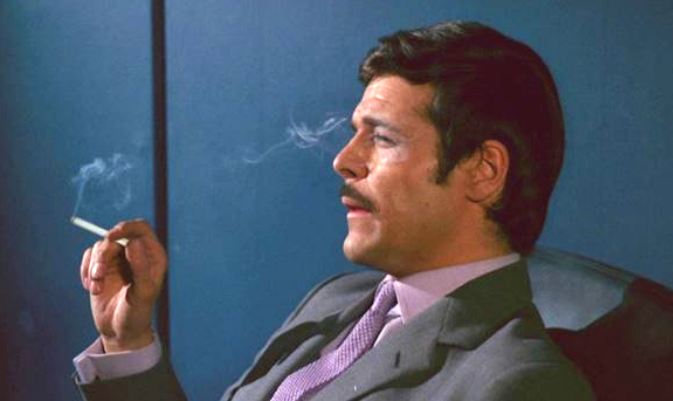
I warn you that this summary will not make much sense. This film wants to be three things: a James Bond spoof, a sci-fi movie, and soft-core porn, but it doesn't really work on any of those levels. It's very bad, almost amateurish at times, but for that reason, it's sort of fun to watch if you're in an MST3K mood. Secret agent James Word (Robin Hawdon), in a very mod zippered black shirt and thin mustache, arrives home after a mission to find a sexy blonde woman named Ann (Yutte Stensgaard) waiting for him. She claims to have been sent by his bosses to debrief him, though he's not sure she's being upfront. They play an excruciatingly long game of strip poker, eventually climb into bed (where he is, I assume, literally debriefed) and he tells her about his last mission: tracking down a gang of often-naked, often-large breasted women from the planet Angvia (get it?) who need to kidnap Earth women to keep the population growing. Another man (James Robertson Justice, who seems quite embarrassed to be present) and his thugs (including the fey Charles Hawtrey, a famous British comedian known for his appearances in the "Carry On" film series) are also following these women, as is some handsome guy in glasses who vanishes from the film after his two short scenes. After this situation is set up, things stop making narrative sense. Justice and his men torture a nude woman, we watch a couple of strippers at work, and 50s starlet Dawn Addams plays Zeta, the head of the Angvians who gives orders from a vaguely defined, colorful room (which reminded me of the setting from ZARDOZ where Sean Connery is tortured, or whatever happens to him). In the exciting finale, a horde of women wearing only string bikini bottoms and dark purple pasties run around a park zapping men unconscious with bizarre arm movements.  The movie ends (I think, but I'm not sure) with Ann turning out to be an Angvian, and she enlists James to be a stud to all the Angvian women. Lying in Arabian Nights pleasure in a satin bathrobe, surrounded by buxom women, he looks happy but plumb tuckered out in the final fade.

This film is based on a Barbarella-like SF serial that ran in something called Zeta Magazine; it's difficult to find much information about this, though cover images from the magazine do come up in Google searches. My theory about what happened: Tigon, a short-lived British studio mostly known for low budget horror movies, put this into production as a spy spoof with a sci-fi angle. But the spy comedy, which was a popular niche genre in the mid-60s, was probably dying on the vine by 1969, so they turned it into a sex farce, or at least threw in a lot of tits. At least once, we see full frontal female nudity as well, though of course, the male never gets naked—though he is shirtless on occasion. I also believe that the ridiculously long—almost 20 minutes—opening, in which Hawdon and Stensgaard do work up a little physical chemistry, came about because the producers realized that their film, after editing, came out to barely an hour, so they padded it out with the poker game, pushing the balance of the movie toward sex rather than spy or SF. Still, there are some pleasures to be had here, even if the viewer is not an admirer of the female form:  it's pop-art colorful; there are a few chuckles, particularly in the scene with a mean-spirited talking elevator; it has a wild theme song; I loved the set for the "self-revelation room," even though it consists solely of aluminum foil with psychedelic colors projected on it. I must admit the reason I watched this was that I had just seen WHEN DINOSAURS RULED THE EARTH and had enjoyed seeing the handsome Robin Hawdon prancing around in a loincloth. He's not quite as appealing here, and soon he left the business to write plays and novels. Can I recommend this? Not really, because today, teens, frat boys and dirty old men have lots of arousing options other than a low-budget titty movie from the 60s. But I'm not sorry I watched it. [Netflix streaming]

Friday, July 07, 2017

WHEN DINOSAURS RULED THE EARTH (1970)

Hammer had a big hit with the caveman/dinosaur flick ONE MILLION YEARS BC, itself based on a 1940 movie, so they went back to the caves for this sequel of sorts, but the absence of Raquel Welch hurt the film's prospects, though Veronica Vetri, outfitted like Welch in a primitive animal-skin bikini, gives it her best. The sun-worshipping Rock Tribe is in the middle of sacrificing some buxom blondes when the moon makes its first appearance in the sky, throwing all into chaos. Sanna (Vetri), one of the blondes, manages to escape into the sea and is rescued by Tara (Robin Hawdon), a handsome fisherman from the Sand Tribe. He takes her back with him but the group—which has its own share of buxom, bikinied women—isn't crazy about her, believing she somehow caused the disruption in the sky caused by the moon, so she has to live more or less in exile, though Tara visits her frequently. She comes to be buddies with a baby dinosaur, though all the tribes live in danger of dinosaur attacks—not to mention a giant crab! In the end, a tidal wave sorts everyone out. As in ONE MILLION YEARS BC, there is no real dialogue here, just an occasional spurt of primitive caveman jargon (you'll get really tired of hearing "Akita!"), and the plot is barely present, despite being based on a story treatment by J.G. Ballard. But the stop-motion effects, supervised by Jim Danforth (who went on to have a long career in special effects), are on a par with the best of FX master Ray Harryhausen; these scenes are what make the movie watchable. Well, that and the physical charms of Vetri and Hawdon. The two have a fairly active sex scene, Vetri bares her breasts at least once, and I quite enjoyed the loinclothed Hawdon. There's also a jealous Sand Tribe woman who has it in for Sanna even more than the rest of them. A killer snake and a man-eating plant also cause problems for the skimply-dressed Sanna. The problem of the co-existence of dinosaurs and humans is, for me, a non-issue in these movies, despite the fuss that some critics make. This is a decent "turn off your mind, leave your libido running at half-speed, and enjoy" flick.  [Blu-Ray]

Wednesday, July 05, 2017

MIDNIGHT MANHUNT (1945)

Jelke (George Zucco) goes into a fleabag hotel, skulks around a bit, then enters Joe Wells' room, shooting him and stealing a portfolio of gems worth a million dollars. Jelke leaves but Joe, still clinging to life, drags himself out of the hotel to the alley behind the Last Gangster Wax Museum and dies there, leaving a trail of blood. A cop named Murphy finds the body—Joe was a notorious crook who hadn't been seen for five years and was presumed dead—and calls his precinct, but when he goes back to get Joe, the body is gone. Reporter Sue Gallagher (Ann Savage) has found the body and props it up in a poker game display in the museum, hoping to keep Joe from the cops until she has time to enter an exclusive story for her paper. Also on the scene: Mr. Miggs, the owner of the museum; Clutch, his malapropism-inclined assistant; and Pete Willis (William Gargan, pictured), a rival reporter who can't decide whether to try and outsmart Sue or help her with her story—and win her heart while he's at it.

This B-thriller has a very cheap look but the plot (a corpse that keeps disappearing and appearing) is a little ahead of its time, and the acting is decent all around. The all-in-one-night setting gives it a pleasing unity even if some of the antics involving the body (which we rarely see) are unmotivated. Gargan and Savage are a nice lead duo though the romance element is lacking. Zucco doesn't get much to do but I always like seeing him. Surprisingly, I liked eternal Bowery Boy Leo Gorcey as Clutch—he handled his wordplay well: when someone needs glasses, he says, "I'd advise you to see an optimist"; he wants the museum patrons to "get proper enumeration for their money"; most politically incorrectly, he says of a woman who has gone to bed, "She's retarded for the evening." A solid hour of entertainment for fans of second-feature flicks. [YouTube]

Thursday, June 29, 2017

THE RED DRAGON (1945)

In Mexico City, a man named Wyans is working on a top-secret atomic bomb project. After an attempt is made to steal his papers, Dorn, his secretary, asks Inspector Caverro to bring Charlie Chan (Sidney Toler) in to help out, but before Chan arrives, Dorn is found at a luncheon party, sitting at his typewriter, shot to death, with just the typed-out phrase "THE$MOST" as a clue. Two oddities: there is Red Dragon brand Chinese ink on the desk; also, although one shot was heard, two bullets were fired, one into the wall, and no gun found, and no one seen leaving the room after the murder. Chan brings his son Tommy (and chauffeur Chattanooga Brown) to help him crack the case, and soon after Wyans' typewriter goes missing, Wyans calls Chan to say he knows how the murder was done, but he is killed in the same way—2 bullets, one shot, no gun—before he can talk. Among the suspects are Marguerite, who has a shady wartime past; the Countess Irena, a club singer; a smuggler, a gunrunner, and a Nazi propagandist. Chan digs up secrets and hidden relationships before another murder and a final gathering of suspects.

As Charlie Chan, Sidney Toler was the successor to Warner Oland after Oland died in 1938, and Toler made 22 Chan films, six more than Oland. However, Oland is better known in the part, perhaps because most of his Chan films were shot for major studio 20th Century Fox, whereas not long after Toler took over, the movies were done at low-budget studio Monogram. But Toler is perfectly acceptable as more or less an Oland clone—though, of course, an actual Asian actor would have undoubtedly been more desirable. Here, in the seventh Monogram film with Toler, he seems a little more lively than Oland was in his last few efforts—though Toler himself would pass away (from cancer) just two years later, and Roland Winters would get the part for last six movies in the canonical series. This is certainly not in the first rank of Chan movies, but neither is it at the bottom of the barrel. The Poverty Row production values are not distracting, though the writing is not strong—we are told at one point that no one is what they seem to be, but the characters are so surface that we don't really have a strong sense of how they're supposed to appear. I like Benson Fong as Tommy, and Willie Best does what he can with the black sidekick stereotype. Fortunio Bonanova makes an above-average policeman associate for Chan. There are better and worse Chans, but this is painless pleasure viewing. In the colorized publicity photo above are, from left, Fong, Toler and Bonanova. [DVD]

Wednesday, June 28, 2017

BEST FOOT FORWARD (1943)

The students as Winsocki Military Academy are getting ready for senior prom and graduation exercises, but cadet Bud Hooper (Tommy Dix) is in a pickle: he sent movie star Lucille Ball (playing herself) a fan letter and asked her to be his date at the prom, never dreaming that she might accept. But she has, egged on by her agent (William Gaxton) who is worried that her career has hit a slump and that this could be good publicity. The problem is that Hooper also asked his longtime girlfriend Helen (Virginia Weidler), and she accepted as well. Hooper tells Helen that he's sick and not to come, but he feels bad about the subterfuge. Ball arrives on a train, expecting a big fanfare welcome, but Hooper and his pals have decided that the best solution to his predicament is to pass Ball off as Helen. (Did it not occur to them that Winsocki might benefit from a movie star appearance, and keep everything above board? To me, this is a major narrative stumbling block, but I was not asked to contribute to the screenplay.) Good-naturedly, Ball agrees to the plan, but who should show up later that day but Helen, come to minister to her sick boyfriend. From here, the complications pile up, leading to a mob scene the night of the prom during which Ball's adoring fans rip her clothes to shreds trying to get some souvenirs.

If you can get past the irritating plot mechanics (the decision not to exploit Ball's presence at the academy, the constant fluctuations of Helen's and Bud's moods, the threat of expulsion for Hooper and his friends), this has a number of enjoyable elements. Ball is great fun, gamely playing herself as a star in decline when in reality, she was just the opposite. Nancy Walker provides several bright spots (singing, dancing and clowning) as a plain-Jane blind date. The production numbers are bright and colorful, especially "The Three B’s" (not Beethoven, Bach & Brahms but barrelhouse, boogie-woogie & blues), and Harry James and his band provide fun versions of "Two O'Clock Jump" and "Flight of the Bumblebee." However, the acting in general is B-movie level. Tommy Dix (pictured with Ball), who was brought in with a handful of others from the original Broadway stage show, is not lead material—he has pretty much one look, glum resignation. Weidler was 16 and at an awkward stage between child actor (THE PHILADELPHIA STORY) and grown-up starlet, and she doesn't quite know which direction to take here—this would, in fact, be her last film, though she managed to appear in over forty films beginning at the age of 4. Gaxton was a big stage star, but his charisma does not translate to film. Fine in smaller roles are June Allyson (in her first movie), Gloria DeHaven, Jack Jordan (another transfer from the stage who, despite pleasant looks and decent acting, never made another film), Chill Wills, Sara Haden and Henry O’Neill. Colorful and glossy and generally fun, but not in the top rank of Arthur Freed's MGM musicals. [TCM]