Thursday, February 27, 2014

THE FIGHTING SEABEES (1944)

In the early days of the Second World War, Wedge Donovan (John Wayne), head of a construction company, has been hired by the Navy to take his men out to islands in the Pacific and build bases and airstrips. They come under fire from the Japanese but because it is illegal to arm civilians, they can't fight back and some of his men come home wounded, and some don't make it home at all. Hot-headed Donovan is understandably upset and Lieutenant Commander Yarrow (Dennis O'Keefe) wants to help, so he takes Donovan to Washington to argue for an official construction brigade before they head out to the Pacific on another job. Reporter Connie Chesley (Susan Hayward), also Yarrow's girlfriend, goes along for the story and starts to fall for Donovan. On the island, the Japanese attack and Donovan tells his men to grab some guns and start shooting. Though the enemy is driven away, Donovan's meddling messes up Yarrow's careful plan of attack, leading to many casualties. Despite this, Yarrow's boss OKs the creation of Construction Brigades (CBs = Seabees) and the workers become full-fledged soldiers with training and weapons. Eventually, while building oil tanks on an island, the men get their first taste of "official" action.

This is an almost completely fictionalized story of the creation of the Seabees, and also a great example of the kind of wartime propaganda movie I enjoy. There is action, with explosions and sacrifice, but there are also relatively rounded characters and humor. Of course, clichés abound: the cocky individual who has to learn his lesson and work as part of a team (Wayne), the more even-tempered buddy who has to help the cocky guy grow (O'Keefe), and the girl in the middle (Hayward). There aren't many surprises but it's well done all around, particularly the battle scene in the middle of the movie. Recognizable supporting players include William Frawley, J.M. Kerrigan and Leonid Kinskey. Wayne even gets a musical number, sort of, when he dances a jitterbug with a hot blonde. [DVD]

Monday, February 24, 2014

THEY CAME TO ROB LAS VEGAS (1968)

Gino gets out of jail and immediately wants to pull an armored truck robbery; his younger brother Tony isn't so sure.  But when the job goes wrong and Gino is killed, Tony decides to get revenge against Skorsky, the head of the armored truck company, who claimed that his security systems were invulnerable. Tony gets a job as a blackjack dealer at a Las Vegas casino, seduces Ann, Skorsky's personal secretary, so that she'll get him the inside info he needs, and gathers a gang to help him. The plan: hijack the truck, take it to the desert between Vegas and Los Angeles, and drive it into an underground garage beneath the sand where they can take their time breaking it open. But little do they know that Skorsky is being watched by the Feds who suspect him of smuggling gold with his legitimate deliveries, so a couple of Treasury agents happen to be on board the truck. Once they get the truck under the sand, the guys start squabbling among themselves, and eventually some Mafia men also get involved. The climax involves helicopters, lots of dead bodies, and lots of cash blowing in the sand.

At the start, this movie has the general feel of a carefree 60s caper movie, but generous amounts of bloodspilling and bad feelings take this off in a darker direction--and it's a half-hour too long. The film looks good (see it in widescreen) and the musical score has a nice Euro-60s feel. Considering the conflicting agendas of the various characters, it's easy to follow, and some of the plot mechanics are ingenious. For example, the garage beneath the desert: I don't for a second believe that could have been done, but the shot of the truck vanishing under the sand is pretty cool. The way they manage to waylay the truck in the first place is also nifty. When the movie sticks to these details, it's fun, but when the characters take center stage, not so much. Gary Lockwood (above) is Tony; as a physical presence, I could watch Lockwood parade around in a snug t-shirt and jeans for the length of an entire movie (which I did while watching MODEL SHOP), but here he mostly wears too many clothes so I had to concentrate on his acting. He's a passive low-key actor, but this part seems to be suited to someone with a little more crazy energy, and I got tired of him having to carry most of the film with his one-note performance. As Ann, Elke Sommer is sexy but just as bland-acting as Lockwood. Jack Palance is OK as the head of the Feds, but Lee J. Cobb is better as Skorsky. Another problem is the moral dynamic. I think we're supposed to sympathize with Tony getting revenge for his brother, but we're not shown enough of their relationship to care, and Tony becomes neurotically focused on breaking open the truck (the fact that he doesn't really care about the money is supposed to make us admire him, but it didn't work for me). Skorsky is a slimeball, leaving us with just the Feds to care about, but we don't really get to know them. This was filmed partly on location, but the desert scenes were shot in Spain, and aside from the lead actors, the rest of the cast is composed of French and Italian actors who are all distractingly dubbed by English-speaking actors. [TCM]

Friday, February 21, 2014

GOOD LUCK, MR. YATES (1943)

Mr. Yates is a respected teacher at a military academy who, feeling pressure to be overseas with the troops and wanting to impress his students, decides to waive his educational deferment to enter the military. The boys, led by Yates' favorite student Jimmy, throw him a big sendoff, but when he goes to sign up, he is declared 4-F on account of a perforated ear drum. His doctor, a German refugee, tells him that they might be able to fix him up enough to pass muster, and, so he doesn't have to go back to school and lose face, his buddy Joe puts him up at a boarding house. Yates gets a job at a defense plant where most of the other boarders work, but writes to his students as though he's at the local boot camp. Complications begin when Ruth, another boarder, gets sweet on Yates, causing tough guy Charlie to get jealous. Then the boys make an unauthorized trip to the boot camp to see Yates, discover he's not there, and get the Bureau of Missing Persons involved. Throw in the boarders' growing suspicion that the doctor is a Nazi and that Yates is a spy, and you have quite a mess to untangle by the fadeout. Predictable but watchable wartime propaganda B-movie. The message here seems to be, even if you can't fight, you can still do important work for your country, though working as a shipyard welder may not feel as important as being a soldier. Jess Barker is OK as Yates but never feels like a consistent character, as though he's just stumbling through his own life with little forethought; Claire Trevor is OK as Ruth and Scotty Beckett does a fine job as Jimmy, but the acting honors belong to pugnacious Tom Neal as Charlie—at times, I was wishing that the movie was about him. (Pictured at left are Barker and Neal.) [TCM]

Thursday, February 20, 2014

THE CHALLENGE (1938)

In 1864, the Matterhorn in the Alps has remained unconquered by climbers. Some villagers think that God wants to keep the mountain's secrets away from human eyes, but that doesn't stop men from trying. British alpinist Edward Whymper (Robert Douglas) tries that summer and asks famous guide Jean Antoine Carrel (Luis Trenker) to accompany him. There is tension between them until Whymper is caught in an avalanche and injured, and Carrel saves him. The two bond and Carrell encourages Whymper to return next year. But by then, problems arise, mostly involving nationalistic pride: Whymper wants to go up the Swiss side, but the Italians tell Carrell that the winning climb should come from the Italian side. When the Italian villagers deliberately thwart communication between Whymper and Carrell, they both lead separate expeditions up the mountain. Whymper gets there first, but tragedy strikes on the way down and four of the British climbers are killed. The villagers assume that Whymper cut their rope, but when Carrell goes looking for evidence, he finds that the rope was not cut but broke on its own. Can he get back to town before a lynch mob forms to punish Whymper?

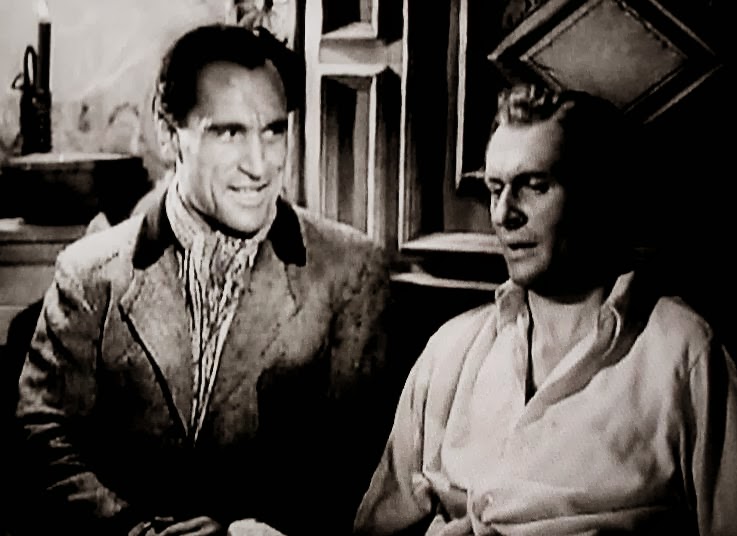
This film, based on real events, feels like an attempt by the British to make their own "mountain movie," a genre that belonged to the Germans—propaganda filmmaker Leni Riefenstahl worked in this genre before she made TRIUMPH OF THE WILL. The scenes on the mountains were directed by Trenker who was in the German HOLY MOUNTAIN with Riefenstahl, and they are fairly good sequences, especially the death fall of the four climbers. The rest of the movie is interesting enough to sit through, though the dramatic tension could use some juicing up. The characters played by Douglas and Trenker (pictured above, Trenker at left), though based on real people, aren't particularly rounded, and their acting is so-so; Trenker especially seems uncomfortable delivering dialogue in English. In fact, much of the story feels like an outline of events rather than a fleshed-out narrative. Favorite line, from one villager to another: "Stir yourself, stir yourself—if you'll pardon the vulgarity." [TCM]

Friday, February 14, 2014

ROMEO AND JULIET (1936)

Oddly, given my love of movies and plays, I had never seen or read this classic Shakespeare work before, unless you count WEST SIDE STORY. People kept telling me I should see the 1968 Zeffirelli version, but this is the one I remember seeing part of on TV way back when I was 9 years old. I only saw the first 15 minutes, but it got me fired up about Shakespeare and I precociously bought a complete plays volume, intending to whip through them all before high school. I didn’t get very far then, though I have since read most of the canonical plays—except this one. I don't think a plot summary is necessary—after all, the phrase "star-crossed lovers" is practically welded to any description of the story. This classy production from MGM followed hot on the heels of Warner Bros. star-studded A MIDSUMMER NIGHT'S DREAM, and it is the sets, costumes and general production values that are most impressive here, particularly in the scene in which Romeo and Juliet meet at a fancy costume ball—I was struck by how much this sequence looked like the "Dance at the Gym" in WEST SIDE STORY. The acting is more hit-and-miss: Norma Shearer (Juliet), in her 30s, and Leslie Howard (Romeo), over 40, are often criticized for being too old to be playing characters that were written to be teenagers, but there are very few lines or situations left that would mark them as that young, so for me, they worked just fine. Shearer occasionally lets the iambic pentameter get the best of her—she feels especially stagy in her big moment when she contemplates going through with her fake suicide—but overall they have nothing to be ashamed of. Edna May Oliver, whom I usually love, goes way overboard hamming up the character of the Nurse, and speaking of hams, John Barrymore as the doomed Mercutio does seem both too old and too showy. I've never liked Andy Devine and he does little to change my mind here as the comic relief servant to the nurse. Basil Rathbone (Tybalt), C. Aubrey Smith (Capulet) and Reginald Denny (Benvolio) are all fine in supporting roles. Low point: in the Mercutio/Tybalt swordfight, Barrymore clearly cannot keep up with the younger, more athletic Rathbone and the scene suffers, even though it looks like a double was used in a few shots. It's fun to hear some of Tchaikovsky's Romeo & Juliet ballet music as part of the score. Perhaps not the best possible screen Shakespeare, but passable. [DVD]

Thursday, February 13, 2014

SUMMER INTERLUDE (1951)

aka ILLICIT INTERLUDE

Early Ingmar Bergman, in a light tone before the heaviness of his subjects (religion, meaning of life, death) turned his films dark and solemn. Not that this one is a comedy. Marie, a young ballerina who has been reminded that she is in the middle of her career, receives a package during a rehearsal for Swan Lake; it's the diary of a young man she had a summer fling with several years ago. She is thrown into a reverie remembering the events of that summer. While staying near the ocean with an uncle who keeps trying to press his attentions on her, Marie meets the handsome young Henrik on a ferry. They go fishing and swimming, pick and eat wild strawberries, and eventually make love. Their idyll is tainted not only by her uncle but also by Henrik's aunt, dressed in black and dying of cancer, though she predicts that she'll outlive Henrik. Near the end of the summer, just after he has jokingly told her that she should marry Superman, he dives into shallow water, hurts his back, and dies as a result of his injuries. In her grieving, she announces that she will hate God until she dies, but back in the present, her art proves to be a tool for transcendence. This seems very much a dry run for later Bergman films; it's shot beautifully and acted well enough, but it’s all fairly surface, which isn’t what we expect from Bergman. Maj-Britt Nilsson and Birger Malmsten are exactly right as the doomed lovers, and the tone is also right: like the look of the film, a mix of clouds and sunshine. It's difficult to know what to make of the uncle—he's not exactly a villain but he's not pleasant to be around, either. Probably not for the casual film fan, but a must for Bergman followers, and a nice respite for me from the crappy winter weather of recent days.  [DVD]

Monday, February 10, 2014

KISMET (1944)

This Arabian Nights story, based on a play from 1911 and remade as a musical in the 50s, has elements in common with the better-known THIEF OF BAGHDAD—including being set in Baghdad—but is not as interesting as that Korda movie. Here, Ronald Colman is the self-proclaimed King of Beggars in Baghdad who is also a magician and a single father, raising a lovely daughter (Joy Page) whom he thinks the world of. At night, Colman disguises himself as a prince and enjoys a dalliance with Marlene Dietrich, who, unknown to him, is married to the cruel, oppressive Grand Vizier (Edward Arnold). There is one more masquerader in the mix: the young and handsome Caliph (James Craig) who wants to be a reformer and strolls the streets at night as the son of the royal gardener. In order to give his daughter a shot at a place in court, Colman pretends to be a visiting prince and makes friends with Arnold, who is about to have Craig assassinated for his meddling; meanwhile, Craig meets and falls for Page. As the plot thickens, narrative coherence plays second fiddle to colorful sets and costumes, comic relief, an occasional song, and the sexy Dietrich doing a writhing dance, her legs painted gold.

This MGM movie looks great and Dietrich is fabulous, but overall it's a sluggish affair, mostly because of leading man Ronald Colman (pictured at right with Dietrich) who sleepwalks through his role, the film's central one, as though it was beneath him. Craig (above) is charming, though Page, his romantic counterpart, is drab—it might have been fun to let Craig and Dietrich pair off and juice up the proceedings with their energy. Much of the dialogue is padded out in Hollywood/Arabian Nights style with long strings of adjectives and flowery description, and this adds to Colman's problem, as in his mouth, that baroque dialogue falls especially flat. Other supporting players include Harry Davenport, Florence Bates, and Hugh Herbert. It's a bit disappointing that there is little fantasy here, unlike in THIEF OF BAGHDAD, though some of Colman's magic tricks are indeed magical and require special effects to carry off. Not a bomb, but not as light and fizzy as it should have been, not as wondrous or adventurous as THIEF. [TCM]

Thursday, February 06, 2014

CONFESSION (1937)

At a Warsaw train station, young Lisa (Jane Bryan), a student at a music conservatory, sees her mother off on a short trip and seems a bit at odds over being alone. A handsome stranger slips her and her friend two tickets to see concert pianist Michael Michailow; they go and discover that the stranger is Michael (Basil Rathbone). It turns out he has seen her perform at school and is impressed by both her talent and her looks. He finagles his way into a private lesson with her and kisses her, and despite their age difference—he looks old enough to be her father—she goes out with him that night. At a nightclub, a sultry blond (Kay Francis, pictured) sings a sad song, "One Hour of Romance," and after the song ends, a spotlight catches Michael kissing Lisa. The singer faints and is led backstage, but moments later returns with a gun and shoots Michael dead. At her trial, she refuses to give any reason for her crime until a suitcase with evidence shows up. In the judge's chamber, she tells the sad story of how a misspent evening with Michael led to her marriage breaking up and her daughter being taken from her—and the topper: Lisa is her daughter though she doesn't know it.

This soap opera story is a little more compelling than average, mostly due to the interesting directorial style, mostly gliding traveling shots and odd angles, of German director Joe May who seems to have been influenced at least slightly by Josef von Sternberg. Kay Francis is no Marlene Dietrich, Sternberg's muse, but she's very good here both as the young wife led astray in the flashback and as the sadder but (theoretically) wiser woman in the present day. Rathbone can do a slimy cad in his sleep and he's fine, as is Jane Bryan even though she really only has two facial expressions: mildly happy and mildly distraught. Ian Hunter is Francis' cuckolded war-hero husband; Donald Crisp is the judge; Veda Ann Borg steals a scene without even speaking as one of Rathbone's bimbos. Apparently this is a scene-by-scene remake of a German film called Mazurka. [TCM]

Monday, February 03, 2014

THE LIFE AND TIMES OF JUDGE ROY BEAN (1972)

In the 1880s there was no law and order in Texas, west of the Pecos River; as we are told, "Only bad men and rattlesnakes lived there." Outlaw Roy Bean arrives at the tiny village of Vinegaroon in the middle of the desert and finds a shabby little shack filled with whores and drunkards. When he sees a book of the laws of Texas in the room, he asks why it's there. "For the whores to piss on," is the reply. The outlaws promptly beat him up, tie him to his horse, set the horse running, and leave him for dead, but a young Mexican woman who lives nearby saves his life, and he goes back and shoots everyone in the whorehouse dead. Bean then decides to be the law west of the Pecos and sets himself up as a judge in the shack. The rest of this episodic movie presents his adventures as he recruits former bad guys to be his deputies, meets up with Grizzly Adams who, preparing to die, gives Bean his beloved pet bear, and sets out to see the famous actress Lily Langtry, with whom he is obsessed—he shoots a drunkard dead who had the gall to deface a poster of her that hangs in his shack. "For Texas and Miss Lily" becomes his battle cry.

This comedy-western, directed by John Huston, has a certain ramshackle, tall-tale, all-over-the-map likability, though at two hours, it goes on a bit too long. There's not much substance to Roy Bean (based on a real person) but Paul Newman holds the screen with authority, making his character charming even when he’s taking his brand of justice too far. The supporting cast is fun, with most members popping up for one or two short scenes: Anthony Perkins (pictured above with Newman) is an itinerant preacher who at one point talks directly to the camera; director Huston cameos as Grizzly Adams; Stacy Keach is Bad Bob, a freaky albino killer; also appearing are Tab Hunter, Ned Beatty and Jacqueline Bisset. Roddy McDowell has a more substantive role as a city-slicker lawyer who becomes Bean's primary nemesis, and Ava Gardner gives the movie a touch of class at the end as Langtry. You can see this was aiming to be another BUTCH CASSIDY, especially with the tacked-on-feeling romance between Newman and his Mexican savior (Victoria Principal in a thankless role)—there's even a song, "Marmalade, Molasses and Honey," sung by Andy Williams, played over a pastoral picnic scene with Newman, Principal, and the bear, but it's not a patch on the ass of "Raindrops Keep Fallin’ On My Head." Still, a generally enjoyable example of freewheeling 70s cinema. [DVD]

Friday, January 31, 2014

BEDEVILLED (1955)

Steve Forrest is a hunky but serious former POW who is now a seminary student on his way to Paris with his friend (Robert Christopher) to finish his studies for the priesthood with a crusty but well-meaning priest (Victor Francen). On the flight over, Forrest gets friendly with a famous fashion designer (Simone Renant) who offers him assistance over the three days of liberty he has in Paris before his studies begin. Soon, he seeks her out for advice when a glamorous blond (Anne Baxter) barges into his taxi and gets him involved in her problems: she left the scene of a murder—she was the victim's mistress—and both the cops and the murdered man's brother are on her trail. This is a rather bland affair; the suspense is so slack that at times it feels like a Paris travelogue—it was shot on location so that's a plus. Forrest is suitably stoic, even a little mysterious; I wanted to know more about his character. For a time, we wonder if he will fall for Baxter and leave God behind, but because Baxter is so clearly a femme fatale, there's not really much danger of that happening. Baxter gives the movie some life with her near-campy performance, which would have seemed more natural if the movie had been closer to a film noir, which it really isn't. I liked Renant but she is given little to do. The film is colorful and the widescreen compositions are nice.  [TCM]

Wednesday, January 29, 2014

WILD BILL HICKOK RIDES (1942)

Shady businessman Harry Farrel (Warren William) is in Chicago when the Great Fire breaks out. He tells his partners he's on to a sure thing out in Powder River, Wyoming: the settlers out there have never made official claims on their land so he's heading out there to swindle the land out from under them. He takes along Belle (Constance Bennett) and her gal pals because their casino has been destroyed in the fire. (When Belle is asked what she's going to do out west, she replies, "Anybody I can," which leads me to believe that gambling isn't the only business going on in her establishment.) On the train to Powder River, a holdup is foiled by the presence of fabled gunfighter Wild Bill Hickok (Bruce Cabot) who is on his way to visit Janey, an orphan girl of his acquaintance, and her guardian Nolan. Belle takes a liking to Hickok, but Farrel quickly realizes that the man will be a thorn in his side, as Nolan is one of the settlers who won't give up his land without a fight. Sure enough, sides are soon drawn, with Farrel, the crooked sheriff (Ward Bond), and a cowardly reporter (Walter Catlett) on the landsnatching side, against Hickok, Nolan, Janey, and the local judge, with Belle in the middle. Farrel frames Nolan for a murder and despite the judge's suspicions, the jury finds Nolan guilty. That night, Farrel's men agitate the townsfolk who drag Nolan out of his cell and lynch him, leaving little Janey an orphan again. When Farrel gets his landgrab going in earnest, Hickok's side seems outnumbered, but when Belle joins the frey on Hickok's side, good may stand a chance.

Plotwise, this is a routine B-western (though as it's a Warner Bros. B-film, the production values are good), but it's the interesting cast that makes this worth watching. Cabot makes a handsome and gentlemanly hero; William all but twirls his mustache playing the villain; Bennett (pictured with Cabot above) provides the sex appeal, if little else (though she does get a decent song, "The Lady Got a Shady Deal"); Bond is solid as always; Catlett is fine in what amounts to a comic relief role; and Howard Da Silva stands out in a small role as a lawyer. The plot moves along nicely, though the last twenty minutes crams in almost too much action—the lynching, a shootout, the landgrabbing, and finally a man-made flood, though the flood scene is very well handled. Good for an old-fashioned Saturday-afternoon Western. [TCM]

Monday, January 27, 2014

THE MOON IS DOWN (1943)

This archetypal WWII resistance movement movie begins with the voice Hitler ranting in German as his evil claw of a hand scratches away at a map of Europe. In a Norwegian mining village, Hitler's troops parachute in, slaughter the small militia group, and connect with Corell, the local quisling—"quisling" being a term for a collaborationist, from the name of the Norwegian politician who did in fact sell out his country for a chance at ruling with the Nazis. With no defenses, the village surrenders. Corell expects to be made mayor, especially because the current mayor is trying his best to obstruct the Nazis' aims whenever possible, but Col. Lanser tells him his usefulness is over. The invaders need the mine to keep running to send ore back to Germany; young Alex resists and hits a German soldier who later dies—he is tried and sentenced to death, and the resistance of the villagers begins as soon as the firing squad executes Alex. Small acts of sabotage occur, but soon the British drop explosives at night and the Norwegians stash them away and begin causing more damage to the Nazi plans, blowing up bridges and transmission lines. The Nazis take ten hostages, including the mayor, and as they are hung in public, the mine explodes, with more explosions seen and heard throughout the town.

Based on a play and novella by John Steinbeck, this is relatively short on action but it works as inspiring propaganda for the underdogs. The sets (interior and exterior) are stagy but effective. The power of the movie rests mostly with three actors: Cedric Hardwicke as the Nazi colonel, Henry Travers as the mayor, and Peter van Eyck (pictured) as the young Nazi soldier Tonder. Each goes for underplaying rather than overplaying, and though that lessens the melodrama, it does make the story feel more real. Van Eyck is especially interesting: his German lieutenant is recognizably human and almost sympathetic in his isolation and desire for friendship and intimacy which is thwarted at every turn by the villagers. The ending is grim but predictable, especially if you've seen other resistance dramas of the era (such as COMMANDOS STRIKE AT DAWN and UNDERGROUND). This has been hard to find, but recently Fox released it as part of their burn-on-demand series. It's not a must-see but WWII movie buffs will want it. [DVD]

Wednesday, January 22, 2014

THE GOLDEN MASK (1953)

aka SOUTH OF ALGIERS

Archaeologist Eric Portman has run out of funding but needs to return to North Africa to substantiate his findings concerning the legend of a treasure buried in the tomb of Roman ruler Marcus Manilius, specifically the cursed golden Mask of Moloch. The British Museum won't give him any more money, but a free-lance adventurer and best-selling author (Van Heflin) has offered to provide funding if he can come along and write a book about their findings. Portman thinks Heflin is just a fame-seeking jerk, but he finally agrees to let him come along. Also along for the trip: Portman's daughter (Wanda Hendrix) and her somewhat milquetoastish fiancé. And it wouldn't be a Hollywood archeology trip without a couple of bad guys following along, hoping to snag the treasure for their own nefarious purposes. First, Heflin is waylaid in a bar by a dancing girl while the baddies ransack his room, looking for a map. Later, Heflin helps two penniless street kids who then help direct him across the Sahara. Everyone gets caught in a sandstorm, then Heflin is kidnapped, leading to a somewhat anti-climactic battle, followed by the predictable re-sorting of Hendrix's romantic feelings. This is a competent but unexciting adventure tale, completely predictable with little to recommend it unless you are a Van Heflin fan. The only real minus for me was that the movie stops dead in its tracks several times to provide: 1) some travelogue footage of Tunis, and 2) lots of scenes of belly-dancing women and men. Oh yeah, and there's a character named Thankyou, which is neither a plus nor a minus. [TCM]

Tuesday, January 21, 2014

THE NIGHT RIDERS (1939)

The cowboy buddies known as the Three Mesquiteers (Stony, Tucson and Lullaby) are on a riverboat when they witness a brief gunfight between gamblers which results in one of them, a man named Talbot, getting knocked overboard. What the Mesquiteers don't see is that on shore, Talbot, seeking help for a wound on his wrist, runs into Hazelton, a former money engraver, and eventually the two of them work out a huge swindle: Hazelton forges a land grant document giving a huge tract of land (which has already been settled by homesteaders) to the Spanish Don Luis de Serrano. Talbot poses as Don Luis and takes his claim to the government which has no choice but to give him the land. At first, he claims he will rule fairly, but very soon he becomes a virtual dictator, levying high taxes, confiscating property, and driving good people, including the Mesquiteers, off the land. Soon, a caped trio of vigilantes known as the Capaqueros comes to the people's rescue, at least until Don Luis hires a militia to hunt them down. Of course, the Capaqueros are the Mesquiteers, and when Stony recognizes that Don Luis is actually Talbot, he comes up with a plan to expose the evildoer.

There is a lot of plot crammed into this 56-minute B-western. I didn't even mention Susan, the damsel in distress who never quite becomes a romantic interest, or the sexy wife of Don Luis, or the presence of President Garfield as a character. I've enjoyed these Three Mesquiteers movies, though in this one, it feels like the director said to Ray Corrigan (as Tucson) and Max Terhune (as Lullaby), relax and let John Wayne (as Stony) take over. Wayne is practically the whole show here—Terhune does an uninspired ventriloquist bit but otherwise seems almost comatose, and Corrigan is slightly more energetic but still a bit wooden. George Douglas is disappointing as the villain, with Doreen McKay only slightly better as his wife. Still, it moves quickly, never bogging down, and it's fun to see the plot work itself out. [DVD]

Friday, January 17, 2014

THE BEAT GENERATION (1959)

Handsome Ray Danton, pictured at right, is hanging out in a beatnik club, the kind where a woman (a cameo by Vampira) holding a white rat chants beat poetry while a shirtless guy sits next to her, arms folded across his chest, glaring into space. A girl tries to hit on Ray, but he responds by telling her to "be cool… there’s no tomorrow—not while the sky drools radiation gumdrops," then goes back to reading Schopenhauer. Danton's father shows up with his new wife but Danton gives them both the cold shoulder, sneeringly calling the new wife, who looks younger than Danton, "Mommy." Turns out Danton is a serial rapist, known in the press as the Aspirin Kid for his M.O.: he goes to the home of a housewife whom he knows will be alone, tells her that he borrowed money from her husband and wants pay it back, then fakes a migraine and asks her for an aspirin. When she returns with the aspirin, he attacks, beats, and rapes her.

The main cop on the case is Steve Cochran, but he's handicapped by his belief that all women are filth (he seems happily married, but his first wife was a tramp), so he basically believes that all the victims were somehow "asking for it." When his own wife becomes a victim of Danton, he remains conflicted, unable to give her the support she needs; when she becomes pregnant soon after and he is clearly unable to deal with it, she considers an abortion. To throw the cops off the track, Danton talks his weaselly buddy (Jim Mitchum) into pulling a copy-cat crime with Mamie Van Doren as the target; the plan goes awry when her husband shows up, but Cochran and his partner (Jackie Coogan) follow Van Doren, thinking that she is seeing the Aspirin Kid on the sly, which takes them, after a couple of false leads, to a swinging beatnik party in a beach house where, as the kids chant "Don’t bug me, Daddy-O," the ludicrous and overlong climax occurs with Cochran chasing a harpoon-carrying Danton right into the ocean.

Despite the unsavory rape aspect of the plot, this is mostly a deliriously fun B-thriller. Many sources call this a film noir, but it has virtually none of the visual elements of noir; only the fact that the lead character has a dark obsession (which is interestingly mirrored by the villain) gives the movie any tie at all to the noir genre. The "beat generation" milieu is mostly tangential to the narrative but those references (clustered at the beginning and end) are what make this fun. Danton's character is obviously not a real "beat" devotee; it's like near the end of shooting, they decided to bookend the film with satiric beatnik scenes to juice up what is otherwise a traditional crime melodrama. Danton is very good and good-looking as the creepy rapist with the charming surface, and Cochran (pictured at left with Danton) is equally good and good-looking as the charming cop with the creepy anti-female views. Mitchum (Robert's son) is OK in his role, though he is completely without charisma; Van Doren ultimately doesn't have much to do, but she comes off as a stronger character than Cochran's wife (Fay Spain, who has more screen time but doesn't register as much); former child star Jackie Coogan (later Uncle Fester on The Addams Family) is fine as Cochran's buddy. Norman Grabowski, looking like an overage frat jock (and in real life a famous hot rod designer) has fun during the final party scene. Louis Armstrong has a cameo as himself, keeping as cool as he can performing the ridiculous title tune: "You beat generation/You think you live as you choose…/I think you're headed for the blues." It’s a low-budget movie but in its widescreen incarnation it doesn’t look cheap. [TCM]

Wednesday, January 15, 2014

TOO LATE FOR TEARS (1949)

Lizabeth Scott and Arthur Kennedy are driving to a party that Scott doesn't want to attend—as they argue, they pull the car over to the side of the road. Another car drives by and the driver, mistaking them for someone else, tosses a valise full of money in the window and speeds away. The driver who was supposed to intercept the cash chases them but Scott gives him the slip. When they get home, Kennedy wants to give the loot ($60,000) to the cops, but Scott talks him into stashing the money at a bus depot locker and thinking it over for a couple of days. The next day, after she goes on a shopping spree spending the money she doesn't have yet, Dan Duryea shows up claiming to be a cop, but he's actually the thug after his money. When she plays tough, Duryea slaps her around, then she bitchslaps him ("What do I call you besides 'stupid'?"). Scott winds up making a deal to keep half the money, but her goody-two-shoes husband won't play along so Scott kills him, gets Duryea to help her dump the body, and tries to file a missing persons report on Kennedy. But two people begin to make things tough for Scott and Duryea: Kennedy’s sister (Kristine Miller) who inconveniently lives right across the hall, and Don DeFoe, a stranger who shows up claiming to be a war buddy of Kennedy's. Not to mention that the claim ticket for the valise becomes difficult to hang on to.

This is a little-known but solid B-noir with a nicely twisty (albeit somewhat predictable) plot and great performances from the main trio. Kennedy's not around long but he makes an impression that lets his character remain vivid throughout. The sultry, deep-voiced Scott could play this kind of role in her sleep; at times, she does seem a little low-energy, but overall she pulls this off well. Best is Duryea (above with Scott) who creates a colorful character on whom it is hard to get a handle. He's tough on the surface but doesn't have the courage of his ambitions, and when he becomes a drunken mess later in the movie, Duryea manages to give him interesting shadings. This being a public domain film, the prints available on DVD are not very good, but you should see this anyway, even though the wimpy title works against it. [DVD]

Monday, January 13, 2014

THE DETECTIVE (1954)

aka FATHER BROWN

The eccentric Father Brown is always trying to save souls, and play detective when he can—as the movie opens, we see him caught by police one night returning some "swag" that a parishioner stole. He even gets the would-be burglar a job as chauffeur to the rich widow Lady Warren. Father Brown's church holds a holy relic, the cross of St. Augustine; the Bishop wants the cross transported to a church congress in Rome but is worried because professional thief Flambeau has threatened to steal it, so Brown suggests taking it himself. Along the way, Brown becomes suspicious of a fellow traveler, a car salesman, and confides in a bearded priest; but, surprise, the salesman is actually a Scotland Yard inspector assigned to keep an eye on Brown, and the bearded priest is Flambeau, who manages to get the best of Brown during a sightseeing visit to some catacombs. Brown has nine days to find Flambeau and recover the cross before he's called before the archbishop.

I haven't read any of the Father Brown stories by G.K. Chesterton, and some fans of the character don't like the liberties taken by this film version, but I found this to be a charming slightly off-kilter comic thriller, with Alec Guinness perfect in the title role. He's a little bumbling but also rather clever, and quite likable. A young Peter Finch (pictured above to the left of Guinness) is just as good as Flambeau, to the point where you're almost not sure who you're rooting for. Each scene in which Guinness and Finch interact is a gem: on the train to Rome, in the catacombs, and at the end in Flambeau's home. Cecil Parker (as the bishop) and Joan Greenwood (as Lady Warren) are fine if underused, and Ernest Thesiger is delightful in what amounts to a cameo as a doddering old archivist. It's a shame Guinness didn’t make more Father Brown films. [TCM]

Friday, January 10, 2014

THE DESERT SONG (1953)

We're told right off the bat that "it is written in the burning sands of the Sahara: when there is wrong, there will always be an El Khobar the Avenger, riding with the Riffs, to right it." The Riffs are the good guys here, and El Khobar is a legendary Moroccan Robin Hood figure who has shown up to help them in their struggle against the plundering ways of the bad guy, Sheik Youssef (Raymond Massey). El Khobar leads raids on Youssef's men to get back the supplies that they stole from the Riffs. In the middle is the French Foreign Legion, led by General Birabeau and his second-in-command, the handsome Captain Fontaine (Steve Cochran). They mean well but can't see beneath Youssef's charming exterior. The dashing and mysterious El Khobar is actually Prof. Bonnard (Gordon MacRae), an anthropologist whose persona is that of a meek, absent-minded academic. Azuri, a spy who dances in the sheik's palace in order to get information to the Riffs, has eyes for El Khobar but he has eyes for no one—until he meets the General's daughter Margot (Kathryn Grayson) who spends a lot of time singing to herself. She makes eyes at Fontaine, so her father hires Bonnard as a tutor to keep her out of trouble, but she still winds up in the thick of things, getting kidnapped by El Khobar in the hopes that he can get her to see that Youssef is not to be trusted. He, also enjoying singing, gets a little flirting in as well, and in the end, after a huge skirmish at the palace, all is righted and El Khobar reveals his true identity to Margot in song.

This film version of the 1926 operetta (I have not seen the 1929 early talkie version but I reviewed the 1943 version here) has gorgeous color and some low-grade but still stimulating spectacle on its side. I don't always like MacRae—I've lumped him in with Howard Keel as being too artificial to be likeable—but he gives a lower-key performance here than he did in OKLAHOMA and CAROUSEL and I grew to like him, especially as the professor who wears Clark Kent glasses (pictured above right with Grayson). In fact, the character comes across as a cross between the Scarlet Pimpernel (the disguise) and Indiana Jones (the academic background, the hat, and a bullwhip he puts to good use during one fight). I don't care for Grayson—operatic singing voice, overdone acting—and the songs seem completely secondary; dare I admit that I fast-forwarded through some of the songs? Luckily, the plot is engaging and the visuals are sumptuous. Massey is fine in his over-the-top villain mode and, of course, Cochran (pictured at left) is a plus even though he doesn't get as much screen time as he should. I didn't like Dick Wesson as a brash reporter who rooms with MacRae; he's supposed to be comic relief but he's not the least bit funny. Also with the handsome Mark Dana as a Legionnaire named Duvalle. This Warner Bros. musical is generally at least as much fun as most of the MGM musicals of the era. [TCM]

Wednesday, January 08, 2014

LIFE BEGINS AT EIGHT-THIRTY (1942)

At Christmastime, we see a rather scraggly Santa Claus belly up to a bar, order a fogcutter, and head off to his shift at Macy's where, when his state of drunkenness becomes plain as he yells at the kiddies and their parents, he is fired. At his apartment building, the man (Monty Woolley) is helped up the stairs by a new neighbor, a composer (Cornel Wilde), who recognizes him as a once-famous actor who has hit the skids and who is now largely in the care of his crippled daughter (Ida Lupino) who is afraid to marry and have children, thinking her lame foot problem would be inherited. As it happens, Wilde's aunt (Sara Allgood) used to act with Woolley and has had a crush on him for years. Between the attentions of Lupino, Wilde and Allgood, Woolley begins to reform, gets a job on a radio soap opera, and even manages to get offered the part of King Lear in a Broadway revival which is being backed by Allgood. But soon, complications arise; Lupino finds out that her foot condition was caused inadvertently by a drunken Woolley and she decides to marry Wilde and move with him to California, not wanting to tell Woolley until after his premiere. The night before the opening, however, Woolley discovers Lupino's plans and succumbs to spirits again. Will everything work out for all concerned?

Though this movie doesn't try for social commentary on substance abuse, neither does it sugar-coat the problems of a recovering alcoholic, and it bounces back and forth between comedy and melodrama. Occasionally it veers off into fairly sappy territory, especially in a late scene between Lupino and Wilde, but for the most part it keeps its balance, mostly thanks to a solid performance by Woolley who isn't afraid to make his character quite unlikable sometimes. Allgood is also fine, doing an understated turn in an unusual role. The opening scene with Woolley as the drunk Santa is like the opening of the later MIRACLE ON 34TH STREET from the viewpoint of the drunk, and the way that sequence straddles the comedy/drama line is perfect. The title refers to the traditional starting time of Broadway plays. [DVD]

Tuesday, January 07, 2014

CAPTAIN SALVATION (1927)

In 1840, young Anson (Lars Hanson) returns to the New England coast town of Maple Harbour fresh from the seminary, ready to join Phillips, the local pastor, as an assistant, and also ready to renew his romance with Phillips' daughter Mary (Marceline Day). But because he dresses so informally (and perhaps because he seems so healthy and full of life), some townsfolk think he's not ready for a life at the pulpit. Even Anson seems vaguely aware that he may not be ready to settle down yet. When a ship founders during a storm, an injured woman on board named Bess (Pauline Starke) is denounced as a whore and no one is willing to help her until Anson arrives. He takes her to a shack where he tends to her and finds out about her rough life—she says her stepfather got her pregnant and that it was "a damn good thing the baby died." The townsfolk shun her, so when a ship bound for Rio arrives, Anson manages to get her passage on it, and at the last minute, disgusted by the local attitudes, he joins her. But the ship turns out to be a convict ship helmed by a disgusting captain (Ernest Torrence) who threatens to force Bess to have sex with the prisoners and later has Anson whipped for insubordination. What will happen to our odd couple? This silent melodrama reminded me a bit of The Scarlet Letter, partly because Lars Hanson played the Reverend Dimmesdale is a silent version of that story opposite Lillian Gish. The acting is generally adequate with some of the typical overacting (Hanson) and underacting (Day) of the era, but Torrence makes a fine and nasty villain, worthy of the phrase "slime-jowled skunk" which Starke uses against him. There is some nice camerawork, and a battle on the ship up in the riggings is quite exciting. The struggle that Hanson undergoes between the traditional pious but intolerant church people and the more inclusive feelings he has makes the movie feel fairly modern. [TCM]